stop start AUDI RS7 SPORTBACK 2015 User Guide
[x] Cancel search | Manufacturer: AUDI, Model Year: 2015, Model line: RS7 SPORTBACK, Model: AUDI RS7 SPORTBACK 2015Pages: 302, PDF Size: 74.76 MB
Page 78 of 302
76 On the road
Driver message in the instrument
cluster display
Turn off ignition befor e le a v ing car
This message appears and a warning tone
sounds if yo u open the dr iver's door when the
ignition is switched on.
Press brake p edal to start engin e
This message appears if you press the
I STAR T ENGINE ST OP ! button to start the en
g ine and do not depress the brake pedal. The
engine can on ly be started if the brake pedal
is depressed.
II Is key in th e vehicle ?
If the indicator light turns on and the mes
sage appears, the remote control key was re
moved from the vehicle while the engine was
running. If the ig nit ion key is not in the vehi
cle you w ill not be able to sw itch on the ign i
tion or resta rt the engine after it has been
switched off. You w ill also not be ab le to lo ck
the veh icle from the outside.
Shift to P , otherwise vehicle can roll away .
Doors do not lo ck if lever i s not in P .
This message appears for safety reasons
along w ith an audib le warn ing tone if the P
selector lever posit io n is not engaged when
stopping the engine with the
I STAR T ENGINE ST OP ! button. Select the P se
lec tor lever po sition. Othe rwise the veh icle
could ro ll and it cannot be locked.
II Ke y is n ot r ecogniz ed . Hold ba ck of key
aga in st marked area . Se e owner' s manual.
If the indicator light turns on and th is mes
sage appears, there is a malfunction
c::> page 76.
Starting the engine if there is a
malfunction
It may not be possible to start the engine un
der certain circumstances, for example if the
battery in the vehicle key
is drained, if inter
ference has affected the key or if there
is a
system malfunction .
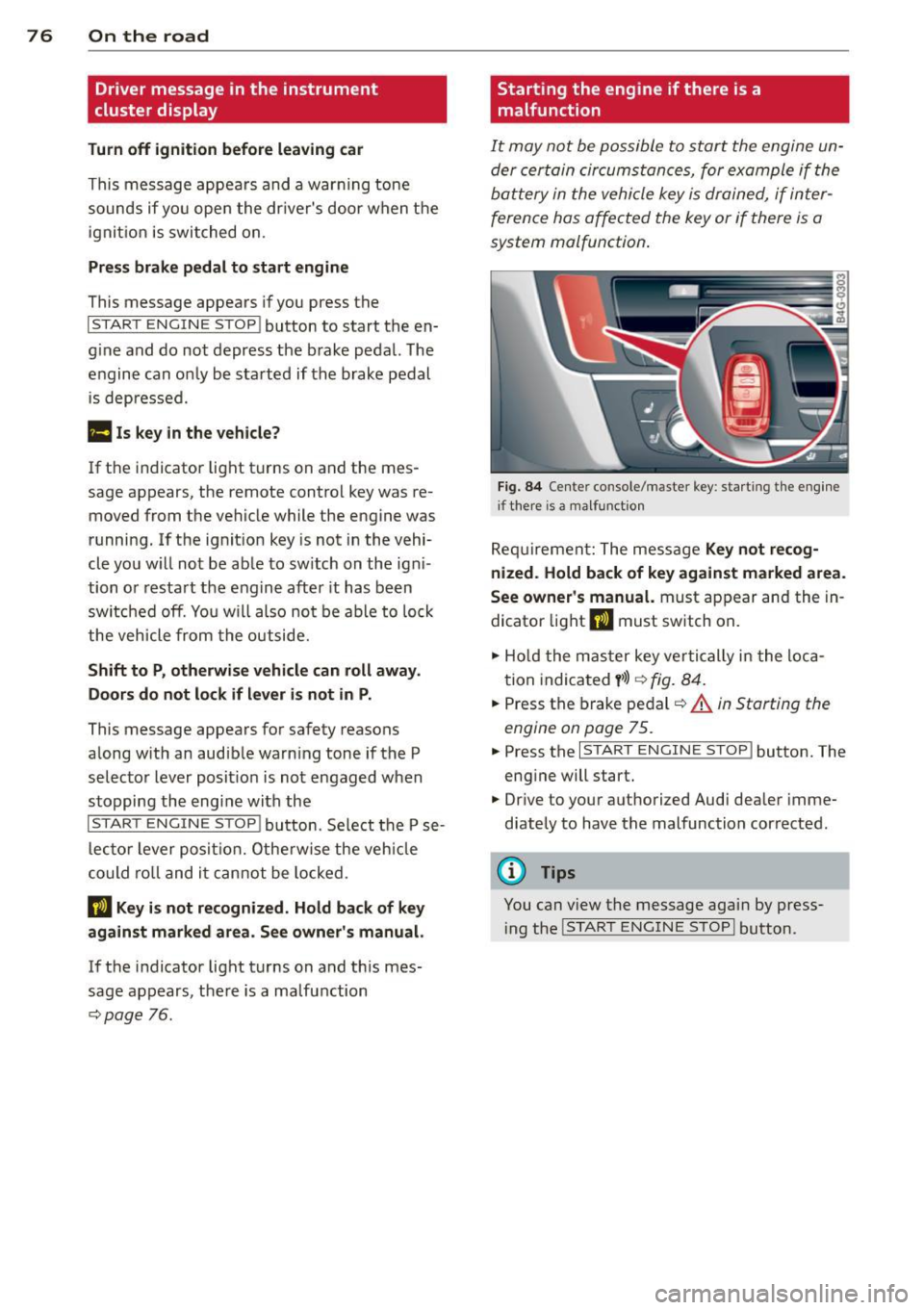
Fig . 8 4 Center console/master key: start ing the eng ine
i f there is a malfunction
Req uirement: The mess age Ke y not r ecog
ni ze d. H old back of ke y again st ma rked are a.
See owne r's manual.
must appear and the in
dicator light
II must sw itch on.
.,. Ho ld the mas ter key vertically in the loca
tion indicated
y >l) r=:> fig. 84 .
.,. Press the brake pedal c::> A in Starting the
engine on page 75 .
... Press the I S TART ENGINE S T OP ! button. The
eng ine will start.
.,. Dr ive to your authorized Audi dealer imme
diately to have the malfunction corrected .
(D Tips
You can view the message again by press
i ng the
I STAR T ENGINE STOP I button.
Page 79 of 302
Electromechanical
parking brake
Operation
The electromechanical parking brake replaces
the hand brake.
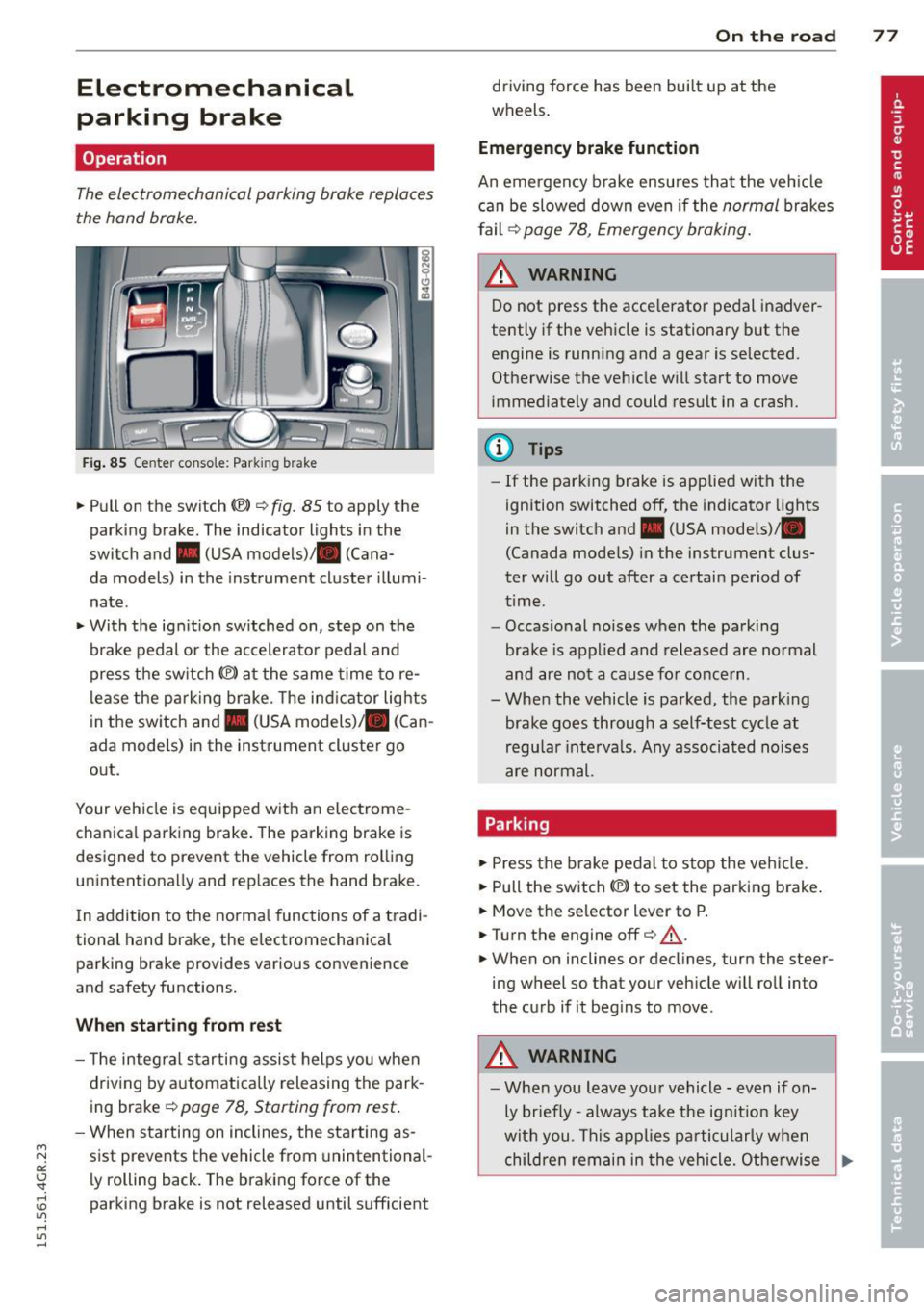
Fig. 85 Center conso le: Park ing brake
.. Pull on the switch (®)¢fig . 85 to apply the
parking brake. The indicator lights in the
switch and. (USA models)/ . (Cana-
da models) in the instrument cluster illumi
nate .
.. With the ignition sw itched on, step on the
brake pedal or the accelerator pedal and
press the sw itch C®> at the same time to re
lease the parking brake. The ind icator lights
in the switch and. (USA models) . (Can
ada mode ls) in the instrument cluster go
out.
Your vehicle is equipped with an electrome
chanica l parking brake. The parking brake is
designed to prevent the vehicle from rolling
unintentionally and replaces the hand brake.
I n addition to the normal functions of a tradi
tional hand brake , the electromechan ical
parking brake provides various convenience
and safety functions.
When starting from rest
-The integral starting assist helps you when
driving by automatically releasing the park
ing brake ¢ page 78, Starting from rest .
- When starting on inclines, the starting as-
"' r-1 sist prevents the vehicle from unintentional-a::
~ Ly rolling back. The braking force of the
:0 parking brake is not released until sufficient
"' ,....,
"' ,....,
On the road 77
driving force has been bui lt up at the
wheels.
Emergency brake function
An emergency brake ensures that the veh icle
can be slowed down even if the normal brakes
fail ¢ page 78, Emergency braking.
_& WARNING
Do not press the acce lerator pedal inadver
tently if the vehicle is stationary but the
engine is running and a gear is selected.
Otherwise the vehicle will start to move immediately and could result in a crash.
(D Tips
-If the parking brake is applied with the
ignition switched off, the indicator lights
in the switch and. (USA models)/ .
(Canada models) in the instrument clus
ter will go out after a certain period of
time.
- Occasional noises when the parking
brake is applied and released are normal
and are not a cause for concern .
- When the vehicle is parked , the park ing
brake goes through a self-test cycle at
regular interva ls . Any associated noises
are normal.
Parking
.,. Press the brake pedal to stop the veh icle.
.. Pull the switch(®) to set the parking brake .
.. Move the selector lever to P.
.. Turn the engine off¢,&. .
.,. When on inclines or declines, turn the steer
ing wheel so that your vehicle will roll into
the curb if it begins to move .
_& WARNING
-When you leave your vehicle - even if on-
ly briefly - always take the ign it ion key
with you . This applies particularly when
children remain in the vehicle. Otherwise
~
Page 80 of 302
78 On the road
th e chi ldren could start the engine, re
lease the parking brake or operate e lec
trical equipment (e.g. power windows) .
The re is the risk of an accide nt.
- When the vehicle is locked, no one -par
t icu larly not ch ildren should remain in
the vehicle . Locked doors make it more
difficult for emergency wor kers to get in
to the vehicle -putt ing lives a t risk.
Starting from rest
The starting assist function ensures that the
parking brake is released automatically upon
starting .
Stopping and applying parking br ake
• Pull the switch(®) to apply the park ing
brake.
Starting and automat ically releasing the
parking brake
• When you start to d rive as usua l, the park
ing brake is automatically re leased and your
vehicle begins to move .
When stopp ing at a traff ic signa l or stopp ing
i n city t raffic, t he parking brake can be ap
plied. The veh icle does not have to be held
with the footbrake. The park ing brake elimi
nates the tendency to c reep with a d rive ra nge
engaged. As soon as you dr ive off as usua l,
the park ing brake is released automati cally
and the veh icle star ts to move .
Starting on slopes
When starting on incl ines, the start ing ass ist
p revents the veh icle from unintentionally ro ll
i ng ba ck. The braking force of t he pa rking
b rake i s not rele ased until sufficient dr iv ing
for ce has been b uilt up at the whee ls.
@ Tips
For safety reasons, the park ing brake is re
leased autom ati cally only when the dr iv
er 's sa fe ty belt i s engage d in the bu ck le.
Emergency braking
In the event that the conventional brake sys
tem fails or locks .
• In an emergency, pull the switc h(® ) and
con tinue to pull it to slow your ve hicle down
w ith the park ing brake.
• As soon as you release the switch (®) or ac-
c e lerate, t he b ra ki ng process stops.
If you pu ll the switch (®) and hold it above a
speed of about 5 mph (8 km/h), the emergen
cy brak ing f unct ion is init iated . T he ve hicle is
braked at all fou r whee ls by a ctivating the hy
draulic brake sy stem. The br ake pe rfor mance
i s sim ilar to ma king an emergency stop~&. .
In order not to act ivate the eme rgency brak
ing by mis take, an audib le warni ng tone (bu z
z er) sounds whe n the swit ch(®) is pulled . As
soon as t he sw itch (®) is re leased , or the acce l
era tor peda l is depressed, eme rgency braking
stops.
_& WARNING ,_
Emergency braking should only be used in
an emergency, when the norma l foot bra ke
has fa iled or the brake pedal is obstructed.
Using the parki ng brake to perform eme r
gency b raking will s low your veh icle down
as if you had made a full bra ke application .
The law s of physi cs cannot be su spen ded
even wi th ESC and i ts asso ciated com po
nents (ABS, A SR, EDL) . In corners and
when road o r weathe r con ditions are bad,
a full brake application can ca use the vehi
cle to sk id or the rear end to break away -
risking an accident.
Speed warning system
, Introduction
The speed warning system helps you to stay
under a specified ma ximum sp eed .
The speed warn ing system warns you if you
are exceeding the maximum speed that you
have set . You will hear a warning tone when
Page 83 of 302
"' N
a:: I.J "". rl I.O
"' rl
"' rl
Audi adapt ive crui se c ontrol an d bra kin g guard 81
Audi adaptive cruise
control and braking
guard
Introduction
App lies to vehicles: with Audi adaptive cruise control
The adaptive cruise control system assists the
driver by regu lating vehicle speed and helping
to maintain a set distance to the vehicle
ahead, within the limits of the system . If the
system detects a moving vehicle up ahead,
adaptive cruise control can brake and then ac
celerate your vehicle. Th is he lps to make driv
ing more comfortable both on long highway
stretches and in stop-and-go traffic.
The braking guard system can warn you about
an impending collision and initiate braking
maneuvers¢
page 87.
Adaptive cruise control and braking guard
have technical limitations that you must
know, so please read this section carefully, un
derstand how the system works and use them
properly at all times.
General information
General information
Applies to vehicles: with Audi adaptive cruise control
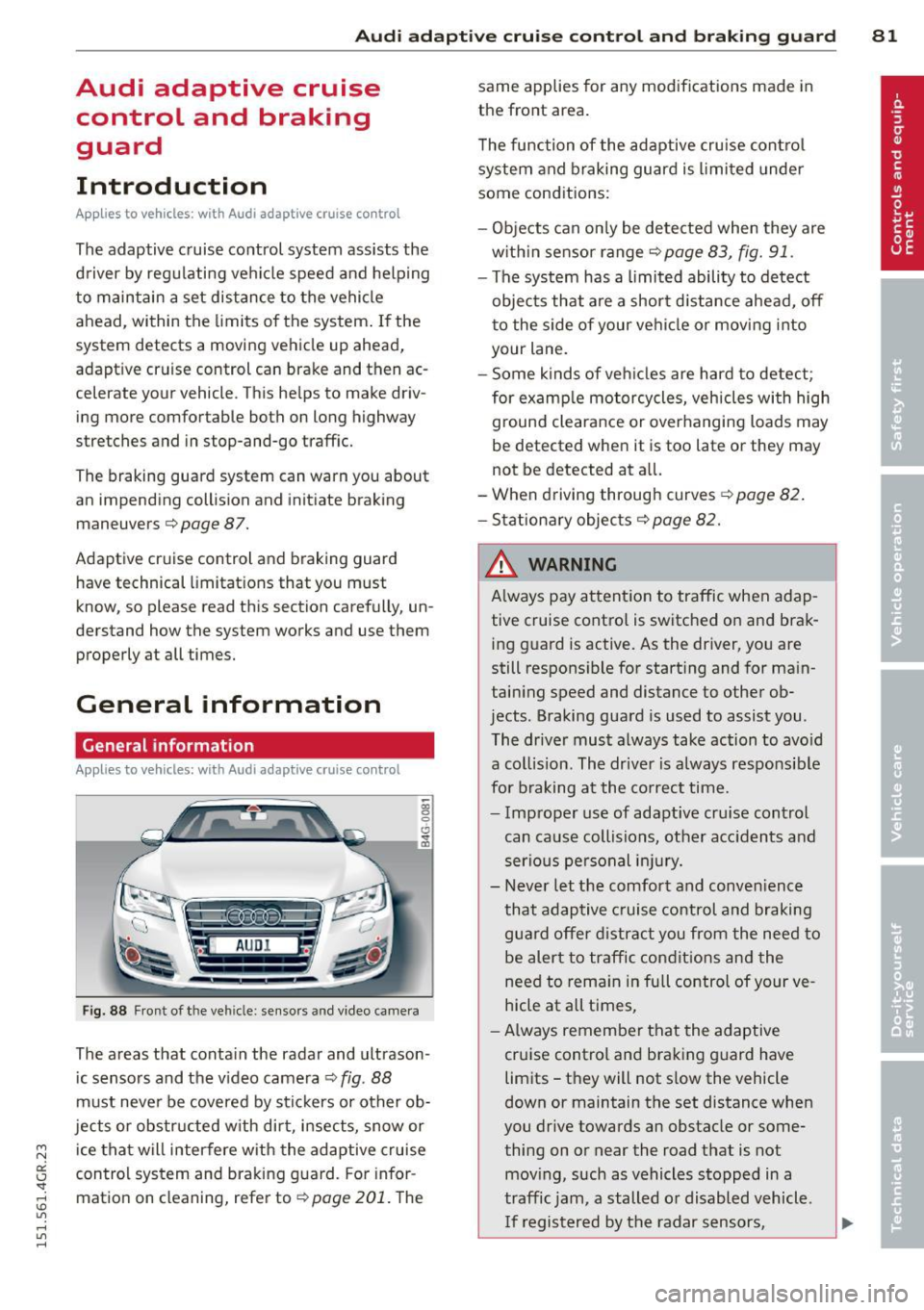
Fig. 88 Front of the vehicle: sensors and video came ra
The areas that contain the radar and ultrason
ic sensors and the v ideo camera ¢
fig. 88
must neve r be covered by stickers or other ob
jects or obstructed with dirt, insects, snow or
ice that will interfere with the adaptive cruise
control system and braking guard. For infor
mation on cleaning, refer to¢
page 201. The same applies for any modifications made in
the front area.
T he function of the adaptive cru ise contro l
system and braking guard is limited under
some conditions:
- Objects can on ly be detected when they are
w ith in sensor range
¢page 83, fig. 91 .
-The system has a limited ability to detect
objects that are a shor t distance ahead,
off
t o the side of your vehicle or moving into
your lane.
- Some kinds of ve hicles are hard to detect;
for examp le motorcycles, vehicles with high
ground clearance or overhanging loads may
be detected when it is too late or they may
not be detected at all.
- When driving through curves
¢page 82 .
- Stationary objects¢ page 82.
& WARNING
Always pay attent ion to traffic when adap
tive cruise control is switched on and brak ing g uard is active. As the driver, you are
still respons ible for starting and for ma in
taining speed and distance to other ob
jects . Braking guard is used to assist you .
The driver must always take action to avo id
a collision. The driver is always responsible
for braking at the co rrect time.
- Improper use of adaptive cru ise control
can cause collisions, other acc idents and
serious pe rsonal in jury.
- Never let the comfort and conven ience
that adaptive cruise control and braking
guard offer d istract you from the need to
be alert to traffic condit ions and the
need to rema in in full control of your ve
hicle at all times,
- Always remember that the adaptive
cruise control and braking guard have
limits -they will not s low the vehicle
down or maintain the set distance when
you drive towards an obstacle or some
thing on or near the road that is not
mov ing, such as vehicles stopped in a
traffic jam, a stalled or disabled vehicle .
I f registered by the radar sensors,
Page 87 of 302
"' N
a:: I.J "". rl I.O
"' rl
"' rl
Audi adaptive cruise control and braking guard 85
Following any changes, the new stored speed
will be displayed briefly in the display @
r::!) page 83, fig. 93.
Driving in stop-and-go traffic
Applies to vehicles: with Audi adaptive cruise co ntrol
The adaptive cruise control system also as
sists you in stop-and-go traffic. If a previous
detected vehicle ahead stops, your vehicle will brake to a stop, within the limits of the sys
tem.
.,. To resume driv ing with adaptive cruise con
trol, tap the accelerator pedal or
.,. Pull the lever toward you into posit ion @
¢page 85, fig. 95 .
@ Tips
-If adaptive cru ise control is active and
your vehicle does not start driving as ex
pected after pulling the lever once, you
can start out again by tapping the accel
erator pedal.
-If an obstacle is detected when your ve
hicle sta rts driving, the system will
prompt you to take over¢
page 86.
Your vehicle will drive more slow ly when
starting. This may also happen in some
situations when no obstacle is apparent.
Interrupting cruise control
App lies to vehicles: with Audi adaptive cruise control
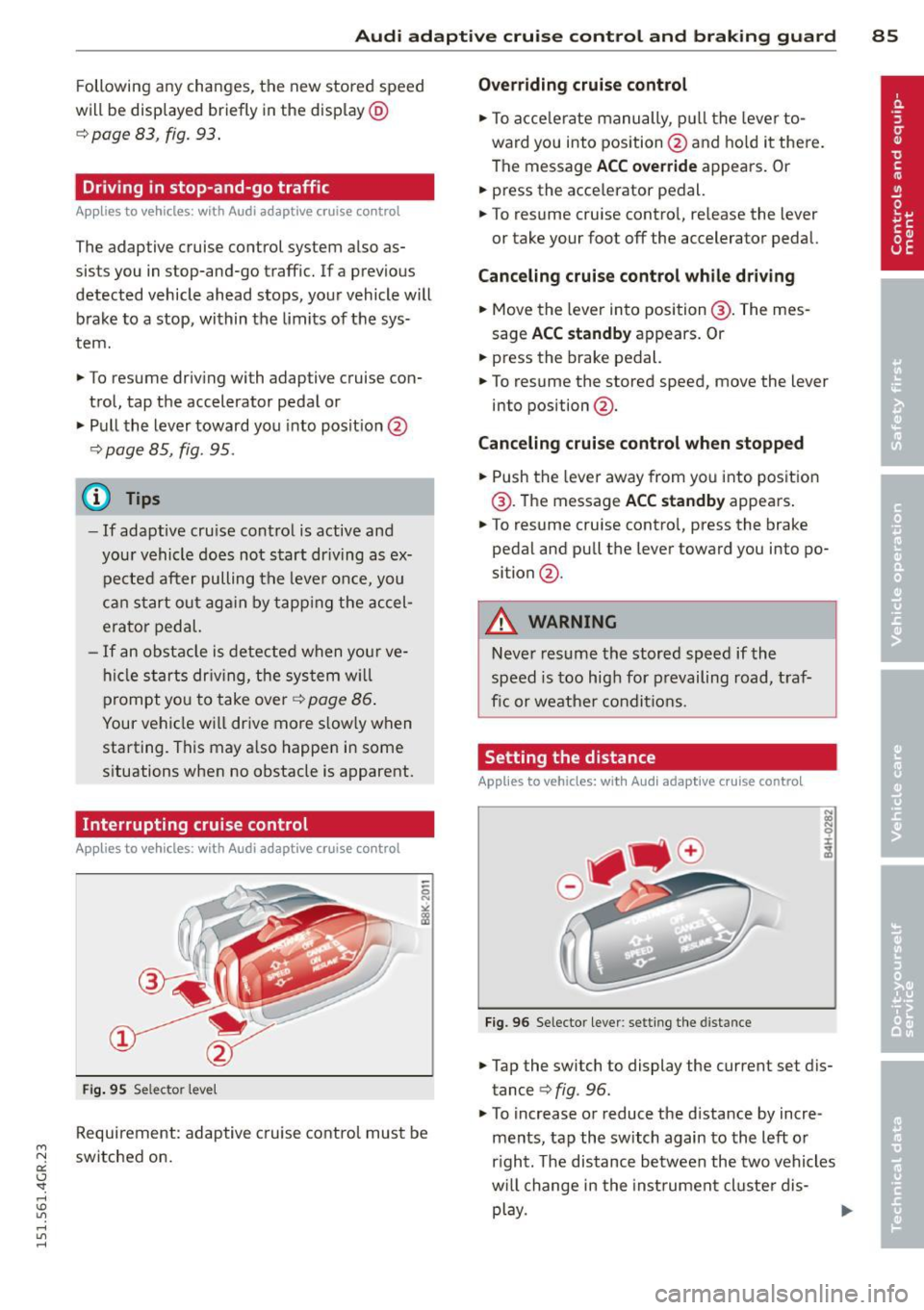
Fig . 95 Se lector leve l
Requirement: adaptive cruise control must be
switched on.
Overriding cruise control
.,. To acce lerate manually, p ull the lever to
ward you into position@and hold it there.
The message
ACC override appears. Or
.. press the acce lerator pedal.
.,. To resume cruise control, re lease the lever
or take your foot off the accelerator pedal.
Canceling cruise control while driving
.,. Move the lever into position @. The mes
sage
ACC standby appears. Or
.,. press the brake pedal.
.,. To resume the stored speed, move the lever
into position @ .
Canceling cruise control when stopped
.,. Push the lever away from you into position
@ . The message
ACC standby appears .
.,. To resume cruise contro l, press the brake
pedal and pu ll the lever toward you into po
sition @.
A WARNING
-
Never resume the stored speed if the
speed is too high for prevailing road, traf
fic or weather conditions.
Setting the distance
Applies to vehicles: wit h Audi adapt ive cr uise contro l
Fig. 96 Selector lever: setting the distance
.,. Tap the switch to display the current set dis
tance ¢
fig. 96.
.,. To increase or reduce the distance by incre
ments, tap the switch again to the left or
r ight. The distance between the two vehicles
w ill change in the instrument cluster dis-
play. ..,.
Page 90 of 302
88 Audi adaptive cruise control and braking guard
stopped vehicle or stationary obstacle (end of a traffic jam or vehicle that has
broken down in traffic).
- Always remember that the radar sensor
for the braking guard works only within
defined detection and range limits that
may prevent the proper detection of oth
er vehicles.
- The radar sensor's function and range
can be reduced by rain, snow and heavy
spray . Moving vehicles up ahead may not
be promptly detected or may not be de
tected at all.
- Reflective surfaces including crash barri
ers or tunnel entrances may impair the
function of the radar sensor.
({) Tips
-You can cancel the braking with increas
ing force that is initiated by the system
by braking yourself, by accelerating no
ticeably or by swerving.
- Braking guard error messages
¢page 88.
- Keep in mind that braking guard can
brake unexpectedly . Always secure any
cargo or objects that you are transport
ing to reduce the risk of damage or in
jury.
Settings in the MMI
Applies to vehicles: with Audi adaptive cruise co ntrol
.. Select : I CARI function button > (Car)* sys
tems
control button > Driver assist > Audi
braking guard.
System -
Switch braking guard On and Off.
When you switch the ignition on, the message
Audi braking guard off appears if the system
is switched off.
Early warning -The distance and approach
warnings in the display can be switched
On/
Off.
(D Tips
- Your settings are automatically stored
and assigned to the remote control key being used at the time the settings are
made.
- If you restrict or switch off the ESC, the
braking guard also switches itself off
¢page 189.
- Switch braking guard off when you are
loading the vehicle onto a vehicle carrier,
train, ship or other type of transporta
tion. This can prevent undesired warn
ings from the braking guard system.
Messages
Applies to vehicles: with Aud i adapt ive cru ise contro l
Braking guard: off
This driver message appears if the system is
turned off via the infotainment. Otherwise , if
the system is turned off, the information ap
pears every time shortly after the start of the
trip.
The driver message also appears if the system
is not available due to a malfunction or if the
ESC is not switched on¢
page 189. If this is
the case, the system will not provide warnings about a possible collision.
Braking guard: activated
This driver message appears if sharp brake
pressure was applied due to an acute warning.
ACC: Unavailable!
ACC and Audi braking guard: not available
The system cannot detect moving vehicles up
ahead correctly and is switched off. The sen
sors have been displaced or are not working
properly. The Audi pre sense functions may al
so be affected . Drive to your authorized Audi
dealer or authorized Audi service facility im
mediately to have the malfunction corrected.
ACC: currently unavailable. No sensor vision
ACC and braking guide: currently unavaila
ble. No sensor vision
This message appears if the sensor view is ob
structed, for example by leaves, snow, heavy
spray or dirt. Clean the sensors¢
page 81,
fig. 88. ll>-
Page 99 of 302
"' N
a:: I.J "". rl I.O
"' rl
"' rl
ability to accelerate on curves. The vehicle is
very responsive to steering.
Curve light*
The curve light adapts to driv ing on curves.
The pivot ing action and the light ing are also
adapted to the mode.
Ad apti ve crui se contr ol*
The behavior when accelerat ing can be ad just
ed from comfortable to sporty, depending on
the dr ive se lect mode . Adaptive cruise control
also responds to the driving behav ior of the
veh icle ahead in a more conservative or sporty
manner .
Engine sound
The sound of the engine is adapted to these
l ected mode and ranges from subtle to sporty.
(D Note
-Make sure there is enough clearance
above and below the vehicle when park
i ng. The height of the vehicle can change
once it is parked d ue to temperature
fluctuations, changes to the load condi
tions and changes to the driving modes,
which can affect clearance.
- When transporting the vehicle on a car
carrier, train, ship or by other means, on
l y tie the veh icle down at the running
surface of the tires, which is the outer
circumference. Securing the vehicle at
the axle components, suspension struts
or tow ing eyes is not perm itted because
the p ressure in the air suspension struts
can change d uring transport. The vehicle
may not be se cured s uff ic ient ly if this
happens.
(D Tips
- In some models, the maxim um vehicle
speed can only be reached in the
Auto
and D ynamic modes.
- Se lecting the
Dynami c mode results in
spor ty sh ifting character istics. The S
gear position engages automatically .
Audi drive sele ct 97
- In ve hicles that have dynamic steering*,
operating noise is heard when starting or
stopping the engine. This does not indi
cate a problem.
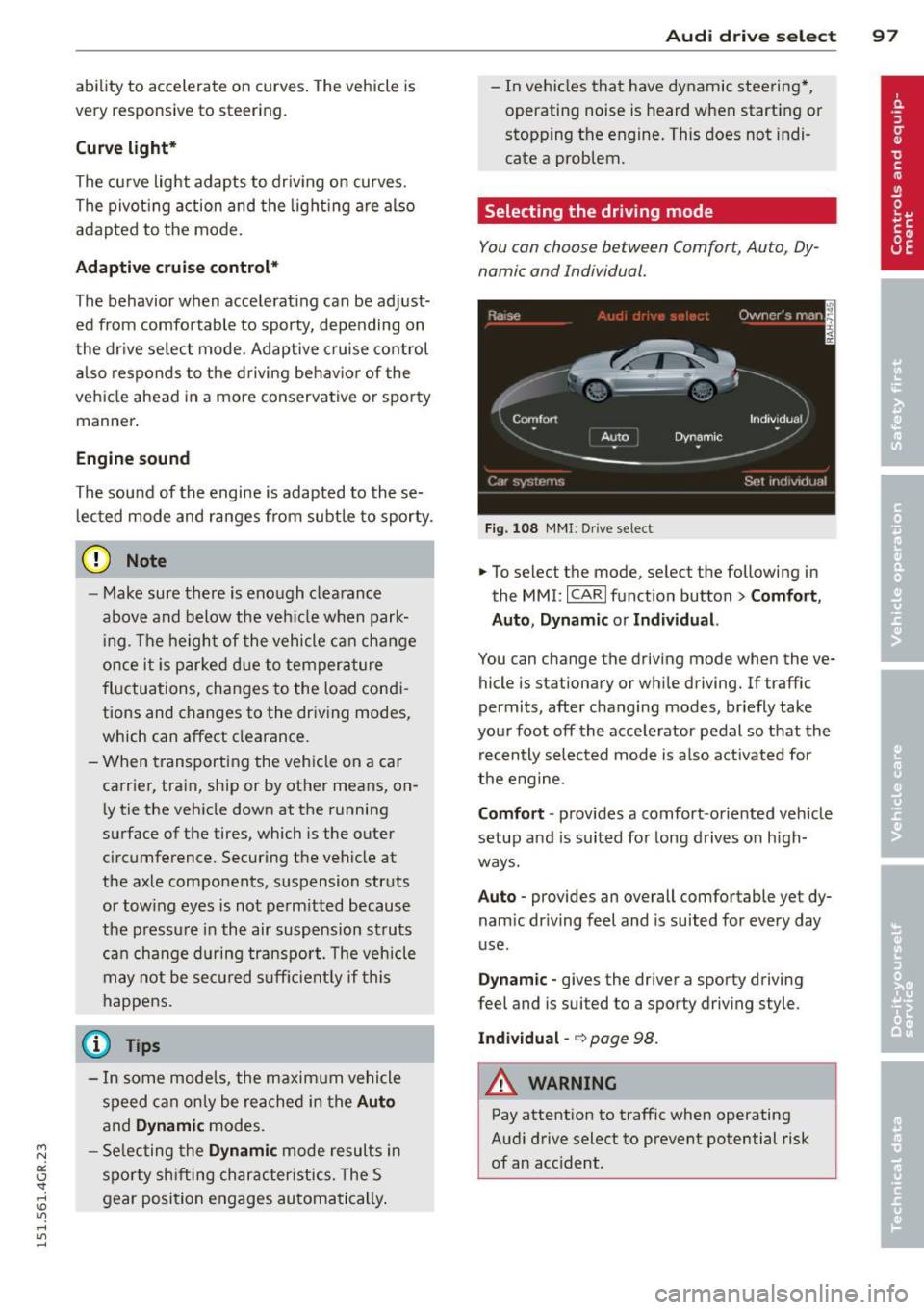
Selecting the driving mode
You can choose between Comfort, Auto, Dy
namic and Individual.
Fig. 108 M MI: Dr ive select
.,. To select the mode, select the following in
the
MMI: I CARI function button> Comfort ,
Auto , Dynamic or Individu al.
You can change the driving mode when the ve
hicle is stationary or while driving. If traffic
permits, after changing modes, br iefly take
your foot off the accele rator pedal so that the
recently selected mode is a lso activated for
the engine.
Comfo rt -prov ides a comfort-oriented veh icle
setup and is suited for long drives on h igh
ways.
Auto -provides an overall comfortable yet dy
nam ic dr iving feel and is suited for every day
use .
Dynam ic -gives the driver a sporty driving
feel and is suited to a sporty driving style.
Indi vidual -~page 98.
&_ WARNING
Pay attention to traffic when operating
Audi drive select to prevent potential risk
of an accident.
-
Page 107 of 302
"' N
a:: I.J "". rl I.O
"' rl
"' rl
lever is left in N (Neutral) for more than ap
proximately 2 second, without the brake ped
al being pressed .
Release button
The release button on the selector lever pre
vents the leve r from being accidentally shifted
into certa in positions. Depending on the direc
tion of the shift, the se lector lever locks at d if
ferent positions. The positions are highlighted in the illustration
c!> fig . 118.
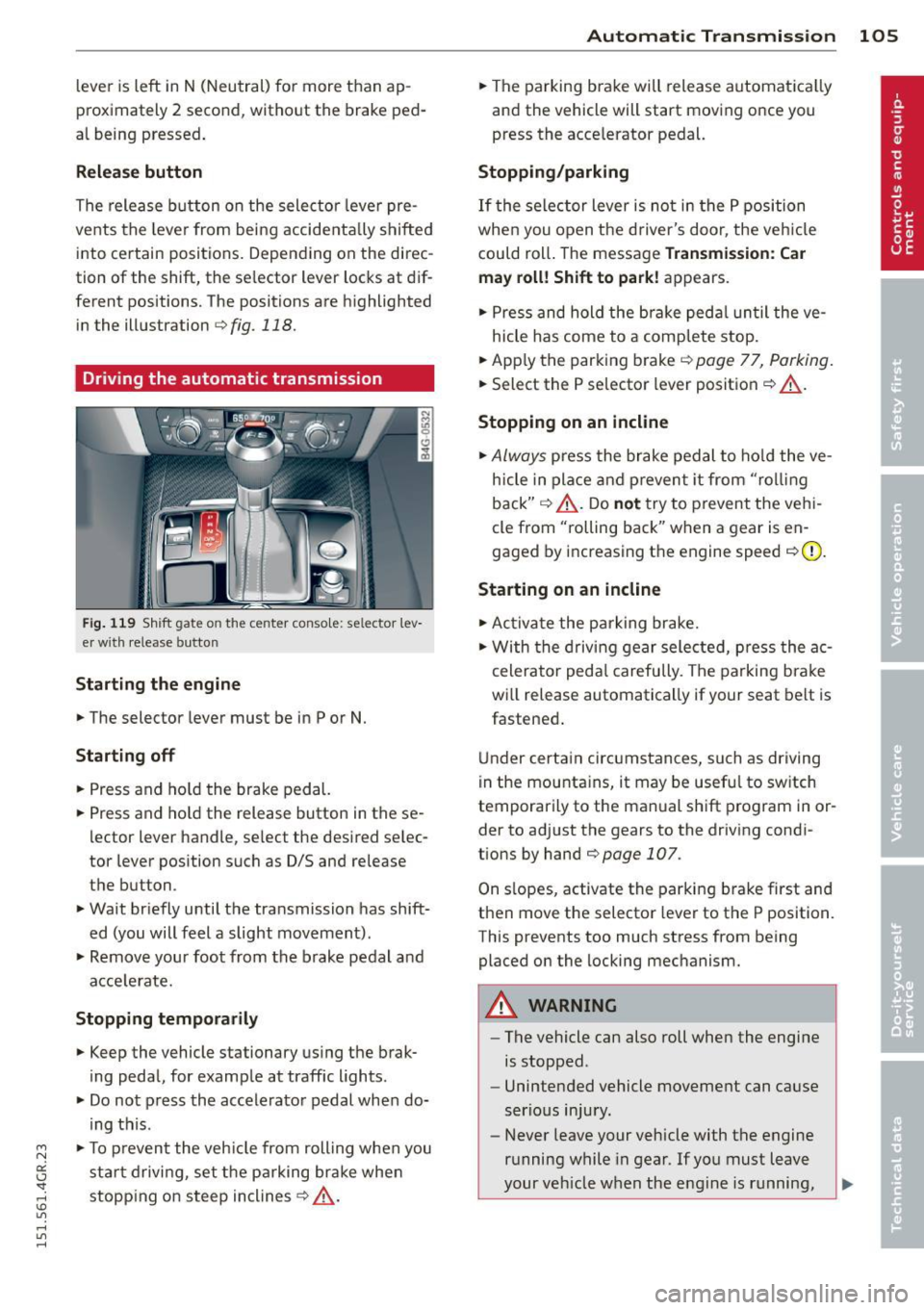
Driving the automatic transmission
Fig. 119 Shift gate on the c ente r conso le: se lector le v
er with release button
Starting the engine
.,. The selector lever must be in P or N.
Starting off
.,. Press and hold the brake pedal.
.,. Press and hold the release button in these
l ector lever handle, se lect the desired se lec
tor lever position such as 0/5 and release
the button .
.,. Wait briefly until the transmission has shift
ed (you will feel a slight movement).
.,. Remove your foot from the brake pedal and
acce lerate.
Stopping temporarily
.,. Keep the vehicle stationary using the brak
ing pedal, for example at traffic lights .
.,. Do not press the accelerator pedal when do
ing this .
.,. To prevent the vehicle from rolling when you
start driving, set the parking brake when
stopping on steep inclines
c!> .&,.
Automatic Transmission 105
.,. The parking brake will release automatica lly
and the vehicle will start moving once you
press the acce lerator pedal.
Stopping/parking
If the selector lever is not in the P position
when you open the driver's door, the vehicle
could roll . The message
Transmission: Car
may roll! Shift to park!
appears .
.,. Press and hold the brake pedal un til the ve-
hicle has come to a complete stop .
.,. App ly the parking b rake
c::> page 77, Parking.
.,. Select the P selector lever position c::> .&,.
Stopping on an incline
.,. Always
press the brake pedal to hold the ve
hicle in place and prevent it from "rol ling
back"
c::> .&, . Do not try to prevent the vehi
cle from "rolling back" when a gear is en
gaged by increasing the engine speed
c::>(D.
Starting on an incline
.,. Activate the parking brake.
.,. With the driving gear selected, press the ac
celerator pedal carefully. The parking brake
wi ll release automatically if your seat belt is
fast ened .
Under certain circumstances, such as driving
in the mountains, it may be useful to switch
temporarily to the manual shift program in or
der to adjust the gears to the driving condi
tions by hand
c::>page 107.
On slopes, activate the parking brake first and
then move the selector lever to the P position.
This prevents too much stress from being placed on the locking mechanism.
A WARNING
-
- The vehicle can also roll when the engine
is stopped .
- Unintended vehicle movement can cause
serious injury.
- Never leave your vehicle with the engine
running while in gear . If you must leave
your veh icle when the engine is running,
Page 116 of 302
114 Park in g s yste m s
c> A in General information on page 111,
r=.>(D in General information on page 112.
The blue area represents an extens ion of the
vehicle's outline by approximately 16 ft
(5 m) to the rear . The long side of the blue
area should be on the curb. The entire blue
area must fit into the parking space .
~ With the vehicle stopped, turn the steer ing
wheel to the r ight as far as it w ill go.
~ Back in to the par king spa ce until the b lue
curve
r=.> fig. 133 touches the curb c> A in
General information on page 111,
¢ (Din
General information on page 112 . Stop the
vehicle.
~ With the veh icle stopped, turn the steer ing
wheel to the left as far as it will go.
~ Continue to back into the parking space un
t il the vehicle is parked pa ralle l to the curb
r=.> A in General information on page 111,
r::> Q) in General information on page 112 .
@ marks the rear bumper . Stop the ve hicle,
at the latest, when the red orientation line
@ borders an object. Keep an eye on the
front of your vehicle whi le doing this .
Parking next to obstacles
If there is a n obsta cle (s uch as a wall) next to
the park ing space, position the ve hicle so
the re is more space o n that s ide. Position the
long side of the b lue surface so that there is
sufficient space from the obstacle . The sur
face m ust not be touch ing . You will also need
to start tur ning the steering wheel much ear
lier . The blue curve
r::> fig. 133 must not touch
the obstacle and should have sufficient room .
(D Note
Remember to maintain sufficient clear
ance from the curb to avoid damaging the
wheel rims .
(!) Tips
The left or right orientation lines and sur
faces will be displayed, depe nding on the
turn signal be ing used .
Peripheral cameras
Introduction
Applies to vehicles: wi th parking system pl us with per ip h
eral c ameras
In add ition to parking system p lus
r=.> page 110, this parking system conta ins pe
ripheral cameras . Depending on the vehicle
equipment, you are assisted by vario us views
s u ch as per iphera l view , corner views at the
fron t and rear of the veh icle, and views d irect
ly in front of or behind the vehicle .
General information
Applies to v ehicl es: wi th parking sys te m plus with pe riph
eral ca meras
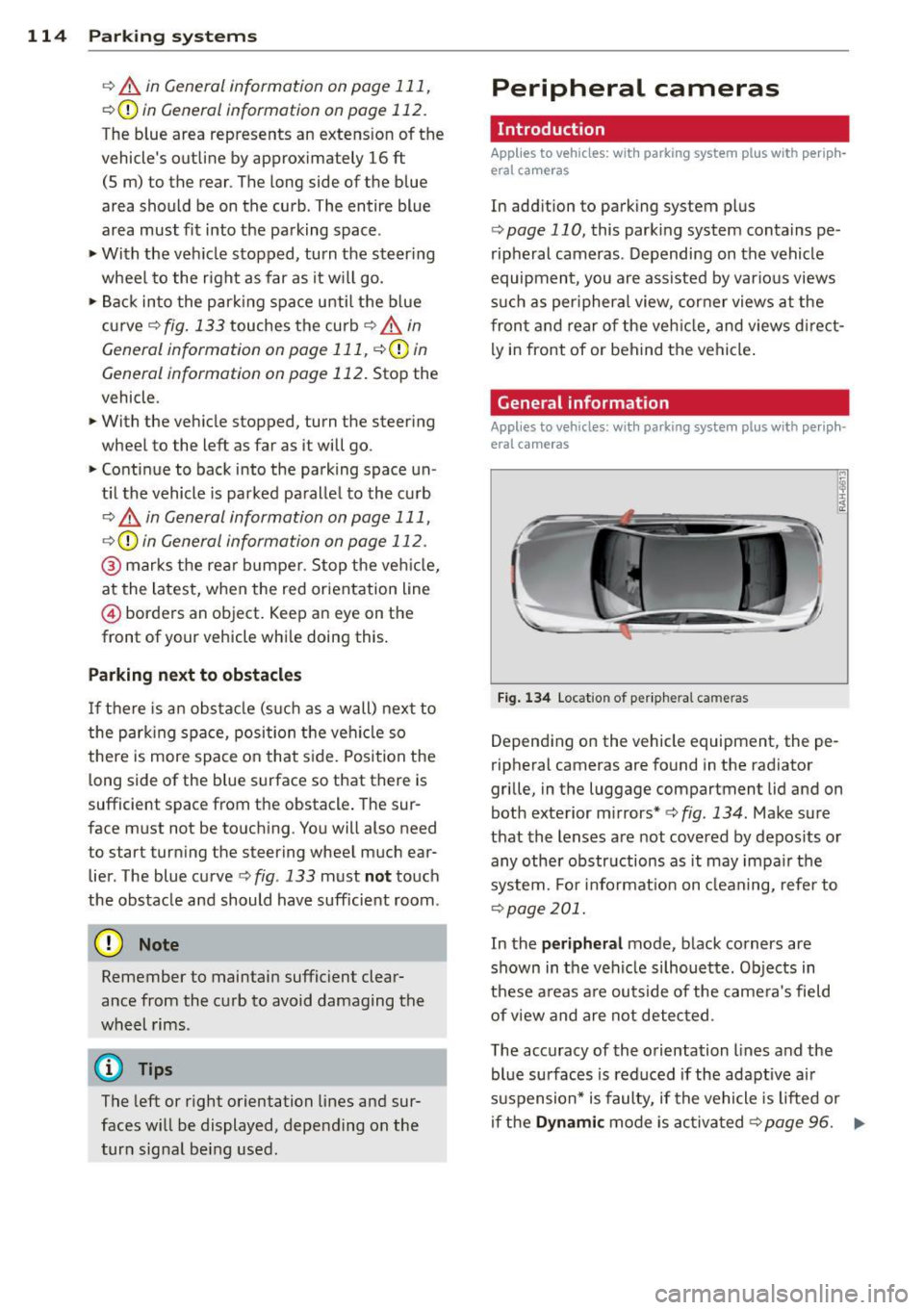
F ig . 1 34 Location of per iphera l came ras
Depending on the vehicle equipment, the pe
ripheral cameras are found in the radiator
grille, in the luggage compartment lid and on
both exterior m irrors *
c> fig. 134. Make sure
that the lenses a re not covered by depos its or
any othe r obstructions as it may impa ir the
system. For informat ion on clean ing, refe r to
r::>page 201.
In the peripheral mode, black corners are
shown in the vehicle silhouette . Objects in
these areas a re ou ts ide of the came ra's field
of view and are not detected.
T he accuracy of the orientation lines and the
blue surfaces is reduced if the adaptive ai r
suspension* is faulty, if the vehicle is lifted or
i f th e
D ynamic mode is activa ted c> page 96. ..,.
Page 120 of 302
118 Parking systems
Parallel parking
App lies to vehicles: with park ing system p lus and rear
mode
This view may be used when parallel parking
along the side of a street.
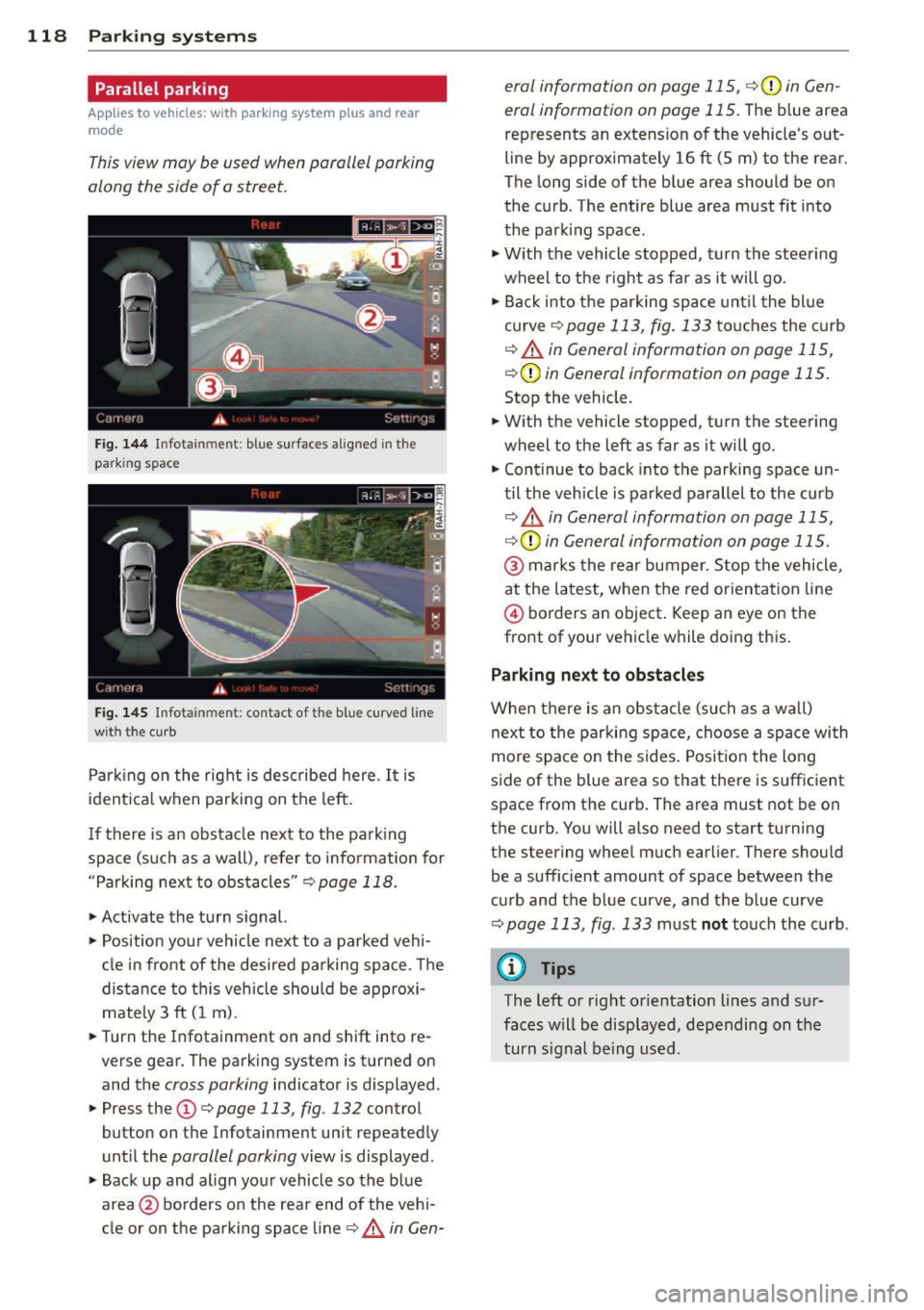
F ig. 1 44 Infot ainmen t: blue surfaces aligned in th e
park ing space
Fig. 1 45 Infota inment: co ntact of the blue curved line
wit h the c urb
Park ing on the right is described here . It is
ident ica l when parking on the left.
I f there is an obstacle next to the park ing
space (such as a wall), refer to information for
"Parking next to obstacles"
c:.? page 118.
~ Activate the turn s ignal.
~ Pos ition your vehicle next to a parked vehi
cl e in front of the desired parking space . T he
distance to th is veh icle sho uld be approxi
mately 3 ft ( 1 m).
~ Turn the Infotainment on and shift into re
verse gear. The parking system is turned on
and the
cross parking indicator is displayed .
~ Press the (D c> page 113, fig. 132 control
button on the Infotainment un it repeatedly
unt il the
parallel parking view is displayed .
~ Backup and align yo ur vehicle so the b lue
area @borders on the rea r end of the vehi
cl e or on the parking space line
c> .&. in Gen - era/ information on page 115,
c>(Din Gen
eral information on page 115.
T he b lue area
represents an extension of the vehicle 's o ut
line by approximately 16 ft (5 m) to the rear.
The long side of the blue area should be on
the curb . The entire blue area must fit into
the park ing space .
~ With the vehicle stopped, turn the steering
wheel to the right as fa r as it will go.
~ Back i nto the parking space unt il t he blue
curve
c> page 113, fig. 133 touches the curb
¢.&. in General information on page 115,
¢ (Din General information on page 115 .
Stop the vehicle.
~ With the vehicle stopped, turn the steering
wheel to the left as far as it w ill go.
~ Continue to back into the parking space un
til the veh icle is parked parallel to the curb
¢ .&. in General information on page 115,
¢ (Din General information on page 115.
@ marks the rear bumper. Stop the vehicle,
at the latest, when the red orientat ion line
@ borders an object . Keep an eye on the
front of your vehicle while doing this.
Parking next to obstacles
When there is an obstacle (su ch as a wa ll)
next to the parking space, choose a spa ce wi th
more space o n the sides . Posit ion the long
side of the blue area so that there is sufficient
space from the curb. The area must not be on
the curb. You will a lso need to start turning
the steering wheel much earlier . There should
be a sufficient amount of space between the
cu rb and the blue curve, and the blue curve
c> page 113, fig . 133 must not touch the curb.
© Tips
The left or right orientation lines and sur
faces will be displayed, depending on the
turn s ignal being used.