stop start AUDI RS7 SPORTBACK 2015 Owner's Manual
[x] Cancel search | Manufacturer: AUDI, Model Year: 2015, Model line: RS7 SPORTBACK, Model: AUDI RS7 SPORTBACK 2015Pages: 302, PDF Size: 74.76 MB
Page 203 of 302
M N
0:: <.J 'SI: ,...., \!) ..,.,
,...., ..,., ,....,
Vehicle care and clean ing
General information
Regular, proper care helps to maintain your
vehicle 's value. It can also be a requirement
when submitting warranty claims for corro
sion damage and paint defects on the body .
The required cleaning and care products can
be obtained from your authorized Audi dealer
or a qualified workshop . Read and follow the
instructions for use on the packaging.
A WARNING
-Us ing clean ing and care products incor
rectly can be dangerous to your hea lth.
- Always store cleaning and care products
out of reach of children to reduce the risk
of poisoning.
@) For the sake of the environment
-Preferably use environmentally-friendly
products when buying cleaning agents.
- Do not d ispose of leftover cleaning and
care products with household trash .
Car washes
-
The longer that deposits such as insects, bird
droppings, tree sap or road salt remain on the
vehicle, the more the surface can be dam
aged. High temperatures such as those
caused by sunlight increase the corrosive ef
fect.
Before washing, wet heavy deposits w ith plen
ty of water.
Also, wash the underside of your vehicle once road salt stops be ing used for the season.
Pressure washers
When washing your vehicles with a pressure
washer, always follow the operating instruc
tions provided w ith the pressure washer . Th is
is especially important in regard to the pres
sure and spraying distance. Do not aim the
spray directly at seals on side w indows, doors,
Vehicle care and cleaning 201
the hood, the rear lid or the sunroof* or at
tires, rubber hoses, insulating material, sen sors* or camera lenses* . Keep a distance of at
least 16 inches (40 cm).
Do not remove snow and ice with a pressure
washer.
Never use rotary nozzles or high pressure noz
zles.
The water temperature must not be above
140 °F (60 °C) .
Automatic car washes
Spray off the vehicle before washing.
Make sure that the windows and roof* are
closed and the windshield wipers are
off. Fol
low instructions from the car wash operator,
especially if there are accessories attached to
your vehicle.
If possible, use car washes that do not have
brushes .
Only use car washes where the vehicle re
mains stat ionary and the wash ing equipment
moves around the vehicle when washing and
drying. Car washes that move the vehicle
through the car wash using a chain are not
recommended.
Washing by hand
Clean the vehic le starting from the top and
working down using a soft sponge or cleaning
brush. Use solvent-free cleaning products .
Washing vehicles with matte finish paint
by hand
To avoid damaging the paint when washing,
first remove dust and large particles from
your vehicle. Insects, grease spots and finger
pri nts are best removed w ith a special cleaner
for matte finish paint .
Apply the product using a microfiber cloth. To
avoid damaging the paint surface, do not use
too much pressure.
Rinse the vehicle thoroughly with water. Then
clean using a neutral shampoo and a soft mi-
crofiber cloth. ..,.
•
•
Page 214 of 302
212 Check ing and filling
- Always disconnect the battery.
- Never smoke or work near heaters or open flames . Fluids in the engine com
partment could start a fire.
- Keep an approved fire extinguisher im
mediately available.
- To avoid electrical shock and persona l in
jury while the engine is running or being started, never touch:
- Ignition cables
- Other components of the high voltage
electronic ignition system.
- If you must perform a check or repa ir
with the engine running:
- Fi rst, fully apply the parking bra ke,
move se lec to r lever to P (Pa rk) .
- Always use extreme caution to preven t
clot hing, jewe lry, or long h air from ge t
ting caught in the radiator fan, V -belts
or other moving parts, or from contact ing hot parts. Tie back hair before
start ing, and do not wear cloth ing that
will hang or droop into the eng ine.
- Min imize exposure to emission and
chemica l hazards¢ ,&..
A WARNING
California Propos ition 65 Warning:
- Engine exhaust, some of its constituents,
and certa in veh icle components conta in
or emit chemicals known to the State of
Califor nia to cause cancer and b irth de
fec ts a nd reproduct ive ha rm. In addition,
certain fluids conta ined in vehicles and
certa in prod ucts of co mponent wear co n
ta in o r emi t chemicals known to the
State o f Ca lifornia to cause can cer and
birth defects or ot her reproductive harm. -
Battery posts, terminals and re lated ac
cessories conta in lead and lead com
pounds, chemicals known to the State of
California to cause cance r and reproduc
tive harms. Wash hands after handling .
(D Note
When adding flu ids, always make sure that
they are poured into the proper conta iner
or f iller opening, otherwise serious dam
age to vehicle systems w ill occur.
® For the sake of the environment
To detect leaks in time, inspect the vehicle
floor pan from underneath regularly. If
you see spots from oil or other ve hicle flu
i ds, have yo ur vehicle inspected by a n au
thori zed Audi dea le r.
Closing the engine hood
.,. Pull the hood down un til the pressure from
t he struts is reduced.
.,. Let the hood drop down and latch in p lace .
Do not try to push it shut; it may fail to en
gage ¢&_ .
A WARNING
-
A hood that is not completely latched
could fly up and b lock your view while dr iv
ing.
- When you close the engine hood, check it
to make sure the safety catch has p roper
ly engaged. The hood sho uld be flush
with the surrou nding vehicle body pa rts.
- If you notice while driv ing t hat the hood
is not s ecured prope rly, stop at onc e and
close it.
Page 241 of 302
Tires and wheels 239
-The tire pressures should only sudden tire failure, loss of •
be checked and adjusted when control, collision, serious per-• '
the tires are cold. The slightly
sonal injury or even death.
raised pressures of warm tires -When the warning symbol
must not be reduced.
[I] appears in the instru-
-Adjust the tire pressure to the ment cluster, stop and in-
load you are carrying. spect the tires.
-Reinstall the valve stem cap -Incorrect tire pressure and/
on the valve. or underinflation can cause
When should I check the tire increased tire wear and can
pressure? affect the handling of the
vehicle and stopping ability.
The correct tire pressure is es -
-Incorrect tire pressures
pecially important at high
and/or underinflation can
speeds. The pressure should
also lead to sudden tire fail-
therefore be checked at least
ure, including a blowout
once a month and always be-
and sudden deflation, caus-
fore start ing a journey.
ing loss of vehicle control.
When should I adjust the -The driver is responsible for
ti re pressures?
the correct tire pressures for
Adjust the tire pressure to the all tires on the vehicle. The
load you are carrying. After applicable pressure values
changing a wheel
or replacing are located on a sticker on
wheels you have to adjust the the driver's side B-pillar.
tire pressures on all wheels. In -Only when all tires on the
addition, you must then store vehicle are filled to the cor-
the new tire pressures in the rect pressure, the tire pres-
tire pressure monitoring sys- sure monitoring system can
tern¢
page 255. work correctly.
A WARNING -The use of incorrect tire
pressure values can lead to
M
Incorrect tire pressures and/ N
0::
accidents or other damage. <.J
or underinflation can lead 'SI: ....
Therefore it is essential that ~ \!) 1.1'1
.... 1.1'1 ....
Page 257 of 302
M N
0:: <.J 'SI: ,...., \!) 1.1'1 ,...., 1.1'1 ,....,
thro ugh or over such obstacles can damage
your tires. Impact with a curb may a lso
cause damage to your tires .
- After any impact, immediately inspect your
tires or have them inspected by the nearest
authorized Audi dea ler. Replace a damaged
t ire as soon as possible.
- Inspect yo ur tires every 2,000 miles (3,000
km) for damage and wear . Damage is not al
ways easy to see. Damage can lead to loss of
air and underinflation, wh ich could eventu
ally cause tire fa ilure . If you be lieve that a
t ire may have been damaged, replace the
t ir e as soo n as possible.
- T hese tires may wear more quickly than oth
ers .
- Please also remember that, while these tires deliver respons ive handling, they may ride
less comfortably and make mo re no ise than
othe r cho ices .
Reduced performance in winter /cold
season conditions
A ll t ires are des igned for certain pu rposes.
The low aspect ratio, ultra hig h pe rformance
tires orig inally installed o n your veh icle are in
tended for maximum dry and wet road per
formance and handling . They are not s uitable
for cold, snowy or icy weather conditions. If
you dr ive under those circumstances, you
should equip your vehicle with all-season or
winter tires, which offer better traction under
those cond itions . We suggest you use the rec
ommended snow or all-season tires specified
fo r your ve hicle, or their equ ivalent.
Refer to¢
page 252 for mo re deta iled infor
mat io n regarding winter t ires .
Tire pressure
monitoring system
U) General notes
Each t ire, includ ing the spare (if provided),
should be checked month ly when cold and in
flated to the inflation pressure recommended by the vehicle manufacture r o n the vehicle
p lacard or tire inflation pressure label. (If yo ur
Tire s an d wheel s 255
vehicle has tires of a different size than the
size indicated on the vehicle placard or tire in
flat ion pressure labe l, you sho uld determine
the proper t ire inflation press ure for those
tires).
As an added safety feature, your vehicle has been equipped with a tire pressure monitoring
system (TPMS) that illum inates a low tire
pressure telltale when one or more of your
ti res is s ignificant ly under-inflated. According
ly, when the low tire pressure telltale illumi
nates, you shou ld stop and check you r tires as
soon as possib le, and inflate them to the
proper pressu re. Driving on a sign ifican tly un
der -infla ted ti re causes the tire to overhea t
and can lead to tire fai lure . Under-inflation al
so reduces fuel efficiency and tire tread life,
and may affect the vehicle 's hand ling and
stopp ing ability.
Please note that the TPMS is not a substitute
for proper tire maintenance, and it is the driv er's respons ibility to maintain correct tire
pressure, even if under-inflation has not
reached the level to tr igger illuminat ion of t he
TPMS low tire pressu re tellta le.
Your vehicle has also been equipped with a
TPMS malfunction indicator to ind icate when
the system is not operating properly. The
TPMS ma lfunction indicator is combined with
the low t ire pressure telltale . Whe n the sys
tem detects a malfunction, the telltale will
flash fo r approximate ly one m inute and then
r em ain continuously illum ina ted . Thi s se
quence will continue upon s ubsequent vehicle
start-ups as long as the malfunction exists .
When the malfunction indicato r is illum ina t
ed, the sys tem may no t be ab le to detec t or
s ignal low tire pressure as in tended . TPMS
malfu nctions may occur for a var iety of rea
sons, incl uding the insta llation of rep lace
ment or a lternate tires or wheels on the vehi
cle that prevent the TPMS from functioning properly. Always check the TPMS malfunction
telltale after rep laci ng one or more tires or
whee ls on your vehicle to ensu re that the re
placement o r alternate tires and wheels a llow
the TPMS to con tinue to funct ion p ro perly .
•
•
Page 264 of 302
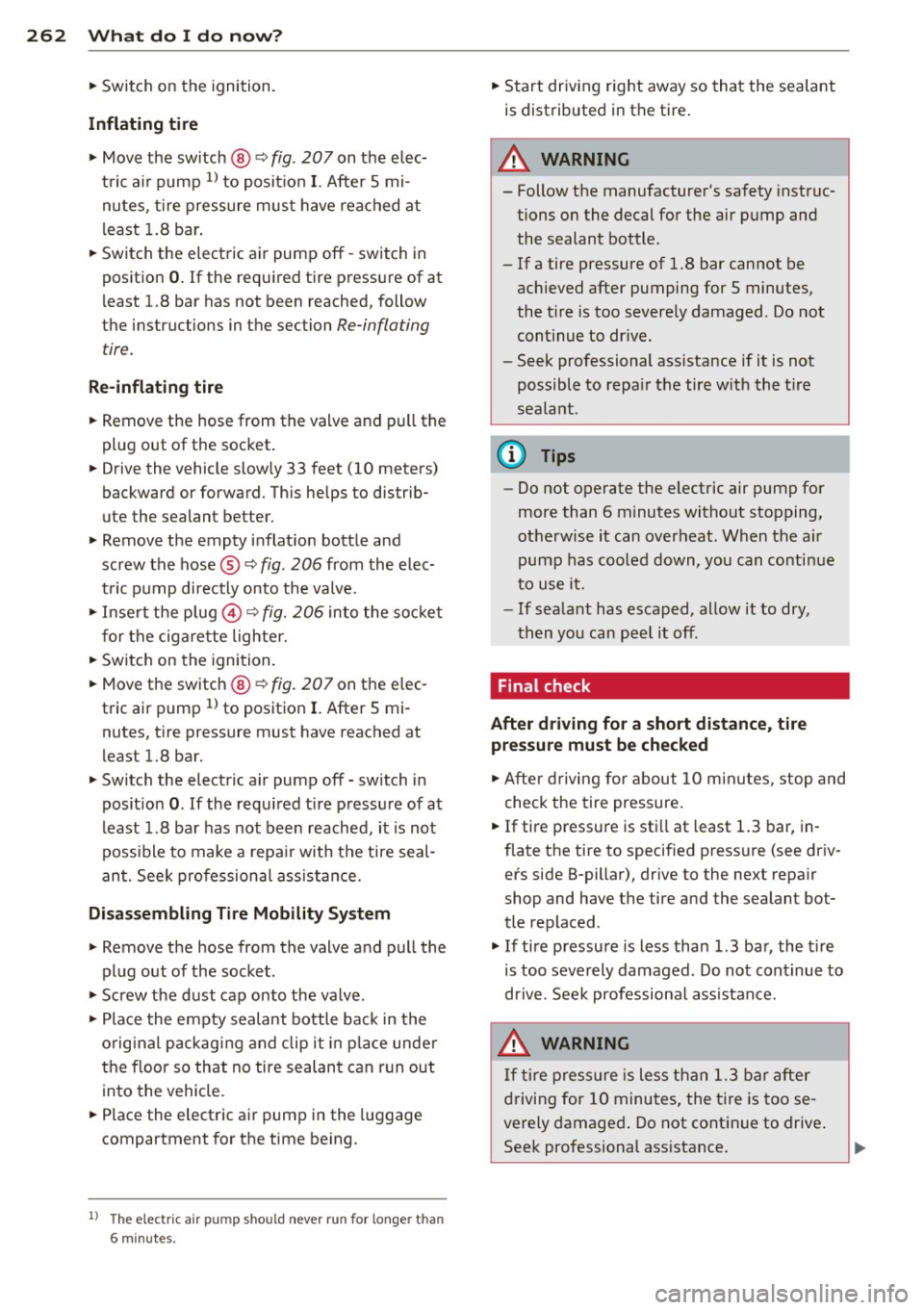
262 What do I do now?
• Switch on the ignition.
Inflating tire
• Move the switch @~ fig. 207 on the elec
tric a ir pump
ll to posit ion I. After 5 mi
nutes, tir e pressure must have reached at
least 1.8 bar.
• Switch the electric air pump off -switch in
position
0. If the required tire pressure of at
l east 1.8 bar has not been reached, follow
the instructions in the section
Re-inflating
tire.
Re-inflating tire
• Remove the hose from the valve and pull the
plug out of the socket.
• Drive the vehicle slow ly 33 feet (10 meters)
backward or forward. This helps to distrib
ute the sealant better.
• Remove the empty inflation bottle and
screw the hose®~
fig. 206 from the elec
t ric pump directly onto the va lve.
• Insert the plug@~
fig. 206 into the socket
for the cigarette lighter.
• Switch on the ignition.
• Move the switch @~
fig. 207 on the e lec
tric air pump
ll to position I. After 5 mi
nutes, tire pressure must have reached at
least 1.8 bar.
• Switch the electric air pump off -switch in
pos it ion
0 . If the requ ired tire pressure of at
least 1.8 bar has not been reached, it is not
poss ible to make a repa ir with the tire seal
ant. Seek professional assistance.
Disassembling Tire Mobility System
• Remove the hose from the valve and pull the
plug out of the socket.
• Screw the dust cap onto the valve .
• Place the empty sealant bottle back in the
original packaging and clip it in place under
the floor so that no tire sealant can run out
into the vehicle.
• Place the electric air pump in the luggage
compartment for the time being.
1l The electr ic air p ump sho uld never ru n fo r long er than
6 minut es.
• Start driving right away so that the sealant
is distributed in the tire .
A WARNING
=
- Follow the manufacturer 's safety instruc-
tions on the decal for the air pump and
the sealant bottle.
- If a tire pressure of 1.8 bar cannot be
achieved after pumping for 5 minutes,
the t ire is too severely damaged. Do not
continue to dr ive .
- Seek professional ass istance if it is not
possible to repa ir the tire w ith the tir e
sealant.
(D Tips
- Do not operate the electric air pump for
more than 6 minutes without stopping,
otherwise it can overheat . When the air
pump has cooled down, you can continue
to use it.
- If sealant has escaped, allow it to dry,
then you can pee l it off.
Final check
After driving for a short distance, tire pressure must be checked
• After driving for about 10 min utes, stop and
check the tire pressure.
• If tire pressure is sti ll at least 1.3 bar, in
flate the tire to specif ied pressure (see driv
er's side B-pillar), drive to the next repair
shop and have the tire and the sealant bot
tle replaced .
• If tire pressure is less than 1.3 bar, the tire
is too severely damaged . Do not continue to
drive. Seek professional assistance.
A WARNING
If tire pressure is less than 1.3 bar after
driving for 10 minutes, the tire is too se
verely damaged. Do not continue to drive.
Seek professional ass istance .
-
Page 274 of 302
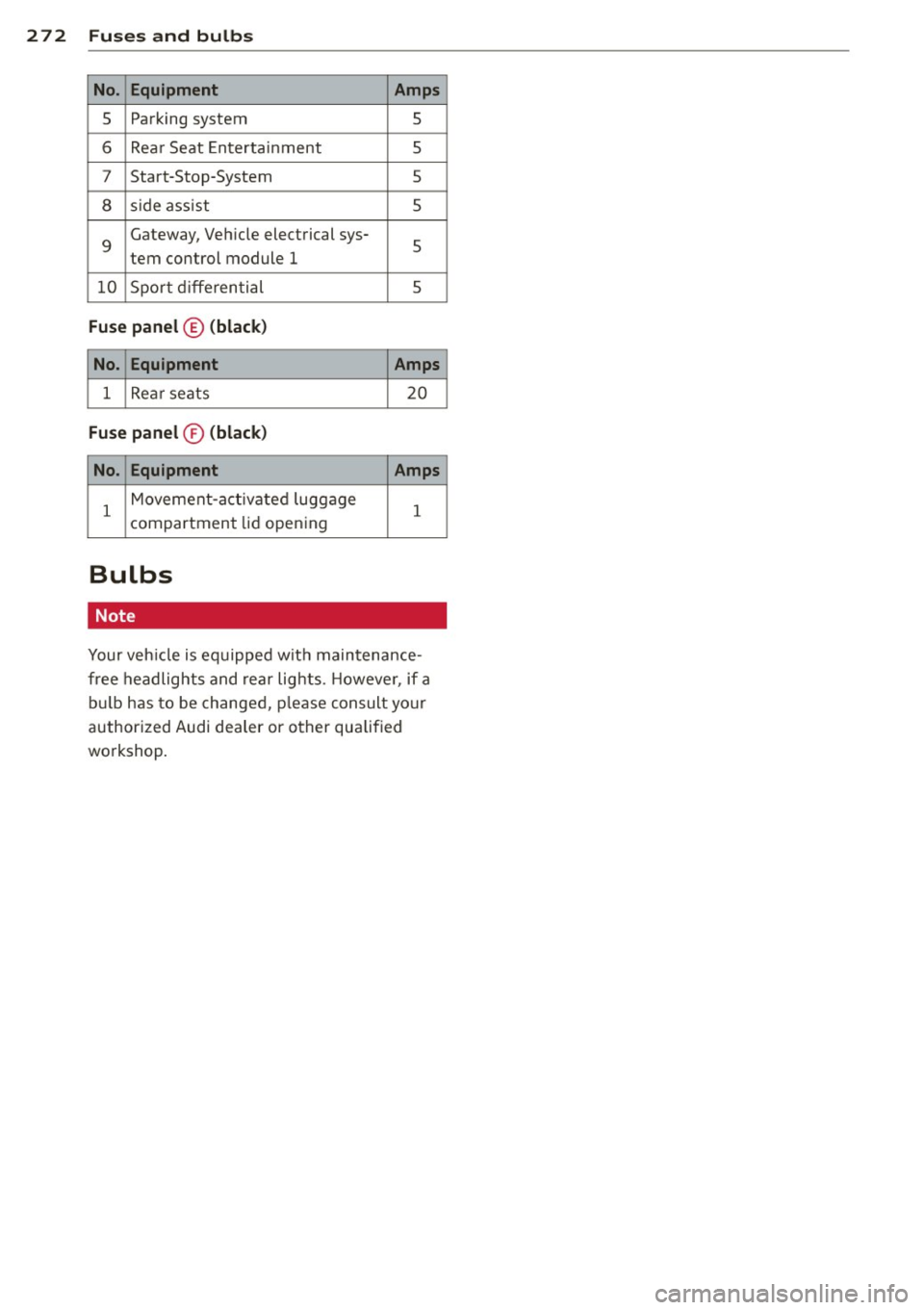
272 Fuses and bulbs
No. Equipment Amps
s Parking system s
6 Rear Seat Entertainment s
7 Start-Stop-System s
8 side assist s
9
Gateway, Vehicle electrical sys-
s tern control module 1
10 Sport differential s
Fuse panel © (black)
No. Equipment Amps
1 Rear seats 20
Fuse panel ® (black)
No. Equipment Amps
1 Movement-activated luggage 1
compartment lid opening
Bulbs
Note
Your vehicle is equipped with maintenance
free headlights and rear lights. However, if a
bulb has to be changed, please consult your
authorized Audi dealer or other qualified
workshop.
Page 290 of 302
288 Index
Child restra int system anchors ....... . 179
Ch ild safety .. ................ ... ... 165
Conve rtible locking retracto r .. .. .... . 176
Important safety instructions for u sing
chi ld safety seats ..................
169
Important things to know when driving
with children .... ....... ... .. .... .
165
Tether anchors . . . . . . . . . . . . . . . . . . . . 182
Tether straps . . . . . . . . . . . . . . . . . . . . . 182
Ch ild safety lock
Rear doors ............... ... .... .. 40
Ch ild safety seats ............... ....
17 1
Booster seats . . . . . . . . . . . . . . . . . . . . . 17 4
Conve rtible child seats ............. 172
Convertible locking retractor .. .. .... . 176
How do I properly install a child safety
seat in my vehicle? ......... ... .... .
169
Infant seats .............. ... .... . 171
Installing .... ............. ...... . 176
Installing a child restraint using the
LATCH system .... ..... .... ... ... ..
181
LATCH system ................. .... 181
Lower anchorages ................. 180
Mount ing and releasing the ancho rage
hook .. .. .. ... .......... ...... .. .
181
Safety instructions ............ .... . 169
Unused safety belts on the rear seat .. 171
C igarette lighter . . . . . . . . . . . . . . . . . . . . . 59
C leaning .. ................. .. .... . 201
C limate control (four-zone)
Operation . . . . . . . . . . . . . . . . . . . . . . . . .
70
Clock .. .... ................... ... .. 26
C losing
Rear lid .. ............... ........ ..
37
Sliding/tilting sunroof ....... .. .. .. . . 41
Cold ti re inflation pressure .... ... .... . 233
Com ing home ... .... ...... .. .. .. .. ..
46
Compartments ............ .. .. .. .. .. 60
Compl iance ........................ 285
Consumer Information . . . . . . . . . . 128, 282
Consumption (fue l) ..... ... .. .. .... .. 24
Contact ing NH TSA .................. 128
Controls
Cleaning . .. ..................... . 203 Convenience key
... ... ....... ... ... .. 35
Starting the engine ............ .. .. .
74
Stopping the eng ine (START ENGINE
STOP button) ......................
75
Switching the ignition on ............ 74
Unlocking and locking vehicle ....... .. 35
Convertib le child safety seats . . . . . . . . .
172
Convertib le locking retractor
A ctivating . .... .. ............. ....
178
Deact ivat ing . ................. .. .. 178
Using to secure a child sa fety seat l.76, 178
Coolant
refer to Eng ine coolant ............. 217
Cooling mode (automat ic climate control) 70
Cruise cont ro l
Changing speed .. ... .. ..... ... .. .. . 80
Presetting your speed .. ..... ... .. .. . 80
Switching off ...................... 80
Switching on . . . . . . . . . . . . . . . . . . . . . . .
79
Warning/ind icator lights ............ . 22
(upholder .. .... .. .. ... ..... ... .. .. . 60
Curve light ........ .. .............. .. 96
Cylinder management
refer to Cylinder on demand System .. . 24
Cylinder on demand System . . . . . . . . . . .
24
D
Data recorde r ... .. ............. .... 186
Date d isp lay .. ...... .............. .. 26
Daytime running lights . .. ..... ... .. .. . 44
Declarat ion of compliance
Adaptive cruise control .............
285
Audi side ass ist .. ............. .. .. 285
Cell phone package . . . . . . . . . . . . . . . . 285
Convenience key . ... ... ......... ... 285
E lectronic immobilizer ... .... ... .. .. 285
Garage door opener (Homelink) ...... 285
Remote control key . . . . . . . . . . . . . . . . 285
Tire pressure monitoring system ..... 285
Decorative parts/trim
Cleaning . ..... .. ... .. ..... ... .. .. 203
D EF
What does this mean when it appears in
the tr ip odometer display? ...........
25
Defective light bulb warni ng ......... .. 21
Page 291 of 302
M N
0:: <.J 'SI: ,...., \!) 1.1'1 ,...., 1.1'1 ,....,
Defrosting (windows)
automatic climate control . ... .. .. .. ..
71
Determi ning cor rect load limit . .. .. .. . 242
Dimensions .. .. ........... .. .. .. ... 280
D imming the rearview mirro r .. .. .. .. .. 5 1
Displays
Clean ing . ..... ........... ... ... ..
203
Distance . . . . . . . . . . . . . . . . . . . . . . . . . . . 24
D oor/ rear lid warning . . . . . . . . . . . . . . . . . 22
Doors
Powe r ch ild safety lock ......... .... .
40
Driver information system
Boost . ... . .... ............. .. .. ..
28
CD/radio display . . . . . . . . . . . . . . . . . . . . 22
Door/rear lid warning . . . . . . . . . . . . . . . 22
E ng ine oil temperatu re d isplay .. ... ... 28
E xterio r tempe ratu re d isp lay . .. .. .. .. 22
On-boa rd compute r . . . . . . . . . . . . . . . . . 24
Shifting indicator . . . . . . . . . . . . . . . . . . . 28
Driver seating position . . . . . . . . . . . . . . . 121
drive select .. .... .. .... ... .. .. .. .... 96
adapt ive a ir s uspension/sport . .. .. .. .. 96
Adapt ive dampers . . . . . . . . . . . . . . . . . . 96
Curve light . . . . . . . . . . . . . . . . . . . . . . . . 96
Eng ine sound ............... ... ... .
96
Safety belt tensioner . . . . . . . . . . . . . . . . 96
Sport different ial . . . . . . . . . . . . . . . . . . . 96
Driving safe ly . . . . . . . . . . . . . . . . . . . . . . 120
D riving thro ugh w ater ...... .. .. .. .. . 19 7
Driving time . . . . . . . . . . . . . . . . . . . . . . . . 24
Dup licate key . . . . . . . . . . . . . . . . . . . . . . . 3 1
D ust filter
refer to Po llutant filte r . . . . . . . . . . . . . . 69
Dynamic steering ............. .... .. 192
E
Easy entry feature . . . . . . . . . . . . . . . . . . . . 7 4
E fficiency program
F ue l economy messages . . . . . . . . . . . . .
25
Other equipment . . . . . . . . . . . . . . . . . . . 25
E lect rical accessories (sockets) . . . . . . . . . 60
Elect romechanical parking brake
Eme rgency braking . . . . . . . . . . . . . . . . . 78
Opera tion . . . . . . . . . . . . . . . . . . . . . . . . . 77
P ark ing .. ... ......... .... ... ... ... 77
Releasing and clos ing ..... .. .. .. .. .. 77
Inde x 289
Starting ass ist . . . . . . . . . . . . . . . . . . . . . 78
Starting from rest . . . . . . . . . . . . . . . . . . 78
Warning/ind icator lights ..... ... .. .. .
15
El ec tromechani ca l powe r ass ist .... .. .. 192
E lectronic differential lock
Warning/ind icator lights . .......... ..
18
Electronic differential lock (EDL) ... .. .. 187
Warning/ind icator lights .......... .. . 18
El ectronic immob ilizer . . . . . . . . . . . . 25, 32
E lectronic power contro l (E PC)
warning/ind icator light ... .. ... ... .. .
19
Electronic Stabilization Cont ro l (ESC) . . . 187
Warning/ind icator lights ........ .. .. . 18
Emergency ac tuatio n
Doors . ... .. .... .. . .. .. ..... ... .. .
37
Power sunroof ..... . .. ..... ... .. .. . 42
Rea r lid ... .. .... ... .. .. ..... ... .. . 39
Emergency b ra ki ng . .. .. ......... .. .. . 78
Emergency flasher . ............. .. .. .
45
Warning/ind icator lights ........... .. 22
Emergency re lease
Se lector lever .. .. .................
108
E mergency s tar ting .... ......... .. .. 2 73
Emergency towing . .. .. .. ...... .... . 275
Emergency wa rn ing triangle ... ... .. .. 259
E nergy ma nagement . .... .... ... .. .. 193
Engine
Compartment .. .. .................
213
Coolant ......... .. ............... 217
starting . . . . . . . . . . . . . . . . . . . . . . . . . . . 7 4
Starting with jumpe r cables ..... .. ..
273
Stoppi ng .. .... .. .................. 75
Engine compartment ................ 213
Closing the hood ................. . 212
Opening the hood .. . .. .. .. ... ... .. 211
Safety i nstr uctions .. .............. . 211
Working in the eng ine compartmen t .. 2 11
Engine coolant .. .. ................. 217
Adding coo lant ... .. .. .. ...... .... . 218
Checking the engine coo lant level . .. .. 217
Expans ion tank .... ............... . 217
Malfunction sy mbol ............ .. .. . 15
Radi ator f an . .. .... ... .......... .. 2 19
Temperat ure gauge ... ...... ... .. .. . 10
Engine o il ..... ... .. ..... .......... 213
Adding ......... .. ..... .......... 215
Additives .. .. .. .. .. .. ........... .. 2 15
•
•
Page 297 of 302
M N
0:: <.J 'SI: ,...., \!) 1.1'1 ,...., 1.1'1 ,....,
Seat belts WhyYOU MUSTwearthem 130
Seat covers Cleaning . .. ............. .. .. .. ... 204
Seat heat ing/vent ilation (automatic cli-
mate control) . . . . . . . . . . . . . . . . . . . . . . . 71
Seating position Driver ... .. ................. .. ... 121
Front passenger .......... .... .. .. . 122
H ow to adjust the front seats . . . . . . . . 122
Incorrect seat position . . . . . . . . . . . . . . 124
Occupants .................. .... .. 12 1
Rear passe ngers . . . . . . . . . . . . . . . . . . . 123
Seat memory .. ........... .. .. .. .... 57
Sea ts
Comfo rt seat side view . . . . . . . . . . . . . . 58
Seat symmetry . . . . . . . . . . . . . . . . . . . . . 58
Seats (number) ............ .... .. ... 130
Select ive unlock feature ..... .. .. .. .. .. 34
Selector lever . ... .. .... ... .. .. .. ... 103
Selector leve r eme rgency r elease . ..... 108
Service and disposal Safety belt pretens ioner ... .. .. .. .. . 137
Service interval disp lay . . . . . . . . . . . . . . . . 26
Shift ing indicato r ........... ... ... ... 28
Shift paddles . . . . . . . . . . . . . . . . . . . . . . . 107
Ship (t ransporti ng your ve hicle) . .. .. .. . 277
Shutting down vehicle ...... .. .. .. .. . 198
Side airbags Description ... .... .... ... .. .. .. ... 158
How they work . . . . . . . . . . . . . . . . . . . . 160
side assist . . . . . . . . . . . . . . . . . . . . . . . . . . 93
Ad justing the brigh tness ... .. .. .. .. .. 95
Sensor range ... ...... ... .. .. .. .... 93
Side assist Activating and deactivating . .. .. .. .. .. 95
C le a ning t he sensors ...... .. .. .. .. . 20 2
Side curta in airbags .. .... .. .. .. .. .. . 161
Descr ipt ion . ................ ... ... 161
H ow they wo rk ............ ... ... .. 163
Safety instructions . . . . . . . . . . . . . . . . . 163
Side marker lights ......... .. .. .. .. .. 44
Ski sack ..... .. ... .. ..... ... .. .. .... 67
also refer to Trunk pass-t hrough .. .. .. 68
Inde x 295
Sliding/tilting s unroo f
Emergency closing . .. ... .... ... .. .. . 42
Open ing and closing . .. ..... ... .. .. . 41
Snow cha ins .. .. .. .... ........... .. 253
Socket . .. .. .. .. .. .. . ... ...... ... .. . 60
Sources of information abo ut child re-
straints and their use .. ... .... ... .. .. 183
Speedometer . .. .. ................. . 25
Speed rat ing letter code .............. 248
Speed warning system . . . . . . . . . . . . . . . . 78
Sport d iffe rential .................. .. 96
Ind icator light . .. .... ........... .. . 21
START ENGINE STOP button ...... .. .. . 74
Star ting from res t ..... .. ..... ... .. .. . 78
Start ing the engine .. . .. .. .. ... ... .. . 74
Steering Electr ically adjustable steering wheel . . 73
Manually adjustable steering wheel . .. . 73
also refer to Electromechanical power as-
s ist . ... .. .. .. .. .. . .. .... .... .... 192
Steering wheel Easy entry feature . . . . . . . . . . . . . . . . . . 7 4
Ind icator lig ht . .. ............. 17,192
Steering wheel heat ing ........ .... .. 72
Steering wheel col umn
Adjusting electrically . ... .... ... .. .. . 73
Adjusting man ua lly . . . . . . . . . . . . . . . . . 73
Stee ring w heel w ith tiptronic ...... .. .. 107
Steps for determin ing correct load limit . 242
Stopping the engine . .. .. ..... ... .. .. . 75
Storage . . . . . . . . . . . . . . . . . . . . . . . . 60 , 64
Su nroof .. .. .. .. .. .. ............... . 41
Sun shade . ... .... .. . .. .. ..... ... .. . 48
Su n visors .. .. .. .. .. . .. .... .... .. .. . 48
Symbols
refer to Warn ing/ indicator lights . .. .. . 11
T
Tachometer . . . . . . . . . . . . . . . . . . . . . 1 1, 22
T ail lights
Cleaning .... .. ...... ........... .. 202
Technical data ... .. .. . .. .... .... .. .. 279
Technical modifications .. ..... ... .. .. 284
T emperatu re display ............. .. .. . 22
•
•