check engine AUDI RS7 SPORTBACK 2015 Owner's Manual
[x] Cancel search | Manufacturer: AUDI, Model Year: 2015, Model line: RS7 SPORTBACK, Model: AUDI RS7 SPORTBACK 2015Pages: 302, PDF Size: 74.76 MB
Page 220 of 302
218 Check ing and filling
fig . 188. With a cold engine, the coo lant
l evel should be between the "min" and
"max" markings . When the engine is warm ,
the leve l may be slightly above the "max"
mark ing .
The location of the coolant expansion tank
can be seen in the engine compartment illus
tration
9 page 213.
To obtain an accurate reading, the engine
must be switched off .
The expans ion tank in you r vehicle is equipped
with an e lectric coolant level sensor.
When the coolant level is too low, the warning l ight in the Auto-Check System
9 page 15 w ill
illum inate unti l you add coolant and the level
has been restored to normal. Even though
there is an electric coolant level senso r, we
still recommend you check the coolant leve l
from time to time .
Coolant loss
Coolant loss may indicate a le ak in the cooling
system . In the event of coolant loss, the cool
ing system should be inspected immediately
by your authorized Audi dealer. It is not
enough merely to add coolant.
I n a
s ealed system, losses can occur only if
the boiling point of the coolant is exceeded as
a result of overheating.
A WARNING
The cooling system is under pressure and can get very hot. Reduce the risk of scald
ing from hot coolant by followi ng these
steps .
- Turn off the engine and allow it to coo l
down.
- Protect your face, hands and arms from
escaping fluid and steam by covering the
cap with a large, thick rag .
- Turn the cap slowly and very carefu lly in
a counter-clockwise direction w hile ap
plying light, downward pressure on the
top of the cap . -
To avoid being burned, do not spi ll anti
freeze or coolant on the exha ust system
or hot engine parts. Under certain cond i
tions, the ethylene glycol in engine coo l
a nt can catch fire.
(D Note
Do not add any type of radiator leak sea l
ant to your veh icle's engine coolant. Add
i ng radiator repair fluid may adverse ly af
fect the funct ion and pe rformance of you r
cooling system and could result in damage
not cove red by your New Veh icle Limited
War ran ty.
Adding coolant
Be very careful when adding engine coolant.
Befo re you check anyth ing in the eng ine com
partment,
always read and he ed all WARN
INGS ¢ ..&. in Working in the engine compart
ment on page
211.
" Requirement: There must be a residua l
amo unt of coolant in the expansion ta nk
¢ (D .
"Tu rn off the engi ne.
" Le t the eng ine cool down.
" Place a thick rag over the coolant expansion
t ank
9 page 217, fig. 191 and ca refully
twist the cap counter-clockwise ¢&,, .
" Add coolant m ixed in the correct rat io
¢
page 217, Coolant up to the MAX mark
ing.
" Make sure that the flu id leve l remains sta -
ble . Add more coo la nt if necessary .
" Twist the cap o n again
tightly .
Replacement engine coo lant must conform to
exact spec ificat ions ¢
page 217, Coolant.
We recommend using only coolant add i-
tive
Gl2++, Gl3 or in an emergency Gl2 +. Do
not use a d ifferent addit ive . In an emergency
use p la in water until you can get the correct
additive and can resto re the co rrect rat io . This
shou ld be done as soon as possib le. .,..
Page 221 of 302
M N
0:: <.J 'SI: ,...., \!) 1.1'1 ,...., 1.1'1 ,....,
If you have lost a consi derable amount of
coolant, then you should add co ld antifreeze
and cold water only when the engine is co ld .
Always use
new engine coolant when refi lling.
D o not fi ll coolant above the "MAX " mark . Ex
cess coolant will be forced out th rough the
p ress ure rel ief valve in the cap when the en
g ine becomes hot .
A WARNING ,_________
-The cooling system is under press ure and
can get very hot . Reduce the risk of
sca ld ing from hot coo lant by following
these steps.
- Tur n
off the eng ine and a llow itto cool
down.
- Protect your face, hands and arms from
escap ing f lu id a nd steam by cover ing
the cap wi th a la rge, thick rag.
- Turn the cap slow ly and very ca refully
in a cou nte r-clockw ise d irect ion while
a pply ing ligh t, downw ard p ress ure on
the to p of the cap.
- To avo id being burned, do no t sp ill an
tifreeze or coolan t on t he exhaust sys
tem or ho t engine parts . U nder certa in
conditions, the ethylene glyco l in en
gine coolant can catc h fire .
- Antifreeze is poisonous . Always store an
tifreeze in its original container and we ll
o ut o f the reach of children.
- If you drain the coolant , it must be
caught and safely stored in a proper con
tainer clearly marked "poison".
@ Note
- Do not add coolant if the expansion tank
i s empty . Ai r could enter the cooling sys
tem and damage the engine. If this is
the case, do not continue driving. Seek professional assistance.
- Coolant po llutes the env ironment and
could cause a n engine fire. Excess coo l
ant wi ll be forced out through the pres
sure re lief valve in the cap when the en
gine becomes hot.
Checkin g and fillin g 219
-If, in an emergency, on ly wate r can be
added, the correct ratio between water
and antifreeze ¢
page 217 must be re
stored as soon as possible.
@) For the sake of the environment
Drained coolant sho uld not be reused. A l
ways d ispose of used coolant while observ
i ng a ll environmental regulations.
, Radiator fan
The radiator fan switches on automatically by
itself .
An auxiliary electric radiato r fan switches on
and
off depending on coolant temperature
and othe r vehicle ope rat ing cond it ions.
After yo u switch the eng ine o ff, the aux iliary
f an can continue running for up to 10 m inutes
- even with the ignition off. It can even switch
on aga in later by itself¢ .&. , if
- the temperatu re of the engine coo lant rises
du e to the h eat build -up from th e engin e in
the engine compa rtment, or
- the engine compa rtment heats up because
the vehicle is parked in intense sunlig ht.
A WARNING ~
- To reduce the risk of persona l inju ry nev-
er touch the radiator fan .
- The a uxiliary electric fan is tempe rat ure
contro lled and can switch on suddenly
even when the engine is not running.
- The a uxiliary radiator fan sw itches on a u
tomatically when the engine coo lant
reaches a certai n temperature and will
continue to ru n until the coo lant temper
ature drops. •
•
Page 222 of 302
220 Checking and filling
Brake fluid
Checking brake fluid level
Fig . 192 Engine compar tment: cove r on the brake fl uid
reservo ir
Before you check anything in the engine com
partment,
always read and heed all WARN
INGS ¢&. in Working in the engine compart
ment on page 211.
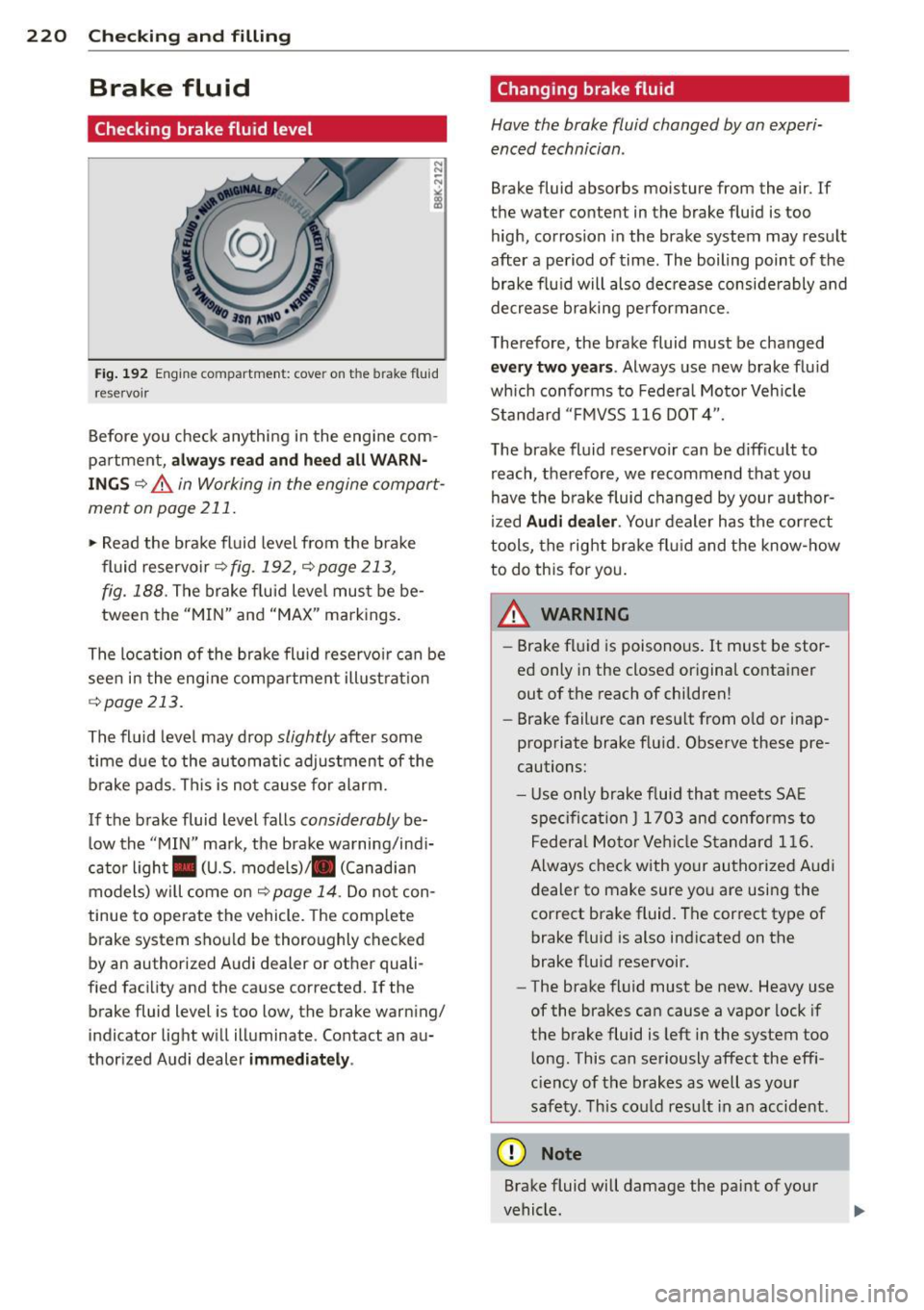
,.. Read the brake fluid level from the brake
fluid reservoir¢
fig . 192, ¢ page 213,
fig. 188 .
The brake fluid level must be be
tween the "MIN" and "MAX" markings.
The location of the brake flu id reservoir can be
seen in the engine compartment illust rat ion
¢ page 213.
The fluid level may drop slightly after some
time due to the automatic adjustment of the
brake pads. This is not cause for alarm.
If the brake fluid level falls
considerably be
low the "MIN" mark, the brake warning/indi
cator light . (U.S. models)/ . (Canadian
models) will come on ¢
page 14. Do not con
tinue to operate the vehicle. The comp lete
brake system shou ld be thoroughly checked
by an authorized A udi dealer or other quali
fied facility and the cause corrected.
If the
brake fluid level is too low, the brake warning/
indic ator light will illuminate. Contact an au
thorized Audi dealer
immediately .
Changing brake fluid
Have the brake fluid changed by an experi
enced technician .
Brake fluid absorbs moisture from the air. If
t he water content in the brake fluid is too
high, corrosion in the brake system may result
after a period of time . The boiling point of the
brake flu id will also decrease conside rably and
decrease braking pe rformance.
Therefore, the brake fluid must be changed
every two years . Always use new brake flu id
which conforms to Federal Motor Vehicle
Standard "FMVSS 116 DOT 4".
The brake fluid reservoir can be difficult to
reach, therefore, we recommend that you
have the brake fluid changed by your author
ized
Audi dealer. Your dealer has the correct
tools, the right brake fluid and the know-how
to do this for you.
A WARNING
- Brake fluid is poisonous . It must be stor
ed only in the closed original container
out of the reach of children!
- Brake failure can resu lt from o ld or inap
propriate brake fluid. Observe these pre
cautions:
- Use only brake fluid that meets SA E
specification
J 1703 and conforms to
Federal Motor Vehicle Standard 116.
Always check with your authorized Audi
dealer to make sure you are using the
correct brake fluid. The correct type of
brake f luid is also indicated on the
brake fluid reservoir.
- The brake fluid must be new. Heavy use
of the brakes can cause a vapor lock if
the brake fluid is left in the system too
long . This can seriously affect the effi
c ie ncy of the brakes as well as your
safety. This could resu lt in an accident.
(D Note
Brake fluid will damage the paint of your
vehicle .
Page 224 of 302
222 Check ing and filling
&
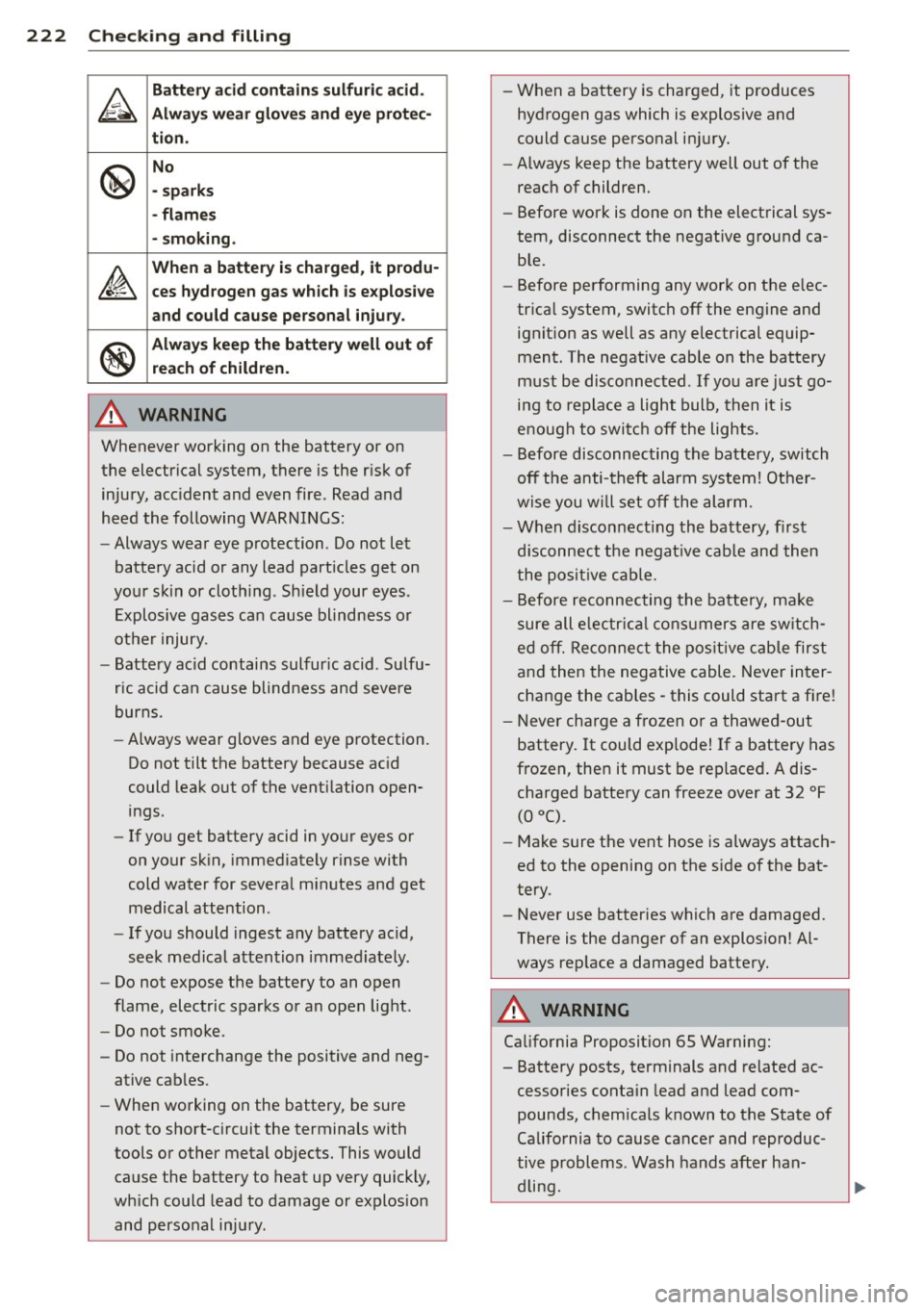
Batt ery aci d c ont ain s s ulfuric acid .
A lw ay s w ear gloves and eye protec-
ti on.
@
No
- spark s
- flame s
· sm okin g.
A
When a b atte ry is ch arged , it p rodu -
ce s hydr oge n ga s wh ich i s ex plosi ve
.
and co uld cause pe rsonal injur y.
®
Alway s keep the batt ery well out of
re ach of children.
A WARNING
Whenever working on the battery or on
the electrical system, there is the r isk of
injury, acc ident and even fire. Read and
heed the following WARNINGS:
- Always wear eye protection. Do not let
battery acid or any lead part icles get on
your sk in or cloth ing . Sh ield your eyes .
Explosive gases can cause blindness or
other injury.
- Battery acid contai ns sulfur ic acid. Sulfu
ric acid can cause blindness and severe
burns.
- Always wear gloves and eye protection.
Do not tilt the battery because ac id
could leak out of the vent ilation open
ings.
- If you get battery acid in your eyes or
on your sk in, immediately rinse with
cold water for severa l m inutes and get
medical attention .
- If you should ingest any battery acid,
seek medical attention immediately .
- Do not expose the battery to an open
flame, electric sparks or an open light.
- Do not smoke.
- Do not interchange the positive and neg-
ative cab les.
- When working on the battery, be sure
not to short-circuit the terminals with
tools or other metal objects. This would
cause the battery to heat up very quickly,
wh ich could lead to damage or explosion
and personal injury. -
When a battery is charged, it produces
hydrogen gas which is explosive and
could cause personal injury.
- Always keep the battery well out of the
reach of children.
- Before work is done on the electrical sys
tem, disconnect the negat ive ground ca
ble.
- Before performing any work on the e lec
trica l system, switch off the engine and
ignit ion as well as any electrical equip
ment. The negative cable on the battery
must be disconnected .
If you are just go
ing to replace a light bulb, then it is
e nough to swi tc h off the lights.
- Before disconnecting the battery, switch
off the anti-theft alarm system! Other
wise you wi ll set off the alarm.
- When disconnecting the battery, f irst
d isconnect the negat ive cab le and then
the posit ive c ab le.
- Before reconnecting the batte ry, ma ke
sure all e lectr ica l consumers are sw itch
ed off . Re connect the pos it ive cable first
and then the negative cable. Never inter
change the cables - this could start a fire!
- Never charge a frozen or a thawed-out
battery. It could exp lode! If a battery has
frozen, then it must be replaced . A dis
charged battery can freeze over at 32
°F
(0 oc).
- Make sure the vent hose is always attach
ed to the opening on the s ide of the bat
tery.
- Never use batteries which are damaged.
There is the danger of an explosion! Al
ways rep lace a damaged battery.
A WARNING
Ca lifornia Proposition 65 Warning:
- Battery posts, terminals and related ac
cessories conta in lead and lead com
pounds, chemicals known to the State of
California to cause cancer and reproduc
tive problems . Wash hands after han-
dling.
~
Page 225 of 302
"' N
a:: I.J ""'. rl I.O
"' rl
"' rl
(D Note
- Do not disconnect the ve hicle battery
when the ignition is on or when the en
gine is running, otherwise, you will dam
age electronic components in the electri
ca l system .
- If your vehicle is going to stand for a
l ong period of time without being driven,
protect the battery from "freezing", oth
erwise it w ill be damaged and w ill then
have to be replaced .
- When opening the doors, the windows
l ower app rox imately 10 mm automati
cally. This f unction is not available when
t h e battery is disconnec ted, wh ic h
means there is a ris k t hat the door se al
or the w indow co uld be damaged .
Battery charging
Starting the engine requires a well charged bat tery.
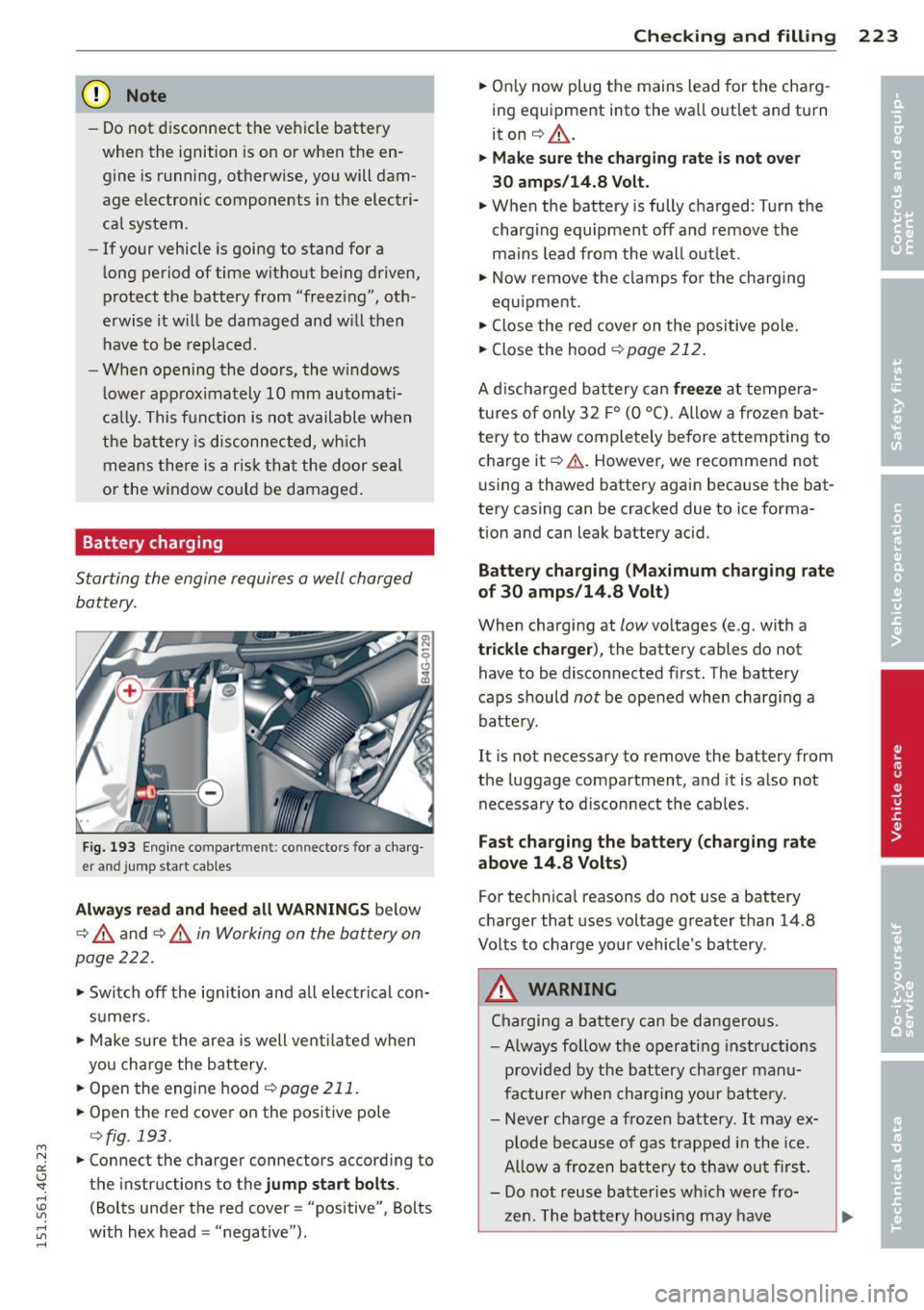
F ig. 1 93 En gine co mpartme nt: c onnectors for a charg
er a nd jum p sta rt cable s
Always read and heed all WARNINGS below
¢ .&. and
¢.&. in Working an the battery on
page 2 22.
"'Switch off the ignit ion and all electrica l con
s u mers .
"' Make sure the area is well vent ilated when
you charge the battery.
"' Open the engine hood
c::> page 211 .
"'Open the red cover o n the posit ive pole
<=> fig . 193.
"' Connect the charger connectors accord ing to
the instruc tions to the
jump start bolts .
(Bolts under the red cover = "positive", Bolts
with hex head = "nega tiv e").
Checkin g and fillin g 223
"'On ly now plug the mains lead for the cha rg
i ng eq uipment into the wa ll outlet and turn
it on
c::> ,&. .
"'Make sure the charging rate is not o ver
30 amps /14.8 Volt .
"'When the battery is fully c harged : Turn the
charg ing equipment off and remove the
mains lead from the wa ll out let .
"' Now remove the clamps fo r the cha rg ing
equ ipme nt.
"' Close the red cover on the positive pole .
"' Close the hood ¢
page 212 .
A d ischa rged batte ry can freeze at tempe ra
tures of only 3 2 F
0 (0 °C). Allow a fro zen bat
te ry to thaw completely before attemp ting to
c h arge it
c::> & . However, we recommend not
using a thawed battery again because the bat
tery casing can be cracked due to ice forma
tion and can leak battery ac id.
Battery charging (Maximum charging rate
of 30 amps /14.8 Volt )
When cha rging at
low vo ltages (e .g. with a
trickle charger), the batte ry cables do not
have to be disconnected f irst . The battery
caps should
not be ope ned when charg ing a
batte ry .
It is not necessary to remove the battery from
the luggage compartment, and it is a lso not
necessary to d iscon nect the cab les .
Fa st charging the battery (cha rging rate
above 14.8 Volts)
Fo r technical reasons do not use a battery
c h a rger that uses voltage g reater than 14 .8
Volts to charge yo ur vehicle's battery .
A WARNING
C harging a battery can be dangero us.
- Always follow t he ope rati ng inst ructions
provi ded by the battery cha rg er ma nu
f ac turer when chargi ng you r battery.
- N ever cha rge a fro zen batte ry.
It may ex
p lode because of gas trapped in the ice .
A llow a froz en ba tte ry to thaw out first.
- D o not r euse ba tte ries wh ich were fro
z en. The bat tery housi ng may
h ave
Page 226 of 302
224 Check ing and filling
cracked an d weake ned when the battery
froze.
- Charge the battery in a we ll ventilated
area. Keep away from open flame or elec
trical spark . Do not smoke. Hydrogen gas
generated by the battery is exp losive.
- To reduce the danger of explosion, never
connect or disconnect charger cables
wh ile the charger is operating .
- Fast charg ing a battery is dangerous and
should only be attempted by a compe
tent technician w ith the proper equip
ment .
- Battery acid that may spill d uring charg
ing should be washed off w it h a solution
of warm water and ba kin g soda to neu
t rali ze the acid.
~ Note
Never use a fast charger as a booster to
start the engine. This will seriously dam
age sensitive ele ct ronic components, such
as co ntrol units, relays, rad io, etc. , a s we ll
as th e batte ry charge r.
Battery replacement
The new battery must have the same specifi
cations and dimensions as the original equip
ment battery.
I ntell igent energy manag ement in your veh i
cle is respo nsible for d ist ribu ting the e lectr i
cal energy throughou t you r vehi cle
~ page 193. The inte lligen t energy m anage
ment system w ill keep the engine batte ry
charged better than vehicles w it h out t his sys
tem . T o make sure the additional e lectrical en
ergy is available once again after you have
changed t he battery, we recommend that you
install batteries of the same type and manu
facture only (the same as those ins talled at
the t ime your vehicle was delivered). Specifi
cations a re listed o n the battery hous ing. You r
author ized de aler m ust code the b attery in
the ene rgy management system to enable yo u
to use the energy managemen t fu nctions co r
rectly after replac ing the battery. T
he new battery must have the same capacity,
vo ltage ( 12-volts) , amperage , construction
and plug sea ling .
When ins tall ing t he battery, make su re the ig
nition and a ll elect rical consume rs are switch
ed off .
(D Note
M ake sure the ven tilat ion hose on the side
of the ba ttery is connecte d, otherwise
fumes or batte ry acid can lea k out .
@ For the sake of the environment
B ecause o f the p rob lem of p roper disposal
of a battery, we recommen d your author
i zed Audi dea ler chan ge the battery for
you . Batteries contain sul fur ic acid and
l ead and must a lways be disposed of p rop
e rly in compliance with all environmental
regulations . Disposing of vehicle batter ies
i mprope rly is very dange rous to th e envi
r o nment.
Windshield/headlight*
washer container
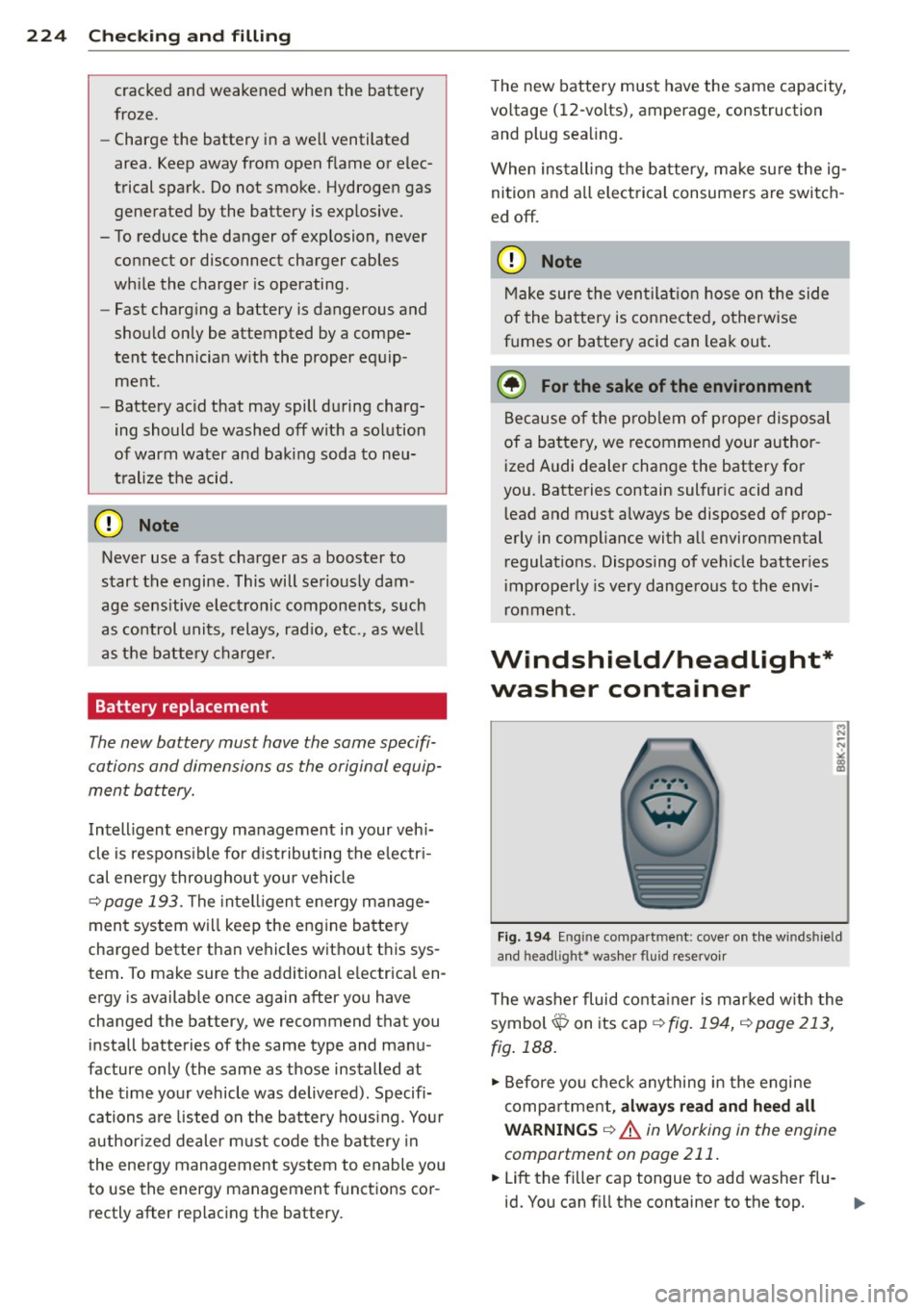
Fi g. 19 4 En gin e co mpa rt m en t: cove r on t he w inds hield
a n d head ligh t* was her fl ui d reservo ir
T he washer fluid co ntai ner is mar ked w it h t he
symbol$ on its cap
~ fig. 194, ~page 213,
fig . 188.
.,. Before you chec k any thing in the engine
comp artment,
always read and heed all
WARNINGS ~ A in Working in the engine
compartment on page 211 .
.,. Lift the fi ller cap tongue to add washer flu -
id. You can f ill the container to the top. ..,.
Page 227 of 302
M N
0:: <.J 'SI: ,...., \!) 1.1'1 ,...., 1.1'1 ,....,
~ Press the cap back onto the filler neck after
filling the container .
You can find the reservoir
c ap acity in the tab le
in
c::> page 280.
C lean water should be used when filling up. If
possible, use soft water to prevent scal ing on
washer jets. A lways add a glass cleane r solu
tion (with frost protection in the winter) .
(D Note
Do not mix engine coolant antifreeze or
any other add itives to fi ll up the wind
shie ld washer reservoir.
Checkin g and fillin g 225
•
•
Page 271 of 302
"' N
a:: I.J "". rl I.O
Fuses and bulbs
Fuses
Replacing fuses
Fuses that have blown will have metal strips
that have burned through.
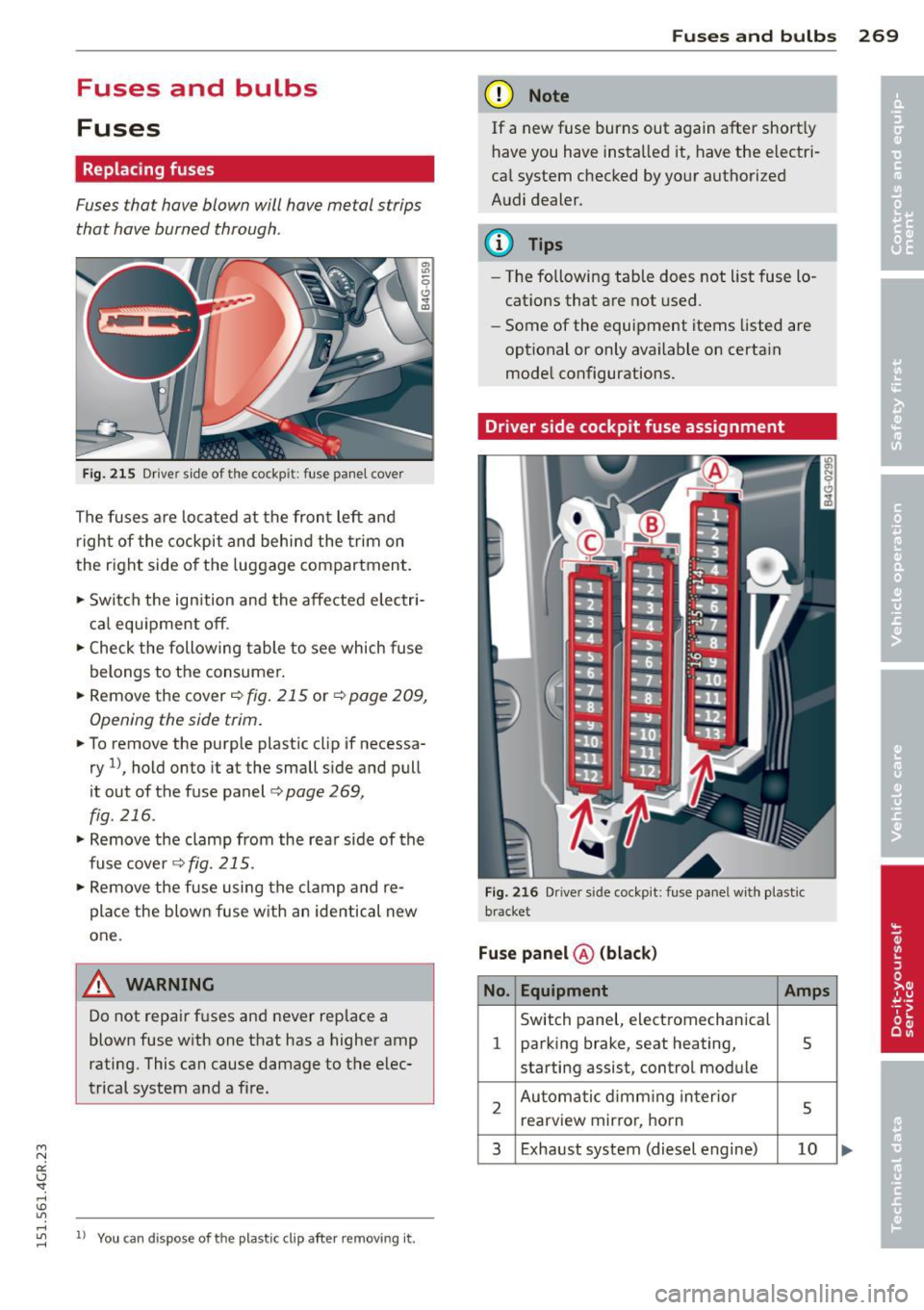
Fig. 215 Dr iver side of the cockp it: fuse panel cover
The fuses are located at the front left and
r igh t of the cockpit and behi nd the trim on
the right side of the luggage compartment .
.. Switch the ign ition and the affected electr i
ca l equipment off .
.. Check the following table to see which fuse
belongs to the consume r .
.. Remove the cover
r:!;> fig. 215 or r:!;> page 209,
Opening the side trim .
.. To remove the purple plastic clip if necessa
ry
ll, hold onto it at the small side and pull
it out of the fuse panel
r:!;> page 269,
fig. 216 .
.. Remove the clamp from the rea r side of the
fuse cover ¢
fig. 215 .
.. Remove the fuse using the clamp and re
pla ce the blown fuse w ith an identical new
one.
& WARNING , -
Do not repair fuses and never replace a
blown fuse w ith one that has a higher amp
rating. This can cause damage to the elec
trical system and a fire.
"' rl
~ 11 You can dis pose of the plastic clip after remov ing it.
Fu se s and bulb s 269
(D Note
If a new fuse burns out again after short ly
have you have insta lled it, have the electri
ca l system checked by your authorized
A udi dealer .
{!) Tips
-The following table does not list fuse lo
cat ions that are not used .
- Some of the equipment items listed are
opt ional or only available on certa in
mode l configurations.
Driver side cockpit fuse assignment
Fi g. 216 Dr iver side cockpit : fuse pa nel w ith plastic
bracket
Fuse panel @ (blac k)
No . Equipment Amps
Switch panel, electromechanica l
1 parking brake, seat heating, 5
starting assist, control module
2 Au tomatic d imm ing in terior
5 rearview mir ror, horn
3 Exhaust system (diesel engine) 10
Page 277 of 302
"' N
a:: I.J "". rl I.O
"' rl
"' rl
-When connecting jumper cables, make
sure that they cannot get caught in any
moving parts in the eng ine compart
ment .
- Before you check anything in the engine
compartment, always read and heed all
WARNINGS
¢ page 211.
(D Note
Improper hook-up of jumper cables can r u
in the generator.
- Always connect POSITIVE( +) to POSI
TIVE(+), and NEGATIVE(-) to NEGATIVE
( - ) gro und post of the battery manager
control unit .
- Check that all screw plugs on the battery
cells a re screwed in firmly . If not, tighten
pl ugs p rior to connecting clamp on nega
tive battery term inal.
- Please note that the procedure f or con
nect ing a jump er cable as desc ribed
above appl ies spec ifically to the case of
you r vehi cle be ing jump started. When
you are giv ing a jump star t to an othe r ve
hi cle, do
not connec t the negat ive (-) ca
ble to the negat ive (-) terminal on the
discharged battery @¢
fig. 220. In
stead, securely connect the negative( -)
cable to e ithe r a solid metal component
that is firmly bolted to the engine block
or to the e ng ine block itse lf. If the bat
te ry tha t is being charged does not vent
to the outside, escaping batte ry gas
could igni te and exp lode!
Emergency towing
with commercial tow truck
General hints
Your Audi requires special handling for tow
tng.
The follow ing information is to be used by
commercia l tow tr uck operators who know
h ow to ope rate thei r equipme nt safe ly.
Emergenc y situ ation s 2 7 5
- Ne ver tow your Audi. Towing will cau se
damage to the engine and tran smission.
- Never wrap the safety chain s or w inch ca
ble s around the brake lines.
- To prevent unnece ssary damage , your Audi
must be transported with a flat bed tru ck.
- To load the vehicle on to the fl at bed , use
the towing loop found in the vehicle tools
a nd attach to the front or rear anchora ge
¢pag e 275 and ¢ page 276 .
_& WARNING
A vehicle being towed is not safe for pas
sengers. Never allow anyo ne to ride in a
vehicle be ing towed, for any reason.
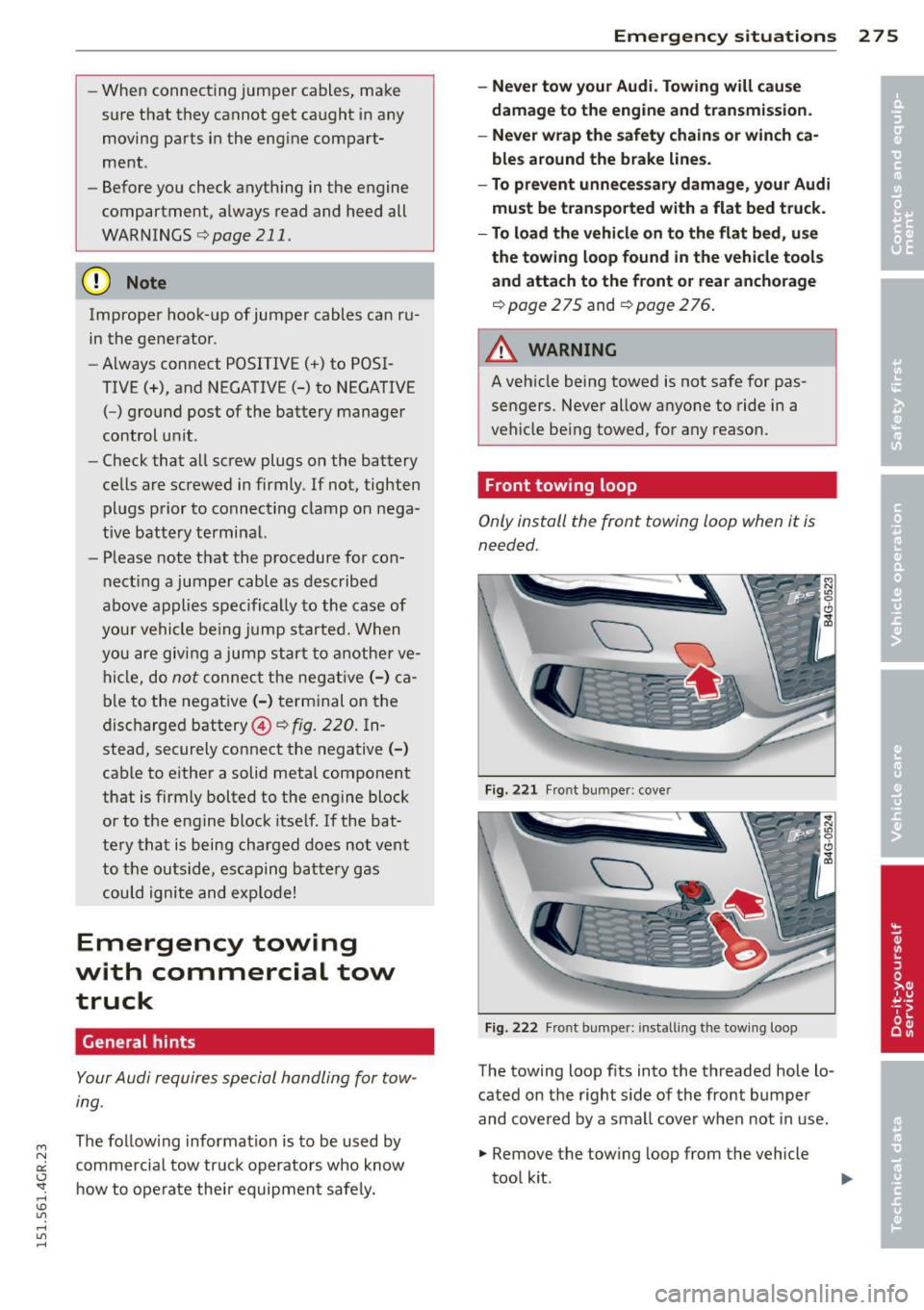
Front towing loop
Only install the front towing loop when it is
needed.
Fig. 22 1 Front bumpe r: cove r
Fig. 222 Front bu mpe r: in stall ing t he tow ing loop
-
The towing loop fits into the threaded hole lo
cated on the right s ide of the front bumpe r
and cove red by a sma ll cover when not in use.
.. Remove the tow ing loop from the vehicle
too l kit .
Page 280 of 302
2 78 Emergency situations
heavy components such as the engine
b lock or transmiss io n are removed.
- W he n removing heavy components like
these, ancho r vehicle to ho ist o r add cor
responding weig hts to ma inta in the cen
ter of g ravity . Othe rwise, the vehicle
might tilt or s lip off t he hoist, causing
ser ious p erson al injury.
(D Note
-Be awa re of the follow ing points befo re
li fting the vehicle:
- The vehicle should never be lifted or
jacked up from underneath the engine oil pan, the transmission housing, the
front or rear axle or the body side
membe rs. This could lead to ser ious
damage.
- To avoid damage to the underbody or
chassis frame , a rubber pad must be
i nserted between the floor jack and
the l ift points.
- Before driving over a workshop hoist,
check that the veh icle weight does not
exceed the permissible lifting capacity
of the hoist .
- Before driving over a workshop hoist,
ensure that there is sufficient clear
ance between the hoist and low parts
of the vehicle.