weight AUDI RS7 SPORTBACK 2015 Owner's Manual
[x] Cancel search | Manufacturer: AUDI, Model Year: 2015, Model line: RS7 SPORTBACK, Model: AUDI RS7 SPORTBACK 2015Pages: 302, PDF Size: 74.76 MB
Page 177 of 302

M N
0:: <.J 'SI: ,...., \!) 1.1'1 ,...., 1.1'1 ,....,
~ Secure unused safety belts on the rear seat
c::> page 171 .
Children up to at leas t 8 years old (over 40 lbs
or 18 kg) are best protected in chi ld safety
seats designed for their age and weight . Ex
perts say that the ske letal structure, particu
larly the pelvis, of these chi ldren is not fu lly
developed, and they must not use the vehicle
safety belts without a su itable child restraint.
It is usually best to put these children in ap
propriate booster seats. Be sure the booster
seat meets all applicable safety standards .
Booster seats raise the seating position of the
chi ld and reposition both the lap and shou lder
parts of the safety belt so that they pass
across the child 's body in the right places. The
routing of the belt over the child's body is very
important for the ch ild's protection, whether
or not a booste r seat is used . Children age 12
and under must always ride in the rear seat.
C hi ldren who are at least 4
ft. 9 in. (57 in
ches/1.45 meters) tall can generally use the
vehicle's three po int lap and shoulder belts .
Never use the lap belt portion of the veh icle's
safety be lt a lone to restrain any child, regard
l ess of how b ig the child is. Always remembe r
that children do not have the pronounced pe l
vic structure required for the proper function
of lap belt portion of the ve hicle's three point
l ap and shoulder be lts. The child's safety ab
solutely requ ires that a lap be lt portion of the
safety belt be fastened snugly and as low as
possible around the pelvis. Never let the lap
be lt portion of the safety belt pass over the
child's stomach or abdomen.
In a cras h, airbags must i nflate within a blink
of an eye and with cons iderable force. In orde r
to do i ts job, the airbag needs room to inflate
so that it will be there to p rotect the o ccupant
as the occupant moves forward into the air
bag.
A vehicle occupant who is out of pos ition and
too close to the airbag gets i n the way of an
inflat ing a irbag. When an occupant is too
close, he or she w ill be str uck violen tly and
Child Sa fet y 175
will receive se rious or possib ly even fatal in
jury .
In orde r fo r the airbag to offer pro te ction, i t is
important tha t all veh icle occupants, espec ial
ly any children, who m ust be in the front seat
because of exceptiona l circumstances, be
properly restrained and as far away from the
airbag as possible . By keeping room between
the child's body and the front of the passen
ger compartment, the a irbag can inflate com
pletely and provide supplemental protection
in certain frontal collisions .
_&. WARNING
Not using a booste r seat, using the boos
ter se at imp roperly, incorrectly installing a
boos ter sea t or using the vehicle safety
belt imp roperly increases the risk of seri
ous persona l injury and death in a collision
or other emergency situat ion. To he lp re
duce the risk of serious personal injury
and/or death:
- The shou lder belt must lie as close to the
center of the ch ild's collar bone as possi
ble and must lie f lat and snug on the up
per body . It must never lie across the
throat or neck . The lap belt must lie
across the pelvis and neve r across the
s tom ach o r abd omen. Make sure that the
be lt lies flat and sn ug. Pull on the bel t to
tighten if necessary.
- Failure to p roperly ro ute safety belts
over a child's body will ca use seve re inj u
ries in an accident or othe r emergency
situation
c::> page 130 .
-The rear side o f the child sa fety seat
should be pos itioned as close as possib le
to the backrest on the vehicle seat.
- For adj ustab le head restraints: adjust or
remove the rea r seat head restraint if it
is difficult to install the child seat w ith
the head restraint in place
c::> page 57. In
stall the head restraint again immed iate
ly once the child seat is removed. Dr iv ing
without head restraints o r with head re-
.
straints that are not properly adjusted ~
•
•
Page 180 of 302

178 Child Saf ety
- Make sure that the PASSENGER AIR BAG
OFF
light comes on and stays on all the
time whenever the ignition is switched on.
- If the
PASS ENGER AIR BAG OFF light
does not come on and stay on, immedi
ately install the rear-facing child safety
seat in a rear seating position and have
the a irbag system inspected by your Audi
dealer.
Activating the convertible locking retractor
Use the convertible locking retractor to se
cure a child restraint .
Always heed the child safety seat manufactur
e r's instructions when install ing a ch ild re
straint in your vehicle. To activate the conver
tib le locking retractor:
• Place the child restraint on a seat, prefera
bly on the rear seat.
• Slow ly pull the be lt
a ll th e wa y out.
• Route it around or through the chi ld re
straint be lt path
q ,& .
• Push the child safety seat down with your
full weight to get the safety belt rea lly t ight.
• Insert the belt tongue into the buckle for
that seating position.
• Gu ide the safety belt back into the retractor
unt il the belt lies flat a nd snug on the ch ild
safety seat.
> You should hear a "click ing" noise as t he
belt w inds back into the ine rtia reel. Test the
convertible locking retractor by pulling on
the belt . You should no longer be able to
pull the belt out of the retractor . The con
vertib le lock ing retractor is now act ivated.
• Make sure that the red release button is fac
ing away from the c hild restra int so that it
can be unbuckled quickly .
• Pullon the belt to make sure the safety belt
is p roperly t ight a nd fastened so that the
seat cannot move fo rward or sideways mo re
than one inch (2.5 cm).
A WARNING
Using the wrong child restraint or an im
p roperly installed chi ld restraint can cause
serious pe rsonal injury or death in a c rash .
- Always make sure that the safety belt re-
tractor is loc ked when installing a child
safety seat. An un locked safety belt re
tracto r cannot hold the child safety seat
in place dur ing no rma l driving o r in a
crash.
- Always buckle the child safety seat firmly
in place even if a ch ild is not si tt ing in it.
A loose child safety seat can fly around
during a s udden stop or in a crash .
- Always make sure the seat backrest to
which the child restraint is installed is in
an upright pos ition and securely latched
into place and cannot fold fo rward. Oth
erwise, the seatback with the child sa fety
seat attached to it could fly forward in
the event of an accident or other emer
gency situation.
- Always read and heed all WARNINGS
whenever us ing a child restrained in ave
h icle is being used
q page 165. Special
p recautions apply when insta lling a child
safety seat on the front passenger seat
q page 141, Child restraints on the front
seat -some important things to know.
-
Deactivating the convertible locking
retractor
The convertible locking retractor for child re
straints will be deactivated automatically when the belt is wound oil the way bock into
the retractor.
• Press the red b utton on the safety belt buck
le. The belt tong ue will pop o ut of t he b uck
le .
• Guide the safety belt all the way back into
its stowed position .
Always let the safety be lt retract completely
into its stowed position. The safety be lt can
now be used as an ordinary safety belt w ith
out the convertible locking retracto r for child
rest raints .
...
Page 230 of 302
228 Tires and wheels
-If you notice unusual vibra
tion or if the vehicle pulls to
one side when driving, al
ways stop as soon as it is
safe to do so and check the
wheels and tires for dam
age.
0 Note
-Please note that summer and winter tires are de
signed for the conditions
that are typical in those sea
sons. Audi recommends us
ing winter tires during the
winter months. Low tem peratures significantly de
crease the elasticity of
summer tires, which affects
traction and braking ability. If summer tires are used
in
very cold temperatures, cracks can form on the tread
bars, resulting in perma
nent tire damage that can
cause loud driving noise and
unbalanced tires. Audi is not
responsible for this type of
damage.
-Burnished, polished or chromed rims must not be used in winter road condi
tions. The surface of the
rims does not have suffi
cient corrosion protection
for this and could be perma
nently damaged by road salt
or similar substances.
Glossary of tire and loading terminology
Accessory weight
means the combined weight (in
excess of those standard items
which may be replaced) of auto matic transmission, power
steering, power brakes, power
windows, power seats , radio,
and heater, to the extent that
these items are available as fac
tory-installed equipment (whether installed or not).
Aspect ratio
means the ratio of the height to
the width of the tire in percent.
Numbers of 55 or lower indi
cate a low sidewall for im
proved steering response and
better overall handling on dry
pavement.
...
Page 231 of 302
Bead
means the part of the tire that
is made of steel wires, wrapped
or reinforced by ply cords and
that is shaped to fit the rim .
Bead separation
means a breakdown of the bond
between components in the
bead.
Cord
means the strands forming the
plies in the tire.
Cold tire inflation pressure
means the tire pressure recom
mended by the vehicle manu
facturer for a tire of a designat
ed size that has not been driven
for more than a couple of miles (kilometers) at low speeds in
the three hour period before
the tire pressure is measured or
adjusted.
Curb weight
means the weight of a motor
vehicle with standard equip
ment including the maximum
capacity of fuel, oil, and cool
ant, air conditioning and addi
tional weight of optional equip
ment.
Tires and wheels 229
Extra load tire
means a tire design to operate
at higher loads and at higher inflation pressures than the
corresponding standard tire. Extra load tires may be identi
fied as "XL", "xl", "EXTRA
LOAD", or "RF" on the sidewall.
Gross Axle Weight Rating ("GAWR")
means the load-carrying capaci
ty of a single axle system,
measured at the tire-ground in
terfaces.
Gross Vehicle Weight Rating ("GVWR")
means the maximum total
loaded weight of the vehicle.
Groove
means the space between two
adjacent tread ribs.
Load rating (code)
means the maximum load that
a tire is rated to carry for a giv
en inflation pressure. You may
not find this information on all
tires because it is not required by law.
•
•
'
Page 232 of 302
230 Tires a nd whee ls
Ma ximum load rating
means the load rating for a tire
at the maximum permissible in
flation pressure for that tire.
Maximum loaded vehicle
weight
means the sum of:
(a) Curb weight
(b) Accessory weight
(c) Vehicle capacity weight, and
(d) Production options weight
Maximum (permissible)
inflation pressure
means the maximum cold infla
tion pressure to which a tire
may be inflated. Also called
"maximum inflation pressure."
Normal occupant weight
means 150 lbs. (68 k ilograms)
times the number of occupants seated in the vehicle up to the
total seat ing capac ity of your
vehicle.
Occupant distribution
means distribution of occu
pants in a vehicle .
Outer diameter
means the overall diameter of
an inflated new tire.
Overall width
means the linear distance be
tween the ex teriors of the side
walls of an inflated tire, includ
ing elevations due to labeling,
decorations, or protect ive
bands or ribs .
Ply
means a layer of rubber -coated
parallel cords .
Production options weight
means the comb ined we ight of
those installed regular produc
tion op tions weighing over 5
lbs . (2. 3 kg) in excess of those
standard items which they re
place, no t prev iously consid
ered in curb weight or accessory
weight , incl uding heavy duty
brakes, ride leve lers, roof rac k,
heavy duty bat tery, and spec ial
trim.
Radial ply tire
means a pneumatic tire in
wh ich the p ly c ords that extend
t o the beads are laid at sub
stantially 90 degrees to the
centerline of the t read .
Page 234 of 302
232 Tires a nd whee ls
Tread separation
means pulling away of the
tread from the tire carcass.
Treadwear indicators (TWI )
means the projections with in
the principal grooves designed
to give a visual indication of the degrees of wear of the tread.
See
¢ page 243, Tread Wear
Indicator (TWI)
for more infor
mation on measuring tire wear.
Uniform Tire Quality Grading
is a tire information sys tem de
veloped by the United States
National Highway Traffic Safety
Administration (NHTSA) that is
designed to help buyers make
relative comparisons among
tires. The UTQG is not a safety
rat ing and not a guarantee that
a tire will last for a prescribed
number of miles (kilometers) or
perform in a certain way. It
simply gives tire buyers addi
tional information to comb ine
with other considerations, such as price, brand loyalty and deal
er recommendations. Under
UTQG, tires are graded by the
tire manufacturers in three areas: treadwear, traction, and
temperature resistance . The UTQG information on the t
ires
molded into the sidewalls.
U.S. DOT Tire Identification
Numbe r (TIN )
,
This is the tire's "serial num
ber" . It begins with the letters
"DOT" and indicates that the
tire meets all federal stand
ards . The next two numbers or
letters indicate the plant where
it was manufactured, and the
last four numbers represent the
week and year of manufacture. F or example,
DO T ... 2214 ...
means that the tire was pro
duced in the 22nd week of
2014. The other numbers are
marketing codes that may or
may not be used by the tire
manufacturer. This information
is used to contact consumers if
a tire defect requires a recall.
Vehicle capacity weight
means the rated cargo and lug
gage load plus 150 lbs. (68 kilograms) times the vehi
cle's total seating capacity as
listed on the label located on
the driver's side B-pillar . .,..
Page 235 of 302
"' N
a:: I.J "". rl I.O
"' rl
"' rl
Vehicle maximum load on the tire
means that load on an individu
al tire that is determined by
distributing to each axle its
share of the maximum loaded
vehicle weight and dividing by two.
Vehicle normal load on the tire
means that load on an individu
al tire that is determined by
Tires and wheels 233
distributing to each axle its
share of the curb weight, acces
sory weight, and normal occu
pant weight (distributed in ac
cordance with table below
¢ page 233) and dividing by
two.
Occupant loading and distribution for vehicle normal load for
various designated seating capacities
Designated seating Vehicle normal load, Occupant distribu-
capacity, number of number of occupants tion in a normally
occupants loaded vehicle
4 2 2 in front
Cold tire inflation pressure
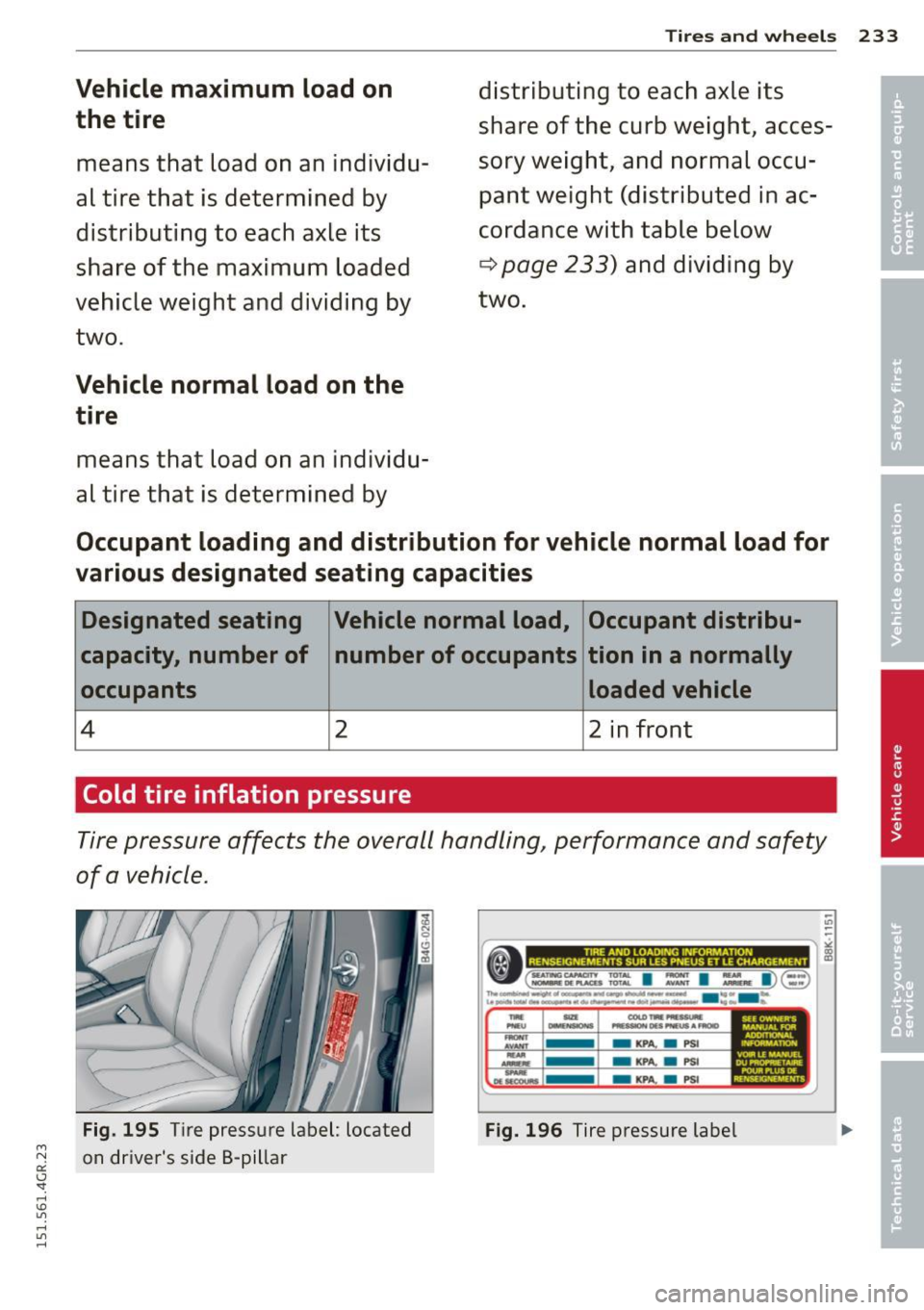
Tire pressure affects the overall
handlingJ performance and safety
of a vehicle.
Fig. 195 Tire pressure label: located
on driver's side B -pillar
-"' ---------------.... ,;,
& =-=====c=-=============== ::l
Ve=~= • = • =-1)§ -n,,......,..__.................................... • .... _ .. .................................... ___...,._ .. . -
- KPA, . PSI
- KPA. . PSI
- KPA. . PSI
Fig. 196 Tire pressure label
Page 236 of 302
234 Tir es a nd whee ls
Ti re pressure generally refers to tant things you can do to help
the amount of a ir in a tire that avoid sudden tire failure . Un-
it needs it to do its job and derinflated tires are a major
safely carry the combined load cause of sudden ti re fa ilu re .
of the en tire vehicle and its con-
Keeping t ires at the right pres-
tents . Tire press ure is measured sure is also important for safe
i n ki lopascals (kPa), the inter- and responsive vehic le han-
national measuring unit and in dling , traction, braking and
pounds pe r square inch (PSI). load carryi ng .
Tire pressures
Ti re pressure is based in part on are particularly important
the vehicle's design and load when the vehicle is being driv-
lim it - the greatest amount of en at higher speeds, and then
weight that the vehicle can car -especially when heavily loaded
ry safely and the tire size. The even within the permissible
p rope r tire pressure is frequent -load-carrying capacities ap-
ly referred to as the " recom-proved for your vehicle.
mended cold tire inflation pres-
The recommended tire pres-
sure." Air in the tires expands
sures for your Audi depend on
when the tire heats up because the kind of tires on your vehicle
of internal friction when it flex-
and the number of passengers
es in use . The ti re pressure is
and/or amount of luggage you
h igher when the tire has
will be transpor ting.
warmed up than when it is The tire pressure labe l is locat-
"cold." It is the inflation p res-
ed on the driver's side 8 -pi llar .
sure in a "cold " tire that counts .
Therefore, you should never let The tire pressure label lists the
recommended cold t ire in fla-
air o ut of a warm tire to match
"cold tire inflation pressure" tion pressures for the vehicle at
its max imum capacity weight
recommendations . The tires
would t hen be underinflated and tires that were on your ve
-
a nd cou ld fai l suddenly . hicle at t
he time it was man u-
f actured .
...
Maintaining proper tire p res-
sure is one of the most impor-
Page 237 of 302
Tires and wheels 235
If you wish to improve comfort
when operating the vehicle at
normal load (up to 2 occu
pants), you can adjust tire
pressures to those specified
for normal vehicle load. Before
operating the vehicle at maxi mum load, you must increase
the tire pressures to those
specified for maximum vehicle
load
c> .&. .
Bear in mind that the tire pres
sure monitoring system can on
ly monitor the tire pressures
you have stored. The system does not recognize the load
condition of your vehicle.
The effectiveness of the tire p ressure monitoring system
will be impaired if you store normal load pressures but then
operate the vehicle at its maxi
mum load
c> .&. .
Model/ Tire designation
See the illustration c> fig. 195
for the location of the label on
driver's side B-pillar (color of
the actual label and exact loca
tion on the vehicle will vary slightly).
Note that the following table is
accurate at the time of going to
press and is subject to change.
In the event of discrepancies,
the tire pressure label is locat ed on the driver's side B-pillar
always takes precedence.
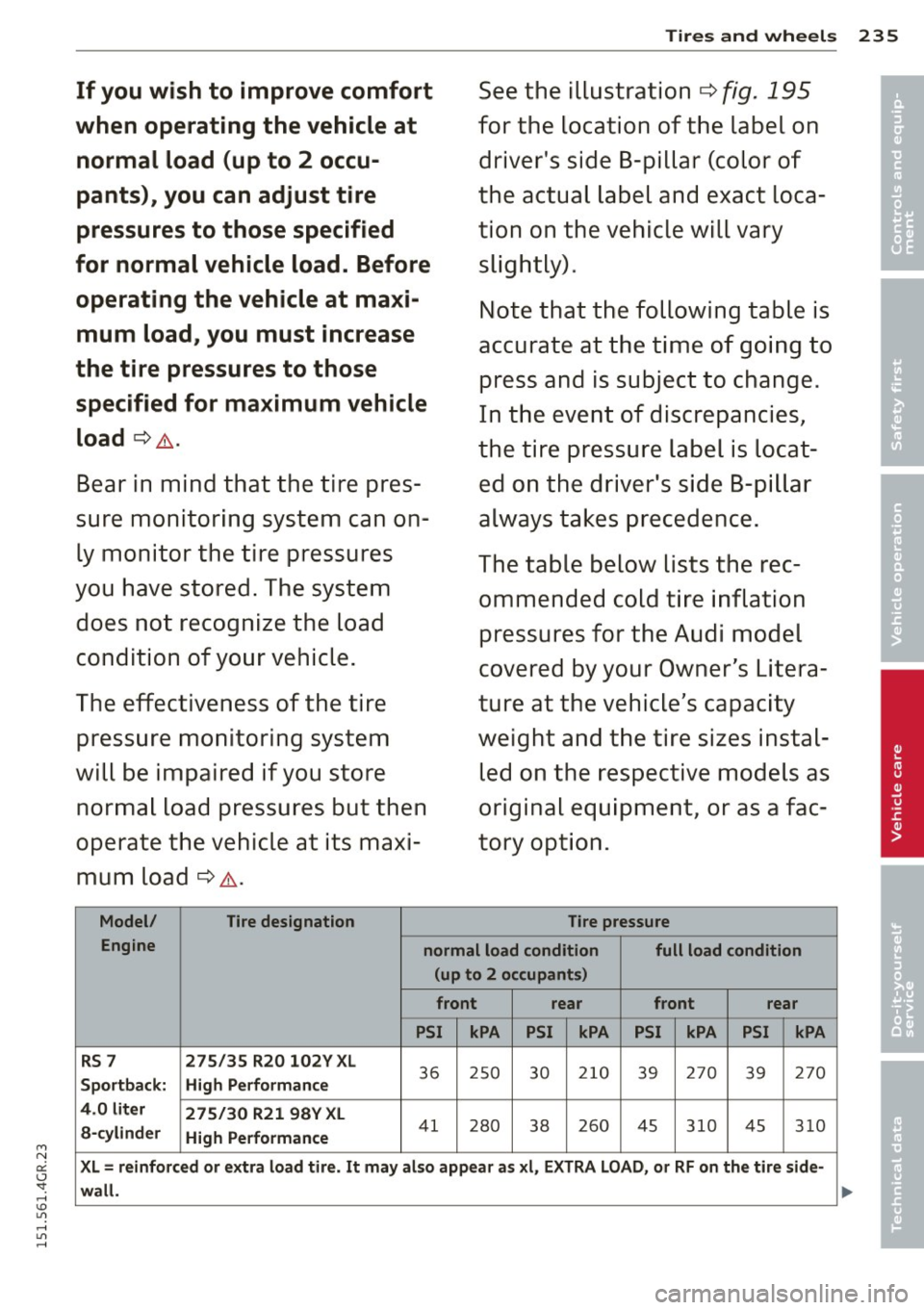
The table below lists the rec ommended cold tire inflation pressures for the Audi model
covered by your Owner's Litera
ture at the vehicle's capacity
weight and the tire sizes instal
led on the respective models as
original equipment , or as a fac
tory option.
Tire pressure
Engine normal load condition full load condition
(up to 2 occupants)
front rear front rear
PSI kPA PSI kPA PSI kPA PSI kPA
RS 7 275/35 R20 102V XL
3 6 250 30 210 39 270 39 270 Sportback: High Performance
4.0 liter 275/30 R21 98V XL
a -cylinder
High Performance
41 280 38 26
0 4 5 310 45 310
XL= reinforced or extra load tire. It may also appear as xl, EXTRA LOAD, or RF on the tire side-
wall.
•
•
'
Page 238 of 302
236 Tires and wheels
Because technical changes may
be made to vehicle equipment
during the model year, always
compare the tire size designa
tion on the tire pressure label
on your vehicle with the tires on
your vehicle . Make sure that the
tire size information on the ve hicle label is the same as the
size of the tires on the vehicle .
This is especially important if
the vehicle belongs to someone else or you bought the vehicle
with different rims/tires or you bought the vehicle as a previ
ously owned vehicle.
Remember, your safety and
that of your passengers also de pends on making sure that load
limits are not exceeded . Vehicle
load includes everybody and ev
erything in and on the vehicle .
These load limits are technical ly referred to as the vehicle's
Gross Vehicle Weight Rating
("GVWR"). The Gross Axle
Weight Rating ("GAWR") is the
maximum load that can be ap
plied at each of the vehicle's
two axles . The Gross Vehicle
Weight Rating and the Gross
Axle Weight Rating are listed on the safety compliance stick- er label located on the driver's
side B-pillar. The tire pressure
label on your Audi lists the
maximum combined weight of
all of the occupants and lug
gage or other cargo that the ve
hicle can carry. For the location
of the tire pressure label
¢ fig. 195.
&_ WARNING
-
Overloading a vehicle can
cause loss of vehicle control,
a crash or other accident, se
rious personal injury, and
even death .
- Carrying more weight than
your vehicle was designed to carry will prevent the ve
hicle from handling properly
and increase the risk of a
loss of vehicle control.
-The brakes on a vehicle that has been overloaded may
not be able to stop the vehi
cle within a safe distance.
- Tires on a vehicle that has
been overloaded can fail
suddenly causing loss of
control and a crash.
-Always make sure that the total load being transported
does not make the vehicle .,.