belt AUDI RS7 SPORTBACK 2015 Owner's Guide
[x] Cancel search | Manufacturer: AUDI, Model Year: 2015, Model line: RS7 SPORTBACK, Model: AUDI RS7 SPORTBACK 2015Pages: 302, PDF Size: 74.76 MB
Page 146 of 302
144 Airbag system
detailed information about airbags, safety
belts and child safety in this and the other
chapters that make up the owner's literature.
Please be sure to heed the WARNINGS -they
are extremely important for your safety and
the safety of your passengers, especially in
fants and small children.
A WARNING
Never rely on airbags alone for protection.
- Even when they deploy, airbags provide only supplemental protection .
- Airbag work most effectively when used
with properly worn safety belts.
- Therefore, always wear your safety belts
and make sure that everybody in your ve
hicle is properly restrained .
- Always hold the steering wheel with both
hands on the outside of the steering
wheel rim at the 9:00 o'clock and 3:00
o'clock positions to help reduce the risk
of personal injury if the driver's airbag in
flates.
- Never hold the steering wheel at the 12
o'clock position or with your hands any
where inside the steering wheel or on the
steering wheel hub. Holding the steering
wheel the wrong way increases the risk of severe injury to the arms, hands, and
head if the driver airbag deploys.
A WARNING
Objects between you and the airbag will
increase the risk of injury in a crash by in
terfering with the way the airbag unfolds
and/or by being pushed into you as the air
bag inflates.
-Always make sure nothing is in the front
airbag deployment zone that could be
struck by the airbag when it inflates.
- Objects in the zone of a deploying airbag
can become projectiles when the airbag
deploys and cause serious personal in
Jury.
- Never hold things in your hands or on
your lap when the vehicle is in use .
-
-Never place accessories or other objects
(such as cup holders, telephone brackets,
note pads, navigation systems, or things
that are large, heavy, or bulky) on the
doors; never attach then to the doors or
the windshield; never place them over or
near or attach them to the area marked
.,AIRBAG" on the steering wheel, instru
ment panel or the seat backrests; never place them between these areas and you
or any other person in the vehicle.
- Never attach objects to the windshield
above the passenger front airbag, such
as accessory GPS navigation units or mu
sic players. Such objects could cause seri
ous injury in a collision, especially when
the airbags inflate.
- Never recline the front passenger seat to
transport objects. Items can also move
into the deployment area of the side air
bags or the front airbag during breaking
or in a sudden maneuver. Objects near
the airbags can fly dangerously through
the passenger compartment and cause
injury, particularly when the seat is re
clined and the airbags inflate.
A WARNING
A person on the front passenger seat, es
pecially infants and small children, will re
ceive serious injuries and can even be kil
led by being too close to the airbag when
it inflates.
- Although the Advanced Airbag System in
your vehicle is designed to turn off the front passenger airbag if an infant or a
small child is on the front passenger
seat, nobody can absolutely guarantee
that deployment under these special
conditions is impossible in all conceiva
ble situations that may happen during
the useful life of your vehicle.
- The Advanced Airbag System can deploy
in accordance with the ,,low risk" option
for 3- and 6-year-old children under the
Page 147 of 302
M N
0:: <.J 'SI: ,...., \!) ..,.,
,...., ..,., ,....,
U.S. Federal Standard if a child with elec
trical capac itance greater than the com
bined capacitance of a typical one-year
old infant restra ined in one of the for
ward fac ing or rearward-fac ing ch ild
seats w ith which your vehicle was certi
fied is on the front passenger seat and
the other conditions for airbag deploy ment are met.
- Acc ident statist ics have shown that chil
dren are generally safer in the rea r seat
area than in the front seating posit ion .
- For their own safety, all children, espe
c ially 12 years and younger, sho uld al
ways ride in the back p roperly rest rained
for their age an d size .
Advanced front airbag system
Your veh icle is equipped w ith a front Advanced
Airbag System in comp liance with Un ited
States Federal Motor Vehicle Safety Standard 208 as applicable at the time your vehicle was
manufactured.
The front Advanced Airbag System supple ments the safety belts to provide add it iona l
protection for the driver's and front passeng
e r's heads and upper bodies in frontal crashes.
The airbags inflate only in frontal impacts
when the vehicle dece le rat io n is high enough.
The front Advanced A irbag System for the
fro nt seat occupants is not a substitute for
your safety belts . Rather, it is part of the over
all occupant rest raint system in your ve hicle.
A lways remember that the airbag system can
only help to pro tect you, if you are s itting up
righ t, wearing yo ur sa fety belt and wearing it
properly. This is why you and yo ur passengers
must always be properly restrained, not just
because the law requires you to be.
The Advanced Airbag System in your veh icle
h as been certified to meet the " low r isk" re
q uir ements for 3 and 6 year-o ld children on
the passenger s ide and very small adu lts on
the dr iver side. The low risk deployment crite
ria are intended to he lp reduce the risk of i n
j ury through interaction with the front airbag
A irbag system 145
that can occur, for examp le, by being too
close to the steering wheel and instr ument
panel when the airbag inflates .
In add ition, the system has been cert ified to
comply with the "s uppression" requirements
of the Safety Standard, to turn off the front
airbag for in fants 12 months o ld and younger
who are rest rained on the front passenger
seat in child restraints that are listed in the
Standa rd
c> page 167, Child restraints and
Advanced front airbag system .
"Suppression" requires the front a irbag on the
passenger side to be turned off if:
- a child up to abo ut one year of age is re
strained on the front passenger seat in one
of the rear-fac ing or forward -facing infant
restraints listed in Federal Motor Vehicle
Safety Standard 208 with which the Ad
vanced Airbag System in your ve hicle was
cert ified . Fo r a listing of the chi ld restraints
that were used to certify you r vehicle's com
p lia nce w it h t he US Safe ty Stand ard
c>page 167,
-When a pe rson is detec ted o n the front pas
senge r seat that has an e lec trica l capa ci
tance t hat is more than the tota l elect rical
capacitance of a child that is about 1 year
old restrained in one of the rear-facing or
forward-facing infant restraints (listed in Federal Motor Vehicle Safety Standard 208
w ith which the Advanced A irbag System in
your vehicle was certified), the front airbag
on t he passenger side may or may not de
ploy.
The
PASSENG ER AIR BAG OFF light comes on
when the electron ic cont ro l unit de tects a to
ta l elect rical capac itance on the front passen
ger seat that requi res the front a irbag to be
turned off. If the
PASSENGER AIR BAG OFF
li gh t does no t come on, the front airbag on
the passenger side has not been turned off by
the contro l unit and can deploy if the control
u nit senses an impact that meets the condi
tions stored in its memory.
If the total e lectr ica l capacitance registered
on the front passenger seat is more than that
ll>
•
•
Page 148 of 302
146 Airbag sys te m
of a typ ica l 1 year -old, but less than the
weight of a sma ll adult, the front airbag on
the passenger side may deploy (the
PASSEN
GER AIR BAG OFF
li ght does not come on).
For exa mple , the air b ag m ay depl oy if:
- a small child that is heavier than a typical 1
year-o ld child is on the front passenger seat
(regardless of whe ther the child is in one of
the chi ld seats listed
c':> page 167),
-a ch ild who has outgrown child rest raints is
on the front passenger seat.
If the front passenger airbag is turned off, the
PA SSENGER AIR BAG OFF light in the cente r
of the instrument panel w ill come on and stay
on.
If the front passenger airbag deploys, the Federal Standard requires the a irbag to meet
the "low risk" deployment criteria to help re
duce the risk of injury through interaction
with the airbag. " Low risk" deployment occurs
in those crashes that take place at lower de
celerations as defined in the e lectronic control
un it
c':>page 151.
Alwa ys rememb er: Even tho ugh your vehicle
is equipped with Advanced Airbags, the safest
p lace for children is properly restrained on the
back seat. Please be sure to read the impor
tant information i n the sect ions that follow
and be sure to heed a ll of the WARNINGS .
A WARNING
To reduce the risk of injury when an airbag
inf lates, a lways wear safety belts prope rly.
- If you are unrestrained, lean ing forward,
sitting sideways or out of position in any
way, your risk of injury is much higher.
- You w ill also receive serious in juries and
cou ld even be killed if you are up against
the a irbag or too close to it when it in
fla tes -even with an Advanced Airbag
c':>page 139.
A WARNING
A child in a rearward -facing child seat in
stalled on the front passenger seat will be seriously injured and can be killed
if the
front airbag inflates - even w ith an Ad
vanced Airbag System.
- Altho ugh the Advanced Airbag System in
your veh icle is designed to turn off the
front airbag when a rearward-facing
child restraint has been installed on the
front passenge r seat, nobody can abso
lutely guarantee that dep loyment is im
possible in all con ceivable s ituations that
may h appen dur ing the usefu l life of y our
veh icle .
- T he inflating airbag will h it the ch ild seat
or infant carrier wi th grea t force and will
smash the child seat and child against
the backrest, center armrest, door, or
roof.
- Always install rearward-facing chi ld re
straints on the rear seat.
- If you must install a rearward fac ing
child seat on the front passenger seat
because of exceptional circumstances
and the
PASSENGER AIR BAG OFF light
does not come on and stay on, immed i
ately insta ll the rear-facing child seat in a
rea r seat ing pos ition and have the airbag
system inspected by you r Audi dealer.
A WARNING
If, in except iona l circumstances, you must
i nsta ll a forward-facing child restraint on
the front passenge r's sea t:
- Always make sure the forward-facing
seat has been designed and ce rtified by
its manufacture r fo r u se on a fron t seat
with a passenger fron t and s ide a irbag .
- Never p ut the fo rward-facing child re
straint up agains t or ve ry near the instru
ment panel.
- Always move the p assenge r seat into its
rearmost pos ition in the seat's fore and
aft ad justment range, as fa r away from
the airbag as possible, before installing
the forward-facing ch ild restra int. The
backrest must be ad justed to an upright
position.
Page 149 of 302
M N
0:: <.J 'SI: ,...., \!) 1.1'1 ,...., 1.1'1 ,....,
-Always make sure that there is nothing
on the front passenger seat that will
cause the capacitive passenger detection
system in the seat to s ignal to the A irbag
System that the seat is occupied by a person when it is not, or to signal that it
is occupied by someone who is heavier
than the person actually s itting on the
seat . The presence of additiona l objects
cou ld cause the passenger front airbag
to be t urned on when it sho uld be off, or
cou ld cause the airbag to work in a way
that is different from the way it wou ld
have worked without the object on the
seat .
- Make sure that the
PASSENGER AIR BAG
OFF
light comes on and stays on all the
t ime whenever the ignition is switched
on.
Advanced Airbag System components
The front passenger seat in your vehicle has a
l ot of very important parts of the Advanced
Ai rbag System in it. These parts incl ude the
capacitive passenger detect ion system, wir
i n g, brackets, and more . The control unit
monitors the system o n the front passenger
seat when the ign ition is switched on and
turns the airbag indicator light on when a
malfunct ion in the one of the system compo
nents is detected ¢ page
152 . Because the
fro nt passenger seat contains important parts
of the Advanced Airbag System, you must
t ake care to p reven t it from being damaged.
D amage to the seat may preven t the Ad
vanced A irbag System for the front passenger
seat from doing its job in a crash .
The front Advanced Airbag System
consists of the following:
-Crash sensors in the front o f the veh icle that
measure vehicle acceleration/dece leration
to provide information to the Advanced Air
bag System about the severity of the crash .
- An electronic co ntrol unit, with integrated
crash sensors for front and side impacts .
The contro l unit "decides" whether to fire
A irbag system 147
the front a irbags based on the in format ion
received from the crash sensors. The contro l
unit also "decides" whether the safety be lt
pretens ioners sho uld be activated .
- An Advanced Airbag with gas generator and
contro l valve for the driver ins ide the steer
ing wheel hub.
- An Advanced Airbag with gas gene rator and
cont ro l valve inside the instrument pane l for
the front passenger.
- A capacitive passenger detection system un
derneath the front passenger seat cover.
This system measures the electrical capac i
tance of the person in the seat. The informa
tion registered is se nt cont inuously to the
el ectr onic contro l un it to regu late deploy
ment of the front Advan ced A irbag on the
passenger side .
- An airbag monitoring system and ind icator
light in the instr ument cluster ¢page
151 .
-A sensor in each front seat registers the dis
tance be twee n the respec tive seat a nd the
s teer ing whee l or inst rument p anel. The i n
forma tion regis tered is sent cont inuo usly to
the electronic cont ro l unit to regulate de
p loyment of the front Adv a need Airbags.
- The
PASSENGER AIR BAG OFF light comes
on and stays on in the center of the instr u
ment panel ¢ pag e
152, fig. 162 and tells
you when the front Advanced Airbag on the passenger side has been turned off.
- A sensor in the safety belt latch for the driv
er and for the front seat passenger that
senses whether that safe ty belt is latched or
not and transmits this information to the
electronic control un it .
.&_ WARNING
D amage to the front passe nger seat can
p revent the front air bag from wor king
properly.
- I mp roper repa ir or d isassembly of the
fro nt pa ssenge r and dr iver seat will pre
vent the Advanced Airbag System from
functioning p roperly.
- Repair s to t he front passenge r seat m ust
be pe rformed by qualified and p roperly
-
trained workshop person ne l. 111>
•
•
Page 151 of 302
"' N
a:: I.J "". rl I.O
"' rl
"' rl
How the Advanced Airbag System
components work together
The front Advanced Airbag System and the
side airbags supplement the protection of
fered by the front three -point safety be lts
with pretensioners and load limiters and the
adjustable head restra ints* to help reduce the
risk of injury in a wide range of acc ident and
crash situat ions. Be sure to read the impor
tant information about safety and heed the
WARNINGS i n this chap ter.
Dep loyment of the Advanced Airbag System
and the activat ion of the safety be lt pre ten
sioners depend on the dece lerat ion meas ured
by the c rash senso rs and registered by the
e lectronic control u nit. Cr ash severity depends
on speed and dece leration as well as the mass
and stiffness of the vehicle or object involved
in the crash.
On the passenge r side, reg ard less of safety
be lt use, the fron t passenger fronta l airbag
will be t urned off i f the electrical capacitance
measured by the capac itive passenger detec
tion system on the front passenger seat is less
than the amount programmed in the e lectron
ic control unit. The front passenger frontal air
bag will also be turned off if the capac itance
measured by the system for the front passen
ge r seat equa ls that of an infant of about one
year of age in one of the child seats that was
used to cert ify the Advanced Airbag Sys tem
u nder Fede ral Motor Vehicle Safety Standard
208 . The
PASSENGER AIR BAG OFF light
comes on and stays on to tell you when t he
front Advanced Airbag System on the passen
ger s ide has been turned off
r:=:, page 152.
A WARNING
To reduce the risk of injury when an airbag
inf lates, a lways wear safety belts properly.
- If you are unrestrained, lean ing forward,
sitting sideways or out of position in any
way, yo ur r isk of inj ury is much hig he r.
- You w ill also receive serious injuries and
cou ld eve n be killed if you are up against
the a irbag or too close to it when it in-
A irba g sy stem 149
flates -even w it h an Advanced A irbag
c=:, page 139.
More important things to know about
front airbags
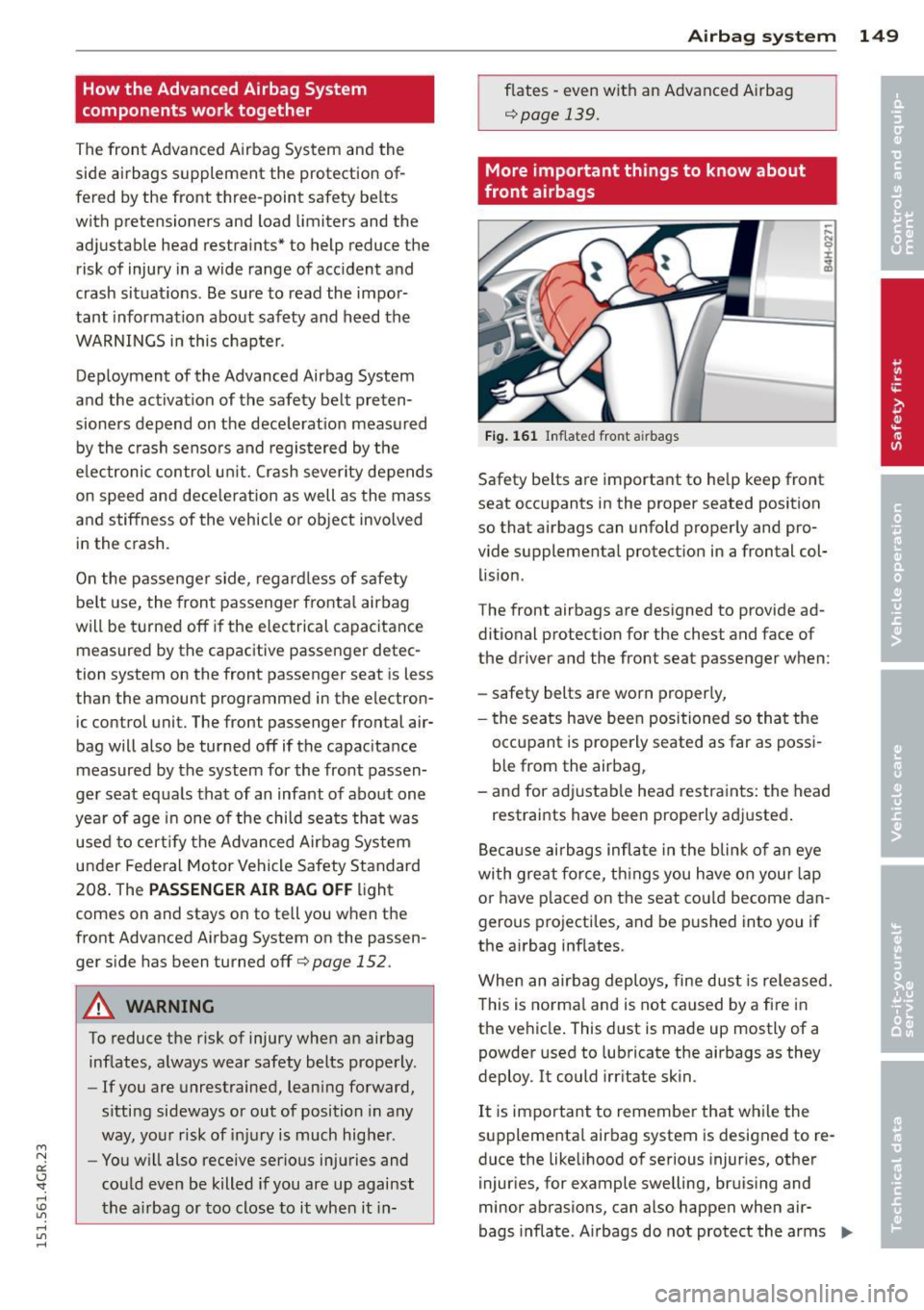
Fi g. 16 1 In flated front airbags
Safety be lts are important to he lp keep front
seat occupants in the proper seated position
so that airbags can unfold properly and pro
vide supplementa l protect ion in a frontal col
li s ion.
The front airbags are des igned to provide ad
ditional protection for the chest and face of
the driver and the front seat passenger when:
- safety belts are worn proper ly,
- t he seats have been positioned so that the
occupant is properly seated as far as poss i
ble from the airbag,
- and for ad justab le head restra ints: the head
restraints have been properly adj usted .
Bec ause airbags infl ate in the bli nk of an eye
wi th great force, th ings you have on your lap
o r have p laced on the seat co uld become dan
gerous projectiles, and be p ushed into you if
the a irbag inf lates.
When an airbag deploys, fine dust is re le ased.
This is norma l and is not caused by a fi re in
the ve hicle . This dust is made up mostly of a
powder used to lubricate the airbags as they
deploy. It could irr itate skin.
It is important to remembe r that wh ile the
supplementa l airbag system is designed to re
duce the like lihood of serious injur ies, other
i njur ies, for example swelling, bruis ing and
minor abrasions, can also happen when air-
bags inflate. A irbags do not protect the arms .,_
Page 152 of 302
150 Airbag sys te m
or the lower parts of the body. Front airbags
supp lement the three-point safety belts only
in some frontal collisions in which the vehicle
dece leration is high enough to deploy the air
bags.
F ront airbag s will not d eplo y:
-if the ignition is switched off when a crash
occurs,
- in side collisions,
- in rear-end collisions,
- in ro llovers,
- when the crash deceleration measured by
the a irbag system is less than the minimum
t h reshold needed for airbag deployment as
registered by the electron ic control uni t.
The f ront pas senger airbag also will not
deploy:
- when the front passenger seat is not occu
pied,
- when the electrical capac itance measured by
the capacitive passenger detect io n sys tem
for the front passenger seat indicates that
the passenger side fronta l airbag must be
switched off by the e lectronic control unit
(the
PA SSENGER AIR BA G OFF light
c> page 152 and how they work comes on
and stays on).
A WARNING
Sitting in the wrong position can increase
the risk of serious injury in crashes.
- To reduce the r isk of injury when the air
bags inflate, the driver and passengers
must always sit in an upright position,
must not lean against or place any part
of the ir body too close to the area where
the a irbags are located.
- Occupants who a re unbelted, out of posi
t ion or too close to the airbag can be se
riously injured by an airbag as it un folds
with great force in the blin k of an eye
i=>page
141.
A WARNING
A child in a rearward-facing child seat in
stalled on the front passenger seat will be
-
seriously injured and can be killed if the
front airbag inflates -even w ith an Ad
vanced Airbag System.
- The inflating airbag will h it the ch ild seat
or infant carrier with great force and will
smash the child seat and child against
the backrest, center armrest, door or
roof.
- Always install rear-fac ing ch ild seats on
the rear seat .
- If you must install a rearward fac ing
child seat on the front passenger seat because of exceptional circumstances
and the
PASSENGER AIR BAG OFF light
does not come on and stay on, immed i
ately insta ll the rear-facing child seat in a
rea r seat ing pos ition and have the airbag
system inspected by yo ur Audi dealer.
A WARNING
c'-----
Objects between you and the airbag will
increase the r isk of injury in a crash by in
terfering with the way the airbag unfolds
or by be ing p ushed into you as the airbag
inflates.
- Never hold things in yo ur hands or on
your lap when the veh icle is in use.
-
- Never transport items on or in the area
of the front passenger seat. Objects
could move into the area of the front air bags during braking or other sudden ma
neuvers and become dangero us projec
tiles that can cause ser ious perso nal in
jury if the a irbags inflate.
- Never p lace or attach accesso ries o r oth
er objects (such as cup holders, te le
p hone bra ckets, large, heavy or bulky ob
jects) on the doors, over o r near the area
marked "AIRBAG" on the steering whee l,
instr ument panel, seat bac krests o r be
tween those areas and yourself. These
objects could ca use in jury in a crash, es
pecially when the airbags inflate.
- Never recline the front passenger 's seat
to transport objects. Items can a lso
move into the a rea of the s ide airbag or
the front airbag during braking or in a
Page 154 of 302
152 Airbag system
-If the air bag indicator light ¢ page 18
comes when the vehicle is be ing used,
have the system inspected immediately
by your autho rized Aud i dea ler . It is pos
s ible that the airbag will inflate when it
is not s upposed to, or w ill not inflate
when it sho uld.
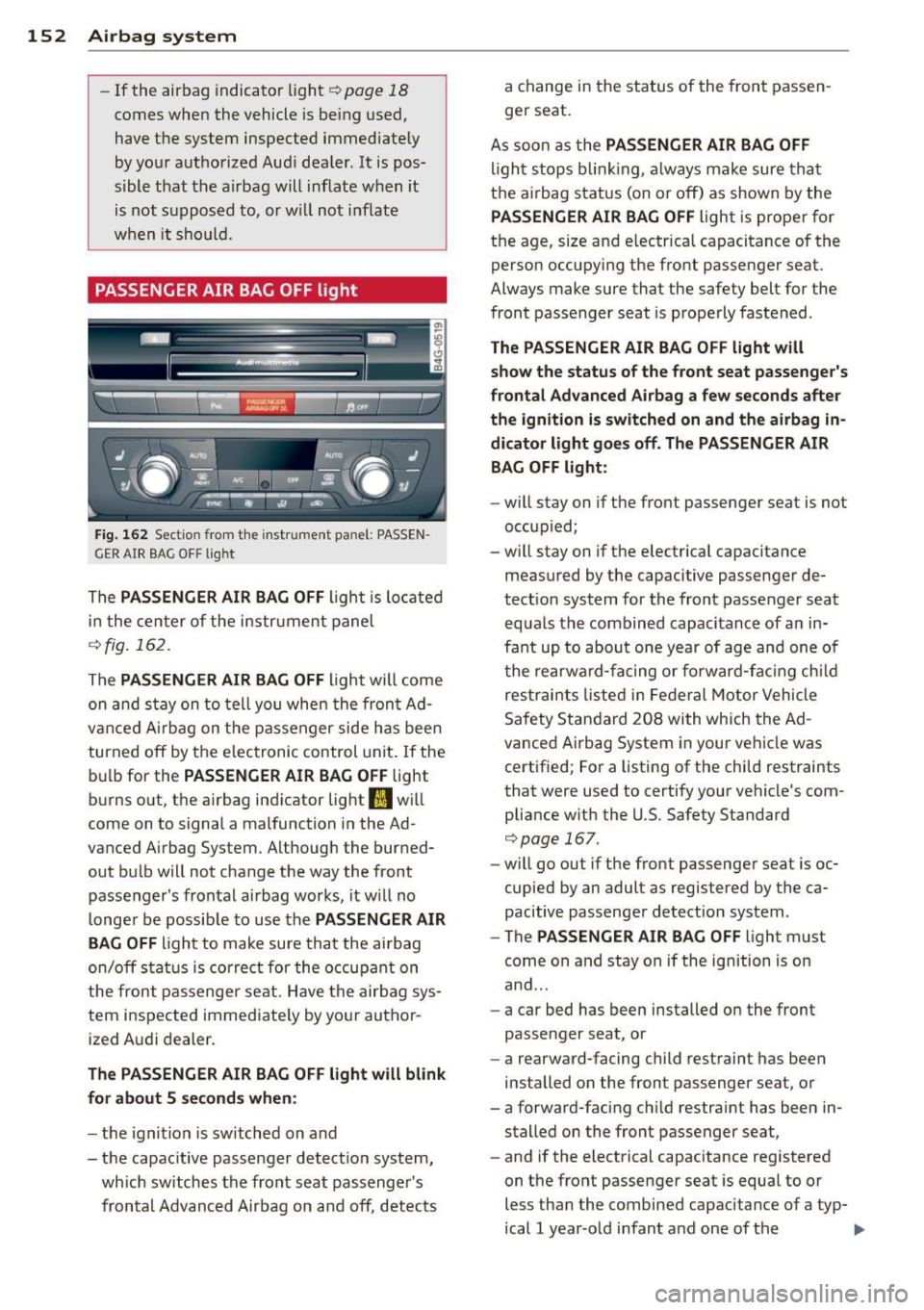
PASSENGER AIR BAG OFF light
Fig. 162 Sect ion from t he in st rument pa nel : PASS EN
GER AIR BAG O FF ligh t
The PASSENGER AIR BAG OFF light is located
in the cen ter o f the instr ument panel
¢ fig . 162.
The PASSENGER AIR BAG OFF light will come
on an d stay on to te ll you when the fron t Ad
v a nce d Airb ag on t he passenger side h as been
turned off by the e lectronic control unit . If the
b ul b for the
PASSENGER A IR BAG O FF light
burns o ut, the airbag ind icator light
II wi ll
come on to signal a malfunction in the Ad
vanced A irbag System . Although the burned
out bulb w ill not change the way the front
passenger's frontal airbag works, it w ill no
longer be possib le to use the
PASSENGER AIR
BAG OFF
light to make sure that the ai rbag
on/off s tat us is correct for the occupant on
the front passenger seat. Have the airba g sys
tem i nspected immediate ly by your autho r
ized A udi dealer.
The PASSENGER AIR BAG OFF light will blink
for about 5 se cond s when :
-the ignit ion is switched on and
- the capac itive passenger detect ion system,
wh ich sw itches the front seat passenger 's
fron tal Advanced Airbag on and off, detects a change in the status of the front passen
ger seat.
As soon as the
PASSENGER AIR BAG OFF
li gh t stops b linking, a lways make sure tha t
the airbag s tatus (on or off) as shown by the
PASSENGER AIR BAG OFF light is proper for
the age, size and e lectrica l capacitance of the
person occupy ing the front passenge r seat.
Always make sure that the safety belt for the
front passenger seat is properly fastened .
The PASSENGER AIR BAG OFF light will
show the status of the front seat passenger 's
frontal Advanced Airbag a few seconds after
the ignition is sw itched on and the airbag in
dicator light go es off . The PASSENGER AIR
BAG OFF light :
-will stay on if the front passenger seat is not
occ upied;
- will stay on if the electrical capacitance
measured by the capacitive passenger de
tect ion system for the front passenger seat
equa ls the combined capacitance of an in
hnt up to abou t one year of age and one of
the rearw ard-facing o r forward-fac ing ch ild
restrai nts listed i n Fede ral Motor Vehicle
Safety Stan dard 2 08 wi th which the Ad
vanced Airbag System in your vehicle was certified; For a listing of the child restraints
that we re used to certify your vehicle's com
pliance w ith the U.S. Safety Standard
¢ page 167.
-will go out if the front passenger seat is oc
cupied by an adult as registered by the ca
pacitive passenger detection system .
- The
PASSENGER AIR BAG OFF light must
come on and stay on if the ignition is on
and ...
- a car bed has been installed on the front
passenger seat, or
- a rearward-facing child restraint has been
installed on the front passenger seat, or
- a forward-facing ch ild restra int has been in
stalled on the front passenger seat,
- and if the electrical capacitance registered
on t he front passenger seat is equal to or
less than the combined capaci tance of a typ-
ical 1 year-o ld i nfant and one of the
1111>
Page 155 of 302
M N
0:: <.J 'SI: ,...., \!) 1.1"1 ,...., 1.1"1 ,....,
rearward-facing or forward-facing chi ld re
straints listed in Federa l Motor Vehicle Safe
ty Standard 208 w ith which the Advanced
Airbag System in your vehicle was certif ied.
I f the front passenger seat is not occupied,
the front airbag will not deploy, and the PAS
SENGER AIR BAG OF F light w ill stay on. Nev
er insta ll a rearward-fac ing ch ild restra int on
the front passenger seat, the safest place for
a child in any kind of child restraint is at o ne
of the seating positions on the rear seat
¢ page 141, Child restraints on the front seat
- some important things to know
and
¢ page 165, Child Safety .
If the PASSENGER AIR BAG light comes
on ...
If the PASSENGER AIR BAG OFF light comes
on when one of the cond itions l isted above is
met, be sure to check the light regularly to
make certain that the PASSENGER AIR BAG
OFF light stays on continuo usly whenever the
ignition is on.
If the PASSENGER AIR BAG
OFF light does not appear on and does not
stay on all the time, stop as soon as it is safe
to do so and
- reactivate the system by turning the ignition
off for more than 4 seconds and then turn ing it on again;
- remove and reinstall the chi ld restraint .
Make sure that the child restraint is properly
installed and that the safety belt for the
front passenger seat has been correct ly
routed through the child restraint as descri
bed in the chi ld restraint manufactu rer's in
structions;
- make sure that the convert ible locking re
t ractor on t he safety be lt for the front pas
senger seat has been act ivate d and that the
sa fety belt has been pulled tight .
- make su re that no electr ica l device (such as
a laptop, CD player, elect ro nic games devi ce,
power inverter or seat heater for chi ld seats)
is p laced or used on the front passenge r
seat if the device is connected to the 12-volt
socket or the c igarette lighter socket;
A irbag system 153
- make sure that no seat heater has been ret
rofitted o r otherwise added to the front pas
senge r seat;
- make sure that nothing can interfere with
the safety belt buck les and that they are not
obstructed;
- make sure t hat there are no wet objects
(s uch as a wet towe l) and no water or other
liquids on the front passenger seat cushion .
If the PASSENGER AIR BAG light still
do es not c ome on ...
If the PASSENGER AIR BAG OFF light still
does not come on and does not stay on con
ti nu ously (when the ignition is switched on),
- take the child restraint off the front passen -
ger seat and install it proper ly at one of the
rear seat positions. Have the airbag system
inspected by your Audi dealer immed iate ly.
- move the child to a rear seat position and
make sure that the c hild is properly restra in
ed in a ch ild restra int that is appropriate for
its size and age.
Th e PASSENGER AIR BAG light should
NOT come on .. .
The PASSENGER AIR BAG OFF light should
NOT come on when the ignit io n is on and an
adult is s itting in a proper seating posit ion on
the front passenge r seat. If the PASSENGER
AIR BAG OFF light comes on and stays on o r
fla shes for about S seconds wh ile d riving, un
der these c ircumstances, make sure that:
- the adult on the front passenge r seat is
p rope rly seated on the ce nte r of the sea t
cushion with his or her back u p ag ainst the
backrest and the backrest is not re clined,
- t he adult i s not tak ing we ight off the sea t by
holding on to the passenger assis t handle
above the fron t passenger door or s upport
ing their weight on the armrest,
- the sa fe ty belt is being proper ly wo rn and
that the re is not a lot of s lack in the safety
be lt webbing,
- t here are no aftermar ket seat covers o r
cushions or other things (s uch as blankets)
on the front passenger seat that might
cause the capacitive passenger detect ion
•
•
Page 158 of 302
156 Airbag system
www.dtsc.ca.gov/hazardouswaste/per
chlorate. When the vehicle or parts of the
restraint system including airbag modules
and safety belts with pretensioners are
scrapped, all applicable laws and regula
tions must be observed. Your authorized
Audi dealer is familiar with these require
ments and we recommend that you have
your dealer perform this service for you.
Other things that can affect Advanced
Airbag performance
Changing the vehicle's suspension system can
change the way that the Advanced Airbag Sys
tem performs in a crash. For example, using
tire-rim combinations not approved by Audi,
lowering the vehicle, changing the stiffness of
the suspension, including the springs, suspen
sion struts, shock absorbers etc. can change
the forces that are measured by the airbag sensors and sent to the electronic control
unit. Some suspension changes can, for exam
ple, increase the force levels measured by the
sensors and make the airbag system deploy in
crashes in which it would not deploy if the
changes had not been made . Other kinds of
changes may reduce the force levels meas ured by the sensors and prevent the airbag
from deploying when it should.
A WARNING
Changing the vehicle's suspension includ
ing use of unapproved tire-rim combina
tions can change Advanced Airbag per
formance and increase the risk of serious
personal injury in a crash.
- Never install suspension components
that do not have the same performance characteristics as the components origi
nally installed on your vehicle.
- Never use tire-rim combinations that
have not been approved by Audi.
Knee airbags
Description of knee airbags
Applies to vehicles: with knee airbags
The knee airbag system can provide supple
mental protection to properly restrained
front seat occupants .
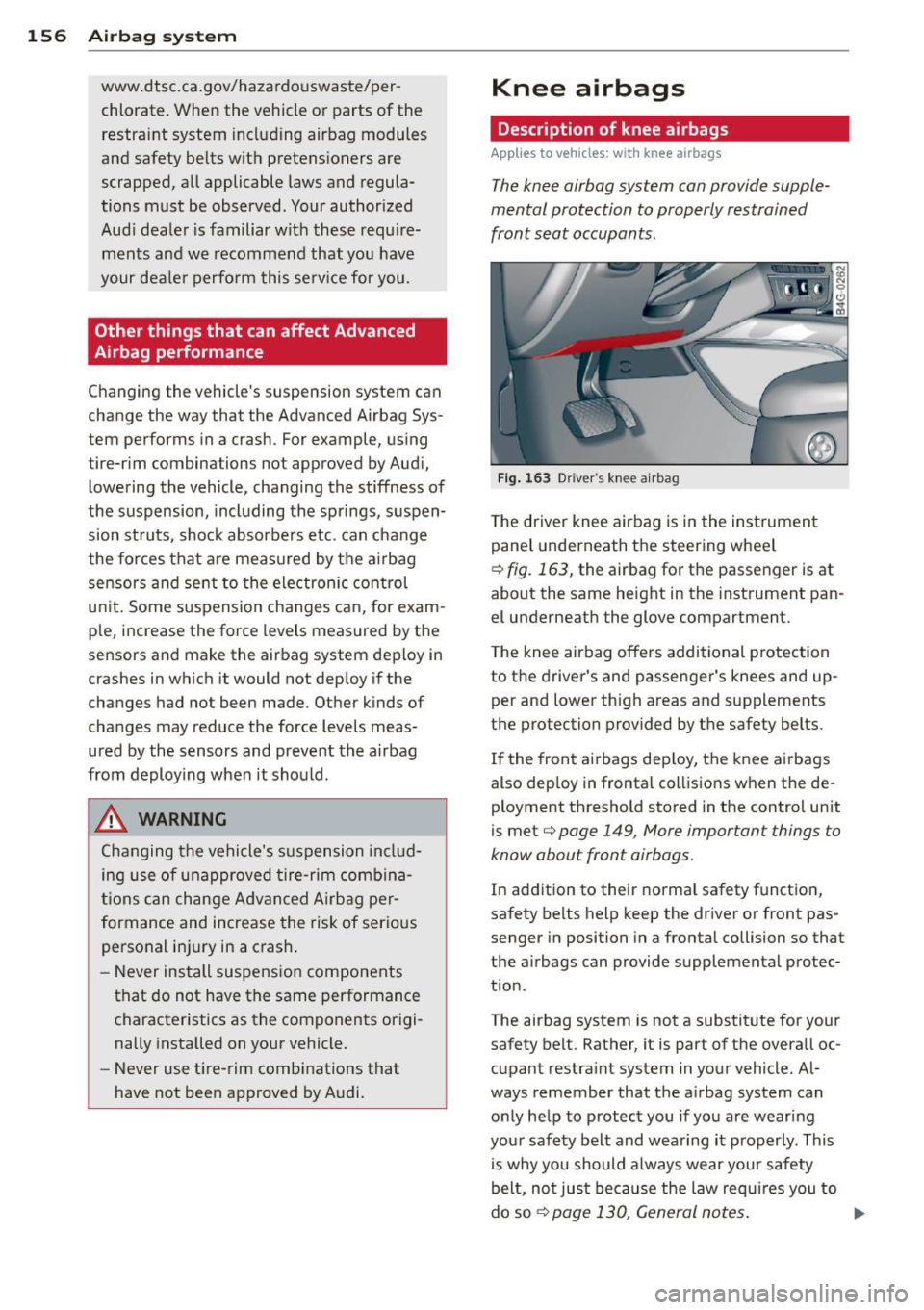
Fig. 163 Driver 's knee airbag
The driver knee airbag is in the instrument
panel underneath the steering wheel
¢ fig. 163, the airbag for the passenger is at
about the same height in the instrument pan
el underneath the glove compartment.
The knee airbag offers additional protection
to the driver 's and passenger's knees and up
per and lower thigh areas and supplements
the protection provided by the safety belts.
If the front airbags deploy, the knee airbags
also dep loy in frontal collisions when the de
ployment threshold stored in the control unit
is met
<=> page 149, More important things to
know about front airbags .
In addition to their normal safety function,
safety belts help keep the driver or front pas
senger in position in a frontal collision so that
the airbags can provide supplemental protec
tion.
The airbag system is not a substitute for your
safety belt . Rather, it is part of the overall oc
cupant restraint system in your vehicle. Al
ways remember that the airbag system can
only help to protect you if you are wearing
your safety belt and wearing it properly. This
is why you should always wear your safety
belt, not just because the law requires you to
do so
¢ page 130 , General notes. ..,.
Page 159 of 302
"' N
a:: I.J "". rl I.O
"' rl
"' rl
Remember too, airbags will deploy only once
and only in certain kinds of accidents -your
safety belts are a lways there to offer protec
tion in those acc idents in which airbags are
not supposed to deploy or when they have al
ready deployed, for example when your vehi
cle str ikes or is struck by another afte r the
fi rst coll is ion.
This is just one of the reasons why an a irbag is
not a substitute for the safety belt . The airbag
system wo rks most effectively when used with
the safety belts . Therefore, always wear your
safety bel ts correctly .
It is important to remember that while the
supplemental knee a irbag system is des igned
to reduce the like lihood of serious injur ies,
o ther in juries, fo r example, swel ling , bruising
and minor abras io ns and frict ion bu rns ca n al
so occur when an airbag in flates.
The knee airbag system basically consists
of :
-The elec tronic control mod ule
- T wo inf latab le airbags (airbag and gas gen-
erato r), one for the driver and one for the
front passenger
- T he airbag ind icator light in the instrument
pane l
The knee airbag system will not deploy:
-when the ign ition is switc hed off
- in frontal collisions w hen the decelerat ion
measured by the control unit is too low
- in s ide collisions
- in rear-end collisions
- in ro llovers
- in the event of a system malfunct io n (wa rn -
i ng/indicator ligh t is on)
r::!>page 18.
& WARNING
- Safety belts and the airbag system can
only p rov ide protection when occ upants
are in the proper seating posit ion
c::>page 149.
-If the airbag indicator light c::> page 18
comes when the vehicle is be ing used,
have the system inspected immediately
A irba g sy stem 15 7
by your authorized A udi dealer. It is pos
sib le that the airbag will inflate when it
is not supposed to , or will not inflate
when it should .
How knee airbags work
Applies to vehicles: with knee airbags
The risk of injury to the leg area can be re
duced by fully inflated knee airbags.
~ N 0 :..c---0
i::....---ali
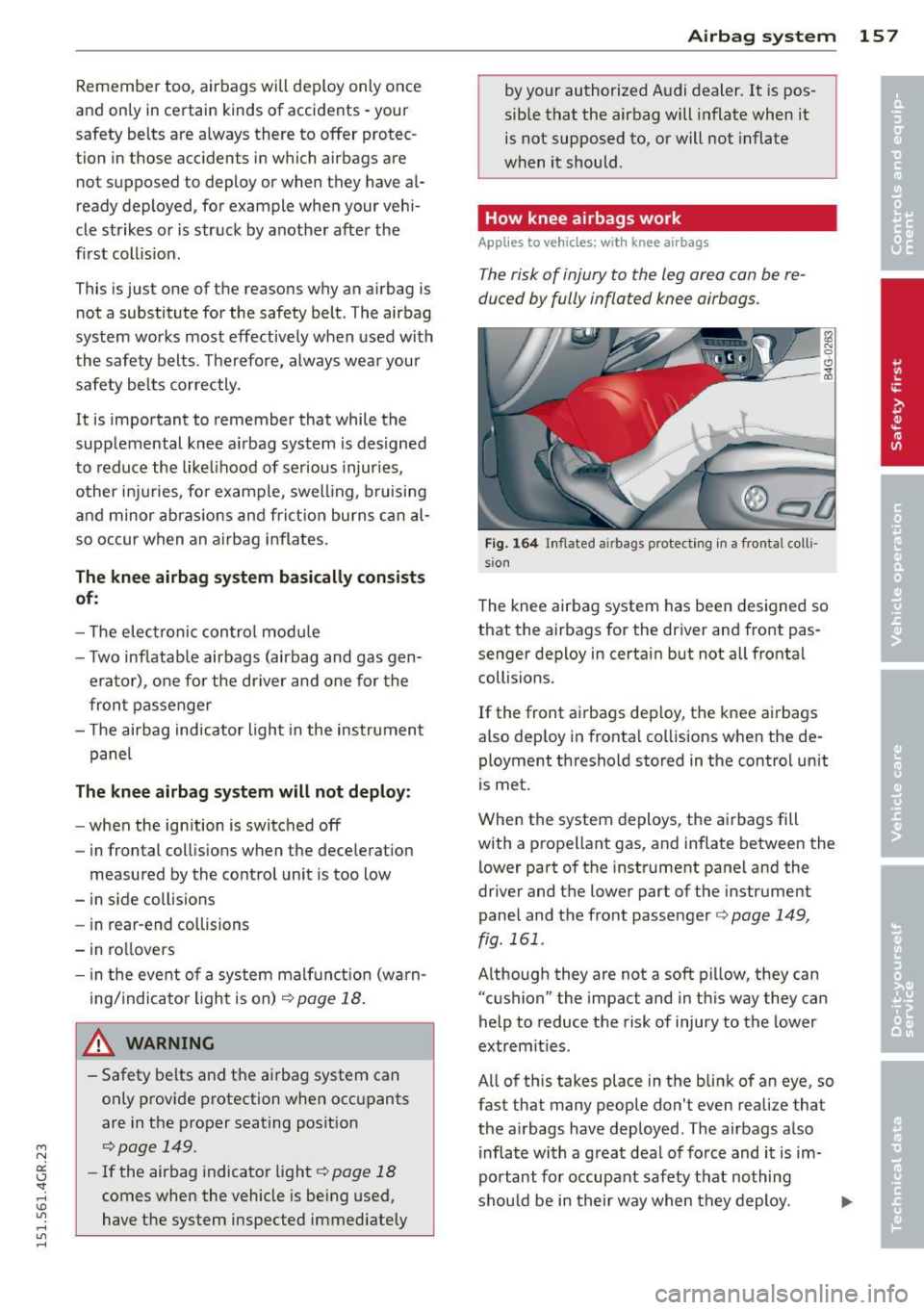
Fi g. 164 In flated a irbags protect ing in a fronta l coll i·
s ion
The knee airbag system has been designed so
that the airbags for the driver and front pas
senger deploy in certain but not all frontal
collisions.
If the front airbags dep loy, the knee airbags
also dep loy in fronta l collisions when the de
ployment th resho ld stored in the control unit
is met.
When the system deploys, the ai rbags fill
with a propellant gas, and inflate between the l ower part of the instrument pane l and the
driver and t he lower part of the instrument
panel and the front passenger
c::> page 149,
fig . 161 .
Although they are not a soft pi llow, they can
"cushion" the impact and in t his way they can
help to reduce the risk of injury to the lower
extremit ies .
A ll of th is takes place in the blink o f an eye, so
fast that many people don't even realize that
the a irbags have deployed. The airbags a lso
i nfla te with a g reat dea l of fo rce and i t is im
po rtant for occupant safety t hat nothing
sho uld be in their way whe n they deploy. ..,.