ignition AUDI RS7 SPORTBACK 2015 Repair Manual
[x] Cancel search | Manufacturer: AUDI, Model Year: 2015, Model line: RS7 SPORTBACK, Model: AUDI RS7 SPORTBACK 2015Pages: 302, PDF Size: 74.76 MB
Page 214 of 302
212 Check ing and filling
- Always disconnect the battery.
- Never smoke or work near heaters or open flames . Fluids in the engine com
partment could start a fire.
- Keep an approved fire extinguisher im
mediately available.
- To avoid electrical shock and persona l in
jury while the engine is running or being started, never touch:
- Ignition cables
- Other components of the high voltage
electronic ignition system.
- If you must perform a check or repa ir
with the engine running:
- Fi rst, fully apply the parking bra ke,
move se lec to r lever to P (Pa rk) .
- Always use extreme caution to preven t
clot hing, jewe lry, or long h air from ge t
ting caught in the radiator fan, V -belts
or other moving parts, or from contact ing hot parts. Tie back hair before
start ing, and do not wear cloth ing that
will hang or droop into the eng ine.
- Min imize exposure to emission and
chemica l hazards¢ ,&..
A WARNING
California Propos ition 65 Warning:
- Engine exhaust, some of its constituents,
and certa in veh icle components conta in
or emit chemicals known to the State of
Califor nia to cause cancer and b irth de
fec ts a nd reproduct ive ha rm. In addition,
certain fluids conta ined in vehicles and
certa in prod ucts of co mponent wear co n
ta in o r emi t chemicals known to the
State o f Ca lifornia to cause can cer and
birth defects or ot her reproductive harm. -
Battery posts, terminals and re lated ac
cessories conta in lead and lead com
pounds, chemicals known to the State of
California to cause cance r and reproduc
tive harms. Wash hands after handling .
(D Note
When adding flu ids, always make sure that
they are poured into the proper conta iner
or f iller opening, otherwise serious dam
age to vehicle systems w ill occur.
® For the sake of the environment
To detect leaks in time, inspect the vehicle
floor pan from underneath regularly. If
you see spots from oil or other ve hicle flu
i ds, have yo ur vehicle inspected by a n au
thori zed Audi dea le r.
Closing the engine hood
.,. Pull the hood down un til the pressure from
t he struts is reduced.
.,. Let the hood drop down and latch in p lace .
Do not try to push it shut; it may fail to en
gage ¢&_ .
A WARNING
-
A hood that is not completely latched
could fly up and b lock your view while dr iv
ing.
- When you close the engine hood, check it
to make sure the safety catch has p roper
ly engaged. The hood sho uld be flush
with the surrou nding vehicle body pa rts.
- If you notice while driv ing t hat the hood
is not s ecured prope rly, stop at onc e and
close it.
Page 217 of 302
"' N
a:: I.J "". rl I.O
"' rl
"' rl
-If you have the impression your engine
consumes excessive amounts of oi l, we
recommend that yo u consult your Audi
dealer to have the cause of your concern
properly diagnosed. Keep in mind that
the accurate measurement of oil con
sumption requires great care and may
take some time . Your Audi dealer has in
str uctions abou t how to measure oil con
sump tion accurately.
Checking the engine oil level
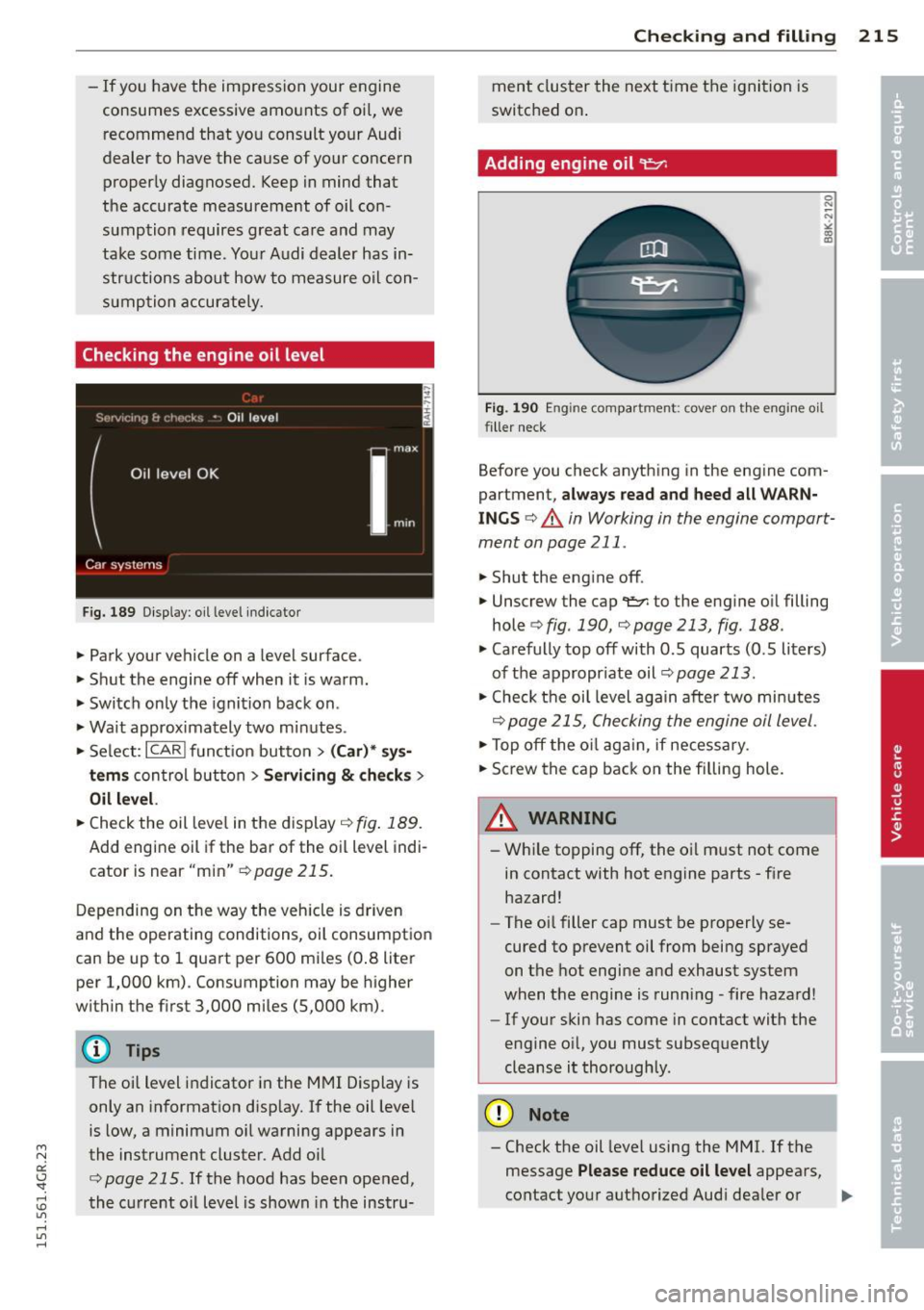
F ig. 189 Di splay : oil lev el indicato r
.,. Park your vehicle on a level surface .
.,. Shut the engine off when it is warm.
.,. Switch only the ignition back on .
.,. Wa it approximately two minutes .
.,. Se lect :
I C ARI funct ion button > ( Car )* sys
tems
con trol button > Ser vici ng & ch ecks >
Oil level.
.,. Check the oil leve l in the display ¢ fig. 189.
Add engine oil if the bar of the oil level indi
cator is near "min"
r:!;> page 215.
Depending on t he way the veh icle is driven
and the operating conditions, oil consumption
can be up to 1 qua rt per 600 mi les (0 .8 liter
per 1,000 km) . Consumption may be higher
within the firs t 3,000 miles (5,000 km) .
@ Tips
The oil level indicator in the MMI Display is
only an in formation disp lay.
If the oil leve l
is low, a minimum o il warning appears in
the instrument cluster. Add oi l
¢page 215. If the hood has been opened,
the c urre nt oil level is shown in the instru- Checkin
g and fillin g 215
ment cluster the next t ime the igni tion is
switched on .
Adding engine oil~
Fig. 19 0 En gin e co mpa rtm ent: cov er on th e engi ne oi l
filler neck
Before you check anyth ing in the engine com
partmen t,
always read and heed all WARN
INGS¢ A in Working in the engine compart
ment on page 211 .
.,. Shut the eng ine off .
.,. Unscrew the cap
¢ fig . 190, ¢page 213, fig.188 .
.,. Carefully top off with 0.5 quarts (0.5 liters)
of the appropr iate oil¢
page 213 .
.,. Check the oi l level again after two mi nutes
¢ page 215, Che cking the engine oil level .
.,. Top off the o il aga in, if necess ary .
.,. Screw the cap back on the fi lling hole.
A WARNING
- Wh ile topping off, the o il m ust not come
in contact with hot engine parts - f ire
hazard!
- The oi l filler cap must be properly se
cured to prevent oil from being sprayed
o n the hot engine and exhaust system
when the engine is runni ng -fire hazard!
- If your s kin has come in contact with the
e ngine o il, you must subsequently
cleanse it thoroughly .
(D Note
-Check the oil level using the MMI. If the
message
Please reduce oil level appears,
contact you r aut hori zed Aud i dea ler or
Ill>-
Page 219 of 302
"' N
a:: I.J "". rl I.O
"' rl
"' rl
Engine cooling system
Coolant
The engine coolant performs two functions: it
keeps the engine from overheating and it pro
tects the engine from freezing in the winter .
The cooling system is sealed and generally re
qu ires little attention .
The cooling system has been filled at the fac
tory with a permanent coolant which does not need to be changed. The coolant consists of a
mixture of specially conditioned water and the
manufacturer's glycol-based coolant addi-
tive G13 antifreeze with anticorros ion addi
tives (50% for USA models; 60% for Canadian models) . This mixture both assures the neces
sary frost protection and protects metal com
ponents in the engine's cooling system from
corrosion and scaling.
It also raises the boil
ing point of the coolant.
Do not reduce the concentration of the coo l
ant in the summer by adding plain water .
The
proportion of coolant additive must be at
least 50% but not more than 60%
to main
tain antifree ze protection and cooling efficien
cy. If the coolant frost protection is too low,
the coolant could freeze and damage the vehi
cle heating and eng ine cooling system .
For year-round driving, antifree ze is added at
the factory for temperatures down to:
- -31°F(-35°C)USA
- -40 ° F ( - 40 °C) Canada.
I f you must add coo lant, use a mixture of wa
ter and coolant addit ive. Mixing the coolant
additive with distilled water is recommended.
& WARNING
Before you check anything in the engine
compartment, always read and heed all
WARNINGS ~.&.
in Working in the engine
compartment on page 211.
(D Note
- Before winter sets in, have the coolant
checked to see if the coolant additive in
Checkin g and fillin g 217
your vehicle is sufficient to meet the cli
mate conditions. This is especia lly impor
tant if you live in a region where the win
ter is extremely co ld. If necessary, in
crease the proportion of coolant additive
to 60% .
- When adding coolant additive to your
cooling system, remember :
- We recommend using only coolant ad
ditive G12++ or G13 (check the label)
for your vehicle . This coolant additive is
avai lable at authorized Audi dealers .
Other types of antifreeze can signifi
cantly reduce corrosion protection. The resulting corrosion can cause a loss of
coolant and serious engine damage.
- Do not add any type of radiator leak seal
ant to your vehicle's engine coolant.
Adding radiator repair fluid may adverse
ly affect the function and performance of
your cooling system and could result in
damage not covered by your New Veh icle
Limited Warranty.
Checking the engine coolant level
The engine coolant level can be checked with
a quick glance.
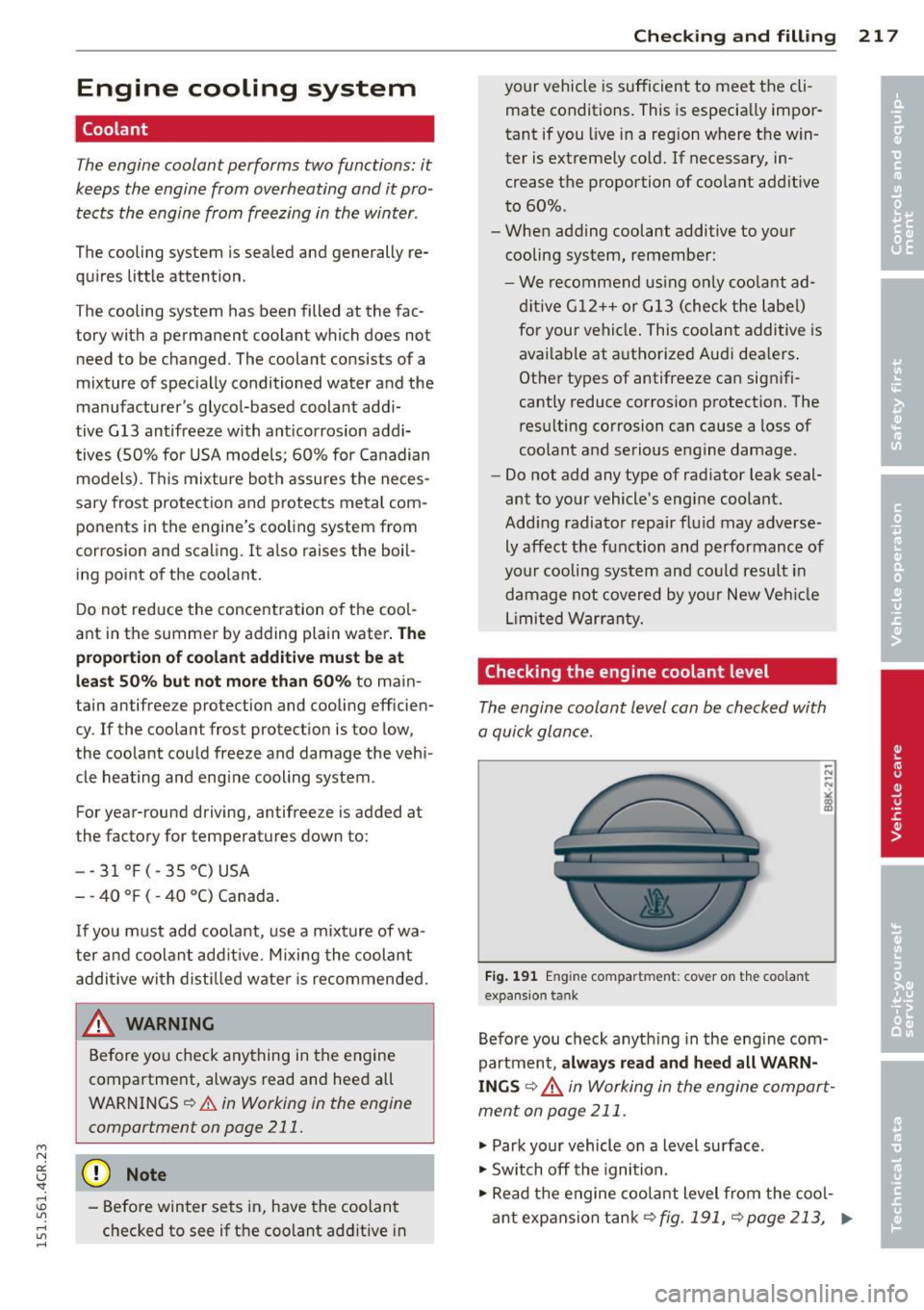
Fig. 191 En gin e compar tment: cover on the coo lant
expansio n tan k
Before you check anyth ing in the eng ine com
partment,
always read and heed all WARN
INGS¢.&, in Working in the engine compart
ment on page 211 .
"'Park your vehicle on a level surface .
"' Sw itch off the ignition.
"' Read the engine coolant level from the cool
ant expansion tank ¢
fig. 191, ¢ page 213, Ill>-
Page 221 of 302
M N
0:: <.J 'SI: ,...., \!) 1.1'1 ,...., 1.1'1 ,....,
If you have lost a consi derable amount of
coolant, then you should add co ld antifreeze
and cold water only when the engine is co ld .
Always use
new engine coolant when refi lling.
D o not fi ll coolant above the "MAX " mark . Ex
cess coolant will be forced out th rough the
p ress ure rel ief valve in the cap when the en
g ine becomes hot .
A WARNING ,_________
-The cooling system is under press ure and
can get very hot . Reduce the risk of
sca ld ing from hot coo lant by following
these steps.
- Tur n
off the eng ine and a llow itto cool
down.
- Protect your face, hands and arms from
escap ing f lu id a nd steam by cover ing
the cap wi th a la rge, thick rag.
- Turn the cap slow ly and very ca refully
in a cou nte r-clockw ise d irect ion while
a pply ing ligh t, downw ard p ress ure on
the to p of the cap.
- To avo id being burned, do no t sp ill an
tifreeze or coolan t on t he exhaust sys
tem or ho t engine parts . U nder certa in
conditions, the ethylene glyco l in en
gine coolant can catc h fire .
- Antifreeze is poisonous . Always store an
tifreeze in its original container and we ll
o ut o f the reach of children.
- If you drain the coolant , it must be
caught and safely stored in a proper con
tainer clearly marked "poison".
@ Note
- Do not add coolant if the expansion tank
i s empty . Ai r could enter the cooling sys
tem and damage the engine. If this is
the case, do not continue driving. Seek professional assistance.
- Coolant po llutes the env ironment and
could cause a n engine fire. Excess coo l
ant wi ll be forced out through the pres
sure re lief valve in the cap when the en
gine becomes hot.
Checkin g and fillin g 219
-If, in an emergency, on ly wate r can be
added, the correct ratio between water
and antifreeze ¢
page 217 must be re
stored as soon as possible.
@) For the sake of the environment
Drained coolant sho uld not be reused. A l
ways d ispose of used coolant while observ
i ng a ll environmental regulations.
, Radiator fan
The radiator fan switches on automatically by
itself .
An auxiliary electric radiato r fan switches on
and
off depending on coolant temperature
and othe r vehicle ope rat ing cond it ions.
After yo u switch the eng ine o ff, the aux iliary
f an can continue running for up to 10 m inutes
- even with the ignition off. It can even switch
on aga in later by itself¢ .&. , if
- the temperatu re of the engine coo lant rises
du e to the h eat build -up from th e engin e in
the engine compa rtment, or
- the engine compa rtment heats up because
the vehicle is parked in intense sunlig ht.
A WARNING ~
- To reduce the risk of persona l inju ry nev-
er touch the radiator fan .
- The a uxiliary electric fan is tempe rat ure
contro lled and can switch on suddenly
even when the engine is not running.
- The a uxiliary radiator fan sw itches on a u
tomatically when the engine coo lant
reaches a certai n temperature and will
continue to ru n until the coo lant temper
ature drops. •
•
Page 225 of 302
"' N
a:: I.J ""'. rl I.O
"' rl
"' rl
(D Note
- Do not disconnect the ve hicle battery
when the ignition is on or when the en
gine is running, otherwise, you will dam
age electronic components in the electri
ca l system .
- If your vehicle is going to stand for a
l ong period of time without being driven,
protect the battery from "freezing", oth
erwise it w ill be damaged and w ill then
have to be replaced .
- When opening the doors, the windows
l ower app rox imately 10 mm automati
cally. This f unction is not available when
t h e battery is disconnec ted, wh ic h
means there is a ris k t hat the door se al
or the w indow co uld be damaged .
Battery charging
Starting the engine requires a well charged bat tery.
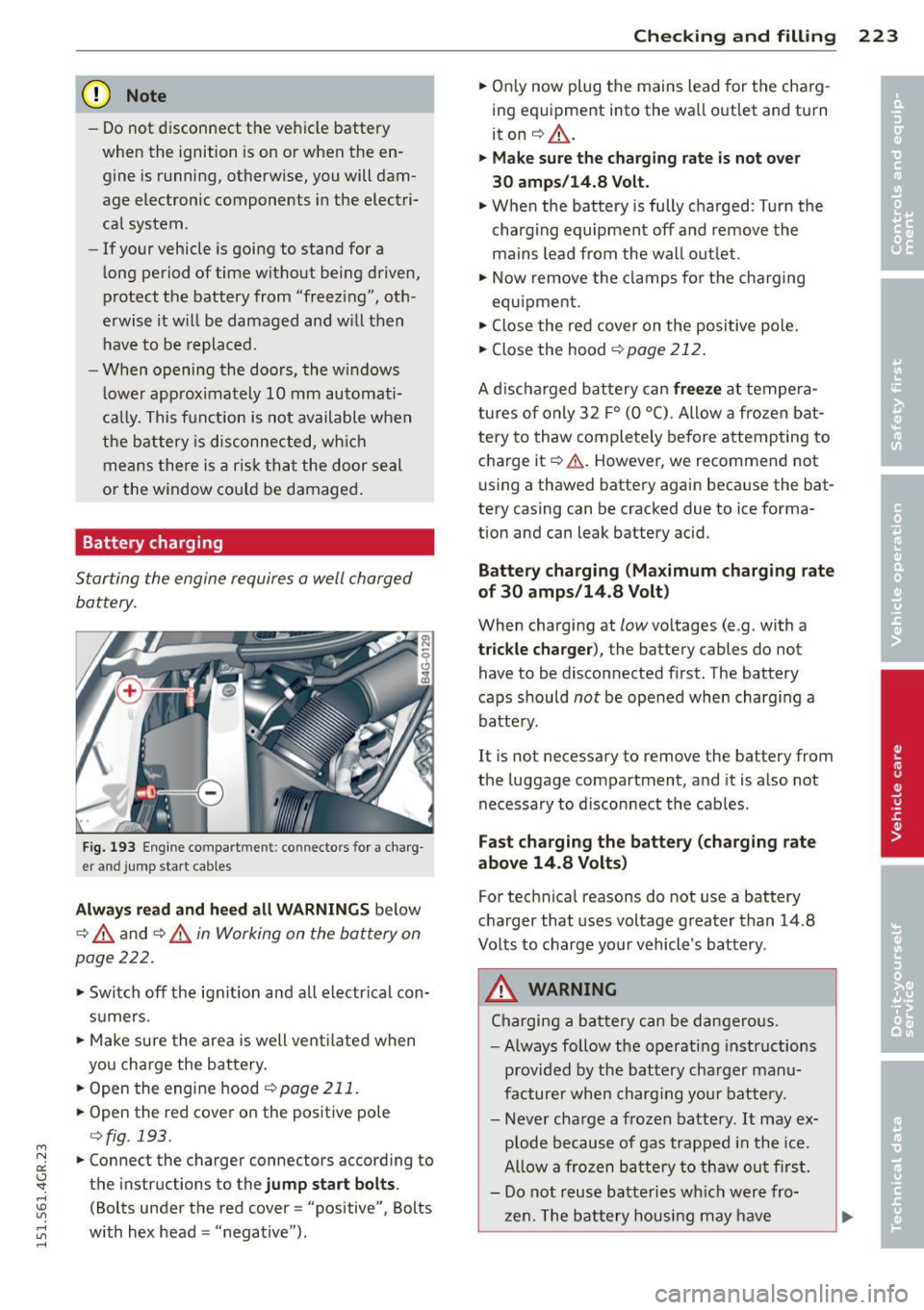
F ig. 1 93 En gine co mpartme nt: c onnectors for a charg
er a nd jum p sta rt cable s
Always read and heed all WARNINGS below
¢ .&. and
¢.&. in Working an the battery on
page 2 22.
"'Switch off the ignit ion and all electrica l con
s u mers .
"' Make sure the area is well vent ilated when
you charge the battery.
"' Open the engine hood
c::> page 211 .
"'Open the red cover o n the posit ive pole
<=> fig . 193.
"' Connect the charger connectors accord ing to
the instruc tions to the
jump start bolts .
(Bolts under the red cover = "positive", Bolts
with hex head = "nega tiv e").
Checkin g and fillin g 223
"'On ly now plug the mains lead for the cha rg
i ng eq uipment into the wa ll outlet and turn
it on
c::> ,&. .
"'Make sure the charging rate is not o ver
30 amps /14.8 Volt .
"'When the battery is fully c harged : Turn the
charg ing equipment off and remove the
mains lead from the wa ll out let .
"' Now remove the clamps fo r the cha rg ing
equ ipme nt.
"' Close the red cover on the positive pole .
"' Close the hood ¢
page 212 .
A d ischa rged batte ry can freeze at tempe ra
tures of only 3 2 F
0 (0 °C). Allow a fro zen bat
te ry to thaw completely before attemp ting to
c h arge it
c::> & . However, we recommend not
using a thawed battery again because the bat
tery casing can be cracked due to ice forma
tion and can leak battery ac id.
Battery charging (Maximum charging rate
of 30 amps /14.8 Volt )
When cha rging at
low vo ltages (e .g. with a
trickle charger), the batte ry cables do not
have to be disconnected f irst . The battery
caps should
not be ope ned when charg ing a
batte ry .
It is not necessary to remove the battery from
the luggage compartment, and it is a lso not
necessary to d iscon nect the cab les .
Fa st charging the battery (cha rging rate
above 14.8 Volts)
Fo r technical reasons do not use a battery
c h a rger that uses voltage g reater than 14 .8
Volts to charge yo ur vehicle's battery .
A WARNING
C harging a battery can be dangero us.
- Always follow t he ope rati ng inst ructions
provi ded by the battery cha rg er ma nu
f ac turer when chargi ng you r battery.
- N ever cha rge a fro zen batte ry.
It may ex
p lode because of gas trapped in the ice .
A llow a froz en ba tte ry to thaw out first.
- D o not r euse ba tte ries wh ich were fro
z en. The bat tery housi ng may
h ave
Page 258 of 302
256 Tire s and wheel s
Description
The tire pressure monitoring system monitors
th e pressure in the four tir es when driving .
The system uses sensors that measure the
temperature and pressure in the tires. Theda
ta is sent from these sensors to the control
module by rad io frequency .
The tire pressure monitoring system shows
the current pressures and temperatures
of the
tires in the Infotainment system
c:> page 256 .
It also compares the current tire pressures
with the sto red press ures and gives a warn ing
in the dr iver information system if the t ire
p ressu re is different from what is sto red
<=:> page 257.
The system does not detect if the sto red ti re
p ressu res matc h the recommended tire pres
sures . Yo u must resave the tire p ress ures
<=:> page 257:
- every time the tire pressures change, for ex
amp le when the load in the veh icle changes,
- after replac ing a tire, or
- i f wheels with new wheel sensors are used .
.,&. WARNING
- The tire pressure mo nitor ing system as
sists t he d rive r in monito ring t ire pres
s ur es. The dr iver is responsible fo r having
the tires in flated t o the co rrec t press ure.
- Do not change t he tire pressu re when the
t empe rat ure of the ti re is high. This
cou ld resul t in ser io us damage to the ti re
and even cause t he tire to burst, increas
ing th e risk of an accident.
- A tire with low pressure flexes more . This
heats the tire up too much. This could
cause the tread to separate and even
cause the tire to burst, increasing the
risk
of a n accident.
- The tire pressure mon itor ing system
does not warn about damage or defects
in the tire construct ion that could ca use
the tire to b urst, for examp le . Inspect
yo ur t ires regularly .
{® For the sake of the environment
Low tire pressure increases fuel consump
tion and tire wear .
(D Tips
- If tires are replaced, the senso rs/valves
do not need to be removed o r replaced.
Just replace the va lve stem and, if neces
sary, the valve and the whee l electronics .
If you have questions, see your a uthor
ized Aud i dea ler o r a qualified workshop .
- Us ing the tire mob ility kit can results in
an incorrect display or a ma lfunction in
t he tire pressure monito ring system .
Have the sensors replaced by an a uthor
ized Aud i dea le r o r a qua lified workshop.
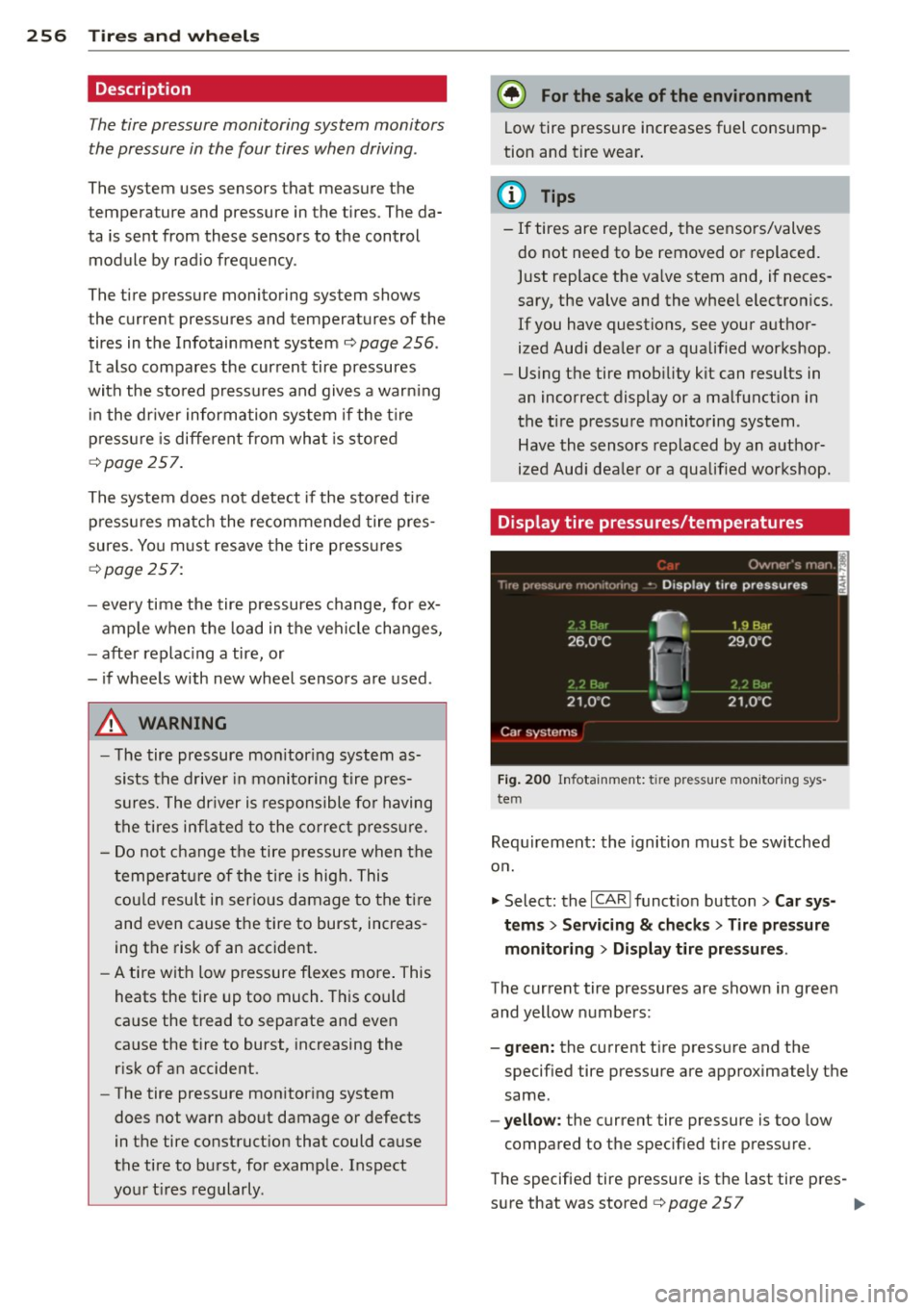
Display tire pressures/temperatures
Fi g. 2 00 In fotainme nt: t ire press ure moni tor ing sys
tem
Requ irement : the ignition must be sw itched
o n .
.,. Select: the
I CAR I funct io n button > Car sy s
tem s
> Servicing & ch eck s > Tire pressure
monitoring
> Disp lay tire pr essures .
The current tire pressures are shown in green
and yellow numbers:
- green: the current tire press ure and the
specified tire pressure are approximately the
same .
-yellow : the current tire pressure is too low
compared to the specified tire pressu re.
The specified tire pressure is th e last tire pres -
s u re that was stored
c:> page 2 5 7 ..,
Page 259 of 302
"' N
a:: I.J "". rl I.O
"' rl
"' rl
Note that the tire pressure also depends on
the tempe rature of the tire . Every 50 °F
(10 °C) increase in tire temperature results in
the tire pressure increasing by approximately
0 .1 bar. The tire pressure increases as the en
g ine becomes warmer while drivi ng .
A WARNING
Read and follow the impo rtant informa
tion and notes
c::> page 2 56.
(D Tips
The tire pressure or temperature are not disp layed i n adaptation mode . Dashes --,-
are show n in p lace o f the pressure and
t em peratur e.
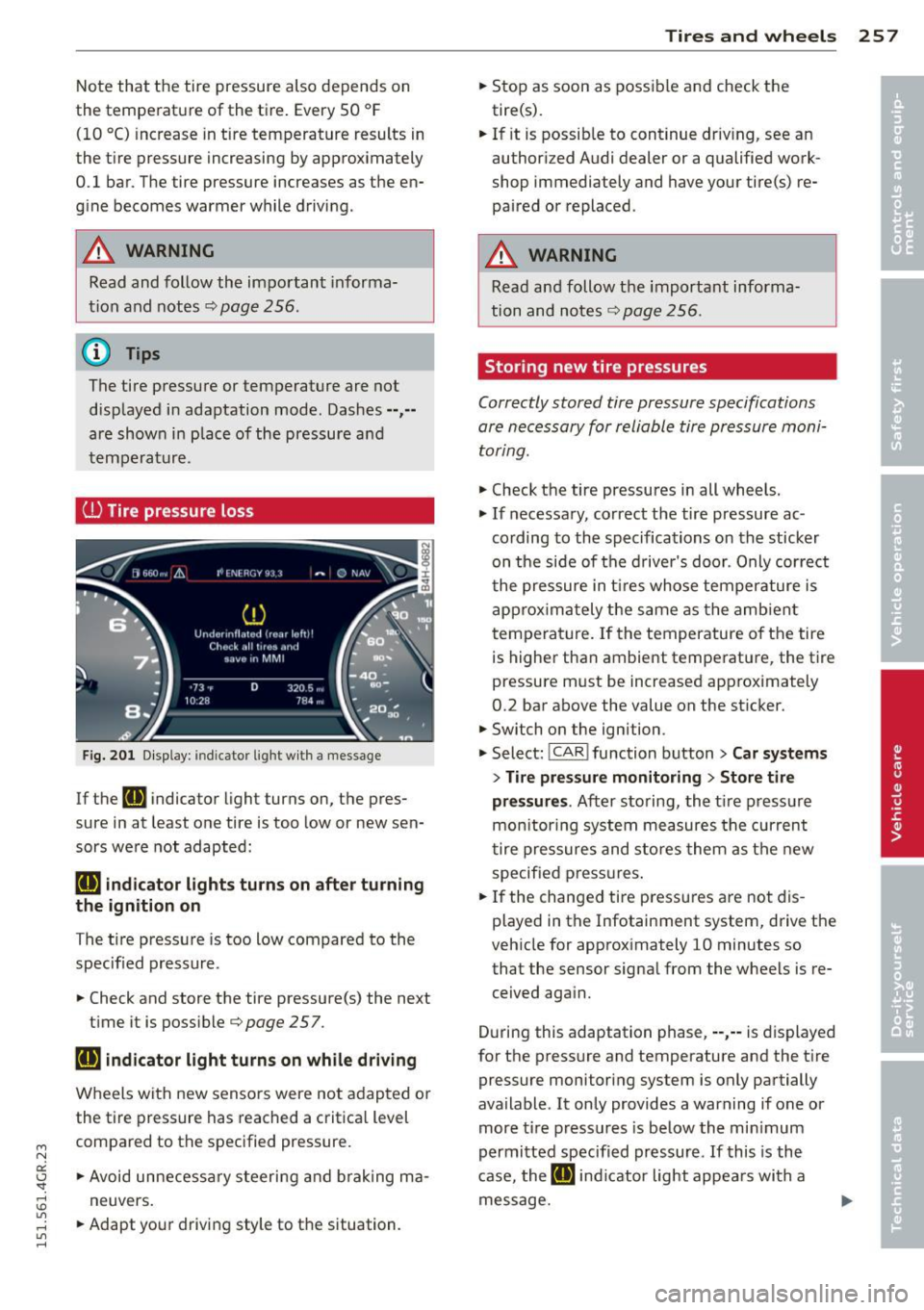
(J) Tire pressure loss
Fig. 201 D isp lay : in dicato r light w it h a message
If the [I] indicator light turns on, t he pres
sure in at least one tire is too low or new sen
sors were not adapted:
[I] indicator lights turns on after turning
the ignition on
The ti re pressu re is too low compared to the
specified pressure .
.. Check and store t he tire pressure(s) the next
time it is poss ible
c::> page 257.
[I] indicator light turns on while driving
Wheels with new senso rs were no t adap ted o r
the tire pressure has reached a critica l level
compared to the specified pressure.
.. Avoid unne cess ary steeri ng and braking m a
neuvers.
.. Adapt yo ur driving style to the s ituation.
Tires and wheels 25 7
.. Stop as soon as poss ible and check the
tire(s) .
.. If it is possib le to continue driv ing, see an
author iz ed Audi dealer or a qualified work
shop immediately and have your tire(s) re
paired or replaced .
A WARNING
Read and follow t he important informa
tion and notes
c::> page 256 .
Storing new tire pressures
-
Correctly stored tire pressure specifications
are necessary for reliable tire pressure moni
toring .
.. Check t he tire pressures in all wheels.
.,. If necessary, correct the tire pressure ac
cording to the specifications on the sticker
on t he side of the d rive r's door . Only correct
t he pressure in t ires whose temperature is
app rox im ately the s ame as th e amb ient
t emperat ure. If the temperature o f the tire
is highe r than ambient tempe rat ure, the t ire
pressure m ust be increased approximately
0.2 bar above the value on the st icker .
.. Switch on the ignition .
.,. Select:
!CAR ! function butt on> Car systems
> Tire pressure mon itoring > Store tire
pressures .
After storing, th e tir e p ress ure
m oni tor ing system measures the cur ren t
t ire pre ssures and st ores them a s the new
specified press ures .
.. If the changed ti re pressu res a re not dis
played in the Infotainment system, drive t he
veh icle for approximately 10 minutes so
that the sensor signa l from the wheels is re
ceived aga in .
D uring this adaptation phase, ··,·· is displayed
for the pressure and temperature and the t ire
pressure monitoring system is only partially
available . It only provides a warning if one or
more t ire press ures is be low the min imum
permi tted specified pr essure . If this is the
case, the
[I] ind ic a tor light appea rs with a
message.
Page 264 of 302
262 What do I do now?
• Switch on the ignition.
Inflating tire
• Move the switch @~ fig. 207 on the elec
tric a ir pump
ll to posit ion I. After 5 mi
nutes, tir e pressure must have reached at
least 1.8 bar.
• Switch the electric air pump off -switch in
position
0. If the required tire pressure of at
l east 1.8 bar has not been reached, follow
the instructions in the section
Re-inflating
tire.
Re-inflating tire
• Remove the hose from the valve and pull the
plug out of the socket.
• Drive the vehicle slow ly 33 feet (10 meters)
backward or forward. This helps to distrib
ute the sealant better.
• Remove the empty inflation bottle and
screw the hose®~
fig. 206 from the elec
t ric pump directly onto the va lve.
• Insert the plug@~
fig. 206 into the socket
for the cigarette lighter.
• Switch on the ignition.
• Move the switch @~
fig. 207 on the e lec
tric air pump
ll to position I. After 5 mi
nutes, tire pressure must have reached at
least 1.8 bar.
• Switch the electric air pump off -switch in
pos it ion
0 . If the requ ired tire pressure of at
least 1.8 bar has not been reached, it is not
poss ible to make a repa ir with the tire seal
ant. Seek professional assistance.
Disassembling Tire Mobility System
• Remove the hose from the valve and pull the
plug out of the socket.
• Screw the dust cap onto the valve .
• Place the empty sealant bottle back in the
original packaging and clip it in place under
the floor so that no tire sealant can run out
into the vehicle.
• Place the electric air pump in the luggage
compartment for the time being.
1l The electr ic air p ump sho uld never ru n fo r long er than
6 minut es.
• Start driving right away so that the sealant
is distributed in the tire .
A WARNING
=
- Follow the manufacturer 's safety instruc-
tions on the decal for the air pump and
the sealant bottle.
- If a tire pressure of 1.8 bar cannot be
achieved after pumping for 5 minutes,
the t ire is too severely damaged. Do not
continue to dr ive .
- Seek professional ass istance if it is not
possible to repa ir the tire w ith the tir e
sealant.
(D Tips
- Do not operate the electric air pump for
more than 6 minutes without stopping,
otherwise it can overheat . When the air
pump has cooled down, you can continue
to use it.
- If sealant has escaped, allow it to dry,
then you can pee l it off.
Final check
After driving for a short distance, tire pressure must be checked
• After driving for about 10 min utes, stop and
check the tire pressure.
• If tire pressure is sti ll at least 1.3 bar, in
flate the tire to specif ied pressure (see driv
er's side B-pillar), drive to the next repair
shop and have the tire and the sealant bot
tle replaced .
• If tire pressure is less than 1.3 bar, the tire
is too severely damaged . Do not continue to
drive. Seek professional assistance.
A WARNING
If tire pressure is less than 1.3 bar after
driving for 10 minutes, the tire is too se
verely damaged. Do not continue to drive.
Seek professional ass istance .
-
Page 273 of 302
"' N
a:: I.J "". rl I.O
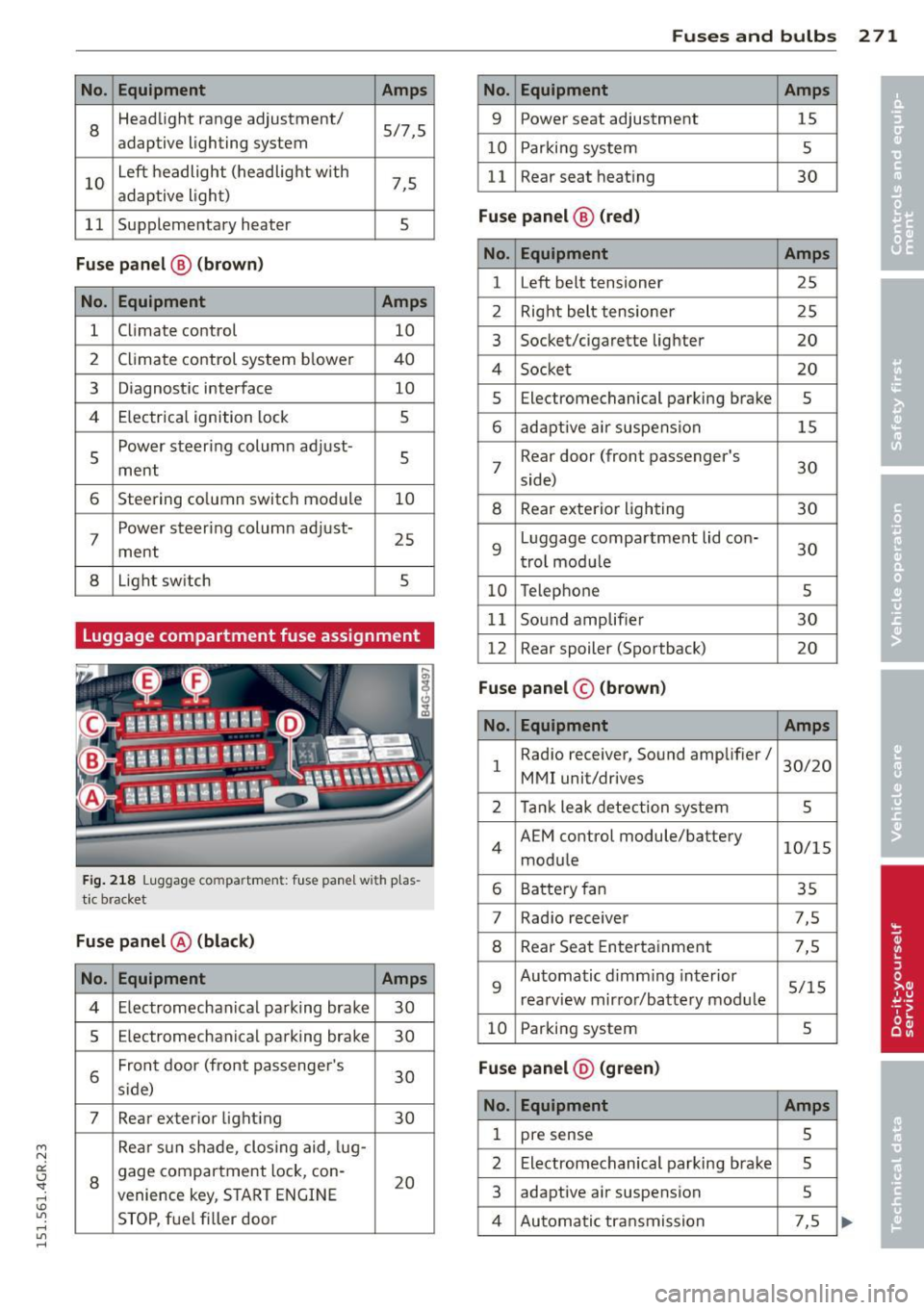
"' rl
"' rl
No. Equ ipment Amps
8
Headlight range adjustment/ 5/7,5
adaptive lighting system
10
Left headlight (headlight with 7,5 adaptive light)
11 Supplementary heater s
Fuse p anel @ (bro wn)
No . Equipment Amps
1 Climate control 10
2
Climate control system blower 40
3
Diagnostic interface 10
4
E lectrical ignition lock 5
5
Power steering column adjust-
ment
5
6 Steering column switch module 10
7
Power steering column adjust-
ment
25
8 Light switch 5
Luggage compartment fuse assignment
Fig . 218 Luggage compartment: fuse panel with plas
tic bracket
Fuse p anel @ (black )
No. Equipment Amps
4 Electromechan ical parking brake 30
5
Electromechanical parking brake 30
6
Front door (front passenge r's
30 s ide)
7 Rear exterior light ing 30
Rea r sun shade, closing aid, lug-
8
gage compartment lock, con-
20 venience key, S TART ENGINE
STOP, fuel filler door
Fu se s and bulb s 2 71
No. Equipment Amps
9 Power seat adjustment 15
10
Parking system 5
11
Rear seat heating 30
Fu se pan el@ (r e d )
No . Equipment Amps
1 Left belt tensioner 25
2
Right belt tensioner 25
3
Socket/cigarette lighter 20
4
Socket 20
5
Electromechanical parking brake 5
6 adaptive air suspension 15
7
Rear door (front passenger's
30 side)
8 Rear exterior lighting 30
9
Luggage compartment lid con-
30 trol mod ule
10 Telephone 5
11
Sound amplifier 30
12
Rear spoiler (Sportback) 20
Fuse panel © (brown)
No . Equipment Amps
1
Radio receiver, Sound amplifier/
30/20
MMI unit/drives
2 Tank leak detection system 5
4
AEM control module/battery 10/15
module
6 Battery fan 35
7
Rad io receiver 7,5
8 Rear Seat Entertainment 7,5
9
Automatic d imm ing interior 5/15
rearview mirror/battery mod ule
10 Parking system 5
Fu se pan el@ (gre en)
No . Equipment Amps
1 pre sense 5
2
Electromechanical parking brake 5
3
adaptive air suspension 5
4 Automatic transmission 7,5
Page 281 of 302
"' N
a:: I.J ""'. rl I.O
"' rl
"' rl
Technical data
Vehicle identification
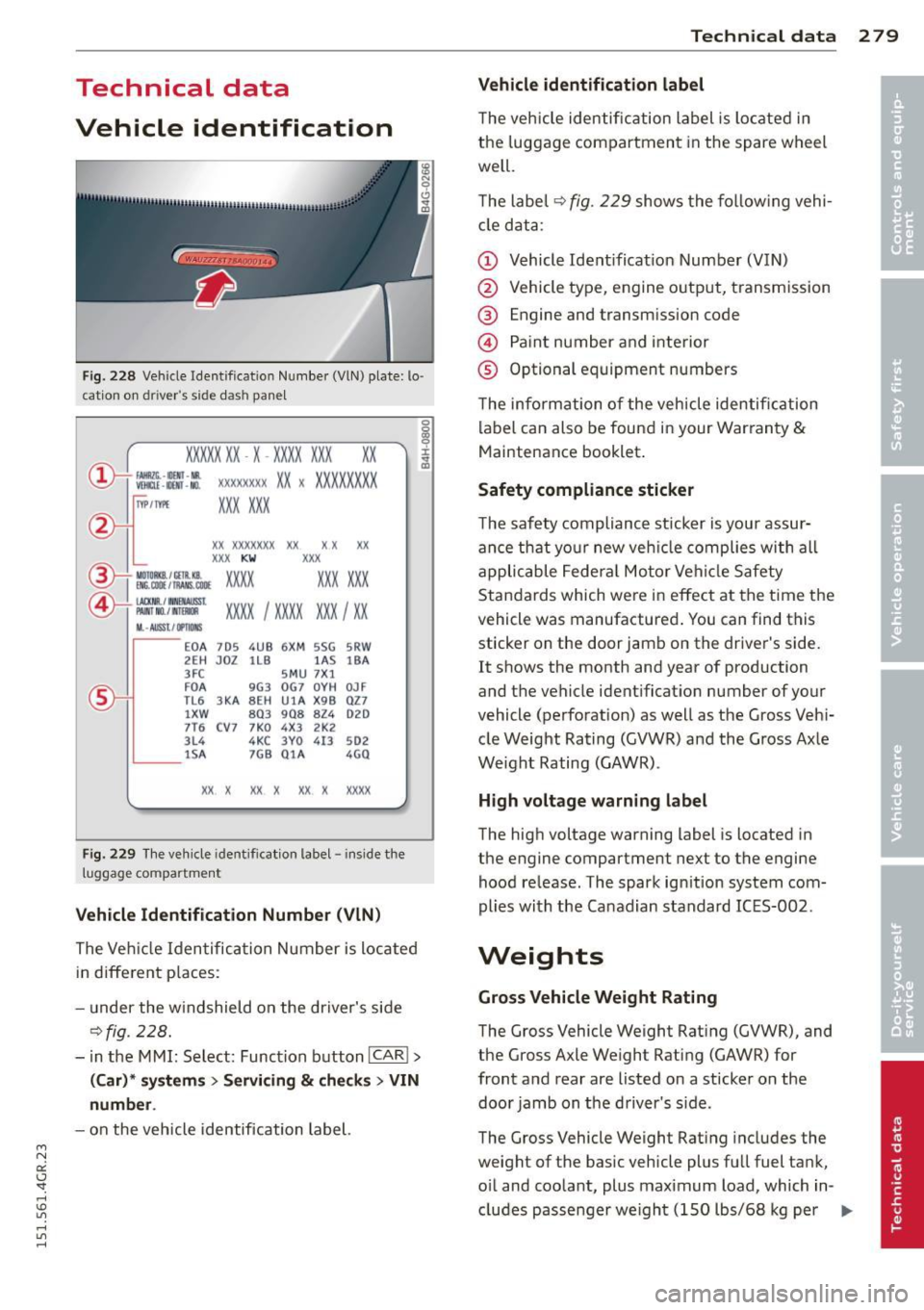
F ig. 228 Veh ide Identificat ion Number (VlN) plate: lo·
cat ion on driver's side dash pane l
XXXXX XX · X -XXXX XXX
~ fAllftlli. -llllll · NR. ~ W!ru -IIOO -NO.
xx
XXXX XXXX XX X XXXXXXXX
XXX XXX
IYP /TYPE
XX XXXXX XX XX X X XX
XXX KW XXX
®i ~W.::·f :l~~ XXXX XXX XXX
©+ ::rw= xxxx I xxxx XXX I xx
M. · AUSSt I IJ'IIDIIS
~--
EOA 7D5 4UB 6XM SSG SR W
2EH JOZ
1L B lAS 1B A
3FC SMU 7Xl
FDA 9G3 OG7 OYH OJF
TL6 3KA 8EH UlA X98 027
l XW 803 908 824 D2D
7T6 CV7 7KO 4X3 2K2
3L4 4KC 3YO 413 502
1SA 7GB 01A 4GO
XX. X XX X XX X XXXX
Fig. 229
The vehicle identification label- in side the
l u ggage compartme nt
Vehicle Identification Number (VlN)
The Veh icle Identification Number is located
in different p laces :
- under the w indshield on the driver's side
¢fig. 228.
- in the MMI: Select: Function button ICAR ! >
(Car)* systems > Servicing & checks > VIN
number .
-on the vehicle identification label.
Techni cal data 2 79
Vehicle identification label
The vehicle identification label is located in
the luggage compartment in the spare wheel
well.
T he label¢
fig. 229 shows the following vehi
cle data:
(D Vehicle Identificat ion Number (VIN)
@ Vehicle type, engine output, transmission
® Engine and transmission code
© Paint number and interior
® Optional equipment numbers
The information of the veh icle identification
label can also be found in your Warranty
&
Maintenance booklet .
Safety compliance sticker
The safety compliance sticker is your assur
ance that your new veh icle complies with all
applicable Federal Motor Vehicle Safety
Standards which were in effect at the time the
vehicle was manufactured. You can find this
sticker on the door jamb on the driver's side.
It shows the month and year of production
and t he vehicle identification number of your
vehicle (perforation) as well as the Gross Vehi
cle Weight Rating (GVWR) and the Gross Axle
Weight Rating (GAWR) .
High voltage warning label
The high voltage warning label is located in
the engine compartment next to the engine
hood release. The spark ignition system com
plies with the Canadian standard ICES-002 .
Weights
Gross Vehicle Weight Rating
The Gross Vehicle Weight Rating (GVWR), and
the Gross Axle Weight Rating (GAWR) for
front and rear are listed on a sticker on the
door jamb on the driver's s ide.
The Gross Vehicle Weight Rating includes the
weight of the basic vehicle plus full fuel tank,
oil and coolant, plus maximum load, which in
cludes passenger we ight (150 lbs/68 kg per
II>--