steering wheel AUDI RS7 SPORTBACK 2015 Owners Manual
[x] Cancel search | Manufacturer: AUDI, Model Year: 2015, Model line: RS7 SPORTBACK, Model: AUDI RS7 SPORTBACK 2015Pages: 302, PDF Size: 74.76 MB
Page 4 of 302
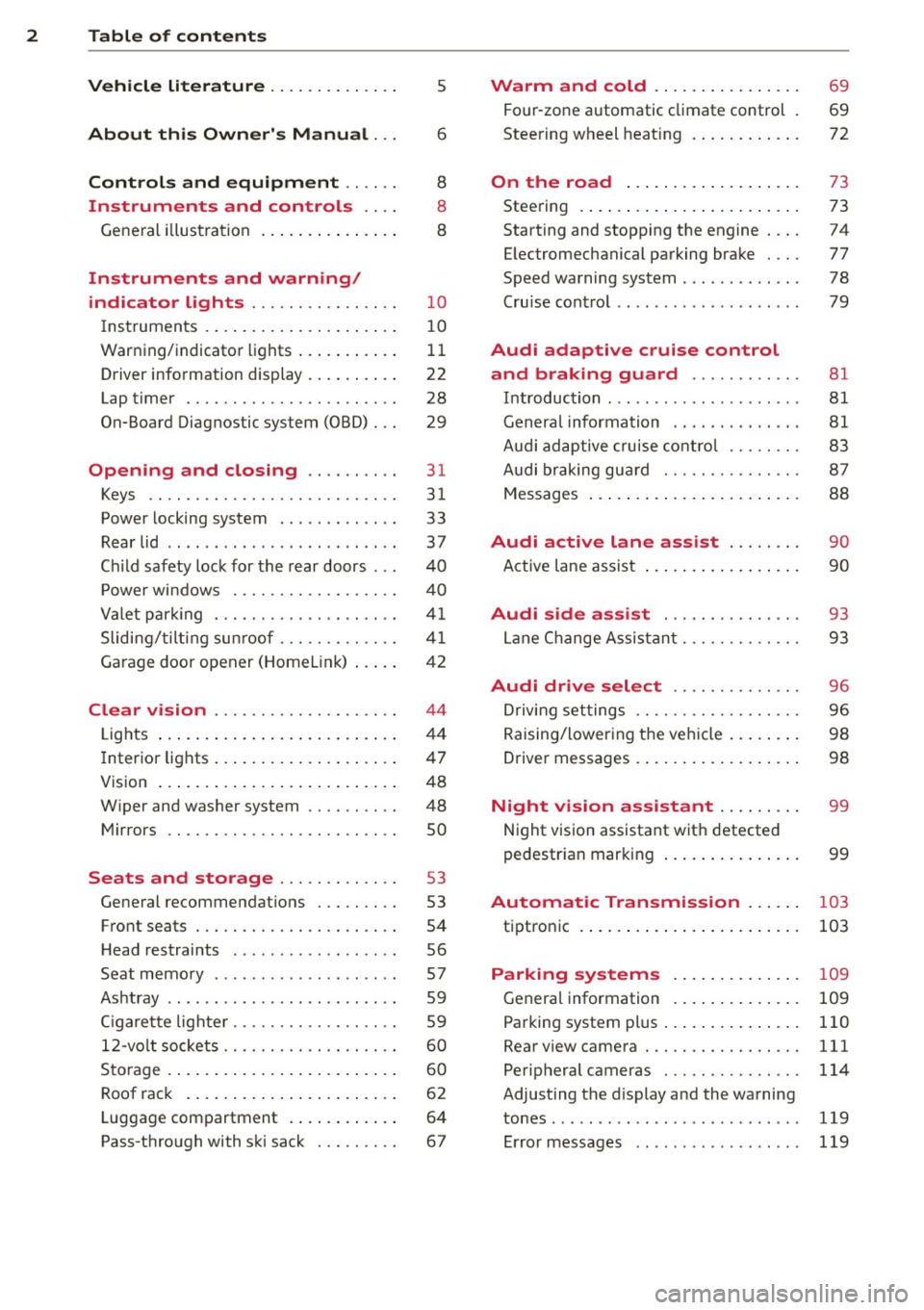
2 Table of contents Vehicle literature ............. .
About this Owner's Manual ...
Controls and equipment .. ... .
Ins truments and controls .. . .
General illustration .............. .
Instruments and warning/
indicator lights ............... .
Instruments ............ ... .. ... .
Warning/indicator lights .......... .
Driver information display ... ... ... .
Lap timer .. ................ ... . .
On-Board Diagnostic system (OBD) .. .
Opening and closing ......... .
Keys .. .. .................. ... . .
Power locking system .......... .. .
Rear lid .... .................. .. .
Child safety lock for the rear doors .. .
Power windows .......... .. .. ... .
Valet parking ................... .
Sliding/tilting sunroof ............ .
5
6
8
8
8
10
10
11
22
28
29
31
31
33
37
40
40
41
41
Garage door opener (HomeLink) . . . . . 42
Clear vision ................... .
Lights .......... ........ .. .. ... .
Interior lights ................... .
V1s1on ..... .............. ... ... .
Wiper and washer system ......... .
Mirrors .. ............... ....... .
44
44
47
48
48
so
Seats and storage . . . . . . . . . . . . . 53
General recommendations ........ .
Front seats ............... ... ... .
Head restraints .... ...... .. .. .. . .
Seat memory ............. ... .. . .
Ashtray ........................ .
Cigarette lighte r ................. .
12-volt sockets ......... ...... .. . .
Storage .... ... .......... ....... .
Roof rack ....... ........ .. .. ... .
Luggage compartment ........ .. . .
Pass -through with ski sack ........ . 53
54
56
57
59
59
60
60
62
64
67
Warm and cold ... .......... .. .
Four-zone automatic climate control
Steering wheel heating ........... .
On the road ... ... .......... .. .
Steering .. .... .. .... ......... .. .
Starting and stopping the engine ... .
Electromechanical parking brake ... .
Speed warning system ............ .
Cruise control . ... ... ......... ... .
Audi adaptive cruise control
and braking guard ........... .
Introduction ..... ............... .
General information .... .... .... . .
Audi adaptive cruise control ....... .
Audi braking guard ............ .. .
Messages ..... .. .. ............ . .
Audi active lane assist ....... .
Active lane assist ... ........... .. .
Audi side assist ......... ..... .
Lane Change Assistant ........ .... .
69
69
72
73
73
74
77
78
79
81
81
81
83
87
88
90
90
93
93
Audi drive select . . . . . . . . . . . . . . 96
Driving settings .. .......... ..... .
Raising/lowering the vehicle ..... .. .
Driver messages .. ... ............ .
Night vision assistant ........ .
Night vision assistant with detected
96
98
98
99
pedestrian marking . . . . . . . . . . . . . . . 99
Automatic Transmission . . . . . . 103
tiptronic . . . . . . . . . . . . . . . . . . . . . . . . 103
Parking systems . . . . . . . . . . . . . . 109
General information . . . . . . . . . . . . . . 109
Parking system plus . . . . . . . . . . . . . . . 110
Rearviewcamera . ............. ... 111
Peripheral cameras . . . . . . . . . . . . . . . 114
Adjusting the display and the warning
tones. ....... ................... 119
Error messages . . . . . . . . . . . . . . . . . . 119
Page 5 of 302
M N
0:: <.J 'SI: ,...., \!) ..,.,
,...., ..,., ,....,
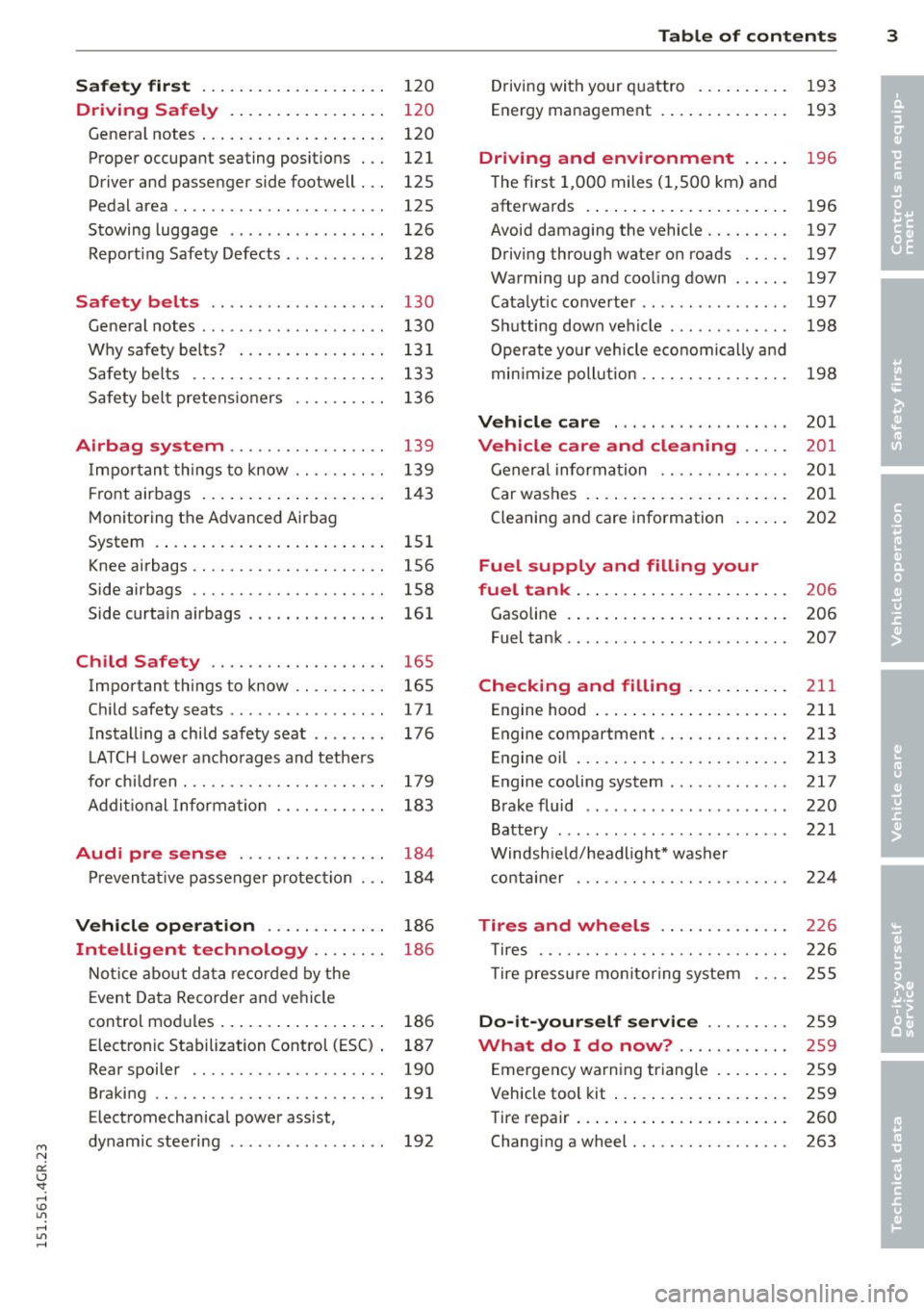
Safet y fir st . . . . . . . . . . . . . . . . . . . . 120
Driving Safely . . . . . . . . . . . . . . . . . 120
General notes . . . . . . . . . . . . . . . . . . . . 120
Proper occupant seating posit ions . . . 121
Driver and passenger side footwell . . . 125
Pedal area . . . . . . . . . . . . . . . . . . . . . . . 125
Stowing luggage . . . . . . . . . . . . . . . . . 126
R eport ing Safety Defects . . . . . . . . . . . 128
Safety belts . . . . . . . . . . . . . . . . . . . 130
General notes . . . . . . . . . . . . . . . . . . . . 130
Why safety bel ts? .. .. .. .. .. . . .. . . 13 1
Safety belts . . . . . . . . . . . . . . . . . . . . . 133
Safety belt p re tens ioners . . . . . . . . . . 136
Airbag system . . . . . . . . . . . . . . . . . 139
I mpor tan t th ings to know . . . . . . . . . . 139
Fr ont airbags . . . . . . . . . . . . . . . . . . . . 14 3
M onitoring the Advanced Airbag
System . . . . . . . . . . . . . . . . . . . . . . . . . 151
Knee airbags . . . . . . . . . . . . . . . . . . . . . 156
Side airbags . . . . . . . . . . . . . . . . . . . . . 158
Side curta in a irbags . . . . . . . . . . . . . . . 161
Ch ild Safety . . . . . . . . . . . . . . . . . . . 165
Important things to know .. .. .. .. . .
C hi ld safety seats ............ .... .
Install ing a chi ld safety seat .. .. ... .
L A TC H L ower ancho rages and tethe rs
fo r ch ild ren . ............. .... .. . .
A ddit io nal Informa tion
Audi pre sense .......... .. .. . .
Pr even ta ti ve passe nger p rotec tion
Vehicle operation ....... .. .. . .
Intelligent technology .. .. .. . .
N ot ice about da ta re corded by the
E vent Data Recorder and vehi cle 165
171
176
179
183
184
18 4
186
186
control mo dules . . . . . . . . . . . . . . . . . . 186
Elect ronic Stabilization Control (ESC) . 187
Rear spoiler . . . . . . . . . . . . . . . . . . . . . 190
Braking . . . . . . . . . . . . . . . . . . . . . . . . . 191
Elect romechan ical power assist,
dynam ic steering . . . . . . . . . . . . . . . . . 192
Table of contents 3
Driving with your q uattro . . . . . . . . . . 193
Energy management . . . . . . . . . . . . . . 193
Driving and environment . . . . . 196
T he first 1,000 miles (1 ,500 km) and
afterwards . . . . . . . . . . . . . . . . . . . . . . 196
Avoid damaging the vehicle . . . . . . . . . 197
Driving throug h water on roads . . . . . 197
Warmi ng up and coo ling down . . . . . . 197
Catalytic co nverter . . . . . . . . . . . . . . . . 197
Sh utting down vehicle . . . . . . . . . . . . . 198
Operate your vehicle economically a nd
min imi ze poll ution . . . . . . . . . . . . . . . . 198
Vehicle care . . . . . . . . . . . . . . . . . . . 201
Vehicle care and cleaning . . . . . 201
Gener al infor mation . . . . . . . . . . . . . . 201
Car washes . . . . . . . . . . . . . . . . . . . . . . 201
Cleaning and care information . . . . . . 202
Fuel supply and filling your
fuel tank . . . . . . . . . . . . . . . . . . . . . . .
206
Gasoline . . . . . . . . . . . . . . . . . . . . . . . . 206
Fuel tank. . . . . . . . . . . . . . . . . . . . . . . . 207
Checking and filling . . . . . . . . . . . 211
Engine hood . . . . . . . . . . . . . . . . . . . . . 211
Engine compartment.............. 213
Engine oil . . . . . . . . . . . . . . . . . . . . . . . 213
Engine cooling system . . . . . . . . . . . . . 217
Brake fluid . . . . . . . . . . . . . . . . . . . . . . 220
Battery . . . . . . . . . . . . . . . . . . . . . . . . . 221
Windsh ie ld/headlight* washer
c ont ainer . . . . . . . . . . . . . . . . . . . . . . . 224
Tires and wheels . . . . . . . . . . . . . . 226
T ires . . . . . . . . . . . . . . . . . . . . . . . . . . . 226
T ire pressure mo nitor ing system 255
Do-it -yourself service . . . . . . . . . 2 59
What do I do now? . . . . . . . . . . . . 259
E mergency warn ing triangle . . . . . . . . 259
Vehicle tool kit . . . . . . . . . . . . . . . . . . . 259
T ire repa ir . . . . . . . . . . . . . . . . . . . . . . . 260
Changi ng a wheel . . . . . . . . . . . . . . . . . 263
•
•
Page 11 of 302
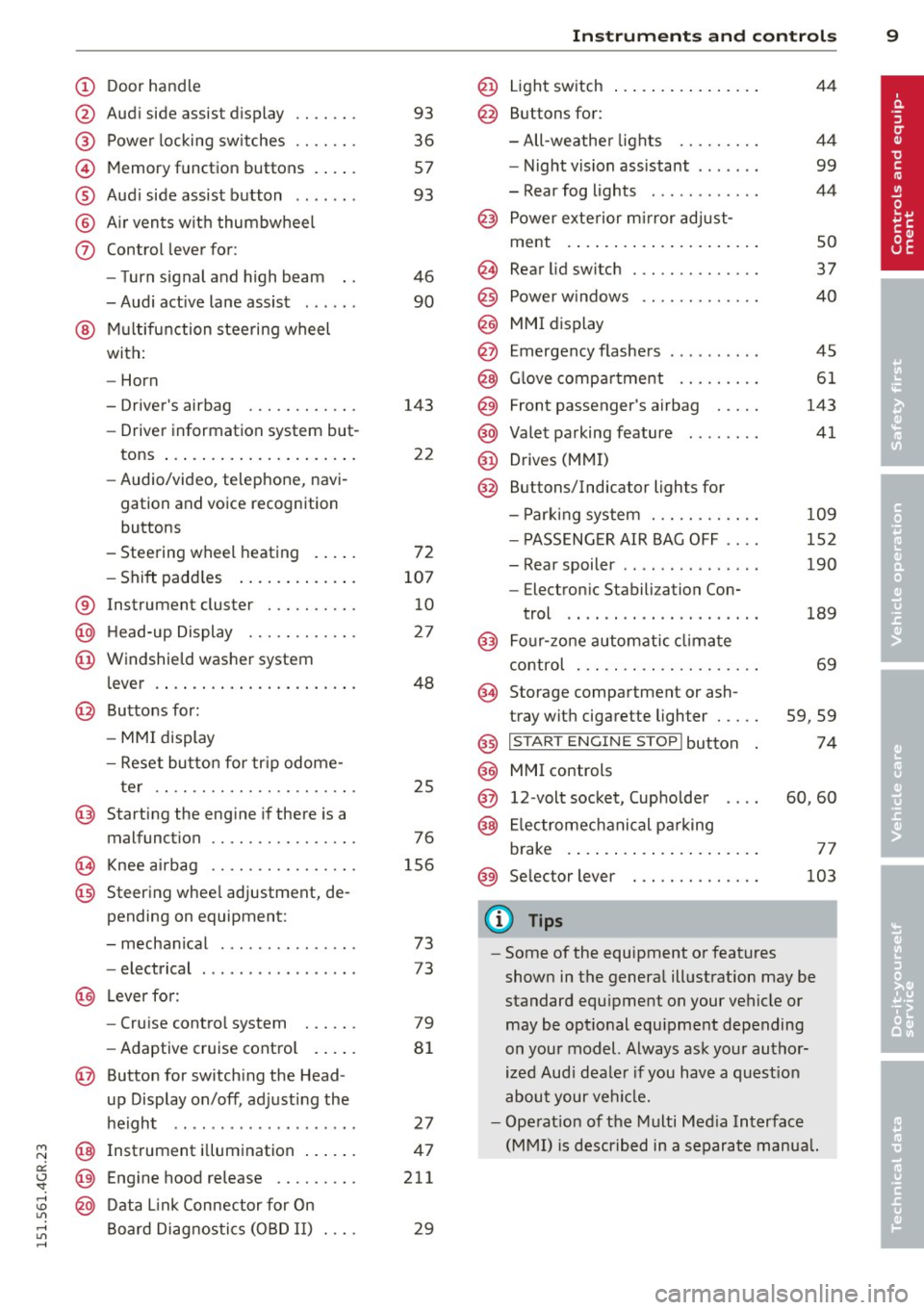
(!) Door handle
@
®
©
®
®
(j)
Audi side assist d isplay
Power locking sw itches
Memory function buttons . ... .
Aud i side assist button .. .. .. .
A ir vents with thumbwheel
Control lever for :
- T urn signal and high beam
- Audi act ive lane assist . .. .. .
@ Mu ltifunction steering wheel
with:
- Horn
- Driver's airbag
- Driver information system but-
tons ... ..... ....... ... .. .
- Audio/video , telephone, navi
gation and voice recognition
buttons
- Steering wheel heating . ... .
- Shift padd les ..... ... .. .. .
® Instrument cluster ..... .. .. .
@ H ead-up Display ....... .. .. .
@ Windsh ield washer system
l ever .... .... ...... ... .. .. .
@ Buttons for :
- MM I display
- Reset button for tr ip odome-
ter .. .. ............. .... .
@ Starting the eng ine if there is a
malfunction
~ Knee airbag ........... .... .
@ Steering whee l adjustment, de
pending on equipment:
- mechanical . ............. .
- electrical
@ Leverfo r:
- Cru ise contro l system
- Adaptive cruise cont ro l .. .. .
@ Button for switch ing the Head
up Display on/off , adjusting the
h eight .. ................ . .
@ Instrument illuminat ion ... .. .
@ Eng ine hood release .... .. .. .
@ D ata Link Connector for On
Board Diag nos tics ( OBD II) . .. .
93
36
57
93
46
90
143
22
72
107 10
27
48
25
76
156
73
73
79
8 1
27
47
211
29
In strument s and control s 9
@ Light switch ..... . .. .. ..... .
@ Buttons for :
- All -weathe r lights
- Night vision assistant . .. ... .
- Rear fog lights . .......... .
@ Power exterior mirror adjust-
ment . ... .... .. . .. .. ..... .
@ Rear lid switc h ............. .
@) Power w indows .... ........ .
@ MMI display
@ Emergency flashers .. .. .. ... .
@ Glove compar tment ........ .
@ Front passenger's airbag .... .
@ Valet parking feature ....... .
@ Drives (MMI)
@ Buttons/Indicator ligh ts for
- P arking system ........... .
- PASSENG ER AIR BAG OFF ... .
- Rear spoiler .. .. . .. .... ... .
- E lectron ic Stabili zation Con-
trol .. .. .. .. .. . ... ...... .
@) Four-zone automatic climate
control . .. .. .. .. .. ........ .
@ Storage compartment or ash-
tray with cigarette ligh ter .....
@) I STAR T ENGIN E ST OPI button
@ MMI controls
@ 12-volt socket , (upholde r
@ Elec tromechanical pa rking
brake . ... .. .... . ... ...... .
@ Selector lever
(D Tips
44
4 4
99
44
so
37
40
45
61
143
41
109
152
190
189
69
59,59
74
60,60
77
103
- Some of the equipment or features
shown in the genera l ill ustration may be
standard equ ipment on your vehicle or
may be opt ional equ ipment depending
on you r model. Always ask your autho r
ized Aud i dea le r i f you have a quest ion
about your ve hicl e.
- Ope rat ion of the Multi Med ia Interface
(MMI) is described in a separate manua l.
Page 13 of 302
M N
0:: <.J 'SI: ,...., \!) ..,.,
,...., ..,., ,....,
Instrument s and warnin g/indic ator ligh ts 11
- Never open the engine hood if you see or
hear steam, or if you see engine coolant
dr ipping from the engine compartment.
You could burn yourself . Let the engine
cool off first until you can no longer see
or hear steam or coo lant escaping.
Q) Note
- Mount ing additional lights or accessories
i n front of the a ir inlets reduces the cool
i ng effect of the rad iator . At h igh outside
temperatures or high eng ine load, the
engine could overheat.
- The front spo ile r has been designed to
proper ly distribute the cooling air wh en
t h e veh icle i s moving.
If the spoiler is
damaged, this cou ld red uce the cooling
effect and the engine co uld then over
heat . Ask yo ur authorized Audi dea ler fo r
ass istance.
Tachometer (engine rev counter)
The tachometer indicates the engine RPM
(revolutions per minutes).
If engine R PM drops be low 1 ,500, you should
downshift to the next lower gea r. T he red area
at the end of the sca le indicates maximum
pe rmissib le engine RPM after the break- in pe
riod. Before reach ing this area, move these
lector lever to position 0/5 (Drive) or ease
your foot off the accelerator peda l.
(D Note
The tachometer needle should only br iefly
be in the red zone: you cou ld damage your
eng ine! The beginn ing of the red zone var
ies depending on the operati ng tempera
ture of the eng ine .
@ For the sake of the environment
Upshift ing early saves fuel and reduces en
gine noise.
@ Tips
The engine speed is limited when the en
g ine is co ld - the full engine output is not ava
ilable . When the engine is at operating
temperature, the red area in the tachome
ter moves to a higher RPM range.
Fuel gauge
The fuel gauge only works when the ignition is
on. If the fue l level drops below 2 .6 gallons
(10 lite rs), the bottom LED turns red and the
indicato r light
(j) turns on ¢ page 20. The
bottom L ED blinks red whe n the fuel level is
very low.
The possible range based on the current fuel level is shown in tab@¢
page 22, fig. 4.
(D Note
Neve r run the ta nk completely dry. A n ir
r egular supply of f uel can cause engine
misfiring and fuel could enter the exha ust
system. The catalytic co nve rter could t hen
ove rheat and be damaged .
Warning/indicator
Lights
Description
The ind icator lights in the instrument cluster
blink or tur n on. They indica te f unct ions or
malfunctions ¢
&.
Messages may appea r with some indicato r
li ghts. A warning signal will sound at t he
same t ime . The indica to r li ghts and messages
i n the center of the displays may be rep lace d
by other disp lays. To show them again, select
the tab for ind icator lights and messages us
ing the multif unction steering whee l
¢
page 22. If there are several malfunc
tions, you can display them one at a time us i ng the thumbwheel.
Some indicators lights in the d isp lay can turn
on in severa l co lors.
A WARNING
- Failure to heed warning lights and other
important vehicle informat ion may resu lt
IJI,,
Page 25 of 302
"' N
a:: I.J "". rl I.O
"' rl
"' rl
Instrument s and warning /indicator lights 23
® ®
Tab Content
2 Indicator lights and messages
Warning when a door, the hood or
the rear lid is not closed
Service interval display<=>
page 26
Speed warning system <=> page 78
3 Night vision assistant* <=> page 99
4 Audio/video
5 Telephone*
6 Navigation*
The second and third tabs are only visib le if at
l east one indicator light or message is shown
or if that system is switched on .
The status line © is located in the bottom
part of the display¢
fig. 4. It displays the ex
terior temperature, time, selector lever posi
tion, trip odometer and odometer .
F or some veh icle functions, you can access the
trip information from the temporary memory
<=> page 24 in the line(!)<=> fig. 5.
A WARNING 1= -
- Never rely exclusively on the outside
temperature display to determine if a
road surface is icy or not. Keep in mind
that road surfaces, especially bridges
and overpasses, could be ice covered and
slippery even at an outside temperature above
41 °F (+5 °().
- Always reduce your speed and dr ive with
special care in cold weather conditions
when the chance of encountering icy
road surfaces increases.
@ Tips
-If the vehicle is stationary, or if you are
driving at a very low speed, the tempera
ture shown in the display might be
s light ly higher than the actual outside
temperature. This is caused by the heat
being radiated from the eng ine.
- You can select the units used for temper
ature, speed and other measurements in
the MMI. -
For information on the audio/video and
navigation* functions, refer to the sepa
rate MMI owner's manua l.
Operation
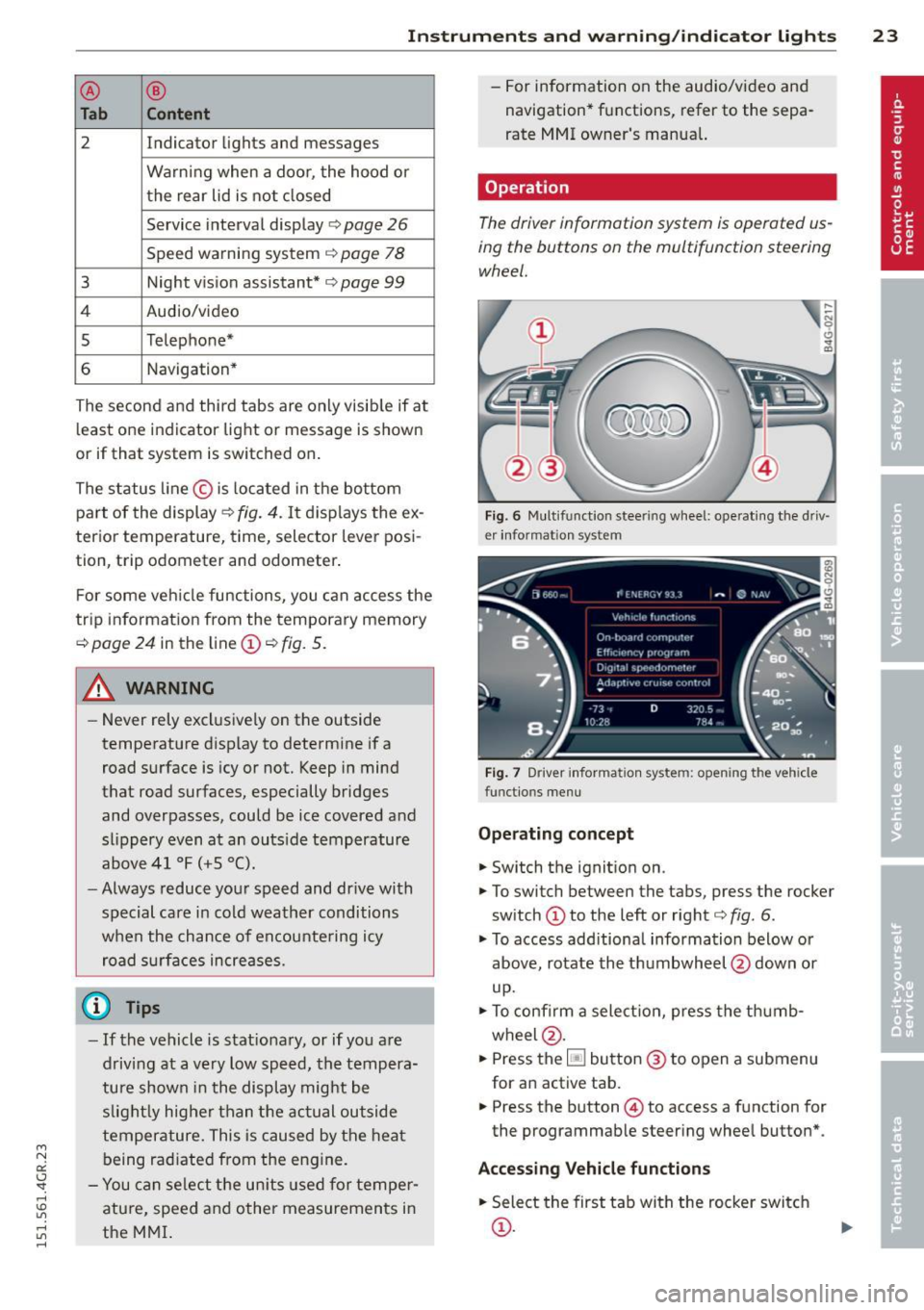
The driver information system is operated us
ing the buttons on the multifunction steering
wheel.
Fig. 6 Multifunction steering wheel: operating the driv
er in formation system
Fig. 7 Driver informat ion system: opening the vehicle
func tions menu
Operating concept
.,. Switch the ignition on.
.,. To switch between the tabs, press the rocker
switch
(D to the left or rig ht <=> fig. 6.
.,. To access additional information below or
above, rotate the t humbwheel @down or
up.
.,. To confirm a selection, press the thumb
wheel @.
.,. Press the~ button @ to open a submenu
for an active tab.
.,. Press the button@) to access a function for
the prog rammab le steering whee l button* .
Accessing Vehicle functions
.,. Select the first tab with the rocker switch
(D.
Page 26 of 302
24 Instruments and warning /indicator lights
• Press the button ~ @-The Vehicle func
tion s
menu appears ¢ fig. 7 .
• To select a menu item, turn and press the
th umbwheel @.
Resetting value s to zero
• Se le ct t he on-board computer / Efficien cy
program
men u item in the Vehicle func
tion s
menu.
• You can now select between the long -term
memory and short-term memory .
• To reset the values i n a memory, press and
hold the thumbwhee l@ for o ne second .
Assigning a function to the
programmable steering wheel button*
• Se lect : I CAR I funct ion button> (Car )* sys
tems
control button > Vehicle settings >
Steering wheel button .
The last function selected displays when you
sw itch the ignition o n.
@ Tips
All stored values will be lost if the vehicle
battery is disconnected.
On -board computer
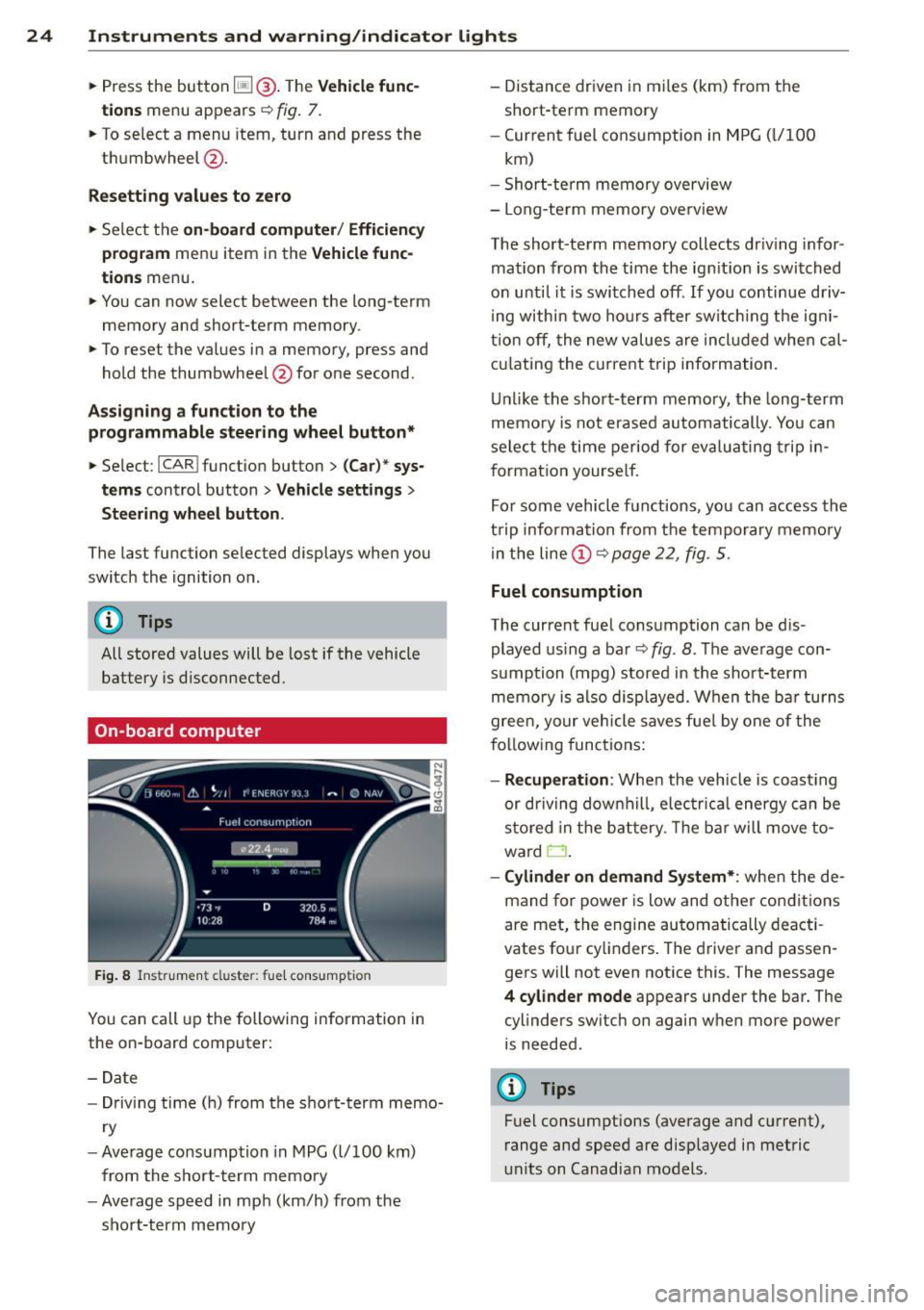
F ig. 8 I n st ru men t cl uster: fu el co nsumpt io n
You can call up the following information in
the on-board computer:
-D ate
- Dr iving tim e (h ) from the s ho rt -te rm memo-
r y
- Ave rag e consump tion in MP G
(l/100 km)
from the s ho rt- term memo ry
- Ave rage spe ed in mph (km/h) from the
s h ort-term memo ry -
Distance driven in mi les (km) from the
short-te rm memory
- Curren t fu el cons umption in MPG
(L/1 00
km)
- Shor t-te rm memory overview
- Long-te rm mem ory ove rview
The short -te rm mem ory collects dr iv in g inf or
mation from the time the ig nitio n is swi tched
o n until it is switched off . If you continu e driv
i ng withi n two ho urs a fter sw itch ing the ig ni
t io n off , the new values are incl uded when cal
c ul ating the c urrent trip inform ation .
Un like the sho rt-term m emory, the long-t erm
memo ry i s not erase d autom atically . You can
se le ct t he time period for eva luating trip in
f ormation yourse lf.
Fo r some vehicle f unct ions, you can access the
t rip informa tion from t he tempo rary mem ory
i n the line@~
page 22, fig . 5.
Fuel consumption
The current fue l cons umption can be d is
played us ing a ba r
~fig . 8. The ave rage con
s u mption (mpg) stor ed in th e sho rt-t erm
m emo ry is a lso displayed. When the ba r tu rns
green, y our veh icle saves fue l by one of the
f ol low ing functions:
- Recuperation : When the vehicle is coast ing
o r driving down hill, elec trica l energy can be
s tor ed in the b attery . Th e ba r will move t o
ward
0 .
-Cylinder on demand Sy stem* : when the de
mand for power is low and other con diti ons
are met, the engine automatically deacti
vates fo ur cylin ders . Th e d river a nd passen
gers will not even notice this. The message
4 cylinde r mode appears under the bar. The
cylinders switch on again w hen more power
is ne eded .
@ Tips
Fuel consumptions (average and current),
r ange and spee d are disp layed i n metric
u nits on Canadian models.
Page 30 of 302
28 Instruments and warning/indicator lights
Boost, shifting and engine oil
temperature indicators
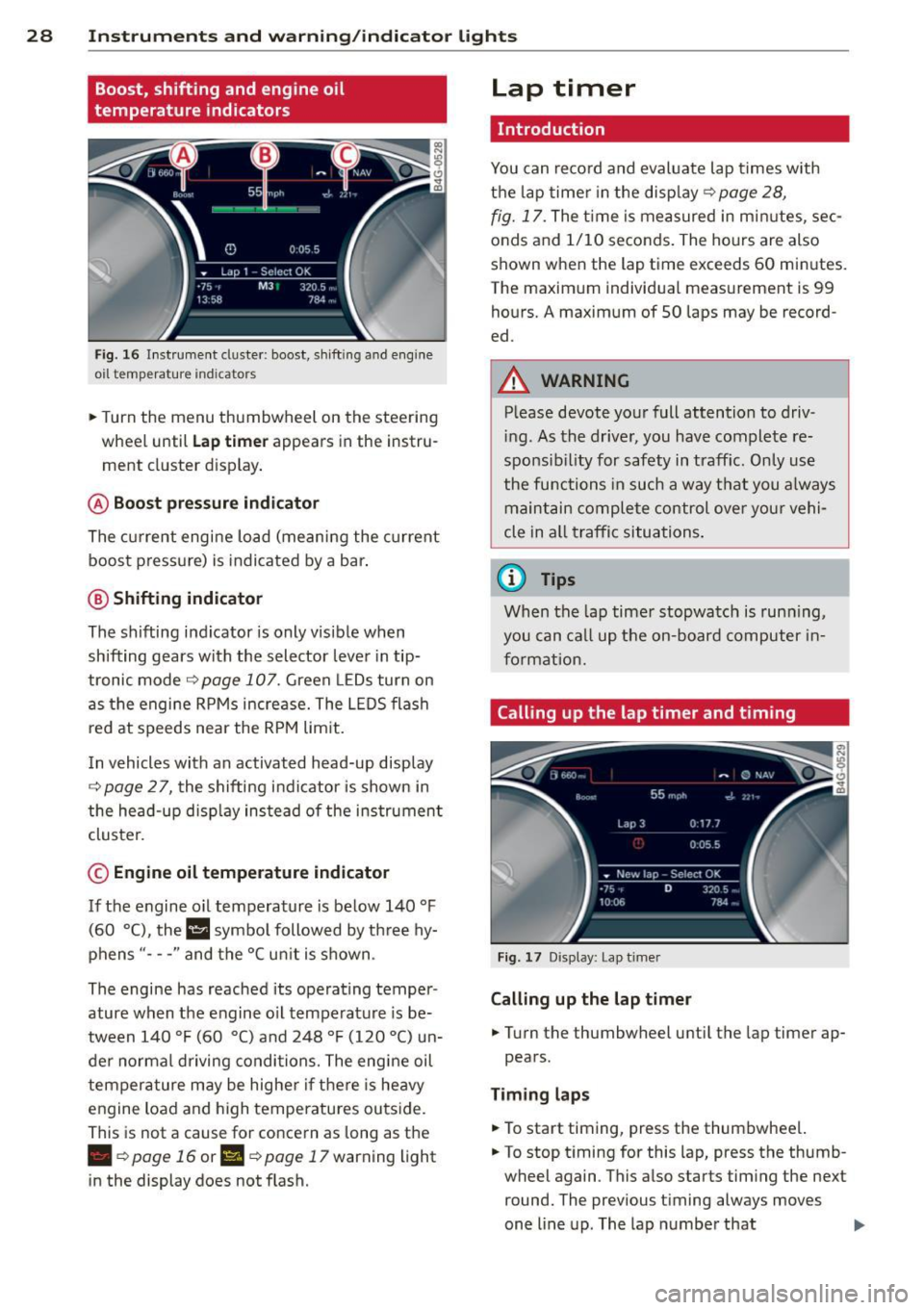
Fig. 16 Instrument duster : boost, shift ing a nd engine
o il t emp erature indicato rs
• Turn the menu thumbwheel on the steering
wheel until
Lap timer appears in the instru
ment cluster display .
@ Boost pressure indicator
The current engine load (meaning the current
boost pressure) is indicated by a bar .
@ Shifting indicator
The shifting indicator is only visible when
shifting gears with the selector lever in tip
tronic mode¢
page 107. Green LEDs turn on
as the engine RPMs increase. The L EDS flash
red at speeds near the RPM lim it.
I n vehicles with an activated head-up display
¢ page 2 7, the shifting indicator is shown in
the head-up disp lay instead of the instrument
cluster.
© Engine oil temperature indicator
If the engine oil temperature is below 140 °F
(60 °(), the l!I symbo l followed by three hy
phens "- - -" and the °C un it is shown .
The engine has reached its operating temper
ature when the engine o il temperature is be
tween 140
°F (60 °() and 248 °F (120 °() un
der normal d riving conditions. The engine oil
temperature may be higher if there is heavy
engine load and high temperatures outside.
This is not a cause for concern as long as the
• ¢page 16 or II ¢page 17 warning light
in the display does not flash.
Lap timer
Introduction
You can record and evaluate lap times with
the lap timer in the disp lay ¢
page 28,
fig. 17. The time is measured in minutes, sec
onds and 1/10 seconds. The hours are also
shown when the lap time exceeds 60 minutes .
The maximum individual measurement is 99
hours.
A maximum of SO laps may be record
ed.
A WARNING
-Please devote your full attention to driv -
in g. As the driver, you have complete re
sponsib ility for safety in traff ic. Only use
the functions in such a way t hat you a lways
maintain complete control over your vehi
cle in all traffic situations .
(i) Tips
When the lap timer stopwatch is running,
you can call up the on-board computer in
formation.
Calling up the lap timer and timing
Fig . 17 D isplay: Lap t imer
Calling up the lap timer
• Turn the thumbwheel until the lap timer ap-
pears.
Timing laps
• To start timing, press the thumbwheel.
• To stop timing for this lap, press the thumb
wheel again . This also starts timing the next
round. The previous timing always moves
one line up . The lap number that
II>
Page 33 of 302
"' N
a:: I.J "". rl I.O
"' rl
"' rl
Opening and closing Keys
Key set
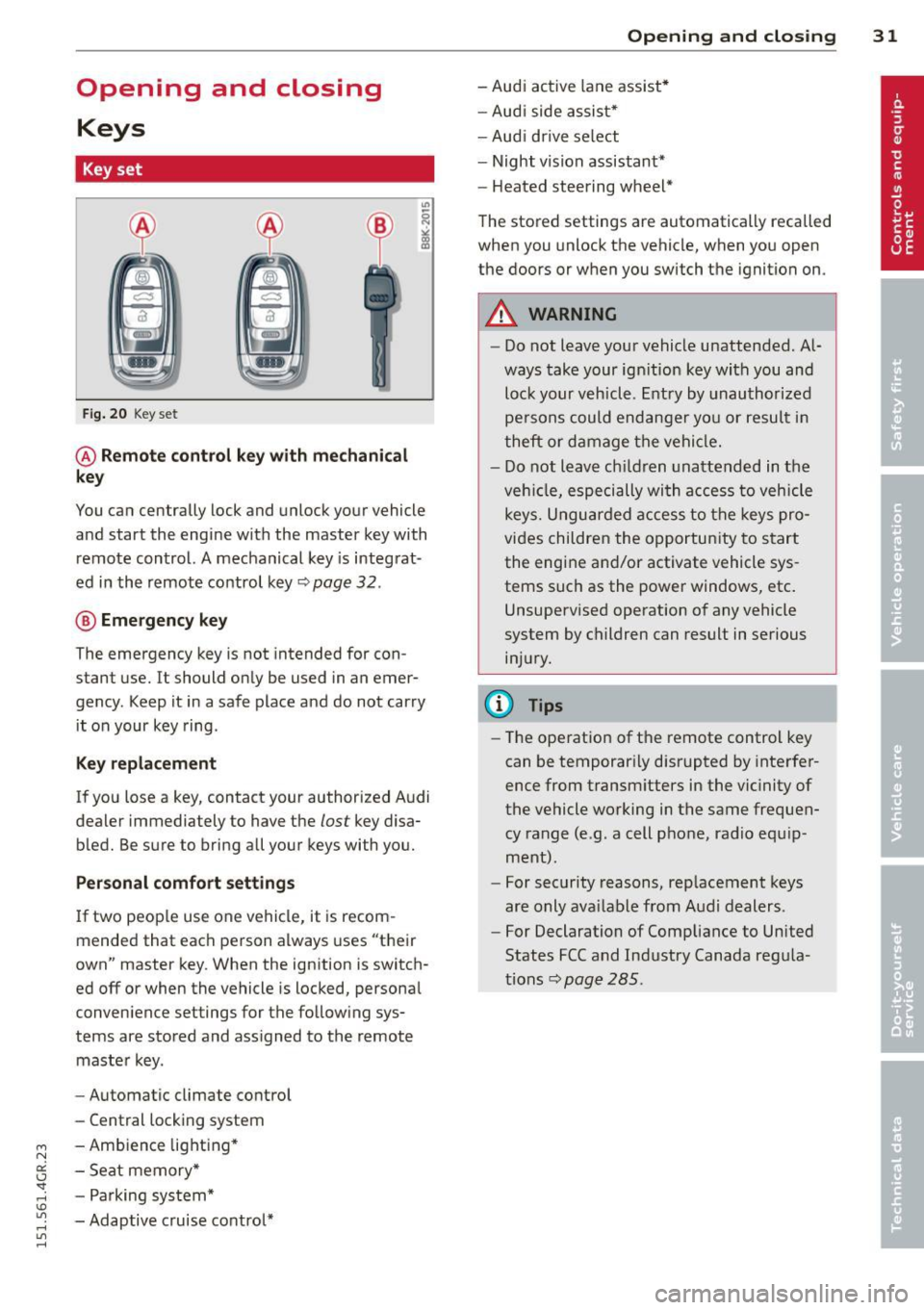
Fig. 20 Key set
@ Remote control key with mechanical
key
You can centrally lock and unlock your vehicle
and start the engine with the master key with
remote control. A mechanical key is integrat
ed in the remote control key~ page
32 .
® Emergency key
The emergency key is not intended for con
stant use.
It should only be used in an emer
gency. Keep it in a safe place and do not carry
it on your key ring .
Key replacement
If you lose a key, contact your authorized Audi
dealer immed iately to have the
lost key disa
bled. Be sure to bring all your keys with you.
Personal comfort settings
If two people use one vehicle, it is recom
mended that each person always uses "their
own" master key. When the ignition is switch
ed off or when the vehicle is locked, personal
convenience settings for the following sys
tems are stored and assigned to the remote
master key.
- Automatic climate control
- Central locking system
- Ambience lighting*
- Seat memory*
- Parking system*
- Adaptive cruise control*
Opening and closing 31
- Audi active lane assist*
- Audi side assist*
-Audi drive select
- Night vision assistant*
- Heated steering wheel*
The stored settings are automatically recalled
when you unlock the vehicle, when you open
the doors or when you switch the ignition on.
A WARNING
-Do not leave your vehicle unattended. Al
ways take your ignition key with you and
lock your vehicle. Entry by unauthorized
persons could endanger you or result in
theft or damage the vehicle.
- Do not leave children unattended in the
vehicle, especially with access to vehicle
keys. Unguarded access to the keys pro
vides children the opportunity to start
the engine and/or activate vehicle sys
tems such as the power windows, etc.
Unsupervised operation of any vehicle
system by children can result in serious
injury.
(D Tips
- The operation of the remote control key
can be temporarily disrupted by interfer
ence from transmitters in the vicinity of
the vehicle working in the same frequen
cy range (e.g. a cell phone, radio equip
ment).
- For security reasons, replacement keys
are only available from Audi dealers.
- For Declaration of Compliance to United
States FCC and Industry Canada regula
tions~ page
285.
Page 55 of 302
M N
0:: <.J 'SI: ,...., \!) 1.1'1 ,...., 1.1'1 ,....,
Seats and storage
General recommen
dations
Why is your seat adjustment so important?
The safety belts and the airbag system can
only provide maximum protection if the front
seats are correctly adjusted.
There are various ways of adjusting the front
seats to provide safe and comfortable support
for the driver and the front passenger. Adjust
your seat properly so that :
- you can easily and quick ly reach all the
switches and controls in the instrument
panel
- your body is properly supported thus reduc ing physical stress and fatigue
- the safety belts and airbag system can offe r
maximum protection
¢ page 139.
In the following sections, you will see exactly
how you can best adjust your seats .
There are special regulations and instructions
for installing a child seat on the front pas
senger's seat. Always fo llow the information
regarding chi ld safety provided in
¢ page 165, Child Safety .
A WARNING
Incorrect seating position of the driver and
all other passengers can result in serious
personal injury.
- Always keep your feet on the f loor when
the vehicle is in motion -never put your
feet on top of the instrument panel, out
of the window or on top of the seat cush
ion. Th is applies especially to the passen
gers . If your seating position is incorrect,
you increase the r isk of injury in the case
of sudden braking or an acc ident. If the
airbag inflates and the seating position
is incorrect, this could result in persona l
injury or even death.
- It is important for both the driver and
front passenger to keep a distance of a t
Seat s an d sto rage 53
least 10 inches (25 cm) between them
selves and the steering wheel and/or in
strument panel. If you're s itting any
closer than th is, the airbag system can
not protect you properly. In addition, the
front seats and head restraints must be
adjusted to your body height so that they
can give you maximum protect ion.
- Always try to keep as much distance as
possible between yourself and the s teer
ing wheel o r instrument pane l.
- Do not adjust the driver's or front pas
senger's seat whi le the vehicle is moving.
Your sea t may move unexpected ly, caus
ing sudden loss of vehicle cont rol and
personal injury . If you adjust yo ur seat
while the veh icle is moving, yo u are out
of posit ion.
Driver's seat
The correct seat position is important for safe
and relaxed driving.
We recommend that you adjus t the dr iver's
seat in the fo llowing manner:
.,. Adjust the seat in fore and aft direction so
that you can easily push the peda ls to the
floor wh ile keeping your knees s lightly bent
i:::> A in Why is your seat adjustment so im
portant? on page 53.
.,. Adjust the backrest so that when you sit
w ith your back against the backrest, you can
still grasp the top of the steering wheel.
.,. For adjustable head restra ints: adjust the
head restra int so the upper edge is as even
as poss ible with the top of your head . If that
is not poss ible, try to adjust the head re
straint so that it is as close to this position
as possible ¢
page 56. Move the head re
straint so that it is as close to the back of
the head as possib le .
A WARNING
-Never place any objects in the dr iver's foot-
well. An object could get into the pedal
area and interfere with pedal funct ion . In
~
Page 74 of 302
7 2 Warm and cold
(D Note
To avoid damage to the heating e lements
in the seats, do not kneel on the seats or
place heavy loads on a small area of the
seat .
Setup
Applies to vehicles: with four-zone a utomat ic clima te con·
tro l
The climate control system setup is accessed
through the MMI .
.,. Se lect : I CAR I func tion button> (Car )* sys·
terns con trol but ton > A /C.
Rear cabin settings*
When th is fu nction is selected, all sett ings for
the rear can be adjusted through the climate
control sys tem in the cockpit. The cl imate
con trol sy stem se ttings cannot be adjusted in
the rea r seat a t the same time. This func tion
switches o ff after a certain period of time or
when one of the dia ls in the cockp it is press
ed .
Auto recirculation*
The sensit ivity level of the au tomatic rec ircu
lation mode can be set at v ario us leve ls from
off to sensit ive. The recirculation mode is con
trolled a utomat ica lly. You must p ress the
I@ FRONT I button if fog forms on the win
dows.
Footwell temperature
You can ad just the footwe ll temperat ure so
that it is cooler or wa rmer.
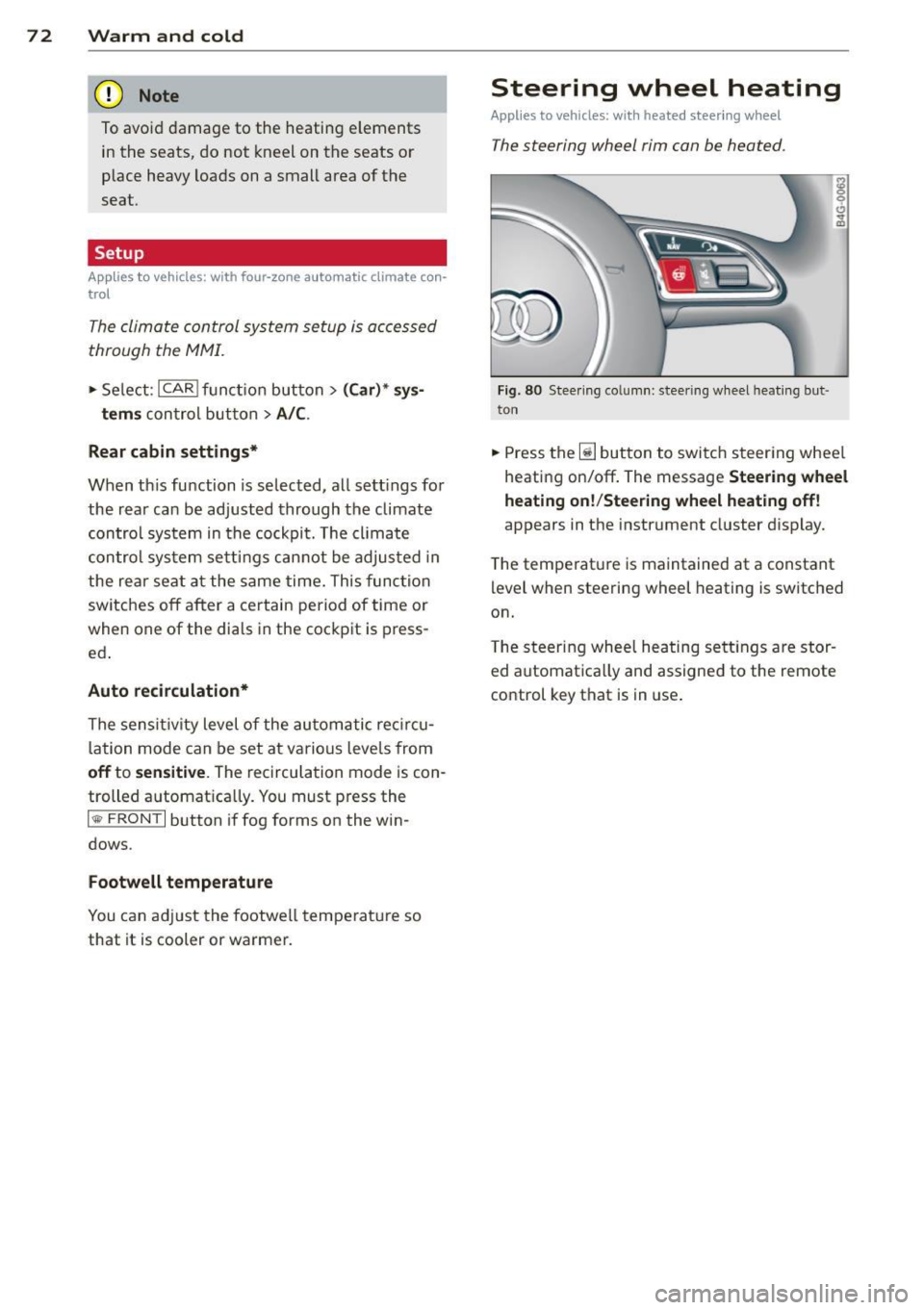
Steering wheel heating
App lies to vehicles: wi th hea ted s tee rin g wheel
The steering wheel rim can be heated .
Fig. 80 S tee ring co lu mn : steeri ng w hee l h ea tin g but ·
ton
.,. Press the~ button to swi tch steering whee l
heati ng on/off . The message
Steering wheel
heating on !/Steering wheel heating off !
appears in the instrument cluster d isplay.
T he temperat ure is maintained at a constant
level when steering wheel heating is switched
on.
T he steering whee l hea ting se tt ings are stor
ed automat ica lly and assigned to the remote
control key that is in use .