warning light AUDI RS7 SPORTBACK 2016 Owners Manual
[x] Cancel search | Manufacturer: AUDI, Model Year: 2016, Model line: RS7 SPORTBACK, Model: AUDI RS7 SPORTBACK 2016Pages: 282, PDF Size: 70.78 MB
Page 212 of 282
Checking and Filling
should be between the "min " and "max" mark
ings. When the engine is warm, the level may
be slightly above the "max" marking.
The location of the coolant expansion tank can be
seen in the engine compartment illustration
<::> page 205.
To obtain an accurate reading, the engine must
be switched off.
The expansion tank in your vehicle is equipped
with an electric coolant level sensor.
When the coolant level is too low, the warning
light in the Auto-Check System <::>
page 15 will il
luminate until you add coolant and the level has
been restored to normal. Even though there is an
electric coolant level sensor, we still recommend
you check the coolant level from time to time.
Coolant loss
Coolant loss may indicate a leak in the cooling
system. In the event of coolant loss, the cooling
system should be inspected immediately by your
authorized Audi dealer. It is not enough merely
to add coolant.
In a
sealed system, losses can occur only if the
boiling point of the coolant is exceeded as a re
sult of overheating.
A WARNING
The cooling system is under pressure and can
get very hot. Reduce the risk of scalding from
hot coolant by following these steps.
-Turn off the engine and allow itto cool down.
- Protect your face, hands and arms from es caping fluid and steam by covering the cap
with a large, thick rag.
- Turn the cap slowly and very carefully in a counter-clockwise direction while applying
light, downward pressure on the top of the
cap.
- To avoid being burned, do not spill anti
freeze or coolant on the exhaust system or
hot engine parts . Under certain conditions,
the ethylene glycol in engine coolant can
catch fire .
210
(D Note
Do not add any type of radiator leak sealant
to your vehicle's engine coolant. Adding radia
tor repair fluid may adversely affect the func
tion and performance of your cooling system
and could result in damage not covered by
your New Vehicle Limited Warranty .
Adding coolant
Be very careful when adding engine coolant.
Before you check anything in the engine compart
ment,
always read and heed all WARNINGS
<::>.& in Working in the engine compartment on
page 203 .
.. Requirement: There must be a residual amount
of coolant in the expansion tank
i:::>Q) .
.. Turn off the engine .
.. Let the engine cool down .
.. Place a thick rag over the coolant expansion
tank <::>
page 209, fig. 186 and carefully twist
the cap counter-clockwise
c::> &,.
.. Add coolant mixed in the correct ratio
<::> page 209, Coolant up to the MAX marking.
.. Make sure that the fluid level remains stable.
Add more coolant if necessary.
.. Twist the cap on again
tightly.
Replacement engine coolant must conform to ex
act specifications <::>
page 209, Coolant.
We recommend using only coolant additive G12+
+, G13 or in an emergency G12+ . Do
not use a
different additive. In an emergency use plain wa
ter until you can get the correct additive and can
restore the correct ratio. This should be done as
soon as possible.
If you have lost a considerable amount of cool
ant, then you should add cold antifreeze and cold
water only when the engine is cold.
Always use
new engine coolant when refilling.
Do not fill coolant above the "MAX" mark . Excess
coolant will be forced out through the pressure
relief valve in the cap when the engine becomes
hot.
~
Page 213 of 282
,&_ WARNING
-The cooling system is under pressure and
can get very hot. Reduce the risk of scalding
from hot coolant by following these steps.
- Turn off the engine and allow it to cool
down.
- Protect your face, hands and arms from
escaping fluid and steam by covering the
cap with a large, thick rag.
- Turn the cap slowly and very carefully in a
counter-clockwise direction while applying light, downward pressure on the top of
the cap.
- To avoid being burned, do not spill ant i
freeze or coolant on the exhaust system or
hot engine parts. Under certa in condi
tions, the ethylene glycol in engine cool
ant can catch fire.
- Antifreeze is poisonous. Always store anti
freeze in its original container and well out
of the reach of children.
- If you drain the coolant, it must be caught
and safely stored in a proper container
clearly marked "poison" .
(D Note
-Do not add coolant if the expansion tank is
empty. Air could enter the cooling system
and damage the eng ine. If this is the case,
do not continue driving. Seek professional
assistance.
- Coolant pollutes the environment and could
cause an engine fire. Excess coolant will be
forced out through the pressure relief valve
i n the cap when the engine becomes hot .
- If, in an emergency, only water can be add ed, the correct ratio between water and an
tifreeze
¢ page 209 must be restored as
soon as possible.
@ For the sake of the environment
Drained coolant should not be reused. Always
dispose of used coolant while observing all
environmental regulat ions.
-
Checking and Filling
Radiator fan
The radiator fan switches on automatically by it
self .
An auxiliary electric radiator fan switches on and
off depending on coolant temperature and other
vehicle operating conditions.
After you switch the engine off, the auxiliary fan
can continue running for up to 10 minutes -even
with the ignition off. It can even switch on again later by itself ¢&. , if
- the temperature of the engine coolant rises due
to the heat build-up from the engine in the en gine compartment, or
- the engine compartment heats up because the
vehicle is parked in intense sunlight.
A WARNING
--
- To reduce the risk of personal injury never
touch the radiator fan .
- The auxiliary electric fan is temperature
controlled and can switch on suddenly even
when the engine is not running .
- The auxiliary radiator fan switches on auto
matically when the engine coolant reaches a
certa in temperature and will continue to run
until the coolant temperature drops.
Brake fluid
Checking brake fluid level
Fig. 187 En g in e compar tment: cover on the b rake fluid
rese rvoir
Before you check anything in the engine compart
ment,
always read and heed all WARNINGS
¢ & in Working in the engine compartment on
page 203 . .,.
211
Page 214 of 282
Checking and Filling
"' Read the brake fluid level from the brake fluid
reservoir
¢ fig. 187, ¢page 205, fig. 183. The
brake fluid level must be between the "MIN"
and "MAX" markings.
The location of the brake fluid reservoir can be
seen in the engine compartment illustration
c>page205.
The fluid level may drop slightly after some time
due to the automatic adjustment of the brake
pads. This is not cause for alarm.
If the brake fluid level falls considerably below
the "MIN" mark, the brake warning/indicator
light
1111 (U.S. models)/ . (Canadian models)
will come on¢
page 14. Do not continue to oper
ate the vehicle. The complete brake system
should be thoroughly checked by an authorized
Audi dealer or other qualified facility and the
cause corrected . If the brake fluid level is too
low, the brake warning/indicator light will illumi
nate. Contact an authorized Audi dealer
immedi
ately.
Changing brake fluid
Have the brake fluid changed by an experienced
technician.
Brake fluid absorbs moisture from the air . If the
water content in the brake fluid is too high , cor
rosion in the brake system may result after a pe
riod of time. The boiling point of the brake fluid
will also decrease considerably and decrease
braking performance.
Therefore, the brake fluid must be changed
every
two years.
Always use new brake fluid which con
forms to Federal Motor Vehicle Standard "FMVSS
116 DOT 4".
The brake fluid reservoir can be difficult to reach,
therefore, we recommend that you have the
brake fluid changed by your authorized
Audi
dealer.
Your dealer has the correct tools, the
right brake fluid and the know-how to do this for
you.
212
A WARNING
-
- Brake fluid is poisonous. It must be stored
only in the closed original container out of
the reach of children!
- Brake failure can result from old or inappro
priate brake fluid. Observe these precau
tions:
- Use only brake fluid that meets SAE speci
fication
J 1703 and conforms to Federal
Motor Vehicle Standard 116. Always check
with your authorized Audi dealer to make
sure you are using the correct brake fluid.
The correct type of brake fluid is also indi
cated on the brake fluid reservoir .
- The brake fluid must be new. Heavy use of
the brakes can cause a vapor lock if the
brake fluid is left in the system too long .
This can seriously affect the efficiency of
the brakes as well as your safety. This
could result in an accident.
(D Note
Brake fluid will damage the paint of your vehi
cle.
@ For the sake of the environment
Because of the problem of proper disposal of
brake fluid as well as the special tools re
quired and the necessary expertise, we rec
ommend that you have the brake fluid
changed by your authorized Audi dealer .
Battery
General information
Under normal operating conditions, the battery
in your Audi does not need any maintenance.
With
high outside temperatures or long daily
drives we recommend that you have the electro
lyte level checked by a service facility. The elec
trolyte level should also be checked each time
the battery is charged ¢
page 214.
Have the battery checked when you take your ve
hicle in for service. You are well advised to re
place a battery that is older than S years.
Page 215 of 282
With certain types o f air bag dep loyment, the
battery is disconnected from the vehicle electri
cal system for safety reasons¢&.
in Repair, care
and disposal of the airbags on page 150 .
Disconnecting the battery terminals
Some vehicle func tions (power w indow re gula
t ors, for example) are lost i f th e battery termi
na ls are d isconnected . These functions have to be
relearned a fter the battery termina ls are con
nected aga in. To prevent th is, the batte ry s hou ld
only be disco nnected from the vehicle e lectr ica l
system w hen abso lut ely necessa ry for repairs.
Veh icles not driven for long periods
If yo u do not drive you r vehicle over a period of
seve ral days or weeks, e lectrical components a re
g radually c ut back or sw itched off. This reduces
e n ergy consumption and ma inta ins starting ca
pability over a longer period ¢
page 186. Some
of the co nvenience funct io ns m ay not o perate,
such as the i nter io r li ghts or powe r seat adjust
men t. T he conve nie nce func tions w ill be av aila ble
ag ain whe n you swi tch on the igni tion and start
the eng ine .
Winter operation
During the win ter mo nth s, ba ttery capaci ty te nds
to decr ease as temperatu res drop . T his is be
c a use more power i s als o c ons umed w hile s tar t
i ng, and t he he adlights, rear w indow de fogge r,
etc., a re used more o ften .
Avoi d unn ecess ary power consu mption, part icu
larl y in cit y tr affic or when traveling on ly sho rt
d is tan ces. Let yo ur au thori ze d Aud i d ealer che ck
the cap aci ty of the vehicle battery before w inte r
sets in ¢
pa ge 214 . A well charge d battery w ill
n ot on ly prevent start ing p roblems w hen the
weather is cold, but will also last longer .
(D Tips
If your ve hicle is left stand ing fo r severa l
weeks at extremely low tem peratures, the ve
hicle batte ry s hould be removed an d sto red
where it will not freeze. This will preve nt it
fro m being damaged an d hav ing to be re
placed.
Checking and Filling
Working on the battery
Be especially careful when working on or near
th e battery.
The battery is located in the luggage compart
ment under the floor. Befo re yo u check anything
i n the luggage compart ment ,
read and heed all
WARNINGS ¢&_ .
Always heed the safety warnings , when wor king
o n the veh icle batte ry or t he ve hicle elec trical
system to prevent in ju ry .
The following WARNINGS are very important
when working on the battery :
Always heed the following WARNING SYM-
BOLS and safety precautions when working on the battery.
®
Always wear eye protection .
~
Battery acid contains sulfuric acid . Al-
ways wear gloves and eye protection .
@
No
- sparks
- flames
· smoking .
~
When a battery is charged, it produces
hydrogen gas which is explosive and
could cause personal injury.
®
Always keep the battery well out of
reach of children .
A WARNING
=
Whenever working on t he battery or on the
e lectr ica l system, the re is the r isk of injury,
accide nt a nd eve n fire. Read and he ed the fol
l ow ing W AR NIN GS:
- Always wear eye prot ection. Do not let bat·
tery acid or any l ead particles g et on you r
skin o r clothing. Shield yo ur ey es. E xplosiv e
g ases can ca use b lindne ss or o ther in jury.
- Ba tte ry acid contai ns sulfur ic acid . Su lfu ric
acid can ca u se blindness and s evere burns.
- Always wea r gloves and eye protection . Do
n ot tilt t he batte ry because aci d could lea k
-
out of the ventilation openings. ""
213
Page 216 of 282
Checking and Filling
-If you get battery acid in your eyes or on
your skin, immediately rinse with cold wa
ter for several minutes and get medical at
tention .
- If you should ingest any battery acid, seek
medical attention immediately.
- Do not expose the battery to an open flame,
electric sparks or an open light .
- Do not smoke.
- Do not interchange the positive and nega-
tive cables.
- When working on the battery, be sure not to
short-circuit the terminals with tools or oth
er metal objects. This would cause the bat
tery to heat up very quickly, which could lead to damage or explosion and personal
injury.
- When a battery is charged, it produces hy
drogen gas which is explosive and could
cause personal injury.
- Always keep the battery well out of the
reach of children.
- Before work is done on the electrical sys
tem, disconnect the negative ground cable.
- Before performing any work on the electri
cal system, switch off the engine and igni
tion as well as any electrical equipment. The negative cable on the battery must be dis
connected. If you are just going to replace a
light bulb, then it is enough to switch off
the lights.
- Before disconnecting the battery, switch off
the anti-theft alarm system! Otherwise you
will set off the alarm.
- When disconnecting the battery, first dis
connect the negative cable and then the
positive cable.
- Before reconnecting the battery, make sure
all electrical consumers are switched off.
Reconnect the positive cable first and then
the negative cable. Never interchange the
cables - this could start a fire!
- Never charge a frozen or a thawed-out bat
tery. It could explode! If a battery has fro
zen, then it must be replaced. A discharged
battery can freeze over at 32 °F (0 °C).
- Make sure the vent hose is always attached
to the opening on the side of the battery.
214
- Never use batteries which are damaged .
There is the danger of an explosion! Always
replace a damaged battery.
A WARNING
California Proposition 65 Warning:
- Battery posts, terminals and related acces
sories contain lead and lead compounds,
chemicals known to the State of California
to cause cancer and reproductive problems.
Wash hands after handling.
(D Note
- Do not disconnect the vehicle battery when
the ignition is on or when the engine is run
ning, otherwise, you will damage electronic
components in the electrical system.
- If your vehicle is going to stand for a long
period of time without being driven, protect
the battery from "freezing", otherwise it
will be damaged and will then have to be re
placed .
- When opening the doors, the windows low
er approximately 10 mm automatically. This
function is not available when the battery is
disconnected, which means there is a risk
that the door seal or the window could be
damaged.
Battery charging
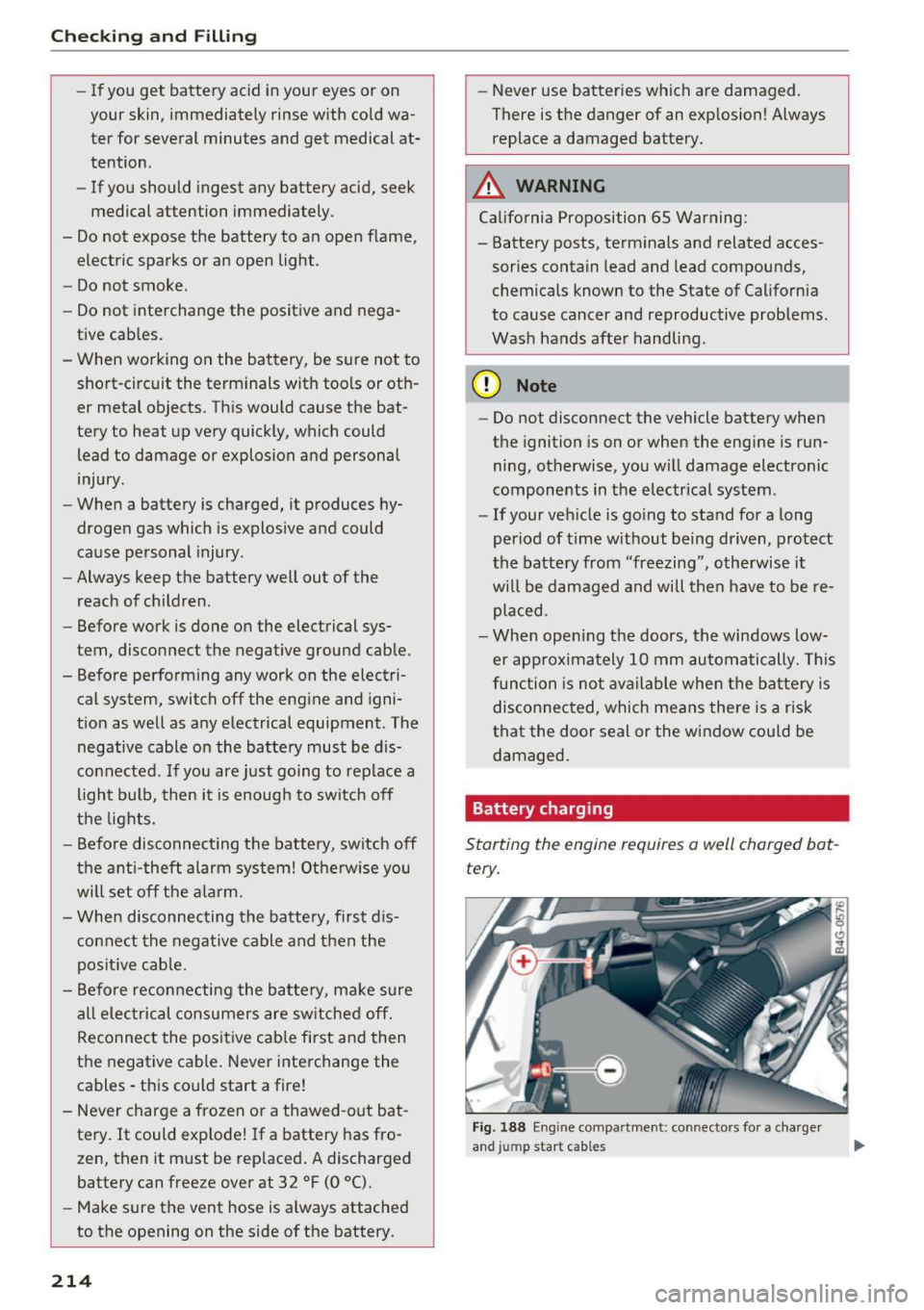
Starting the engine requires a well charged bat tery.
Fig . 188 En g in e compartment: con nectors fo r a charger
and jump start cab les
Page 239 of 282
The specified tire pressure is the last tire pres
sure that was stored
¢ page 2 3 7 .
Note that the tire p ressure also depends on the
temperature of the t ire . Every 10 °C increase in
tire temperature results in the tire pressure in
creasing by approximate ly 0 .1 bar. The tire pres
sure increases as the eng ine becomes warmer
while driving.
A WARNING
Read and follow the important information
and notes <=>
page 236.
@ Tips
The tire pressure or temperature are not dis played in adaptation mode. Dashes ··.·· are
shown in place of the pressure and tempera
ture .
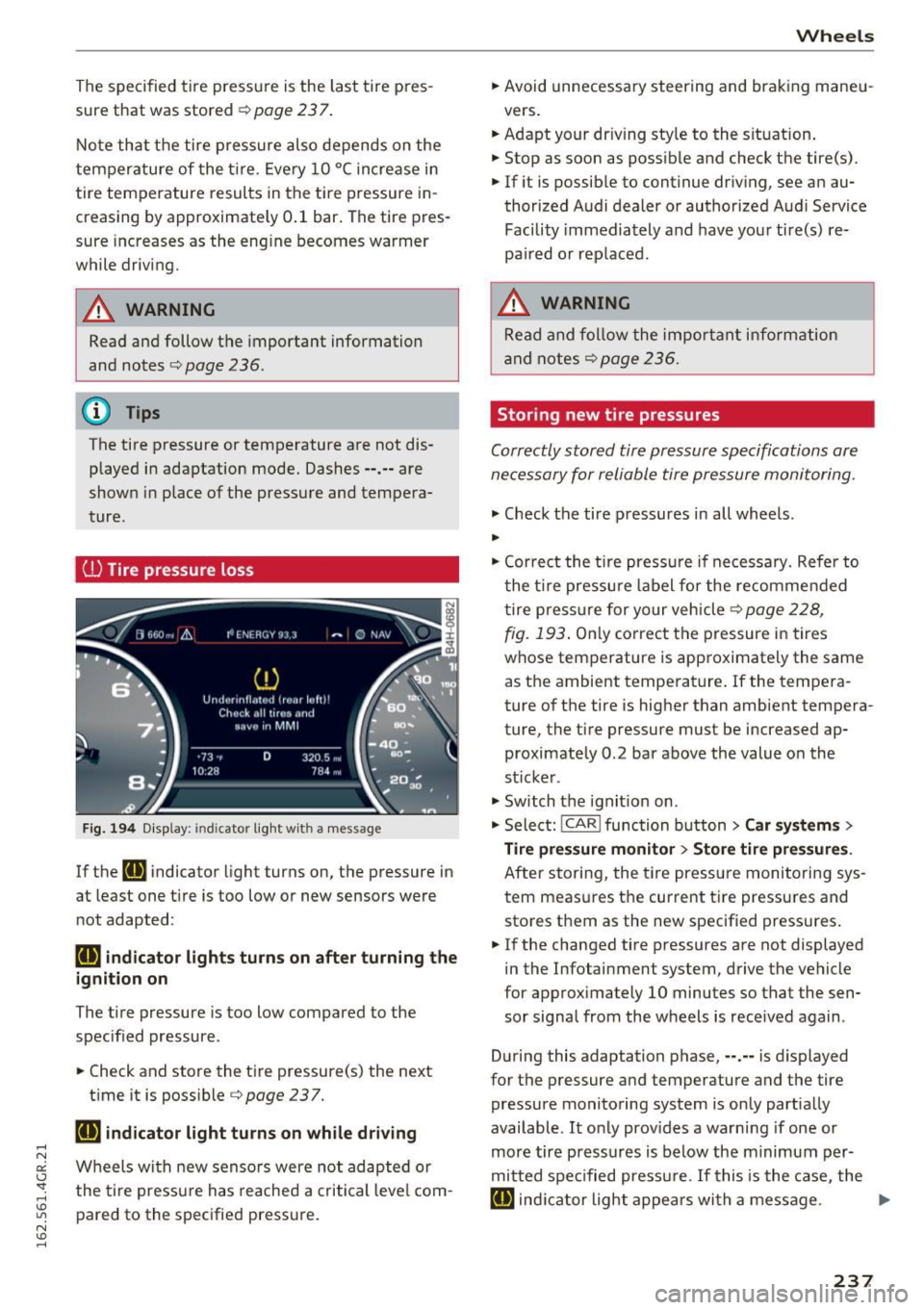
(D Tire pressure loss
Fig. 194 Display : indic ato r light with a message
If the [IJ indicator light turns on, the pressure in
at least one t ire is too low or new sensors were
not adapted :
rt] indicator lights turns on after turning the
ignition on
The tire pressure is too low compared to the
specified pressure.
"' Check and store the tire pressure{s) the next
time it is possible<=>
page 237.
rt] indicator light turns on while driving
Wheels with new senso rs were not adapted or
the tire pressure has reached a critical leve l com
pared to the specified pressure.
Wheels
"' Avoid unnecessary steering and braking maneu-
vers .
"' Adapt your dr iving sty le to the situation .
"' Stop as soon as possible and check the tire(s).
"' If it is possib le to continue driving, see an au-
thorized Audi dealer or authorized A udi Service
Facility immediately and have your tire(s) re
pa ired or rep laced.
A WARNING
Read and follow the important i nformation
and notes
¢page 236.
Storing new tire pressures
Correctly stored tire pressure specifications are
necessary for reliable tire pressure monitoring.
"' Check the tire pressures in all wheels .
..
"'Cor rect the tire pressure if necessa ry. Refer to
the tire pressure label for the re commended
t ire pressure for your vehicle
c> page 228,
-
fig. 193 . Only correct the pressure in tires
whose temperature is approximately the same
as the ambient temperature. If the tempera
ture of the tire is higher than ambient tempera
ture, the tire pressure must be increased ap
proximately 0 .2 bar above the value on the
sticker .
"' Switch the ignition on .
"' Select:
!CAR ! function button> Car systems>
Tire pressure monitor > Store tire pressures .
After storing, the tire pressure monitoring sys
tem measures the current tire pressures and
stores them as the new specified pressures .
"'If the changed tire pressures are not displayed
in the Infotainment system, drive the vehicle
for approximately 10 minutes so that the sen
sor signal from the wheels is received again .
During this adaptation phase, ··.·· is displayed
for the pressure and temperature and the tire
pressure monitoring system is only partially
available .
It only prov ides a warning if one or
more tire pressures is below the minimum per
mitted spec ified pressu re. If this is the case, the
[IJ indic ator light appea rs with a message . ""
237
Page 240 of 282
Wheels
_& WARNING
Read and follow the important information
and notes¢
page 236.
Malfunctions
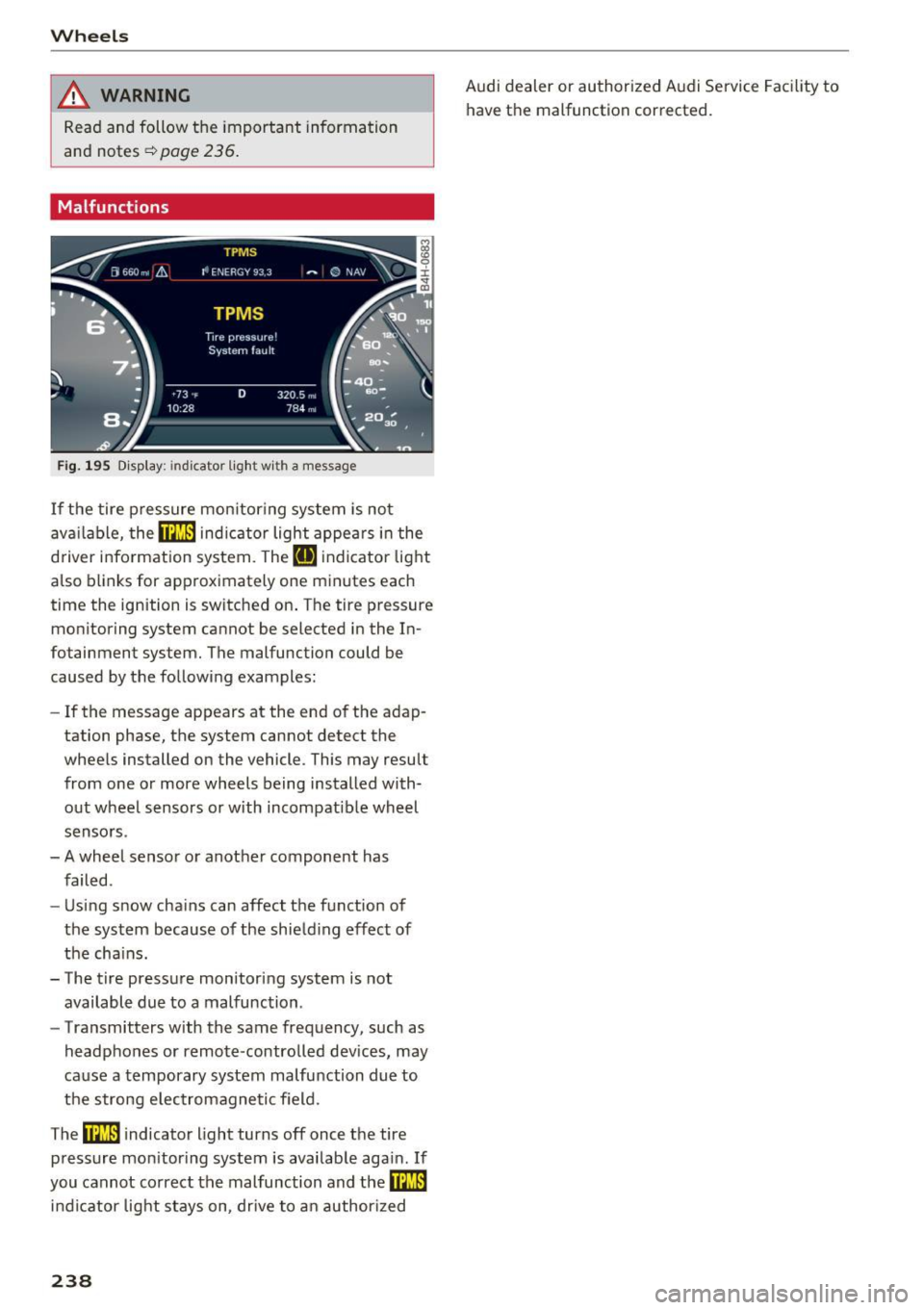
Fig . 195 D isp lay: indicator lig ht w ith a message
If the tire p ressure mon itoring system is not
ava ilable,
the m indic a tor light appea rs i n the
d river information system. The
RI] ind icato r light
also blinks for approximately one minutes each
time the ignition is switched on . The tire pressure
monitoring system cannot be selected in the In
fotainment system. The malfunction could be
caused by the following examples:
- If the message appears at the end of the adap
tation phase, the system cannot detect the
whee ls installed on the vehicle. This may result
from one o r more wheels being installed with
out wheel sensors or with incompatible wheel
senso rs.
- A wheel senso r or anot her component has
failed .
- Using snow cha ins can affect the function of
the system because of the shie ld ing effect of
the cha ins.
- The t ire pressure monitoring system is not
available due to a malfunction .
- Transmitters with the same frequency, such as
headphones or remote-controlled devices, may
ca use a temporary system malfu nction due to
the strong e lec trom agne tic field.
The
ffim i ndicator light turns off once the tire
pressure mon itor ing system is available aga in . If
you cannot correct the malfunction and
the m
in dicator light stays on, drive to an author ized
238
Audi dealer or authorized Audi Service Facility to
have the malfunction corrected.
Page 243 of 282
Preliminary steps
Some preliminary steps are necessary for tire re
pair.
• If you have a flat tire, park the vehicle as far as
poss ible from moving traffic.
• Apply the
parking brake firmly .
• Move the
selector lever to the P position .
• Check whether a repair using the Tire Mobility
System is possible ¢
page 239, General and
safety pointers.
• Have all passengers leave the vehicle and stay
away from the danger zone
~ _& .
• Take the sealant bottle and the electric air
pump from the luggage compartment under
the floor
¢page 239, fig. 197 .
• Remove the "max . SO mph" (80 km/h) sticker
from the sealant bottle and affix it to the in
strument cluster in the dr iver's view .
..&, WARNING
- Turn the hazard flashers on and set up the
warning triangle* if you have a flat tire in
moving traffic. In this way you protect your
self and other road users.
- Make sure that all passengers are in a safe
place, out of the danger zone (for example,
behind a guard rail).
(D Note
Particular care is necessary if you are making
a tire repair on a steep incline.
{i) Tips
Obey all laws .
Emergency assistance
Making a tire repair
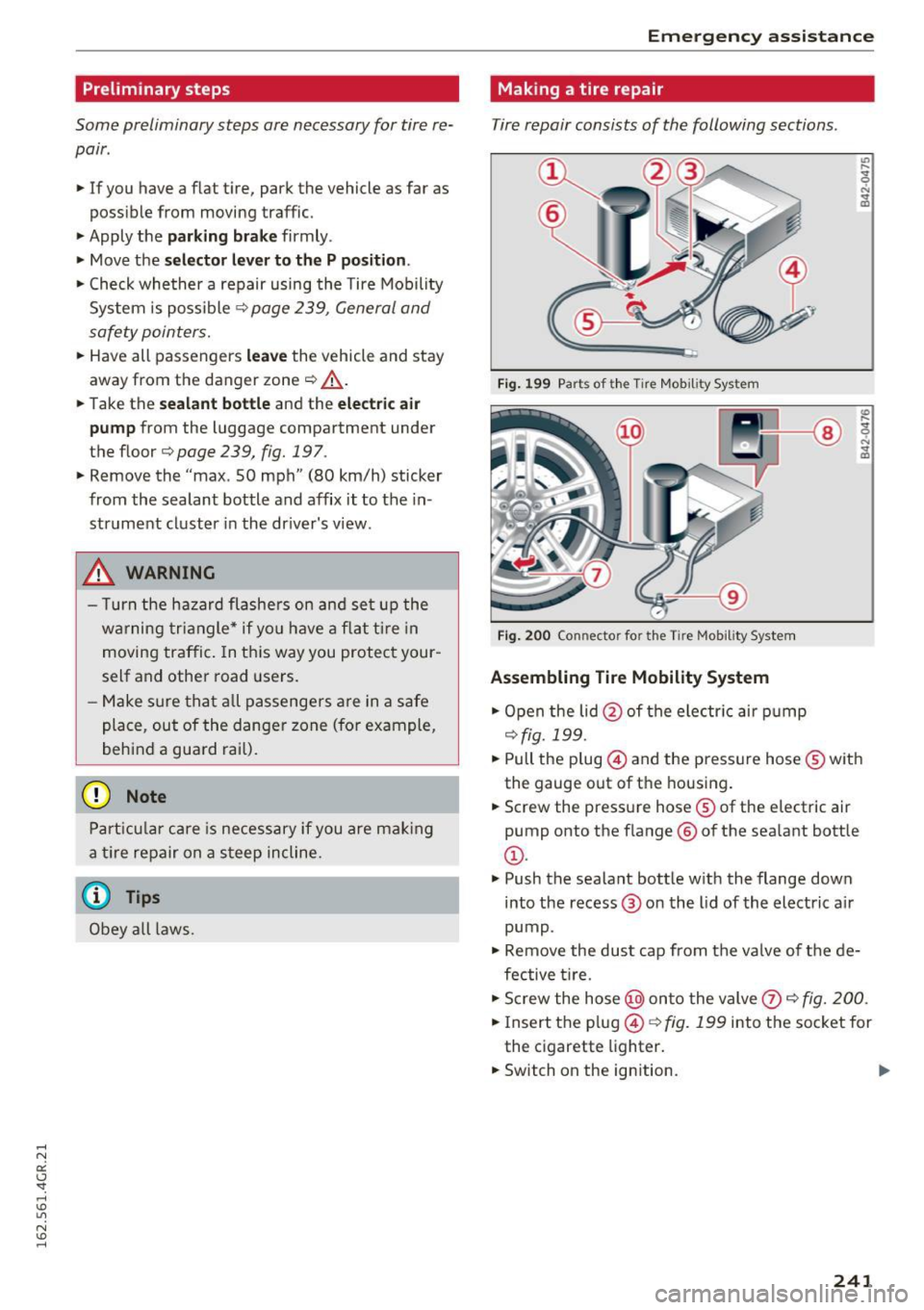
Tire repair consists of the following sections .
Fig. 199 Parts of th e Tire Mobility System
Fig. 200 Con necto r fo r t he Tire Mobi lity System
Assembling Tire Mobility System
• Open the lid@ of the electr ic air pump
¢fig. 199 .
• Pull the p lug @ and the pressure hose® with
the gauge out of the housing.
• Screw the pressure hose® of the electric air
pump onto the f lange ® of the sealant bottle
@.
• Push the sealant bottle w ith the flange down
into the recess @ on the lid of the electric a ir
pump .
• Remove the dust cap from the va lve of the de
fective ti re.
• Screw the hose@) onto the valve
(J) ~ fig. 200.
• Ins ert the plug @¢ fig. 199 into the socket for
the cigarette lighter.
• Switch on the ign ition.
241
Page 244 of 282
Emergency assistance
Inflating tire
.,. Move the switch@¢ fig. 200 on the e lectric air
pump
ll to position I. After S minutes, tire
pressure must have reached at least 1.8 bar.
.,. Switch the electric air pump off- switch in posi
tion
0. If the required tire pressure of at least
1.8 bar has not been reached, follow the in
structions in the section
Re-inflating tire.
Re-inflating tire
.,. Remove the hose from the va lve and pu ll the
plug out of the socket.
.,. Drive the vehicle slowly 33 feet (10 meters)
backward or forward . This helps to distribute
the sealant better .
.,. Remove the empty inflation bottle and screw
the hose ®~
fig. 199 from the electric pump
directly onto the
valve.
.,. Inse rt the plug ©~ fig. 199 into the socket for
the cigarette lighter.
.,. Switch on the ignition .
.,. Move the switch @¢
fig. 200 on the electric air
pump
ll to posit ion I. After S minutes, tire
pressure must have reached at least 1.8 bar.
.,. Switch the electric air pump off- switch in posi
tion
0. If the required tire pressure of at least
1.8 bar has not been reached, it is not possible
to make a repair with the tire sea lant . Seek p ro
fessional assistance.
Disassembling Tire Mobility System
.,. Remove the hose from the valve and pull the
plug out of the socket .
.,. Screw the dust cap onto the
valve.
.,. Place the empty sealant bottle back in the orig
inal packaging and clip it in place under the
floor so that no tire sealant can ru n out into the
vehicle.
.,. Place the electric air pump in the luggage com
partment for the time being.
.,. Start driving right away so that the sealant is
distributed in the tire.
l ) The electric air pu m p sho uld never r un for lo ng er than 6
m in ute s.
242
A WARNING ,_ -
- Follow the manufacturer's safety instruc
tions on the decal for the air pump and the
sealant bottle .
- If a tire pressure of 1.8 bar cannot beach
ieved after pumping for S minutes, the tire
is too severely damaged . Do not continue to
drive .
- Seek professional assistance if it is not pos
sible to repair the tire with the tire sealant .
(D Tips
-Do not operate the e lectr ic air pump for
more than 6 minutes without stopping, oth
erwise it can overheat . When the air pump
has cooled down, you can continue to use it.
- If sealant has escaped, allow it to dry, then
you can peel it off .
· Final check
After driving for a short distance , tire
pressure must be checked
.,. After driving for about 10 minutes, stop and
check the tire pressure.
.,. If tire pressure is sti ll at least 1.3 bar, inflate
the t ire to specified pressure (see drivers side
B-pillar), drive to the next repair shop and have
the tire and the sealant bottle replaced.
.,. If tire pressure is less than 1.3 bar, the tire is
too severely damaged . Do not continue to
drive . Seek profess ional assistance .
A WARNING
If tir e pressure is less than 1.3 bar after driv
in g for 10 minutes, the tire is too severely
damaged. Do not continue to drive. Seek pro
fessional assistance.
(D Tips
After a tire repair , have the sealant bottle re
placed at a dealership. This restores full func
tionality to the Tire Mobility System.
Page 245 of 282
Replacing wheels
Before changing a wheel
Observe the following precautions for your own
and your passenger's safety when changing a
wheel.
.,. After you experience a tire failure, pull the car
well away from moving traffic and try to reach
level ground before you stop¢.,&..
.. All passengers should
leave the car and move
to a safe location (for instance, beh ind the
guardrail)¢ .,&. .
.,. Engage the
parking brake to prevent your vehi
cle from rolling unintentionally¢ .,&..
.. Move
selector lever to position P ¢ .,&. .
.. Take the
jack out of the luggage compartment
c:>page 239.
A WARNING
You or your passengers could be injured while
chang ing a wheel if you do not follow these
safety precautions:
- If you have a flat tire, move a safe distance
off the road. Turn off the engine, turn the
eme rgency flashers on and use other warn
ing devices to alert other motorists.
- Make sure that passengers wait in a safe
place away from the vehicle and well away
from the road and traffic.
- To help prevent the vehicle from moving
sudden ly and possibly slipping off the jack,
always fully set the parking brake and block
the wheel diagonally opposite the wheel be
ing changed . When one front wheel is lifted
off the ground, placing the Automatic
Transmission in P (Park) will
not prevent the
vehicle from moving.
- Before you change a wheel, be sure the
ground is level and firm. If necessary, use a
sturdy board under the jack.
- Always store the veh icle tool k it, the jack
and the replaced tire in the luggage com
partment
c> page 124.
(D Note
If you are changing the whee l on a steep in
cline, use a rock or similar object to b lock the
Emergency assistance
opposite wheel to prevent the vehicle from
moving.
(D Tips
- Before changing the wheel, you must acti
vate the jacking mode, so that the automat
ic controls for the Adaptive Air Suspension*
do not make it more difficu lt to lift the vehi
cle with the jack
c> page 245.
- Obey all laws .
Changing a wheel
When you change a wheel, follow the sequence
described below step-by-step and in exactly thot
order .
1. Activate the vehicle jack mode* c> page 245.
2. Remove the
wheel bolt caps*. For more de
tails see also
¢ page 244, Wheels with
wheel bolt caps.
3. Loosen the wheel bolts c:> page 244.
4. Locate the proper mounting point for the
jack and align the jack below that point
~page 245.
5. Raise the car with the jack c:> page 245.
6. Remove the
wheel with the flat tire and then
install the other whee l¢
page 246.
7. Tighten all whee l bolts lightly.
8.
Lower the vehicle with the jack.
9. Use the wheel bolt wrench and
firmly tighten
all wheel bolts
c> page 244.
10. Replace the
wheel bolt caps*.
11. Deact ivate the vehicle jack mode* in the
MMI:
I CARI funct ion button> (C ar )* systems
contro l butto n > Servicing & checks > Air
susp.: jack mode >
Off.
The vehicle jack mode* switches off automat ical
ly at speeds above 6 mph (10 km/h) .
A WARNING
-
Always read and follow all WARNINGS and in-
formation
¢ .&. in Raising the vehicle on
page
245 and ¢ page 247.
243