warning AUDI RS7 SPORTBACK 2016 Owners Manual
[x] Cancel search | Manufacturer: AUDI, Model Year: 2016, Model line: RS7 SPORTBACK, Model: AUDI RS7 SPORTBACK 2016Pages: 282, PDF Size: 70.78 MB
Page 245 of 282
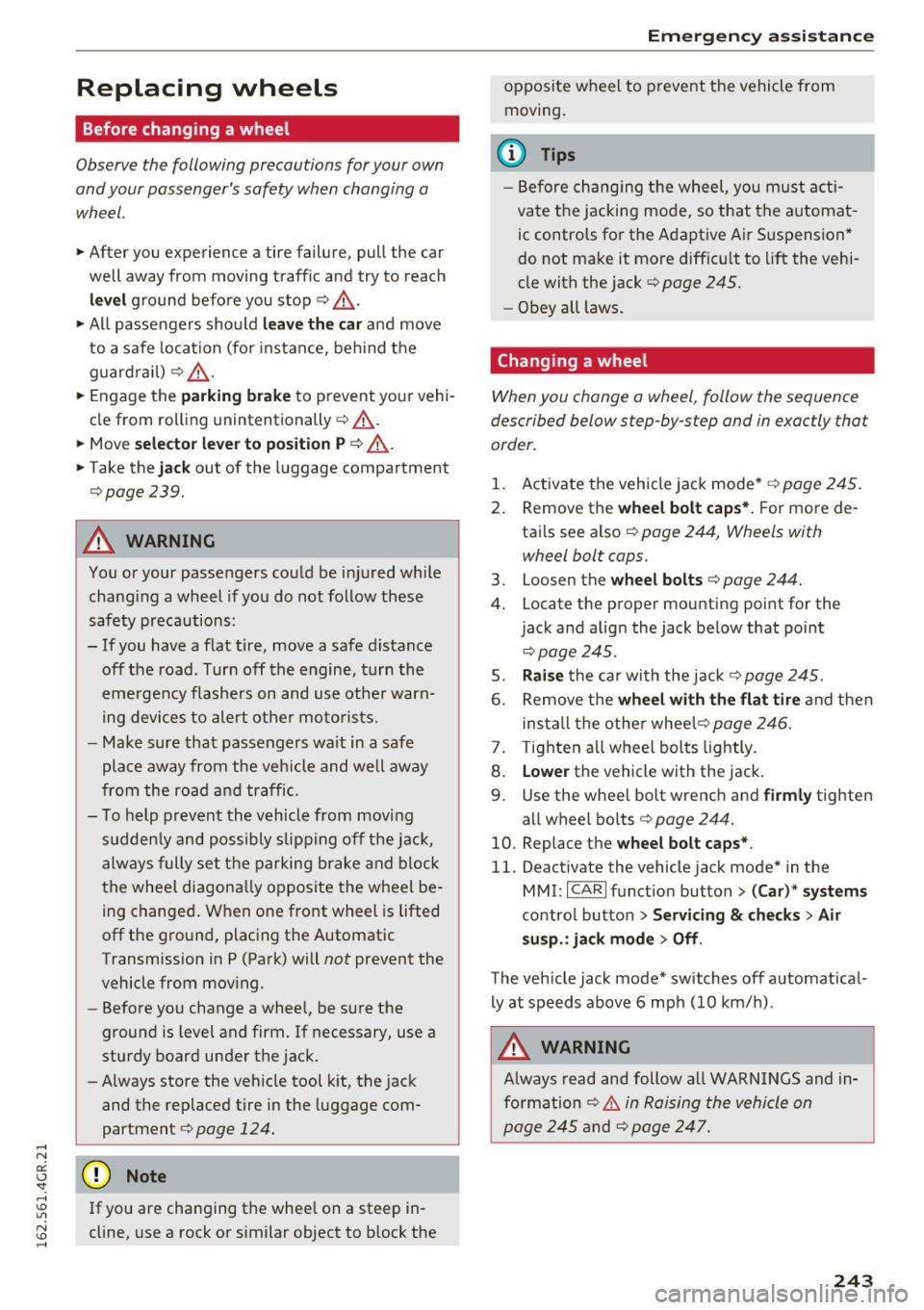
Replacing wheels
Before changing a wheel
Observe the following precautions for your own
and your passenger's safety when changing a
wheel.
.,. After you experience a tire failure, pull the car
well away from moving traffic and try to reach
level ground before you stop¢.,&..
.. All passengers should
leave the car and move
to a safe location (for instance, beh ind the
guardrail)¢ .,&. .
.,. Engage the
parking brake to prevent your vehi
cle from rolling unintentionally¢ .,&..
.. Move
selector lever to position P ¢ .,&. .
.. Take the
jack out of the luggage compartment
c:>page 239.
A WARNING
You or your passengers could be injured while
chang ing a wheel if you do not follow these
safety precautions:
- If you have a flat tire, move a safe distance
off the road. Turn off the engine, turn the
eme rgency flashers on and use other warn
ing devices to alert other motorists.
- Make sure that passengers wait in a safe
place away from the vehicle and well away
from the road and traffic.
- To help prevent the vehicle from moving
sudden ly and possibly slipping off the jack,
always fully set the parking brake and block
the wheel diagonally opposite the wheel be
ing changed . When one front wheel is lifted
off the ground, placing the Automatic
Transmission in P (Park) will
not prevent the
vehicle from moving.
- Before you change a wheel, be sure the
ground is level and firm. If necessary, use a
sturdy board under the jack.
- Always store the veh icle tool k it, the jack
and the replaced tire in the luggage com
partment
c> page 124.
(D Note
If you are changing the whee l on a steep in
cline, use a rock or similar object to b lock the
Emergency assistance
opposite wheel to prevent the vehicle from
moving.
(D Tips
- Before changing the wheel, you must acti
vate the jacking mode, so that the automat
ic controls for the Adaptive Air Suspension*
do not make it more difficu lt to lift the vehi
cle with the jack
c> page 245.
- Obey all laws .
Changing a wheel
When you change a wheel, follow the sequence
described below step-by-step and in exactly thot
order .
1. Activate the vehicle jack mode* c> page 245.
2. Remove the
wheel bolt caps*. For more de
tails see also
¢ page 244, Wheels with
wheel bolt caps.
3. Loosen the wheel bolts c:> page 244.
4. Locate the proper mounting point for the
jack and align the jack below that point
~page 245.
5. Raise the car with the jack c:> page 245.
6. Remove the
wheel with the flat tire and then
install the other whee l¢
page 246.
7. Tighten all whee l bolts lightly.
8.
Lower the vehicle with the jack.
9. Use the wheel bolt wrench and
firmly tighten
all wheel bolts
c> page 244.
10. Replace the
wheel bolt caps*.
11. Deact ivate the vehicle jack mode* in the
MMI:
I CARI funct ion button> (C ar )* systems
contro l butto n > Servicing & checks > Air
susp.: jack mode >
Off.
The vehicle jack mode* switches off automat ical
ly at speeds above 6 mph (10 km/h) .
A WARNING
-
Always read and follow all WARNINGS and in-
formation
¢ .&. in Raising the vehicle on
page
245 and ¢ page 247.
243
Page 246 of 282
Emerg ency assis ta nce
After changing a wheel
A wheel change is not complete without the do
ing the following.
• Always store the vehicle tool kit, the jack* and
the replaced tire in the luggage compartment
<=>page 124.
• As soon as possible, have the tightenin g tor
qu es
on all whee l bolts checked with a torque
wrench. The correct tightening torque is 90 ft lb (120 Nm).
• Have the flat tire
replac ed as soon as possible.
(D Tips
- If yo u notice that the whee l bolts are cor
roded and difficu lt to turn wh ile changing a
tire, they should be replaced before you
check the tightening torque.
- Drive at reduced speed until you have the
tightening torques checked .
- After changing a w heel, the tire pressure in
a ll four tires must be checked/corrected and
the tire pressure monitoring indicator must be stored in the MMI
c> page 23 7.
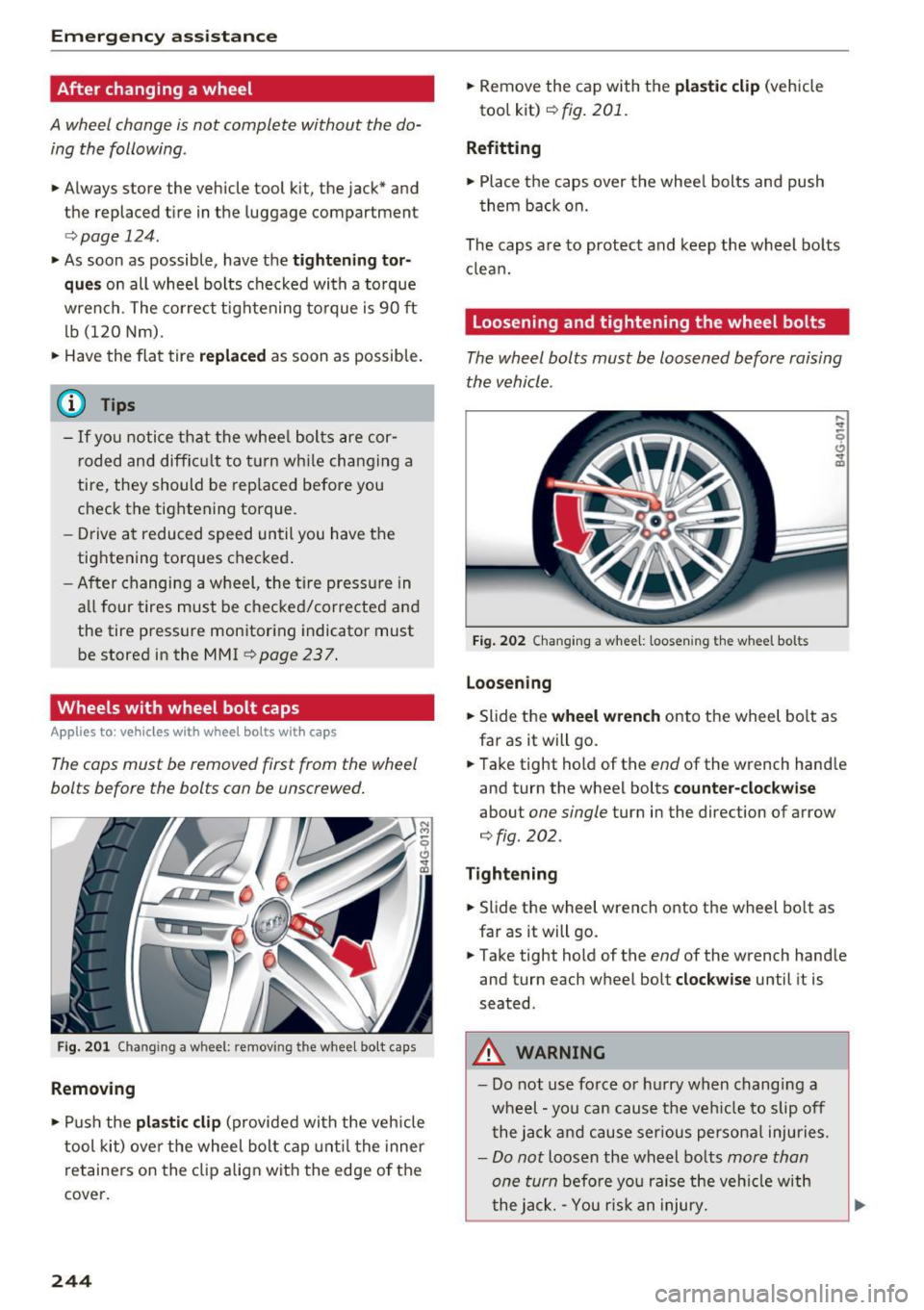
Wheels with wheel bolt caps
A ppl ies to: ve hicles w ith whee l bolts w it h ea ps
The caps must be removed first from the wheel
bolts before the bolts can be unscrewed .
Fig. 201 Chang ing a wheel : removing the whee l bo lt caps
Removing
• Push the
pla stic clip (provided with the veh icle
tool kit) over the wheel bolt cap unt il the inner
retainers on the clip align wit h the edge of the
cover.
244
• Remove the cap with t he pla stic clip (vehicle
tool kit)
c> fig. 201.
Refitt ing
• Place t he caps over the wheel bolts and push
them back on.
The caps are to protect and keep the wheel bo lts
clean.
Loosening and tightening the wheel bolts
The wheel bolts must be loosened before raising
the vehicle .
Fig. 202 Chang ing a whee l: loosening the wheel bolts
Lo ose ning
• Slide the
w hee l w ren ch onto the wheel bo lt as
far as it will go.
• Take tight hold of the
end of the wrench hand le
and turn the wheel bolts
count er-clo ckwis e
about one single turn in the direction of arrow
¢fig. 202.
Tightening
• Slide the wheel wrench onto the wheel bo lt as
far as it will go.
• Take tight hold of the
end of the wrench handle
and turn each wheel bolt
clockwis e until it is
seated .
_&. WARNING
- Do not use force or hurry when changing a
wheel -you can cause the veh icle to slip off
the jack and cause serious persona l injuries.
- Do not loosen the wheel bo lts more than
one turn
before you raise the veh icle w ith
the jack. -You r is k an injury.
Page 247 of 282

@ Tips
-Never use the hexagonal socket in the han
dle of the screwdriver to loosen or tighten
the wheel bo lts .
- If a whee l bolt is very tight, you may find it
easier to loosen by carefully pushing down
on the end of the wheel bolt wrench with
one foot only . As you do so, hold on to the
car to keep your balance and take care not
to s lip.
Raising the vehicle
The vehicle must be li~ed with the jack first be
fore the wheel can be removed .
Fig. 203 S ill pane ls: markin gs
a,
"' ~ 9
---~,.----~ a,
Fig . 204 S ill : posit io ning th e vehi cle ja ck
.. Activate the vehicle jack mode* in the MMI:
I CAR ! function button > (C ar)* sys tems contro l
button
> Serv icing & checks> Air s usp. : jac k
mod e> On.
.. Engage the par king br ake to preven t your vehi
cle from roll ing unintentionally .
.. Move the
selector lever t o position P .
.... N .,. Find the cover on the si ll that is nearest the a::
~ wheel that will be changed¢ fig. 203. Under
~ the cover, there is a liftin g point on the sill for U"I
~ the vehicle jack .
......
Em ergen cy a ssis tanc e
.. Remove the cover from the sill before lift ing
the vehicle with a vehicle jack¢
page 246 .
.. Turn the vehicle ja ck located under the lifting
point on the sill to raise the jack unt il its arm ®
¢
fig. 204 is located under the designated plas
tic mount ¢
.&,¢(D .
.. Alig n the jack so that its arm@¢ fig. 204 en
gages in the designated lifting point in the door
sill and the movable base @ lies flat o n the
gro und . The base @ must be
vertical unde r the
lifting point @ .
.. Wind the jack up further until the f lat tire
comes off the ground¢_&. .
Pos ition the vehicle jack
only under the des igna t
ed lift ing points on the sill
¢ fig. 203. There is ex
actly
one l ocation for each whee l. The jack must
not be posit ioned at any other location¢ & ¢0 .
An
un stable surfa ce under the jack can cause the
vehicle to slip off the jack . Always provide a f irm
base for the jack on the ground. If necessary
place a sturdy board o r similar support under the
jack. On
ha rd, slipper y surfa ce s (such as tiles)
use a rubbe r mat or similar to prevent the jack
from slipping ¢& .
A WARNING
-You o r your passengers could be inj ured
while changing a wheel if you do not fo llow
these safety precautions :
- Position the vehicle jack only at the des ig
nated lift ing po ints and align the jack.
Otherwise, the vehicle jack could slip and
cause an injury if it does not have suffi
c ient hold on the vehicle .
- A soft or unstable surface under the jack
may cause the veh icle to slip off the jack .
Always provide a firm base for the jack on
the g round . If necessary, use a sturdy
boa rd unde r the jack.
- On hard, slippery surface (s uch as t iles)
u se a rubber mat or sim ilar to prevent the
ja ck from s lipping.
- To help prevent injury to yourse lf and your
passengers:
- Do not raise the vehicle until you are sure
the jack is securely engaged.
245
Page 250 of 282
Emerg enc y assis ta nc e
-Repl ace th e flat tire with a ne w one and have
it in st a lled on you r vehicl e as s oon as poss i
ble . R emount the wheel co ve r.
Until th en, driv e with extr a care and at r educe d
s peeds .
A WARNING
-If you are going to equip your vehicle w ith
t ires or rims which differ from those which
were factory installed, then be sure to read
the informat ion¢
page 225, New tires or
wheels.
- Always make sure the damaged wheel or
even a flat tire and the jack and tool kit are
properly secured in the luggage compart
ment and are not loose in the passenger
compartment.
- In an accident or sudden ma neuver they
could fly forward, injuring anyone in the ve
hicle.
- Always store damaged wheel, jack and too ls
sec urely in the luggage compartment. Oth
erwise, in an accident or s udden maneuver
they could fly forward, causing injury to pas
sengers in the vehicle.
(D Note
Do not use commercia lly available t ire seal
ants . Otherwise , the electrical components of
the t ire pressure monito ring sys tem wi ll no
longer work properly and the sensor for the
tire press ure monitoring system will have to
be replaced by qualified workshop .
248
-
Page 251 of 282
Fuses
Replacing fuses
A fuse that has blown will have metal strips that have burned through.
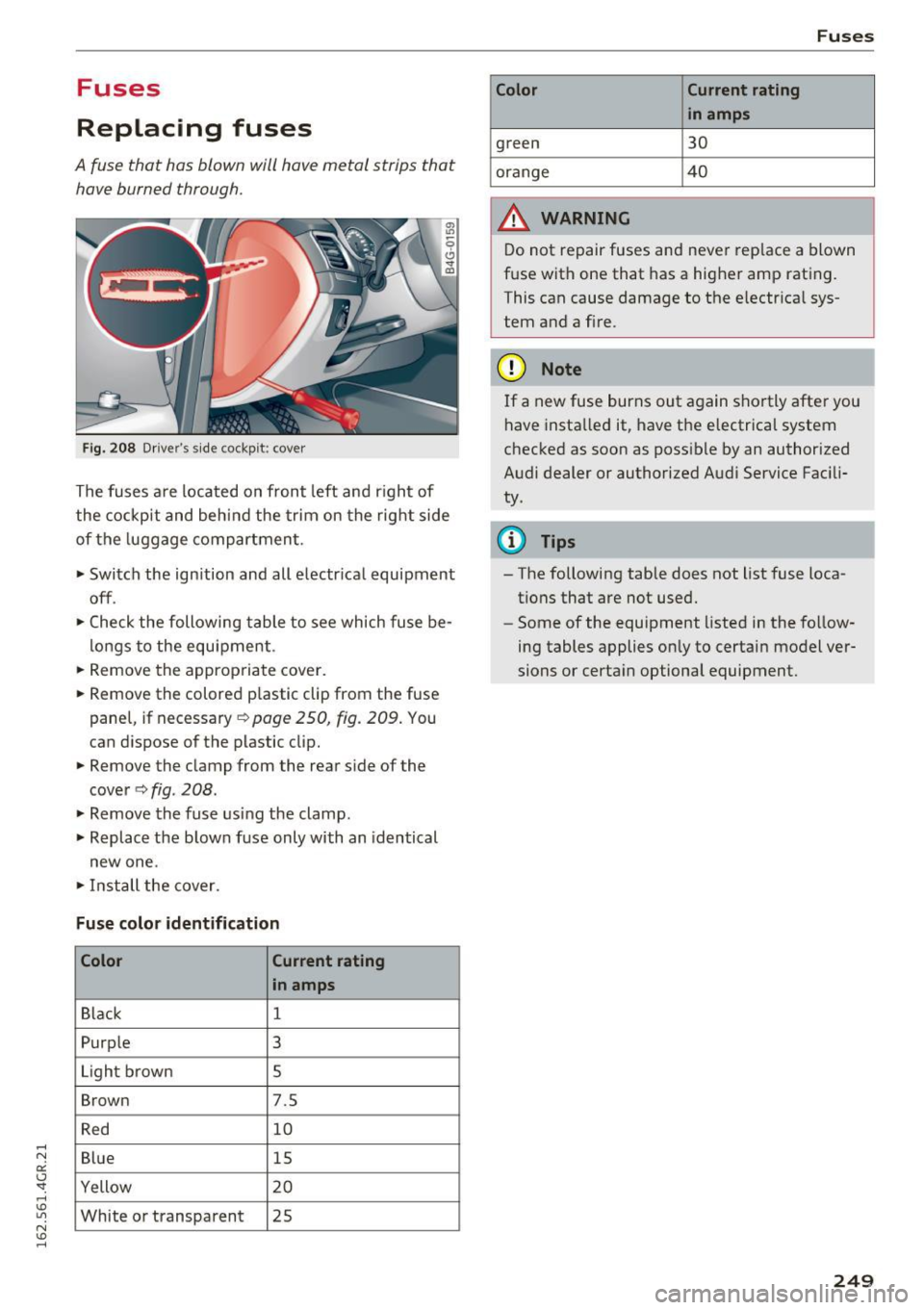
Fig. 208 Drive r's side cockpit : cover
The fuses are located on front left and right of
the cockpit and behind the trim on the right side
of the luggage compartment.
.,. Switch the ignition and all electrical equipment
off .
.,. Check the following table to see which fuse be
longs to the equipment .
.,. Remove the appropriate cover.
.,. Remove the colored p lastic clip from the fuse
panel, if necessary ~
page 250, fig. 209. You
can dispose of the plastic clip .
.,. Remove the clamp from the rear side of the
cover
c> fig . 208 .
.,. Remove the fuse using the clamp .
.,. Replace the b lown fuse only with an identical
new one .
.,. Install the cover.
Fuse color identification
Color Current rating
in amps
Black 1
Purple 3
Light brown s
Brown 7.5
Red 10
Blue 15
Yellow 20
White or transparent 25
Fuses
Color Current rating
in amps
green 30
orange 40
,&_ WARNING
= -Do not repair fuses and never replace a blown
fuse with one that has a higher amp rating.
This can cause damage to the electr ical sys
tem and a fire.
(D Note
If a new fuse burns out again shortly after you
have installed it, have the electrical system
checked as soon as poss ible by an authorized
Audi dealer or authorized Audi Service Facili
ty .
Ci) Tips
-The following table does not list fuse loca
tions that are not used .
- Some of the equipment listed in the follow
ing tables applies only to certain model ver
sions or certa in optional equipment.
249
Page 255 of 282
Emergency situations
General
This chapter is intended for trained emergency
crews and working personnel who have the nec
essary tools and equipment to perform these
ope rations.
Starting by pushing or
towing
(D Note
Veh icles with an automatic transmission can
not be started by pushing or towing.
Starting with jumper
cables
If necessary, the engine can be started by con
necting it to the battery of another vehicle .
If the engine shou ld fail to start because of a dis
charged or weak battery, the battery can be con
nected to the battery of
another vehicle, using a
pair of jumpe r cables to start the engine.
Jumper cables
Use only jumper cables of suffic iently large cross
section
to carry the starter current safely. Refer
to the manufacturer's specifications.
Use only jumper cables with
insulated term inal
clamps which are dis tinct ly marked :
plus(+) cable in most cases colored re d
minus( -) cable
in most cases colored blac k.
A WARNING
Batteries contain electricity, acid, and gas.
Any of these can cause very serious or fatal in
jury. Follow the instructions below for safe
handling of your vehicle's battery.
- Always shield your eyes and avo id leaning
over the battery whenever poss ible.
- A discharged battery can freeze at tempera
tures just below 32 °F (0 °C) . Before con
necting a jumper cable, you must thaw the
Emergency situations
frozen battery completely, otherwise it
could explode .
- Do not allow battery acid to contact eyes or
skin. Flush any contacted area with water immediately.
- Improper use of a booster battery to start a
vehicle may cause an exp losion.
- Vehicle batteries generate exp losive gases.
Keep sparks, flame and lighted cigarettes
away from batteries.
- Do not try to jump start any vehicle with a
low acid level in the battery .
- The vo ltage of the booster battery must also
have a 12-volt rating. The capacity (Ah) of
the booster battery should not be lower
than that of the discharged battery. Use of
batter ies of different voltage or substantial
ly different "Ah" rating may cause an exp lo
sion and personal injury .
- Never charge a frozen battery. Gas trapped
in the ice may cause an explosion.
- Never charge or use a battery that has been
frozen . The battery case may have be weak
ened .
- Use of batter ies of different voltage or sub
stantially different capacity (Ah) rating may
cause an exp losion and injury. The capac ity
(Ah) of the booster battery should not be
lowe r than that of the discharged battery.
- Before you check anything in the eng ine
compartment, always read and heed all
WARNINGS
r::!)page 203.
(D Note
-Applying a higher voltage booster battery
will cause expensive damage to sensitive
electronic components, such as control
units, relays, radio, etc.
- Th ere must be no electrical contact between
the vehicles as otherwise current could al
ready start to flow as soon as the positive
(+) terminals are connected.
(D Tips
The discharged battery must be properly con-
nected to the vehicle's e lectrical system. ..,.
253
Page 256 of 282

Emergency situations
When jump starting or charging the battery,
never connect the negative ground cable to
the battery negative post because the battery
manager system must be able to detect the
battery's state of charge. Always connect the
negative ground cable to the negat ive ground
post of the battery manager control unit .
Use of jumper cables
Make sure to connect the jumper cable clamps in
exactly the order described below!
Fig. 212 Engine compartment: connectors for ju mp start
cab les a nd charger
® .--l @
Fig. 213 Ju mp start ing wit h the battery o f another vehicle:
@ -boos te r battery ,® -discharged vehicle battery
The procedure described below for connecting
jumper cables is intended to provide a jump start
for your vehicle.
Vehicle with discharged battery:
• Turn off lights and accessories , move lever of
automatic transmission to N (Neutral) or P
(Park) and set parking brake .
Connect POSITIVE(+) to POSITIVE(+) (red)
• Open the red cover on the positive term inal
~ fig . 212.
254
1. Connect one end of the red positive cable on
the
jump start bolt 9 fig. 213 @ (bolt under
the red cover= "positive") of the vehicle to be
started ®·
2. Connect the other end to the positive termi-
nal@ of the booster battery @.
Connect NEGATIVE (- ) to NEGATIVE (-)
(black)
3. Connect one end of the black negative cable
to the negative term inal @ of the booster
battery @.
4 . Connect the other end to the
jump start pin
@ (bolts with hex head bolt= "negat ive") of
the vehicle to be started ®·
Starting the engine
• Start the eng ine of the vehicle with the booster
battery @. Run the engine at a moderate
speed.
• Sta rt engine w ith discharged vehicle ba ttery @
in the usual manner.
• If the engine fails to start, do not keep the
starter cranking for longer than 10 seconds.
Wait for about 30 seconds and then try again.
• With engine running, remove jumper cables
from both vehicles in the exact
reverse order.
• Close the red cover on the positive terminal.
The battery is vented to the outside to prevent gases from entering the vehicle interior . Make
sure that the jumper clamps are well connected
with their metal parts in full contact with the battery terminals.
&_ WARNING
To avoid ser ious personal injury and damage
to the vehicle, heed all warnings and instruc
tions of the jumper cable manufacturer. If in
doubt, call for road service.
- Jumper cables must be long enough so that
the vehicles do not touch.
- When connecting jumper cables, make sure
that they cannot get caug ht in any moving
parts in the engine compartment.
- Before you check anything in the engine
compartment, always read and heed all
WARNINGS
¢ page 203.
Page 257 of 282
(D Note
Im pro per hook-u p of jum per cables can ru in
the gene ra tor.
- Always connect P OSITI VE( +) to POS ITI VE
( + ), and NEGATIVE( -) to NEGATIVE( -)
ground post of t he battery manager contro l
u nit .
- Check that a ll sc rew p lugs on the battery
ce lls a re sc rewed in firmly . If not, t igh ten
pl ugs p rio r to connecting clamp on negative
batte ry te rminal.
- Please note t hat the procedure fo r con nect
i ng a jumper cab le as desc ribe d above ap
p lies specifica lly to the case of yo ur vehicle
being jump s tarte d. W hen you are giv ing a
ju mp s ta rt to an othe r vehicl e, do
not con
n ect t he nega tive (- ) ca b le t o t he nega tive
(-) t ermin al on the di scharged battery @
c::> fig . 2 13 . Instead, securely connec t the
negative (-) cable to either a solid metal
com ponent that is f irm ly bolted t o the e n
gine block o r to t he engine bloc k itsel f. If
the battery that is be ing c ha rge d d oes not
vent to the outs ide, escap ing batte ry gas
could ignite and e xplode!
Towing with a tow truck
General hints
Your Audi require s speci al handling f or towing.
Th e follow ing informat ion is to be used by com
mercia l tow tr uck o pera tors who know how to op
e rat e the ir equip men t sa fely.
- Never tow your Audi. Towing will cause dam
age to the engine and transmission .
- Never wrap the safety chains or winch cables
around the brake lines.
- To prevent unnecessary damage, your Audi
must be transported with a flat bed truck.
- To load the vehicle on to the flat bed, use the
towing loop found in the vehicle tools and at
tach to the front or rear anchorage
c::> page 255 and c::> pag e 256 .
Emergency situations
A WARNING
-A vehicle being towe d is not safe for passen-
ge rs. Neve r allow a nyo ne to ride in a vehicle
b eing towed, for any reason.
Front towing loop
Fi g. 214 Fron t bumper: cover
Fig. 215 Fron t bumper: installing the tow ing loop
The threaded opening for the towing loop is lo
cated behind a cover on the rig ht side of the front
bumper .
.,. Remove the towing loop from the vehicle too l
kit<=>
page 239.
.,. Press the cap inward with brief, forceful pres
sure <=>
fig. 214 . The cap will loosen from the
bumper.
.,. Tigh ten t he towing loop in the threaded o pen
ing until it sto ps
c::> fig. 215 and t hen tig hten it
w it h a wheel wre nc h .
.,. After usi ng, p lace the tow ing loop ba ck in t he
ve hicle tool kit.
A WARNING
--
If t he tow ing loop is not tig htened until it
stops when installing, t he threads may be
255
Page 258 of 282
Emergency situations
pulled out when towing the vehicle and that
could cause an accident.
Rear towing loop
I
0 ~ • -- cc
Fig. 216 Rear bumper: cover
0
Fig. 217 Rear bumper : in stall ing the towing loop
The th readed opening is located in the bumper
on the right rear side.
"' Remove the tow ing loop from the vehicle tool
kit
~page 239.
"'Press the cap inward with brief, forceful pres
sure
¢ fig. 216 . The cap will loosen from the
bumper.
"' Tighten the towing loop in the threaded open
ing until it stops
c,, fig. 217 and then tighten it
with a wheel wrench .
"' After using, place the towing loop back in the
vehicle tool kit.
_& WARNING
If the towing loop is not tightened until it
stops when insta lling, the threads may be
pulled out when towing the vehicle and that
cou ld cause an accident .
256
-
Loading the vehicle onto a flat bed truck
Fig. 218 Vehicle on flat bed tru ck
Front hook up
"' Align the vehicle with the centerline of the car
carrier ramp.
"' Attach the winch hook to the front towline eye
previously installed .
Rear hook up
"' Align the vehicle with the centerline of the car
carrier ramp.
"' Attach the winch hook to the rear towline eye
previously installed .
@ Tips
Check carefully to make sure the hook-up is
secure before moving the car up the flatbed
truck ramp.
Vehicle transport
Whenever you have your vehicle transported, be
sure to note the following:
(D Note
Mount the tie-down chains/cables over the
running surface (circumfe rence) of the tires.
Never secure the vehicle by the axle, the sus
pension struts or the front or rear towline
eye. For technical reasons, the pressure in the
suspension struts may change during the
transport and this will adversely affect vehicle
handling.
Page 259 of 282

Raising the vehicle
Lifting with workshop hoist and with floor
jack
The vehicle may only b e li~ ed at the lifting
points illustra ted.
F ig. 219 Front lift ing po int
F ig. 220 Rea r lift ing po int
.,. Read and heed WARNING c:> &_ .
.. Activate the vehicle jack mode* in the MMI:
I CAR I funct ion button> (Car) * systems contro l
button >
Servicing & checks > Air susp.: jack
mode > On .
.. Loca te lift ing po ints c:> fig . 219 and c:> fig . 22 0 .
.. Adju st lifting arms of wo rkshop ho ist o r floo r
j ac k t o ma tch vehicl e lifting poin ts.
.. In se rt a rub ber pa d between the f loor jack/
wor kshop hoist a nd the lifting points .
T he vehicle ja ck mode* mus t be activa ted so th at
the au tomatic a djustment of the Adaptive Air
Suspension * does not make it more d ifficult to
raise the ve hicle w it h the floo r jack.
If you must lift your vehicle with a floor jack to
work underneath , be sure the vehicle is safely
supported on stands intended for this purpose .
Emergency situations
Front lifting point
The li fting poin t is lo cate d on the floor p an rein
f orceme nt ab out at the same level as the ja ck
mounting point
c:> fig . 219 . Do not lift the vehi
cle at the vertical sill reinforcement.
Rear lifting point
T he lifting point is lo cated on the ver tic al rein
f orcement o f the lower s ill for the on- bo ar d jac k
<=> fig. 220.
Lifting with vehicle jack
Refer to c:> page 245 .
A WARNING
- To reduce the r is k of se rious inju ry and vehi
cle damag e.
- Always lift the vehicle on ly at the special
workshop h oist a nd floor jack lift points
il
lustrated c:> fig. 219 and c:> fig. 220.
- Failure to lift t he veh icle at these points
could cause t he veh icle to tilt o r fall from
a lift i f th ere is a change in vehicle weight
dist ribution and balance . This might hap
pen, fo r example, when heavy compo
n en ts such as the eng ine block o r tran s
mis sio n a re re moved .
- Whe n re mov ing heavy co m ponents like
these, an ch or vehicle t o hois t or ad d co rre
spon ding weig hts t o m aintai n the cen ter of
g ravi ty . Ot herw ise, the vehicle mig ht tilt or
slip off t he hoist, caus ing se rious pe rsonal
i njur y .
(D Note
-Be aw are of the fo llow ing points b efor e lift
ing the vehicle:
-The vehicle should never be lifted or
jacked up from underneath the engine oil
pan, the transmission housing, the front
or rear axle or the body side members.
This could lead to serious damage .
- To avoid damage to the underbody or
chassis frame, a rubber pad must be in
serted between the floor jack and the lift
points . .,.
257