ABS AUDI RS7 SPORTBACK 2016 User Guide
[x] Cancel search | Manufacturer: AUDI, Model Year: 2016, Model line: RS7 SPORTBACK, Model: AUDI RS7 SPORTBACK 2016Pages: 282, PDF Size: 70.78 MB
Page 131 of 282
Never rely on airbags alone for protection. Even
when they deploy, airbags provide on ly additional
protection. Airbags are not supposed to dep loy in
all kinds of accidents. A lthough your Audi is
equipped with airbags, all vehicle occupants, in
cluding the dr iver, must wear safety belts cor
rectly in order to minimize the risk of severe in
jury or death in a crash .
Remember too, that airbags will deploy only
once and that your safety belts are always there
to offer protect ion in those accidents in w hich
a ir bags are not supposed to deploy or when they
have already deployed. Unbelted occupants can
also be thrown o ut of the vehicle where even
more severe or fatal injur ies can occur.
It is also important for the rear passengers to
wear safety belts correctly . Unbelted passengers
in the rear seats endanger not only themse lves
but also the driver and other passengers
¢ fig. 147. In a frontal collision they will be
thrown forward violently, where they can hit and
injure the driver and/or front seat passenger .
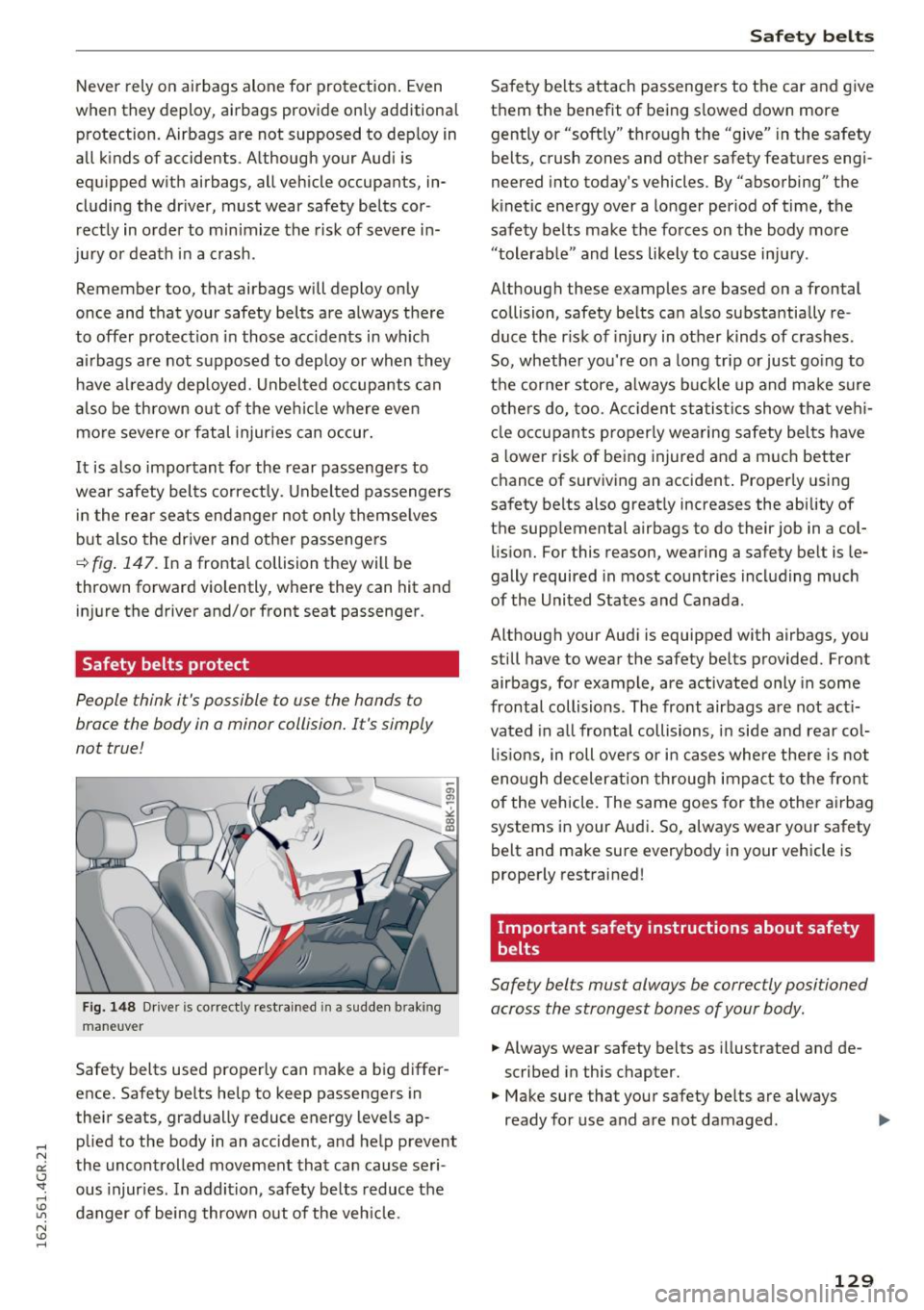
Safety belts protect
People think it's possible to use the hands to
brace the body in a minor collision. It 's simply
not true!
Fig. 148 Dr iver is correctly restra ined in a sudden b raking
maneuver
Safety belts used properly can make a big differ
ence. Safety belts help to keep passengers in
their seats, gradually reduce energy levels ap
plied to the body in an accident, and help prevent
the uncontrolled movement that can cause se ri
ous injur ies. In addition, safety belts reduce the
danger of being thrown out of the vehicle.
Safety belts
Safety belts attach passengers to the car and give
them the benefit of being slowed down more
gently or "softly" through the "give" in the safety
belts, crush zones and other safety features engi
neered into today's vehicles. By "absorbing" the
kinetic ene rgy over a longer period of time, the
safety belts make the forces on the body more
"tolerab le" and less likely to ca use injury .
Although these examples are based on a frontal collision, safety be lts can also substantially re
duce the r isk of injury in other k inds of crashes.
So, whether you're on a long trip or just going to
the corner store, always buckle up and make sure
others do, too. Acciden t statist ics show that vehi
cle occupants properly wearing safety belts have
a lower risk of being injured and a much better
chance of surviving an accident . Properly using
safety belts also greatly increases the ability of
the supp lemental airbags to do their job in a col
lision. For this reason, wearing a safety belt is le
gally required in most count ries including much
of the United States and Canada .
Although your Aud i is equipped with airbags, you
still have to wear the safety belts provided. Front
airbags, for example, are activated only in some
frontal collisions. The front airbags are not act i
vated in all frontal collisions, in side and rear col
lisions , in roll overs or in cases where there is not
enough deceleration through impact to the front
of the vehicle. The same goes for the other air bag
systems in your Audi . So, always wear your safety
belt and make sure everybody in your vehicle is
properly restrained!
Important safety instructions about safety
belts
Safety belts must always be correctly positioned
across the strongest bones of your body.
.,. Always wear safety belts as illustrated and de
scribed in this chapter.
.,. Make sure that your safety belts are always
ready for use and are not damaged.
129
Page 142 of 282
Airbag system
& WARNING
Objects between you and the airbag will in
crease the risk of injury in a crash by interfer
ing with the way the airbag unfolds and/or by
being pushed into you as the airbag inflates.
-Always make sure nothing is in the front air -
bag deployment zone that could be struck
by the airbag when it inflates .
- Objects in the zone of a deploying airbag
can become projectiles when the airbag de
ploys and cause serious personal injury.
- Never hold things in your hands or on your
lap when the vehicle is in use .
- Never place accessories or other objects
(such as cup holders, telephone brackets,
note pads, navigation systems, or things
that are large, heavy, or bulky) on the doors;
never attach then to the doors or the wind
shield; never place them over or near or at
tach them to the area marked ,,AIRBAG" on
the steering wheel, instrument panel or the
seat backrests; never place them between
these areas and you or any other person in
the vehicle.
- Never attach objects to the windshield
above the passenger front airbag, such as
accessory GPS navigation units or music
players . Such objects could cause serious in
jury in a collision , especially when the air
bags inflate .
- Never recline the front passenger seat to
transport objects. Items can also move into
the deployment area of the side airbags or
the front airbag during breaking or in a sud
den maneuver. Objects near the airbags can
fly dangerously through the passenger com
partment and cause injury, particularly
when the seat is reclined and the airbags in
flate.
& WARNING
A person on the front passenger seat, espe cially infants and small children, will receive
serious injuries and can even be killed by be
ing too close to the airbag when it inflates.
-Although the Advanced Airbag System in
your vehicle is designed to turn off the front
140
-
passenger airbag if an infant or a small child
is on the front passenger seat, nobody can
absolutely guarantee that deployment un
der these special conditions is impossible in
all conceivable situations that may happen
during the useful life of your vehicle .
- The Advanced Airbag System can deploy in
accordance with the ,,low risk" option for 3-
and 6-year-old children under the U .S . Fed
eral Standard if a child with electrical capac
itance greater than the combined capaci
tance of a typical one-year old infant re
strained in one of the forward facing or rear
ward-facing child seats with which your ve
hicle was certified is on the front passenger
seat and the other conditions for airbag deployment are met .
- Accident statistics have shown that children
are generally safer in the rear seat area than
in the front seating position .
- For their own safety, all children, especially
12 years and younger, should always ride in
the back properly restrained for their age
and size.
Advanced front airbag system
Your vehicle is equipped with a front Advanced
Airbag System in compliance with United States
Federal Motor Vehicle Safety Standard 208, as
well as Canada Motor Vehicle Safety Standard
(CMVSS) 208 as applicable at the time your vehi
cle was manufactured.
The front Advanced Airbag System supplements
the safety belts to provide additional protection
for the driver's and front passenger's heads and upper bodies in frontal crashes. The airbags in
flate only in frontal impacts when the vehicle de
celeration is high enough.
The front Advanced Airbag System for the front
seat occupants is not a substitute for your safety belts. Rathe r, it is part of the overall occupant re
straint system in your vehicle . Always remember
that the airbag system can only help to protect
you, if you are sitting upright, wearing your safe
ty belt and wearing it properly . This is why you
and your passengers must always be properly .,.
Page 144 of 282
Airbag syste m
A WARNING
A child in a rearward-facing chi ld seat instal
led on the front passenger seat will be ser i
ously injured and can be k illed if the front air
bag inflates - even with an Advanced Airbag
System.
- Although the Advanced A irbag System in
you r vehicle is designed to tu rn off the front
airbag when a rea rward-facing child re
straint has been insta lled on the fron t pas
senger seat, nobody can absolutely g uaran
tee that deployment is impossible in a ll con
ceivable situations that may happen during
the useful life of your vehicle.
- The inflating airbag w ill hit the child seat or
infant carrier w ith great force and will
smash the ch ild seat and child against the
backrest, center armrest, door, or roof.
- Always install rearward-facing ch ild re
straints on the rear seat.
- If you must install a rearward fac ing ch ild
seat on the front passenger seat because of
exceptional c ircumstances and the
PASSEN
G ER A IR BAG OFF light does not come on
and stay on, immediately insta ll the rear
facing child seat in a rea r seating pos ition
and have the airbag system inspected by
yo ur Audi dealer.
A WARNING
If, i n ex cept ional circumstances, you must i n
stall a forward-facing chi ld restraint on the
front passenger's seat:
- Always make sure the forward-facing se at
has been designed and ce rtified by its man
ufacturer for use on a f ront seat with a pas
senger front and side a irbag .
- Never put the forward -facing child restraint
u p against or very near the instrument pan
el.
- Always move the passenger seat into its
rearmost position in the seat's fore and aft
adjustment range, as fa r away from the air
bag as possib le, before insta lling the for
ward-facing child restra int. The backrest
must be adjusted to an upright posit ion.
142
- Always make sure that there is noth ing on
the front passenge r seat that will cause the
capacitive passenger detection system in
the seat to signal to the Airbag System that
the seat is occup ied by a person when it is
not, or to s ignal that it is occupied by some
one who is heavier than the person act ually
si tti ng o n the sea t. T he prese nce of addi
tional obje cts could cause the passenger
front airbag to be turned on when it should
be off , or could cause the airbag to work in a
way that is d ifferent from the way it wou ld
have wo rked without the object on the seat.
- Make sure that the
PASSENGER AIR BAG
OF F light comes on and stays on all the time
whenever the ignit ion is switched on.
Advanced Airbag System components
The front passenger seat in your veh icle has a lot
of ve ry important parts of the Advanced A irbag
System i n it. These parts incl ude t he capacitive
passenger detection system, wir ing, b rackets,
and more. The control uni t monitors the system
o n the front passenge r seat when t he ignit ion is
swi tched on and turns the airbag indica tor ligh t
o n when a malfunction in the one of the system
components is detected
~ page 147 . Because
the front passenger seat contains important
parts of the Advanced Airbag System, you must
take care to prevent it from being damaged.
Damage to the seat may prevent the Advanced
Airbag System for the front passenger seat from
do ing its job in a crash.
The front Advanced Airbag System consists
of the following:
- Crash sensors i n the front of the veh icle that
measu re vehicle acce le ration/dece le ration to
prov ide informa tion to the Advanced A irbag
System abo ut the sever ity of the cr as h .
- An elect roni c contro l unit, w ith integ rated
cr ash sensors for front an d side impacts. The
c ont rol u nit "de cides" whether to fi re the fron t
airbags based on the information received from
the crash sensors. The cont ro l unit also "de
cides" whether the safety belt pretensioners
should be activated. ..,_
Page 153 of 282
@ For the sake of the environment
Undeployed airbag modu les and pretension
ers might be classified as Perchlorate Materi
al -special handling may apply, see
www.dtsc .ca.gov/hazardouswaste/perchlo
rate . When the veh icle or parts of the re
straint system including airbag modules and
safety belts with pretensioners are scrapped,
all applicable laws and regulations must be
observed. Your authorized Audi dealer is fa
miliar with these requirements and we recom
mend that you have your dealer perform this
service for you.
Other things that can affect Advanced
Airbag performance
Changing the vehicle's suspension system can
change the way that the Advanced Airbag System
pe rforms in a crash. For examp le, using tire-rim
comb inat ions not approved by Audi, lowering the
veh icle, changing the stiffness of the suspension,
including the springs, suspension struts, shock
absorbers etc . can change the forces that are
measured by the airbag sensors and sent to the
e lectronic control unit . Some suspension changes
can, for example, increase the force levels meas
ured by the sensors and make the airbag system
deploy in crashes in wh ich it would not deploy if
the changes had not been made . Other kinds of
changes may reduce the force levels measured by
the sensors and prevent the airbag from deploy
ing when it should.
_& WARNING
Changing the vehicle's suspension including
use of unapproved tire-rim combinations can
change Advanced Airbag performance and in
crease the risk of serious personal injury in a
crash.
- Never install suspens ion components that
do not have the same performance charac
teristics as the components originally instal
led on your vehicle.
- Never use tire-rim combinations that have
not been approved by Audi.
Airbag system
Knee airbags
Description of knee a irbags
Applies to: vehicles wit h knee airbags
The knee airbag system can provide supplemen
tal protection to properly restrained front seat
occupants .
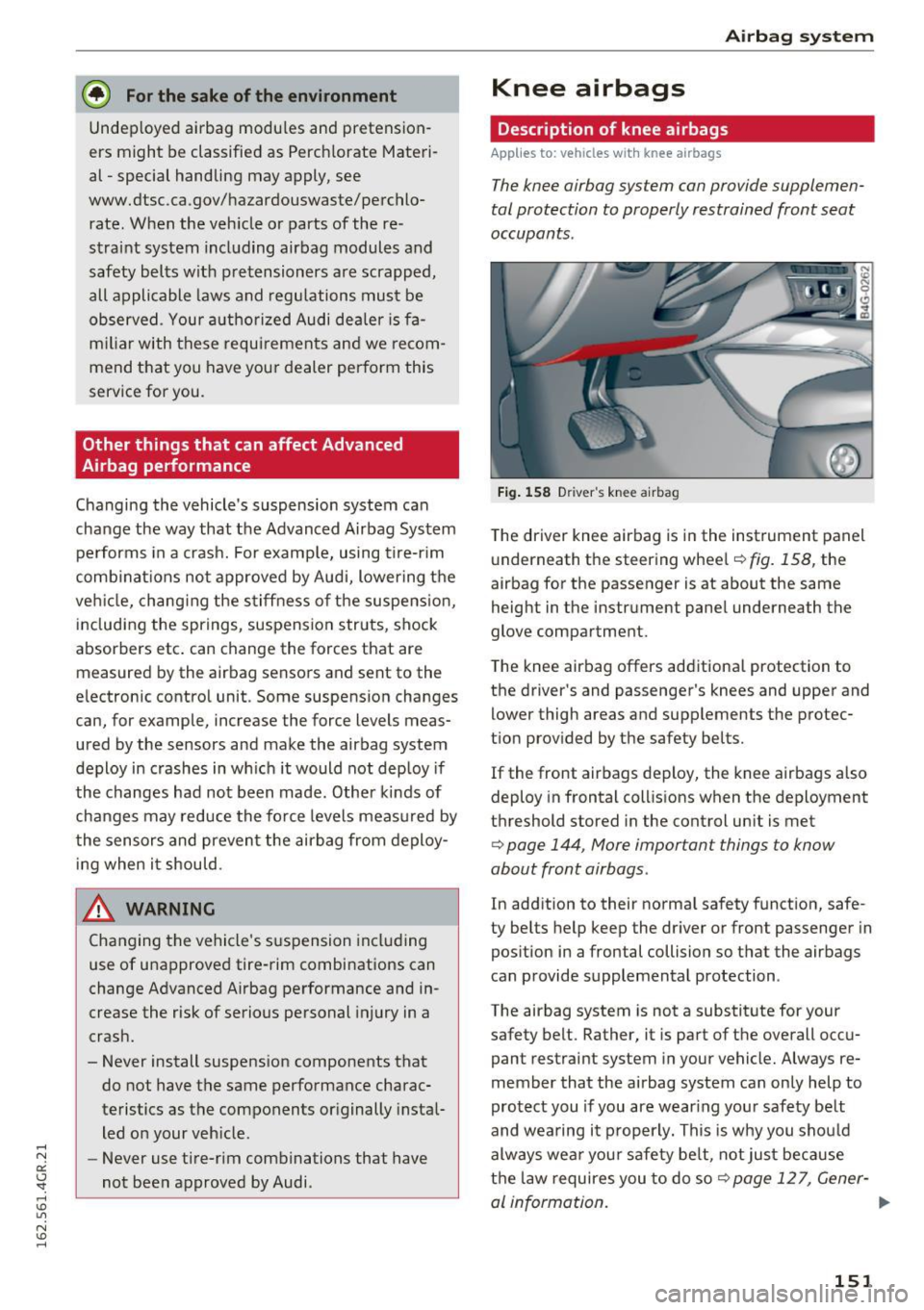
Fig. 158 Driver 's knee air bag
The driver knee airbag is in the inst rument panel
u nderneath the steering wheel¢
fig. 158, the
airbag for the passenger is at about the same
height in the instrument pane l underneath the
glove compartment.
The knee airbag offers additional protection to
the driver's and passenger's knees and upper and lower thigh areas and supplements the protec
tion provided by the safety belts.
If the front airbags deploy, the knee airbags also
deploy in frontal collisions when the deployment
threshold stored in the control unit is met
¢ page 144, More important things to know
about front airbags .
In addition to their normal safety function, safe
ty belts help keep the dr iver or front passenger in
pos ition in a frontal collision so that the airbags
can provide supplemental protection .
The airbag system is not a substitute for your
safety belt. Rather, it is part of the overall occu
pant restraint system in your vehicle. Always re
member that the airbag system can only help to
protect you if you are wear ing your safety be lt
and wea ring it properly. This is why you shou ld
always wea r your safety belt, not just because
t h e law requires you to do so ¢
page 12 7, Gener-
al information.
IJJ>-
151
Page 170 of 282
Child safety
seating position on the rear seat and have
the airbag system inspected by your author
ized Audi dealer.
- Take the child restraint off the front passen
ger seat and install it properly at one of the
rear seat positions if the
P A SSEN GER AIR
BAG OFF
light does not stay on whenever
the ignition is switched on.
Booster seats and safety belts
Properly used booster sea ts can help protect
children weighing between about 40 lbs . and 80
lbs . (18 kg and 36 kg) who are less than
4 ft. 9
in . (57 inches/1.45 meters) tall .
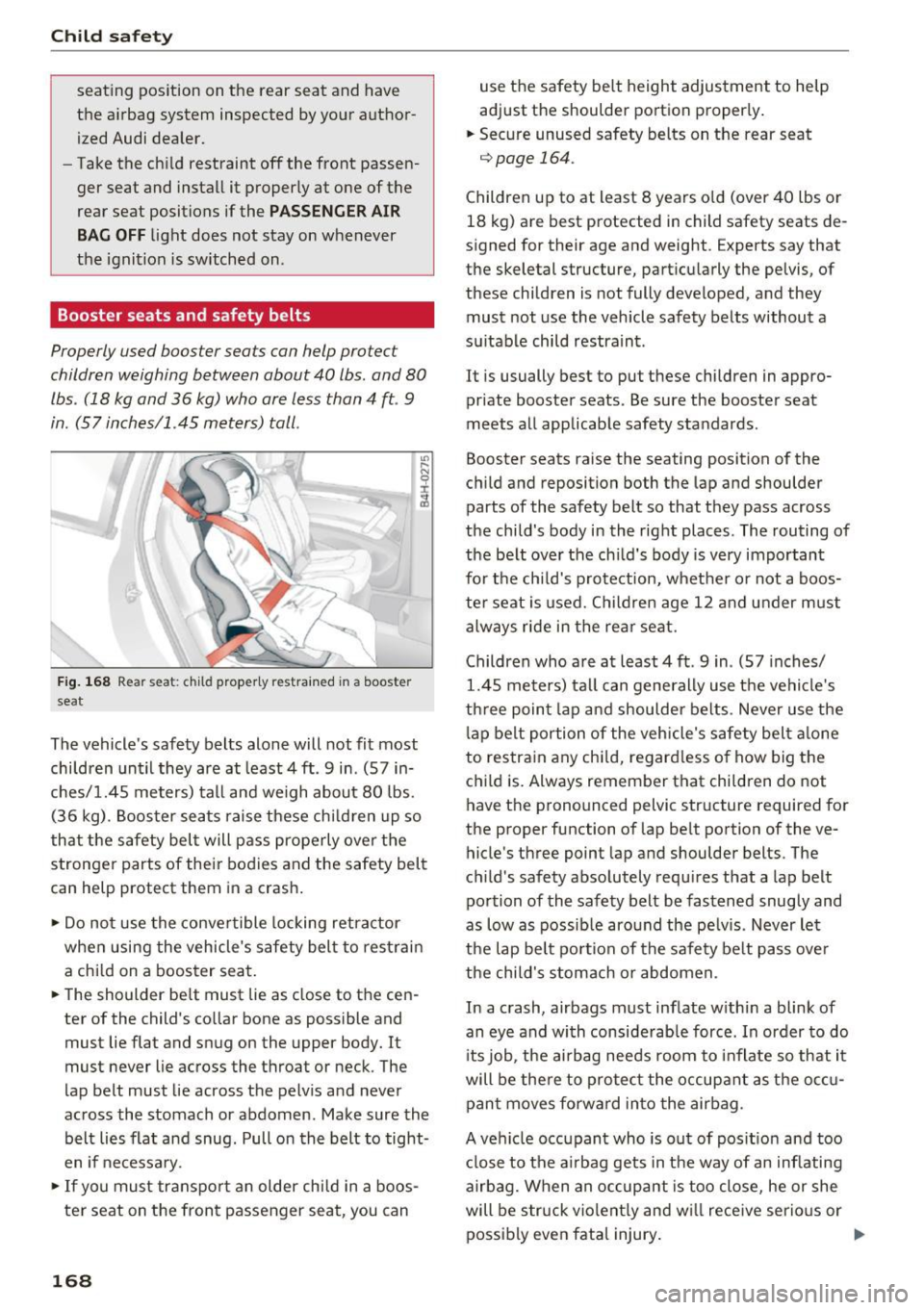
Fig . 1 68 Rea r seat : chi ld proper ly restrain ed in a booster
seat
The vehicle's safety belts alone will not fit most
chi ldren until they are at least 4 ft. 9 in . (57 in
ches/1.45 meters) tall and weigh about 80 lbs.
(36 kg). Booster seats raise these chi ldren up so
that the safety belt will pass properly over the
stronge r parts of their bodies and the safety belt
can help protect them in a crash.
• Do no t use the conve rtible locking retractor
whe n using the vehicle's safety belt to restrain
a chi ld on a booster seat.
• The shoulder be lt must lie as close to the cen
ter of the child's collar bone as possible and
must lie flat and snug on the upper body. It
must never lie across the throat or neck. The
lap belt must lie across the pelv is and never
across the stomach or abdomen . Make sure the
belt lies flat and snug. Pull on the belt to tight
en if necessa ry .
• If you must transpo rt an older chi ld in a boos
ter seat on the front passenger seat , you can
168
use the safety belt height adjustment to help
adjust the shoulder portion properly.
• Secure unused safety belts on the rear seat
c::, page 164.
Children up to at least 8 years o ld (over 40 lbs or
18 kg) are best protected in child safety seats de
signed for their age and weight. Experts say that
the skeletal structure, part icularly the pelvis, of
these children is not fully developed, and they
must not use the vehicle safety belts without a
su itable child restraint .
It is usually best to put these children in appro
priate booster seats . Be sure the booster seat
meets all applicable safety sta ndards .
Booster seats raise the seating position of the
ch ild and reposition both the lap and shoulder
parts of the safety belt so that they pass across
the child's body in the right places. The routing of
the be lt over the ch ild's body is very important
fo r the ch ild's protect ion, whet her or not a boos
te r seat is used. C hildren age 12 a nd under m ust
always ride in the re ar seat.
Children who a re at least 4 ft. 9 in . (5 7 inches/
1.45 meters) tal l can generally use t he vehicle's
th ree poin t lap a nd shoulder belts . Never use the
l ap belt portion of the veh icle's safety bel t alone
to restrain any chi ld, regard less o f how big the
ch ild is. Always remember that children do not
have the pronounced pelvic structure required for
the proper function of lap be lt portion of the ve
hicle's three point lap and shoulder belts. The
c hi ld's safety absolutely requ ires that a lap belt
portion of the safety belt be fastened snugly and
as low as possib le around the pe lvis . Never le t
the lap belt po rtion of the safety be lt pass ove r
the child's stomach or abdomen.
In a crash, airbags must inflate w ithi n a blink of
an eye and with considerab le force. In order to do
i ts job, the airbag needs room to inflate so that i t
will be there to protect the occup ant as the occ u
pan t moves forw ard in to the airbag.
A vehicle occupan t who is out of pos it ion and too
cl ose to the a irbag gets in the way of an inflating
airbag. When an occupant is too close, he or she
will be struck vio lent ly and w ill rece ive serio us or
possib ly even fatal injury.
II>
Page 182 of 282
Intelligent Technology
shared, please see your contract with the
wireless te lecommunications provider and the
"About Aud i connect" tab in your vehicle's
MMI:
! MENUI button> Audi connect > About
Audi connect .
Electronic Stabilization
Control (ESC)
Description
E SC helps to imp rove ro ad hold ing and vehicle
dynamics to help reduce the probab ility of skid
d ing and loss of veh icle control. It works only
when the engine is runn ing . ESC detects certain
d iffic ult dr iving situat io ns, including when the
ve hicl e is begin ning to spin (yaw) o ut of contro l
and h elps you to ge t the veh icle b ack u nde r con
trol by se lectively bra king the wheels, and/or re
ducing engine powe r and providing steering as
sistance to help hold the vehicle on the driver's
intended course. The indicator light
GI in the in
strument cluster blinks when ESC is tak ing action
t o he lp you contro l the vehicle.
ESC has lim itations. It is important to remembe r
that ESC cannot overcome the laws o f physics. It
will not a lways be able to help out under all con
d itions you may come up aga inst . For example,
ESC may not always be ab le to help you master
situations where there is a sudde n change in the
coeff ic ie nt of fr iction of the road surface. W hen
there is a se ction of dry roa d that is sudde nly cov
e red with w ater, slush o r sn ow , ESC c annot pe r
form the same way i t wou ld on the dry s urface. If
the vehicle hydrop lanes (rides on a cushion of wa
ter instead of t he road su rface), ESC w ill not be
ab le to he lp you stee r the veh icle because contact
with the pavement has been inte rru pted and the
ve hicle cannot be b raked or steered . Dur ing fast
cor nering, part icu la rly on w inding roads, ESC
can not always deal as effect ive ly w it h difficult
d riving situat ions than a t lowe r speeds .
Always ad just yo ur speed and driving sty le to
road, traffic and weath er cond itions . ESC canno t
over ride the vehicle's phys ical lim its, increase the
ava ilab le traction, o r keep a ve hicle on t he road if
roa d depa rture is a re su lt of driver in attention .
I nstead, ESC imp roves the possibili ty of keep ing
180
t h e veh icle unde r contro l and on t he road d uring
extreme mane uvers by using the driver's steer ing
i nputs to help keep the veh icle go ing in the in
tended direction. If you are traveling at a speed
that causes you to run off the road before ESC
can p rovide any assistance, you may not exper i
ence the be nefits of ESC.
ESC is switc hed on all the time. In certa in s itua
tions when you need less tract ion, you can sw itch
off ASR by press ing the button
[g] c:> page 181,
fig . 175 . Be sure to switc h ASR on aga in whe n
you no longer nee d less tract ion.
The following systems are integrated in the ESC:
Anti-lock braking system (ABS)
A BS prevents the w heels from locking w hen bra k
i ng . The veh icle can still be steered even dur ing
hard braking. App ly steady p ressure to the brake
pedal. Do not pump the pedal. A pulsing in the
brake peda l ind icates that the system is act ing to
stab ilize the veh icle.
Brake a ssist system
The brake assist system can decrease b raking dis
tance. It increases b raking powe r whe n the dr iver
presses the b rake peda l quickly in emergency sit
uat ions. You must press a nd hold the brake peda l
u nt il the dange rous situation is over . In vehicles
with adaptive cruise co ntrol*, the brake ass ist
syste m is more se nsitive if the distance detected
t o t he veh icle ah ead is too sm all. On vehicle s wi th
a ctiv ate d a nd fun ctioni ng nigh t vis ion assi st*, the
brake assis t sys tem can respond more sensit ively
i f there is a warning .
Anti-slip regulation (ASR )
ASR reduces e ngine powe r whe n the d rive whee ls
begin s pin nin g and ad apts the force to the ro ad
con ditions. This m akes i t easier to s tar t, a cce ler
ate and drive up incl ines .
Electronic differential lock (EDL)
E DL applies t he b rakes to a whee l th at s tarts
sp inning a nd transfers the dr ive power to the
othe r drivi ng whee ls . This fu nction is n ot a vail a-
b le at hig he r sp eeds . .,..
Page 183 of 282
In extreme cases, EDL automatically switches off
to keep the brake on the braked wheel from over
heating. The vehicle is still working correctly. EDL
will switch on again automatically when condi
tions have returned to normal.
Steering recommendation
The ESC helps to stabilize the vehicle by changing
the steering torque .
I n vehicles with dynamic steering*, ESC also
helps to stabilize the steering in critical situa
tions.
Selective wheel torque control
Selective wheel torque control is used when driv
ing on curves. The front wheel on the inside of
the curve or both wheels on the inside of the
curve are braked selectively as needed. This al
lows more precise driving in curves.
Automatic post-collision braking system
The "Automatic post-collision brak ing system"
can help to reduce the risk of sliding and of other
coll isions after an accident.
If the airbag control
module detects a collision above a certain vehicle
speed, the vehicle is braked by the ESC.
The vehicle does not brake automatically if:
- the driver presses the accelerator pedal, or
- the braking force generated by the pressed
brake pedal is greater than the brak ing force
that would be initiated by the system, or
- the ESC, the brake system or the vehicle electri
cal system are not function ing .
Switching on /off
Intelligent Technology
A WARNING
-- The ESC and its integrated systems cannot
overcome the limits posed by natural physi
cal laws. This is especia lly important on slip
pery or wet roads. If the systems begin act
ing to stabilize your vehicle, you should im
mediately alter your speed to match the
road and traffic conditions. Do not let the
increased safety provided tempt you into
taking r isks. This cou ld increase your risk of
a collision .
- Please note the risk of a collision increases
when driving fast, especially through curves
and on slippery or wet roads, and when dr iv
ing too close to objects ahead. The ESC and
its integrated systems cannot always pre
vent collisions -there is still a risk of acci
dents!
- Press the accelerator pedal carefully when
accelerating on even, slippery surfaces such
as ice and snow. The dr ive wheels can spin
even when these control systems are instal
led and this can affect driving stability and
i n crease the risk of a collision .
(j) Tips
-ABS and ASR only function correctly when
all four wheels are equipped with identical
tires. Different tire sizes can lead to a reduc
tion in engine power.
- You may hear noises when the systems de
scribed are working.
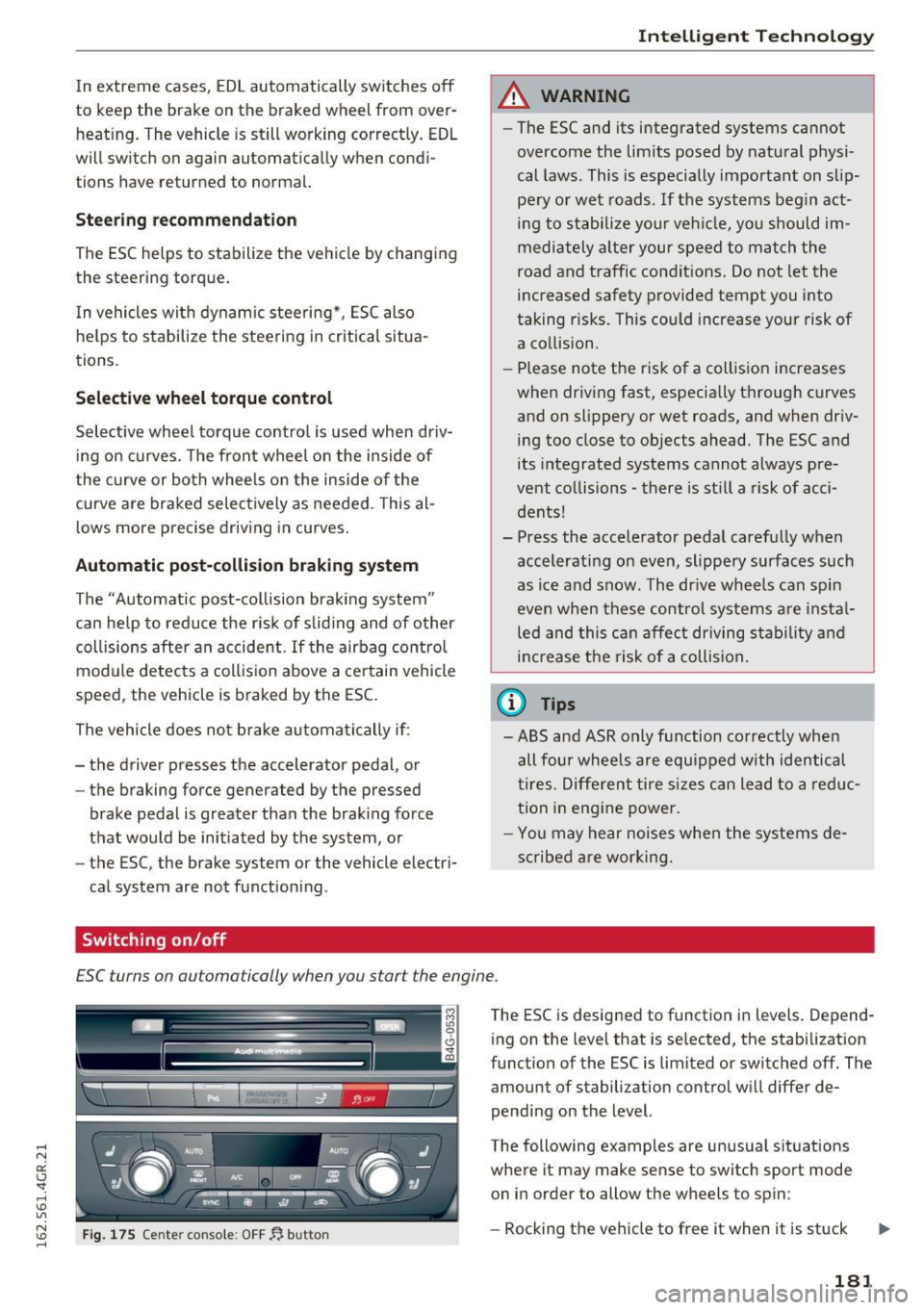
£SC turns on automatically when you start the engine.
Fig. 175 Center console: OFF~ button
The ESC is designed to function in levels. Depend
ing on the level that is se lected, the stabilization
function of the ESC is limited or switched off. The amount of stabilization control will differ de
pending on the level.
The following examples are unusual situations
where it may make sense to switch sport mode on in order to allow the wheels to spin:
- Rocking the vehicle to free it when it is stuck ..,.
181
Page 185 of 282
Effect of wat er and road salt
In ce rtain situations, for example after driving
through water, in heavy rain, afte r ove rnight con
densation or after washing your car, the braking
effect can be reduced by moisture or ice on the
brake rotors and brake pads. The brakes must be
dried first w ith a few careful brake applications.
At higher speeds and with the windshie ld wipers
turned on, the brake pads press against the brake rotors for a short amount of time. Th is occurs at
regular intervals without the driver noticing and
provides for better brake response time under
wet conditions .
The effectiveness of the brakes can be reduced
when the vehicle is driven on a salt-covered road
and the brakes are not used. Likewise, you clean
off accumulated salt coat ing from brake discs
and pads with a few cautious applications of the b rake ¢_&. .
Due to their surface character istics, ceramic
brake roto rs* absorb mo isture in such condit ions.
This can cause a temporary reduc tion in braking
force compared to dry brakes. You can compe n
sate fo r th is by press ing the b rake peda l harder.
Corrosion
There may be a tende ncy for d irt to bu ild up on
the brake pads and corros ion to form on the discs
if the car is not dr iven regularly or only fo r sho rt
tr ips with little use of the brakes.
If the brakes are not used frequently, or if corro
sion has formed on the discs, it is adv isable to
clean off the pads and discs by brak ing firmly a
few t imes from a mode rately h igh speed ¢,& .
Faults in the brake system
If you should notice a sudden increase in brake
pedal travel, then one of the two brake c ircuits
may have failed
¢ ,& .
Low brake fluid le vel
Malfunct ions can occur in the brake system if the
brake fl uid level is too low. The brake fluid level
is monitored electronically .
Intelligent Technology
Brake booster
The brake boos ter works w ith v acuum press ure
which is crea ted on ly when the engine is running
¢ & .
Brake lining wear status
Brake lining wea r may be chec ked by visua l in
spe ct ion of the condition of the brake pads
t hr ough the openings in t he wheel. If necessary,
the wheel may be removed for this inspection
¢ page 243, Replacing wheels .
_8 WARNING "'----
-New b rake pads don't have the best stop
p ing power and must be "broken-in" d uring
the initial 250 miles (400 km). The b reak-in
period can be considerably longer for
veh icles with ceramic brake roto rs*. You can
compensate for this by pressing the brake
pedal mo re firmly. This also applies late r
when new p ads are inst alled.
- You shou ld pe rform braking maneuvers for
the purpose of cleaning the brake system
only i f road condit io ns pe rmit. O ther ro ad
users m ust no t be put at r is k - you may
cause an accident!
- Before descending a steep g rade, reduce
speed and shift transmission into a lower
gear o r lower driving range. Do not r ide the
brakes or hold the pedal down too long or
too often. This cou ld cause t he b rakes to get
hot and dimin ish braking effic iency.
- Do not " ride the brakes" by rest ing your foot
on the pedal when you do not intend to brake. This may cause the brakes to over
heat, premature wear and increased stop
p ing distance .
- Unde r certain climatic and ope rating condi
tions such as passing t hrough water, d riving
i n heavy rain o r afte r wash ing the veh icle,
the effectiveness of the brakes ca n be re
duce d. In winter, ice can accum ulate on the
b rake pads, lin ings, discs and dr ums. Care
fu lly apply brakes for a test. Brakes will d ry
an d ice coatings will be cleaned off after a
few ca refu l brake applications.
183
Page 198 of 282
Care and cleaning
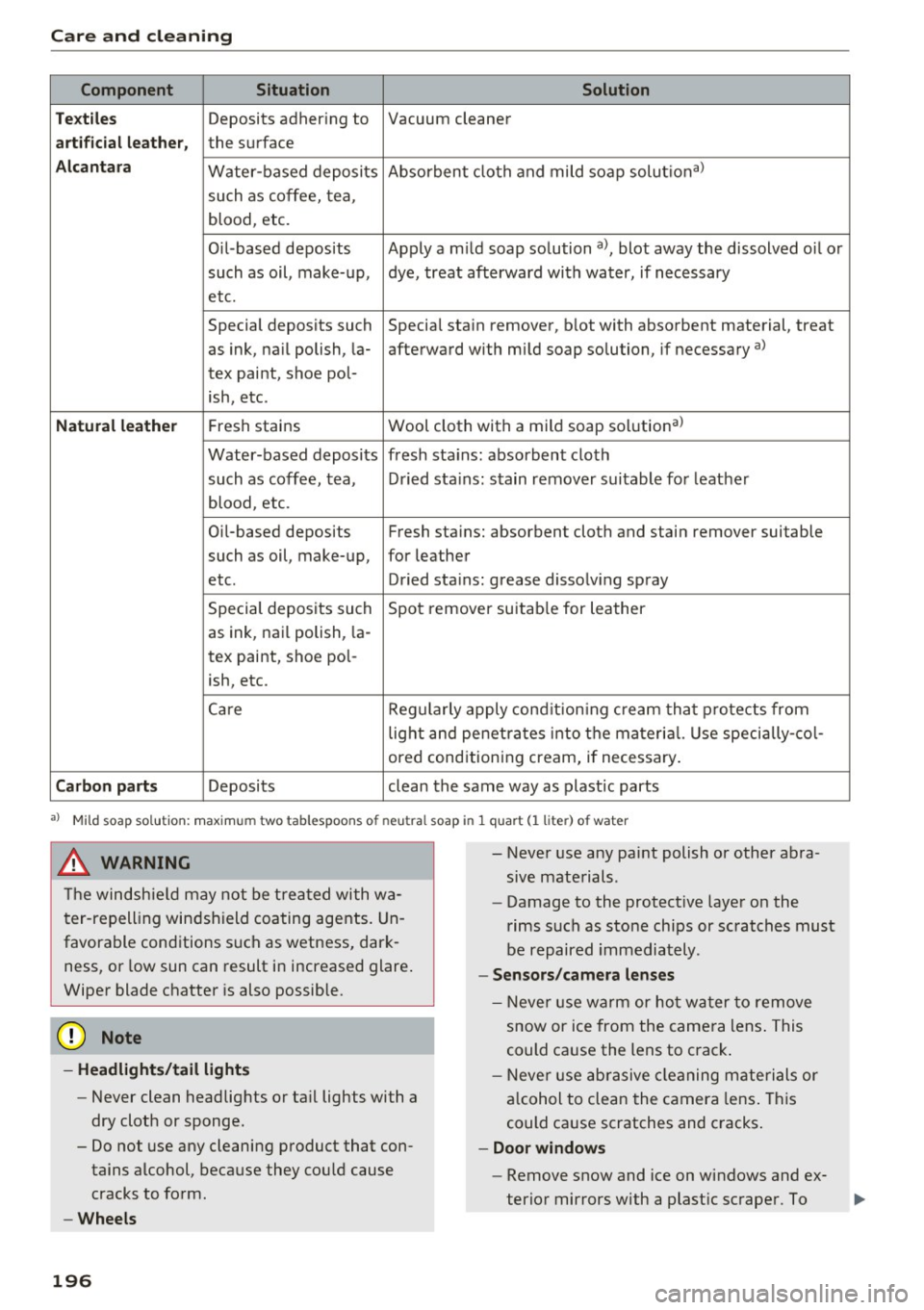
Component Situation Solution
Te xtil es
Deposits adhering to Vacuum cleaner
a rt ifici al le ather , the surface
Alcant ara Water-based deposits Absorben
t cloth and mild soap solutiona>
such as coffee, tea,
blood, etc.
O il-based deposits Apply a m ild soap solution a), blot away the dissolved oil or
such as oil, make-up, dye, treat afterward with water, if necessary
etc.
Special deposits such Special stain remover, b lot with absorbent material, treat
as ink, na il polish, la- afterward with mild soap solution, if necessary a)
tex paint, shoe pol-
ish, etc.
Natural leather Fresh stains Wool cloth with a mild soap so
lutiona)
Water-based deposits fresh sta ins: absorbent cloth
such as coffee, tea, Dried sta ins: stain remover suitable fo r leather
blood, etc.
Oil-based deposits Fresh staiins: absorbent cloth and stain remover suitable
such as oil, make-up, for leather
etc. Dried sta ins : grease dissolv ing spray
Special deposits such Spot remover suitab le for leather
as ink, nai l polish, la -
tex paint, shoe pol-
ish, etc.
Ca re Regularly apply cond ition ing cream that protects from
light and penet rates into the materia l. Use specia lly-co l-
ored conditioning cream, if necessary.
Carbon parts Deposits clean the same way as plastic parts
a) Mild soap solution: maximum two tablespoons of neutral soap in 1 quart (l liter) of water
_& WARNING
The windshie ld may not be trea ted with wa
ter-repelling windshield coating agents. Un
favorable conditions s uch as wetness, dark
ness, or low sun can result in increased glare .
Wiper blade chatter is also possible.
(D Note
- Headlights/tail light s
-Never clean headlights or tail lights with a
dry cloth or sponge.
- Do not use any cleaning product that con
tains alcohol, because they could cause
cracks to form.
- Wheels
196
-
- Never use any paint polish or other abra
sive materials.
- Damage to the protect ive layer on the
rims such as stone chips or scratches must
be repaired immediately.
- Sensors /camera lenses
- Neve r use wa rm or ho t wa ter to remove
snow or ice from the camera lens . This
could cause the lens to crack .
- N eve r use ab rasive cleaning materials or
a lcohol to clea n the camera lens . This
could cause scratches and cracks .
-Doo r window s
-Remove snow and ice on windows and ex-
terior mirrors with a plast ic scraper. To
Page 214 of 282
Checking and Filling
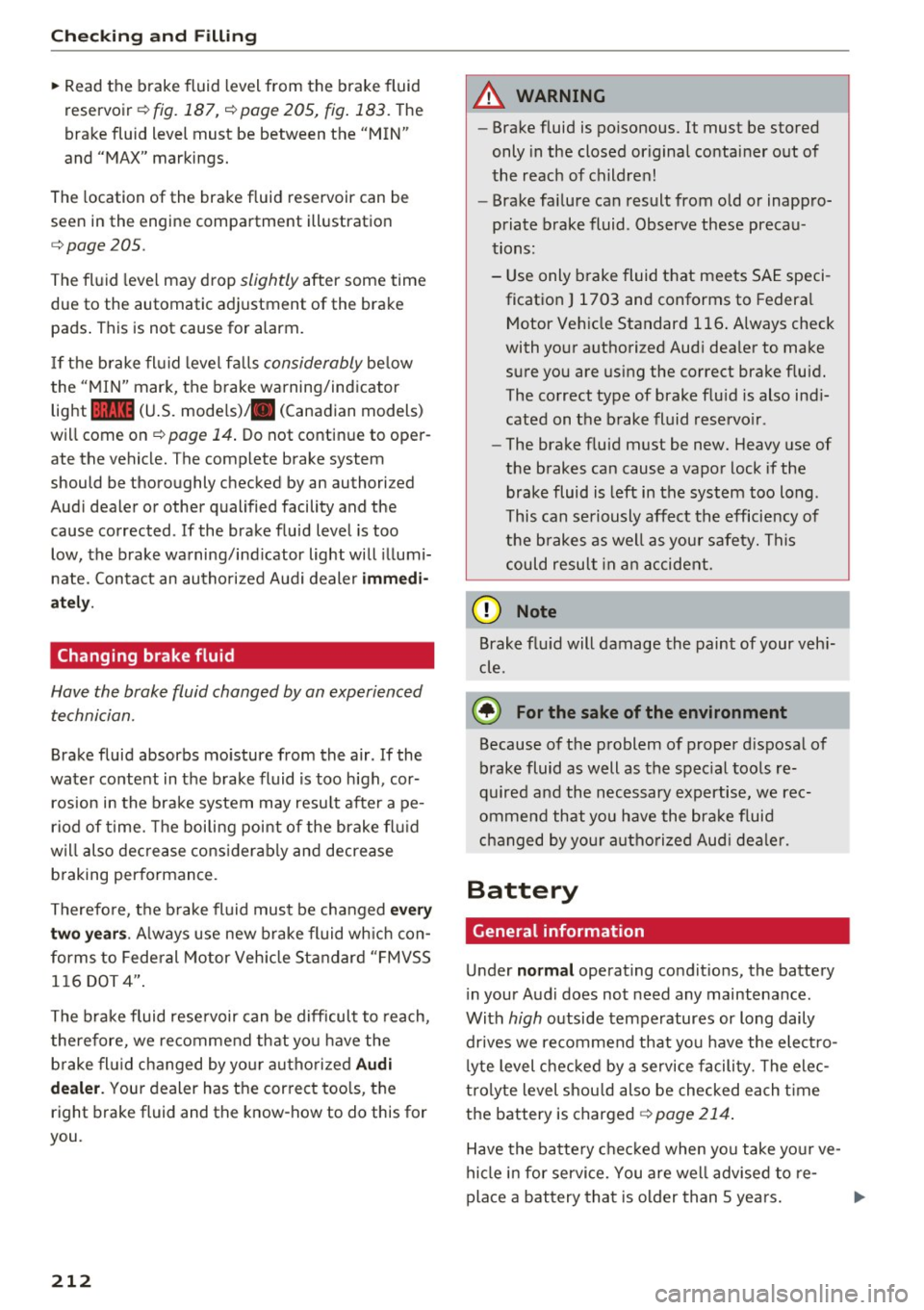
"' Read the brake fluid level from the brake fluid
reservoir
¢ fig. 187, ¢page 205, fig. 183. The
brake fluid level must be between the "MIN"
and "MAX" markings.
The location of the brake fluid reservoir can be
seen in the engine compartment illustration
c>page205.
The fluid level may drop slightly after some time
due to the automatic adjustment of the brake
pads. This is not cause for alarm.
If the brake fluid level falls considerably below
the "MIN" mark, the brake warning/indicator
light
1111 (U.S. models)/ . (Canadian models)
will come on¢
page 14. Do not continue to oper
ate the vehicle. The complete brake system
should be thoroughly checked by an authorized
Audi dealer or other qualified facility and the
cause corrected . If the brake fluid level is too
low, the brake warning/indicator light will illumi
nate. Contact an authorized Audi dealer
immedi
ately.
Changing brake fluid
Have the brake fluid changed by an experienced
technician.
Brake fluid absorbs moisture from the air . If the
water content in the brake fluid is too high , cor
rosion in the brake system may result after a pe
riod of time. The boiling point of the brake fluid
will also decrease considerably and decrease
braking performance.
Therefore, the brake fluid must be changed
every
two years.
Always use new brake fluid which con
forms to Federal Motor Vehicle Standard "FMVSS
116 DOT 4".
The brake fluid reservoir can be difficult to reach,
therefore, we recommend that you have the
brake fluid changed by your authorized
Audi
dealer.
Your dealer has the correct tools, the
right brake fluid and the know-how to do this for
you.
212
A WARNING
-
- Brake fluid is poisonous. It must be stored
only in the closed original container out of
the reach of children!
- Brake failure can result from old or inappro
priate brake fluid. Observe these precau
tions:
- Use only brake fluid that meets SAE speci
fication
J 1703 and conforms to Federal
Motor Vehicle Standard 116. Always check
with your authorized Audi dealer to make
sure you are using the correct brake fluid.
The correct type of brake fluid is also indi
cated on the brake fluid reservoir .
- The brake fluid must be new. Heavy use of
the brakes can cause a vapor lock if the
brake fluid is left in the system too long .
This can seriously affect the efficiency of
the brakes as well as your safety. This
could result in an accident.
(D Note
Brake fluid will damage the paint of your vehi
cle.
@ For the sake of the environment
Because of the problem of proper disposal of
brake fluid as well as the special tools re
quired and the necessary expertise, we rec
ommend that you have the brake fluid
changed by your authorized Audi dealer .
Battery
General information
Under normal operating conditions, the battery
in your Audi does not need any maintenance.
With
high outside temperatures or long daily
drives we recommend that you have the electro
lyte level checked by a service facility. The elec
trolyte level should also be checked each time
the battery is charged ¢
page 214.
Have the battery checked when you take your ve
hicle in for service. You are well advised to re
place a battery that is older than S years.