height AUDI RS7 SPORTBACK 2016 User Guide
[x] Cancel search | Manufacturer: AUDI, Model Year: 2016, Model line: RS7 SPORTBACK, Model: AUDI RS7 SPORTBACK 2016Pages: 282, PDF Size: 70.78 MB
Page 133 of 282
Automatic safety belt r etractors
Every safety be lt is equ ipped wi th an automatic
be lt retractor on the shoulder belt. Th is feature
l ocks the belt when the belt is p ulled out fast,
during hard braking and in an accident. The belt may also lock when you drive up or down a steep
h ill or through a sharp curve. During normal driv
ing the belt lets you move freely .
Safety be lt pret en sioner s
The safety belts are equipped with a belt preten
sioner that helps to tighten the safety belt and
remove slack when the pretensioner is activated
c:;, page 133 . The function of the pretensioner is
monitored by a warning light
c:;, page 17.
Con vertible loc king retractor
Every safety belt exc ept the one on the driver
seat is equipped with a convertible locking retrac
tor that
mu st be used when the safety belt is
used to attach a child seat. Be sure to read the
important information about this featu re
c;, page 169.
& WARNING
Improperly posit ioned safety be lts ca n cause
ser ious injury in an accident
c:;, page 131,
Safety belt position.
- Safety belts offer optimum protection only
when the seatback is upr ight and belts are
prope rly pos itioned on the body.
- If the rear seat ba ckrest is not securely
latched, the passenger wi ll move fo rward
with the ba ckrest during sudden b raking, in
a sudden mane uver and especially in a
c rash.
- Never a ttach the safety belt to the buckle
for another seat. Attaching the belt to the
wrong buckle will red uce safety belt effec
t iveness and can cause serious personal in
jury.
- A passenger who is not proper ly restrained
can be seriously in jured by the safety be lt it
self when it moves from the stronger parts
of the body into cr itical areas like-the abdo
men .
Safet y bel ts
-Always lock the convertible locking retractor
when yo u are securing a child seat in the ve
hicle
c;, page 171.
(0 Tips
For information on safety belt pretensioners,
r efer to
c:;, page 133 .
Safety belt position
Correct belt position is the key to getting maxi
mum protection from safety belts.
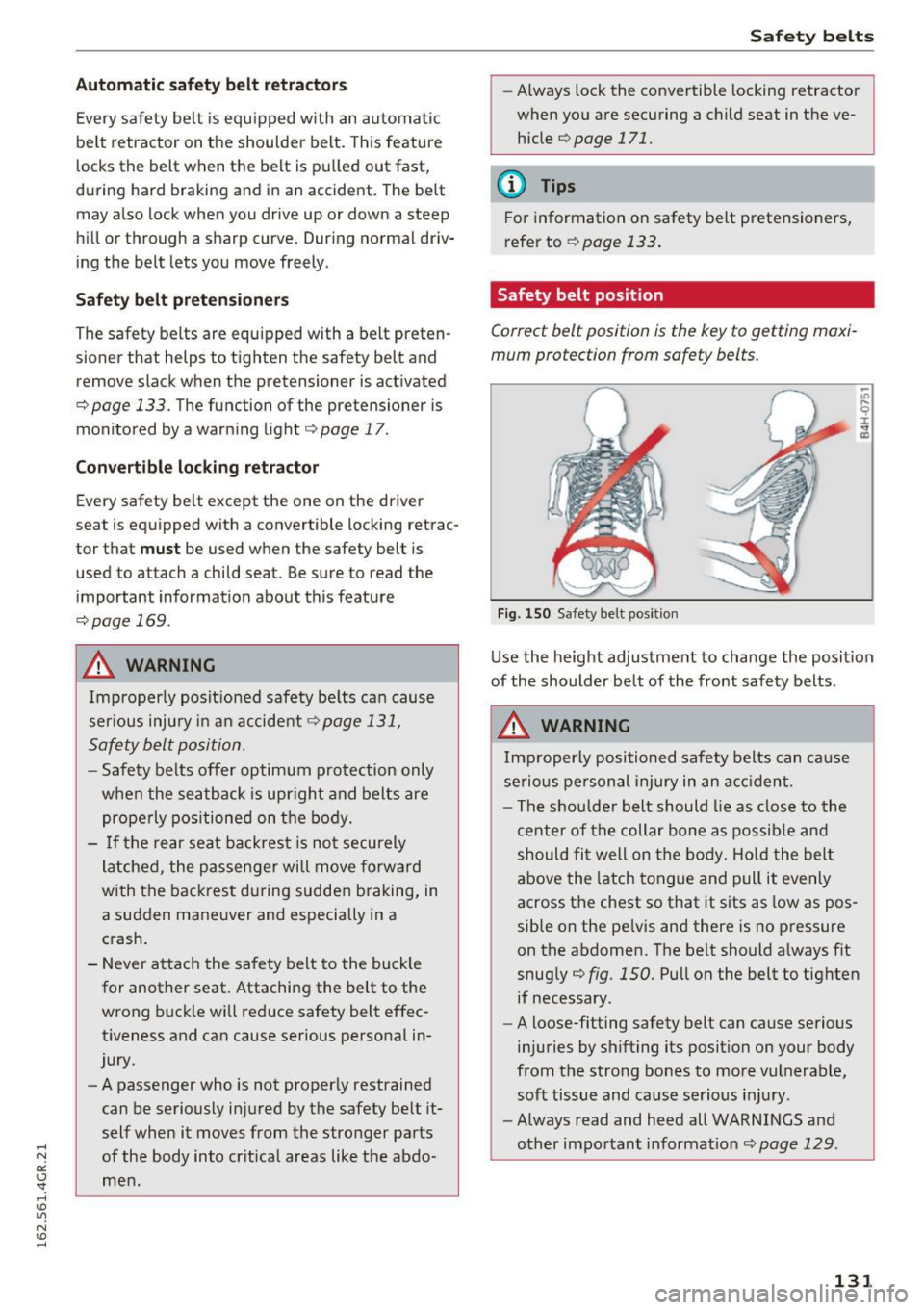
Fi g. 1 50 Safety belt pos it ion
U se the height adjustme nt to change the posit ion
of the shoulder belt of the fro nt safety belts .
& WARNING
Imp roperly positioned safety belts can ca use
se rio us pe rson al injury in an a cciden t.
- The s hou lde r belt should lie as close to the
center of t he collar bone as possib le and
should fi t well on the bo d y. Ho ld the belt
above the latch tongue and pull it evenly
across the chest so that it sits as low as pos
sible on the pe lvis and there is no pressure
on the abdomen. The belt should a lways fit
snug ly
¢fig. 150. Pull on the belt to tighten
if necessary .
- A loose-fitting safety belt can cause serious
i nj uries by shifting its position on your body
from the strong bones to more vulnerable,
soft tissue and cause serious inj ury .
- Always read and heed all WARNINGS and
other important informat ion
c:;, page 129 .
131
Page 134 of 282
Safe ty belts
Pregnant women must also be correctly
restrained
The best way to protect the fetus is to make sure
that expectant mothers always wear safety belts
corre ctly -throughout the pregnancy.
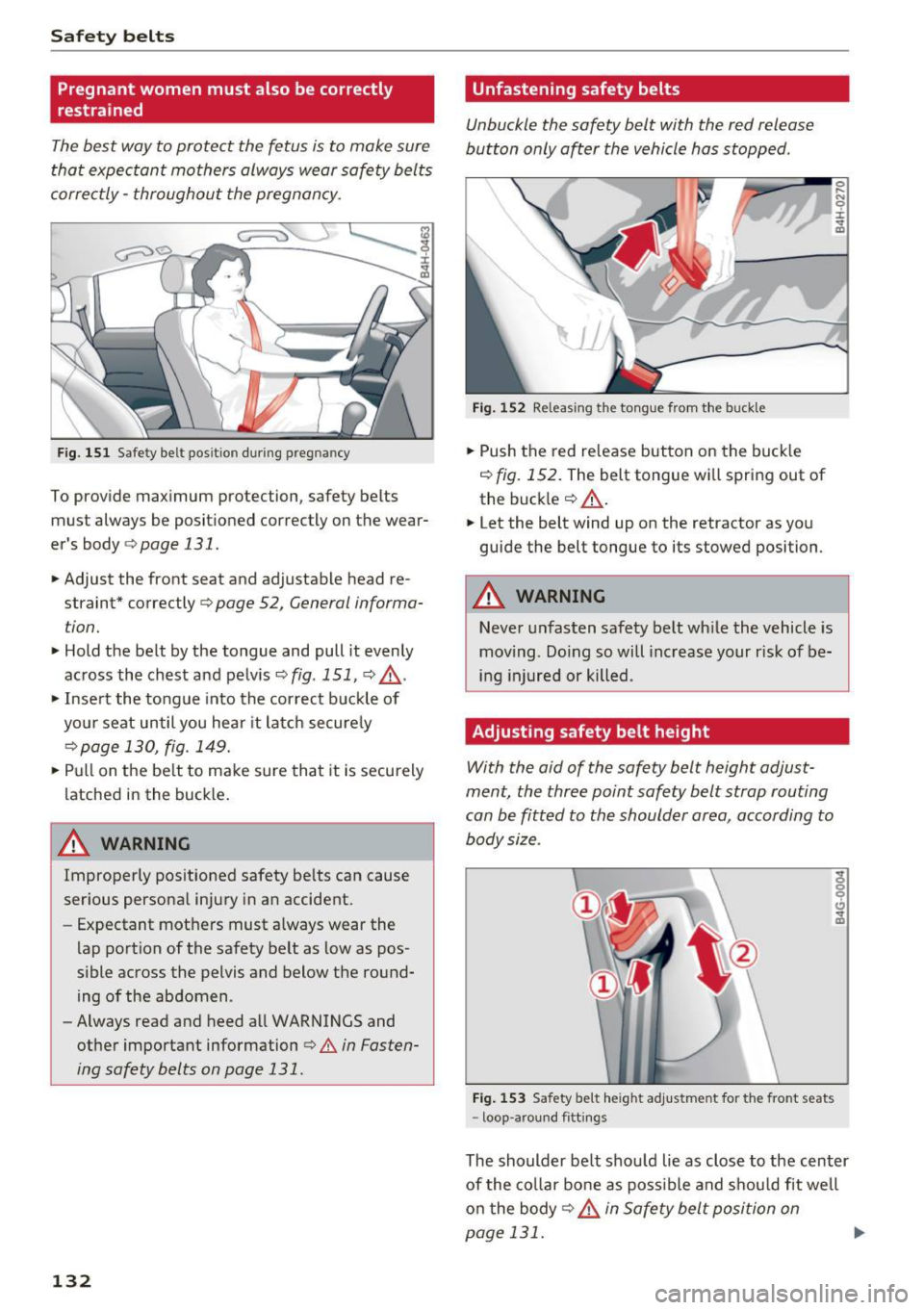
Fig. 151 Safety belt pos ition during pregnancy
To provide maximum protection, safety belts
must always be posit ioned correctly on the wear
er's body
¢ page 131.
... Adjust the front seat and ad justable head re
straint* correctly ¢
page 52, General informa
tion .
... Hold the belt by the tongue and pull it evenly
across the chest and pelv is
r::;, fig. 151 , ¢ _&..
... Inse rt the tongue into the correct buckle of
your seat until you hear it latch secure ly
¢page 130, fig. 149.
... Pull on t he be lt to make sure that it is securely
latched in the buck le .
A WARNING
Improperly pos itioned safety be lts can cause
ser ious persona l injury in an accident.
- Expectant mothers must a lways wear the
lap portion of the safety belt as low as pos
sible across the pelvis and below the round ing of the abdomen .
- Always read and heed all WARNINGS and
other important information¢ &.
in Fasten
ing safety belts on page 131.
132
Unfastening safety belts
Unbuckle the safety belt with the red release
button only ofter the vehicle hos stopped.
.,,
Fig . 15 2 Releasing the tongue from the buckle
... Push the red re lease button on the buck le
r:::;, fig. 152. The belt tongue wi ll spring out of
the buck le
r::;, A .
... Let the belt wind up on the retractor as yo u
guide the belt tongue to its stowed position .
A WARNING
Never unfasten safety belt while the vehicle is
moving . Do ing so will increase your r isk of be
ing inj ured or killed .
Adjusting safety belt he ight
With the aid of the safety belt height adjust
ment, the three point safety belt strop routing
con be fitted to the shoulder area, according to
body size.
F ig . 153 Safety belt height adj ustment for the front seats
- loop -around fittings
0 ,-. N 0 :i: .. m
The shoulder be lt shou ld lie as close to the center
of the co llar bo ne as poss ible and s hou ld fit well
o n the body
r::;, .&. in Safe ty belt posi tion on
page 131. ..,,.
Page 135 of 282
~ Push the loop-around fittings up qfig. 153 @,
or
~ squeeze together the(!) button, and push the
loop-around fittings
do wn@ .
~ Pull the belt to make sure that the upper at
tachment is properly engaged .
A WARNING
Always read and heed all WARNINGS and oth
er important informat ion
qpage 129.
With the front seats, the height adjustment
of the seat can also be used to adjust the po
sition of the safety belts.
Improperly worn safety belts
Incorrectly positioned safety belts can cause se
vere injuries.
Wearing safety belts improperly can cause seri
ous injury or death. Safety belts can only work
when they are correctly pos itioned on the body .
Improper seating positions reduce the effect ive
n ess of safety be lts and will
even i ncrease the
ris k of injury and death by mov ing the safety belt
to cr it ica l areas of the body. Imp roper seating
positions also increase the risk of serious inj ury
and death when an airbag deploys and strikes an
occ upant who is not in the correct seat ing posi
tion. A driver is respons ible for the safety of all
vehicle occupants and espec ia lly for children.
Therefore:
~ Never permit anyone to assume an incorrect
s itting position in the veh icle wh ile traveling
Q A .
A WARNING
Improperly worn safety belts increase the risk
of serious personal injury and death wheneve r
a vehicle is be ing used.
- Always make sure that al l vehicle occupants
are correctly restra ined and stay in a co rrect
seating pos it io n whenever the ve hicle is be
ing used.
S afet y be lts
- Always read and heed all WARNINGS and
other important in format ion
q page 129.
Belt tensioners
How safety belt pretensioners work
In front, side and rear-end collisions above a
particular severity and in a rollover, safety belts are tensioned automatically.
Rever sible safety belt tensioner s
The safety belts on the front seats are equipped
with power reversible tensioners. The following
funct ions are available when the dr iver's/front
passenger's safety belts are fastened:
- Automatic tens ioners: at the start of a drive,
the safety belts automatically adjust to the passenger after a certain time period or vehicle
speed. To switch the automatic tensioners off,
select the following in the MMI :
!CARI function
button
> (Car )* system s > Vehicle setting s >
Seats > Driver's seat or Passeng er' s s eat > Au
tom atic belt ten sioner
> Off .
- In certain driving situations, the safety bel ts
may tighten w it h a reve rsib le tensioning func
tion
q page 177.
-The safety be lts may also tigh ten with this re-
versible tension ing function in m inor collisions.
Pyrotechnic safety belt pretens ioners
The safety belts are equipped w it h safety belt
prete nsioners. The system is activated by sensors
in front, side and rear -end collisions of great se
verity and in a ro llover. This tightens the belt and
takes up belt slack
q .& in Service and disposal of
safety belt pretensioner on page 134.
Taking up
the slack he lps to reduce forward occupant
movement during a collision.
A WARNING
--
- It is poss ible for the pretensioners to dep loy
incorrectly.
- The pyrotechnic system can only provide
protection for one collision. If the pyrotech
n ic pretens ioners deploy, the pretensioning
system must be replaced.
133
Page 153 of 282
@ For the sake of the environment
Undeployed airbag modu les and pretension
ers might be classified as Perchlorate Materi
al -special handling may apply, see
www.dtsc .ca.gov/hazardouswaste/perchlo
rate . When the veh icle or parts of the re
straint system including airbag modules and
safety belts with pretensioners are scrapped,
all applicable laws and regulations must be
observed. Your authorized Audi dealer is fa
miliar with these requirements and we recom
mend that you have your dealer perform this
service for you.
Other things that can affect Advanced
Airbag performance
Changing the vehicle's suspension system can
change the way that the Advanced Airbag System
pe rforms in a crash. For examp le, using tire-rim
comb inat ions not approved by Audi, lowering the
veh icle, changing the stiffness of the suspension,
including the springs, suspension struts, shock
absorbers etc . can change the forces that are
measured by the airbag sensors and sent to the
e lectronic control unit . Some suspension changes
can, for example, increase the force levels meas
ured by the sensors and make the airbag system
deploy in crashes in wh ich it would not deploy if
the changes had not been made . Other kinds of
changes may reduce the force levels measured by
the sensors and prevent the airbag from deploy
ing when it should.
_& WARNING
Changing the vehicle's suspension including
use of unapproved tire-rim combinations can
change Advanced Airbag performance and in
crease the risk of serious personal injury in a
crash.
- Never install suspens ion components that
do not have the same performance charac
teristics as the components originally instal
led on your vehicle.
- Never use tire-rim combinations that have
not been approved by Audi.
Airbag system
Knee airbags
Description of knee a irbags
Applies to: vehicles wit h knee airbags
The knee airbag system can provide supplemen
tal protection to properly restrained front seat
occupants .
Fig. 158 Driver 's knee air bag
The driver knee airbag is in the inst rument panel
u nderneath the steering wheel¢
fig. 158, the
airbag for the passenger is at about the same
height in the instrument pane l underneath the
glove compartment.
The knee airbag offers additional protection to
the driver's and passenger's knees and upper and lower thigh areas and supplements the protec
tion provided by the safety belts.
If the front airbags deploy, the knee airbags also
deploy in frontal collisions when the deployment
threshold stored in the control unit is met
¢ page 144, More important things to know
about front airbags .
In addition to their normal safety function, safe
ty belts help keep the dr iver or front passenger in
pos ition in a frontal collision so that the airbags
can provide supplemental protection .
The airbag system is not a substitute for your
safety belt. Rather, it is part of the overall occu
pant restraint system in your vehicle. Always re
member that the airbag system can only help to
protect you if you are wear ing your safety be lt
and wea ring it properly. This is why you shou ld
always wea r your safety belt, not just because
t h e law requires you to do so ¢
page 12 7, Gener-
al information.
IJJ>-
151
Page 170 of 282
Child safety
seating position on the rear seat and have
the airbag system inspected by your author
ized Audi dealer.
- Take the child restraint off the front passen
ger seat and install it properly at one of the
rear seat positions if the
P A SSEN GER AIR
BAG OFF
light does not stay on whenever
the ignition is switched on.
Booster seats and safety belts
Properly used booster sea ts can help protect
children weighing between about 40 lbs . and 80
lbs . (18 kg and 36 kg) who are less than
4 ft. 9
in . (57 inches/1.45 meters) tall .
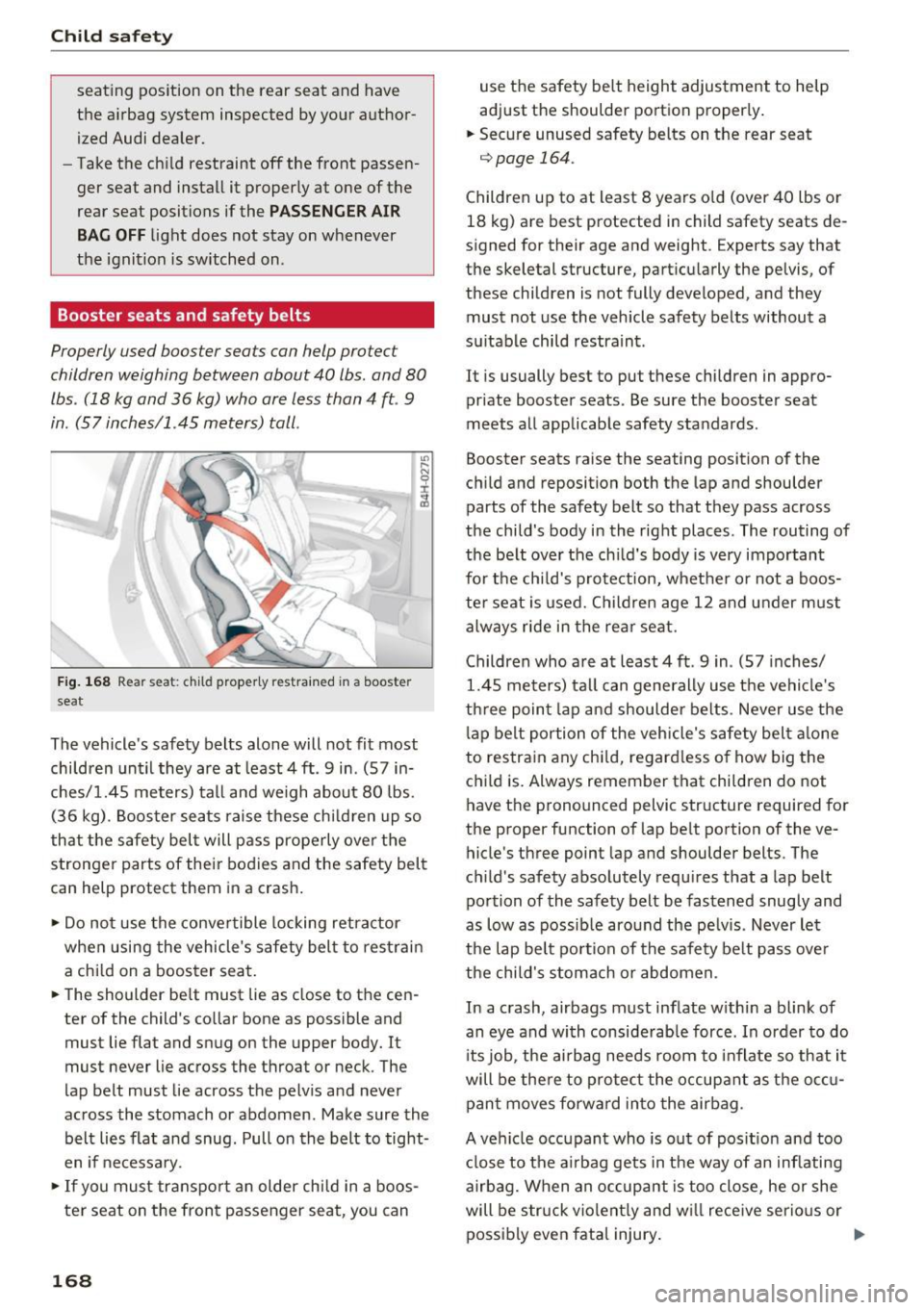
Fig . 1 68 Rea r seat : chi ld proper ly restrain ed in a booster
seat
The vehicle's safety belts alone will not fit most
chi ldren until they are at least 4 ft. 9 in . (57 in
ches/1.45 meters) tall and weigh about 80 lbs.
(36 kg). Booster seats raise these chi ldren up so
that the safety belt will pass properly over the
stronge r parts of their bodies and the safety belt
can help protect them in a crash.
• Do no t use the conve rtible locking retractor
whe n using the vehicle's safety belt to restrain
a chi ld on a booster seat.
• The shoulder be lt must lie as close to the cen
ter of the child's collar bone as possible and
must lie flat and snug on the upper body. It
must never lie across the throat or neck. The
lap belt must lie across the pelv is and never
across the stomach or abdomen . Make sure the
belt lies flat and snug. Pull on the belt to tight
en if necessa ry .
• If you must transpo rt an older chi ld in a boos
ter seat on the front passenger seat , you can
168
use the safety belt height adjustment to help
adjust the shoulder portion properly.
• Secure unused safety belts on the rear seat
c::, page 164.
Children up to at least 8 years o ld (over 40 lbs or
18 kg) are best protected in child safety seats de
signed for their age and weight. Experts say that
the skeletal structure, part icularly the pelvis, of
these children is not fully developed, and they
must not use the vehicle safety belts without a
su itable child restraint .
It is usually best to put these children in appro
priate booster seats . Be sure the booster seat
meets all applicable safety sta ndards .
Booster seats raise the seating position of the
ch ild and reposition both the lap and shoulder
parts of the safety belt so that they pass across
the child's body in the right places. The routing of
the be lt over the ch ild's body is very important
fo r the ch ild's protect ion, whet her or not a boos
te r seat is used. C hildren age 12 a nd under m ust
always ride in the re ar seat.
Children who a re at least 4 ft. 9 in . (5 7 inches/
1.45 meters) tal l can generally use t he vehicle's
th ree poin t lap a nd shoulder belts . Never use the
l ap belt portion of the veh icle's safety bel t alone
to restrain any chi ld, regard less o f how big the
ch ild is. Always remember that children do not
have the pronounced pelvic structure required for
the proper function of lap be lt portion of the ve
hicle's three point lap and shoulder belts. The
c hi ld's safety absolutely requ ires that a lap belt
portion of the safety belt be fastened snugly and
as low as possib le around the pe lvis . Never le t
the lap belt po rtion of the safety be lt pass ove r
the child's stomach or abdomen.
In a crash, airbags must inflate w ithi n a blink of
an eye and with considerab le force. In order to do
i ts job, the airbag needs room to inflate so that i t
will be there to protect the occup ant as the occ u
pan t moves forw ard in to the airbag.
A vehicle occupan t who is out of pos it ion and too
cl ose to the a irbag gets in the way of an inflating
airbag. When an occupant is too close, he or she
will be struck vio lent ly and w ill rece ive serio us or
possib ly even fatal injury.
II>
Page 221 of 282
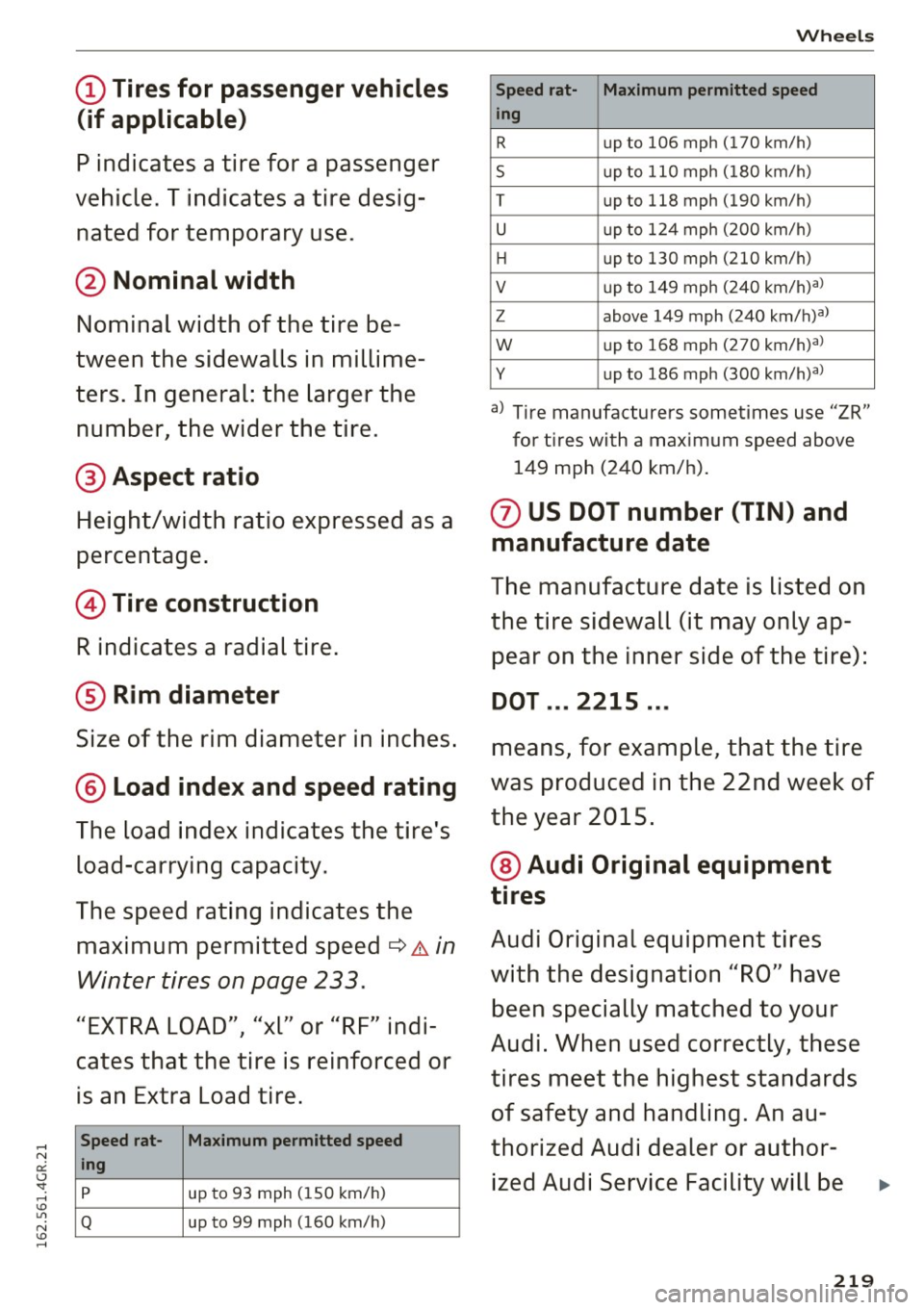
(D Tires for passenger vehicles
(if applicable)
P indicat es a tir e for a p asse ng er
vehi cle. T indi cates a tire de sig
nated for tempor ary us e.
@ Nominal width
Nominal width of the tire be
tween the sidew alls in millime
ters. In general: the larger the number, the wider the tire.
@ Aspect ratio
Height /width ratio expressed as a
percentage.
@ Tire construction
R indicates a radial tire.
® Rim diameter
Siz e of the rim diameter in inches.
@ Load index and speed rating
The load ind ex indi cates the tire' s
lo ad-ca rry in g ca pacity.
The speed rating indicates the maximum permitted speed¢.&
in
W inter tires o n page 233 .
"EXTRA LOAD", "xl" or "RF" indi
cate s that the tire i s reinfor ced or
is an Extra Load tire.
Speed rat- Maximum permitted speed
ing
p
up t o 93 mph ( 150 km/h)
Q up to 99 mph (160 km/ h)
Wheels
Speed rat- Maximum permitted speed
ing
R up to 106 mph (170 km/h)
s u p to 11 0 mph ( 180 km/h)
T up to 118 mph (190 km/h)
u u p to 124 mph ( 200 km/h)
H up to 130 mph (210 km/h)
V up to 14 9 mph (2 40 km/h)al
z above 149 mph (240 km/h)al
w up to 168 mph (270 km/h)al
y up to 186 mph (300 km/h)al
a) Tire manufac turers sometimes use "ZR"
f or tires with a max imum speed above
149 mph (2 40 km/h) .
(j) US DOT number (TIN) and
manufacture date
The m anufac ture date i s listed on
the tire sidewall (it ma y only ap
pear on the inner side of the tire):
DOT ... 2215 ...
means, for example , that the tire
was produced in the 22nd week of
the year 2015.
@ Audi Original equipment
tires
Audi Original equipment tire s
with th e designation "RO " hav e
b een specially mat ch ed to your
Audi. When u sed correctly, thes e
tires meet the high est stand ards
of safety and handling. An au
thorized Audi dealer or author
ized Audi Service Facility will be
219
Page 222 of 282
Wheels
happy to provide more informa
tion .
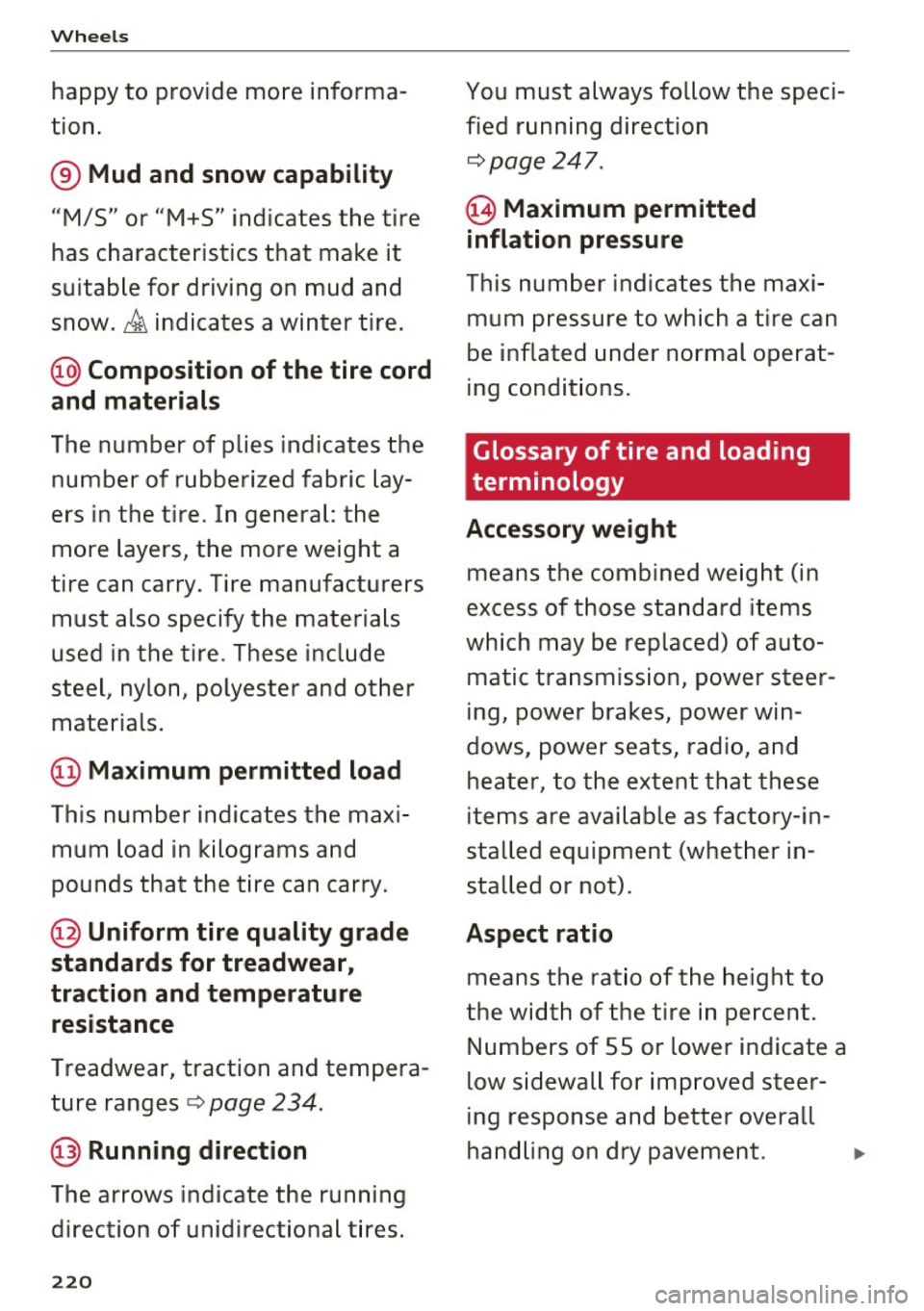
® Mud and snow capability
"M/S" or "M+S" indicates the tire
has characteristics that make it
suitab le for driving on mud and
snow .
& indicates a winter t ire .
@ Compos ition of the tire cord
and materials
The number of plies indicates the
number of rubberized fabric lay
ers in the tire . In general: the
more layers, the more weight a
tire can carry. Tire manufacturers must also specify the materia ls
used in the tire . These include
steel, nylon, polyester and other
materials .
@ Maximum permitted load
This number indicates the maxi
mum load in k ilograms and
pounds that the tire can carry.
@ Uniform tire quality grade
standards for treadwear,
traction and temperature
resistance
Treadwear, traction and tempera
ture ranges
c::> page 234 .
@ Running direction
The arrows indicate the running
direction of unidirec tiona l tires.
220
You must a lways follow the speci
fied runn ing direction
c::> page 247.
@ Maximum permitted
inflation pressure
This number indicates the maxi
mum pressure to which a tire can be inflated unde r normal operat
ing condit ions .
Glossary of tire and loading
terminology
Accessory weight
means the comb ined we ight (in
excess of those standard items
which may be replaced) o f auto
matic tra nsmission , power steer
ing , power brakes , power wi n
dows, power seats , radio , and
heater, to the extent that these
items a re available as facto ry-in
stalled equipment (whet her in
stalled or not).
Aspect ratio
means the rat io of the height to
the width o f the tire in pe rcent.
Numbe rs of 55 or lower indicate a
low sidewa ll for imp roved steer
ing response and better overa ll
handling on dry pavement .
...
Page 235 of 282
Winter tires
Winte r ti res s ignificantly improve the veh icle's
handling when driving in winter condit ions. Be
cause of the ir construction (width, compound,
tread pattern), summer tires provide less trac
tion o n ice and snow.
,.. Use w inter t ires on all fo ur wheels.
,.. Only use winter t ires that are approved for your
vehicle.
,.. Please note that the maximum permitted
speed may be lower with winter tires
9 &, . An
authorized Audi dealer or authorized Audi Serv
ice Facility can inform you about the maximum
permitted speed for your tires.
,.. Check the tire press ure after installing wheels
9page 228.
The effectiveness of winter tires is reduced great
ly when the tread is worn down to a depth of
0 .1 57 inch (4 mm). The character istics of winter
tires a lso dec rease great ly as the tire ages, re
ga rdless of the remaining tread.
_& WARNING
- Never drive faster than the maxim um per
mitted speed for your tires. This cou ld cause
the tires to heat up too much . Th is increases
the risk of an accident because it can cause
the tire to burst.
- Always adapt your dr iv ing to the road and
traff ic conditions. Drive carefully and reduce
your speed on icy or slippery roads. Even
winter tires can lose traction on black ice.
@ For the sake of the environment
Reinstall summer ti res at the appropriate
time, because they provide better handling
when roads are free of snow and ice. Summer tires cause less road noise, t ire wear and fuel
consumption.
You ca n also use all season tires instead of
w inter t ires. Please note that in some coun
tries where w inter t ires are required, only
w inter t ires with the
& symbol may be per
m itted.
-
Wh eel s
Snow chains
Snow chains improve traction in the snow .
,.. On ly install snow chains on the front wheels.
,.. Check and correct the seating of the snow
chains if necessary after driving a few feet. Fol
low the instruct ions from the manufacturer.
,.. Note the maximum permitted speed when dr iv
ing wit h snow chains. Do not exceed 30 mph
(SO km/h) .
Snow cha ins not o nly improve the
driving in win
te r road condit ions, but also the
braking.
Use of snow chains is only permitted with certa in
rim/tire comb inat ions due to technical reasons.
Check with an authorized Audi dealer or author
ized Audi Service Facili ty to see if you may use
snow c ha ins.
You must remove the chains when driving on roads that are
free of snow . When roads are free
of snow, snow chai ns can impa ir handling and
damage the tires, and the chains will qu ic kl y be
dest royed.
_& WARNING ~
Using incorrect snow chains or ins tall ing snow
chains incorrect ly can resu lt in loss of veh icle
control, which increases the risk of a n acci
dent.
(D Note
- Snow chains can damage the rims/wheel
covers* if the chains come into direct con
tact with them . Remove the wheel covers*
first. Use coated snow chains.
- Using snow c hains that add more than 0.4
inch ( 10.5 mm) of height can severely dam
age the whee l housings and other vehicle
components.
- Do not insta ll and use snow chains if there is
a malfunction in the adapt ive a ir suspen
sion*, because the vehicle he ight will be
very low. If you drive with snow chains any
way, the wheel housings and other vehicle
components can be seve rely damaged.
233
Page 236 of 282
Wheels
(D Tips
When using snow chains, it may be useful to
sw itch on sport mode
¢ page 181.
Low aspect ratio tires
Your Aud i is factory-equipped with low aspect ra
tio tires. These tires have been thoroughly tested
and been selected specifically for your model fo r
thei r supe rb perfo rmance, road feel and handling
unde r a va riety of d riving conditions . As k yo ur au
thor ized Audi dealer for mo re de tails.
The low aspect ratio of these t ires is indicated by
a nume ra l of
55 or less in the tire's size desig na
tion . The nume ra l rep resents the rat io of t he
tire 's sidewall he igh t in relat io n t o it s tread w idth
e xpresse d in percen tage. Convention al ti res have
a height/w idth ratio o f 60 o r more .
The performance of low -aspect-ratio tires is par
ticularly sensitive to improper inflation pres
sure. It is therefore important that low a spect
ratio tires are inflated to the specified pre ssure
and that the inflation pressure is regularly
checked and maintained. Tire pressures should
be checked at le ast once a month and alwa ys
before a long trip¢
page 228.
What you can do to avoid tire and rim
damage
Low aspect rat io tires can be damaged more easi
ly by impact with potholes, curbs, gullies or
ridges on the road, pa rt icu la rly if the t ire is un
de rinflated.
In order to minimize the occurrence of impact
damage to the t ires of your ve hicle, we recom
mend that you observe the fo llow ing precau
tions:
- Always maintain recommended inflation pres
su res . Check your tire pressure every 2,000
miles (3,000 km) and add air if necessary .
- Drive caref ully on roads with potho les, deep
gul lies or r idges . The impact from drivi ng
through or over s uch obstacles can damage
you r tires. Im pact with a cu rb may also cause
damage to you r tires .
234
-After any impact, immed iate ly inspect you r
tires or have them inspected by the nearest au
thorized Aud i dealer. Replace a damaged tire as
soon as possible.
- Ins pect your tires every 2,000 mi les (3,000 km)
for damage and wear . Damage is not always
easy to see . Damage can lead to loss of a ir and
underinfla tion, w hich could even tua lly cause
tire fa ilure . If yo u be lieve that a tire may have
been damaged, replace the tire as soon as pos
sible.
- These tires may wear mo re quickly than others .
- Please also remember that, while t hese tires
delive r responsive hand ling, they may ride less
comforta bly and make mo re noise than o ther
choi ces.
Reduced performance in winter/cold season
conditions
A ll ti res are des igned for certain purposes. The
l ow aspect ratio, ultra h igh performance tires
o rigina lly ins talled on your veh icle are inten ded
f o r m ax imu m dr y and wet ro ad perfo rma nce and
handling . They a re not sui table for co ld, snowy or
i cy weather conditions . If yo u drive under those
c ir cu mstances, you should equip yo ur vehicle
with all-season o r winter tires, which offer better
tract ion under t hose conditions. We suggest you
use the recommended snow or a ll-season tires
spec ified for your vehicle, o r th e ir equiva le nt.
Re fer to
c:> page 233 for more detailed in forma
tion regard ing winter tires.
Uniform tire quality grading
- Tread wea r
- Tract io n AA AB C
- Tempe rature ABC
Quali ty g rades can be fo und whe re appli cab le on
t h e tire side wall between tread shou lder and
max imum section width
¢ page 218, fig. 190 .
For example : Tread wear 200 , Traction AA , Tem
per atu re
A .
All passenge r ca r tir es mus t conform to Fede ral
Safety Req uiremen ts in add it io n to these grades . ..,.
Page 248 of 282

Emergency assistance
-Passengers must not remain in the vehicle
when it is jacked up.
- Make sure that passengers wait in a safe
place away from the vehicle and well away
from the road and traffic.
- Make sure jack posit ion is correct, adjust
as necessary and then continue to raise
the jack.
- Changes in temperature or load can affect
the height of the vehicle.
(D Note
Do not lift the vehicle by the sill. Position the
vehicle jack only at the designated lifting
points on the sill. Otherwise, your vehicle will
be damaged.
@ Tips
The vehicle jack mode* switches off automati
cally at speeds
above 6 mph (10 km/h).
Removing and installing the sill extension
cover
Applies to: vehicles w ith sil l extension
Fig. 205 Sill: removing the cover
.,. Pull the cover down to remove it. c:> fig. 205
.,. To install the cover, insert i t in the mount and
press it upward until it clicks into place. The
cover must be flush with the surface of the sill
extension .
1
> A pp lies to vehicles wit h c eramic brake ro tor s*: Use a sec
on d alig nment pin* (sto re d in th e spare w hee l w ell mold
in g) fo r the lower hole, foll ow in g t he descrip tion for the
firs t alig nm ent pin.
246
@ Tips
Some models may also have a cover for the
rear vehicle lift point.
Taking the wheel off/installing a wheel
Follow these instructions step -by-step for chang
ing the wheel.
Fig. 206 Changing a wheel : using the sc rewdr iver han d le
(wi th t he blade re m oved) to turn the bol ts
Fig. 207 Changing a wh eel: alignment pin in side the t op
ho le
After you have loosened all wheel bolts and
raised the vehicle off the ground,
remove and re
place the wheel as follows:
Removing the wheel
.,. Use the hexagonal socket in the screwdriver
handle
to completely remove the topmost
wheel bolt and set it aside on a
clean surface
c::> fig. 206.
.,. Sc rew the threaded end of the alignment pin
from the tool kit hand-t ight into the empty bolt
hole
¢ fig . 2011>. .,.