engine oil AUDI RS7 SPORTBACK 2016 Owner's Manual
[x] Cancel search | Manufacturer: AUDI, Model Year: 2016, Model line: RS7 SPORTBACK, Model: AUDI RS7 SPORTBACK 2016Pages: 282, PDF Size: 70.78 MB
Page 211 of 282
Cooling system
Coolant
The engine coolant performs two functions: it
keeps the engine from overheating and it pro
tects the engine from freezing in the winter .
The cooling system is sealed and generally re
q ui res little atte ntion .
The cooling system has been filled at the factory
with a permanent coolant which does not need to
be changed . The coolant consists of a mixture of
specially condit ioned water and the ma nufactur
er's glycol-based coolant additive G13 an tifreeze
with ant icor rosion additives
(50% for USA mod
e ls;
60% fo r Canadia n models). This m ix tu re
bo th ass ures the necessa ry fros t prote ction and
protects metal componen ts in the engi ne's coo l
ing system from corrosion and scaling .
It also
raises the boiling point of the coolant.
D o not red uce the con cen trat ion of the coolant in
the summer by adding p lain wa ter.
The propor
tion of coolant additive mu st be at least 50 %
but not more than 60%
to maintain antifreeze
protection and cooling efficiency. If the coolant
frost protection is too low, the coolant could
freeze and damage the vehicle heating and en
g ine cooling system .
For year-round driving, antifreeze is added at the
factory for temperatures down to:
- -3 1 °F ( -3 5 °C) USA
- -4 0 °F ( - 40 °C) Canada.
If yo u m ust add coo lant, use a m ixt ure of water
and coolant addit ive. Mixing the cool ant additive
with d istilled w ater is recommended .
_& WARNING
Before you che ck anythi ng in t he eng ine com
pa rtment, a lways read and heed a ll WARN
INGS
~ .& in Working in the engine compart
ment on page 203 .
(D Note
-Before winter se ts in, have the coo lant
checked to see if the coolant additive in your
vehicle is sufficient to meet the c limate con -
Checking and Filling
ditions. This is especia lly important if you
live in a region whe re the winter is extreme
ly cold. If necessary, increase the propo rtion
of coolant addit ive to
60%.
- Whe n adding coolant additive to your cool
ing system, remember :
- We recommend us ing o nly coola nt addi
tive G 12++ or G13 (c hec k the label) for
y o ur vehi cle. Thi s coo lant ad ditive is av ail
abl e at a uth orized Au di dea le rs. Ot her
types o f ant ifreeze ca n sign ifican tly re
d uce corrosion protection. The resu lting
cor ros ion can cause a loss of coolant and
se rious engine damage.
- Do not add any type of radiator leak sealant
to your vehicle's engine coolant . Adding ra
diator repair fluid may adversely affect the
function and performance of your cooling system and could result in damage not cov
ered by your New Veh icle Limited War ra nty .
Checking the engine coolant level
The engine coolant level can be checked with a
quick glance .
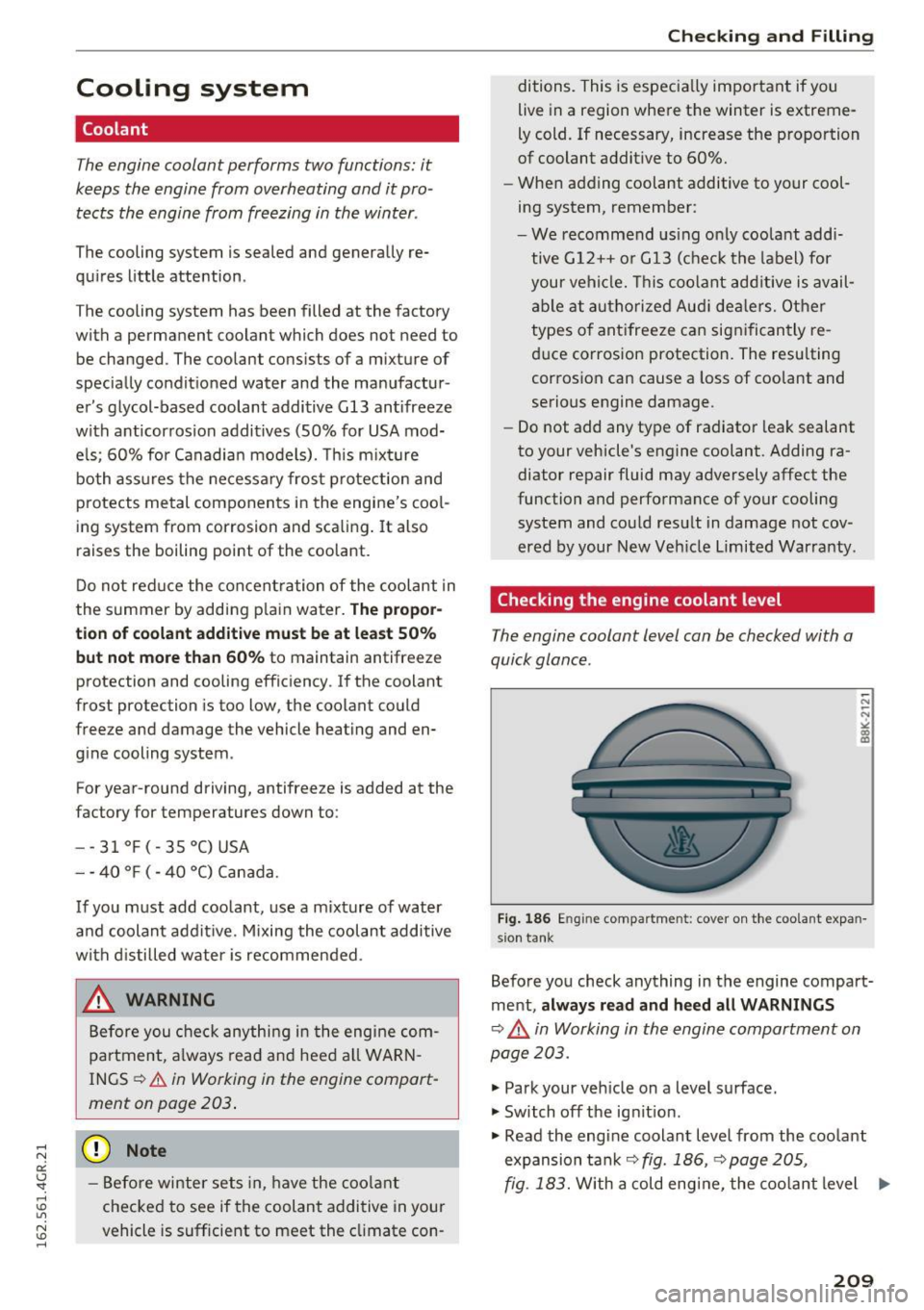
Fig. 186 E ngine compar tmen t: cover on t he coo lant expan
s io n t ank
Befo re you check anything in the engine compart
me nt,
always read and heed all WARNINGS
~ .&. in Working in the engine compartment on
page 203.
" Park your veh icle on a leve l s u rface.
" Sw itch off the ig nit ion .
.. Read the eng ine coolant leve l from the coo lant
expansion tan k
r=;,fig. 186, r=;,page 205,
fig . 183.
W ith a cold eng ine, the coolant level ..,.
209
Page 212 of 282
Checking and Filling
should be between the "min " and "max" mark
ings. When the engine is warm, the level may
be slightly above the "max" marking.
The location of the coolant expansion tank can be
seen in the engine compartment illustration
<::> page 205.
To obtain an accurate reading, the engine must
be switched off.
The expansion tank in your vehicle is equipped
with an electric coolant level sensor.
When the coolant level is too low, the warning
light in the Auto-Check System <::>
page 15 will il
luminate until you add coolant and the level has
been restored to normal. Even though there is an
electric coolant level sensor, we still recommend
you check the coolant level from time to time.
Coolant loss
Coolant loss may indicate a leak in the cooling
system. In the event of coolant loss, the cooling
system should be inspected immediately by your
authorized Audi dealer. It is not enough merely
to add coolant.
In a
sealed system, losses can occur only if the
boiling point of the coolant is exceeded as a re
sult of overheating.
A WARNING
The cooling system is under pressure and can
get very hot. Reduce the risk of scalding from
hot coolant by following these steps.
-Turn off the engine and allow itto cool down.
- Protect your face, hands and arms from es caping fluid and steam by covering the cap
with a large, thick rag.
- Turn the cap slowly and very carefully in a counter-clockwise direction while applying
light, downward pressure on the top of the
cap.
- To avoid being burned, do not spill anti
freeze or coolant on the exhaust system or
hot engine parts . Under certain conditions,
the ethylene glycol in engine coolant can
catch fire .
210
(D Note
Do not add any type of radiator leak sealant
to your vehicle's engine coolant. Adding radia
tor repair fluid may adversely affect the func
tion and performance of your cooling system
and could result in damage not covered by
your New Vehicle Limited Warranty .
Adding coolant
Be very careful when adding engine coolant.
Before you check anything in the engine compart
ment,
always read and heed all WARNINGS
<::>.& in Working in the engine compartment on
page 203 .
.. Requirement: There must be a residual amount
of coolant in the expansion tank
i:::>Q) .
.. Turn off the engine .
.. Let the engine cool down .
.. Place a thick rag over the coolant expansion
tank <::>
page 209, fig. 186 and carefully twist
the cap counter-clockwise
c::> &,.
.. Add coolant mixed in the correct ratio
<::> page 209, Coolant up to the MAX marking.
.. Make sure that the fluid level remains stable.
Add more coolant if necessary.
.. Twist the cap on again
tightly.
Replacement engine coolant must conform to ex
act specifications <::>
page 209, Coolant.
We recommend using only coolant additive G12+
+, G13 or in an emergency G12+ . Do
not use a
different additive. In an emergency use plain wa
ter until you can get the correct additive and can
restore the correct ratio. This should be done as
soon as possible.
If you have lost a considerable amount of cool
ant, then you should add cold antifreeze and cold
water only when the engine is cold.
Always use
new engine coolant when refilling.
Do not fill coolant above the "MAX" mark . Excess
coolant will be forced out through the pressure
relief valve in the cap when the engine becomes
hot.
~
Page 214 of 282
Checking and Filling
"' Read the brake fluid level from the brake fluid
reservoir
¢ fig. 187, ¢page 205, fig. 183. The
brake fluid level must be between the "MIN"
and "MAX" markings.
The location of the brake fluid reservoir can be
seen in the engine compartment illustration
c>page205.
The fluid level may drop slightly after some time
due to the automatic adjustment of the brake
pads. This is not cause for alarm.
If the brake fluid level falls considerably below
the "MIN" mark, the brake warning/indicator
light
1111 (U.S. models)/ . (Canadian models)
will come on¢
page 14. Do not continue to oper
ate the vehicle. The complete brake system
should be thoroughly checked by an authorized
Audi dealer or other qualified facility and the
cause corrected . If the brake fluid level is too
low, the brake warning/indicator light will illumi
nate. Contact an authorized Audi dealer
immedi
ately.
Changing brake fluid
Have the brake fluid changed by an experienced
technician.
Brake fluid absorbs moisture from the air . If the
water content in the brake fluid is too high , cor
rosion in the brake system may result after a pe
riod of time. The boiling point of the brake fluid
will also decrease considerably and decrease
braking performance.
Therefore, the brake fluid must be changed
every
two years.
Always use new brake fluid which con
forms to Federal Motor Vehicle Standard "FMVSS
116 DOT 4".
The brake fluid reservoir can be difficult to reach,
therefore, we recommend that you have the
brake fluid changed by your authorized
Audi
dealer.
Your dealer has the correct tools, the
right brake fluid and the know-how to do this for
you.
212
A WARNING
-
- Brake fluid is poisonous. It must be stored
only in the closed original container out of
the reach of children!
- Brake failure can result from old or inappro
priate brake fluid. Observe these precau
tions:
- Use only brake fluid that meets SAE speci
fication
J 1703 and conforms to Federal
Motor Vehicle Standard 116. Always check
with your authorized Audi dealer to make
sure you are using the correct brake fluid.
The correct type of brake fluid is also indi
cated on the brake fluid reservoir .
- The brake fluid must be new. Heavy use of
the brakes can cause a vapor lock if the
brake fluid is left in the system too long .
This can seriously affect the efficiency of
the brakes as well as your safety. This
could result in an accident.
(D Note
Brake fluid will damage the paint of your vehi
cle.
@ For the sake of the environment
Because of the problem of proper disposal of
brake fluid as well as the special tools re
quired and the necessary expertise, we rec
ommend that you have the brake fluid
changed by your authorized Audi dealer .
Battery
General information
Under normal operating conditions, the battery
in your Audi does not need any maintenance.
With
high outside temperatures or long daily
drives we recommend that you have the electro
lyte level checked by a service facility. The elec
trolyte level should also be checked each time
the battery is charged ¢
page 214.
Have the battery checked when you take your ve
hicle in for service. You are well advised to re
place a battery that is older than S years.
Page 218 of 282
Check ing and F illing
througho ut your vehicle ¢ page 186 . The intelli
gent energy management system wi ll keep the
engine battery charged better than veh icles with
out this system . To make sure the addit ional
electrical energy is avai lab le once again after you
have changed the battery, we recommend that
you install batter ies of t he same type and manu
facture on ly (the same as those insta lled at the
time your veh icle was delive red). Spec ificat ions
are listed on t he b attery housing. Your author
i z ed dealer must code the battery in the energy
management system to enable you to use the en
ergy manag ement functions correctly after re
p lacing the battery.
The new battery must have the same capac ity,
voltage (12 -vo lt), amperage, const ruction and
p lug sealing .
W hen insta lling the ba tte ry, make sure the igni
tion and all elec trical consumers are sw itched
off .
(D Note
Mak e sure the ve ntila tio n hose on t he side of
the batte ry is connecte d, othe rw ise f umes o r
battery acid can lea k out .
@) For the sake of the environment
Because of the prob lem of pr oper disposal of
a ba ttery, we recommen d your au thor ized
Audi dea le r change the battery fo r you. Bat
teries contain su lf u ric acid and lea d and must
always be disposed o f prope rly in comp liance
w ith all environmental regulations. D isposing
of vehicle batteries improperly is very danger
ous to the e nvironment.
216
Windshield washer
system
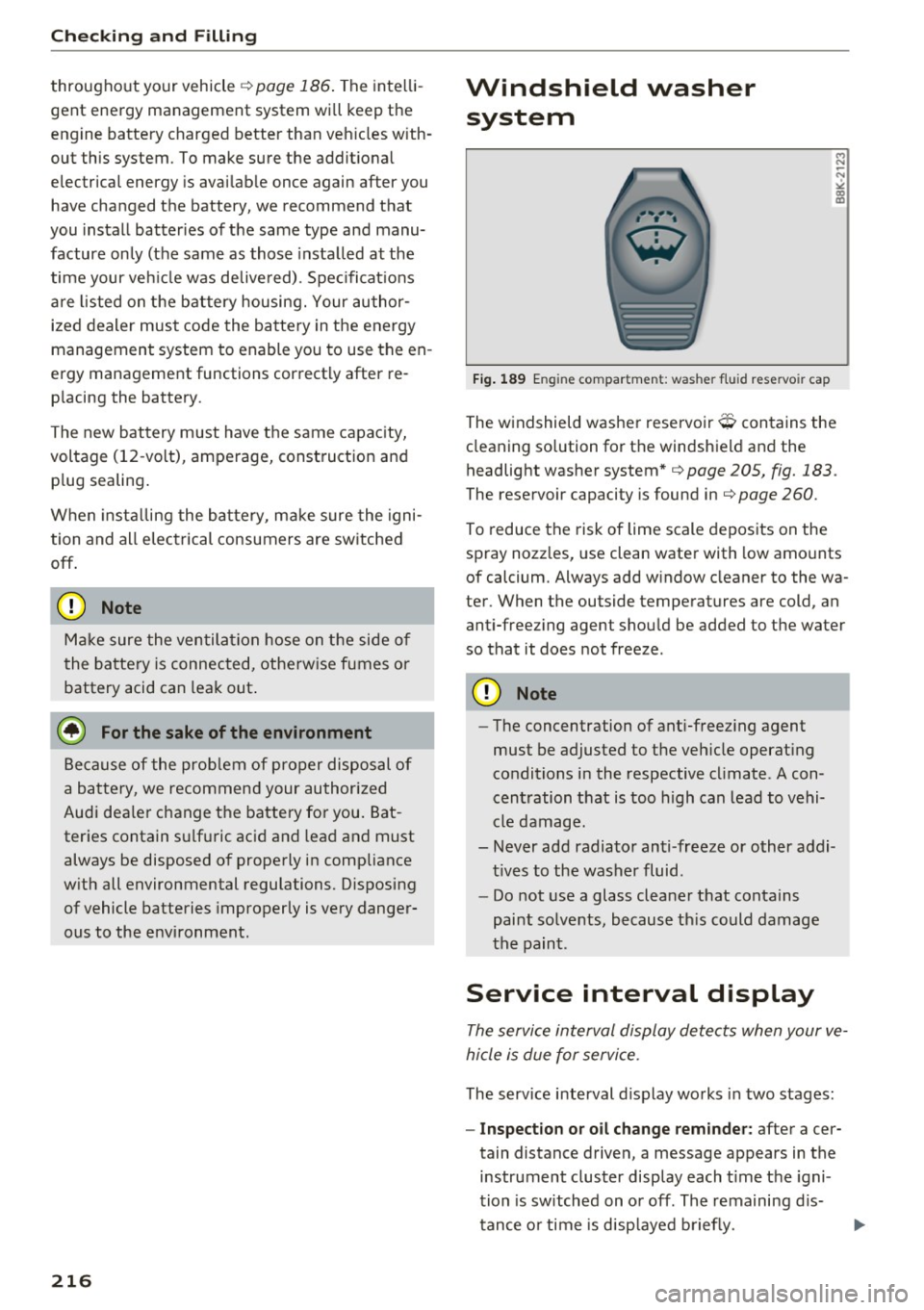
Fi g. 189 En gin e compar tm en t: was her flui d rese rvoir cap
.., N
-N ~ a, m
The w indshield washer reservoir O contains the
cleaning so lution for the windshie ld and the
headlight washer system *
9 page 205, fig. 183.
The reservoir capacity is found in 9 page 260 .
To reduce the risk of lime scale depos its on the
spray nozzles, use clean water with low amo unts
of calcium. Always add w indow cleaner to the wa
ter. When the outside temperatures are cold, an anti-freez ing agent shou ld be added to the water
so that it does not freeze .
(D Note
-The concentration of ant i-f reez ing agent
must be adjusted to the ve hicle operat ing
conditions i n the respective cl imate . A con
cen tration t hat is too high can lead to vehi
cle damage.
- Never ad d radia tor an ti-freeze or other addi
t ives to the washer fluid .
- Do not use a glass cleaner t hat contains
paint so lvents, because th is could damage
the pain t.
Service interval display
The service interval display detects when your ve
hicle is due for service .
The service interval d isplay wo rks i n two stages:
- Inspection or oil change rem inder: after a cer-
tain distance drive n, a message appears in the
instrument cluster display each t ime t he igni
tion is switched on o r off . The remaining d is-
t ance o r time is disp layed b riefly. .,..
Page 219 of 282
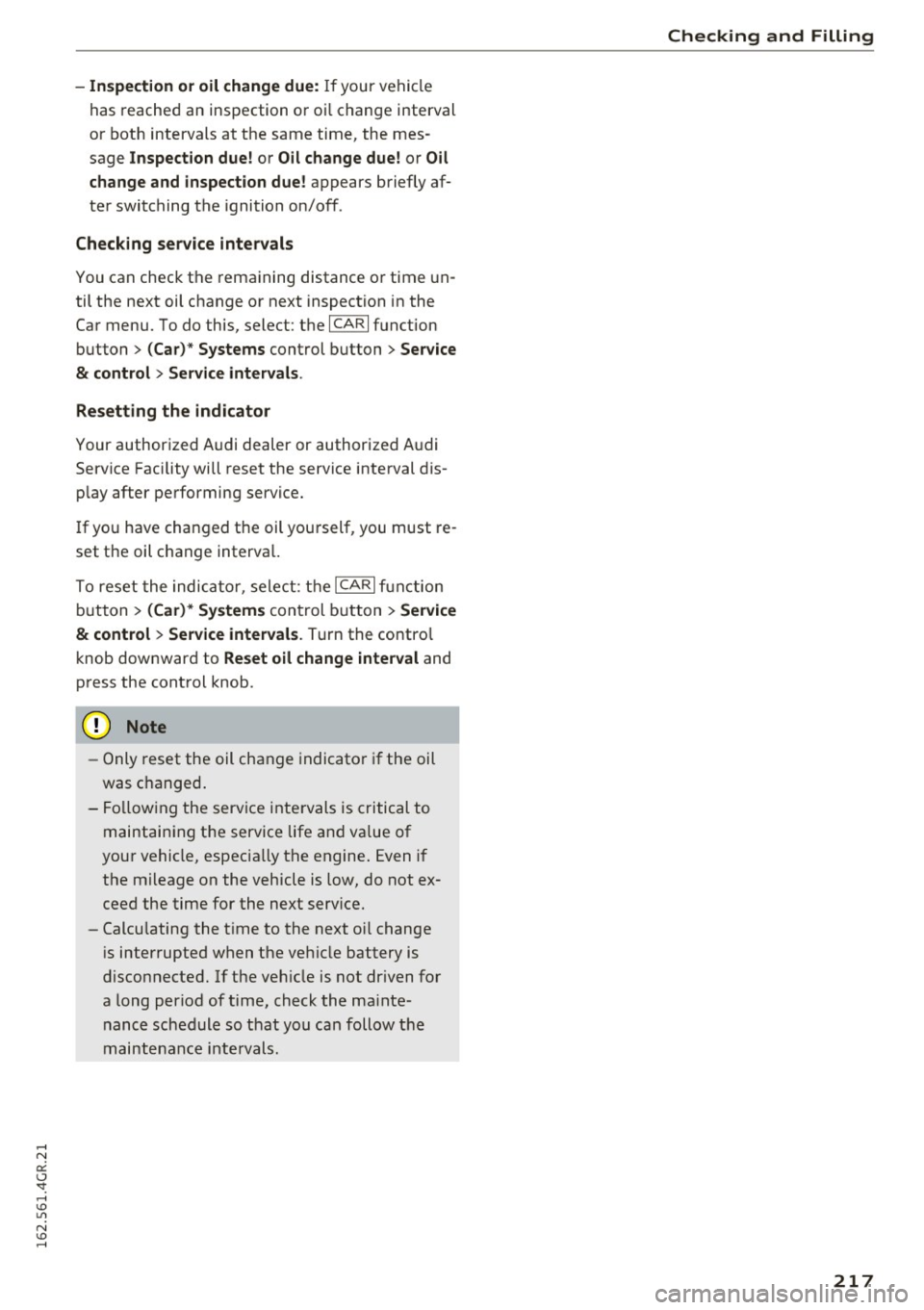
-Inspection or oil change due: If your vehicle
has reached an inspection or oi l change interval
or both intervals at the same time, the mes
sage
Inspection due! or Oil change due! or Oil
change and inspection due!
appears briefly af
ter switching the ignition on/off .
Checking service intervals
You can check the remaining distance or time un
til the next oil change or next inspection in the
Car menu. To do this, select: the
ICARI function
button
> (Car)* Systems control button > Service
& control > Service intervals.
Resetting the indicator
Your authorized Audi dealer or authorized Audi
Service Facility will reset the service interval dis
p lay after performing service.
I f you have changed the oil you rself, you must re
set the oil change interval.
To reset the indicator, select: the
ICARI funct ion
button
> (Car)* Systems control button > Service
& control > Service intervals. Turn the contro l
knob downward to
Reset oil change interval and
press the control knob.
@ Note
-Only reset the oil change indicator if the oil
was changed .
- Following the service inte rvals is critical to
maintain ing the service life and va lue of
your vehicle, especially the engine . Even if
the mileage on the vehicle is low, do not ex
ceed the time for the next serv ice.
- Calcu lating the time to the next o il change
i s interrupted when the vehicle battery is
disconnected. If the veh icle is not driven for
a long period of time, check the ma inte
nance schedule so that you can follow the
maintenance intervals.
Checking and Filling
217
Page 232 of 282
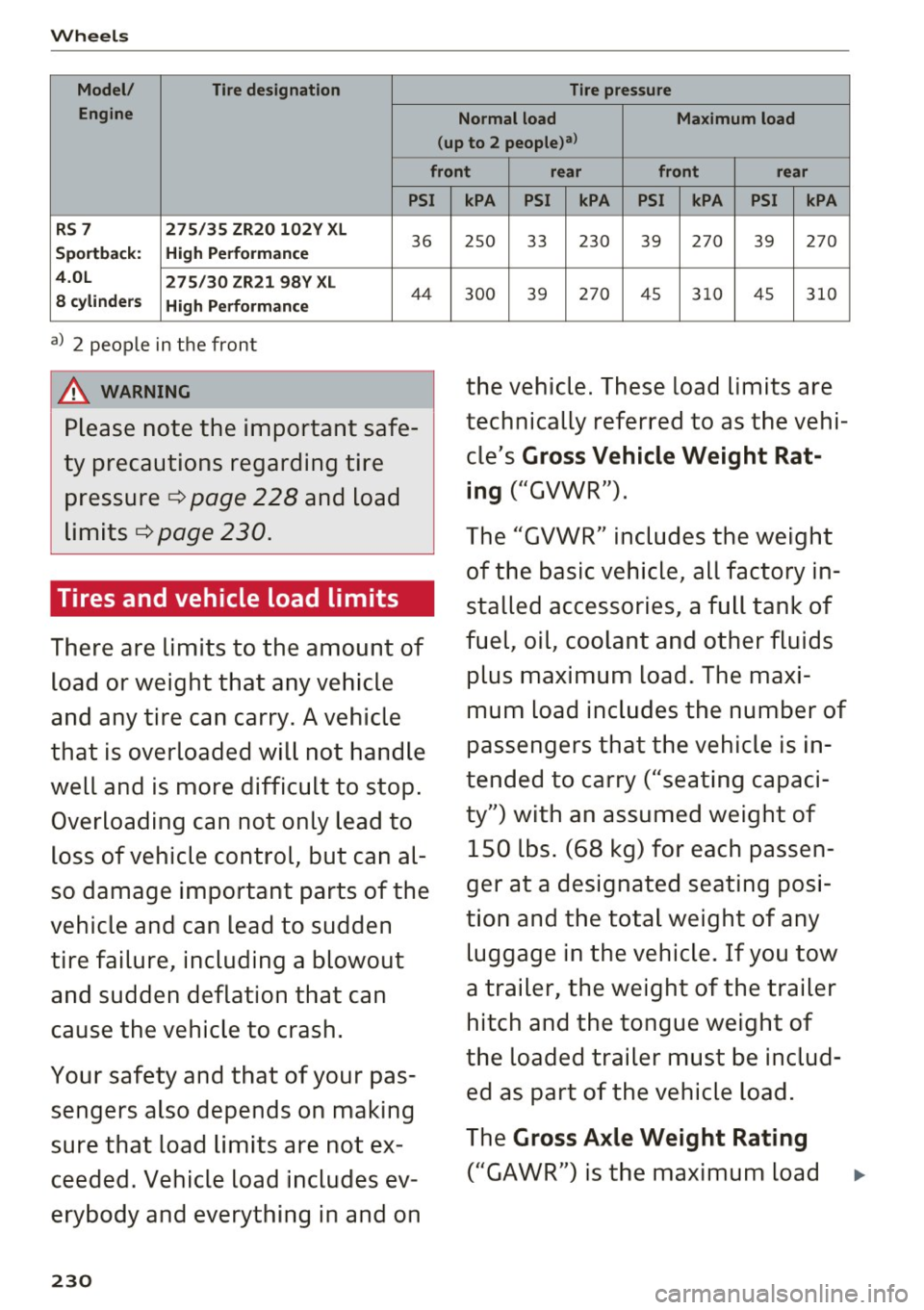
Wheels
Model/ Tire designation Tire pressure
Engine Normal load Maximum load
(up to 2 people)a>
front rear front rear
PSI
RS 7 275/35 ZR20 102Y XL
Sportback: High Performance
36
4.0L 275/30 ZR21 98Y XL
8 cylinders High Performance
44
a) 2 people in the front
A WARNING
Please note the important safe
ty precautions regarding tire
pressure ¢
page 228 and load
limits ¢
page 230.
Tires and vehicle load limits
There are limits to the amount of
load or weight that any vehicle
and any tire can carry. A vehicle
that is overloaded will not handle
well and is more difficult to stop. Overloading can not only lead to
loss of vehicle control, but can al
so damage important parts of the
vehicle and can lead to sudden
tire failure, including a blowout and sudden deflation that can
cause the vehicle to crash.
Your safety and that of your pas sengers also depends on making
sure that load limits are not ex
ceeded . Vehicle load includes ev
erybody and everything in and on
230
kPA PSI kPA PSI kPA PSI kPA
25 0 33 230 39 270
39 270
30 0 39 270 45 310 45
310
the vehicle. These load limits are
technically referred to as the vehi
cle's
Gross Vehicle Weight Rat
ing
("GVWR").
The "GVWR" includes the weight of the basic vehicle, all factory in
stalled accessories , a full tank of
fuel, oil, coolant and other fluids
plus maximum load. The maxi
mum load includes the number of
passengers that the vehicle is in
tended to carry ("seating capaci
ty") with an assumed weight of 150 lbs. (68 kg) for each passen
ger at a designated seating posi
tion and the total weight of any luggage in the vehicle. If you tow
a trailer, the weight of the trailer hitch and the tongue weight of
the loaded trailer must be includ ed as part of the vehicle load.
The
Gross Axle Weight Rating
("GAWR") is the maximum load
Page 259 of 282

Raising the vehicle
Lifting with workshop hoist and with floor
jack
The vehicle may only b e li~ ed at the lifting
points illustra ted.
F ig. 219 Front lift ing po int
F ig. 220 Rea r lift ing po int
.,. Read and heed WARNING c:> &_ .
.. Activate the vehicle jack mode* in the MMI:
I CAR I funct ion button> (Car) * systems contro l
button >
Servicing & checks > Air susp.: jack
mode > On .
.. Loca te lift ing po ints c:> fig . 219 and c:> fig . 22 0 .
.. Adju st lifting arms of wo rkshop ho ist o r floo r
j ac k t o ma tch vehicl e lifting poin ts.
.. In se rt a rub ber pa d between the f loor jack/
wor kshop hoist a nd the lifting points .
T he vehicle ja ck mode* mus t be activa ted so th at
the au tomatic a djustment of the Adaptive Air
Suspension * does not make it more d ifficult to
raise the ve hicle w it h the floo r jack.
If you must lift your vehicle with a floor jack to
work underneath , be sure the vehicle is safely
supported on stands intended for this purpose .
Emergency situations
Front lifting point
The li fting poin t is lo cate d on the floor p an rein
f orceme nt ab out at the same level as the ja ck
mounting point
c:> fig . 219 . Do not lift the vehi
cle at the vertical sill reinforcement.
Rear lifting point
T he lifting point is lo cated on the ver tic al rein
f orcement o f the lower s ill for the on- bo ar d jac k
<=> fig. 220.
Lifting with vehicle jack
Refer to c:> page 245 .
A WARNING
- To reduce the r is k of se rious inju ry and vehi
cle damag e.
- Always lift the vehicle on ly at the special
workshop h oist a nd floor jack lift points
il
lustrated c:> fig. 219 and c:> fig. 220.
- Failure to lift t he veh icle at these points
could cause t he veh icle to tilt o r fall from
a lift i f th ere is a change in vehicle weight
dist ribution and balance . This might hap
pen, fo r example, when heavy compo
n en ts such as the eng ine block o r tran s
mis sio n a re re moved .
- Whe n re mov ing heavy co m ponents like
these, an ch or vehicle t o hois t or ad d co rre
spon ding weig hts t o m aintai n the cen ter of
g ravi ty . Ot herw ise, the vehicle mig ht tilt or
slip off t he hoist, caus ing se rious pe rsonal
i njur y .
(D Note
-Be aw are of the fo llow ing points b efor e lift
ing the vehicle:
-The vehicle should never be lifted or
jacked up from underneath the engine oil
pan, the transmission housing, the front
or rear axle or the body side members.
This could lead to serious damage .
- To avoid damage to the underbody or
chassis frame, a rubber pad must be in
serted between the floor jack and the lift
points . .,.
257
Page 261 of 282

Technical data
Vehicle identification
F ig . 2 21 Vehi cle Ident if icatio n Number (VlN) plate : loca·
t ion on dr iver 's side dash pane l
XXXXX XX -X -XX XX X XX XX
CD+ ~t :1 :: xxxxxxxx xx x x x xxx xxx
T VP /fffl XXX XXX
XX XXXXXXX XX X X XX
XXX
K W XXX
®i ~:J ·f lfils~~ XXXX XXX XXX
®-+ ~N:a=i~l xxxx ; xxxx xx x ; xx
II. · AUSS, I OPTIONS
E0 A
7D5 4UB 6
XM 5SG 5R W
2EH J0Z lLB l
A S lB A
3FC SM U 7Xl
F 0 A 9G3 0G7 0YH 0JF
TL 6 3KA 8EH UlA X 98 QZ7
l XW 803 908 824 020
7T6 C V7 7 K0 4 X3 2 K2
3L4 4KC 3Y0 413
502
lS A
7GB 01A 4G0
XX. X XX X XX X xxxx
Fig. 222 Th e ve hicle identifica tion label- inside the lug
gage compartment
Veh icle Identification Number (VlN )
The Vehicle Identific ation N umbe r is locate d in
d if f eren t places:
- u nder the w indshield on the dr iver's side
¢ fig . 22 1.
- in the M MI: Select: Funct ion button ICAR I >
(Car) * systems > Servicing & check s > VIN
;:::J numb er.
(3 -on the vehicle identification label.
'
Technical data
Vehicle identification label
T he veh icle identification label is lo cate d in the
l uggage compa rtment in the spare whee l we ll.
T he labe l¢
fig. 222 shows the fo llowing vehicle
da ta:
(D Vehicle Identification Number (VIN)
@ Vehicle type, eng ine ou tput, transm ission
@ Engine and transmission code
@ Paint numbe r and interior
® Optional equipment numbers
T he information of the veh icle identification label
c a n al so be fo und in your Warran ty
& M ainte
nance booklet.
Safety compliance sticker
The safety compliance st icker is yo ur ass urance
that your new vehi cle complies w ith all applicable
Federal Motor Vehicle Safety Standards which
we re in effect at the time the vehicle w as m anu
fac tured. Yo u ca n fi nd this sticker on the door
jamb on the driver 's side. It shows the month and
year of production and t he ve hicle identification
number of your ve hicle (perforation) as well as
the Gross Vehicle Weight Rat ing (GVWR) and the
G ross A xle We ight Rati ng (GAWR).
H igh vo ltage warning label
T he high voltage warning label is located in the
engine compa rtment next to the engine hood re
lease. The spark ignition system complies with
t h e Canadian standard ICES-002.
Weights
Gross Vehicle Weight Rating
The Gross Vehicle Weight Rating (GVWR), and
t h e Gross Axle Weight Rating (GAWR) for front
and rear are listed on a sticker on the door jamb
o n the dr iver 's side.
The Gross Vehicle Weight Rating includes the
weight of the basic vehicle plus fu ll fuel tank, oil
and coolant, p lus maxim um load, which includes
passenger weight (150 lbs/68 kg per des ignated
seat ing pos ition) and luggage weight
c:> .&, . .,.
259
Page 263 of 282
Technical data
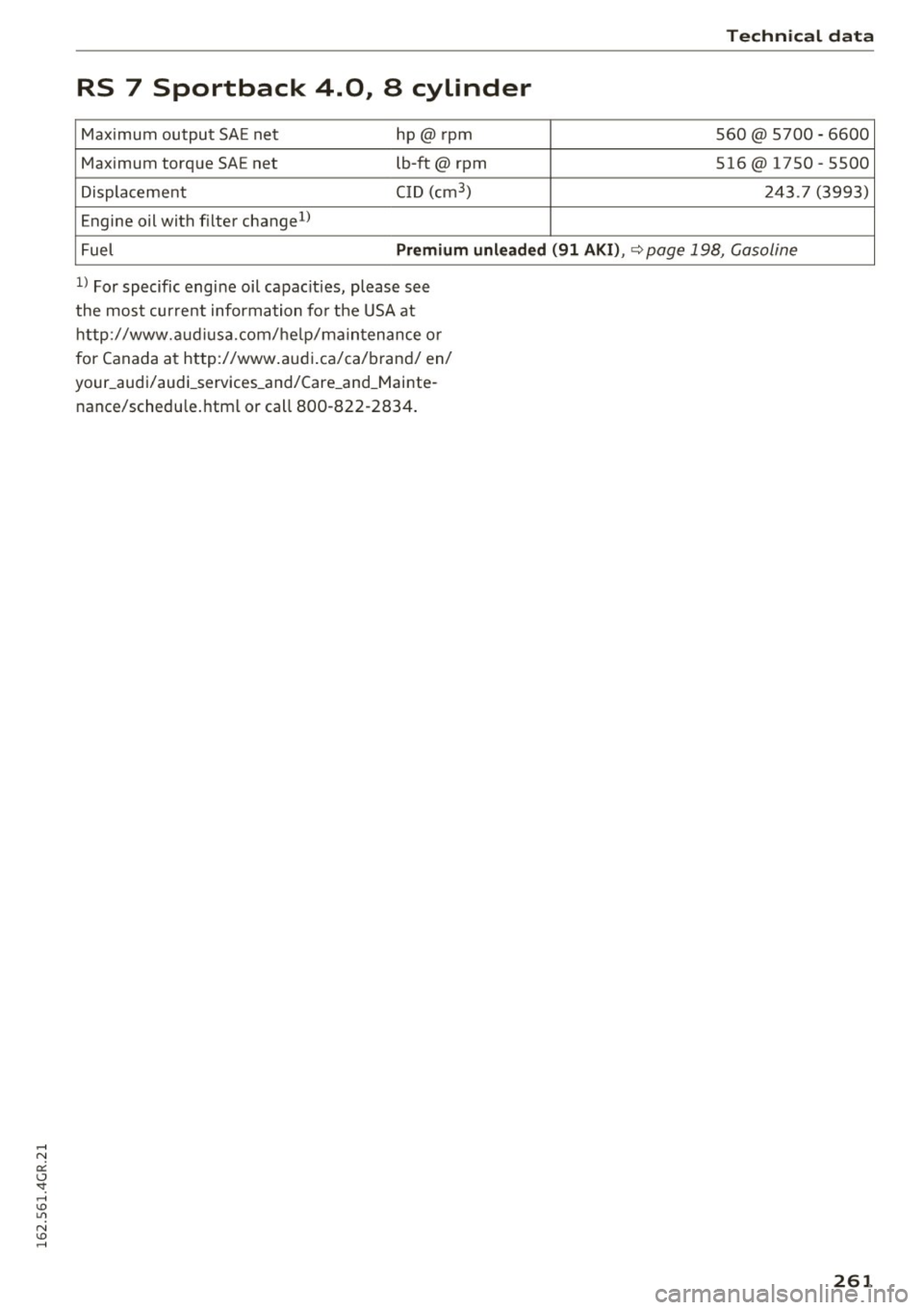
RS 7 Sportback 4.0, 8 cylinder
Maximum output SA E net hp@rpnn 560@ 5700 - 6600
Maximum torque SAE net lb-ft@ rpm 516@ 1750 -5500
Displacement CID (cm
3
) 243 .7 (3993)
Engine oil with filter change
1 )
Fuel Premium unleaded (91 AKI) , qpage 198, Gasoline
ll For specific engine oil capac ities, please see
the most current information for the USA at http ://www. audiusa.com/help/maintenance or
for Canada at http://www.audi.ca/ca/brand/ en/
your_audi/audi_services _and/Care _and _Mainte
nance/schedule.html or call 800-822-2834.
261
Page 264 of 282
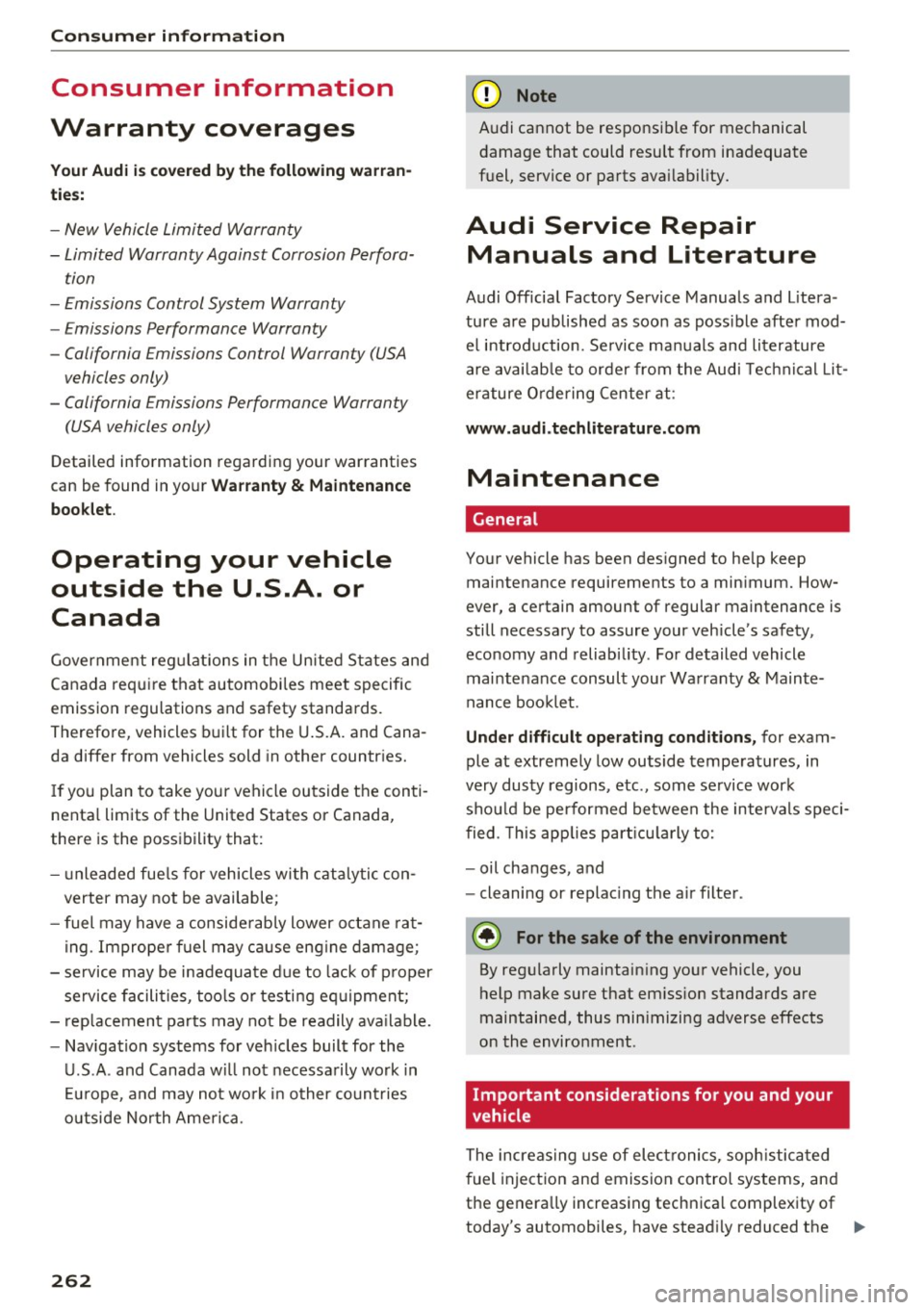
Consumer information
Consumer information
Warranty coverages
Your Audi is covered by the following warran
ties:
- New Vehicle Limited Warranty
- Limited Warranty Against Corrosion Perfora-
tion
- Emissions Control System Warranty
- Emissions Performance Warranty
- California Emissions Control Warranty (USA
vehicles only)
- California Emissions Performance Warranty
(USA vehicles only)
Detailed information regarding your warranties
can be found in your
Warranty & Maintenance
booklet .
Operating your vehicle
outside the U.S.A. or
Canada
Government regulati ons in the United States and
Canada require that automobi les meet specific
emission regulations and safety standards.
Therefore, vehicles built for the U.S.A. and Cana
da differ from vehicles sold in other countries.
If you plan to take your vehicle outside the conti
nenta l limits of the United States or Canada,
there is the poss ibility that:
- un leaded fue ls for vehicles with catalytic con
verter may not be available;
- fuel may have a considerably lower octane rat
ing . Improper fuel may cause engine damage;
- service may be inadequate due to lack of proper
service facilities, tools or testing equipment;
- r eplacement parts may not be readily available.
- Nav igation systems for veh icles built for the
U.S .A . and Canada will not necessarily work in
Europe, and may not work in other countries
outside North America.
262
(D Note
Audi cannot be responsib le for mechanical
damage that could result from inadequate
f u el, service or parts ava ilability.
Audi Service Repair
Manuals and Literature
Audi Official Factory Service Manuals and Litera
ture are published as soon as poss ible after mod
el introd uction . Service manuals and literature
are available to order from the Audi Technical Lit
erature Ordering Center at :
www.audi.techliterature .com
Maintenance
General '
Your vehicle has been designed to help keep
maintenance requirements to a min imum. How
ever, a certain amount of regular maintenance is
still necessary to assure your vehicle's safety,
economy and reliability . For detailed vehicle
maintena nce consult your Warranty & Mainte
nance booklet .
Under difficult operating conditions, for exam
ple at extremely low outside temperatures, in
very dusty regions, etc., some se rvice work
should be performed between the intervals speci
fied. This applies particularly to:
- oil changes, and
- cleaning or replac ing the a ir filter .
@ For the sake of the environment
By regularly maintaining your vehicle, you
help make sure that emission standards are
maintained, thus min imizing adverse effects
on the environment.
Important considerations for you and your
vehicle
The increas ing use of elect ronics, soph istica ted
fuel injection and emission control systems, and
the genera lly increasing technica l complexity of
today's automobiles, have stead ily reduced the ..,_