engine AUDI RS7 SPORTBACK 2016 Manual PDF
[x] Cancel search | Manufacturer: AUDI, Model Year: 2016, Model line: RS7 SPORTBACK, Model: AUDI RS7 SPORTBACK 2016Pages: 282, PDF Size: 70.78 MB
Page 252 of 282
Fuses
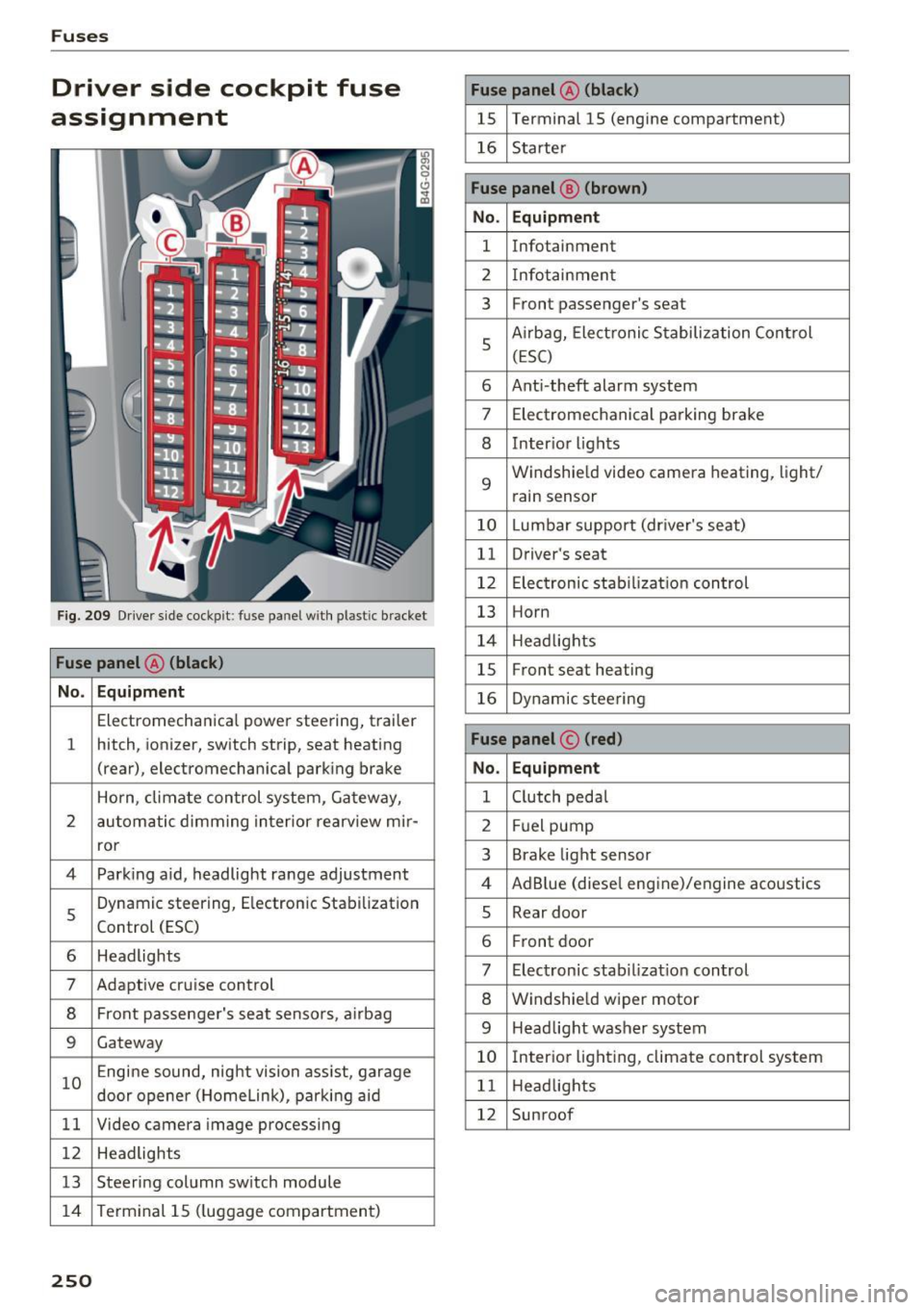
Driver side cockpit fuse
assignment
Fig . 209 Driver side cockp it: fuse panel with plastic bracket
Fuse panel @ (black)
No . Equipment
Electromechanical power steering, trailer
1 hitch, ionizer, switch strip, seat heating
(rear), electromechanical parking brake
Horn, climate control system, Gateway,
2 automatic dimming interior rearv iew mir·
ror
4 Park ing aid, headlight range adjustment
5 Dynamic steering, Electron
ic Stabilization
Control (ESC)
6 Headlights
7 Adaptive cruise control
8 Front passenger's seat sensors, airbag
9 Gateway
10 Engine sound, night vision
assist, garage
door opener (Home Link), parking aid
11 Video camera
image processing
12 Headlights
13 Steering column switch module
14 Terminal 15 (luggage compartment)
250
Fuse panel
@ (black)
15 Terminal 15 (engine compartment)
16 Starter
Fuse panel @ (brown)
No. Equipment
1 Infotainment
2 Infotainment
3 F
ron t passenger's seat
5 Airbag, Elect
ronic Stabilization Control
(ESC)
6 Anti·theft alarm system
7 Electromechanical parking brake
8 Inter ior lights
9
Windshield video camera heating, light/
rain sensor
10 Lumbar support (driver's seat)
11 Driver's seat
12 Electronic stabilization control
13 Horn
14 Headlights
15 Front
seat heating
16 Dynamic steering
Fuse panel © (red)
No . Equipment
1 Clutch pedal
2 Fuel pump
3 Brake light sensor
4 AdBlue (diesel
engine)/engine acoustics
5 Rear door
6 Front
door
7 Electronic stab ilizat ion control
8 Windshield wiper motor
9 Headlight washer system
10 Interior
lighting, climate control system
11 Headlights
12 Sunroof
Page 253 of 282
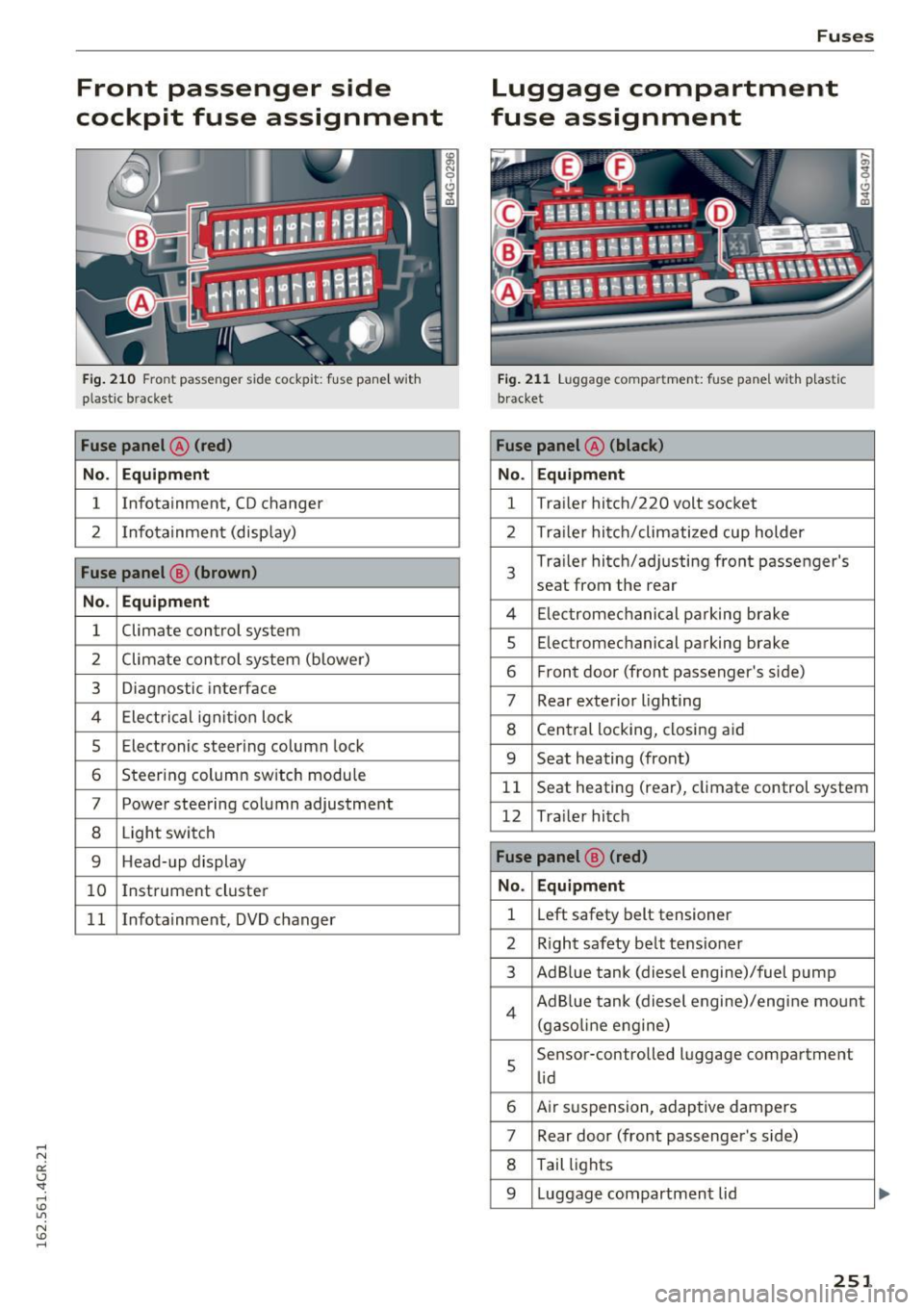
Front passenger side
cockpit fuse assignment
F ig. 21 0 Front passenger side cockpit: f use pane l w it h
p las tic bracket
Fuse panel @ (red )
No . Equipment
1 Infotainment, CD changer
2 I
nf otainment (disp lay)
Fuse panel @ (brown )
No . Equipment
1 Climate control system
2 Climate cont
rol sys tem (blowe r)
3 Diagnostic interface
4 Ele ctrical ignit io n lock
5 Electronic steering column lock
6 Steer ing col umn sw itch module
7 Power steering column adjustment
8 Light switch
9 Head-up display
1 0 I
nst rument cluste r
1 1 Infotainment, DVD changer
Fuses
Luggage compartment
fuse assignment
F ig . 2 1 1 Luggage compa rtment: fuse panel with p last ic
b racket
Fuse panel @ (black )
No . Equipment
1 Tra
iler hitc h/220 volt socket
2 Tra ile r hi tc h /climati zed cup holder
3
Tra iler hitch/ad justing front passenger's
seat from the rear
4 El ec tromec ha nic al pa rking brake
5 Electromec hanical parking brake
6 F ront door (front passenger's s ide)
7 Rear exterior lighting
8 Cen tral locking, closi ng a id
9 Seat heating (front)
1 1 Seat heating (rear), climate control system
12 Tra ile r hitc h
Fuse panel @ (red)
No . Equipment
1 L
eft safety belt tensioner
2 R igh t safety be lt tens ione r
3 Ad B lue tank (diesel engine)/fuel pump
4 Ad B lue tank (diesel engine)/eng ine mo unt
(gaso line e ngine)
s
Sensor-controlled l uggage compartment
li d
6 Air s uspension, adaptive dampers
7 Rear door (front passenger's side)
8 Tail lights
9 Luggage compartmen t lid
251
...
Page 254 of 282
Fuses
Fuse panel@ (red ) Fuse panel® (black)
10 Rear seat enterta inment No. Equipment
12
Rea r spo ile r (Sportbac k), t ilt/open sun-
roof, P anorama glass roof 1 Rear window defogge
r
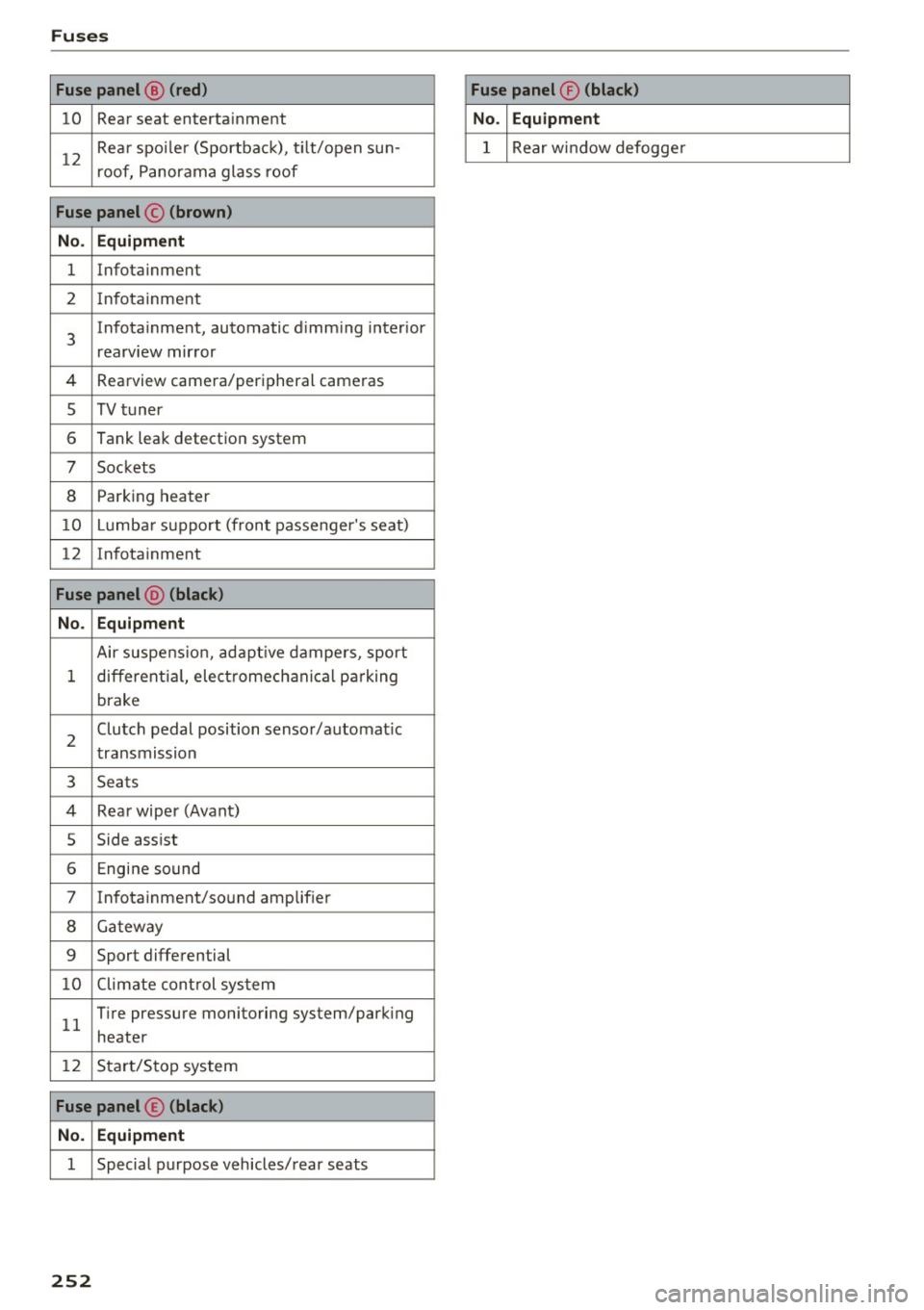
Fuse panel © (brown)
No . Equipment
1 Infotainment
2 In fota inment
3
Infotainment , automatic d imm ing inter ior
rearv iew mir ror
4 Rearview camera/peripheral cameras
s TV t uner
6 Tank leak detection system
7 Sockets
8 Park ing heater
10 Lumb ar su ppo rt (front passenger 's seat)
12 In fotainment
Fuse panel @ (black)
No. Equipment
Air suspe nsio n, ad aptive dampers, sport
1 different ia l, elect romech anic al par king
brake
2
Clutch pedal position sensor/automa tic
t ransmission
3 Seats
4 Rea r wiper (Avant)
5 Side assist
6 Engine sound
7 In fota inment/so und amplif ier
8 Ga tew ay
9 Sport differential
1 0 Climate cont rol sys tem
1 1
T ire pressure monitoring system/park ing
heater
12 S tar t/S to p sys tem
Fuse panel © (black)
No. Equipment
1 Special purpose vehicles/ rear seats
252
Page 255 of 282
Emergency situations
General
This chapter is intended for trained emergency
crews and working personnel who have the nec
essary tools and equipment to perform these
ope rations.
Starting by pushing or
towing
(D Note
Veh icles with an automatic transmission can
not be started by pushing or towing.
Starting with jumper
cables
If necessary, the engine can be started by con
necting it to the battery of another vehicle .
If the engine shou ld fail to start because of a dis
charged or weak battery, the battery can be con
nected to the battery of
another vehicle, using a
pair of jumpe r cables to start the engine.
Jumper cables
Use only jumper cables of suffic iently large cross
section
to carry the starter current safely. Refer
to the manufacturer's specifications.
Use only jumper cables with
insulated term inal
clamps which are dis tinct ly marked :
plus(+) cable in most cases colored re d
minus( -) cable
in most cases colored blac k.
A WARNING
Batteries contain electricity, acid, and gas.
Any of these can cause very serious or fatal in
jury. Follow the instructions below for safe
handling of your vehicle's battery.
- Always shield your eyes and avo id leaning
over the battery whenever poss ible.
- A discharged battery can freeze at tempera
tures just below 32 °F (0 °C) . Before con
necting a jumper cable, you must thaw the
Emergency situations
frozen battery completely, otherwise it
could explode .
- Do not allow battery acid to contact eyes or
skin. Flush any contacted area with water immediately.
- Improper use of a booster battery to start a
vehicle may cause an exp losion.
- Vehicle batteries generate exp losive gases.
Keep sparks, flame and lighted cigarettes
away from batteries.
- Do not try to jump start any vehicle with a
low acid level in the battery .
- The vo ltage of the booster battery must also
have a 12-volt rating. The capacity (Ah) of
the booster battery should not be lower
than that of the discharged battery. Use of
batter ies of different voltage or substantial
ly different "Ah" rating may cause an exp lo
sion and personal injury .
- Never charge a frozen battery. Gas trapped
in the ice may cause an explosion.
- Never charge or use a battery that has been
frozen . The battery case may have be weak
ened .
- Use of batter ies of different voltage or sub
stantially different capacity (Ah) rating may
cause an exp losion and injury. The capac ity
(Ah) of the booster battery should not be
lowe r than that of the discharged battery.
- Before you check anything in the eng ine
compartment, always read and heed all
WARNINGS
r::!)page 203.
(D Note
-Applying a higher voltage booster battery
will cause expensive damage to sensitive
electronic components, such as control
units, relays, radio, etc.
- Th ere must be no electrical contact between
the vehicles as otherwise current could al
ready start to flow as soon as the positive
(+) terminals are connected.
(D Tips
The discharged battery must be properly con-
nected to the vehicle's e lectrical system. ..,.
253
Page 256 of 282

Emergency situations
When jump starting or charging the battery,
never connect the negative ground cable to
the battery negative post because the battery
manager system must be able to detect the
battery's state of charge. Always connect the
negative ground cable to the negat ive ground
post of the battery manager control unit .
Use of jumper cables
Make sure to connect the jumper cable clamps in
exactly the order described below!
Fig. 212 Engine compartment: connectors for ju mp start
cab les a nd charger
® .--l @
Fig. 213 Ju mp start ing wit h the battery o f another vehicle:
@ -boos te r battery ,® -discharged vehicle battery
The procedure described below for connecting
jumper cables is intended to provide a jump start
for your vehicle.
Vehicle with discharged battery:
• Turn off lights and accessories , move lever of
automatic transmission to N (Neutral) or P
(Park) and set parking brake .
Connect POSITIVE(+) to POSITIVE(+) (red)
• Open the red cover on the positive term inal
~ fig . 212.
254
1. Connect one end of the red positive cable on
the
jump start bolt 9 fig. 213 @ (bolt under
the red cover= "positive") of the vehicle to be
started ®·
2. Connect the other end to the positive termi-
nal@ of the booster battery @.
Connect NEGATIVE (- ) to NEGATIVE (-)
(black)
3. Connect one end of the black negative cable
to the negative term inal @ of the booster
battery @.
4 . Connect the other end to the
jump start pin
@ (bolts with hex head bolt= "negat ive") of
the vehicle to be started ®·
Starting the engine
• Start the eng ine of the vehicle with the booster
battery @. Run the engine at a moderate
speed.
• Sta rt engine w ith discharged vehicle ba ttery @
in the usual manner.
• If the engine fails to start, do not keep the
starter cranking for longer than 10 seconds.
Wait for about 30 seconds and then try again.
• With engine running, remove jumper cables
from both vehicles in the exact
reverse order.
• Close the red cover on the positive terminal.
The battery is vented to the outside to prevent gases from entering the vehicle interior . Make
sure that the jumper clamps are well connected
with their metal parts in full contact with the battery terminals.
&_ WARNING
To avoid ser ious personal injury and damage
to the vehicle, heed all warnings and instruc
tions of the jumper cable manufacturer. If in
doubt, call for road service.
- Jumper cables must be long enough so that
the vehicles do not touch.
- When connecting jumper cables, make sure
that they cannot get caug ht in any moving
parts in the engine compartment.
- Before you check anything in the engine
compartment, always read and heed all
WARNINGS
¢ page 203.
Page 257 of 282
(D Note
Im pro per hook-u p of jum per cables can ru in
the gene ra tor.
- Always connect P OSITI VE( +) to POS ITI VE
( + ), and NEGATIVE( -) to NEGATIVE( -)
ground post of t he battery manager contro l
u nit .
- Check that a ll sc rew p lugs on the battery
ce lls a re sc rewed in firmly . If not, t igh ten
pl ugs p rio r to connecting clamp on negative
batte ry te rminal.
- Please note t hat the procedure fo r con nect
i ng a jumper cab le as desc ribe d above ap
p lies specifica lly to the case of yo ur vehicle
being jump s tarte d. W hen you are giv ing a
ju mp s ta rt to an othe r vehicl e, do
not con
n ect t he nega tive (- ) ca b le t o t he nega tive
(-) t ermin al on the di scharged battery @
c::> fig . 2 13 . Instead, securely connec t the
negative (-) cable to either a solid metal
com ponent that is f irm ly bolted t o the e n
gine block o r to t he engine bloc k itsel f. If
the battery that is be ing c ha rge d d oes not
vent to the outs ide, escap ing batte ry gas
could ignite and e xplode!
Towing with a tow truck
General hints
Your Audi require s speci al handling f or towing.
Th e follow ing informat ion is to be used by com
mercia l tow tr uck o pera tors who know how to op
e rat e the ir equip men t sa fely.
- Never tow your Audi. Towing will cause dam
age to the engine and transmission .
- Never wrap the safety chains or winch cables
around the brake lines.
- To prevent unnecessary damage, your Audi
must be transported with a flat bed truck.
- To load the vehicle on to the flat bed, use the
towing loop found in the vehicle tools and at
tach to the front or rear anchorage
c::> page 255 and c::> pag e 256 .
Emergency situations
A WARNING
-A vehicle being towe d is not safe for passen-
ge rs. Neve r allow a nyo ne to ride in a vehicle
b eing towed, for any reason.
Front towing loop
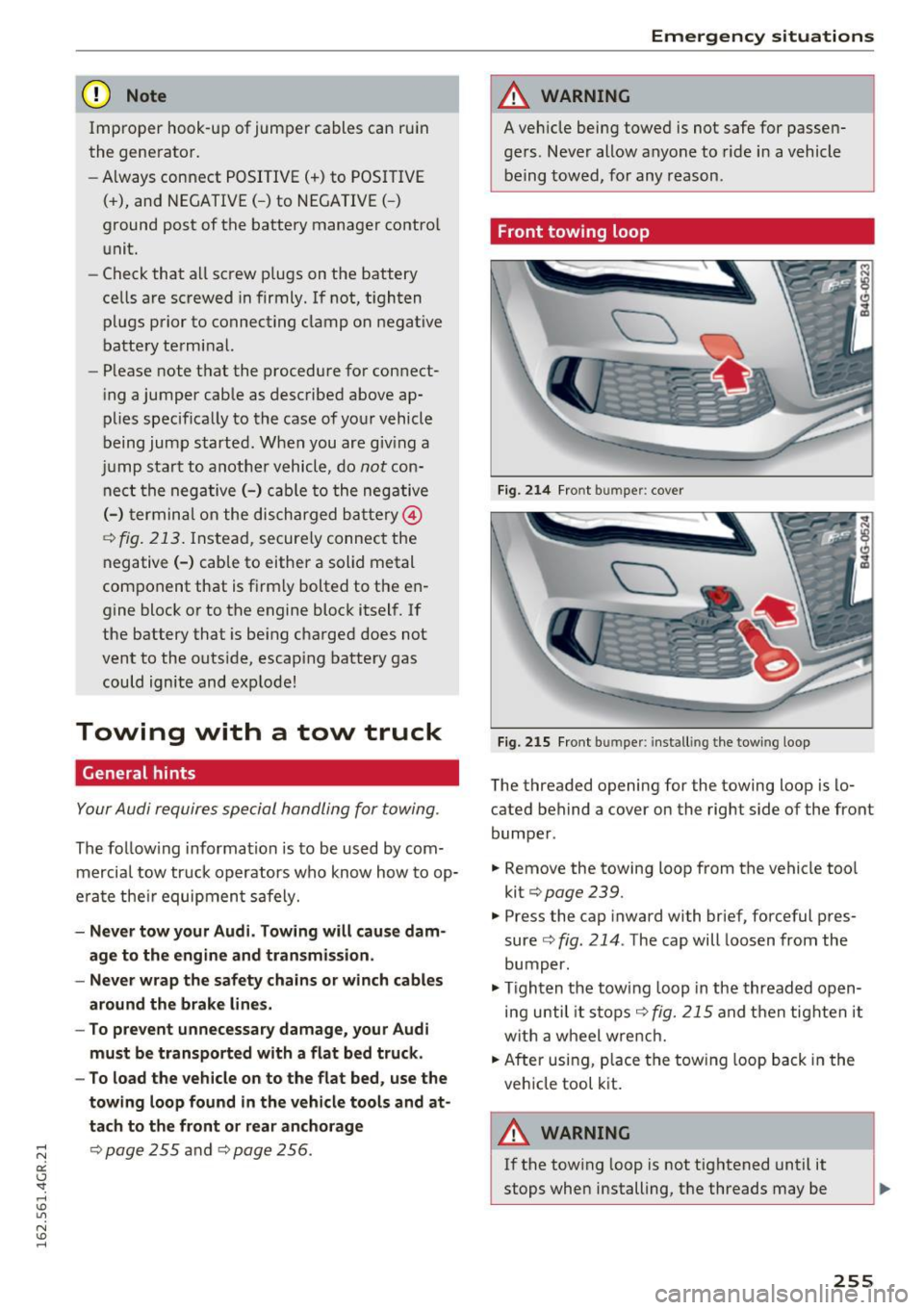
Fi g. 214 Fron t bumper: cover
Fig. 215 Fron t bumper: installing the tow ing loop
The threaded opening for the towing loop is lo
cated behind a cover on the rig ht side of the front
bumper .
.,. Remove the towing loop from the vehicle too l
kit<=>
page 239.
.,. Press the cap inward with brief, forceful pres
sure <=>
fig. 214 . The cap will loosen from the
bumper.
.,. Tigh ten t he towing loop in the threaded o pen
ing until it sto ps
c::> fig. 215 and t hen tig hten it
w it h a wheel wre nc h .
.,. After usi ng, p lace the tow ing loop ba ck in t he
ve hicle tool kit.
A WARNING
--
If t he tow ing loop is not tig htened until it
stops when installing, t he threads may be
255
Page 259 of 282

Raising the vehicle
Lifting with workshop hoist and with floor
jack
The vehicle may only b e li~ ed at the lifting
points illustra ted.
F ig. 219 Front lift ing po int
F ig. 220 Rea r lift ing po int
.,. Read and heed WARNING c:> &_ .
.. Activate the vehicle jack mode* in the MMI:
I CAR I funct ion button> (Car) * systems contro l
button >
Servicing & checks > Air susp.: jack
mode > On .
.. Loca te lift ing po ints c:> fig . 219 and c:> fig . 22 0 .
.. Adju st lifting arms of wo rkshop ho ist o r floo r
j ac k t o ma tch vehicl e lifting poin ts.
.. In se rt a rub ber pa d between the f loor jack/
wor kshop hoist a nd the lifting points .
T he vehicle ja ck mode* mus t be activa ted so th at
the au tomatic a djustment of the Adaptive Air
Suspension * does not make it more d ifficult to
raise the ve hicle w it h the floo r jack.
If you must lift your vehicle with a floor jack to
work underneath , be sure the vehicle is safely
supported on stands intended for this purpose .
Emergency situations
Front lifting point
The li fting poin t is lo cate d on the floor p an rein
f orceme nt ab out at the same level as the ja ck
mounting point
c:> fig . 219 . Do not lift the vehi
cle at the vertical sill reinforcement.
Rear lifting point
T he lifting point is lo cated on the ver tic al rein
f orcement o f the lower s ill for the on- bo ar d jac k
<=> fig. 220.
Lifting with vehicle jack
Refer to c:> page 245 .
A WARNING
- To reduce the r is k of se rious inju ry and vehi
cle damag e.
- Always lift the vehicle on ly at the special
workshop h oist a nd floor jack lift points
il
lustrated c:> fig. 219 and c:> fig. 220.
- Failure to lift t he veh icle at these points
could cause t he veh icle to tilt o r fall from
a lift i f th ere is a change in vehicle weight
dist ribution and balance . This might hap
pen, fo r example, when heavy compo
n en ts such as the eng ine block o r tran s
mis sio n a re re moved .
- Whe n re mov ing heavy co m ponents like
these, an ch or vehicle t o hois t or ad d co rre
spon ding weig hts t o m aintai n the cen ter of
g ravi ty . Ot herw ise, the vehicle mig ht tilt or
slip off t he hoist, caus ing se rious pe rsonal
i njur y .
(D Note
-Be aw are of the fo llow ing points b efor e lift
ing the vehicle:
-The vehicle should never be lifted or
jacked up from underneath the engine oil
pan, the transmission housing, the front
or rear axle or the body side members.
This could lead to serious damage .
- To avoid damage to the underbody or
chassis frame, a rubber pad must be in
serted between the floor jack and the lift
points . .,.
257
Page 261 of 282

Technical data
Vehicle identification
F ig . 2 21 Vehi cle Ident if icatio n Number (VlN) plate : loca·
t ion on dr iver 's side dash pane l
XXXXX XX -X -XX XX X XX XX
CD+ ~t :1 :: xxxxxxxx xx x x x xxx xxx
T VP /fffl XXX XXX
XX XXXXXXX XX X X XX
XXX
K W XXX
®i ~:J ·f lfils~~ XXXX XXX XXX
®-+ ~N:a=i~l xxxx ; xxxx xx x ; xx
II. · AUSS, I OPTIONS
E0 A
7D5 4UB 6
XM 5SG 5R W
2EH J0Z lLB l
A S lB A
3FC SM U 7Xl
F 0 A 9G3 0G7 0YH 0JF
TL 6 3KA 8EH UlA X 98 QZ7
l XW 803 908 824 020
7T6 C V7 7 K0 4 X3 2 K2
3L4 4KC 3Y0 413
502
lS A
7GB 01A 4G0
XX. X XX X XX X xxxx
Fig. 222 Th e ve hicle identifica tion label- inside the lug
gage compartment
Veh icle Identification Number (VlN )
The Vehicle Identific ation N umbe r is locate d in
d if f eren t places:
- u nder the w indshield on the dr iver's side
¢ fig . 22 1.
- in the M MI: Select: Funct ion button ICAR I >
(Car) * systems > Servicing & check s > VIN
;:::J numb er.
(3 -on the vehicle identification label.
'
Technical data
Vehicle identification label
T he veh icle identification label is lo cate d in the
l uggage compa rtment in the spare whee l we ll.
T he labe l¢
fig. 222 shows the fo llowing vehicle
da ta:
(D Vehicle Identification Number (VIN)
@ Vehicle type, eng ine ou tput, transm ission
@ Engine and transmission code
@ Paint numbe r and interior
® Optional equipment numbers
T he information of the veh icle identification label
c a n al so be fo und in your Warran ty
& M ainte
nance booklet.
Safety compliance sticker
The safety compliance st icker is yo ur ass urance
that your new vehi cle complies w ith all applicable
Federal Motor Vehicle Safety Standards which
we re in effect at the time the vehicle w as m anu
fac tured. Yo u ca n fi nd this sticker on the door
jamb on the driver 's side. It shows the month and
year of production and t he ve hicle identification
number of your ve hicle (perforation) as well as
the Gross Vehicle Weight Rat ing (GVWR) and the
G ross A xle We ight Rati ng (GAWR).
H igh vo ltage warning label
T he high voltage warning label is located in the
engine compa rtment next to the engine hood re
lease. The spark ignition system complies with
t h e Canadian standard ICES-002.
Weights
Gross Vehicle Weight Rating
The Gross Vehicle Weight Rating (GVWR), and
t h e Gross Axle Weight Rating (GAWR) for front
and rear are listed on a sticker on the door jamb
o n the dr iver 's side.
The Gross Vehicle Weight Rating includes the
weight of the basic vehicle plus fu ll fuel tank, oil
and coolant, p lus maxim um load, which includes
passenger weight (150 lbs/68 kg per des ignated
seat ing pos ition) and luggage weight
c:> .&, . .,.
259
Page 263 of 282
Technical data
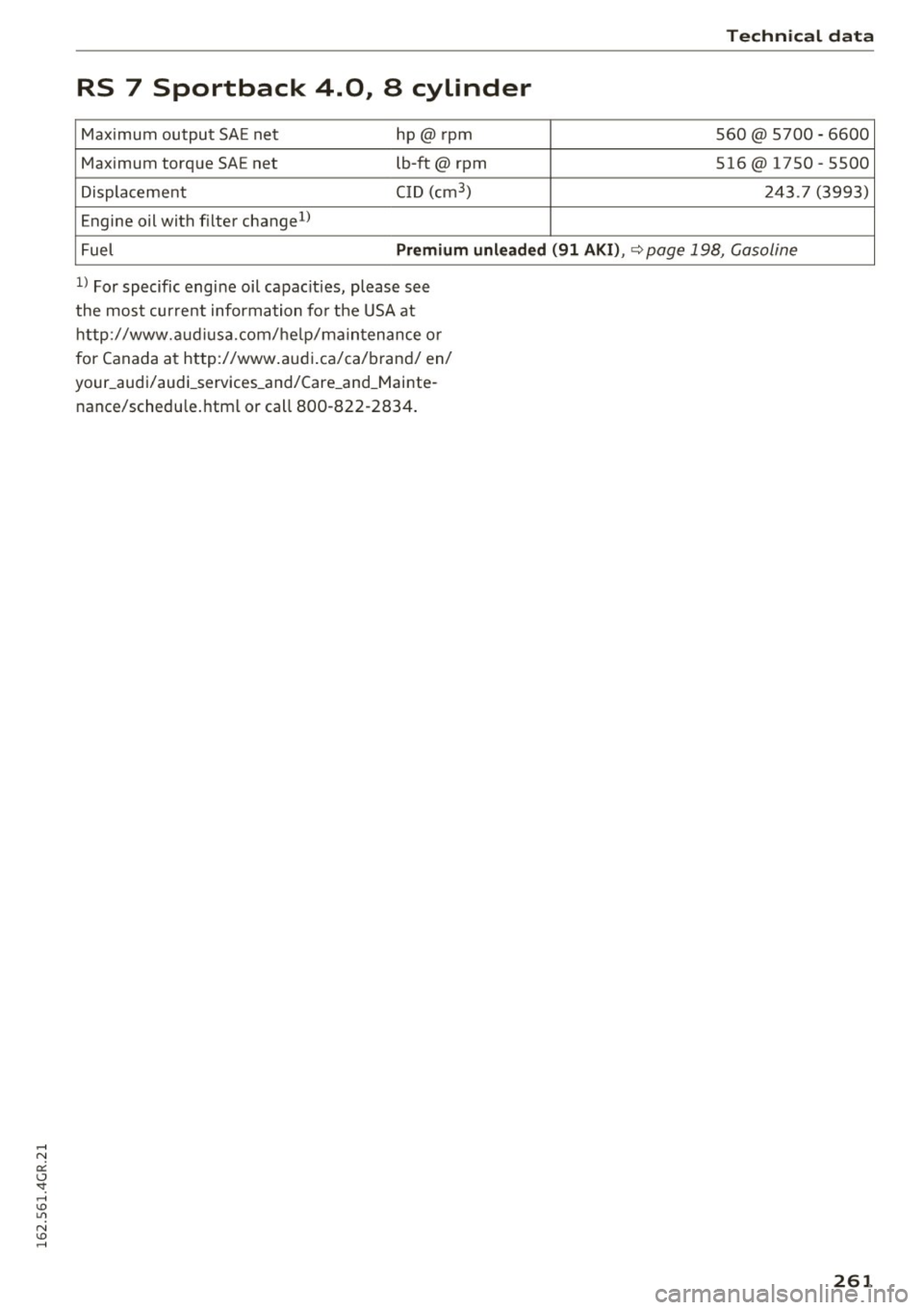
RS 7 Sportback 4.0, 8 cylinder
Maximum output SA E net hp@rpnn 560@ 5700 - 6600
Maximum torque SAE net lb-ft@ rpm 516@ 1750 -5500
Displacement CID (cm
3
) 243 .7 (3993)
Engine oil with filter change
1 )
Fuel Premium unleaded (91 AKI) , qpage 198, Gasoline
ll For specific engine oil capac ities, please see
the most current information for the USA at http ://www. audiusa.com/help/maintenance or
for Canada at http://www.audi.ca/ca/brand/ en/
your_audi/audi_services _and/Care _and _Mainte
nance/schedule.html or call 800-822-2834.
261
Page 264 of 282
Consumer information
Consumer information
Warranty coverages
Your Audi is covered by the following warran
ties:
- New Vehicle Limited Warranty
- Limited Warranty Against Corrosion Perfora-
tion
- Emissions Control System Warranty
- Emissions Performance Warranty
- California Emissions Control Warranty (USA
vehicles only)
- California Emissions Performance Warranty
(USA vehicles only)
Detailed information regarding your warranties
can be found in your
Warranty & Maintenance
booklet .
Operating your vehicle
outside the U.S.A. or
Canada
Government regulati ons in the United States and
Canada require that automobi les meet specific
emission regulations and safety standards.
Therefore, vehicles built for the U.S.A. and Cana
da differ from vehicles sold in other countries.
If you plan to take your vehicle outside the conti
nenta l limits of the United States or Canada,
there is the poss ibility that:
- un leaded fue ls for vehicles with catalytic con
verter may not be available;
- fuel may have a considerably lower octane rat
ing . Improper fuel may cause engine damage;
- service may be inadequate due to lack of proper
service facilities, tools or testing equipment;
- r eplacement parts may not be readily available.
- Nav igation systems for veh icles built for the
U.S .A . and Canada will not necessarily work in
Europe, and may not work in other countries
outside North America.
262
(D Note
Audi cannot be responsib le for mechanical
damage that could result from inadequate
f u el, service or parts ava ilability.
Audi Service Repair
Manuals and Literature
Audi Official Factory Service Manuals and Litera
ture are published as soon as poss ible after mod
el introd uction . Service manuals and literature
are available to order from the Audi Technical Lit
erature Ordering Center at :
www.audi.techliterature .com
Maintenance
General '
Your vehicle has been designed to help keep
maintenance requirements to a min imum. How
ever, a certain amount of regular maintenance is
still necessary to assure your vehicle's safety,
economy and reliability . For detailed vehicle
maintena nce consult your Warranty & Mainte
nance booklet .
Under difficult operating conditions, for exam
ple at extremely low outside temperatures, in
very dusty regions, etc., some se rvice work
should be performed between the intervals speci
fied. This applies particularly to:
- oil changes, and
- cleaning or replac ing the a ir filter .
@ For the sake of the environment
By regularly maintaining your vehicle, you
help make sure that emission standards are
maintained, thus min imizing adverse effects
on the environment.
Important considerations for you and your
vehicle
The increas ing use of elect ronics, soph istica ted
fuel injection and emission control systems, and
the genera lly increasing technica l complexity of
today's automobiles, have stead ily reduced the ..,_