ESP AUDI RS7 SPORTBACK 2016 Manual Online
[x] Cancel search | Manufacturer: AUDI, Model Year: 2016, Model line: RS7 SPORTBACK, Model: AUDI RS7 SPORTBACK 2016Pages: 282, PDF Size: 70.78 MB
Page 215 of 282
With certain types o f air bag dep loyment, the
battery is disconnected from the vehicle electri
cal system for safety reasons¢&.
in Repair, care
and disposal of the airbags on page 150 .
Disconnecting the battery terminals
Some vehicle func tions (power w indow re gula
t ors, for example) are lost i f th e battery termi
na ls are d isconnected . These functions have to be
relearned a fter the battery termina ls are con
nected aga in. To prevent th is, the batte ry s hou ld
only be disco nnected from the vehicle e lectr ica l
system w hen abso lut ely necessa ry for repairs.
Veh icles not driven for long periods
If yo u do not drive you r vehicle over a period of
seve ral days or weeks, e lectrical components a re
g radually c ut back or sw itched off. This reduces
e n ergy consumption and ma inta ins starting ca
pability over a longer period ¢
page 186. Some
of the co nvenience funct io ns m ay not o perate,
such as the i nter io r li ghts or powe r seat adjust
men t. T he conve nie nce func tions w ill be av aila ble
ag ain whe n you swi tch on the igni tion and start
the eng ine .
Winter operation
During the win ter mo nth s, ba ttery capaci ty te nds
to decr ease as temperatu res drop . T his is be
c a use more power i s als o c ons umed w hile s tar t
i ng, and t he he adlights, rear w indow de fogge r,
etc., a re used more o ften .
Avoi d unn ecess ary power consu mption, part icu
larl y in cit y tr affic or when traveling on ly sho rt
d is tan ces. Let yo ur au thori ze d Aud i d ealer che ck
the cap aci ty of the vehicle battery before w inte r
sets in ¢
pa ge 214 . A well charge d battery w ill
n ot on ly prevent start ing p roblems w hen the
weather is cold, but will also last longer .
(D Tips
If your ve hicle is left stand ing fo r severa l
weeks at extremely low tem peratures, the ve
hicle batte ry s hould be removed an d sto red
where it will not freeze. This will preve nt it
fro m being damaged an d hav ing to be re
placed.
Checking and Filling
Working on the battery
Be especially careful when working on or near
th e battery.
The battery is located in the luggage compart
ment under the floor. Befo re yo u check anything
i n the luggage compart ment ,
read and heed all
WARNINGS ¢&_ .
Always heed the safety warnings , when wor king
o n the veh icle batte ry or t he ve hicle elec trical
system to prevent in ju ry .
The following WARNINGS are very important
when working on the battery :
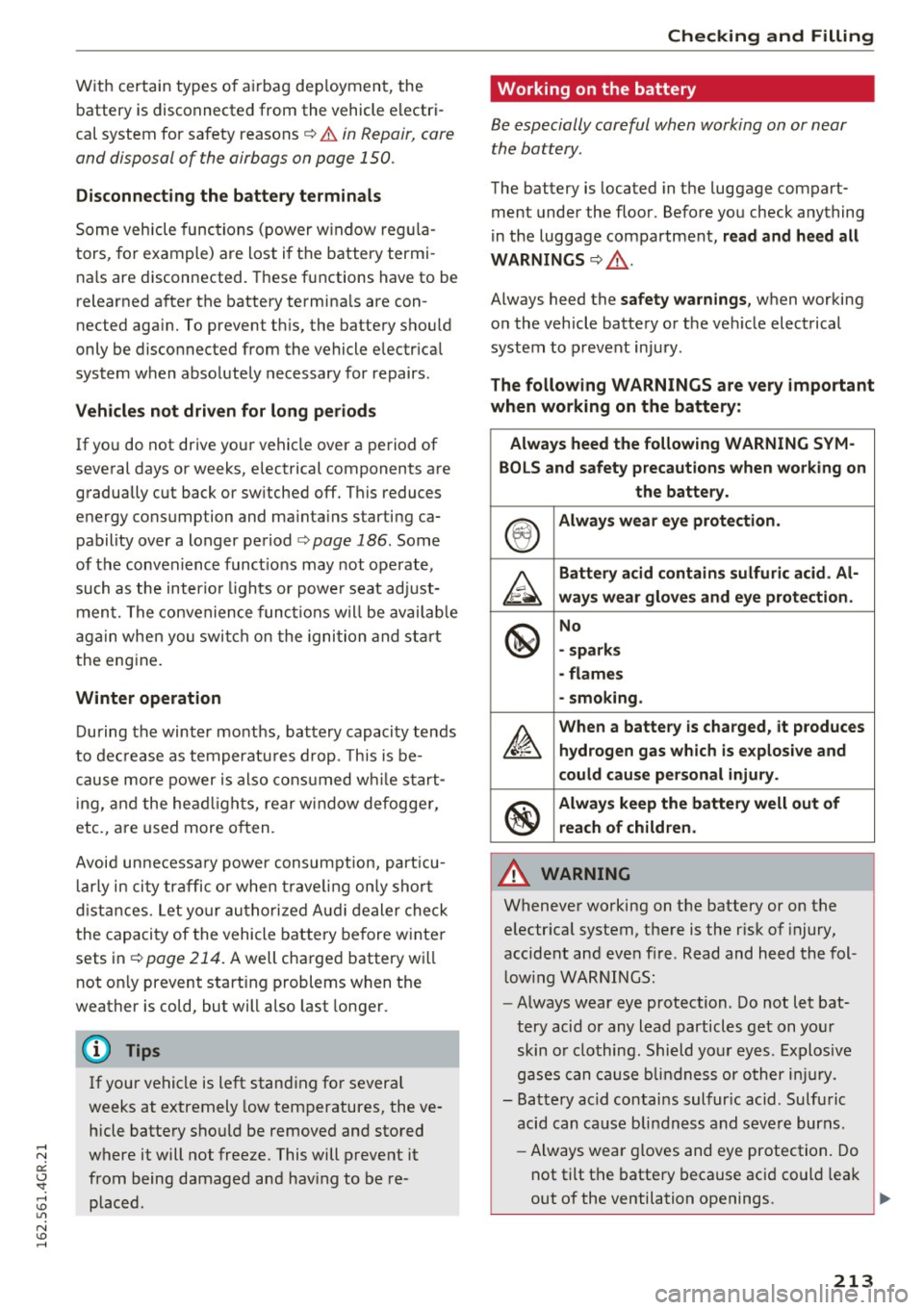
Always heed the following WARNING SYM-
BOLS and safety precautions when working on the battery.
®
Always wear eye protection .
~
Battery acid contains sulfuric acid . Al-
ways wear gloves and eye protection .
@
No
- sparks
- flames
· smoking .
~
When a battery is charged, it produces
hydrogen gas which is explosive and
could cause personal injury.
®
Always keep the battery well out of
reach of children .
A WARNING
=
Whenever working on t he battery or on the
e lectr ica l system, the re is the r isk of injury,
accide nt a nd eve n fire. Read and he ed the fol
l ow ing W AR NIN GS:
- Always wear eye prot ection. Do not let bat·
tery acid or any l ead particles g et on you r
skin o r clothing. Shield yo ur ey es. E xplosiv e
g ases can ca use b lindne ss or o ther in jury.
- Ba tte ry acid contai ns sulfur ic acid . Su lfu ric
acid can ca u se blindness and s evere burns.
- Always wea r gloves and eye protection . Do
n ot tilt t he batte ry because aci d could lea k
-
out of the ventilation openings. ""
213
Page 217 of 282
Always r ead and h eed all W ARNING S below
~ A. and
¢A. in Working on the battery on
page 213.
.,. Switch off the ignition and all electrica l con
sumers .
.,. Make sure the area is well venti lated when you
charge the battery.
.,. Open the engine hood
¢page 203.
.,. Open the red cover on the positive pole
¢fig . 188 .
.,. Connect the charger co nnectors according to
the instructions to the
j ump start bo lt s. (Bolts
under the red cover= "positive", Bolts with hex
head
= "negat ive") .
.,. Only now plug the mains lead for the charging
equipment into the wall outlet and turn it on
¢&_ .
.,. M ake s ure th e char ging rate is not o ver
30 amp s/14.8 Volt.
.,. When the battery is fully charged: Turn the
charg ing equipment off and remove the mains
lead from the wall outlet.
.,. Now remove the clamps for the charging equ ip-
ment.
.,. Close the red cover on the positive pole.
.,. Close the hood
¢ page 204.
A discharged battery can fre eze at temperatures
of only 32 F
0 (0 °C). A llow a frozen battery to
thaw comp lete ly before attempt ing to charge it
¢ ,&. However, we recommend not using a
thawed battery again because the battery casing
can be cracked due to ice formation and can leak
battery acid.
Battery chargin g (Ma ximum cha rging rate of
30 amp s/14 .8 Volt )
When charging at low voltages (e.g. with a trick
le cha rger ),
the battery cables do not have to be
d isconnected first. The battery caps should
not
be opened when charging a battery .
It is not necessary to remove the battery from
the luggage compartment, and it is also not nec
essary to disconnect the cables.
Check ing and Filling
Fast charging the batt ery (charging rate
ab ove 14.8 Volt )
For technical reasons do not use a battery charg
er that uses vo ltage greater than 14.8 Volt to
charge your vehicle's battery.
A WARNING
=
Charging a battery can be dangerous .
-Always follow the operating instructions
provided by the battery charger manufactur
er when charging your battery .
- Never charge a frozen battery. It may ex
plode because of gas trapped in the ice. Al
low a froze n battery to thaw out first .
- Do not reuse batter ies which were frozen.
The battery hous ing may have cracked and
weakened when the battery froze .
- Charge the battery in a well ventilated area.
Keep away from open flame or electrical
spark. Do not smoke . Hydrogen gas generat
ed by the battery is explos ive.
- To reduce the danger of explosion, never connect or d isconnect charge r cables while
the charger is ope rating .
- Fast charg ing a battery is dangerous and
should only be attempted by a competent
technicia n w ith the prope r equipment.
- Batte ry acid that may spill during charging
should be washed off w ith a so lution of
warm water and baking soda to neutra lize
t he acid .
{[) Note
Never use a fast charger as a booster to start
the e ngine. This will se riously damage sensi
tive electronic components, such as control
units, re lays, radio, etc., as well as the bat tery
charge r.
Battery replacement
The new battery must have the same specifica
tions and dimensions as the original equipment
battery .
Intelligent ene rgy manageme nt in yo ur vehicle is
responsib le for distr ib uting the electrica l energy
Iii>-
215
Page 218 of 282
Check ing and F illing
througho ut your vehicle ¢ page 186 . The intelli
gent energy management system wi ll keep the
engine battery charged better than veh icles with
out this system . To make sure the addit ional
electrical energy is avai lab le once again after you
have changed the battery, we recommend that
you install batter ies of t he same type and manu
facture on ly (the same as those insta lled at the
time your veh icle was delive red). Spec ificat ions
are listed on t he b attery housing. Your author
i z ed dealer must code the battery in the energy
management system to enable you to use the en
ergy manag ement functions correctly after re
p lacing the battery.
The new battery must have the same capac ity,
voltage (12 -vo lt), amperage, const ruction and
p lug sealing .
W hen insta lling the ba tte ry, make sure the igni
tion and all elec trical consumers are sw itched
off .
(D Note
Mak e sure the ve ntila tio n hose on t he side of
the batte ry is connecte d, othe rw ise f umes o r
battery acid can lea k out .
@) For the sake of the environment
Because of the prob lem of pr oper disposal of
a ba ttery, we recommen d your au thor ized
Audi dea le r change the battery fo r you. Bat
teries contain su lf u ric acid and lea d and must
always be disposed o f prope rly in comp liance
w ith all environmental regulations. D isposing
of vehicle batteries improperly is very danger
ous to the e nvironment.
216
Windshield washer
system
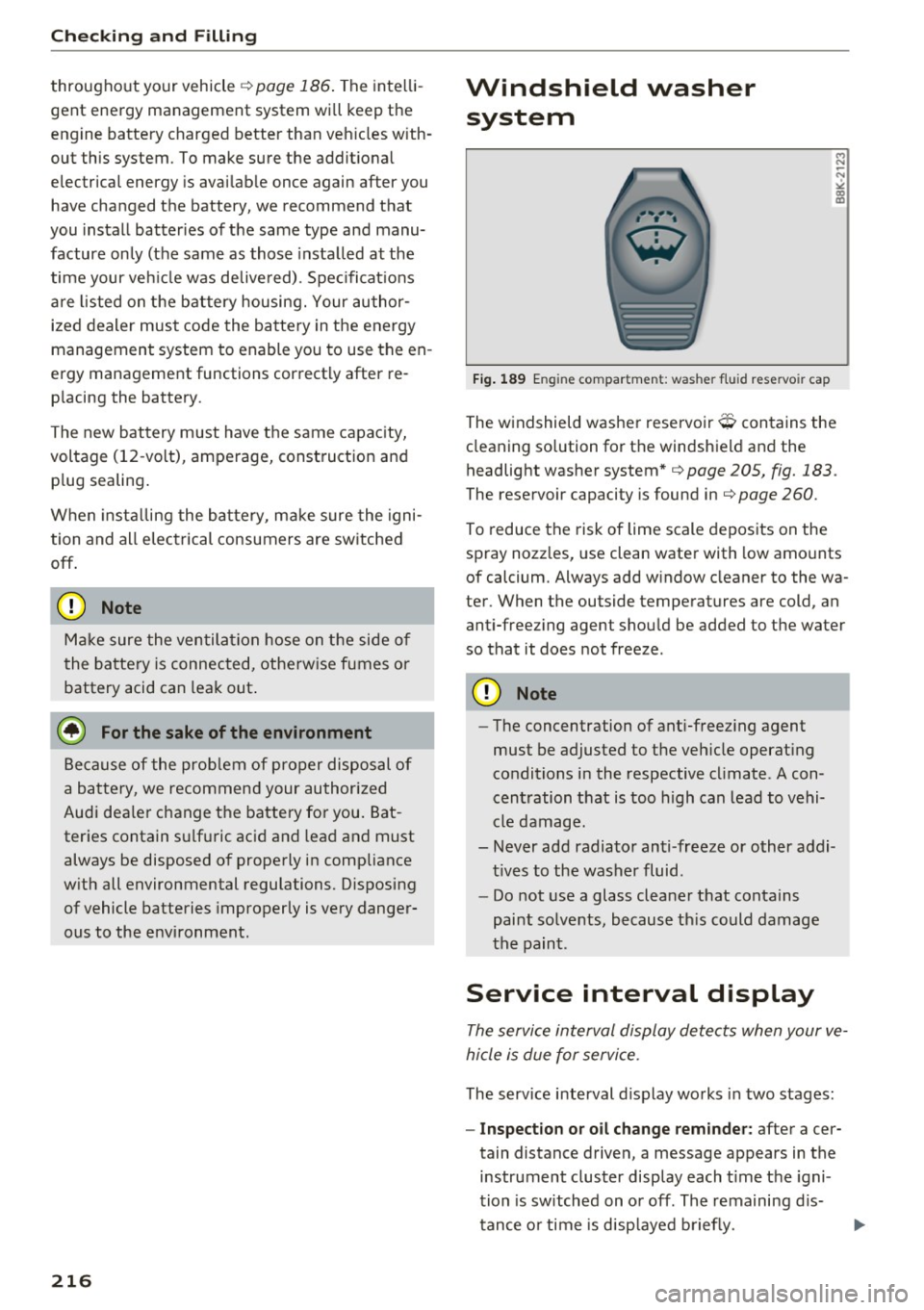
Fi g. 189 En gin e compar tm en t: was her flui d rese rvoir cap
.., N
-N ~ a, m
The w indshield washer reservoir O contains the
cleaning so lution for the windshie ld and the
headlight washer system *
9 page 205, fig. 183.
The reservoir capacity is found in 9 page 260 .
To reduce the risk of lime scale depos its on the
spray nozzles, use clean water with low amo unts
of calcium. Always add w indow cleaner to the wa
ter. When the outside temperatures are cold, an anti-freez ing agent shou ld be added to the water
so that it does not freeze .
(D Note
-The concentration of ant i-f reez ing agent
must be adjusted to the ve hicle operat ing
conditions i n the respective cl imate . A con
cen tration t hat is too high can lead to vehi
cle damage.
- Never ad d radia tor an ti-freeze or other addi
t ives to the washer fluid .
- Do not use a glass cleaner t hat contains
paint so lvents, because th is could damage
the pain t.
Service interval display
The service interval display detects when your ve
hicle is due for service .
The service interval d isplay wo rks i n two stages:
- Inspection or oil change rem inder: after a cer-
tain distance drive n, a message appears in the
instrument cluster display each t ime t he igni
tion is switched on o r off . The remaining d is-
t ance o r time is disp layed b riefly. .,..
Page 219 of 282
-Inspection or oil change due: If your vehicle
has reached an inspection or oi l change interval
or both intervals at the same time, the mes
sage
Inspection due! or Oil change due! or Oil
change and inspection due!
appears briefly af
ter switching the ignition on/off .
Checking service intervals
You can check the remaining distance or time un
til the next oil change or next inspection in the
Car menu. To do this, select: the
ICARI function
button
> (Car)* Systems control button > Service
& control > Service intervals.
Resetting the indicator
Your authorized Audi dealer or authorized Audi
Service Facility will reset the service interval dis
p lay after performing service.
I f you have changed the oil you rself, you must re
set the oil change interval.
To reset the indicator, select: the
ICARI funct ion
button
> (Car)* Systems control button > Service
& control > Service intervals. Turn the contro l
knob downward to
Reset oil change interval and
press the control knob.
@ Note
-Only reset the oil change indicator if the oil
was changed .
- Following the service inte rvals is critical to
maintain ing the service life and va lue of
your vehicle, especially the engine . Even if
the mileage on the vehicle is low, do not ex
ceed the time for the next serv ice.
- Calcu lating the time to the next o il change
i s interrupted when the vehicle battery is
disconnected. If the veh icle is not driven for
a long period of time, check the ma inte
nance schedule so that you can follow the
maintenance intervals.
Checking and Filling
217
Page 222 of 282
Wheels
happy to provide more informa
tion .
® Mud and snow capability
"M/S" or "M+S" indicates the tire
has characteristics that make it
suitab le for driving on mud and
snow .
& indicates a winter t ire .
@ Compos ition of the tire cord
and materials
The number of plies indicates the
number of rubberized fabric lay
ers in the tire . In general: the
more layers, the more weight a
tire can carry. Tire manufacturers must also specify the materia ls
used in the tire . These include
steel, nylon, polyester and other
materials .
@ Maximum permitted load
This number indicates the maxi
mum load in k ilograms and
pounds that the tire can carry.
@ Uniform tire quality grade
standards for treadwear,
traction and temperature
resistance
Treadwear, traction and tempera
ture ranges
c::> page 234 .
@ Running direction
The arrows indicate the running
direction of unidirec tiona l tires.
220
You must a lways follow the speci
fied runn ing direction
c::> page 247.
@ Maximum permitted
inflation pressure
This number indicates the maxi
mum pressure to which a tire can be inflated unde r normal operat
ing condit ions .
Glossary of tire and loading
terminology
Accessory weight
means the comb ined we ight (in
excess of those standard items
which may be replaced) o f auto
matic tra nsmission , power steer
ing , power brakes , power wi n
dows, power seats , radio , and
heater, to the extent that these
items a re available as facto ry-in
stalled equipment (whet her in
stalled or not).
Aspect ratio
means the rat io of the height to
the width o f the tire in pe rcent.
Numbe rs of 55 or lower indicate a
low sidewa ll for imp roved steer
ing response and better overa ll
handling on dry pavement .
...
Page 227 of 282
Occupant loading and distri
but ion for vehicle normal load
for various design ated se ating
c a pa cit ies
Refer to the tire inflation pres
sure label ¢
page 228, fig. 193
for the number of seating posi
tions. Refer to the table ¢
table
on page 230
for the number of
people that correspond to the ve
hicle normal load.
New tires or wheels
Audi recommends having all work
on tires or wheels performed by
an authorized Audi dealer or au
thorized Audi Service Facility .
These facilities have the proper
knowledge and are equ ipped with
the required tools and replace
ment parts .
.,,. New tires do not yet have the
opt imum adhesion properties.
Drive carefully and at moderate
speeds for the first 500 km w ith
new tires.
... use tires of the same construc
tion, size (rolling circumference)
and the same tread pattern on
all four wheels.
;;:: .,,.Do not replace tires individually .
oi
~ At least replace both tires on the ....
~ same axle at the same time. N
"' ....
Wheels
.,,.Audi recommends that you use
Audi Original equipment tires. If
you would like to use different
tires, please note that the tires may perform differently even if
they are the same size ¢
A-
.,,. If you would like to equip your
vehicle w ith a tire/r im combina
tion that is different from what
was installed at the factory, con sult with an authorized Audi
dealer or authorized Aud i Service
Facility before making a pur
chase¢
A -
All four wheels must be equipped
with tires that are the same brand
and have the same construction
and tread pattern so that the
drive system is not damaged by
different tire speeds. For this rea
son, in case of emergency, only use a spare tire* that is the same
circumference as the regular
tires.
,& WA RNING -
-Only use tire/rim combina
tions and suitable wheel bolts
that have been approved by Audi. Otherwise, damage to
the vehicle and an accident could result .
225
Page 229 of 282
... N oi '-' ":
running across the tread. Marks
on the tire sidewall (for example "TWI" or other symbols) indicate
the positions of the tread wear in
dicators.
The tires have reached the mini mum tread depth
l ) when they
have worn down to the treadwear
indicators . Replace the tires with
new ones
¢ ,1,. .
Wheel rotation
Rotating the wheels regularly is
recommended to ensure the tires
wear evenly. To rotate wheels, in
stall the wheels from the rear
axle on the front axle and vice
versa. This will allow the tires to
have approximately the same
length of service life.
For unidirectiona l tires, make
sure the tires are installed accord
ing to the running direction indi
cated on the tire sidewall
¢page 247 .
Hidden damage
Damage to tires and rims can of
ten occur in locations that are hidden. Unusual vibrations in the
vehicle or pulling to one side may
~ l) Obey any applicable regulations in your
~ country . ...
Wheels
indicate that there is tire damage.
Reduce your speed immediately.
Check the tires for damage. If no
damage is visible from the out
side, drive slowly and carefully to
the nearest authorized Audi deal
er or authorized Audi Service Fa
cility to have the vehicle inspect
ed.
&_ WARNING
-
Tread that has worn too low or
different tread depths on the
tires can reduce driving safety.
This can especially have a nega tive effect on handling, on the
risk aquaplaning when driving
through water, when driving
through curves and when brak ing, which increases the risk of
an accident.
227
Page 236 of 282
Wheels
(D Tips
When using snow chains, it may be useful to
sw itch on sport mode
¢ page 181.
Low aspect ratio tires
Your Aud i is factory-equipped with low aspect ra
tio tires. These tires have been thoroughly tested
and been selected specifically for your model fo r
thei r supe rb perfo rmance, road feel and handling
unde r a va riety of d riving conditions . As k yo ur au
thor ized Audi dealer for mo re de tails.
The low aspect ratio of these t ires is indicated by
a nume ra l of
55 or less in the tire's size desig na
tion . The nume ra l rep resents the rat io of t he
tire 's sidewall he igh t in relat io n t o it s tread w idth
e xpresse d in percen tage. Convention al ti res have
a height/w idth ratio o f 60 o r more .
The performance of low -aspect-ratio tires is par
ticularly sensitive to improper inflation pres
sure. It is therefore important that low a spect
ratio tires are inflated to the specified pre ssure
and that the inflation pressure is regularly
checked and maintained. Tire pressures should
be checked at le ast once a month and alwa ys
before a long trip¢
page 228.
What you can do to avoid tire and rim
damage
Low aspect rat io tires can be damaged more easi
ly by impact with potholes, curbs, gullies or
ridges on the road, pa rt icu la rly if the t ire is un
de rinflated.
In order to minimize the occurrence of impact
damage to the t ires of your ve hicle, we recom
mend that you observe the fo llow ing precau
tions:
- Always maintain recommended inflation pres
su res . Check your tire pressure every 2,000
miles (3,000 km) and add air if necessary .
- Drive caref ully on roads with potho les, deep
gul lies or r idges . The impact from drivi ng
through or over s uch obstacles can damage
you r tires. Im pact with a cu rb may also cause
damage to you r tires .
234
-After any impact, immed iate ly inspect you r
tires or have them inspected by the nearest au
thorized Aud i dealer. Replace a damaged tire as
soon as possible.
- Ins pect your tires every 2,000 mi les (3,000 km)
for damage and wear . Damage is not always
easy to see . Damage can lead to loss of a ir and
underinfla tion, w hich could even tua lly cause
tire fa ilure . If yo u be lieve that a tire may have
been damaged, replace the tire as soon as pos
sible.
- These tires may wear mo re quickly than others .
- Please also remember that, while t hese tires
delive r responsive hand ling, they may ride less
comforta bly and make mo re noise than o ther
choi ces.
Reduced performance in winter/cold season
conditions
A ll ti res are des igned for certain purposes. The
l ow aspect ratio, ultra h igh performance tires
o rigina lly ins talled on your veh icle are inten ded
f o r m ax imu m dr y and wet ro ad perfo rma nce and
handling . They a re not sui table for co ld, snowy or
i cy weather conditions . If yo u drive under those
c ir cu mstances, you should equip yo ur vehicle
with all-season o r winter tires, which offer better
tract ion under t hose conditions. We suggest you
use the recommended snow or a ll-season tires
spec ified for your vehicle, o r th e ir equiva le nt.
Re fer to
c:> page 233 for more detailed in forma
tion regard ing winter tires.
Uniform tire quality grading
- Tread wea r
- Tract io n AA AB C
- Tempe rature ABC
Quali ty g rades can be fo und whe re appli cab le on
t h e tire side wall between tread shou lder and
max imum section width
¢ page 218, fig. 190 .
For example : Tread wear 200 , Traction AA , Tem
per atu re
A .
All passenge r ca r tir es mus t conform to Fede ral
Safety Req uiremen ts in add it io n to these grades . ..,.
Page 237 of 282
Tread wear
The
tread wear grade is a comparative rating
based on the wear rate of the tire when tested
under controlled conditions on a specified gov
ernment test course.
F or example, a t ire graded 150 would wear one
and one half (11/2) times as well on the govern
ment course as a tire graded 100 .
The relative performance of tires depends upon
the actual conditions of their use, however, and
may depart significantly from the norm due to
variations in driving habits, service practices and
differences in road characteristics and climate .
Traction
The
traction grades, from highest to lowest, are
AA, A, Band
C. Those grades represent the tire's
ability to stop on wet pavement as measured un
der controlled conditions on specified govern ment test surfaces of asphalt and concrete. A tire
marked C may have poor traction performance
¢ .&, .
Temperatur e
The
temperature grades are A (the highest), B,
and C, representing the tire's resistance to the
generation of heat and its ability to dissipate heat when tested under controlled conditions on
a specified indoor laboratory test wheel.
Sustained high temperature can cause the mate rial of the tire to degenerate and reduce tire life,
and excessive temperature can lead to sudden
tire failure
c:> .&, .
The grade C corresponds to a level of perform
ance which all passenger car tires must meet un
der the Federal Motor Vehicle Safety Standard No. 109. Grades Band A represent higher levels
of performance on the laboratory test wheel than
the minimum required by law.
A WARNING
-
The traction grade ass igned to this tire is
based on straight-ahead braking traction
tests, and does not include acceleration, cor
nering, hydroplaning or peak traction charac
teristics.
Wheels
A WARNING
The temperature grade for this tire is estab lished for a tire that is properly inflated and
not overloaded. Excessive speed, underinfla
tion, or excessive loading, either separately or
i n comb inat ion, can cause heat buildu p and
possible tire failure.
A WARNING
-
-
Temperature grades apply to tires that are
properly inflated and not over or underinflat
ed.
Tire pressure monitoring system
ill General notes
Each tire, including the spare (if provided),
shou ld be checked monthly when cold and inflat
ed to the inflation pressure recommended by the
vehicle manufacturer on the vehicle placard or
tire inflation pressure label. (If your vehicle has
tires of a different size than the size indicated on
the vehicle placard or tire inflation pressure la
bel, you should determine the proper tire infla
t ion pressure for those tires).
As an added safety feature, your vehicle has been equipped with a tire pressure monitor ing system
(TPMS) that illuminates a low tire pressure tell
tale when one or more of your tires is significant ly under -inf lated. Accordingly, when the low t ire
pressure telltale illuminates, you should stop and
check your tires as soon as possib le, and inflate
them to the proper pressure . Driving on a signifi
cant ly under-inflated tire causes the tire to over
heat and can lead to tire failure. Under-inflation
also reduces fue l efficiency and tire tread life,
and may affect the vehicle's handling and stop
ping ability .
Please note that the TPMS is not a substitute for
proper tire maintenance, and it is the driver's re
sponsibility to maintain correct tire pressure,
even if under-inflation has not reached the level
to trigger illumination of the TPMS low tire pres-
sure telltale . .,.
235
Page 238 of 282
Wheels
Your vehicle has also been equipped with a TPMS
malfunction indicator to indicate when the sys
tem is not operat ing properly . The TPMS mal
function indicator is combined with the low tire pressure telltale. When the system detects a
malfunction, the telltale will flash for approxi
mately one minute and then remain cont inuously
illum inated . This sequence will continue upon
subsequent veh icle start-ups as long as the ma l
function ex ists .
When the malfunct io n indicator is illuminated,
the system may not be able to detect or signal low tire pressu re as intended . TP MS ma lfunctions
may occur for a variety of reasons, including the
installation of replacement or alternate ti res or
wheels on the vehicle that prevent the TPMS
from functioning properly. A lways check the
TPMS malfunction telltale after replacing one or
more tires or wheels on your vehicle to ensure
t hat the replacement or alternate tires and
wheels allow the TPMS to continue to function
properly.
Description
The tire pressure monitoring system monitors
the pressure in the four tires when driving .
The system uses sensors that measure the tem
perature and pressure in the tires. The data is
sent from these sensors to the control module by
radio frequency .
The tire pressure monitoring system shows the current pressures and temperatures of the tires in the Infotainment system
c.>page 236. It also
compares the current t ire pressures with the
stored tire pressures and gives a warning in the
driver information system if the tire pressure is
d ifferent from what is stored¢
page 237.
The system does not detect if the stored t i re
pressures match the recommended tire pres
sures. You must resave the tire pressures
c.> page 23 7:
-every time the tir e pressures change, for exam
ple when the load in the vehicle changes,
- after replac ing a tire, or
- if wheels with new wheel sensors are used .
236
A WARNING ,_
- The tire pressure monitoring system ass ists
the dr iver in monitoring tire pressures. The
driver is responsible for having the tires in
flated to the correct pressure.
- Do not change the t ire pressure when the
temperature of the tire is high . This could
result in serious damage to the tire and
even cause the tire to burst, increasing the
ris k of an accident.
- A tire with low pressure flexes more. This
heats the tire up too much. This could cause
the tread to separate and even cause the
tire to burst, increasing the risk of an acci
dent .
- The tire pressure monitoring system does
not warn about damage or defects in the
tire construction that could cause the tire to burst, for example. Inspect your t ires regu
larly.
@ Tips
- If tires are replaced, the sensors/va lves do
not need to be removed or replaced. Just re
placed the va lve stem and, if necessary, the
valve and the wheel electronics. If you have
questions, see your authorized Audi dealer
or authorized Audi Service Facility.
- An incorrect display or a malfunction in the
tire pressure monitoring system can occur
after using the tire mobility kit. Have the
sensors rep laced by an authorized Audi
dealer or authorized Audi Service Facility.
Display tire pressures/temperatures
Requirement: the ignition must be switched off.
.,. Select: the
I CARI funct ion button > Car systems
> Service & control > Tire pressure monitor >
Display tire pre ssure .
The current tire pressures are shown in green and
yellow numbers in the Infotainment system:
-green: the current tire pressure and the spec i
fied tire pressure are approx imately the same .
-yellow: the current tire pressure is too low
compared to the spec ified t ire pressure .