ESP AUDI RS7 SPORTBACK 2016 Manual PDF
[x] Cancel search | Manufacturer: AUDI, Model Year: 2016, Model line: RS7 SPORTBACK, Model: AUDI RS7 SPORTBACK 2016Pages: 282, PDF Size: 70.78 MB
Page 188 of 282
Intelligent Technology
Audi dealer immediately to have the malfunction
corrected. The color of the indicator light depends on the vehicle speed.
_& WARNING
-
Driving at higher speeds without the rear
spoiler deployed can impair handling charac
teristics, making the vehicle harder to con
trol.
- Always make sure that the spoiler is de
ployed when driving at speeds over 85 mph
(140 km/h) . If the rear spoiler warning/indi
cator light in the instrument cluster comes
on, the rear spoiler may not have deployed.
- Never drive at speeds higher than 85 mph
(140 km/h) if the spoiler is not deployed .
Have the spoiler inspected as soon as possi
ble by an authorized Audi dealer or qualified
workshop.
- Always obey speed limits and other traffic
laws.
_& WARNING
Improper operation of the rear spoiler can
cause crushing injuries.
- Always make sure that nobody, especially
children, is in the way when the rear spoiler
is deployed or retracted.
@) Note
- Never push on the vehicle on the rear spoil
er . This could cause damage.
- To prevent damage to the rear spoiler do
not lean or place anything on it.
-
- Only operate the rear spoiler manually when
the luggage compartment lid is close and
the rear spoiler moving parts are not
blocked. Otherwise, damage could occur.
(D Tips
Clean the rear spoiler compartment every 2 to
3 months. To function correctly, the rear
spoiler must be free of ice, snow and leaves.
186
Energy management
' The starting ability is optimized
The energy management system manages the
electrical energy distribution and optimizes the
availability of electrical energy for starting the
engine.
When a vehicle with a conventional energy sys
tem is not driven for a long time, the battery is
drained by equipment (for example the immobil
izer). In certain circumstances , there could may
not be enough energy to start the engine .
Your vehicle is equipped with an intelligent ener
gy management system for distributing electrici
ty. This significantly improves the starting ability
and increases the battery life.
The energy management system Is made up of
battery diagnosis , idling current management
and dynamic energy management.
Battery diagnosis
The battery diagnosis determines the battery charge level. The sensors detect the battery, the
battery current, and the battery temperature .
The current charge level and the performance of
the battery are determined based on this.
Idling current management
The idling current management decreases the
energy used while parked . With the engine
switched off, it manages the energy distribution
to the different electrical components. Date from
battery diagnosis is taken into account for this.
Depending on the battery charge level, electrical
equipment is switched off one item after the oth
er, to prevent the battery from draining and to
retain the starting ability.
Dynamic energy management
While driving, dynamic energy management dis
tributes the appropriate amount of energy to the
electrical equipment .
It controls the battery
charge level so that more energy is not used then
is being generated in order to maintain an opti-
mal battery charge level.
ll>
Page 190 of 282
Driving and the environment
Driving and the
environment
Breaking in
New engine
The engine needs to be run-in during the first
1,000 miles (1,500 km).
For the first 600 miles (1,000 kilometers):
.,. Do not use full throttle .
.,. Do not drive at engine speeds that are more
than 2/3 of the maximum permitted RPM .
.,. Avo id high engine speeds.
From 600 to 1,000 miles (1,000 to 1,500
kilometers):
.,. Speeds can gradually be increased to the maxi
mum perm issib le road or engine speed.
During and after break-in period
.,. Do not rev the engine up to high speeds when it
is cold . This applies whether the transmission is
i n N (Neutral) or in gear .
After the break-in period
.,. Do not exceed maximum engine speed under
any circumstances.
.,. Upshift into the next higher gear
before reach
i ng the red area at the end of the tachometer
scale~
page 10 .
During the first few hours of driving, the engine's
internal friction is higher than later when all the
mov ing parts have been broken in. How well this
break- in process is done depends to a considera
b le extent on the way the vehicle is d riven during
the first 1,000 miles (1,500 kilometers).
(D Note
Extremely high engine speeds are automati
cally reduced. However, these rpm lim its are
programmed for an engine we ll run-in, not a
new engine .
188
® For the sake of the environment
Do not drive with unnecessarily high engine
speeds -upshifting early saves fuel, reduces
noise and protects the environment.
New tires
If your vehicle is running on new tires, drive par
ticularly careful for the first 350 m iles (500 kilo
meters) after f itting .
.8, WARNING
New tires tend to be slippe ry and must also
be "broken-in". Be sure to remember this dur
ing the first 350 mi les (500 kilometers).
Brake gent ly. Avoid following closely behind
other ve hicles or other situations that might
require sudden, hard braking.
Avoid damaging the
vehicle
When you are driving on poor roads, or over
curbs, steep ramps, etc., make certain that low
lying parts such as spo ilers and exhaust system
parts do not bottom out and get damaged .
-
This is especially true for vehicles with low-slung
chassis (sports chassis)* and fully loaded
vehicles.
Driving through water on
roads
Note the following to avoid vehicle damage when
driving through water, for examp le on flooded
roads:
- The water must not be any highe r than the bot
tom of the vehicle body.
- Do not drive faster than walk ing speed .
.8, WARNING
After driving through water or mud, the brak
ing effect can be red uced due to moisture on
the brake discs and brake pads . A few careful
brake applications should dry off the brakes.
Page 193 of 282
Avoid full throttle
Driving at moderate speeds saves fuel and im
proves your mileage.
11-Try and keep well below your car's maximum
speed.
Accelerating gently reduces fuel consumption, engine wear, and does not disturb the environment.
Fuel consumption, exhaust emissions and engine
noise increase disproportionately at high speeds.
If you drive at approximately three quarters of
top speed, fuel consumption will be reduced by
one half. Never drive faster than the posted
speed limit and weather conditions permit.
Reducing unnecessary idling
Even when your car is just idling i t burns up fuel.
11-Shut the engine off when you are not driving
the vehicle.
11-Do not warm up the vehicle by letting the en-
gine run at idle .
It makes sense to shut off the engine in traffic
jams, when waiting for trains to pass at railroad crossings, or at traffic lights that have long waits
on red . Turning the engine off for just 30-40 sec
onds saves more fuel than is burned starting the
. . engine again.
It takes a long time for the engine to warm up
fully when it is running at idle. However, wear
and noxious emissions are especially high when
the eng ine is warm ing up. So you should drive
away as soon as you start the engine and avoid
running at high rpms while the engine is still
warming up.
CD Note
Do not leave engine idling unattended after
starting.
If warning lights should come on to
indicate improper operation, they would go
unheeded. Extended idling also produces
heat, which could result in overheating or
other damage to the vehicle or other proper
ty.
Driving and the environment
Regular maintenance
A badly tuned engine unnecessarily wastes a lot of fuel .
11-Have your vehicle serviced at regular intervals.
By having your vehicle regularly serviced by an
Audi dealer helps to ensure that it runs properly and economically. The condition of your vehicle
not only affects its safety and ability to hold its
value, it also affects
fuel consumption .
Check your oil each time you fill your tank.
The amount of oil used is related to engine load
and speed.
It is normal for the oil consumption of a new en
gine to reach its lowest value after a certain mile
age has been driven.
You must drive your vehicle about 3,000 miles (5,000 kilometers) before you can properly as
sess oil consumpt ion.
This also applies to fuel consumption and eng ine
output .
CD Note
-Have your vehicle maintained properly and
in accordance with the service recommenda
tions in your Warranty
& Maintenance book
let. Lack of proper maintenance as wel l as
improper use of the vehicle w ill impair the
function of the emission control system and
could lead to damage.
- Do not alter or remove any component of
the Emission Control System unless ap
proved by the manufacturer .
- Do not alter or remove any device, such as
heat shields, switches, ignition wires,
valves, which are designed to protect your
vehicle's Emission Control System and other important vehicle components.
Fewer short trips
Fuel consumption will always be relatively high
on short trips .
11-Try to avoid driving short distances with a cold
engine. .,.
191
Page 195 of 282
Care and cleaning
General information
Regular, proper care helps to maintain your vehi
cle's value. It can a lso be a requirement when
submitting warranty claims for corrosion damage
and paint defects on the body.
The necessary care products can be obtained
from your authorized Audi dealer or authorized
Audi Service Facility . Read and follow the instruc
tions for use on the packaging.
A WARNING
- Us ing clean ing and care products incorrectly
can be dangerous to your health.
- Always store clean ing and care products out
of reach of children to reduce the r isk of po i
soning .
@ For the sake of the environment
- Preferably use environmentally-friendly
products when buying cleaning agents.
- Do not dispose of leftover cleaning and care
products with household trash.
Car washes
The longer that deposits remain on the vehicle,
the more the surface may be damaged. High
temperatures such as those caused by sunlight increase the damag ing effect.
Befor e washing, rinse
off heavy depos its with
p lenty of water.
S tubborn depos its such as bird droppings or tree
sap are best removed with plenty of water and a
microfiber cloth.
A lso, wash t he underside of yo ur vehicle once
road sa lt stops being used for the season .
Pressure washers
When washing your ve hicles w ith a pressure
washer, always follow the ope rating inst ructions
p rovided w ith the pressure washe r. This is espe
cially important in regard to the pressu re and
sp raying distance. Do not a im the spray directly
at seals on side windows, doors, the hood, the
Ca re and cleaning
rea r lid or the s unroo f* or at tires, rubber hoses,
insulating material, sensors* or camera lenses* .
Keep a d istance of at least 16 inches (40 cm) .
Do not remove snow and ice with a pressure
washer.
Never use rota ry nozzles or high pressure noz
zles.
T he water temperatu re must not be above 140 °F
(60 °C).
Automatic car washe s
Spray off the vehicle before washing.
Make s ure that the windows and roo f* are closed
and the windshield wipers are
off . Follow instruc
tions from the car wash operator, especially if
there are accessories attached to your vehicle.
If possible, use car washes that do not have
brushes .
Only use car washes where the veh icle remains
sta tiona ry and the washing equipment moves
around the vehicle when washing and drying . Car
washes that move the vehicle through the car
wash using a chain are not recommended .
Washing by hand
Clean the vehicl e s tarting from the top and wor k
ing down using a soft sponge or cleaning br ush.
Use solvent -free cleaning products.
Washing vehicles with matte finish paint by
hand
To avo id damaging the pa int when washi ng, first
remove dust and large pa rticles from you r vehi
cl e. Insects, grease spo ts and fingerpr ints are
best removed w ith a special clea ner fo r matte
finish paint.
Apply t he product using a microfiber cloth . To
avo id damag ing the pa int surfa ce , do not use too
much pressure .
Rinse the vehicle thoroughly w ith wate r. Then
clean using a neutral shampoo and a soft mic ro-
fiber cloth. .,..
193
Page 197 of 282
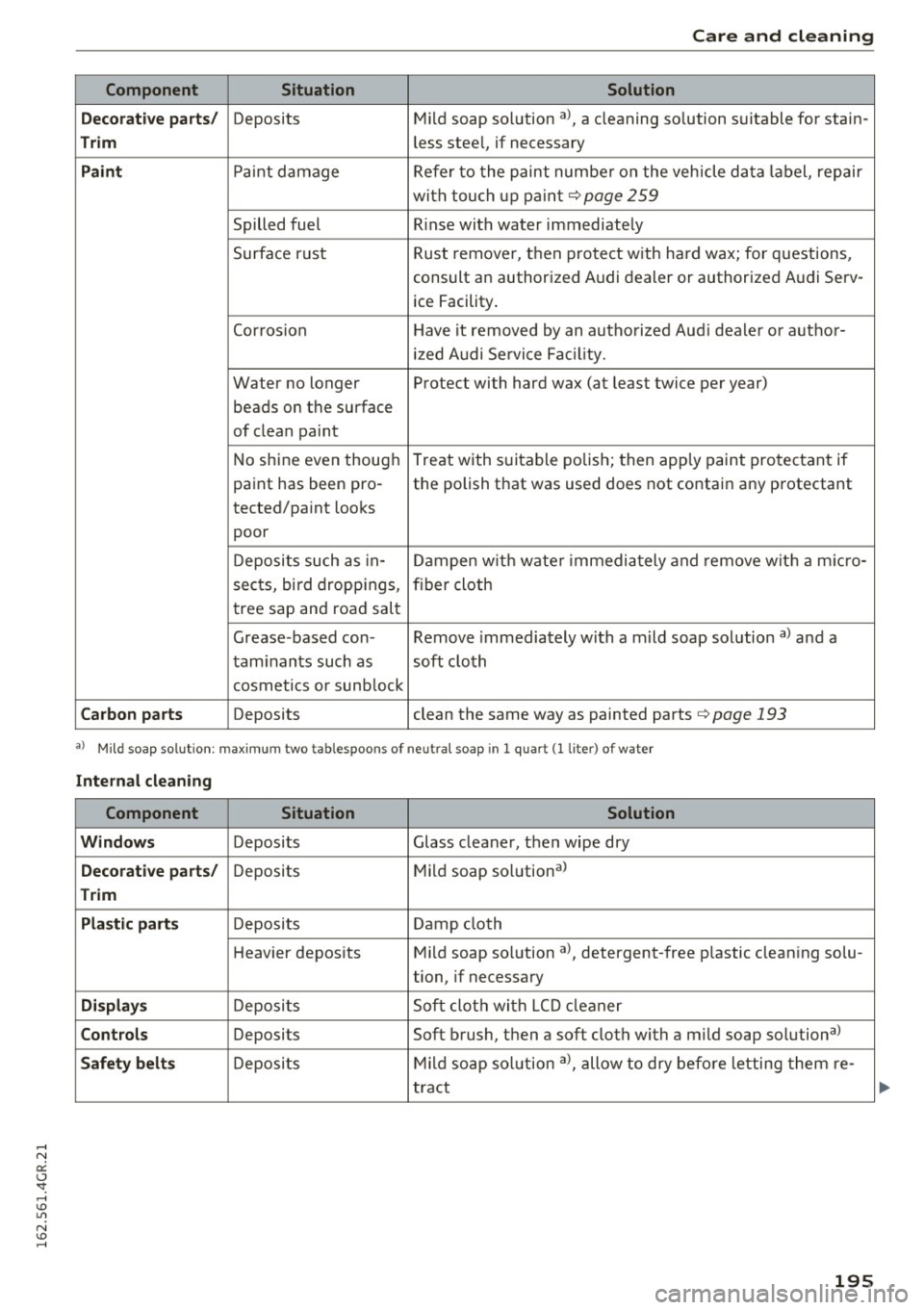
Care and cleaning
Component Situation Solution
Decorati ve parts/
Deposits Mild
soap solution al, a cleaning so lution suitable for stain-
Trim less stee l, if necessary
Paint Pain t damage Refer to the paint number on the veh icle data label, repair
with touch up paint
q page 259
Spilled fuel Rinse with water immediately
Surface rust Rust remover,
then protect with hard wax; for questions,
consult an authorized Audi dealer or authorized Audi Serv- ice Facility.
Corrosion Have it removed by an authorized Aud i dealer or author-
ized Audi Se rvice Fac ility.
Water no longer Protect with hard wax (at least twice per year) beads on the surface
of clean paint
No shine even though Treat with suitable
polish; then apply paint protectant if
paint has been pro -the polish that was used does not contain any protectant
tected/paint looks
poor
Deposits such as in-Dampen with wate r immediately and remove wit h a m icro -
sects, bird droppings, fiber cloth
tree sap and road salt
Grease -based con- Remove immediately with a mild soap solution al and a
taminants such as soft cloth
cosmetics or sunb lock
Carbon parts Deposits clean the same way as painted parts q page 193
a) M ild soap so lu tio n: maxim um two ta blespoons of ne utra l s oap in 1 quar t (l li te rl of water
Internal cleaning
Component Situation Solution
Windows
Deposits Glass cleaner, then wipe dry
Decorative parts/ Deposits Mild
soap solution al
Trim
Plastic part .s
Deposits Damp cloth
Heavier deposits Mild soap solution al, detergent-free p lastic clean ing solu-
tion, if necessary
Displays Deposits Soft cloth with LCD cleaner
Controls Deposits Soft brush, then a soft cloth with a mild soap solutional
Safety belts Deposits Mild
soap solution al, allow to dry before letting them re-
tract
195
Page 198 of 282
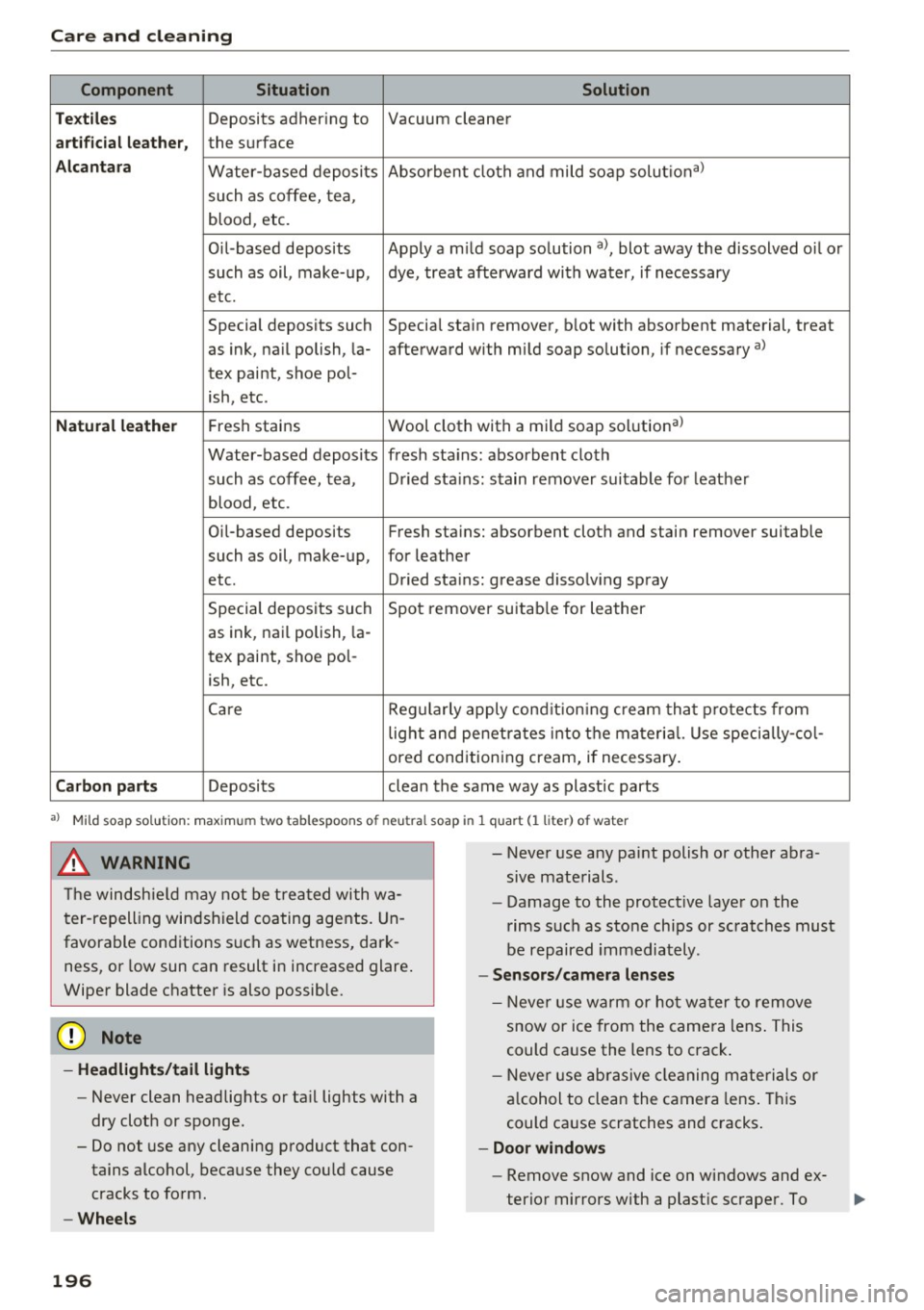
Care and cleaning
Component Situation Solution
Te xtil es
Deposits adhering to Vacuum cleaner
a rt ifici al le ather , the surface
Alcant ara Water-based deposits Absorben
t cloth and mild soap solutiona>
such as coffee, tea,
blood, etc.
O il-based deposits Apply a m ild soap solution a), blot away the dissolved oil or
such as oil, make-up, dye, treat afterward with water, if necessary
etc.
Special deposits such Special stain remover, b lot with absorbent material, treat
as ink, na il polish, la- afterward with mild soap solution, if necessary a)
tex paint, shoe pol-
ish, etc.
Natural leather Fresh stains Wool cloth with a mild soap so
lutiona)
Water-based deposits fresh sta ins: absorbent cloth
such as coffee, tea, Dried sta ins: stain remover suitable fo r leather
blood, etc.
Oil-based deposits Fresh staiins: absorbent cloth and stain remover suitable
such as oil, make-up, for leather
etc. Dried sta ins : grease dissolv ing spray
Special deposits such Spot remover suitab le for leather
as ink, nai l polish, la -
tex paint, shoe pol-
ish, etc.
Ca re Regularly apply cond ition ing cream that protects from
light and penet rates into the materia l. Use specia lly-co l-
ored conditioning cream, if necessary.
Carbon parts Deposits clean the same way as plastic parts
a) Mild soap solution: maximum two tablespoons of neutral soap in 1 quart (l liter) of water
_& WARNING
The windshie ld may not be trea ted with wa
ter-repelling windshield coating agents. Un
favorable conditions s uch as wetness, dark
ness, or low sun can result in increased glare .
Wiper blade chatter is also possible.
(D Note
- Headlights/tail light s
-Never clean headlights or tail lights with a
dry cloth or sponge.
- Do not use any cleaning product that con
tains alcohol, because they could cause
cracks to form.
- Wheels
196
-
- Never use any paint polish or other abra
sive materials.
- Damage to the protect ive layer on the
rims such as stone chips or scratches must
be repaired immediately.
- Sensors /camera lenses
- Neve r use wa rm or ho t wa ter to remove
snow or ice from the camera lens . This
could cause the lens to crack .
- N eve r use ab rasive cleaning materials or
a lcohol to clea n the camera lens . This
could cause scratches and cracks .
-Doo r window s
-Remove snow and ice on windows and ex-
terior mirrors with a plast ic scraper. To
Page 201 of 282
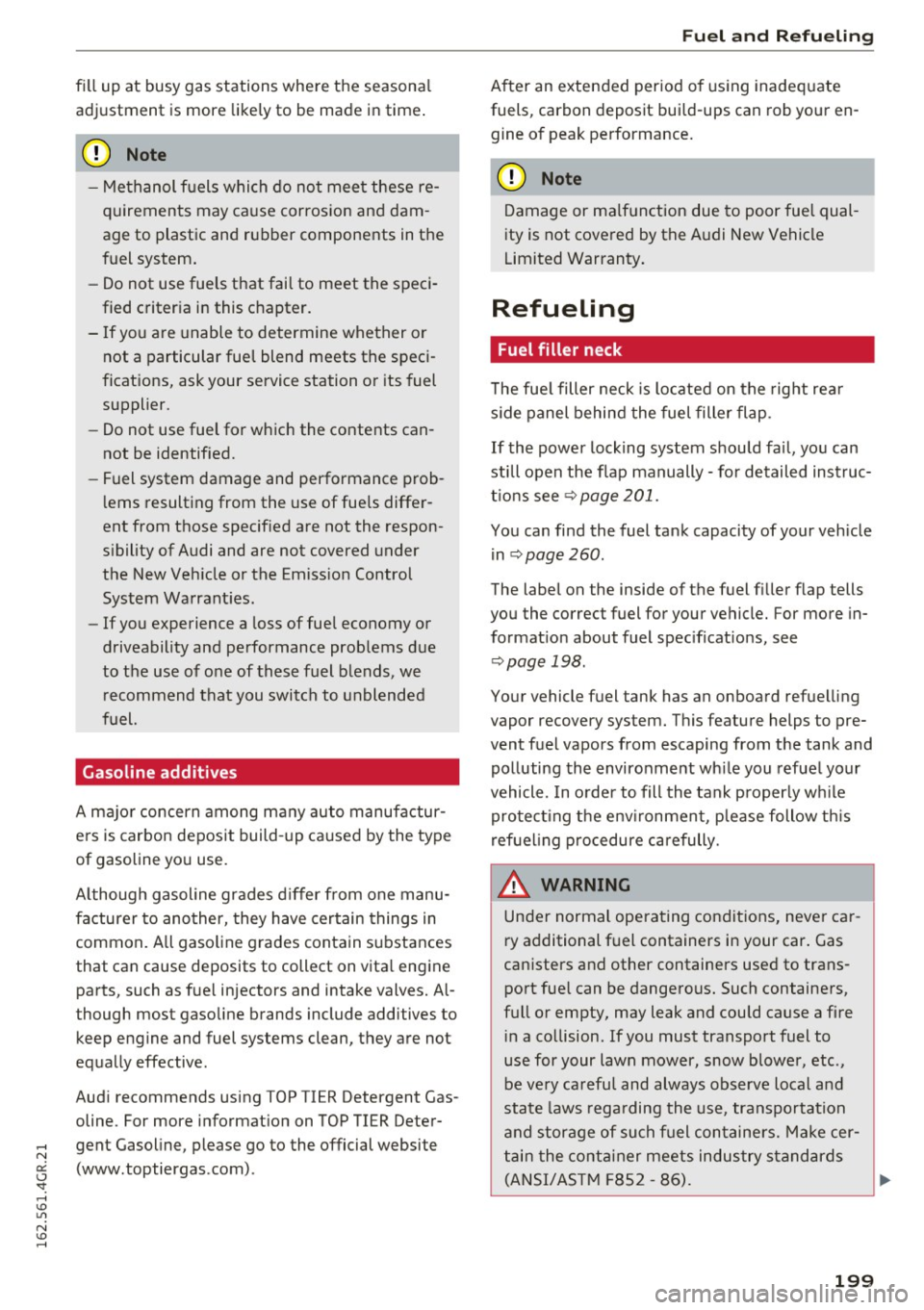
fill up at busy gas st ations where the season al
adjustm ent is mor e likely to be made in time .
(D Note
-Me thanol f uels which do not mee t these re
quirements may ca use corros ion and dam
age to plastic and rubber components in the
fuel system .
- Do not use fuels that fai l to meet the speci
fied criter ia in this chapter.
- If you are unable to determine whether or not a particular fuel blend meets the speci
ficat ions, ask your service station or its fuel
supplier.
- Do not use fuel for which the contents can
not be identif ied.
- Fuel system damage and performance prob
lems resulting from the use of fue ls differ
ent from those specified are not the respon
s ibility of Audi and are not covered under
the New Veh icle or the Emiss ion Control
System Wa rrant ies.
- If you experience a loss of fue l economy or
driveability and performance prob lems due
to the use of one of these fuel b lends , we
recommend that you switch to unblended
fuel.
Gasoline additives
A ma jo r concern among many au to manufactur
e rs is carbon deposit build-up caused by the type
of gasoline you use.
A lthough gasoline gr ades d iffer from one manu
facturer to ano ther, they have cer tain things in
common . All gasoline grades contain substances
that can cause deposits to coll ect on v ita l eng ine
parts, such as f uel injectors and intake valves. Al
though most gasoline brands include additives to
keep engine and fuel systems clean, they are not
equally effective.
Aud i recommends using TOP TIER Detergent Gas
oline. For more informat ion on TOP TIER Deter -
,... gent Gasoline, please go to the official website
N
t3 (www .toptiergas .com) .
'SI: ....
After an extended period o f using inadeq uate
fuels, carbon deposit bui ld-ups can rob your en
gine o f peak performance.
(D Note
Damage or ma lf u nction due to poor fuel qual
ity is not covered by the A udi New Vehicle
Limited Warranty .
Refueling
Fuel filler neck
The fue l filler neck is located on the rig ht rea r
s ide panel behind the fuel filler flap .
If the power lock ing system shou ld fai l, yo u can
still open the flap manually -fo r detailed inst ruc
t io ns see c:>
page 201.
You can find the fuel tank capacity of your vehicle
i n c:>
page 260 .
The label on the inside of the fuel f iller flap tells
you the correct fuel for your vehicle. For more in
format ion about fuel spec ificat ions, see
c=> page 198 .
Your vehicle fuel tank has an on board refuelling
vapor recovery system. T his feature helps to pre
vent fuel vapors from escaping from the tank and polluting the environme nt wh ile you refuel your
vehicle . In o rder to fill the tank p roper ly w hile
pro tect ing t he e nvir onment, p lease follow th is
ref ue ling pro cedure ca re fully.
A WARNING
Under normal opera ting cond itions, neve r ca r
ry additional f uel containers in your car . Gas
canisters and other containers used to trans
port fue l can be dange rous. Such containe rs,
full or empty, may leak and could cause a fire
i n a co llision. If you must transport fuel to
use for your lawn mower, snow blower, etc .,
be ve ry ca reful and always observe local and
state laws rega rding the use, transportation
a nd stor age of su ch f uel con tainers. Make cer
t ai n t he cont ainer meets industry stand ards
(A NSI/AS TM F852 -86).
199
Page 202 of 282
Fuel and Refueling
(D Note
Never drive your vehicle until the fuel tank is
completely empty. The irregular supply of
fuel can cause misfiring. Gasoline could enter
the exhaust system and damage the catalytic
converter .
Refuelling
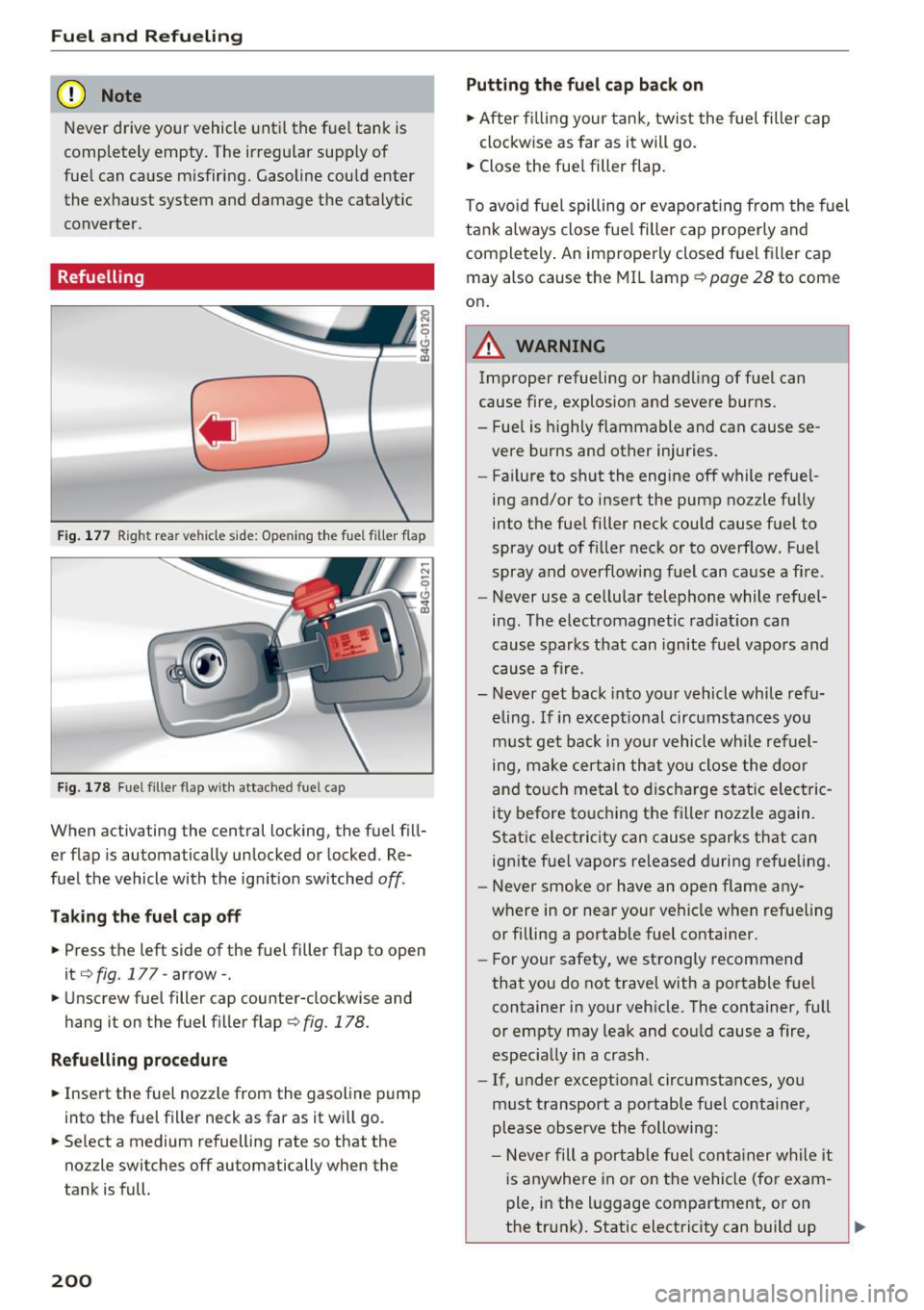
Fig. 177 Right rear vehicle side: Opening the fuel filler flap
Fig. 178 Fuel filler flap w ith attached fuel cap
When activating the central locking, the fuel fill
er flap is automatically unlocked or locked. Re
fuel the vehicle with the ignition switched
off.
Taking the fuel cap off
.. Press the left side of the fuel filler flap to open
it
9 fig. 177-arrow- .
.. Unscrew fuel filler cap counter-clockwise and
hang it on the fuel filler flap¢
fig. 178.
Refuelling procedure
.. Insert the fuel nozzle from the gasoline pump
into the fuel filler neck as far as it will go.
.. Select a medium refuelling rate so that the
nozzle switches off automatically when the
tank is full.
200
Putting the fuel cap back on
.. After filling your tank, twist the fuel filler cap
clockwise as far as it will go.
.. Close the fuel filler flap.
To avoid fuel spilling or evaporating from the fuel
tank always close fuel filler cap properly and
completely. An improperly closed fuel filler cap
may also cause the MIL lamp ¢
page 28 to come
on.
A WARNING
Improper refueling or handling of fuel can
cause fire, explosion and severe burns. -
- Fuel is highly flammable and can cause se
vere burns and other injuries .
- Failure to shut the engine off while refuel
ing and/or to insert the pump nozzle fully
into the fuel filler neck could cause fuel to
spray out of filler neck or to overflow. Fuel
spray and overflowing fuel can cause a fire.
- Never use a cellular telephone while refuel
ing. The electromagnetic radiation can
cause sparks that can ignite fuel vapors and
cause a fire.
- Never get back into your vehicle while refu
eling.
If in exceptional circumstances you
must get back in your vehicle while refuel
ing, make certain that you close the door
and touch metal to discharge static electric
ity before touching the filler nozzle again.
Static electricity can cause sparks that can
ignite fuel vapors released during refueling.
- Never smoke or have an open flame any
where in or near your vehicle when refueling
or filling a portable fuel container .
- For your safety, we strongly recommend
that you do not travel with a portable fuel
container in your vehicle. The container, full
or empty may leak and could cause a fire,
especially in a crash .
- If, under exceptional circumstances, you
must transport a portable fuel container,
please observe the following:
- Never fill a portable fuel container while it
is anywhere in or on the vehicle (for exam
ple, in the luggage compartment, or on
the trunk). Static electricity can build up
Ii>-
Page 205 of 282
Checking and Filling Hood
Releasing the engine hood
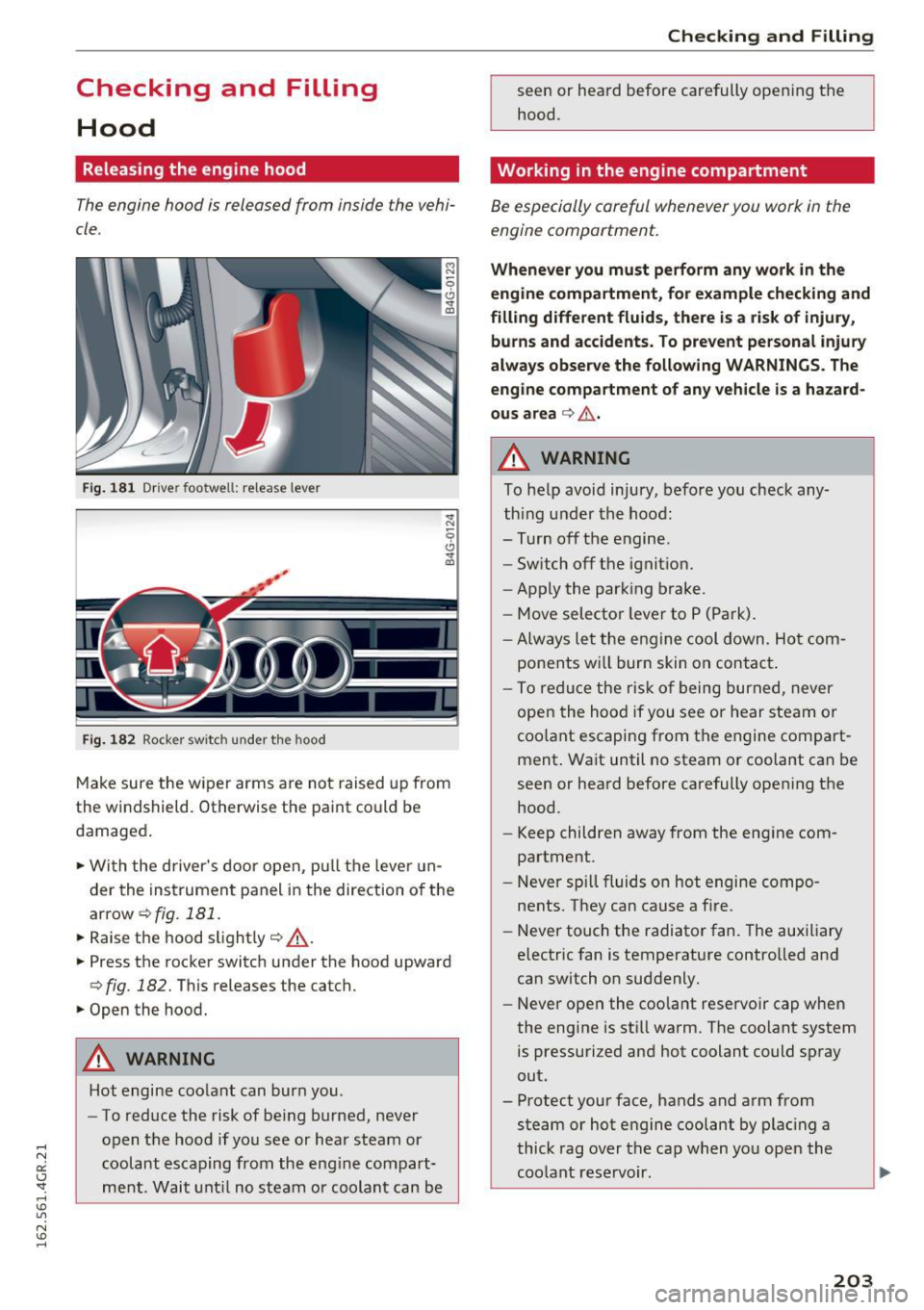
The engine hood is released from inside the vehi
cle .
Fig. 1 81 Dr ive r foo twell: re lease leve r
Fig. 1 82 Roc ke r sw itc h und er the hood
M ake sure the w iper arms are not raised u p from
the w indshield. Otherwise the pa int co uld be
damaged .
• Wi th the d river's door open, p ull th e leve r un
der the instrumen t panel i n the direction of the
ar row
r::;, fig. 181 .
• Raise the hood sl ight ly c:;, A -
• Press the rocker switc h under the hood upward
c;, fig . 182. This releases the catch.
• Open the hood.
_& WARNING
Hot engine coo lant can bur n you .
- To reduce the risk of be ing burned, never
open the hood if yo u se e or hear steam or
coolant escaping from the eng ine compart
me nt. W ait unt il no steam o r co olant ca n be
Checking and Filling
seen or hea rd before carefully opening the
hood .
Working in the engine compartment
Be especially careful whenever you work in the
engine compartment.
Whenever you must perf orm any work in the
engine compartment , for example checking and
filling different fluids , the re is a risk of injur y,
burn s and accidents. To prevent personal injury
always observe the following WARNINGS. The
eng ine compartment of any veh icle is a hazard
ous area
c:;, A .
_& WARNING
To he lp avoid injury, before you check any
th ing under the hoo d:
-T urn off the engine .
- Sw itch off the ignit ion.
- Apply the parking brake.
- Move selector lever to P (Pa rk).
- Always let the en gine cool down. Ho t com-
ponents wi ll burn skin on con tact .
-
-To reduce the ris k of b eing bur ned, never
open the hood if you see or hear steam o r
coo lant escaping from the engine compart
ment. Wa it until no steam or coolant can
be
seen or hea rd before carefully opening the
hood.
- Keep children away from the engine com
partment .
- Never sp ill fluids on hot engine compo
nents. They can cause a f ire.
- Never touch the radiator fan . The auxiliary
electric fan is temperature contro lled and
can switch on suddenly.
- Never open the coo lant reservoir cap when
the engine is st ill warm. The coolant system
is pressuri zed and hot coolant could sp ray
out.
- Protect your face, hands and arm from
steam or hot engine coolant by plac ing a
thick rag over the cap when yo u open the
coolant reservoir .
203
Page 211 of 282
Cooling system
Coolant
The engine coolant performs two functions: it
keeps the engine from overheating and it pro
tects the engine from freezing in the winter .
The cooling system is sealed and generally re
q ui res little atte ntion .
The cooling system has been filled at the factory
with a permanent coolant which does not need to
be changed . The coolant consists of a mixture of
specially condit ioned water and the ma nufactur
er's glycol-based coolant additive G13 an tifreeze
with ant icor rosion additives
(50% for USA mod
e ls;
60% fo r Canadia n models). This m ix tu re
bo th ass ures the necessa ry fros t prote ction and
protects metal componen ts in the engi ne's coo l
ing system from corrosion and scaling .
It also
raises the boiling point of the coolant.
D o not red uce the con cen trat ion of the coolant in
the summer by adding p lain wa ter.
The propor
tion of coolant additive mu st be at least 50 %
but not more than 60%
to maintain antifreeze
protection and cooling efficiency. If the coolant
frost protection is too low, the coolant could
freeze and damage the vehicle heating and en
g ine cooling system .
For year-round driving, antifreeze is added at the
factory for temperatures down to:
- -3 1 °F ( -3 5 °C) USA
- -4 0 °F ( - 40 °C) Canada.
If yo u m ust add coo lant, use a m ixt ure of water
and coolant addit ive. Mixing the cool ant additive
with d istilled w ater is recommended .
_& WARNING
Before you che ck anythi ng in t he eng ine com
pa rtment, a lways read and heed a ll WARN
INGS
~ .& in Working in the engine compart
ment on page 203 .
(D Note
-Before winter se ts in, have the coo lant
checked to see if the coolant additive in your
vehicle is sufficient to meet the c limate con -
Checking and Filling
ditions. This is especia lly important if you
live in a region whe re the winter is extreme
ly cold. If necessary, increase the propo rtion
of coolant addit ive to
60%.
- Whe n adding coolant additive to your cool
ing system, remember :
- We recommend us ing o nly coola nt addi
tive G 12++ or G13 (c hec k the label) for
y o ur vehi cle. Thi s coo lant ad ditive is av ail
abl e at a uth orized Au di dea le rs. Ot her
types o f ant ifreeze ca n sign ifican tly re
d uce corrosion protection. The resu lting
cor ros ion can cause a loss of coolant and
se rious engine damage.
- Do not add any type of radiator leak sealant
to your vehicle's engine coolant . Adding ra
diator repair fluid may adversely affect the
function and performance of your cooling system and could result in damage not cov
ered by your New Veh icle Limited War ra nty .
Checking the engine coolant level
The engine coolant level can be checked with a
quick glance .
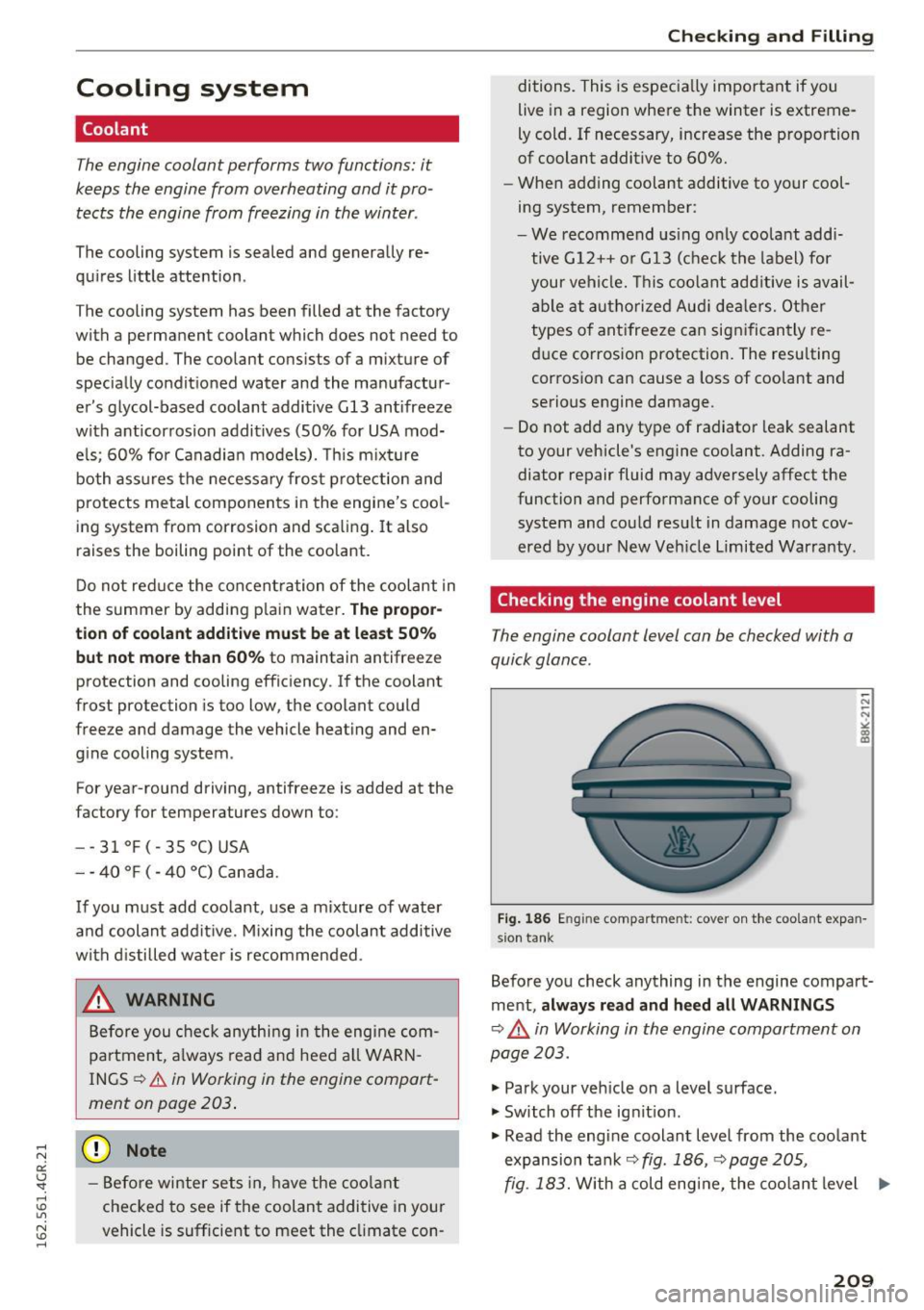
Fig. 186 E ngine compar tmen t: cover on t he coo lant expan
s io n t ank
Befo re you check anything in the engine compart
me nt,
always read and heed all WARNINGS
~ .&. in Working in the engine compartment on
page 203.
" Park your veh icle on a leve l s u rface.
" Sw itch off the ig nit ion .
.. Read the eng ine coolant leve l from the coo lant
expansion tan k
r=;,fig. 186, r=;,page 205,
fig . 183.
W ith a cold eng ine, the coolant level ..,.
209