brake fluid AUDI RS7 SPORTBACK 2016 Owners Manual
[x] Cancel search | Manufacturer: AUDI, Model Year: 2016, Model line: RS7 SPORTBACK, Model: AUDI RS7 SPORTBACK 2016Pages: 282, PDF Size: 70.78 MB
Page 16 of 282
Instruments and indicator lights
Audi active lane assist *
¢page89
High beam assist"
¢ page44
High beam
¢page44
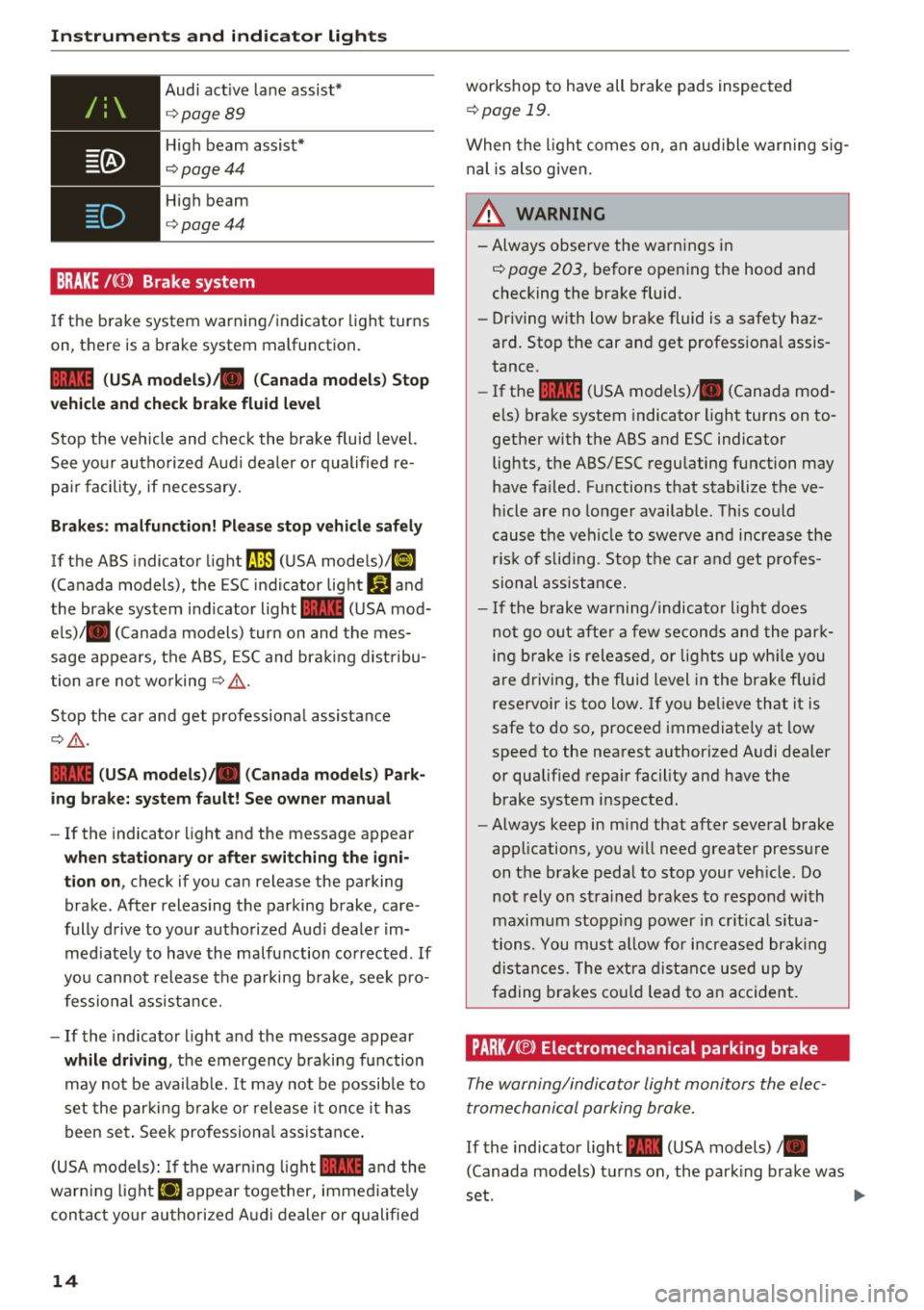
BRAKE/( ©) Brake system
If the b rake system warning/ indicator light turns
on, there is a brake system malfunction .
1111 (USA model s)/. (Canada model s) Stop
v ehicle and check brake fluid le vel
Stop the veh icle and check the brake fluid level.
See yo ur autho rized Aud i deale r or qualified re
pa ir facility, if necessary.
Brakes : malfun ction! Pl eas e stop vehicle saf ely
If the ABS indicator light rJ] (USA mode ls)/ ll]
(Canada models), the ESC indicator light DJ and
the brake system ind icator light
1111 (USA mod
e ls)/ . (Canada models) turn on and the mes
sage appears, the AB S, ESC and brak ing dist ribu
tion a re not wo rking
¢ .&, .
Stop the car and get professiona l assistance
Q .&, .
1111 (US A mod els )/ . (Canada models ) Park
ing brake : sy ste m f ault! See owne r manua l
-If the indicator light and the messag e appear
whe n stationa ry or afte r switching the igni
tion on ,
check if you can release the parking
brake . After releasing the parking brake , care
fully drive to yo ur authorized Aud i dealer im
med iate ly to have the ma lfunction co rrected . If
you cannot release the parking brake , see k pro
fessional ass istance .
- If the indicator l ight and the message appear
whil e driving , the emergency braking function
may not be avai lab le. It may not be possib le to
set the par kin g b rake o r release it once it h as
been set . Seek professiona l assistance .
(USA models): If the warn ing light
1111 and the
warn ing light
llJ appear together, immed iate ly
con tact yo ur authori zed A udi dealer or qualified
14
workshop to have all brake pads inspected
¢ page 19.
When the light comes on , an aud ible warn ing sig
nal is also given.
_&. WARNING
-Always observe the warnings in
¢ page 203, before open ing the hood and
checking the brake fluid.
- Driving with low brake fluid is a safety haz
ard. Stop the car and get professional assis
tance .
- If the
1111 (USA models)/ . (Canada mod
els) brake system indicato r light turns on to
gethe r with the ABS and ESC indicator
lights, the ABS/ESC regu lating function may
have fa iled . Functions that stabilize the ve
hicle are no longer available . Th is could
cause the vehicle to swerve and increase the ris k of sliding . Stop the car and get profes
sional ass is tance.
- If the brake warning/indicator ligh t does
not go out afte r a few seconds and the par k
ing brake i5 relea5ed, or light5 up wh ile you
are driving, the fluid level in the brake fluid
reservoir is too low. If yo u be lieve that it is
safe to do so, proceed immediately at low
speed to the nearest authorized Audi dealer
or qualif ied repa ir facility and have the
brake system inspected.
- Always keep in m ind that after several brake
applications, you w ill need greater pressure
on the b rake pedal to stop your veh icle . Do
not rely on strained brakes to respond with
maximum stopp ing power in cr itical s itua
tions. You must a llow for increased brak ing
distances. The extra dist ance used up by
fading bra kes co uld lead to an accident.
PARK/ C®) Electromechanical parking brake
The warning/indicator light monitors the elec
tromechanical parking brake .
If the indicator light -(USA models) •
(Canada mode ls) t urns on , the park ing brake was
set .
~
Page 185 of 282
Effect of wat er and road salt
In ce rtain situations, for example after driving
through water, in heavy rain, afte r ove rnight con
densation or after washing your car, the braking
effect can be reduced by moisture or ice on the
brake rotors and brake pads. The brakes must be
dried first w ith a few careful brake applications.
At higher speeds and with the windshie ld wipers
turned on, the brake pads press against the brake rotors for a short amount of time. Th is occurs at
regular intervals without the driver noticing and
provides for better brake response time under
wet conditions .
The effectiveness of the brakes can be reduced
when the vehicle is driven on a salt-covered road
and the brakes are not used. Likewise, you clean
off accumulated salt coat ing from brake discs
and pads with a few cautious applications of the b rake ¢_&. .
Due to their surface character istics, ceramic
brake roto rs* absorb mo isture in such condit ions.
This can cause a temporary reduc tion in braking
force compared to dry brakes. You can compe n
sate fo r th is by press ing the b rake peda l harder.
Corrosion
There may be a tende ncy for d irt to bu ild up on
the brake pads and corros ion to form on the discs
if the car is not dr iven regularly or only fo r sho rt
tr ips with little use of the brakes.
If the brakes are not used frequently, or if corro
sion has formed on the discs, it is adv isable to
clean off the pads and discs by brak ing firmly a
few t imes from a mode rately h igh speed ¢,& .
Faults in the brake system
If you should notice a sudden increase in brake
pedal travel, then one of the two brake c ircuits
may have failed
¢ ,& .
Low brake fluid le vel
Malfunct ions can occur in the brake system if the
brake fl uid level is too low. The brake fluid level
is monitored electronically .
Intelligent Technology
Brake booster
The brake boos ter works w ith v acuum press ure
which is crea ted on ly when the engine is running
¢ & .
Brake lining wear status
Brake lining wea r may be chec ked by visua l in
spe ct ion of the condition of the brake pads
t hr ough the openings in t he wheel. If necessary,
the wheel may be removed for this inspection
¢ page 243, Replacing wheels .
_8 WARNING "'----
-New b rake pads don't have the best stop
p ing power and must be "broken-in" d uring
the initial 250 miles (400 km). The b reak-in
period can be considerably longer for
veh icles with ceramic brake roto rs*. You can
compensate for this by pressing the brake
pedal mo re firmly. This also applies late r
when new p ads are inst alled.
- You shou ld pe rform braking maneuvers for
the purpose of cleaning the brake system
only i f road condit io ns pe rmit. O ther ro ad
users m ust no t be put at r is k - you may
cause an accident!
- Before descending a steep g rade, reduce
speed and shift transmission into a lower
gear o r lower driving range. Do not r ide the
brakes or hold the pedal down too long or
too often. This cou ld cause t he b rakes to get
hot and dimin ish braking effic iency.
- Do not " ride the brakes" by rest ing your foot
on the pedal when you do not intend to brake. This may cause the brakes to over
heat, premature wear and increased stop
p ing distance .
- Unde r certain climatic and ope rating condi
tions such as passing t hrough water, d riving
i n heavy rain o r afte r wash ing the veh icle,
the effectiveness of the brakes ca n be re
duce d. In winter, ice can accum ulate on the
b rake pads, lin ings, discs and dr ums. Care
fu lly apply brakes for a test. Brakes will d ry
an d ice coatings will be cleaned off after a
few ca refu l brake applications.
183
Page 205 of 282
Checking and Filling Hood
Releasing the engine hood
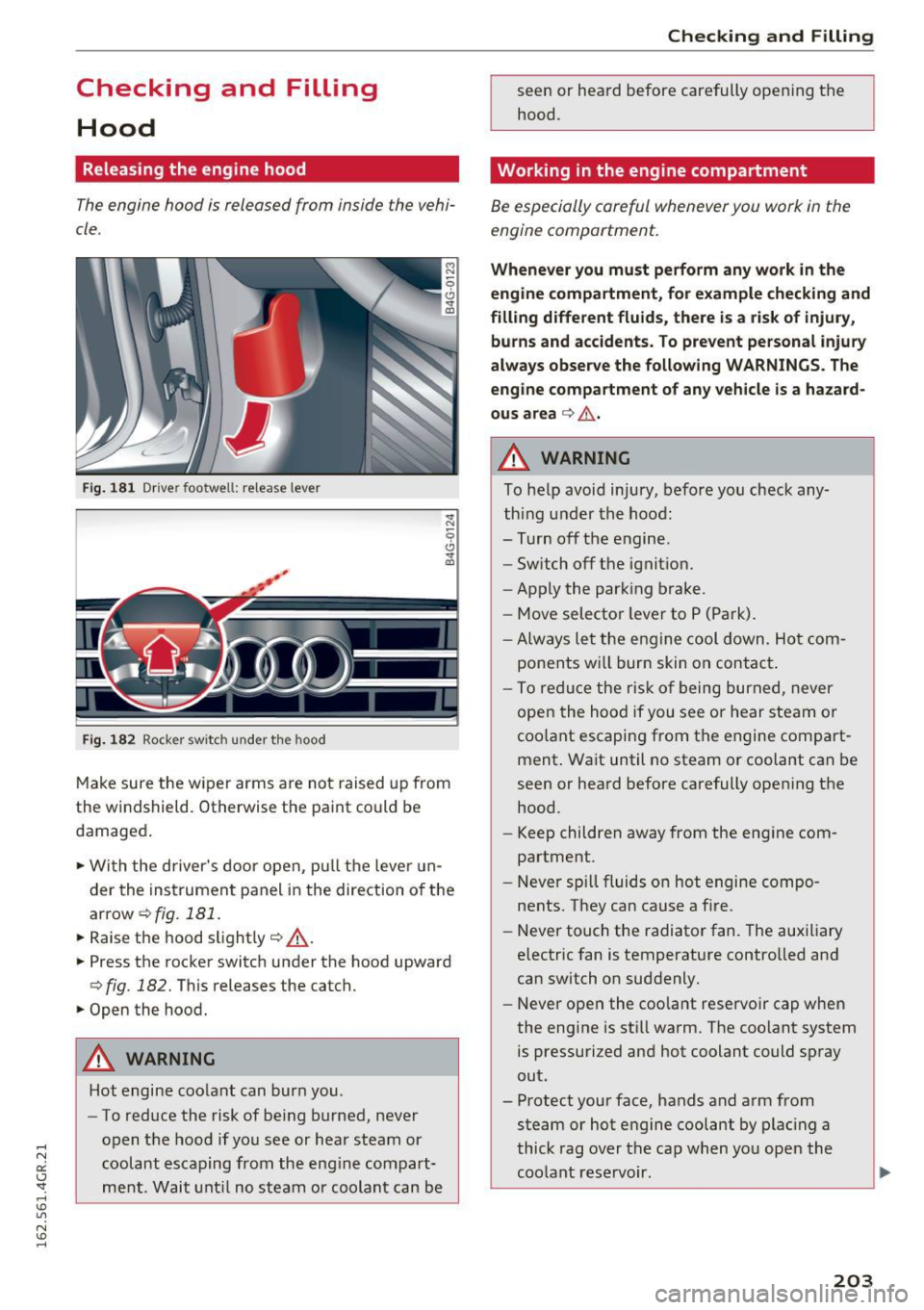
The engine hood is released from inside the vehi
cle .
Fig. 1 81 Dr ive r foo twell: re lease leve r
Fig. 1 82 Roc ke r sw itc h und er the hood
M ake sure the w iper arms are not raised u p from
the w indshield. Otherwise the pa int co uld be
damaged .
• Wi th the d river's door open, p ull th e leve r un
der the instrumen t panel i n the direction of the
ar row
r::;, fig. 181 .
• Raise the hood sl ight ly c:;, A -
• Press the rocker switc h under the hood upward
c;, fig . 182. This releases the catch.
• Open the hood.
_& WARNING
Hot engine coo lant can bur n you .
- To reduce the risk of be ing burned, never
open the hood if yo u se e or hear steam or
coolant escaping from the eng ine compart
me nt. W ait unt il no steam o r co olant ca n be
Checking and Filling
seen or hea rd before carefully opening the
hood .
Working in the engine compartment
Be especially careful whenever you work in the
engine compartment.
Whenever you must perf orm any work in the
engine compartment , for example checking and
filling different fluids , the re is a risk of injur y,
burn s and accidents. To prevent personal injury
always observe the following WARNINGS. The
eng ine compartment of any veh icle is a hazard
ous area
c:;, A .
_& WARNING
To he lp avoid injury, before you check any
th ing under the hoo d:
-T urn off the engine .
- Sw itch off the ignit ion.
- Apply the parking brake.
- Move selector lever to P (Pa rk).
- Always let the en gine cool down. Ho t com-
ponents wi ll burn skin on con tact .
-
-To reduce the ris k of b eing bur ned, never
open the hood if you see or hear steam o r
coo lant escaping from the engine compart
ment. Wa it until no steam or coolant can
be
seen or hea rd before carefully opening the
hood.
- Keep children away from the engine com
partment .
- Never sp ill fluids on hot engine compo
nents. They can cause a f ire.
- Never touch the radiator fan . The auxiliary
electric fan is temperature contro lled and
can switch on suddenly.
- Never open the coo lant reservoir cap when
the engine is st ill warm. The coolant system
is pressuri zed and hot coolant could sp ray
out.
- Protect your face, hands and arm from
steam or hot engine coolant by plac ing a
thick rag over the cap when yo u open the
coolant reservoir .
203
Page 206 of 282
Checking and Filling
-Do not remove the engine cover under any
circumstances . This increases the risk of
burns.
- If work on the fuel system or the electrical
system is necessary:
- Always disconnect the battery.
- Never smoke or work near heaters or open
flames . Fluids in the engine compartment
could start a fire.
- Keep an approved fire extinguisher imme
diately available .
- To avoid electrical shock and personal injury
while the engine is running or being started,
never touch:
- Ignition cables
- Other components of the high voltage
electronic ignition system.
- If you must perform a check or repair with
the engine running:
- First, fully apply the parking brake, move
selector lever to P (Park) .
- Always use extreme caution to prevent
clothing, jewelry, or long hair from get
ting caught in the radiator fan, V -belts or
other moving parts, or from contacting
hot parts. Tie back hair before starting,
and do not wear clothing that will hang or
droop into the engine.
- Minimize exposure to emission and chemi
cal hazards
,=:, .&. -
A WARNING
California Proposition 65 Warning:
- Engine exhaust, some of its constituents,
and certain vehicle components contain or
emit chemicals known to the State of Cali
fornia to cause cancer and birth defects and
reproductive harm. In addition, certain flu
ids contained in vehicles and certain prod
ucts of component wear contain or emit
204
chemicals known to the State of California
to cause cancer and birth defects or other
reproductive harm .
- Battery posts, terminals and related acces
sories contain lead and lead compounds,
chemicals known to the State of California
to cause cancer and reproductive harms .
Wash hands after handling.
(D Note
When adding fluids, always make sure that
they are poured into the proper container or
filler opening, otherwise serious damage to
vehicle systems will occur.
@ For the sake of the environment
To detect leaks in time, inspect the vehicle
floor pan from underneath regularly . If you
see spots from oil or other vehicle fluids, have
your vehicle inspected by an authorized Audi
dealer.
Closing the engine hood
.,. Pull the hood down until the pressure from the
struts is reduced.
.,. Let the hood
drop down and latch in place. Do
not try to push it shut;
it may fail to engage
¢ _& .
A WARNING
A hood that is not completely latched could
fly up and block your view while driving .
- When you close the engine hood, check it to
make sure the safety catch has properly en
gaged . The hood should be flush with the
surrounding vehicle body parts.
- If you notice while driving that the hood is
not secured properly, stop at once and close it .
-
Page 207 of 282
Checking and Filling
Engine compartment
Engine compartment overview
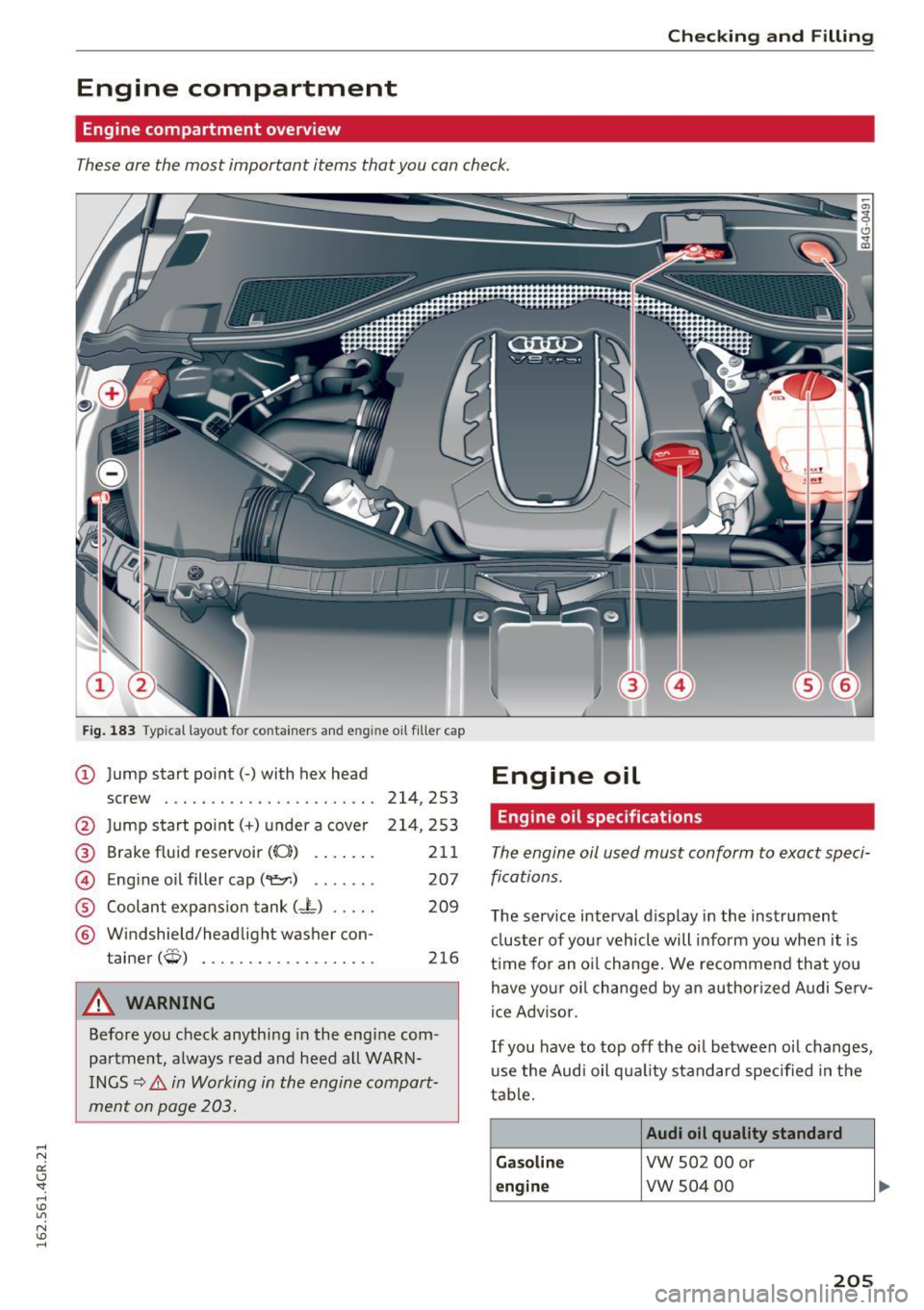
These are the most important items that you can check.
Fig. 183 Typical layout for containers and e ngine oil fille r cap
(D Jump start point(-) with hex head Engine oil
screw . .. .... .... .... ..... .. . 214, 253
@ Jump start po int( +) under a cover 214 ,253
@ Brake fluid reservoir (0:) . . . . . . . 211
@ Eng ine oil filler cap(~) . . . . . . . 207
® Coolant expans ion tank (- L) . . . . . 209
® Windshield/headlight washer con-
tainer
(W) . . . . . . . . . . . . . . . . . . . 216
A WARNING
Before you check anything in the engine com
partment, always read and heed all WARN
INGS
¢ .&. in Working in the engine compart
ment on page 203.
Engine oil specifications
The engine oil used must conform to exact speci
fications.
The service interval display in the instrument
cluster of your vehicle will inform you when it is
t ime for an o il change. We recommend that you
have your oil changed by an authorized Audi Serv-
ice Adv isor.
If you have to top off the oi l between oil changes,
use the Audi oil quality standard specified in the
table.
Audi oil quality standard
Gasoline
VW 502 00 or
engine VW S04 00
205
Page 213 of 282
,&_ WARNING
-The cooling system is under pressure and
can get very hot. Reduce the risk of scalding
from hot coolant by following these steps.
- Turn off the engine and allow it to cool
down.
- Protect your face, hands and arms from
escaping fluid and steam by covering the
cap with a large, thick rag.
- Turn the cap slowly and very carefully in a
counter-clockwise direction while applying light, downward pressure on the top of
the cap.
- To avoid being burned, do not spill ant i
freeze or coolant on the exhaust system or
hot engine parts. Under certa in condi
tions, the ethylene glycol in engine cool
ant can catch fire.
- Antifreeze is poisonous. Always store anti
freeze in its original container and well out
of the reach of children.
- If you drain the coolant, it must be caught
and safely stored in a proper container
clearly marked "poison" .
(D Note
-Do not add coolant if the expansion tank is
empty. Air could enter the cooling system
and damage the eng ine. If this is the case,
do not continue driving. Seek professional
assistance.
- Coolant pollutes the environment and could
cause an engine fire. Excess coolant will be
forced out through the pressure relief valve
i n the cap when the engine becomes hot .
- If, in an emergency, only water can be add ed, the correct ratio between water and an
tifreeze
¢ page 209 must be restored as
soon as possible.
@ For the sake of the environment
Drained coolant should not be reused. Always
dispose of used coolant while observing all
environmental regulat ions.
-
Checking and Filling
Radiator fan
The radiator fan switches on automatically by it
self .
An auxiliary electric radiator fan switches on and
off depending on coolant temperature and other
vehicle operating conditions.
After you switch the engine off, the auxiliary fan
can continue running for up to 10 minutes -even
with the ignition off. It can even switch on again later by itself ¢&. , if
- the temperature of the engine coolant rises due
to the heat build-up from the engine in the en gine compartment, or
- the engine compartment heats up because the
vehicle is parked in intense sunlight.
A WARNING
--
- To reduce the risk of personal injury never
touch the radiator fan .
- The auxiliary electric fan is temperature
controlled and can switch on suddenly even
when the engine is not running .
- The auxiliary radiator fan switches on auto
matically when the engine coolant reaches a
certa in temperature and will continue to run
until the coolant temperature drops.
Brake fluid
Checking brake fluid level
Fig. 187 En g in e compar tment: cover on the b rake fluid
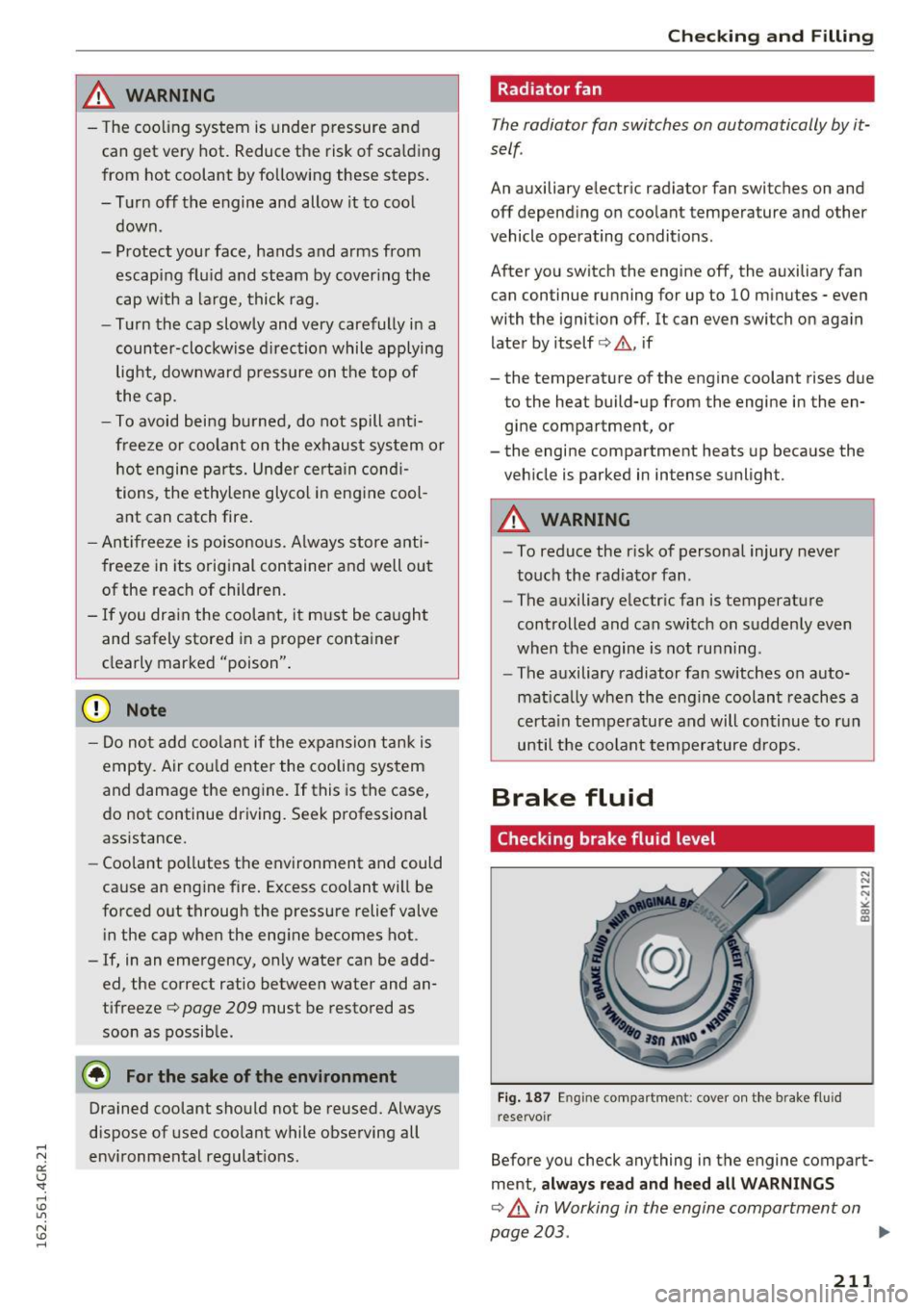
rese rvoir
Before you check anything in the engine compart
ment,
always read and heed all WARNINGS
¢ & in Working in the engine compartment on
page 203 . .,.
211
Page 214 of 282
Checking and Filling
"' Read the brake fluid level from the brake fluid
reservoir
¢ fig. 187, ¢page 205, fig. 183. The
brake fluid level must be between the "MIN"
and "MAX" markings.
The location of the brake fluid reservoir can be
seen in the engine compartment illustration
c>page205.
The fluid level may drop slightly after some time
due to the automatic adjustment of the brake
pads. This is not cause for alarm.
If the brake fluid level falls considerably below
the "MIN" mark, the brake warning/indicator
light
1111 (U.S. models)/ . (Canadian models)
will come on¢
page 14. Do not continue to oper
ate the vehicle. The complete brake system
should be thoroughly checked by an authorized
Audi dealer or other qualified facility and the
cause corrected . If the brake fluid level is too
low, the brake warning/indicator light will illumi
nate. Contact an authorized Audi dealer
immedi
ately.
Changing brake fluid
Have the brake fluid changed by an experienced
technician.
Brake fluid absorbs moisture from the air . If the
water content in the brake fluid is too high , cor
rosion in the brake system may result after a pe
riod of time. The boiling point of the brake fluid
will also decrease considerably and decrease
braking performance.
Therefore, the brake fluid must be changed
every
two years.
Always use new brake fluid which con
forms to Federal Motor Vehicle Standard "FMVSS
116 DOT 4".
The brake fluid reservoir can be difficult to reach,
therefore, we recommend that you have the
brake fluid changed by your authorized
Audi
dealer.
Your dealer has the correct tools, the
right brake fluid and the know-how to do this for
you.
212
A WARNING
-
- Brake fluid is poisonous. It must be stored
only in the closed original container out of
the reach of children!
- Brake failure can result from old or inappro
priate brake fluid. Observe these precau
tions:
- Use only brake fluid that meets SAE speci
fication
J 1703 and conforms to Federal
Motor Vehicle Standard 116. Always check
with your authorized Audi dealer to make
sure you are using the correct brake fluid.
The correct type of brake fluid is also indi
cated on the brake fluid reservoir .
- The brake fluid must be new. Heavy use of
the brakes can cause a vapor lock if the
brake fluid is left in the system too long .
This can seriously affect the efficiency of
the brakes as well as your safety. This
could result in an accident.
(D Note
Brake fluid will damage the paint of your vehi
cle.
@ For the sake of the environment
Because of the problem of proper disposal of
brake fluid as well as the special tools re
quired and the necessary expertise, we rec
ommend that you have the brake fluid
changed by your authorized Audi dealer .
Battery
General information
Under normal operating conditions, the battery
in your Audi does not need any maintenance.
With
high outside temperatures or long daily
drives we recommend that you have the electro
lyte level checked by a service facility. The elec
trolyte level should also be checked each time
the battery is charged ¢
page 214.
Have the battery checked when you take your ve
hicle in for service. You are well advised to re
place a battery that is older than S years.
Page 269 of 282
Anti-theft systems Electronic immobilizer . . . . . . . . . . . . . . . . . 31
Ashtray . . . . . . . . . . . . . . . . . . . . . . . . . . . . . . 58
Audi drive select
refer to Drive select . . . . . . . . . . . . . . . . . . . 95
Audi Service Repair Manuals and Literature 262
AUTO 4-z one deluxe automatic climate control . . 68
Automatic headlights . . . . . . . . . . . . . . . . . 43
Auto Lock . . . . . . . . . . . . . . . . . . . . . . . . . . . . 32
Automatic belt retractor . . . . . . . . . . . . . . . 130
Automatic post-collision brak ing system . . 181
Automatic Shift Lock (ASL) . . . . . . . . . . . . . 102
Automatic transmission . . . . . . . . . . . . . . . . 101
Automatic Shift Lock (ASL) . . . . . . . . . . . . 102
Driving . . . . . . . . . . . . . . . . . . . . . . . . . . . . 103
E mergency mode . . . . . . . . . . . . . . . . . . . . 105
Emergency release . . . . . . . . . . . . . . . . . . . 106
Kick-down . . . . . . . . . . . . . . . . . . . . . . . . . . 105
Manual shift program . . . . . . . . . . . . . . . . 105
Selector lever . . . . . . . . . . . . . . . . . . . . . . . 101
Automatic wipe/wash system . . . . . . . . . . . . 49
Auto Safety Hotline . . . . . . . . . . . . . . . . . . . 125
Average consumption . . . . . . . . . . . . . . . . . . . 23
Average speed . . . . . . . . . . . . . . . . . . . . . . . . 23
Avoid damaging the vehicle . . . . . . . . . . . . . 188
B
Battery . . . . . . . . . . . . . . . . . . . . . . . . . . . . . 212
Charge level . . . . . . . . . . . . . . . . . . . . . . . . 186
Charg ing ... .. ............... .. .... . 214
Energy management . . . . . . . . . . . . . . . . . 186
I mportant warn ings .......... .. .. .. . 213
Jump starting . . . . . . . . . . . . . . . . . . . . . . . 253
Location . . . . . . . . . . . . . . . . . . . . . . . . . . . 213
Replacing the battery . . . . . . . . . . . . . . . . 215
Winter operation . . . . . . . . . . . . . . . . . . . . 212
Working on the battery . . . . . . . . . . . . . . . 213
Before driving . . . . . . . . . . . . . . . . . . . . . . . . 118
Belt tensioners . . . . . . . . . . . . . . . . . . . . . . . 133
Blended gasoline . . . . . . . . . . . . . . . . . . . . . 198
Blower (4-zone deluxe automatic climate con-
trol) . . . . . . . . . . . . . . . . . . . . . . . . . . . . . . . . . 69
Boost display . . . . . . . . . . . . . . . . . . . . . . . . . 26
Booster seats . . . . . . . . . . . . . . . . . . . . . . . . 168
Boost pressure indicator . . . . . . . . . . . . . . . . 26
Index
Brake fluid
Changing the brake fluid . . . . . . . . . . . . . . 212
Checking the brake fluid level . . . . . . . . . . 211
Brakes Indicator light . . . . . . . . . . . . . . . . . . . . . . . 20
Brake system Anti-lock braking system . . . . . . . . . . . . . . . 18
Brake booster . . . . . . . . . . . . . . . . . . . . . . . 183
Brake fluid . . . . . . . . . . . . . . . . . . . . . . . . . 211
Brake fluid specifications for refill and re
placement . . . . . . . . . . . . . . . . . . . . . . . . . 212
Brake power assist unit . . . . . . . . . . . . . . . 182
Brakes..... ... .. .. ................ . 182
Electromechanical parking brake . . . . . . . . 7 4
Fluid reservoir . .. .. ............... .. 211
Warning/indicator lights . . . . . . . . . . . . . . . 14
Worn brake pads symbol . . . . . . . . . . . . . . . 19
Braking Brake assist . . . . . . . . . . . . . . . . . . . . . . . . 180
Emergency braking function . . . . . . . . . . . . 76
Braking guard . . . . . . . . . . . . . . . . . . . . . . . . . 79
Messages . . . . . . . . . . . . . . . . . . . . . . . . . . . 86
Settings . . . . . . . . . . . . . . . . . . . . . . . . . . . . 86
Break-in period
Brake pads . . . . . . . . . . . . . . . . . . . . . . . . . 182
T ires ......... .... ................ .
Breaking in
New tires
C
188
188
225
California Proposition 65 Warning . . . . . . . 204
Battery specific . . . . . . . . . . . . . . . . . . . . . 214
Capacities . . . . . . . . . . . . . . . . . . . . . . . . . . . 260
Engine oil . . . . . . . . . . . . . . . . . . . . . . . . . . 205
Car carrier Transporting your vehicle . . . . . . . . . . . . . 256
Care . . . . . . . . . . . . . . . . . . . . . . . . . . . . . . . . 193
Cargo area . . . . . . . . . . . . . . . . . . . . . . . . . . . 124
Cargo net . . . . . . . . . . . . . . . . . . . . . . . . . . . . 64
Catalytic converter . . . . . . . . . . . . . . . . . . . . 189
Center armrest Cockpit . . . . . . . . . . . . . . . . . . . . . . . . . . . . . 55
Central locking . . . . . . . . . . . . . . . . . . . . . . . . 31
Emergency locking . . . . . . . . . . . . . . . . . . . . 36
Power windows . . . . . . . . . . . . . . . . . . . . . . 40
Setting . . . . . . . . . . . . . . . . . . . . . . . . . . . . . 33
Sunroof. . . . . . . . . . . . . . . . . . . . . . . . . . . . . 40
267
Page 272 of 282
Index
Starting . . . . . . . . . . . . . . . . . . . . . . . . . . . . 72
Starting with jumper cables . . . . . . . . . . . 253
Stopping . . . . . . . . . . . . . . . . . . . . . . . . . . . . 73
Engine compartment . . . . . . . . . . . . . . . . . . 205
Closing the hood . . . . . . . . . . . . . . . . . . . . 204
Opening the hood . . . . . . . . . . . . . . . . . . . 203
Safety instructions . . . . . . . . . . . . . . . . . . . 203
Working in the engine compartment . . . . 203
Engine coolant . . . . . . . . . . . . . . . . . . . . . . . 209
Adding coolant .. ............. .... .. . 210
Checking the engine coolant level. . . . . . . 209
Expansion tank . . . . . . . . . . . . . . . . . . . . . . 209
Radiator fan .... ................ .... 211
Temperature gauge . . . . . . . . . . . . . . . . . . . 10
Engine oil . . . . . . . . . . . . . . . . . . . . . . . . . . . 205
Adding . . . . . . . . . . . . . . . . . . . . . . . . . . . . 207
Additives . . . . . . . . . . . . . . . . . . . . . . . . . . . 207
Changing . . . . . . . . . . . . . . . . . . . . . . . . . . 208
Checking oil level . . . . . . . . . . . . . . . . . . . . 207
Consumption . . . . . . . . . . . . . . . . . . . . . . . 207
Indicator light . . . . . . . . . . . . . . . . . . . . . . . 16
Oil consumption . . . . . . . . . . . . . . . . . . . . . 206
Pressure malfunction . . . . . . . . . . . . . . . . . 16
Sensor defective . . . . . . . . . . . . . . . . . . . . . . 20
Specification and viscosity . . . . . . . . . . . . . 205
Temperature ind icator . . . . . . . . . . . . . . . . . 26
Eng ine sound . . . . . . . . . . . . . . . . . . . . . . . . . 95
Engine speed limitation (indicator light) 20
Engine warm-up request
I ndicator l ight . . . . . . . . . . . . . . . . . . . . . . .
20
Environment
Catalytic converter . . . . . . . . . . . . . . . . . . .
189
Disposing of your vehicle battery . . . . . . . 215
Driving at high speeds . . . . . . . . . . . . . . . . 191
Fuel. .... .. .. .. ... .......... .. .. .. . 200
Leaks under your vehicle . . . . . . . . . . . . . . 203
Letting the vehicle stand and warm up. .. 191
Proper disposal of drained brake fluid . . . 212
Proper disposal of drained engine coolant 210
Proper disposal of drained engine oil 207, 208
Recycling used engine oil . . . . . . . . . . . . . 207
Unleaded fuel . . . . . . . . . . . . . . . . . . . . . . . 198
What should I do with an old battery? . . . 215
ESC
Automatic post-co llision braking system .
181
Event Data Recorder (EDR) . . . . . . . . . . . . . 179
E . k xpans1on tan . . . . . . . . . . . . . . . . . . . . . . . 209
270
Exterior lighting . . . . . . . . . . . . . . . . . . . . . . . 43
Exterior mirrors
Adjusting . . . . . . . . . . . . . . . . . . . . . . . . . . . 47
D' .
1mming ............................
48
Heating... .. .. .. .. .. ............. ... 47
Exterior temperature display . . . . . . . . . . . . .
22
F
Fastening
Booster seats . . . . . . . . . . . . . . . . . . . . . . .
168
Convertible child safety seats . . . . . . . . . . 166
Infant seats . . . . . . . . . . . . . . . . . . . . . . . . 165
Floor mats . . . . . . . . . . . . . . . . . . . . . . . . . . . 123
Foot pedals . . . . . . . . . . . . . . . . . . . . . . . . . . 123
For the sake of the environment
Environmentally-friendly driving . . . . . . .
190
Gasoline fumes and the environment . . . . 200
Reducing eng ine noise by early upsh ifting . 10
Refueling . . . . . . . . . . . . . . . . . . . . . . . . . . 200
Saving fuel by early upshifting . . . . . . . . . . 10
w . th .
arming up e engine . . . . . . . . . . . . . . . . 72
Front airbags
D . t· escnp 10n . . . . . . . . . . . . . . . . . . . . . . . . . 139
How they work . . . . . . . . . . . . . . . . . . . . . . 144
Frontal collisions and the laws of physics . . 128
Front seats . . . . . . . . . . . . . . . . . . . . . . . . . . . 53
Adjusting . . . . . . . . . . . . . . . . . . . . . . . . . . 120
Child restraints in the front seat . . . . . . . . 136
Fuel
Additives . . . . . . . . . . . . . . . . . . . . . . . . . . .
198
Blended gasoline . . . . . . . . . . . . . . . . . . . . 198
Current consumpt ion . . . . . . . . . . . . . . . . . . 23
Fuel filler neck . . . . . . . . . . . . . . . . . . 199, 200
Fuel gauge . . . . . . . . . . . . . . . . . . . . . . . 10, 11
Gasoline . . . . . . . . . . . . . . . . . . . . . . . . . . . 198
Gasoline additives . . . . . . . . . . . . . . . . . . . 199
Indicator light . . . . . . . . . . . . . . . . . . . . . . . 20
Octane rating . . . . . . . . . . . . . . . . . . . . . . . 198
Recommendation. . . . . . . . . . . . . . . . . . . . 198
Refuelling . . . . . . . . . . . . . . . . . . . . . . . . . . 200
Saving fuel . . . . . . . . . . . . . . . . . . . . . . . . . 190
T k . an capacity . . . . . . . . . . . . . . . . . . . . . . . 260
Fueling
Fuel filler door emergency release . . . . . .
201
Fuel gauge . . . . . . . . . . . . . . . . . . . . . . . . . . 11