charging AUDI RS7 SPORTBACK 2016 Owners Manual
[x] Cancel search | Manufacturer: AUDI, Model Year: 2016, Model line: RS7 SPORTBACK, Model: AUDI RS7 SPORTBACK 2016Pages: 282, PDF Size: 70.78 MB
Page 203 of 282
while filling and can ignite fuel vapors causing a fire.
- Always place a portable fuel conta iner on
the ground before filling.
- Always keep the filler nozz le completely
inside the portab le container before and
during filling.
- If fill ing a portable container made of
metal, the filler nozzle must always be in
contact with the container . This will help
prevent static electricity from discharging
and cause a fire.
- Never spi ll fuel inside the vehicle or lug
gage compartment. Fuel vapors are h ighly
flammable.
- Always observe local and state/provincia l
laws regarding the use, storage and trans
portation of fuel containers.
- Make certa in the fuel conta iner meets in
dustry standards (ANSI/ ASTM F852-86).
CD Note
If any fuel has spilled onto the car, it should
be removed immediately to prevent damage
to the paint .
@ For the sake of the environment
As soon as the correctly operated nozzle
switches off automatically for the first t ime,
the tank is full. Do not try to add more fuel
because fuel may spill out. In addition, the
expansion space in the fuel tank will be filled -
causing the fuel to overflow when it becomes
warm and pollu te the environment.
@ Tips
- Running your engine while refuelling may
cause vapors to escape or even cause fuel to
spill out of the tank. This would then shut
off the fuel nozzle before the tank is full.
- Do not refuel your vehicle with the ignition
switched on. The fuel ga uge may otherwise
not indicate the correct fue l level after refu
elling.
- The fuel filler flap of your vehicle is not
l ocked when you lock the vehicle from the
i nside.
Fuel and Refueling
Fuel filler door emergency release
If the central locking system is faulty, the fuel
filler door can be unlocked manually.
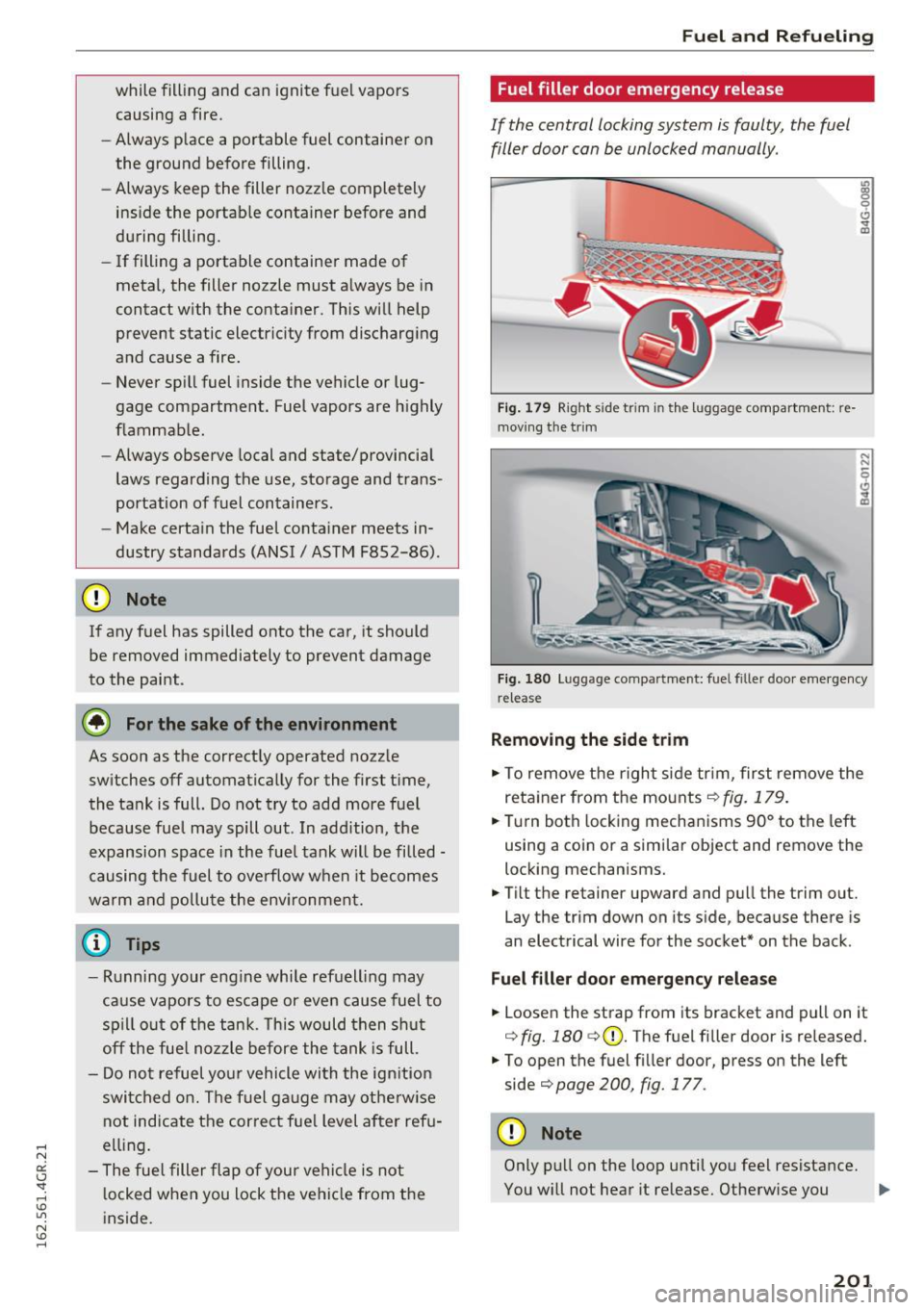
Fig. 179 Right s ide t rim in t he lu ggage compartm en t: re
moving the t rim
Fig. 180 Lu ggage compa rtment: fuel fill er door emergency
release
Removing the side trim
.,. To remove the right side tr im, first remove the
reta iner from the mounts
c:> fig. 179.
... Turn both locking mechanisms 90° to the left
using a coin or a similar object and remove the
locking mechanisms.
• Tilt the retainer upward and pull the trim out.
Lay the trim down on its side, because there is
an electrical wire for the socket* on the back .
Fuel filler door emergency release
... Loosen the strap from its bracket and pull on it
c:> fig. 180 c:>(D. The fuel filler door is released.
.,. To open the fuel filler door, press on the left
side
c:> page 200, fig. 177.
CD Note
Only pull on the loop until you feel resistance.
You w ill not hear it re lease. Otherwise you ..,.
201
Page 216 of 282
Checking and Filling
-If you get battery acid in your eyes or on
your skin, immediately rinse with cold wa
ter for several minutes and get medical at
tention .
- If you should ingest any battery acid, seek
medical attention immediately.
- Do not expose the battery to an open flame,
electric sparks or an open light .
- Do not smoke.
- Do not interchange the positive and nega-
tive cables.
- When working on the battery, be sure not to
short-circuit the terminals with tools or oth
er metal objects. This would cause the bat
tery to heat up very quickly, which could lead to damage or explosion and personal
injury.
- When a battery is charged, it produces hy
drogen gas which is explosive and could
cause personal injury.
- Always keep the battery well out of the
reach of children.
- Before work is done on the electrical sys
tem, disconnect the negative ground cable.
- Before performing any work on the electri
cal system, switch off the engine and igni
tion as well as any electrical equipment. The negative cable on the battery must be dis
connected. If you are just going to replace a
light bulb, then it is enough to switch off
the lights.
- Before disconnecting the battery, switch off
the anti-theft alarm system! Otherwise you
will set off the alarm.
- When disconnecting the battery, first dis
connect the negative cable and then the
positive cable.
- Before reconnecting the battery, make sure
all electrical consumers are switched off.
Reconnect the positive cable first and then
the negative cable. Never interchange the
cables - this could start a fire!
- Never charge a frozen or a thawed-out bat
tery. It could explode! If a battery has fro
zen, then it must be replaced. A discharged
battery can freeze over at 32 °F (0 °C).
- Make sure the vent hose is always attached
to the opening on the side of the battery.
214
- Never use batteries which are damaged .
There is the danger of an explosion! Always
replace a damaged battery.
A WARNING
California Proposition 65 Warning:
- Battery posts, terminals and related acces
sories contain lead and lead compounds,
chemicals known to the State of California
to cause cancer and reproductive problems.
Wash hands after handling.
(D Note
- Do not disconnect the vehicle battery when
the ignition is on or when the engine is run
ning, otherwise, you will damage electronic
components in the electrical system.
- If your vehicle is going to stand for a long
period of time without being driven, protect
the battery from "freezing", otherwise it
will be damaged and will then have to be re
placed .
- When opening the doors, the windows low
er approximately 10 mm automatically. This
function is not available when the battery is
disconnected, which means there is a risk
that the door seal or the window could be
damaged.
Battery charging
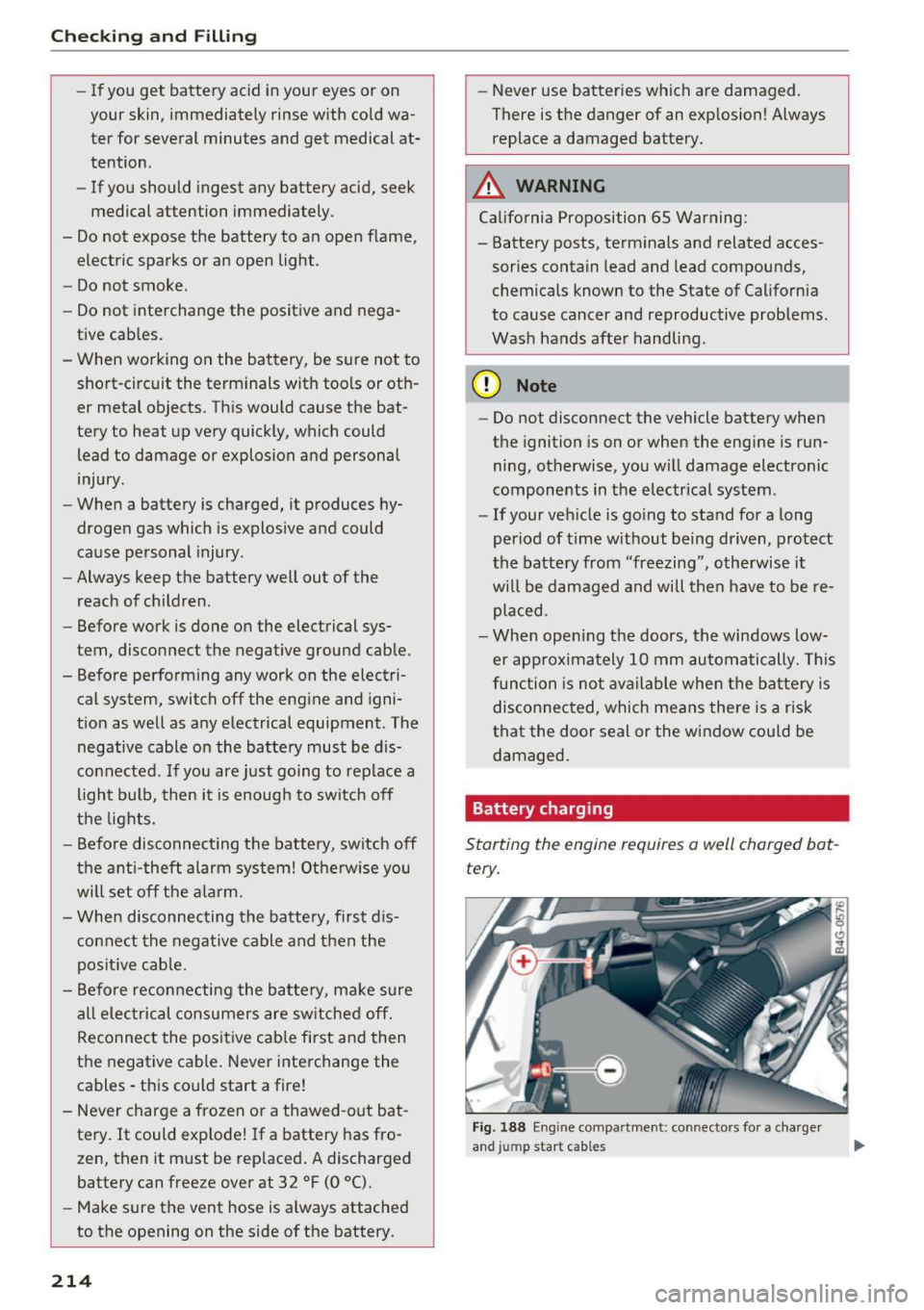
Starting the engine requires a well charged bat tery.
Fig . 188 En g in e compartment: con nectors fo r a charger
and jump start cab les
Page 217 of 282
Always r ead and h eed all W ARNING S below
~ A. and
¢A. in Working on the battery on
page 213.
.,. Switch off the ignition and all electrica l con
sumers .
.,. Make sure the area is well venti lated when you
charge the battery.
.,. Open the engine hood
¢page 203.
.,. Open the red cover on the positive pole
¢fig . 188 .
.,. Connect the charger co nnectors according to
the instructions to the
j ump start bo lt s. (Bolts
under the red cover= "positive", Bolts with hex
head
= "negat ive") .
.,. Only now plug the mains lead for the charging
equipment into the wall outlet and turn it on
¢&_ .
.,. M ake s ure th e char ging rate is not o ver
30 amp s/14.8 Volt.
.,. When the battery is fully charged: Turn the
charg ing equipment off and remove the mains
lead from the wall outlet.
.,. Now remove the clamps for the charging equ ip-
ment.
.,. Close the red cover on the positive pole.
.,. Close the hood
¢ page 204.
A discharged battery can fre eze at temperatures
of only 32 F
0 (0 °C). A llow a frozen battery to
thaw comp lete ly before attempt ing to charge it
¢ ,&. However, we recommend not using a
thawed battery again because the battery casing
can be cracked due to ice formation and can leak
battery acid.
Battery chargin g (Ma ximum cha rging rate of
30 amp s/14 .8 Volt )
When charging at low voltages (e.g. with a trick
le cha rger ),
the battery cables do not have to be
d isconnected first. The battery caps should
not
be opened when charging a battery .
It is not necessary to remove the battery from
the luggage compartment, and it is also not nec
essary to disconnect the cables.
Check ing and Filling
Fast charging the batt ery (charging rate
ab ove 14.8 Volt )
For technical reasons do not use a battery charg
er that uses vo ltage greater than 14.8 Volt to
charge your vehicle's battery.
A WARNING
=
Charging a battery can be dangerous .
-Always follow the operating instructions
provided by the battery charger manufactur
er when charging your battery .
- Never charge a frozen battery. It may ex
plode because of gas trapped in the ice. Al
low a froze n battery to thaw out first .
- Do not reuse batter ies which were frozen.
The battery hous ing may have cracked and
weakened when the battery froze .
- Charge the battery in a well ventilated area.
Keep away from open flame or electrical
spark. Do not smoke . Hydrogen gas generat
ed by the battery is explos ive.
- To reduce the danger of explosion, never connect or d isconnect charge r cables while
the charger is ope rating .
- Fast charg ing a battery is dangerous and
should only be attempted by a competent
technicia n w ith the prope r equipment.
- Batte ry acid that may spill during charging
should be washed off w ith a so lution of
warm water and baking soda to neutra lize
t he acid .
{[) Note
Never use a fast charger as a booster to start
the e ngine. This will se riously damage sensi
tive electronic components, such as control
units, re lays, radio, etc., as well as the bat tery
charge r.
Battery replacement
The new battery must have the same specifica
tions and dimensions as the original equipment
battery .
Intelligent ene rgy manageme nt in yo ur vehicle is
responsib le for distr ib uting the electrica l energy
Iii>-
215
Page 256 of 282

Emergency situations
When jump starting or charging the battery,
never connect the negative ground cable to
the battery negative post because the battery
manager system must be able to detect the
battery's state of charge. Always connect the
negative ground cable to the negat ive ground
post of the battery manager control unit .
Use of jumper cables
Make sure to connect the jumper cable clamps in
exactly the order described below!
Fig. 212 Engine compartment: connectors for ju mp start
cab les a nd charger
® .--l @
Fig. 213 Ju mp start ing wit h the battery o f another vehicle:
@ -boos te r battery ,® -discharged vehicle battery
The procedure described below for connecting
jumper cables is intended to provide a jump start
for your vehicle.
Vehicle with discharged battery:
• Turn off lights and accessories , move lever of
automatic transmission to N (Neutral) or P
(Park) and set parking brake .
Connect POSITIVE(+) to POSITIVE(+) (red)
• Open the red cover on the positive term inal
~ fig . 212.
254
1. Connect one end of the red positive cable on
the
jump start bolt 9 fig. 213 @ (bolt under
the red cover= "positive") of the vehicle to be
started ®·
2. Connect the other end to the positive termi-
nal@ of the booster battery @.
Connect NEGATIVE (- ) to NEGATIVE (-)
(black)
3. Connect one end of the black negative cable
to the negative term inal @ of the booster
battery @.
4 . Connect the other end to the
jump start pin
@ (bolts with hex head bolt= "negat ive") of
the vehicle to be started ®·
Starting the engine
• Start the eng ine of the vehicle with the booster
battery @. Run the engine at a moderate
speed.
• Sta rt engine w ith discharged vehicle ba ttery @
in the usual manner.
• If the engine fails to start, do not keep the
starter cranking for longer than 10 seconds.
Wait for about 30 seconds and then try again.
• With engine running, remove jumper cables
from both vehicles in the exact
reverse order.
• Close the red cover on the positive terminal.
The battery is vented to the outside to prevent gases from entering the vehicle interior . Make
sure that the jumper clamps are well connected
with their metal parts in full contact with the battery terminals.
&_ WARNING
To avoid ser ious personal injury and damage
to the vehicle, heed all warnings and instruc
tions of the jumper cable manufacturer. If in
doubt, call for road service.
- Jumper cables must be long enough so that
the vehicles do not touch.
- When connecting jumper cables, make sure
that they cannot get caug ht in any moving
parts in the engine compartment.
- Before you check anything in the engine
compartment, always read and heed all
WARNINGS
¢ page 203.