warning light AUDI S3 2009 Owners Manual
[x] Cancel search | Manufacturer: AUDI, Model Year: 2009, Model line: S3, Model: AUDI S3 2009Pages: 324, PDF Size: 76.02 MB
Page 209 of 324
_____________________________________________ C_ l_ e _a_ n_ in_ g_a _ n_d_ p_ r_ o_ t _e_ c_t _io _ n __ !II
•
High temperatures, as from exposure to intense sunlight, intens ify
the corrosive effect particularly when humidity is high as well.
Under ce rtain circumstances ,
weekly washing may be necessary .
Under other conditions, a monthly washing and waxing may be
adequate.
After the winter, the
underside of the vehicle should be thoroughly
washed, preferably in a professional car wash.
& WARNING
Always read and heed all WARNINGS and other information
=>
page 206 . •
Automatic car wash
The vehicle can be washed in almost any modern auto
matic car wash.
The vehicle paint is so durable that the vehicle can normally be
washed without problems in an automatic car wash . However , the
effect on the paint depends to a large extent on the design of the
facility, the filtering of the wash water, the type of wash and care
material, etc. If the paint has a dull appearance after going through
the car wash or is scratched, bring this to the attention of the oper
ator immediately . If necessary, use a different car wash .
Before going through a car wash, be sure to take the usual precau
tions such as closing the windows and panoramic sliding sunroof *.
Remove antenna if applicable.
If you have installed additional accessories on the vehicle -such as
spoilers, roof rack , etc. -it is best to ask the car wash operator if
these should be removed .
& WARNING
Always read and heed all WARNINGS and other information
=> page 206. •
Washing the vehicle by hand
A lot of water is needed when washing a vehicle by hand.
-Before you start washing, make sure you have read and
understood the WARNINGS=:>
& in "General informa
tion" on
page 206 .
-First soak all dried dirt until it is soft, then rinse it off.
- As you clean your vehicle, start with the roof and work
your way down to the bottom , using a sponge, a sponge
glove or a clean brush.
- Rinse the sponge or the sponge glove often, flushing it
clean each time.
- Use special car shampoo only for very persistent dirt.
- Rinse the car thoroughly with water.
- Use a chamois leather to gently wipe the exterior dry.
Use a separate sponge for cleaning the wheels, door sills and other
regions exposed to road dirt. In this way , you will not scratch the
paint with coarse particles imbedded in the sponge the next time
you wash the car.
& WARNING
• Do not clean the underside of the chassis, fenders, wheel
covers, or other hard to reach parts without protecting your hands
and arms. You may cut yourself on sharp-edged metal parts . .,
Vehicle care
I t •
Page 210 of 324

., __ C_ le_ a _ n_i_n ~g _ a_ n_ d __ p_r _o _t _e _c_ t_ i_o _n ___________________________________________ _
& WARN ING (c o ntinu ed )
• Always read and heed all WARNINGS and oth er informat ion
~ page 2 06.
0 Not e
• Never try to remove dirt, mud or dust if the surface of the vehicle
is dry. Never use a dry cloth or sponge, since this cou ld scratch your
veh ic le's paint or w indows .
• Never wash your car in bright sunlight. Drops of water act as
magnifying lenses and may damage your paint.
• When you wash your car in the winter : if you rinse your vehic le
with a hose, be careful not to aim the stream of water directly at
locks, or at door or hatch openings -they can freeze shut.
• Never use sponges designed to remove insects, or any kitchen
scouring s ponges or simila r products. They can damage your paint
finish .
• Never use a dry cloth or sponge to c lean the head ligh ts. O nly use
wet cloths or sponges to prevent scratches . It is best to use soapy
water.
c£, For the sake of the environment
In the interest of the environment, the vehicle shou ld on ly be
washed in specia l wash bays. •
Washing your vehicle with a power washer
Cleaning the exterior of your car wi th a high -p ressure
power washer is safe as l ong as y ou observe a few simple
rules .
-Before us ing the p ower washer, make s ure you have read
and unde rs too d t he WAR NINGS=:>
& in "General in for
mati on" o n
page 206.
-Always follow the operati ng inst ructions fo r th e pow er
washer.
Make sure that the jet on t he spray hose produces a "fan
sha ped sp ray".
D o
not hold the spray nozzle too close to soft materials.
When cleaning the vehicle with a power washer always follow the
opera ting instructions. Th is applies particularly to the
operating
pre ssure
and the spraying distance . Maintain a sufficient distance
t o soft ma teria ls such as rubber hoses a nd sound/vibrat ion dead
ening materia ls (particularly on the underside of the engine hood).
Do not use a jet which sprays water in a
direct stream o r one tha t
has a
rotating j et.
Water temperature shou ld not exceed 140 °F (60 °Cl.
& WARNING
Never wash tires with a jet that sp ray s water in a dire ct stream .
This could c ause invi sible damage to the tire s and we ake n them ,
even if the spray i s from a relatively long distan ce and for a short
time . D amag ed and weakened tires can fail and cau se ac cident s
a nd p erson al injury.
0 Note
To avoid damaging your vehic le, always make sure that there is
suffic ient distance between the spray hea d and so ft m ateria ls like
rubber hoses, plastic parts and sound -deadening materials . Never
aim the spray head at the same p oint for a l ong time . This a lso
applies to cleaning head lights and painted bumpers . Remember:
t he c loser the n ozzle is to the surface of the materia l, the greater the
stress on the material. •
Page 211 of 324

_____________________________________________ C_ l_ e _a_ n_ in_ g_a _ n_d_ p_ r_ o_ t _e_ c_t _io _ n __ lfll
•
Waxing
Wax prote cts the vehicle's paint.
- Use a manually applied car wax occasion ally to protect
t h e paint.
A good wax coating protects the vehicle paint to a large extent
against th e environm ental factors listed under~
page 206,
"Washing" and even against slight scratches .
You can use a liquid car wax to protect your paint as soon as one
wee k after you r vehic le has been delivered .
Even if you regularly use a
waxing process in automatic car washes,
we recommend that you manua lly app ly a coat of wax to give the
paint e xtra protection, par ticu lar ly if water no longer beads on the
clean paint.
Protec t plastic body parts with car wax in the same way as the
vehic le body.
During warm weather dead insects tend to col lect on the front
bumpe r and on the forward area of the hood. They are much easie r
to remove from paint that is waxed
often.
& WARNING
Always read and heed all WARNINGS and other information
~ page 206 .
0 Note
Do not use ca r wax on
• matte or anodized meta l trim
• rubber or rubber -like trim. •
Polishing
Polishi ng resto res the gloss to the p aint.
Po lish your vehic le on ly if the paint has lost its shine and the g loss
cann ot be brought back wi th wax .
I f the polish used does not contain preservative compounds , the
paint must be waxed afterwards~
page 209, "Waxing".
& WARNING
Always read and heed all WARNINGS and other information
~ page 206 .
0 Note
Do not treat matte anodized metal trim, plastic or rubber parts with
polish or wax .•
Trim strips
Metal trim needs special c are.
Fo r envi ronmental reasons, Audi fab ricates the bright trim strips
and trim pieces from pure chromium -free aluminum .
Dirt and marks on the trim strips should be removed with a
pH
balanced
c leaning agent (do no t use a chr ome clean er). Authorized
Audi dea lers carry c leaning products which have been tested for use
on your vehicle and are not harm fu l to the enviro nment .
To avoid corrosion on the exterior trim strips , only a pH -ba lanced
solution shou ld be used for the windshield washer .
& WARNING
Always read and heed all WARNINGS and other information
~ page 206 .•
Vehicle care I t •
Page 212 of 324

-~_C_ l_ e _a _n_ in_g=- a _n_d__, p,__ ro_ t_e _c_ t_ i_o _n _____________________________________________ _
Plastic and vinyl
Plastic needs special care.
Use a clean, damp cloth or sponge to remove dust and light surface
dirt. For other soil, use a lukewarm all -purpose cleaning solution or
a mild saddle soap for vinyl trim. Remove water spots and traces of
soap with a clean, damp cloth or sponge . Use a clean, soft cloth to
rub dry .
Grease, tar or oil stains can be removed with a clean cloth or sponge
soaked with all-purpose cleaner or with a solvent designed espe
cially to clean vinyl.
Occasionally apply a colorless vinyl or leather preservative to retain
the material's luster and pliability.
& WARNING
Always read and heed all WARNINGS and other information
~ page206. •
Aluminum trim
Use only neutral-pH products to remove spots and deposits from
aluminum surfaces. Chrome care products and alkaline cleaners
will attack aluminum surfaces and can damage them over time.
& WARNING
Always read and heed all WARNINGS and other information
~ page206 .•
Touch-up paint
Minor paint damages should be touched up immediately.
-Use either a touch -up paint stick or spray paint to cover
minor scratches and nicks.
Your authorized Audi dealer has touch-up paint for minor scratches
and stone chips. Scratches should be touched up soon after they
occur to prevent corrosion.
If a spot starts to rust, however, a simple touch-up job will not be
enough. The affected surface must be sanded smooth and coated
with an anti-rust primer before the painted finish can be restored.
The number for the original vehicle paint can be found on the
vehicle identification label~
page 298 .
& WARNING
Always read and heed all WARNINGS and other information
~ page206.•
Windows
Clear vision to all sides.
Clean all windows regularly to remove road film and
carwash wax buildup.
- Remove snow from windows using a brush.
- Use a plastic ice scraper to remove ice from windows and
mirrors.
- Remove other residue on the windows with a spray-on
glass cleaner.
- Wipe the windows dry with a clean piece of cloth or
kitchen paper towel.
Page 214 of 324
-Cleaning and prot
ection
-~--------------
Paint scratches should be touched up as soon as possible to prevent
corrosion => page 210, "Touch -up pain t" .
& WARNING
• Moi sture and i ce on brak es may affect b raking efficiency -
=> page 193 , "Gene ral inform ation ". Te st the brakes caref ully a fter
e ac h veh icle was h.
• Alway s read and heed all WARNING S and t he infor mation
=> page 206. •
App lies to vehi cles : w ith Cast a lloy whee ls
Cast (light) alloy wheels
Cast (light) alloy wheels require special care.
- Wash the wheels with a spo nge or hose brush every
o ther week .
- For deep cleaning afte rwards, use only a dedicated
a cid
free
cast alloy whee l cleaner.
- Rub a coat of
liquid wa x onto the rims every t hree month .
Be sure to reach and treat all parts of the rim.
To preserve the decorative appearance of the cast alloy wheels,
some special care is necessary. In addition to road dirt and salt, brake dust is also corrosive . If left on for too long, brake dust can
cause pitting.
Use on ly specia l acid -free cleaners formu lated for a lloy rims . Safe
products are available at your authorized Audi dealer. Never leave
the cleaner on the rims longer than specified on the label. If not rinsed off promptly, the acid contained in some cleaners can attack
t he threads on the wheel bolts. Never use abrasive or metal po
lishing cleaning agents . If the protec
t ive coating has been chipped, e.g . by kicked up road dirt, touch it
up as soon as possib le.
& WARNING
• Moisture a nd ice on br akes m ay affect braking efficien cy
=> page 193, "Gen eral inf or mation ". Te st the brake s carefully each
ti m e you wa sh th e vehi cle .
• Always read and heed all WARNINGS and other informa tion
=> page 206 . •
Body cavity sealing
T he body cavity se aling does not need to be checked.
All body cavities which could be affected by corrosion have been
thorough ly protected a t the factory .
This sealing does not require any inspection or additional treat
ment . If any wax should seep out of the cavi ty when the amb ient
temperature is high, it can be removed with a p lastic scraper and a
suitable solvent .
& WARNING
Solvents can be dangerous .
• Ben zin e is flamm able and to xic. If you use b en zi ne for re moving
the wax, keep spark s, flame and lighted cigarette s away . Never
dump ben zine on the ground , into open st ream s or do wn sewage
dr ain s.
• Be sure to ob serve all safet y and env ironmental regul atio ns .
Follow all in stru ction s on the c ont ainer .
• Always read and heed all WARNINGS and ot her info rm ation
=> page 206 . •
Page 218 of 324

___ C_ le_ a _ n_i_n ~g _ a_ n_ d __ p_r _o _t _e _c_ t_ i_o _n ___________________________________________ _
Leath er ca re
- Every half year use an approved leather care product
(available from your authorized Audi dealer) to care for
the leathe r.
- App ly the product very spar ingly .
- Wipe it off wit h a damp cloth.
If you have any questions about c leaning and caring for the lea ther
in your vehic le, it is best to contact your authorized Audi dea ler, who
wi ll be glad to help you and te ll you about our full range of leather
care products, such as :
• Leather cleaning and care kit
• Creams to care for co lored leather
• Spot removers for bal lpoint pens, shoe polish, etc.
• Oil/grease disso lving spray
• New and upcoming pr oducts.
& WARNING
Alway s read and heed all WARNINGS and other informat ion
=> page 206.
0 Note
• Never use chemical solvents (e .g. lighter f luid, turpentine),
waxes, shoe po lish or s imilar products on the leather surfaces in
your Audi.
• To avoid damage, have stubborn stains removed by a commer
cia l cleaning specialist. •
Applies to vehi cles: w it h A lcantara up hols te ry
Cleaning Alcantara ® (synthetic suede)
Removing dust and dirt
- Mois te n a cl oth, squeeze out e xcess wa ter and w ipe dow n
t h e seat surfaces.
Removing stains
- Mois ten a cloth wit h lukewarm water or with diluted
ethyl (rubbing ) alcohol.
D ab at the stain . Start at the outside and wor k inwards.
O nce the s ta in i s no longer v isib le, use a sof t dry clo th or
t issu e to soak up t he moistur e.
D o no t use leather cleaning produc ts on A lcantara.
You may use a suitable shampoo for re moving dust and dirt.
Dust and grit in the pores and seams can scratch and damage the
sur face. If the car is left s tanding in the s un fo r long periods, the
A lcantara shou ld be protected against direct sunl ight to prevent it
from fading. S ligh t co lor var iations w ill deve lop in no rmal use a nd
are not an indication of materia l deterioration .
0 Note
• Never use chemical so lvents (e .g . lighter fluid, turpentine),
waxes, shoe polish or similar products on Alcantara ® surfaces.
• To avoid damage, have stubborn stains removed by a commer
cia l cleaning specialist.
• Do not use brushes, stiff sponges or similarly abrasive cleaning
aids .•
Page 219 of 324
_____________________________________________ C_ l_ e _ a_ n_ in--= g'--- a_n _d___, p_ r _o_ te_ c_t _io _ n __ fflllll
•
Safety belts
Only well-maintained safety belts work reliably when
needed.
- Keep belts clean.
- For cleaning, use a mild soap and water solution. Let
belts dry thoroughly and away from direct sunlight.
- Do not allow inertia reel safety belts to retract before
they are completely dry.
- Check the condition of your safety belts
regularly.
Heavily soiled safety belts may not retract properly.
& WARNING
Damaged safety belts can break in a crash .
• Anything that might damage your safety belts could mean that
you and your passengers would not be adequately protected in an
accident.
• Safety belt performance depends on correct installation. Never
remove belts from the vehicle to clean them .
• Do not use chemical cleaning agents, bleach or dyes. They have
corrosive properties which weaken the webbing.
• When cleaning your safety belts, inspect them for damage. If
you discover damage, see your authorized Audi dealer.
• Always read and heed all WARNINGS and other information
=:, page 206. •
Engine compartment
Be especially careful when cleaning the engine compart
ment.
Always switch off the ignition before cleaning the engine =:> &.
Plenum panel
Remove leaves from the plenum panel in front of the windshield
under the engine hood. This prevents the water drain holes from
becoming blocked, and it prevents debris from entering the vehicle
interior through the heating and ventilation ducts .
Corrosion protection
The engine compartment and transmission have been corrosion
protected at the factory.
Good anti-corrosion treatment is very important, particularly in the
winter. If the vehicle is frequently driven on salt treated roads, the
entire engine compartment and plenum panel should be thor
oughly cleaned at the end of winter and retreated to prevent salt
damage. At the same time, the underside of the vehicle should be
washed as well.
If the engine compartment is cleaned at any time with grease
removing solutions
3l, or if you have the engine washed , the anti
corrosion treatment is almost always removed as well . It is therefore
essential to have a long-lasting corrosion protection reapplied to all
surfaces, seams, joints and components in the engine compart
ment.
& WARNING
Be aware: The engine compartment of any motor vehicle is a
potentially hazardous area.
• Before working in the engine compartment, be sure to read the
information
=:> page 217 . .,,_
31 Use only the correct cleaning solutions. Never use gasoline or diesel fuel.
Vehicle care I t •
Page 226 of 324
___ C_h_ e_ c_k _in --== g'-- a_n _d_ f_il _li _n ..:::g:::..- ___________________________________________ _
Checking and filling
Engine hood
Releasing the engine hood
The engine hood is released from inside the vehicle.
-Open the driver's door .
Fig. 167 Driver's side
footwell: engine hood
release lever
-Pull the release lever on the left under the instrument
panel
~ fig. 167 in direction of the arrow.
The hood pops up slightly under spring pressure. •
Opening the engine hood
Fig. 168 Engine hood
release lever
Before opening the engine hood, make sure that the wind
shield wipers are folded flat against the windshield. Other
wise, they could damage the paint on the hood.
Pull the release lever~ fig. 168 in the direction indicated
by the arrow. This release the hook under the hood.
- Open the hood all the way.
& WARNING
Hot engine coolant can burn you!
• To reduce the risk of being burned, never open the hood if you
see or hear steam or coolant escaping from the engine compart
ment. Wait until no steam or coolant can be seen or heard before
carefully opening the hood. •
Page 231 of 324
___________________________________________ C_ h_e _c_ k_ i_n _g _ a_n _d_ f_il _li _n _g __ ffllll
•
the form of Service or Repair Orders that all schedu led maintenance
was performed in a time ly manner .•
Engine oil consumption
The engine in your vehicle depends on an adequate
amount of oil to lubricate and cool all of its moving parts.
In order to provide effective lubrication and cool ing of internal
engine components , all internal combustion engines consume a
certain amount of oil. Oil consumption varies from engine to engine
and may change significantly over the life of the engine. Typically,
engines with a specified break -in period (see~
page 197) consume
more oil during the break-in period than they consume af ter oi l
consumption has stabi lized .
Unde r normal conditions, the rate of oil consumption depends on
the quality and viscosity of the oil, the RPM (revolutions per minute)
at which the engine is operated, the ambient temperature and road
conditions . Further factors are the amount of oil dilution from water
condensation or fuel residue and the oxidation level of the o il. As
any engine is subject to wear as mileage builds up, the oil consump
tio n may increase over time unt il rep lacement of worn components
may become necessary.
W ith all these variables coming into play, no standard rate of oil
consu mption can be estab lished or specified. There is no a lternative
to regular and frequent checking of the oil level, see
Note .
If the yellow engi ne oil level warning symbol in the instrume nt
cluster lights up, you should check the oil level as soon as
poss ible
with the oil dipstick~ page 229 . Top off the oil at your
earliest convenience~
page 230.
& WARNING
Before you che ck anything in the eng ine comp artment , alw ay s
read and heed all WARNINGS
~ & in "Working in the engine
c ompartment " on
page 22 5.
0 Note
Driving with an insufficie nt o il level is l ikely to cause severe damage
to the engine.
[ i ] Tip s
• The oil pressure warning displ ay ce,. is not an indi cat or of the oil
level . Do not rely on it. Instead , check the oil level in your engine at
regular interv als , prefe rably ea ch time you refuel , and always before
going on a long trip.
• If you have the impression your engine consumes excessive
amoun ts of oil, we recommend that you consu lt your authorized
Audi dealer to have the cause of your concern proper ly diagnosed .
Keep in mind that the accura te m easuremen t of oil consumption
requires great care and may take some time . Your authorized Audi
dea ler has instructions about how to measu re oil consumption
accurately .•
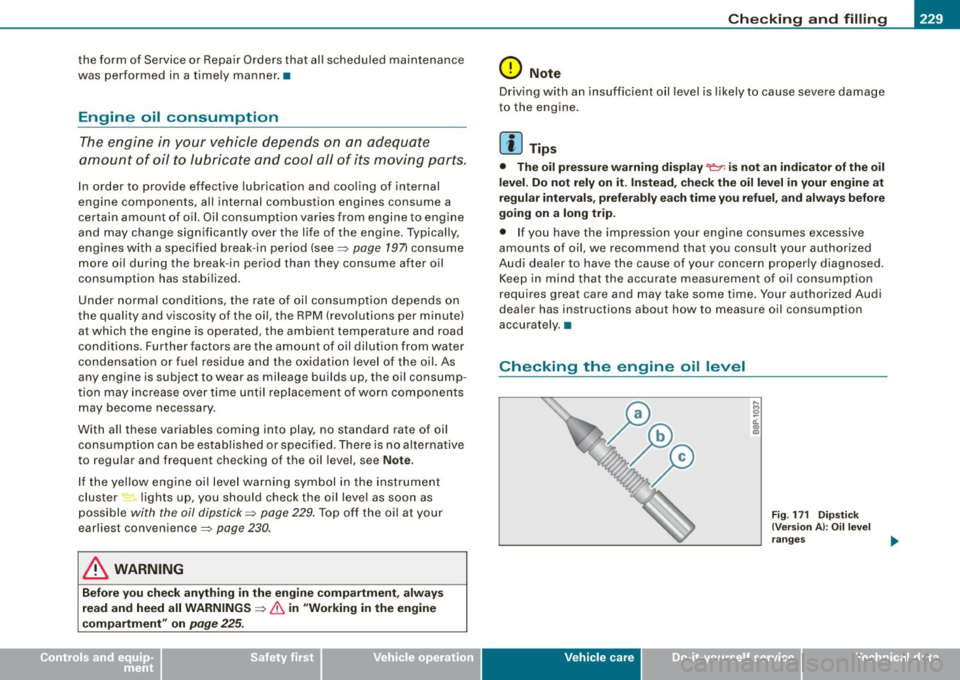
Checking the engine oil level
Vehicle care I t •
Fig . 171 Dip sti ck
( V ersio n A):
Oil le vel
ran ges
Page 235 of 324
Checking and filling -
---------------------=----"=---------
0 Note
• Before winter sets in, have the coolant checked to see if the
coolant additive in your vehicle is sufficient to meet the climate
conditions. This is especially important if you live in a region where
the winter is extremely cold. If necessary, increase the proportion of
coolant additive to 60%.
• When adding coolant additive to your cooling system,
remember:
-We recommend using only coolant additive G12+ + (check the
label) for your vehicle. This coolant additive is available at autho
rized Audi dealers. Other types of antifreeze can significantly
reduce corrosion protection . The resulting corrosion can cause a
loss of coolant and serious engine damage .
• Do not add any type of radiator leak sealant to your vehicle's
engine coolant. Adding radiator repair fluid may adversely affect the
function and performance of your cooling system and could result
in damage not covered by your New Vehicle Limited Warranty .•
Checking the engine coolant level
The engine coolant level can be checked with a quick
glance.
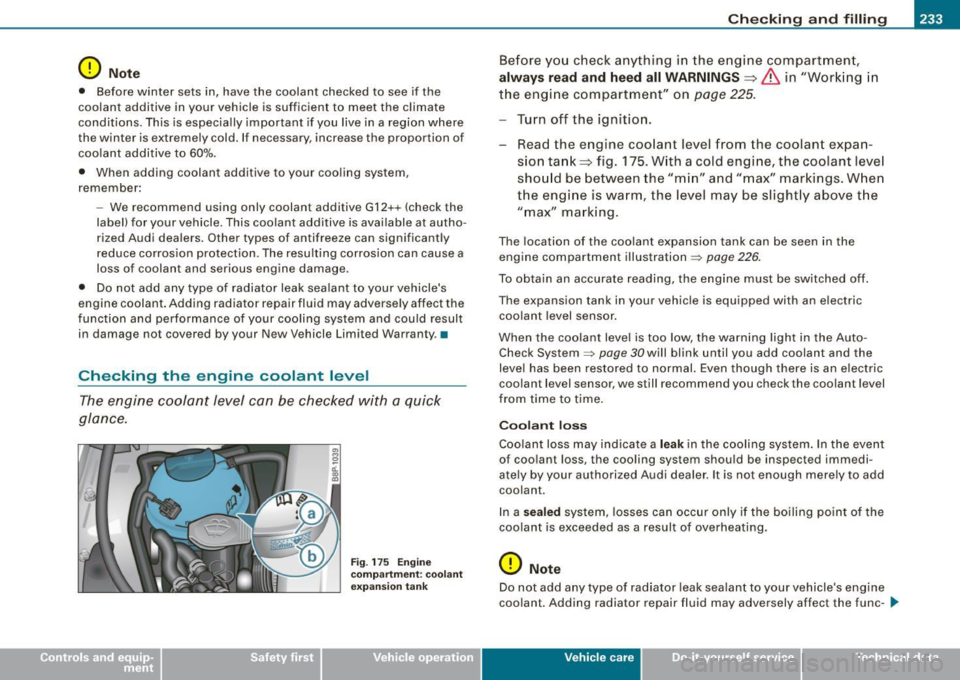
Fig . 175 Engine
compartment : coolant
expansion tank
Before you check anything in the engine compartment,
always read and heed all WARNINGS==> & in "Working in
the engine compartment" on
page 225.
Turn off the ignition.
Read the engine coolant level from the coolant expan
sion tank==> fig. 175. With a cold engine, the coolant level
should be between the "min" and "max" markings. When
the engine is warm, the level may be slightly above the
" max" marking.
The location of the coolant expansion tank can be seen in the
engine compartment illustration=>
page 226.
To obtain an accurate reading, the engine must be switched off.
The expansion tank in your vehicle is equipped with an electric
coolant level sensor.
When the coolant level is too low, the warning light in the Auto
Check System =>
page 30will blink until you add coolant and the
level has been restored to normal. Even though there is an electric
coolant level sensor, we still recommend you check the coolant level
from time to time.
Coolant loss
Coolant loss may indicate a leak in the cooling system. In the event
of coolant loss, the cooling system should be inspected immedi
ately by your authorized Audi dealer. It is not enough merely to add
coolant.
In a
sealed system, losses can occur only if the boiling point of the
coolant is exceeded as a result of overheating.
0 Note
Do not add any type of radiator leak sealant to your vehicle's engine
coolant. Adding radiator repair fluid may adversely affect the tune- _..
Vehicle care I I Technical data