warning light AUDI S3 2009 Owners Manual
[x] Cancel search | Manufacturer: AUDI, Model Year: 2009, Model line: S3, Model: AUDI S3 2009Pages: 324, PDF Size: 76.02 MB
Page 236 of 324
-~_C_ h_e _c _ k_ i_n ...:::g::;...._ a_n_ d_ f_ i_ll _in -'g:::;.._ ___________________________________________ _
tion and performance of your cooling system and could resu lt in
d am age not co vered by yo ur Ne w Vehicle Li mited Warranty .•
Adding coolant
B e very caref ul whe n addin g engine c oo lant.
Before you check a nything in the e ngine compartmen t,
always read and heed all WARNINGS=> & in "Work ing in
the en gine compartmen t" on
pa ge 225.
- Turn off the engine.
- Le t the engin e coo l down.
Place a thi ck ra g o ver th e c oolan t expansio n ta nk
=> pa ge 233, fi g. 1 75 a nd carefully twi st th e cap coun te r
cl ockwi se
=> &.
- Add cool ant.
- Twist the cap on aga in
tightly.
Replacement engine coolant must conform to exact specifications
~ page 232, "Coola nt". Even in a n eme rge ncy, if co olant add itive
G 12++. G12+ or G 12 is not availab le, do
not use a diffe rent additive.
Use plain water instead unt il you ca n get the c orrect additive and
can restore the correct ratio . This should be done as soon as
possible.
If you have lost a considerable amount of coo lant, then you should
add co ld antifreeze and cold water only when the engine is cold.
A lways use
new e n gin e c oolan t wh en refi llin g.
Do not fi ll coo lant above the "MAX" mark. Excess coolant will be
f o rced ou t through the pressure re lief va lve in the cap when the
engine becomes hot.
& WARNING
• The cooling system is under pressure and can get very hot .
Redu ce the risk of scalding from hot coolant by following these
steps .
- Turn off the engine and allow it to cool down.
- Protect your face , hands and arms from e scaping fluid and
steam by covering the cap with a large, thick rag.
- Turn the cap slowly and very carefully in a counter -clockwise
direction while applying light , downward pressure on the top
of the cap.
- To avoid being burned , do not spill antifreeze or coolant on
the e xhaust system o r hot engine parts . Under certain condi
tions , the ethylene glycol in engine coolant can catch fire.
• Antifreeze is poisonous . Always store antifreeze in its original
container and well out of the rea ch of children.
• If you drain the coolant , it must be caught and safely stored in
a proper container clearly marked "poison".
0 Note
• Coo la n t po llutes t he environ ment and cou ld cause a n engine
fire . Excess coolant will be forced out through the pressure re lief
va lve in t he cap when t he eng in e b ecomes hot .
• I f, in an emergency, on ly water can be added, the correct ratio
be tween wa ter and antifree ze~
page 232 mus t be restore d as soon
as possib le .
'£> For the sake of the environment
D rained coolant should not be reused. Always d ispose of used
coo la nt whi le observing all e nvi ro n men tal reg ulat ions .•
Page 237 of 324
Checking and filling -
---------------------=----"=---------
Radiator fan
The radiator fa n switches on au toma tically by i tself.
T he e lectric radiator fan is control led bythermoswitches that switch
on and off depending on coolan t and engine compar tm ent temper
atures .
An auxiliary e lectric radiator fan * switches on and off depending on
coolant temperature and other vehicle operation conditions.
After switching off the engine , the auxiliary fan -even with the igni
tio n off -ca n co ntinue runni ng for u p to 10 minutes. It can even
switch on again later by itself=>&, if
• the temperat ure of the engine coolant rises due to the heat
build -up from the engine in the engine compartment, or
• t he engine co mpart men t heats up because the vehicle is parked
in intense sunlight.
& WARNING
• To reduce the risk of personal injury never tou ch the r ad iator
fan .
• The auxiliary electric fan is temperature controlled and can
switch on suddenly even when the engine i s not running .
• The auxiliary radiator fan switches on automatically when the
engine cool ant reache s a certain temperature and will continue to
run until the coolant temperature drop s. •
Brake fluid
Checking brake fluid level
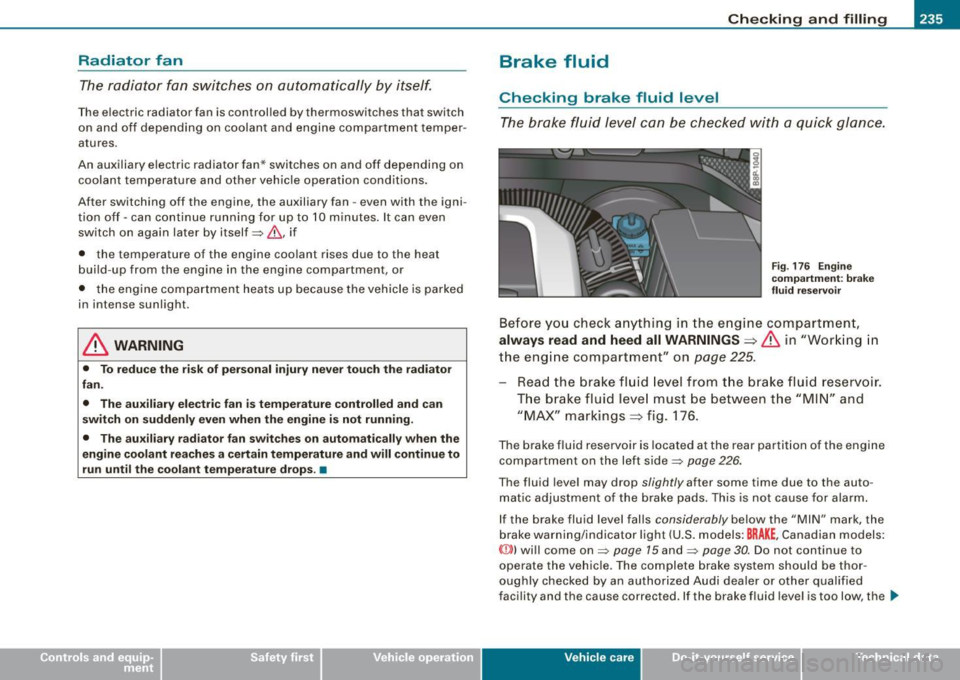
The bra ke flu id l evel can be che cke d wi th a q uick gla nce.
Fig . 17 6 Engine
c o mpartment : brake
fluid re ser vo ir
Be fore yo u check anythin g in the e ng ine compar tm ent,
always read and heed all WARNINGS=> & in "Working in
t h e eng ine compartment" on
page 225.
Read t he brake fl uid lev el from t he brake flui d res ervoir .
T he b rak e fluid l eve l must b e between the
"MI N" and
"M AX" markings => fig. 176.
The brake f luid reservoir is located at the rear pa rtit ion of the engine
compartment on the left side=> page 226.
T he fluid leve l may drop slightly after some time due to the auto
ma tic adjustment o f the brake pads. Th is is not cause for alarm .
I f the brake flu id leve l falls considerably below the "MIN" mark, the
brake warning/indicator light (U.S . models :
BRAKE, Canadian models:
ID ) will come on=> page 15 and=> page 30. Do not continue to
operate the vehic le . The complete brake system should be thor
oughly checked by an au thorized Audi dealer or other qualified
facility and the cause corrected. If the brake fluid leve l is too low, the .,,_
Vehicle care I I irechnical data
Page 238 of 324
___ C_h_ e_ c_k _in --== g'-- a_n _d_ f_il _li _n ..:::g:::..- ___________________________________________ _
brake warning/indicator light will illuminate . Contact an authorized
Audi dealer
i m medi at ely.•
Changing brake fluid
Have the brake fluid changed by an experienced techni
cian.
Brake fluid absorbs moisture from the ai r. If the water content in the
brake fluid is too high, corrosion in the brake system may result
after a period of time. The boiling point of the brake fluid wil l also
decrease considerably and decrease braking performance .
Therefore, the brake fluid must be changed
e ver y two years. Always
use new brake fluid which conforms to Federa l Motor Vehicle Stan
dard "FMVSS 116 DOT 4" .
The brake fluid reservoir can be difficu lt to reach , therefore, we
recommend that you have the brake fluid changed by your autho
rized
Audi d ealer. Your dealer has the correct tools, the right brake
fluid and the know-how to do this for you.
& WARNING
• Bra ke fluid i s poisonous . It mu st be stored on ly in the close d
ori ginal container out of the rea ch of children!
• Bra ke fa ilure can result from old or inappropri ate brake fluid .
Observe the se pre caution s:
- Use o nly brake fluid that meets SAE spe cifi ca tion
J 170 3 and
c onform s to Fed era l Moto r Vehic le Sta nda rd 116 . Always c heck
w ith your authori zed Audi de aler to m ake sure you are using
the correct brake fluid. The corr ect type of brake fluid i s als o
indi cated o n the br ake fl uid reser vo ir.
- The br ake flu id mu st be ne w. Hea vy use of the brake s can
c au se a vap or lo ck if the bra ke fluid i s left in the system too
long. Thi s can seriou sly affect the efficienc y of the brake s as
we ll as your safet y. Thi s co uld re su lt in an acci dent .
0 Note
Brake fluid wi ll damage the paint of your vehicle .
<£' For the sake of the environment
Because o f the problem of prope r disposal of brake flu id as we ll as
the special tools required and the necessary expertise, we recom
mend that you have the brake fluid changed by your authorized Audi
dea ler. •
Battery
General information
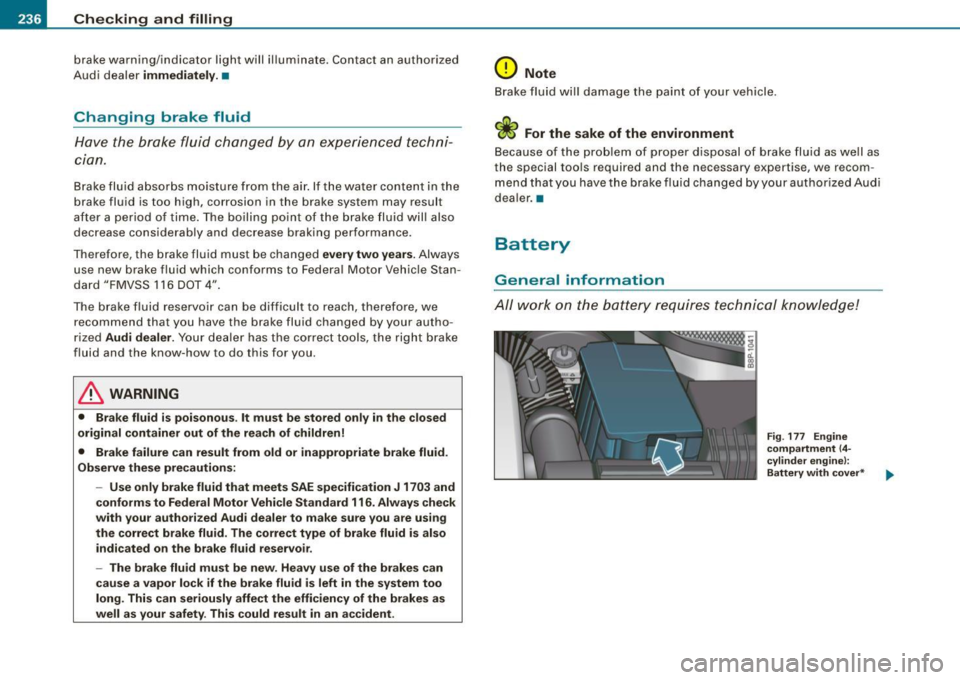
All w ork on the battery requires technical knowledge!
Fi g. 177 E ng ine
co mp artm ent (4 -
c yli nder engin e):
Bat tery w it h cove r"
Page 241 of 324
___________________________________________ C_ h_e _c_ k_ i_n _g _ a_n _d_ f_il _li _n _g __ lR
•
& W ARNING (continu ed )
• Always wear eye protection. Do not let battery acid or any lead
particles get on your skin or clothing . Shield your eyes. Explosive
gases can cause blindness or other injury !
• Battery acid contains sulfuric acid . Sulfuric ac id can cause
blindness and severe burns .
- Always wear gloves and eye protection. Do not tilt the
battery because acid could leak out of the ventilation openings.
- If you get battery acid in your eyes or on your skin , immedi
ately rinse with cold water for several minutes and get medical
attention .
- If you should ingest any battery acid , seek medical attention
immediately .
• Do not expose the battery to an open flame , electric sparks or
an open l ight .
• Do not smoke.
• Do not interchange the positive and negative cables .
• When working on the batte ry , be sure not to short -circuit the
terminals with tools or other metal objects . This would cause the
battery to heat up very quickly , whi ch could lead to damage or
explosion and personal injury .
• When a battery is charged , it produces hydrogen gas which is
explosive and could cause personal injury .
• Always keep the battery well out of the reach of children .
• Before work is done on the electrical system, disconnect the
negat ive ground cable .
• Before performing any work on the electrical system , switch off
the engine and ignition as well as any electrical equipment . The
negative cable on the battery must be disconnected . If you are just
going to replace a light bulb , then it is enough to switch off the
lights.
• Before disconnecting the battery , sw itch off the anti-theft
alarm sy stem! Otherwise you will set off the alarm.
& W ARNING (continued )
• When disconnecting the battery, first disconnect the negative
cable and then the positive cable.
• Before reconnecting the battery , make sure all electrical
consumers are switched off. Reconnect the positive cable first and
then the negative cable . Never interchange the cables -this could
start a fire!
• Never charge a frozen or a thawed -out battery. It could
explode!
If a battery has frozen , then it must be replaced . A
discharged battery can freeze over at 32 °F (0 °CI.
• Make sure the vent hose is always atta ched to the opening on
the side of the battery.
• Never use batteries which are damaged . There is the danger of
an explosion! Always replace a damaged battery .
& WARNING
California Proposition 65 Warning:
• Battery posts , terminals and related accessories contain lead
and lead compounds , chemicals known to the State of Californi a
to cause cancer and reproductive problems . Wash hands after
handling.
0 Note
• D o not d iscon nect the veh ic le bat tery w hen the ign it io n i s
switched on or when the engine is ru nning, otherwise, you wi ll
da mag e ele ctro nic c ompo nents in the e lectr ical system.
• Appl ies to vehic les with 4 -cylinde r engine: When working on the
eng ine, protec t th e batter y hous ing from ultrav iolet ( UV) rays by not
parking the vehicle in direct sun light .
• If y our veh icl e is goi ng to sta nd for a lo ng period o f time with out
being dr iven, protect the battery from "freezing", otherwise it will
b e dama ged and w ill t hen ha ve to be replaced .•
Vehicle care
I t •
Page 242 of 324
-~_C_ h_e _c _ k_ i_n ...:::g::;...._ a_n_ d_ f_ i_ll _in -'g:::;.._ ___________________________________________ _
Applies to vehicles: w ith 4-cy linder engine
Charging of battery (4 -cylinder engine)
All work on the battery requires technical knowledge!
A charged battery ensures good star ting performance. A
discha rged battery can
freeze at temperatures of only O °C.
A thawed battery must be replaced, as the battery housing may be cracked due to freez ing and could therefore leak
acid .
-Always read and heed all WARNINGS below=> & and
=> & in "Working on the battery" on
page 238.
-Sw itch off the ignit ion and all e lectr ica l co nsumers .
- Make s ure the a rea is we ll ven tilated when y ou c harge
the batte ry.
- Connec t cha rger cab les.
Charger cable s mu st alway s be
conne cted POSITIVE
G) to POSITIVE G) and NEGATIVE Q
to NEGATIVE Q.
- Switch on the charger.
- Make sure the charging rate is not over 6 amps.
- Turn off th e ch arge r=> & .
- Disconnect the c harger cables.
- Connect both battery cables to the battery if necessary -
first plus, then minus .
The battery must not be opened!=> 0 in "General information" on
page 236.
It is not necessary to remove the battery from the engine compart
ment, and it is also not necessary to disconnect the cables .
Normally, a battery shou ld be charged at no more than 10 percent
of its rated capacity. For example, a charging
current of 4.5 amps would be used on a
b attery rated at 45 Ah. Rated capacity of the battery in your vehic le
is listed on the battery housing.
The battery caps should
not be opened when charging a battery .
& WARNING
Charging a battery c an be dangerou s.
• Never ch ar ge a fro zen batt ery. It m ay ex pl ode be cause of g as
trapped in the i ce. Allow a fro zen battery to thaw out fir st.
• Do not reu se b atteries whic h w ere fro zen . The batter y housing
ma y hav e cra cked and weakened when the batter y fro ze.
• Charge the b atter y in a w ell vent ila ted area . K eep away from
open flame or e le ctric al s p a rk . Do not smoke . Hydrogen g as gener
a ted by t he b attery i s ex plo sive .
• To redu ce the dang er of e xplo sion , never connect o r di sconnect
c h arger cables while t he ch arger is operating .
• Fas t ch ar ging a batte ry is dang erou s and should only be
att empted by a comp etent techni cian with the proper equipment .
• Batter y ac id that m ay spill durin g ch arging should be wa shed
off with a solution of warm water and baking soda to neutr alize
the acid.
0 Note
Never use a fast charger as a booster to start the engine. This will
seriously damage sensitive electronic components, such as control
units, re lays, radio, etc ., as well as the battery charger.
[ i ] T ips
The veh icle battery must not be charged with a standard sma ll
charger that plugs into the cigarette lighter or out let. •
Page 243 of 324
_____________________________________________ C_h_ e_ c _ k_in -= g_a _ n_d _ f_il _li _n ..;::g =-- ____.•
Ap plies t o vehicles: w ith 6 -cylin d er engine
Charging of battery 6 -cylinder engine )
All work on the battery requires specialized knowledge!
The battery is maintenance-free and is inspected regu
larly as part of vehicle service.
If starting problems occur because the battery charge is too low,
this may indicate a defective battery. In this case we recommend
having a qualified workshop inspect and charge the battery or
replace it if necessary. A discharged battery can
freeze at tempera
tures of only O °C. A thawed battery must be replaced, as the battery
housing may be cracked due to freezing and could therefore leak
acid.
Charging the battery
Battery charging should be performed by a qualified workshop,
since batteries employing a special technology are used which
require current-limited constant voltage charging.
0 Note
The vehicle may be optionally equipped with a gel battery, which can only be charged at a constant current-limited voltage.
• To prevent damage to the battery and the electronics system, a
gel battery that is connected must under no circumstances be
charged with a quick charger.
[ i] Tips
The vehicle battery must not be charged with a standard small
charger that plugs into the cigarette lighter or outlet. •
Windshield washer container
Using plain water is not adequate for filling the wind
shield washer system.
Fig . 179 Engine
compartment : wind
shield washer fluid
container
The windshield washer fluid container is located on the
right side of the engine compartment~ fig. 179. The
washer fluid container is marked with the symbol %Pis on
its cap.
- Before you check anything in the engine compartment,
always
read and heed all WARNINGS~ & in "Working
in the engine compartment" on
page 225.
-Lift the filler cap tongue to add washer fluid. You can fill
the container to the top.
- Press the cap back onto the filler neck after filling the
container.
You can find the reservoir capacity in the table in~ page 300.
To prevent lime residue from building up on the spray jets, use
distilled water when refilling. Always add a glass cleaner solution
(with frost protection in the winter}. .,._
Vehicle care I I irechnical data
Page 266 of 324
___ T _i_r e_=- p_r_e _ s_ s_ u_r_ e _ m_ o_ n_i_t _o _r_ i _ n .,;:g ::;.._ s_ y=--- s_t _e _m_ * __________________________________________ _
Tire pressure monitoring system*
Applies to vehicles: with tire pressu re monitoring system
General notes ' J
Each tire, including the spare (if provided), should be checked
monthly when cold and inflated to the inflation pressure recom
mended by the vehicle manufacturer on the vehicle placard or tire
inflation pressure label. (If your vehicle has t ires of a d ifferent size
than the size indicated on the vehicle placard or tire inflation pres
sure label, you should determine the proper tire inflation pressure
for those ti res.)
As an added safety feature, your vehicle has been equipped with a
tire pressure monitoring system (TPMS) that i lluminates a low tire
pressure tellta le when one or more of your tires is significantly
under-inflated. Accord ingly, when the low tire pressure telltale illu
minates, you shou ld stop and check your tires as soon as possible,
and inflate them to the proper pressure. Driving on a significantly
under-inflated tire causes the tire to overheat and can lead to tire
failure . Under -inflat ion also reduces fuel efficiency and t ire tread
life, and may affect the vehic le's handling and stopping ability.
Please note that the TPMS is not a substitute for proper tire mainte
nance, and it is the driver's responsibi lity to maintain correct tire
pressure, even if under -inflation has not reached the level to trigger
il luminat ion of the TPMS low tire pressure te lltale.
Your vehicle has also been equipped with a TPMS ma lfunction indi
cator to indicate when the system is not operating proper ly . The
TPMS malfunction indicator is combined with the low tire pressure
telltale. When the system detects a malfunction, the tellta le wi ll
flash for approximately one minute and then remain continuously illuminated. This sequence will continue upon subsequent vehicle
start-ups as long as the malfunction exists .
When the ma lfunction indicator is illuminated, the system may not
be able to detect or signal low tire pressure as intended. TPMS
malfunctions may occur for a variety of reasons, including the insta
llation of replacement or alternate tires or wheels on the
vehic le that prevent the TPMS from functioning properly. Always
check the TPMS malfunction tellta le after replac ing one or more
tires or whee ls on your vehicle to ensure that the replacement or
a lternate tires and wheels a llow the TPMS t o continue to funct ion
properly. •
Applies to vehicles: with tire pressur e monitoring system
Introduction
The tire pressure monitoring system monitors air pressure
in all four road wheels while the vehicle is moving.
As soon as the tire p ressure monitoring system senses a significant
loss of air pressure in one or severa l tires, text messages and ye llow
sy mbo ls appear in the instrument cluster display to alert the driver.
The warning light in the instrument cluster comes on when the
tire is significantly underinflated
=> page 13 .
Th e warning light l also i lluminates in the case of a system
malfunction.
Be aware tha t tire pressure is a lso dependent on the temperature of
the tire . For every 18 °F (1 O °C) increase in tire temperature, tire pres
sure increases by about 1.5 psi (0 .1 ba r). The tire warms up while the
vehic le is moving and tire pressure rises. So you should adjust tire
pressure on ly when they are
cold, when the temperature of the tires
is roughly the same as the ambient air temperature.
I n order to keep the tire pressure monitoring system properly ca li
b rated, tire pressure on all four tires shou ld be checked a t regu lar
interva ls, adjusted if necessary, and saved in the proper setting
(reco mmended pressure) :::>
page 266.
The tire pressure is shown either on the driver's side 8 -pi llar or on
the inside of the fuel fi ller flap. _..
Page 267 of 324
__________________________________________ T_i_re _ p =----r_e _s _ s_ u_ r_e _ m_ o_n_ i_ t _o _r_ i_n -=g =-- s....: y:.... s_ te_ m_ * __ _
•
& WARNING
• When the t ire pres sure monitoring sy stem warning light is l it ,
one or more of your tire s is significantly underinflated . You should
stop and che ck your tires as soon as possible , and inflate them to
the proper pres sure as ind icated on the vehicle's tire pressure
label :::::,
page 247 . Driving on a signifi cantly unde rinflated tire
causes the tire to overheat and can lead to tire failure. Underinfla
tion also is likely to impair the vehicle's handling and stopping ability .
• Do not adju st tire pressure when tire temperature is e xcess ive.
This could lead to serious tire damage and even cause the tire to
burst , with the additional dan ger of an accident.
W For the sake of the environment
D riving with u nder inflated tires r educes fue l effi ciency and ti re
tread life.
[ i J Tip s
• Each tire, including the spare , should be checked monthly when
t he tempe rat ure of the t ires is a bout t he sa me as amb ient a ir
temperature and set to the recommended inflation pressure as
speci fied o n the ti re pre ssure label :::::,
page 247.
• The factory supplied spare whee l is equipped with a sensor for
t he ti re press ure m onit ori ng sys te m. As long as the spare w hee l is
not mounted, the t ire pressure of this tire wil l not be monitored .
• T he tire pressure mon itori ng system help s t he d river mo nitor ti re
pressures, but the driver is stil l responsible for maintaining the
c orrect tire press ure.
• T ire pressure must only be adjusted when the temperature of the
ti res is abou t th e sam e as ambie nt air te mperatu re.
• When t ires a re replaced, the sen so rs and valves shou ld not be
e xcha nged . T he va lve co re, nut, va lv e sea ling and sea l was her (replacement kit) needs to be replaced
. If necessary, the valve and
t he wheel electr onics have to be rep laced.
• I f you should put different whee ls and tires on your vehic le (e.g.
win ter w hee ls a nd tires), y ou must be certa in tha t the whee ls and
tires are compat ible with the tire pressure monitoring system .
Otherwise the sys te m will r egiste r a ma lfunc tion and a fau lt
message will be displayed . For more information, contact your
au thorized A udi dea le r.
• Adjust the tire pressure and store the pressure in the tire pres
su re moni tor ing sys tem to t he loa d you are carrying.
• F or Dec laration of Comp liance to United States FCC and Industry
Cana da regula tions :::::,
page 307 . •
A pplies to veh ic les : w ith tir e pressu re mon itor ing system
Significant loss of air pressure j'
Th e yellow symb ol app ear s i n the event o f a sig ni ficant
Jo ss of a ir pr es su re.
Fig . 185 Di sp lay :
yellow symbol with message
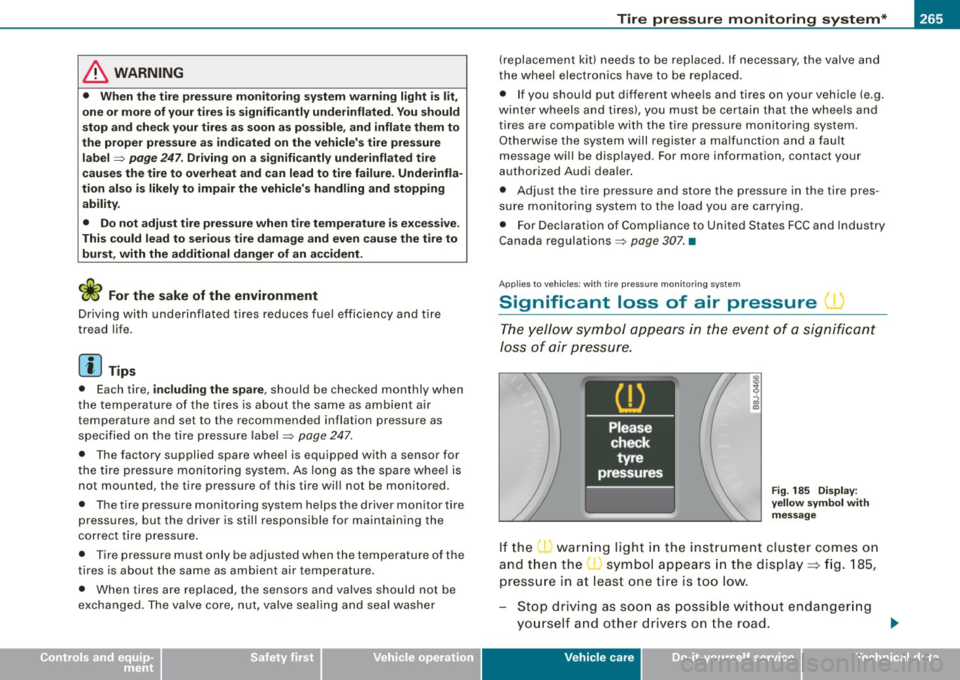
I f th e warning ligh t in the ins trumen t clu ste r com es o n
a nd t hen the s ymb ol appea rs in t he dis pla y~ fig. 1 85,
pre ssure in at least o ne tire is t oo l ow.
S to p drivi ng as soo n a s possib le wit h out e nda nge rin g
y o urs elf a nd other dr ivers on t he road. ._
Vehicle care I t •
Page 268 of 324
-Tire pressure monitoring system* __ ..:.._____:__..:...::....:..:..:..-=.:..: ..:..::.-=.:..~~.:.=.:..:.::...__ ____________________ _
-Inspect all tires.
- Change the tire if necessary~ page
272.
The warning light in the instrument cluster comes on when the
tire is significantly underinflated .
In addition, the tire symbol ,_, appears in the display together with
the message
Please check tire pressure=> page 265, fig. 185.
After a few seconds, the message disappears again. If you would
like to show the message again, press the Set/Check button
=>
page 8, fig. 2 @ .
[ i ] Tips
• In the case of an intentional loss of air pressure, such as when
readjusting tire pressure, the pressure must be stored again after
ward =>
page 266.
• Tire pressure must only be adjusted when the temperature of the
tires is about the same as ambient air temperature.
• The yellow symbol disappears when the tire pressure is
corrected and the new pressure is stored in the system=>
page 266.
• After changing a wheel or replacing a wheel with the spare tire
you have to adjust the tire pressures on all wheels. In addition, you must then initialize the new tire pressures in the tire pressure moni
toring system =>
page 267. •
Applies to vehicles: with tire pr essu re mon itoring system
Storing tire pressures
Correct storage of specified pressure is the basic require
ment for reliable tire pressure monitoring .
1 1 1 J
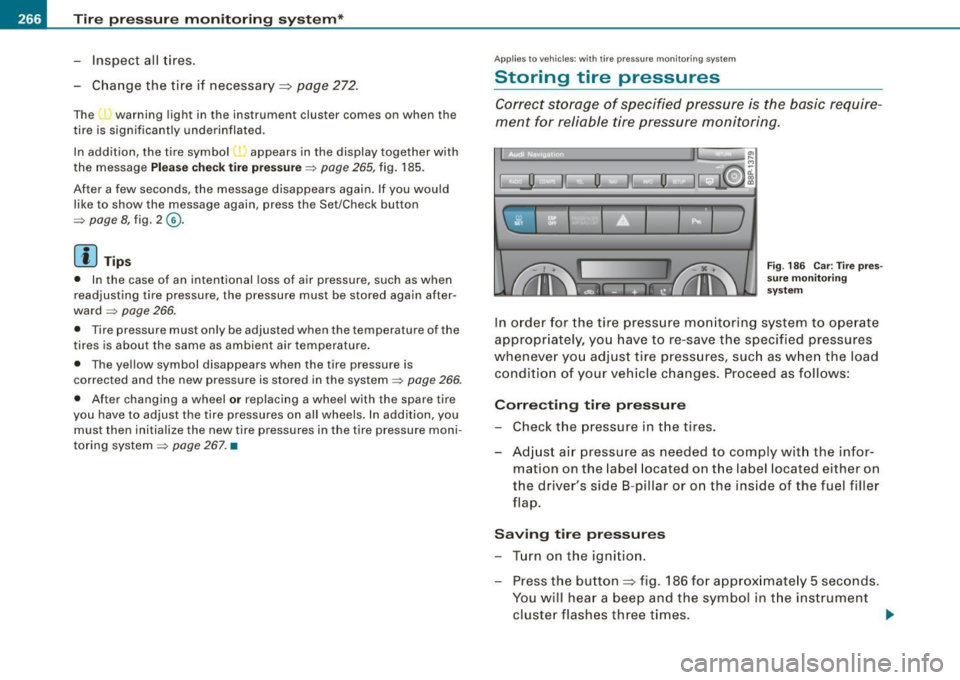
Fig. 186 Car: Tire pres
sure monitoring
system
In order for the tire pressure monitoring system to operate
appropriately, you have to re-save the specified pressures
whenever you adjust tire pressures, such as when the load condition of your vehicle changes. Proceed as follows:
Correcting tire pressure
- Check the pressure in the tires.
- Adjust air pressure as needed to comply with the infor- mation on the label located on the label located either on
the driver's side 8 -pillar or on the inside of the fuel filler
flap .
Saving tire pressures
-Turn on the ignition.
- Press the button~ fig. 186 for approximately 5 seconds.
You will hear a beep and the symbol in the instrument
cluster flashes three times. ..,.
Page 269 of 324
__________________________________________ T_i_re _ p =----r_e _s _ s_ u_ r_e _ m_ o_n_ i_ t _o _r_ i_n -=g =-- s....: y:.... s_ te_ m_ * __ !II
•
All pressure warning indicators in the display will be canceled.
Fo llowing each intent ional change in specified pressures, tire pres
sures must be saved again .
After the pressures are saved, the tire pressure monitoring system
measures the current tire pressures and saves them as the new
specified pressures.
[ i] Tips
• The tire pressure is shown on the tire pressure label. The tire
pressure label is located either on the driver's side B -pillar or on the
inside of the fuel filler flap. The tire pressure label lists the recom
mended cold tire inflation pressures for the vehicle at its maximum
capacity weight and the tires that were on your vehicle at the time
it was manufactured. For recommended tire pressures for normal
load conditions, please see chapter~
page 247.
• The tire pressure monitoring system helps the driver monitor tire
pressures, but the driver is still responsible for maintaining the
correct tire pressure. •
Applies to vehicles: with tir e pressure monitor ing system
Wheel change
If a wheel is changed, the wheels that were exchanged
have to be reprogrammed.
- Turn on the ignition.
- Press the button=>
page 266, fig. 186 for approximately 5
seconds. You will hear a beep and the symbol in the
button flashes three times.
Programming is necessary:
• after the tires have been rotated on the vehicle, or the spare tire
is used, •
if tires with new wheel sensors are used.
All pressure warning indicators in the display will be canceled. The
system malfunction error message will not disappear until the
vehicle is underway. With pressing the button~
page 266, fig. 186,
the reprogramming of the new sensors and storing of actual pres
sures starts . This learning phase can take up to 10 minutes driving
time.
During the learning process the tire pressure monitoring system is
not available. •
Applies to vehic les: with tir e pr essure monitor ing system
Malfunctions *
A malfunction can have various causes.
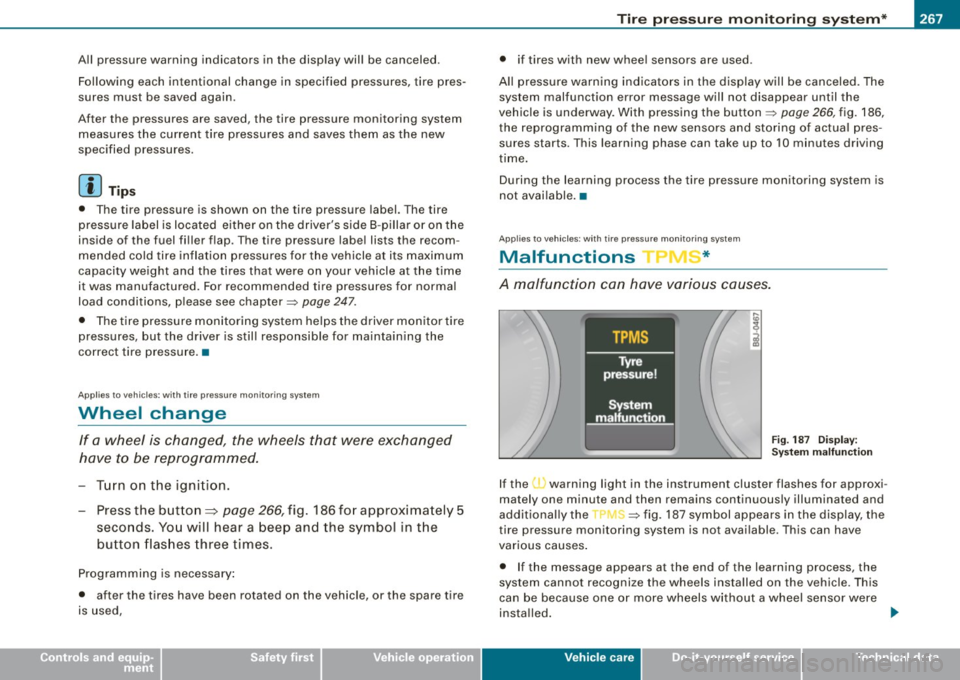
Fig. 187 Display:
System malfunction
If the '-warning light in the instrument cluster flashes for approxi
mately one minute and then remains continuously illuminated and
additionally the
~ f ig. 187 symbol appears in the display, the
tire pressure monitoring system is not available . This can have
various causes.
• If the message appears at the end of the learning process, the
system cannot recognize the wheels installed on the vehicle . This
can be because one or more wheels without a wheel sensor were
installed. .,,_
Vehicle care I t •