warning AUDI S3 2009 Owners Manual
[x] Cancel search | Manufacturer: AUDI, Model Year: 2009, Model line: S3, Model: AUDI S3 2009Pages: 324, PDF Size: 76.02 MB
Page 223 of 324
Fuel supply and filling your fuel tank -------------=-=--=-------=:a....:.--------J
The labe l on the inside of the fuel filler flap tel ls you the correct fuel
fo r your vehicle . For mo re information about fuel specifications, see
=> page 279.
Your vehicle fuel tank has an on -board refuelling vapor recovery
sys tem. Th is feature helps to prevent fue l vapors from escapin g
from the tank and polluting the environment wh ile you refue l your
veh ic le . I n order to fill the tank properly while protecti ng the envi
ronment, please follow this refuel ing procedure carefully .
& WARNING
Under normal operating conditions , never carry additional fuel
c ontainers in your car . Ga s canister s and other containers used to
transport fuel can be dangerous . Such conta iners , full or empty,
may leak and could cause a fire in a collision . If you mu st transport
fuel to use for your l awn mower , snow blower , etc. , be very c areful
and always ob serve local and state laws regarding the u se , tran s
port ation and storage of su ch fuel containers . Make certain the
c ontainer meets industry standard s (ANSI/ASTM F852 · 86 1.
0 Note
Neve r drive yo ur vehicle un til the fue l tank is comp le tely d ry. The
irregular supp ly of fuel can cause misfiring . Gasoline could enter
int o t he exhaus t system and damage the cataly tic conver ter. •
Refuelling
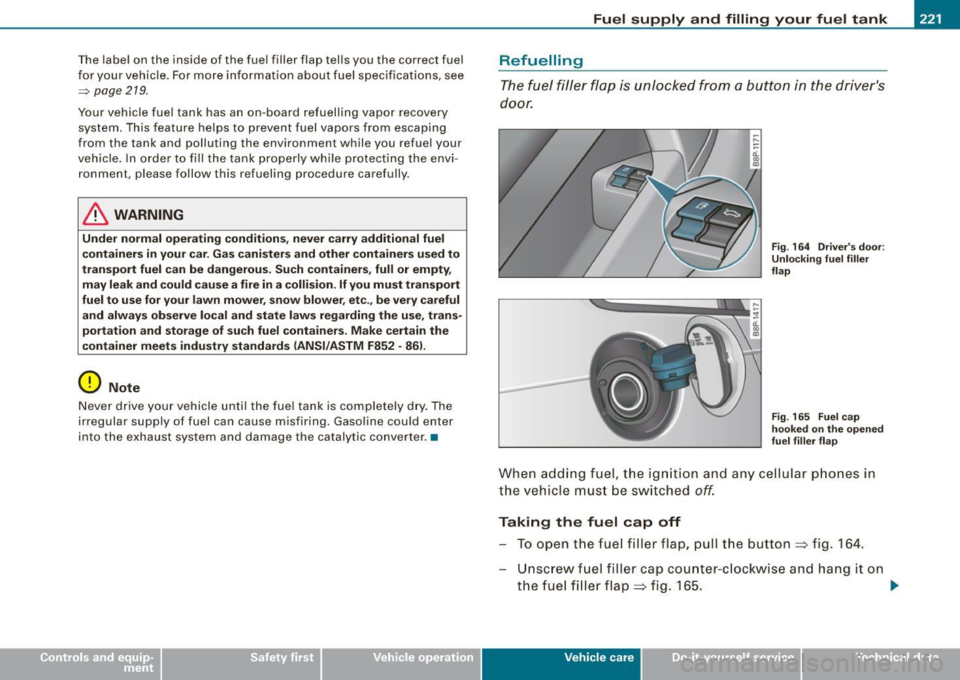
The fuel filler fl ap is unl ocked f rom a but ton i n the driver' s
door.
F ig . 164 Driver 's do or:
Unlo cking fuel filler
flap
F ig . 165 Fue l cap
ho oked on th e op ened
fuel fi ller flap
W hen a dding f uel, the ig nitio n and a ny c ellu lar phones in
th e ve hicl e m ust b e sw it c hed
off.
Taking the fuel cap off
To open t he fue l fille r flap, pull the button~ fig. 164.
U nsc re w fu el filler c ap co unter-c lockwise and hang it on
t h e fue l fi ller flap ~ fig. 165 . ..,
Vehicle care I I irechnical data
Page 224 of 324
-Fuel supply and filling your fuel tank Pll:I-----=--=----:.------=-=---------------
Refuelling procedure
-Insert the fuel nozzle from the gasoline pump into the
fuel filler neck as far as it will go.
- Select a medium refuelling rate so that the nozzle switches off automatically when the tank is full.
Putting the fuel cap back on
- After filling your tank, twist the fuel filler cap clockwise
until you hear a definite click.
Close the fuel filler flap.
To avoid fuel spilling or evaporating from the fuel tank always close
fuel filler cap properly and completely. An improperly closed fuel
filler cap may also cause a message in the driver information system
or cause th e MIL lamp => page 21 to come on.
& WARNING
Improper refueling or handling of fuel can cause fire, explosion
and severe burns.
• Fuel is highly flammable and can cause severe burns and other
injuries.
• Failure to shut the engine off while refueling and/or to insert
the pump nozzle fully into the fuel filler neck could cause fuel to
spray out of filler neck or to overflow. Fuel spray and overflowing
fuel can cause a fire.
• Never use a cellular telephone while refueling. The electromag
netic radiation can cause sparks that can ignite fuel vapors and
cause a fire.
• Never get back into your vehicle while refueling.
If in excep
tional circumstances you must get back in your vehicle while refu eling, make certain that you close the door and touch metal to
discharge static electricity before touching the filler nozzle again.
& WARNING (continued)
Static electricity can cause sparks that can ignite fuel vapors
released during refueling.
• Never smoke or have an open flame anywhere in or near your
vehicle when refueling or filling a portable fuel container.
• For your safety, we strongly recommend that you do not travel
with a portable fuel container in your vehicle. The container, full or empty may leak and could cause a fire, especially in a crash.
• If, under exceptional circumstances, you must transport a
portable fuel container, please observe the following: -Never fill a portable fuel container while it is anywhere in or
on the vehicle (for example, in the luggage compartment, or on
the trunk). Static electricity can build up while filling and can ignite fuel vapors causing a fire.
- Always place a portable fuel container on the ground before
filling.
- Always keep the filler nozzle completely inside the portable
container before and during filling.
- If filling a portable container made of metal, the filler nozzle
must always be in contact with the container. This will help
prevent static electricity from discharging and cause a fire.
- Never spill fuel inside the vehicle or luggage compartment. Fuel vapors are highly flammable .
- Always observe local and state/provincial laws regarding the
use, storage and transportation of fuel containers.
- Make certain the fuel container meets industry standards
(ANSI / ASTM F852-861.
(D Note
If any fuel has spilled onto the car, it should be removed immedi -
ately to prevent damage to the paint.
~
Page 226 of 324
___ C_h_ e_ c_k _in --== g'-- a_n _d_ f_il _li _n ..:::g:::..- ___________________________________________ _
Checking and filling
Engine hood
Releasing the engine hood
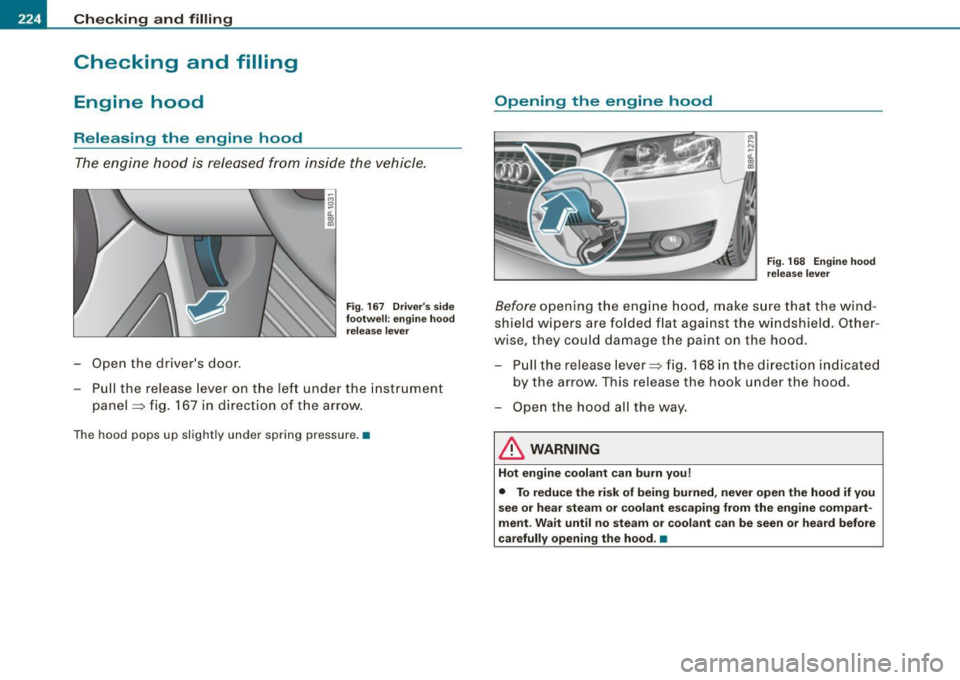
The engine hood is released from inside the vehicle.
-Open the driver's door .
Fig. 167 Driver's side
footwell: engine hood
release lever
-Pull the release lever on the left under the instrument
panel
~ fig. 167 in direction of the arrow.
The hood pops up slightly under spring pressure. •
Opening the engine hood
Fig. 168 Engine hood
release lever
Before opening the engine hood, make sure that the wind
shield wipers are folded flat against the windshield. Other
wise, they could damage the paint on the hood.
Pull the release lever~ fig. 168 in the direction indicated
by the arrow. This release the hook under the hood.
- Open the hood all the way.
& WARNING
Hot engine coolant can burn you!
• To reduce the risk of being burned, never open the hood if you
see or hear steam or coolant escaping from the engine compart
ment. Wait until no steam or coolant can be seen or heard before
carefully opening the hood. •
Page 227 of 324
Checking and filling -
--------------~-
•
Closing the engine hood
-Pull the hood dow n until the pressure fro m t he s trut is
r edu ce d .
- Let the hood
drop dow n and latch in p lace . Do not try to
pus h it shut ;
it ma y fail to enga ge => & .
& WARNING
A hood that is not completely latched could fly up and block your
view while driving.
• When you close the engine hood, check it to make sure the
safety catch has properly engaged. The hood should be flush with
the surrounding vehicle body parts .
• If you notice while driving that the hood is not secured prop
erly , stop at on ce and close it. •
Working in the engine compartment
B e e speci ally ca reful wh ene ver you work in th e e ng in e
co mpartmen t!
Whenever you must perform any work in the engine compartment ,
for example checking and filling different fluids , there is a ri sk of
injury , burns and accidents . To prevent personal injury always
observe the following WARNINGS . The engine compartment of any
vehicle is a hazardous area!
~ &
& WARNING
To help avoid injury , before you check anything under the hood :
• Turn off the engine.
• Remove the ignition key .
• Set the parking brake fully .
& WARNING (continued )
• Move selector lever of automatic transmission to "P" (Park) ;
put manual transmission in Neutral .
• Always let the engine cool down . Hot components will burn
skin on contact.
• To reduce the risk of being burned , never open the hood if you
see or hear steam or coolant escaping from the engine compart
ment . Wait until no steam or coolant can be seen or heard before
carefully opening the hood .
• Keep children away from the engine compartment .
• Never spill fluids on hot engine components . They can cause a
fire.
• Never touch the radiator fan. The auxiliary electric fan is
temperature controlled and can switch on suddenly.
• Never open the coolant reservoir cap when the engine is still
warm . The coolant system is pressurized and hot coolant could
spray out!
• Protect your face , hands and arm from steam or hot engine
coolant by placing a thick rag over the cap when you open the
coolant reservoir .
• If work on the fuel system or the electri cal system is necessary :
- Always disconnect the battery .
- Never smoke or work near heaters or open flames . Fluids in
the engine compartment could start a fire .
- Keep an approved fire extinguisher immediately available.
• To avoid electrical shock and personal injury while the engine
is running or being started , never touch :
- Ignition cables
- Other components of the high voltage electronic ignition
system .
• If you must perform a check or repair with the engine running : ..,
Vehicle care
I t •
Page 228 of 324
___ C_ h_ e _ c_k _in--= g'-- a_n _d_ f_il _li _n --=g==-- --------------------------------------------
& WARNING (continued )
-First, fully apply the park ing brake, move selector lever of
automatic transmission to "P " (Park ); put manual transmission
in Neutral.
- Alway s use extreme c aution to prevent clothing , jewel ry , or
long hair from gettin g caught in the radiator fan , V-belts or
other moving parts , or from contacting hot parts. Tie back hair
before starting , and do not wear clothing that will hang or
droop into the engine .
• Minimize exposure to emission and chemi cal hazard s
=> &.
& WARNING
Californ ia Proposition 65 Warning :
• Engine exhaust , some of its constituents , and certa in vehicle
component s contain or emit chemical s known to the State of Cali
fornia to cause cancer and birth defe cts and reproductive h arm . In
addition, certain fluid s contained in vehicles and certain products
of component wear contain or emit chem icals known to the State
of California to cause cancer and birth defects or other reproduc
tive harm.
• Battery posts , terminals and related ac cessories contain lead
and lead compounds , chem icals known to the State of California
to cause cancer and reproductive harms. Wash hand s after
handling .
0 Note
When adding fluids , always make sure that the y are pou red into the
proper conta iner or filler opening, otherw ise serious damage to
vehicle systems will occur .
<£' For the sake of the environment
To detect leaks in t ime , inspect the veh icle floor pan from unde r
neath regularly. If you see spots from oil or other veh ic le fluids, have
you r ve hicle i nsp ected by a n authori zed Audi dealer .•
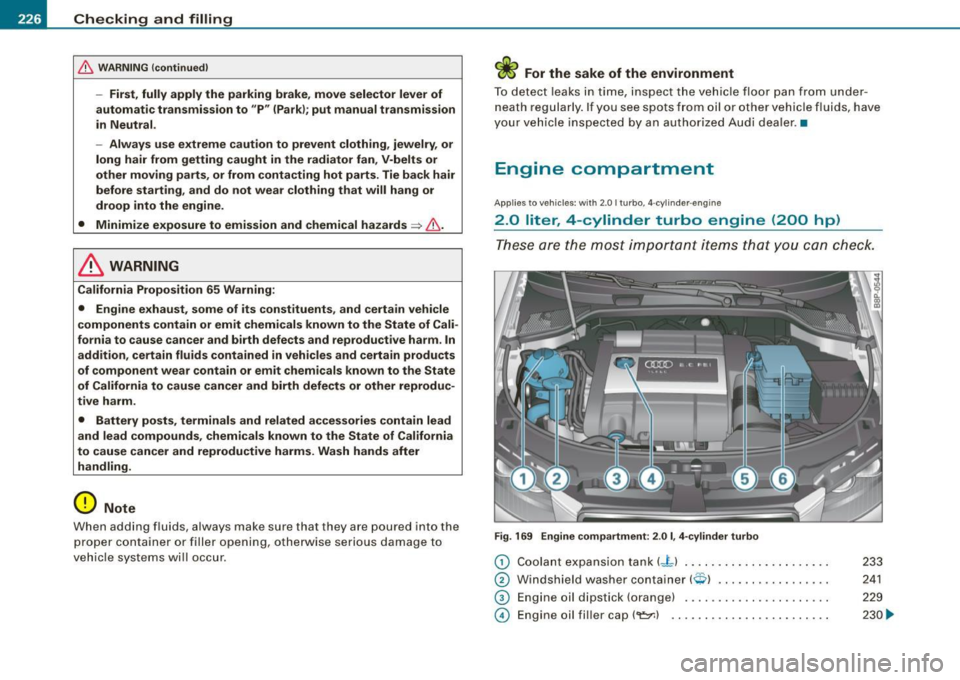
Engine compartment
A pp lies t o ve hicles: wit h 2.0 I tur bo, 4-cy linder •engi ne
2 .0 liter , 4 -cylinder turbo engine (200 hp )
These a re th e mo st imp ortan t items that you can check.
F ig . 169 Engine comp artment : 2.0 I , 4 -cylinder turbo
G) Coolant expans ion tank ( - f- ) ... .. .... ... .... ..... .
0 Windshie ld washe r con tainer ( Q ) .. ..... .... ..... .
© Engi ne oil dipstick (orange) .............. ... .... .
© Engin e oil filler cap ('e:r.) ............ ..... .... .. .
233
241
229
2 30 ..,,
Page 229 of 324
_____________________________________________ C_h_ e_ c _ k_in -= g_a _ n_d _ f_il _li _n ..;::g =--____.•
© Brake fluid reservoir ( ) . ....... ... ............ .
© Battery .. ... ................................. .
& WARNING
Before you check anything in the engine compartment, always
read and heed all WARNINGS
~ & in "Working in the engine
compartment" on
page 225. •
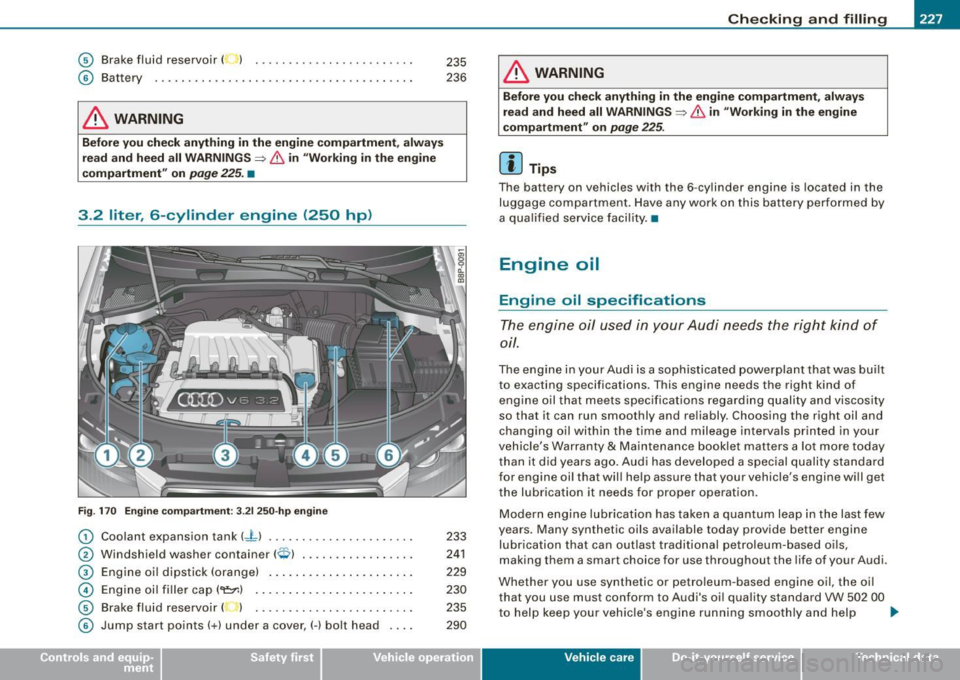
3.2 liter , 6 -cylinder engine (250 hp)
Fig. 170 Engine compartment: 3.21 250-hp engine
G) Coolant expansion tank (-L ) ................. .... .
@ Windshield washer container (,$ ) . ... ... .. .... ... .
@ Engine oil dipstick (orange) ...... ... ... .... .. ... .
© Engine oil filler cap ("1::r.) ..... .... .............. .
© Brake fluid reservoir ( ) . ...... ...... .......... .
© Jump start points(+) under a cover,(-) bolt head ... .
235
236
233
241
229
230
235
290
& WARNING
Before you check anything in the engine compartment, always
read and heed all WARNINGS
~ & in "Working in the engine
compartment" on
page 225.
[ i] Tips
The battery on vehicles with the 6-cylinder engine is located in the
luggage compartment. Have any work on this battery performed by
a qualified service facility.•
Engine oil
Engine oil specifications
The engine oil used in your Audi needs the right kind of
oil.
The engine in your Audi is a sophisticated powerplant that was built
to exacting specifications . This engine needs the right kind of
engine oil that meets specifications regarding quality and viscosity
so that it can run smoothly and reliably. Choosing the right oil and
changing oil within the time and mileage intervals printed in your
vehicle's Warranty
& Maintenance booklet matters a lot more today
than it did years ago. Audi has developed a special quality standard
for engine oil that will help assure that your vehicle's engine will get
the lubrication it needs for proper operation .
Modern engine lubrication has taken a quantum leap in the last few
years. Many synthetic oils available today provide better engine
lubrication that can outlast traditional petroleum-based oils,
making them a smart choice for use throughout the life of your Audi .
Whether you use synthetic or petroleum-based engine oil, the oil
that you use must conform to Audi's oil quality standard VW 502 00
to help keep your vehicle's engine running smoothly and help
ti,,,
Vehic le care I I irechnical data
Page 231 of 324
___________________________________________ C_ h_e _c_ k_ i_n _g _ a_n _d_ f_il _li _n _g __ ffllll
•
the form of Service or Repair Orders that all schedu led maintenance
was performed in a time ly manner .•
Engine oil consumption
The engine in your vehicle depends on an adequate
amount of oil to lubricate and cool all of its moving parts.
In order to provide effective lubrication and cool ing of internal
engine components , all internal combustion engines consume a
certain amount of oil. Oil consumption varies from engine to engine
and may change significantly over the life of the engine. Typically,
engines with a specified break -in period (see~
page 197) consume
more oil during the break-in period than they consume af ter oi l
consumption has stabi lized .
Unde r normal conditions, the rate of oil consumption depends on
the quality and viscosity of the oil, the RPM (revolutions per minute)
at which the engine is operated, the ambient temperature and road
conditions . Further factors are the amount of oil dilution from water
condensation or fuel residue and the oxidation level of the o il. As
any engine is subject to wear as mileage builds up, the oil consump
tio n may increase over time unt il rep lacement of worn components
may become necessary.
W ith all these variables coming into play, no standard rate of oil
consu mption can be estab lished or specified. There is no a lternative
to regular and frequent checking of the oil level, see
Note .
If the yellow engi ne oil level warning symbol in the instrume nt
cluster lights up, you should check the oil level as soon as
poss ible
with the oil dipstick~ page 229 . Top off the oil at your
earliest convenience~
page 230.
& WARNING
Before you che ck anything in the eng ine comp artment , alw ay s
read and heed all WARNINGS
~ & in "Working in the engine
c ompartment " on
page 22 5.
0 Note
Driving with an insufficie nt o il level is l ikely to cause severe damage
to the engine.
[ i ] Tip s
• The oil pressure warning displ ay ce,. is not an indi cat or of the oil
level . Do not rely on it. Instead , check the oil level in your engine at
regular interv als , prefe rably ea ch time you refuel , and always before
going on a long trip.
• If you have the impression your engine consumes excessive
amoun ts of oil, we recommend that you consu lt your authorized
Audi dealer to have the cause of your concern proper ly diagnosed .
Keep in mind that the accura te m easuremen t of oil consumption
requires great care and may take some time . Your authorized Audi
dea ler has instructions about how to measu re oil consumption
accurately .•
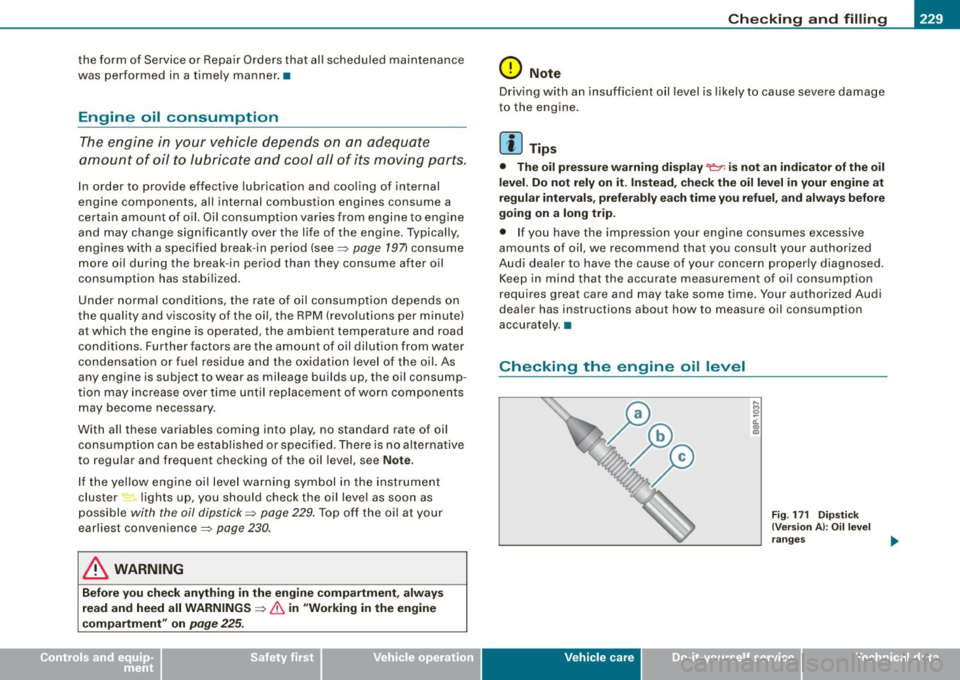
Checking the engine oil level
Vehicle care I t •
Fig . 171 Dip sti ck
( V ersio n A):
Oil le vel
ran ges
Page 232 of 324
___ C_h_ e_ c_k _in --== g'-- a_n _d_ f_il _li _n ..:::g:::..- ___________________________________________ _
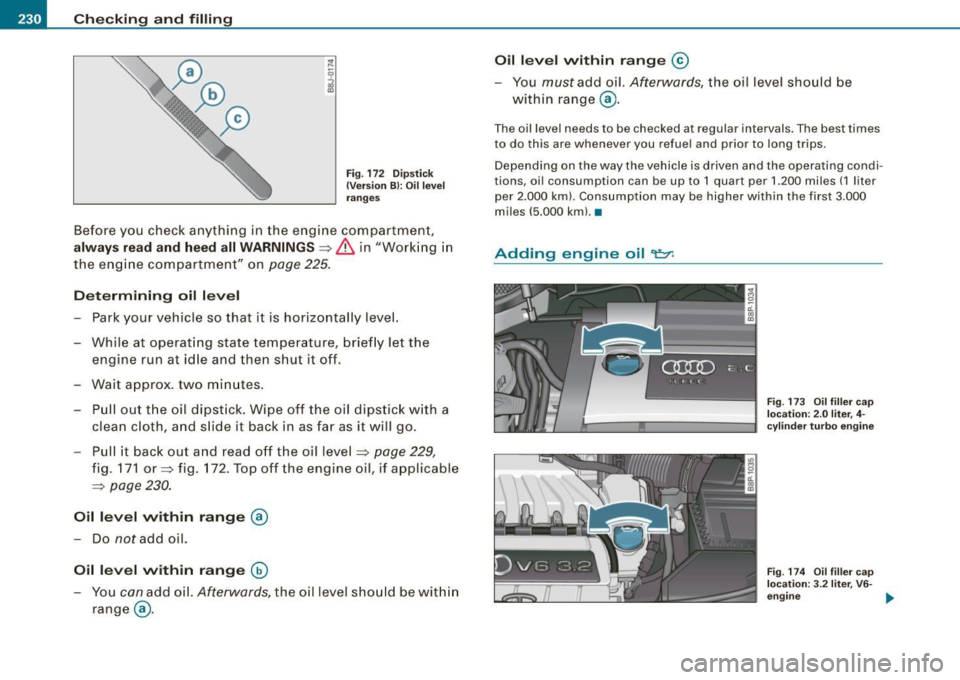
Fig. 172 Dipstick
(Version B): Oil level
ranges
Before you check anything in the engine compartment,
always read and heed all WARNINGS =>
& in "Working in
the engine compartment" on
page 225.
Determining oil level
Park your vehicle so that it is horizontally level.
- While at operating state temperature, briefly let the
engine run at idle and then shut it off.
- Wait approx. two minutes.
- Pull out the oil dipstick. Wipe off the oil dipstick with a
clean cloth, and slide it back in as far as it will go.
Pull it back out and read off the oil level =>
page 229,
fig. 171 or::::> fig. 172. Top off the engine oil, if applicable
=>
page 230.
Oil level within range @
- Do not add oil.
Oil level within range
@
- You can add oil. Afterwards, the oil level should be within
range @. Oil level within range
©
You must add oil. Afterwards, the oil level should be
within range @.
The oil level needs to be checked at regular intervals. The best times
to do this are whenever you refuel and prior to long trips.
Depending on the way the vehicle is driven and the operating condi
tions, oil consumption can be up to 1 quart per 1.200 miles (1 liter
per 2.000 km). Consumption may be higher within the first 3 .000
miles (5.000 kml. •
Adding engine oil "l=:7:
Fig . 173 Oil filler cap
location: 2.0 liter, 4 -
cylinder turbo engine
Fig . 174 Oil filler cap
location: 3.2 liter , VS-
engine ...
Page 233 of 324
Checkin g and fillin g ---------------~-!':WIii
•
Before you check a nything in the e ngine compartment,
alw ay s re ad and heed all WARNINGS ~
& in "Working in
the engine compartment" on
page 225.
- Unscrew the cap~ to the engine oil filli ng hole
~ page 230, fig . 173 or~ page 230, fig. 174 .
Carefully top off with the appropriate o il in 0 .5 liter doses .
- Check the oil level again after two minutes~
page 229.
-Top off t he o il a gai n, i f n ecessary .
- Screw the cap back on the filling hole and s lide the oil
dipstic k in as far as i t will go.
& WARNING
• While topping off , th e oil mu st n ot com e in c ont act with h ot
e ng ine part s -fire h aza rd!
• The oil fill er cap mu st b e prope rly sec ured to pre vent oil fr om
b ei ng spr ay ed on th e hot eng ine and e xha ust s yste m when th e
engine i s runni ng -fire haz ard!
• If you r skin h as come in co ntac t wi th th e engin e oil , you mus t
s ub sequ entl y c leanse it tho rou ghl y.
0 Note
• The oil level must not be above range @- danger of converter or
engine damage! Contact a qualified workshop to draw off oi l, if
necessary.
• Audi d oes no t r ecommend th e use of o il a ddit iv es . The y may
d am age the engin e and adver sely aff ect y our New Vehi cle Limited
Warr ant y.
<£' For the sak e of th e environment
• Under no circumstances can the oi l come in contact with the
sewage network or the soi l.
• Observe and follow legal regulations when disposing of empty
oi l containers. •
Changing the engine oil
We recommend that have your oil changed by an autho
rized Audi dealer or a qualified service station.
Before you check anything in the engine co mpart ment, always re ad
an d heed all WARN INGS=>
& in "Working in the engine compart
ment" on
page 225.
The engine oi l must be changed according to the interva ls specified
in your Warranty
& Maintenance booklet. This is very important
because the lubricat ing properties o f oi l d im inish g radua lly during
normal vehicle use.
Under some circumstances the engine oil shou ld be changed more
frequently . Change oil more often if you drive mostly short
distances, operate the vehicle in dusty areas or under predomi
nantly stop -and -go traffic conditions, or have your vehicle where
temperatures remain below freezing for extended periods .
Detergent additives in the oil w ill make fresh oi l look dark after the
engine has been running for a short time . This is normal and is not
a reason to change the oil more often than recommended .
Because of the problem of proper disposal, along with the spec ial
tools and necessary expertise required, we strong ly recommend
that you have your oi l changed by an authorized
Audi de aler or a
qualified service station .
If you choose to ch ang e yo ur oil your self , please note the following
important information : .,_
Vehicle care I t •
Page 234 of 324
-Checking and filling
P'N:1--------=-------------------
& WARNING
To reduce the ri sk of personal inju ry if you mu st change the engine
oil in your vehicle your self:
• Wear eye prote ction .
• To reduce the ri sk of bu rn s from hot engine oil , let the engine
c ool down to the tou ch .
• When remo ving th e oil dr ain pl ug w ith your fing ers, s tay a s fa r
a w ay as po ssibl e. Alw ays keep your forearm p arallel to the grou nd
to help prevent hot oil from running down your arm .
• Drai n the oil into a container de signed for th is purpose , one
l a rg e enough to hold at le ast the tot al a mount of oil in your eng ine .
• Engine oil is poi sonou s. Keep it well out of the rea ch of children .
• Continuous contact with used engine oil i s harmful to your
skin. Always prote ct your skin by wa shin g oil off thoroughly with
s oap and water .
0 Note
Never mix oil additives with your engine oil. These additives can
damage your engine and adversely affect your Audi New Vehicle Limited Warranty .
~ For the sake of the environment
• Before changing your oil, first make sure you know where you
can proper ly dispose of the used oil.
• Always dispose of used engine oil properly . Do not dump it on
garden soil, wooded areas, into open st reams or down sewage
drains .
• Recycle used engine oi l by taking it to a used engine oi l collec
tion facility in your area, or contact a service station .•
Engine cooling system
Coolant
The engine coolan t perf orms two func tions: it keeps the
engine from overheating an d it protects the engine from
freezing in the winter.
The cooling system is sealed and general ly requires litt le attention.
The coo ling system has been fi lled at the factory with a permanent
coo lant which does not need to be changed. The coolant consists of
a mixture of water and the manufacturer's glycol -basedcoolant
additive G12+ + antifreeze with anti corrosion additives (50% for USA
models; 60% for Canadian mode ls) . This mixture both assures the
necessary frost protection and protects metal components in the
engine's cooling system from corrosion and scaling. It also raises
the boil ing point o f the coolant.
D o not reduce the concentration of the coo lant in the summer by
adding pla in water.
Th e proporti on of coolant additive must b e at
l e as t 50 % but not more than 60 %
to maintain antifreeze protection
and cooling efficiency . If the coolant frost protect ion is too low, the
coo lant could freeze and damage the vehicle heating and engine
coo ling system.
For year-round driving, antifreeze is added at the factory for temper
atures down to :
• -31 °F ( -35 °C) USA
• - 40 °F ( - 40 °C) Canada .
You can mix the G12 ++ coolan t additive with other additives G12 + or
G12. Always check with your authorized Audi dealer.
& WARNING
Bef ore you che ck anything in the engine compartment , alwa ys
read and heed all WARNING S
~ & in "Working in the engine
c ompartment " on
page 225.