change time AUDI S3 2009 User Guide
[x] Cancel search | Manufacturer: AUDI, Model Year: 2009, Model line: S3, Model: AUDI S3 2009Pages: 324, PDF Size: 76.02 MB
Page 105 of 324
_________________________________________________ w_ a_ r_ m __ a_n_ d_ c_ o_ld __ _
Switching between Fahrenheit and
Centigrade
You can change the temperature display from °F (Fahren
heit) to °C (Centigrade) and vice versa.
- Hold the [,;;S;)I button down=> page 100, fig. 108 .
- Turn the rotary sw itch (driver's s ide) @for 3 seconds +.•
Air recirculation (~ ]
The air recirculation prevents e xhaust fumes or other
pollution from entering the vehicle.
Switching air r ecircul ation on
- Press[ ~)=> page 100,fig. 108 =>&
Switching air recircul ation off
- Press~ again, or
- press [AUTO
J, or
- press[@ ).
I n the air recirculation mode, the air in the passenger compartment
is recirculated to prevent exhaust fumes and other pol lut ion from
entering the vehicle. We recommend that you use the manua l air
recirculat ion under the following conditions:
• when driving through tunnels
• in a traffic jam .
& WARNING
Do not use thi s setting f or e xte nded period s of time . The wind ows
c ould fog up sin ce no fre sh air ca n enter the v ehic le . If th e
Controls and equip
ment
& WARN ING (c ontinu ed)
window s fog up, pre ss the air r ecircul ation butt on agai n immed i
a te ly to sw itch off the air r ecirculation function or selec t defro st. •
Adjusting the fan speed 8 G
The automatically selected fan speed can be increased or
decreased .
-Press the 8 or G buttons in the center of the control
panel =>
page 100 , fig. 108 to adjust the fan speed to yo ur
comfo rt.
The air conditioning system automatically regu lates the fan speed
in response to the interior temperature . However, you can also
adjust the fan speed manua lly . A line of sma ll bars in the center
d isplay above the fan con trol buttons will retreat or extend to reflect
your adjustments to the fan speed .•
Air distribution
T he aut omatically controlled air distribution can be
changed manually.
You can use the [ 1!:. ), l~l or l~ l buttons separately or together in
combination. To switch back to the automa tic air distribu tion
setting, either switch off the buttons you previously selected, or
press
[ A UTO ).
Each of the three buttons has its own specific function (the re fer
ence numbers refer to the air outlets) :::>
page 104, fig . 109 .
Air dir ected to th e wind ows ~
All the air is directed to outlets G),@ and G). Contrary to when [@1
is pressed, th e amount of air remains the same. .,_
I • •
Page 163 of 324

__________________________________________________ A_ i_ r _b _a...; g::- s_ y=--- s_t _e _m __ lflll
& W ARNING (continued )
seating position and have the airbag system inspected by your
authorized Audi dealer.
• A tight tether or other str ap on a rearward-fac ing child restr aint
attached to the front pas senger seat can put too much pressure
on the weight-sensing mat in the seat and reg ister more weight
than i s actually on the seat. The heavier weight registered can
make the system work as though an adult were on the seat and
deploy the Advanced Airbag when it must be suppressed causing
s erious or even fatal injury to the child .
• If, in exceptional circumstances , you mu st in stall a forward
fac ing child restra int on the front passenger seat , always move the
seat into its rearmost position in the seat's fore and aft ad just
ment range , as far away from the airbag as possible . The backrest
must be adjusted to an upright position . Make sure that the
PASSENGER AIR BAG OFF light comes on and stay s on all the time
whenever the ignition is switched on .
& WARNING
• If the PASSENGER AIR BAG OFF light does not go out when an
adult is sitting on the front passenger seat after taking the steps
described above, make sure the adult is properly seated and
restrained at one of the rear seating positions .
• Have the airbag system inspected by your authorized Audi
dealer before transporting anyone on the front passenger seat .
[ i ] Tips
If the weight -sensing mat in the front passenger seat detects an
e mp ty seat, the fro nt air b ag on the pa ssenge r sid e will be t urned
off, and the PASSENGER AIR BAG OFF l ight will stay on .
a
Controls and equip
ment Safety first
Vehicle operation
Repair, care and disposal of the airbags
Parts of the airbag system are insta lled at many different places on
your Au di. In stal lin g, re moving, ser vic in g or re pair in g a part in an
area of the vehicle can damage a part of an a irbag system and
pre ven t that system from wo rki ng p rope rly in a co llision .
There are some important things you have to know to make sure
that the effectiveness of the system will not be impai red an d that
d iscarded co mponents do not cause inju ry or po llute t he e nv iron
ment .
& WARNING
Improper care , servicing and repair procedures can increase the
risk of personal injury and death by preventing an airbag from
deploying when needed or deploying an airbag unexpectedly:
• Never cover , obstruct , or change the steering wheel horn pad
or airbag cover or the instrument panel or modify them in any way .
• Never attach any obje cts su ch as cup holders or telephone
mountings to the surfaces covering the airbag units.
• For cleaning the horn pad or instrument panel, use only a soft ,
dry cloth or one moi stened with plain water . Solvents or cleaners
c ould damage the airbag cover or change the stiffness or strength
of the material so that the airbag cannot deploy and protect prop
erly .
• Never repair , adjust , or change any parts of the airbag system.
• All work on the steering wheel , instrument panel , front seats or
electrical system (including the installation of audio equipment ,
c ellular telephones and CB radios , etc .I must be performed by a
qualified technician who has the training and special equipment
necessary .
• For any work on the airbag system , we strongly recommend
that you see your authorized Audi dealer or qualified workshop .
• Never modify the front bumper or parts of the vehicle body .
Vehicle care Do-it-yourself service Technical data
Page 196 of 324
___ ln_ t _e_ ll-'"ig ...,_ e_ n_t _t_ e_ c_ h _ n_o _ l_o _,.g= y,_ __________________________________________ _
Low brake fluid level
Ma lfu ncti ons can occ ur in th e brake system if the bra ke flu id leve l is
too low. The brake fluid leve l is monitored e lectronically.
Brake lining wear status Bra ke lining wear may be checked by visual inspection of the condi
t ion of the brake pa ds through the o pen in g s in t he wheel. If neces
sary, the wheel may be removed for this inspection=>
page 272 ,
"Whee l change".
& WARNING
• You should perform braking maneuver s for the purpose of
cleaning the brake system only if road cond itions permit . Other
road u sers must not be put at risk -you may cause an accident !
• Before des cending a steep grade , reduce speed and shift trans
mission into a lower gear or lower driving range. Do not ride the
brake s or hold the pedal down too long or too often . This could
c ause the brakes to get hot and diminish braking efficiency.
• Do not "ride the brakes " by resting your foot on the pedal when
you do not intend to brake. This may cause the brakes to overheat, p rem ature wear and in creased stopping distance .
• Under certain climatic and operating conditions such as
passing through water , driv ing in heavy rain or after washing the
vehicle , the effectiveness of the brakes can be reduced. In winter ,
ice can accumulate on the brake pads , linings , discs and drums.
Carefully apply brakes for a test. Brakes will dry and ice coatings
will be cleaned off afte r a few careful b rake appli cations .
• Driving for an extended period of time on salt -covered roads
without using your brakes can also affe ct braking effic ien cy. Clean
off accumulated salt coating from brake discs and pads with a few
careful brake applications .
• If you damage the front spoiler , or if you install a different
spoiler , be sure the air flow to the front brakes is not obstru cted .
Otherwise the brake system could overheat reducing the effe ctive
ness of the entire brake system .
& WARNING (continued )
• Failure of one brake circuit will impair the braking capability
resulting in an increased stopping distance . Avoid driv ing the
vehicle and have it towed to the nearest authorized Audi dealer or
qu alified workshop. •
Brake booster
The bra ke boos ter adds e xtra bra king pow er.
Th e brake boost er wo rks wit h vacuum p ressu re wh ich is created
only when the engine is running=>& .
& WARNING
• Never let the vehicle roll to a stop with the engine shut off.
• If the brake booster is not working , for e xample when towing
your vehicle, or because the brake booster has somehow been damaged , the brake pedal must be pressed considerably harder to
make up for the lack of booster assistance . •
Functioning of Anti-Lock Brake System (ABS}
A BS p revents t he wheels from lockin g up unde r braking.
The ABS co ntrib utes effectively to ve hic le c ont ro l since it preven ts
the whee ls from
locking when the bra kes are app lied. Th is means
that the vehicle remains stee rable and is less l ikely to skid .
With ABS you do not need to
pump the brake. Just hold the brake
pedal down .
Ho wever , do not e xpect that t he ABS shor tens brak ing distance
under
all circumstances . When driv ing on gravel or on newly fa llen
snow on top of icy surfaces, b raki ng d istance may be even longer,
th ere for e, u nder these circumstances, it is esp ecially important t hat
you drive s lowly and w ith g reat ca re . ._
Page 222 of 324
Fuel supply and filling your fuel tank
Blend of gasoline and ethanol (grain alcohol or ethyl alcohol}
• Anti -knock index must be 87 AKI or higher.
• Blend must not contain more than 10% ethanol.
Blend of gasoline and MTBE
• Anti-knock index must be 87 AKI or higher.
• Blend must contain not more than 15% MTBE.
Seasonally adjusted gasoline
Many gasoline grades are blended to perform especially well for
winter or summer driving. During seasonal change -over, we suggest
that you fill up at busy gas stations where the seasonal adjustment
is more likely to be made in time.
0 Note
• Methanol fuels which do not meet these requirements may
cause corrosion and damage to plastic and rubber components in
the fuel system.
• Do not use fuels that fail to meet the specified criteria in this
chapter.
• If you are unable to determine whether or not a particular fuel
blend meets the specifications, ask your service station or its fuel
supplier.
• Do not use fuel for which the contents cannot be identified.
• Fuel system damage and performance problems resulting from
the use of fuels different from those specified are not the responsi
bility of Audi and are not covered under the New Vehicle or the
Emission Control System Warranties.
• If you experience a loss of fuel economy or driveability and
performance problems due to the use of one of these fuel blends,
we recommend that you switch to unblended fuel. •
Gasoline additives
A major concern among many auto manufacturers is carbon
deposit build-up caused by the type of gasoline you use.
Although gasoline grades differ from one manufacturer to another,
they have certain things in common . All gasoline grades contain
substances that can cause deposits to collect on vital engine parts,
such as fuel injectors and intake valves. Although most gasoline
brands include additives to keep engine and fuel systems clean,
they are not equally effective.
Audi recommends using TOP TIER Detergent Gasoline. For more
information on TOP TIER Detergent Gasoline, please go to the offi
cial website (www.toptiergas.com).
After an extended period of using inadequate fuels, built-up carbon
deposits can rob your engine of peak performance.
(D Note
Damage or malfunction due to poor fuel quality is not covered by
the Audi New Vehicle Limited Warranty. •
Fuel tank
Fuel filler neck
The fuel filler neck is located on the right rear side panel behind the
fuel filler flap.
If the power locking system should fail, you can still open the flap
manually - for detailed instructions see=>
page 223.
You can find the fuel tank capacity of your vehicle in Technical Data
=> page 300. .,_
Page 230 of 324
-~_C_ h_e _c _ k_ i_n ...:::g::;...._ a_n_ d_ f_ i_ll _in -'g:::;.._ ___________________________________________ _
prevent the formation of harmful deposits, sometimes called
"sludge," that over time can lead to expensive repairs.
At the time of printing, engine oils available in the U .S . and Canada
that meet the exacting specifications of Audi oil standard VW 502 00
are synthetic engine oils. This does not mean, however, that every
synthetic engine oil will meet Audi oil standard VW 502 00. So
always be sure that you use an approved oil.
To help prevent the formation of harmful deposits use only oil with
the following specifications printed on the oil container:
Audi oil standard VW 502 00
Oil container labels may carry the specification singly or in combi
nation with other designations and oil quality standards.
Viscosity
Engine oils are graded according to their viscosity. The proper
viscosity grade oil for your engine depends on climactic or seasonal conditions where you drive. You can use oil with a viscosity grade of
SAE 5W40 across all temperature ranges for normal driving condi
tions .
However, if engine oil viscosity grade SAE 5W40 is not available, you
can also use viscosity grade SAE 5W-30 or SAE 0W-40 as long as it
meets Audi oil quality standard VW 502 00 specifications.
Because engine oil that meets the Audi oil standard may not be
available everywhere when you need it, we strongly recommend
that you always carry with you an extra quart {liter) of oil that
expressly conforms to the VW 502 00 specification, in case you have
to top off the oil while on the road.
Only if the level of the oil is at or below the minimum mark on the
oil dipstick -and no oil that expressly conforms to Audi oil standard
VW 502 00 specifications is available -may you top off with a high
quality engine oil, preferably synthetic -based, that meets ACEA A3,
ACEA A5 or ACEA B5, API SL or ILSAC GF-3 specifications, but even
then, only in viscosity grades SAE 5W -40, SAE 5W -30, or SAE 0W -40 .
However, during the entire time between oil change intervals, never top off with more than a total of 0
.5 qt/liter engine oil that does not
conform to Audi oil specification VW 502 00.
For more information about engine oil that has been approved for
your vehicle, please contact either your authorized Audi dealer or
Audi Customer Relations at 1 (800) 822-2834 or visit our web site at
www.audiusa.com or www.audicanada.ca. Here you will also find a
current list of oils (manufacturers, brand names etc.) that conform
to Audi oil standard VW 502 00.
Changing the engine oil
The engine oil and oil filter must be changed according to the
mileage (kilometers) and time intervals specified in your vehicle 's
Warranty
& Maintenance booklet. Do not exceed these intervals -
harmful deposits from old engine oil can reduce engine perfor
mance and can lead to expensive engine repairs.
Changing the oil at the recommended intervals is so very important
because the lubricating properties of oil decrease gradually during
normal vehicle use. If you are not sure when you have your oil
changed, ask your authorized Audi Service Advisor.
Under some circumstances the engine oil should even be changed
more frequently . Change oil more often if you drive mostly short
distances, operate the vehicle in dusty areas or mostly under stop
and-go traffic conditions, or when you use your vehicle where
temperatures stay below freezing point for long periods.
Detergent additives in the oil will make fresh oil look dark after the
engine has been running for a short time. This is normal and is not
a reason to change the oil more often than recommended .
Damage or malfunctions due to lack of maintenance
It is essential that you change your oil at the recommended intervals
using only engine oil that complies with Audi oil standard
VW 502 00 . Your New Vehicle Limited Warranty does not cover
damage or malfunctions due to failure to follow recommended
maintenance and use requirements as set forth in the Audi Owner's
Manual and Warranty & Maintenance booklet. Your dealer will have
to deny warranty coverage unless you present to the dealer proof in
~
Page 231 of 324
___________________________________________ C_ h_e _c_ k_ i_n _g _ a_n _d_ f_il _li _n _g __ ffllll
•
the form of Service or Repair Orders that all schedu led maintenance
was performed in a time ly manner .•
Engine oil consumption
The engine in your vehicle depends on an adequate
amount of oil to lubricate and cool all of its moving parts.
In order to provide effective lubrication and cool ing of internal
engine components , all internal combustion engines consume a
certain amount of oil. Oil consumption varies from engine to engine
and may change significantly over the life of the engine. Typically,
engines with a specified break -in period (see~
page 197) consume
more oil during the break-in period than they consume af ter oi l
consumption has stabi lized .
Unde r normal conditions, the rate of oil consumption depends on
the quality and viscosity of the oil, the RPM (revolutions per minute)
at which the engine is operated, the ambient temperature and road
conditions . Further factors are the amount of oil dilution from water
condensation or fuel residue and the oxidation level of the o il. As
any engine is subject to wear as mileage builds up, the oil consump
tio n may increase over time unt il rep lacement of worn components
may become necessary.
W ith all these variables coming into play, no standard rate of oil
consu mption can be estab lished or specified. There is no a lternative
to regular and frequent checking of the oil level, see
Note .
If the yellow engi ne oil level warning symbol in the instrume nt
cluster lights up, you should check the oil level as soon as
poss ible
with the oil dipstick~ page 229 . Top off the oil at your
earliest convenience~
page 230.
& WARNING
Before you che ck anything in the eng ine comp artment , alw ay s
read and heed all WARNINGS
~ & in "Working in the engine
c ompartment " on
page 22 5.
0 Note
Driving with an insufficie nt o il level is l ikely to cause severe damage
to the engine.
[ i ] Tip s
• The oil pressure warning displ ay ce,. is not an indi cat or of the oil
level . Do not rely on it. Instead , check the oil level in your engine at
regular interv als , prefe rably ea ch time you refuel , and always before
going on a long trip.
• If you have the impression your engine consumes excessive
amoun ts of oil, we recommend that you consu lt your authorized
Audi dealer to have the cause of your concern proper ly diagnosed .
Keep in mind that the accura te m easuremen t of oil consumption
requires great care and may take some time . Your authorized Audi
dea ler has instructions about how to measu re oil consumption
accurately .•
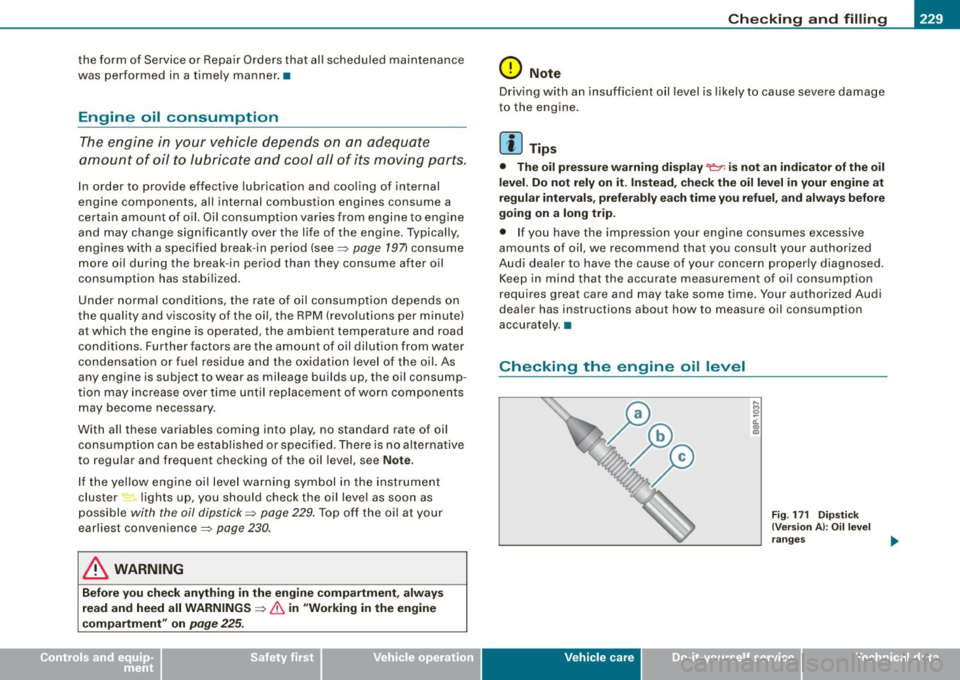
Checking the engine oil level
Vehicle care I t •
Fig . 171 Dip sti ck
( V ersio n A):
Oil le vel
ran ges
Page 233 of 324
Checkin g and fillin g ---------------~-!':WIii
•
Before you check a nything in the e ngine compartment,
alw ay s re ad and heed all WARNINGS ~
& in "Working in
the engine compartment" on
page 225.
- Unscrew the cap~ to the engine oil filli ng hole
~ page 230, fig . 173 or~ page 230, fig. 174 .
Carefully top off with the appropriate o il in 0 .5 liter doses .
- Check the oil level again after two minutes~
page 229.
-Top off t he o il a gai n, i f n ecessary .
- Screw the cap back on the filling hole and s lide the oil
dipstic k in as far as i t will go.
& WARNING
• While topping off , th e oil mu st n ot com e in c ont act with h ot
e ng ine part s -fire h aza rd!
• The oil fill er cap mu st b e prope rly sec ured to pre vent oil fr om
b ei ng spr ay ed on th e hot eng ine and e xha ust s yste m when th e
engine i s runni ng -fire haz ard!
• If you r skin h as come in co ntac t wi th th e engin e oil , you mus t
s ub sequ entl y c leanse it tho rou ghl y.
0 Note
• The oil level must not be above range @- danger of converter or
engine damage! Contact a qualified workshop to draw off oi l, if
necessary.
• Audi d oes no t r ecommend th e use of o il a ddit iv es . The y may
d am age the engin e and adver sely aff ect y our New Vehi cle Limited
Warr ant y.
<£' For the sak e of th e environment
• Under no circumstances can the oi l come in contact with the
sewage network or the soi l.
• Observe and follow legal regulations when disposing of empty
oi l containers. •
Changing the engine oil
We recommend that have your oil changed by an autho
rized Audi dealer or a qualified service station.
Before you check anything in the engine co mpart ment, always re ad
an d heed all WARN INGS=>
& in "Working in the engine compart
ment" on
page 225.
The engine oi l must be changed according to the interva ls specified
in your Warranty
& Maintenance booklet. This is very important
because the lubricat ing properties o f oi l d im inish g radua lly during
normal vehicle use.
Under some circumstances the engine oil shou ld be changed more
frequently . Change oil more often if you drive mostly short
distances, operate the vehicle in dusty areas or under predomi
nantly stop -and -go traffic conditions, or have your vehicle where
temperatures remain below freezing for extended periods .
Detergent additives in the oil w ill make fresh oi l look dark after the
engine has been running for a short time . This is normal and is not
a reason to change the oil more often than recommended .
Because of the problem of proper disposal, along with the spec ial
tools and necessary expertise required, we strong ly recommend
that you have your oi l changed by an authorized
Audi de aler or a
qualified service station .
If you choose to ch ang e yo ur oil your self , please note the following
important information : .,_
Vehicle care I t •
Page 238 of 324
___ C_h_ e_ c_k _in --== g'-- a_n _d_ f_il _li _n ..:::g:::..- ___________________________________________ _
brake warning/indicator light will illuminate . Contact an authorized
Audi dealer
i m medi at ely.•
Changing brake fluid
Have the brake fluid changed by an experienced techni
cian.
Brake fluid absorbs moisture from the ai r. If the water content in the
brake fluid is too high, corrosion in the brake system may result
after a period of time. The boiling point of the brake fluid wil l also
decrease considerably and decrease braking performance .
Therefore, the brake fluid must be changed
e ver y two years. Always
use new brake fluid which conforms to Federa l Motor Vehicle Stan
dard "FMVSS 116 DOT 4" .
The brake fluid reservoir can be difficu lt to reach , therefore, we
recommend that you have the brake fluid changed by your autho
rized
Audi d ealer. Your dealer has the correct tools, the right brake
fluid and the know-how to do this for you.
& WARNING
• Bra ke fluid i s poisonous . It mu st be stored on ly in the close d
ori ginal container out of the rea ch of children!
• Bra ke fa ilure can result from old or inappropri ate brake fluid .
Observe the se pre caution s:
- Use o nly brake fluid that meets SAE spe cifi ca tion
J 170 3 and
c onform s to Fed era l Moto r Vehic le Sta nda rd 116 . Always c heck
w ith your authori zed Audi de aler to m ake sure you are using
the correct brake fluid. The corr ect type of brake fluid i s als o
indi cated o n the br ake fl uid reser vo ir.
- The br ake flu id mu st be ne w. Hea vy use of the brake s can
c au se a vap or lo ck if the bra ke fluid i s left in the system too
long. Thi s can seriou sly affect the efficienc y of the brake s as
we ll as your safet y. Thi s co uld re su lt in an acci dent .
0 Note
Brake fluid wi ll damage the paint of your vehicle .
<£' For the sake of the environment
Because o f the problem of prope r disposal of brake flu id as we ll as
the special tools required and the necessary expertise, we recom
mend that you have the brake fluid changed by your authorized Audi
dea ler. •
Battery
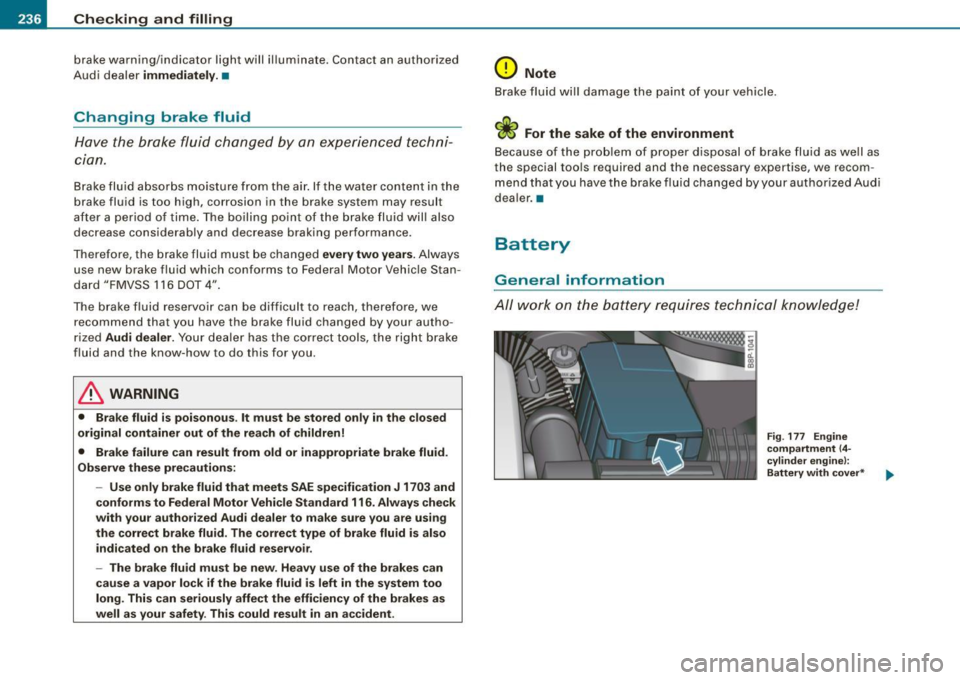
General information
All w ork on the battery requires technical knowledge!
Fi g. 177 E ng ine
co mp artm ent (4 -
c yli nder engin e):
Bat tery w it h cove r"
Page 241 of 324
___________________________________________ C_ h_e _c_ k_ i_n _g _ a_n _d_ f_il _li _n _g __ lR
•
& W ARNING (continu ed )
• Always wear eye protection. Do not let battery acid or any lead
particles get on your skin or clothing . Shield your eyes. Explosive
gases can cause blindness or other injury !
• Battery acid contains sulfuric acid . Sulfuric ac id can cause
blindness and severe burns .
- Always wear gloves and eye protection. Do not tilt the
battery because acid could leak out of the ventilation openings.
- If you get battery acid in your eyes or on your skin , immedi
ately rinse with cold water for several minutes and get medical
attention .
- If you should ingest any battery acid , seek medical attention
immediately .
• Do not expose the battery to an open flame , electric sparks or
an open l ight .
• Do not smoke.
• Do not interchange the positive and negative cables .
• When working on the batte ry , be sure not to short -circuit the
terminals with tools or other metal objects . This would cause the
battery to heat up very quickly , whi ch could lead to damage or
explosion and personal injury .
• When a battery is charged , it produces hydrogen gas which is
explosive and could cause personal injury .
• Always keep the battery well out of the reach of children .
• Before work is done on the electrical system, disconnect the
negat ive ground cable .
• Before performing any work on the electrical system , switch off
the engine and ignition as well as any electrical equipment . The
negative cable on the battery must be disconnected . If you are just
going to replace a light bulb , then it is enough to switch off the
lights.
• Before disconnecting the battery , sw itch off the anti-theft
alarm sy stem! Otherwise you will set off the alarm.
& W ARNING (continued )
• When disconnecting the battery, first disconnect the negative
cable and then the positive cable.
• Before reconnecting the battery , make sure all electrical
consumers are switched off. Reconnect the positive cable first and
then the negative cable . Never interchange the cables -this could
start a fire!
• Never charge a frozen or a thawed -out battery. It could
explode!
If a battery has frozen , then it must be replaced . A
discharged battery can freeze over at 32 °F (0 °CI.
• Make sure the vent hose is always atta ched to the opening on
the side of the battery.
• Never use batteries which are damaged . There is the danger of
an explosion! Always replace a damaged battery .
& WARNING
California Proposition 65 Warning:
• Battery posts , terminals and related accessories contain lead
and lead compounds , chemicals known to the State of Californi a
to cause cancer and reproductive problems . Wash hands after
handling.
0 Note
• D o not d iscon nect the veh ic le bat tery w hen the ign it io n i s
switched on or when the engine is ru nning, otherwise, you wi ll
da mag e ele ctro nic c ompo nents in the e lectr ical system.
• Appl ies to vehic les with 4 -cylinde r engine: When working on the
eng ine, protec t th e batter y hous ing from ultrav iolet ( UV) rays by not
parking the vehicle in direct sun light .
• If y our veh icl e is goi ng to sta nd for a lo ng period o f time with out
being dr iven, protect the battery from "freezing", otherwise it will
b e dama ged and w ill t hen ha ve to be replaced .•
Vehicle care
I t •
Page 247 of 324
________________________________________________ T_ i _r_e _s_ a_n_ d_ w_ h_ e_e _ l_s __ _
•
Groove
means the space between two adjacent tread ribs.
Load ra ting (code)
means the maximum load that a tire is rated to carry for a given
inflation pressure. You may not find this information on all tires
because it is not required by law.
M ax im um l oad ra tin g
means the load rating for a tire at the maximum permissib le infla
tion pressure for that tire.
Ma ximum l oaded v ehi cle weigh t
means the sum of:
(a) Curb weight
(b) Accessory weight
(c) Vehic le capacity weight, and
(ct) Production options weight
M ax im um (p er mi ssibl e) infl ati on pr essur e
means the maximum cold inflation pressure to wh ich a tire may be
inflated. Also ca lled "maximum inflation pressure."
Normal occ upa nt wei ght
means 150 lbs. (68 kilograms) times the number of occupants
seated in the vehicle up to the to tal seating capacity of your vehicle.
O ccupant di stributi on
means distribution of occupants in a vehicle .
Outer di am eter
means the overall diameter of an inflated new tire.
O ve rall wi dth
means the linear distance between the exteriors of the sidewa lls of
an inflated tire, includ ing elevations due to labeling, decorations, or
protective bands or ribs.
Pl y
means a layer of rubber -coated para lle l cords.
P rodu ction opt io ns wei ght
means the combined weight of those installed regular production
options weighing over 5 lbs . (2.3 kg) in excess of those standard
i t ems wh ich they replace, not previously considered in curb weigh t
or accessory weight, including heavy duty brakes, ride levelers, roof
rack, heavy duty battery, and specia l trim .
Radi al p ly tire
means a pneumatic tire in which the ply cords that extend to the
beads are laid at substantially 90 degrees to the centerline of the
tread .
Reco mm ended infl ati on pr essu re
see => page 244, "Cold tire inflation pressure".
Rein force d tir e
means a tire designed to operate at higher loads and at higher infla
tion pressures than the corresponding standard tire. Reinforced
t ires my be identified as "XL", "xi", "EXTRA LOAD", or "RF" on the
sidewall.
R im
means a metal support for a tire or a tire and tube assembly upon
wh ich the t ire beads are seated.
Rim di amet er
means nominal diameter of the bead seat. If you change your whee l
size, you wi ll have to purchase new tires to match the new rim diam
eter .
Rim siz e de sig nation
means rim diameter and width.
Rim wid th
means nominal distance between rim flanges.
Vehicle care I t •