change time AUDI S3 2009 Owner's Manual
[x] Cancel search | Manufacturer: AUDI, Model Year: 2009, Model line: S3, Model: AUDI S3 2009Pages: 324, PDF Size: 76.02 MB
Page 250 of 324
-~_T_ ir_e_ s_ a_ n_d _ w_ h_ e_e _l_s _________________________________________________ _
vehicle at its maximum capacity weight and tires that were on your
vehicle at the time it was manufactured.
If you wish to improve comfort when operating the vehicle at
normal load (up to 3 occupants), you can adjust tire pressures to
those specified for normal vehicle load. Before operating the vehicle at maximum load, you must increase the tire pressures to those
specified for maximum vehicle load
=> &.
Bear in mind that the tire pressure monitoring system* can only
monitor the tire pressures you have stored. The system does not
recognize the load condition of your vehicle.
The effectiveness of the tire pressure monitoring system* will be impaired if you store normal load pressures but then operate the
vehicle at its maximum load=>&. See
the illustrat ion=>
page 247, fig. 180 for the location of the label
either on driver's side B -pillar or inside the fuel filler flap (color of
the actual label and exact location on the vehicle will vary slightly).
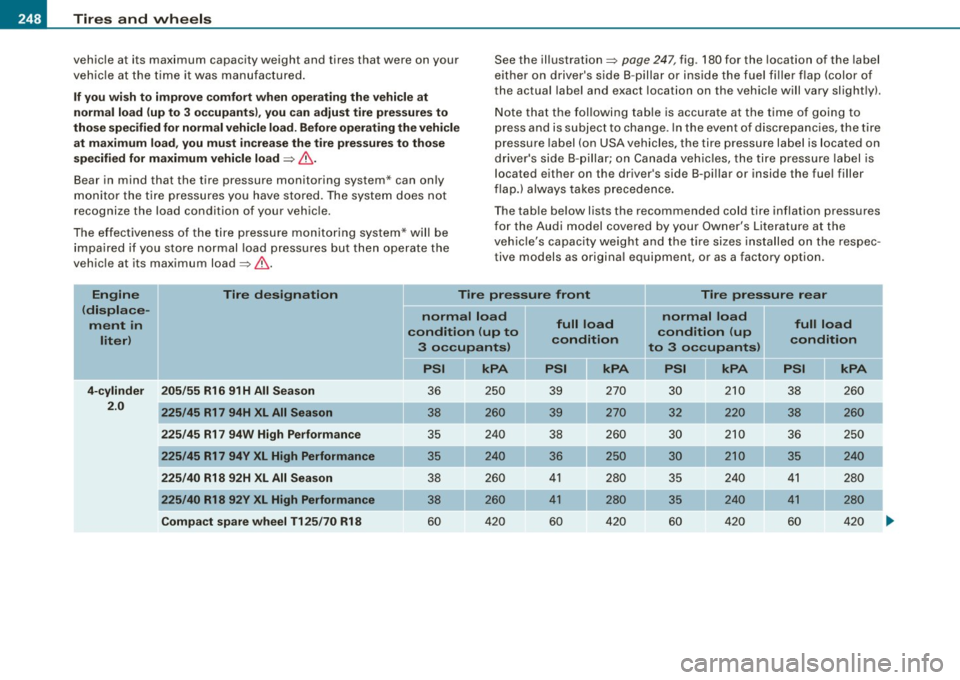
Note that the following table is accurate at the time of going to
press and is subject to change . In the event of discrepancies, the tire
pressure label (on USA vehicles, the tire pressure label is loc ated on
driver's side B-pillar; on Canada vehicles, the tire pressure label is
loca ted either on the driver's side B-pillar or inside the fue l filler
flap.I always takes precedence.
The table below lists the recommended cold tire inflation pressures
for the Audi model covered by your Owner's Literature at the
vehicle's capacity weight and the tire sizes installed on the respec
tive models as original equipment, or as a factory option.
Engine
(displace
ment in
liter)
Tire designation Tire pressure front
Tire pressure rear
4-cylinder
2.0
205/55 R16 91 H All Season
225/45 R17 94H XL All Season
225/45 R17 94W High Performance
225/45 R17 94Y XL High Performance
225/40 R18 92H XL All Season
225/40 R18 92Y XL High Performance
Compact spare wheel T125/70 R18 normal load
condition (up to
3 occupants)
PSI
36 250
38 260
35 240
35 240
38 260
38 260
60 420
full load
condition
kPA
39 270
39 270
38 260
36 250
41 280
41 280
60 420
normal load
full load
condition (up
condition to 3 occupants)
kPA kPA
30 210
38 260
32 220 38 260
30 210
36 250
30 210
35 240
35 240 41 280
35 240 41 280
60 420
60 420
Page 268 of 324
-Tire pressure monitoring system* __ ..:.._____:__..:...::....:..:..:..-=.:..: ..:..::.-=.:..~~.:.=.:..:.::...__ ____________________ _
-Inspect all tires.
- Change the tire if necessary~ page
272.
The warning light in the instrument cluster comes on when the
tire is significantly underinflated .
In addition, the tire symbol ,_, appears in the display together with
the message
Please check tire pressure=> page 265, fig. 185.
After a few seconds, the message disappears again. If you would
like to show the message again, press the Set/Check button
=>
page 8, fig. 2 @ .
[ i ] Tips
• In the case of an intentional loss of air pressure, such as when
readjusting tire pressure, the pressure must be stored again after
ward =>
page 266.
• Tire pressure must only be adjusted when the temperature of the
tires is about the same as ambient air temperature.
• The yellow symbol disappears when the tire pressure is
corrected and the new pressure is stored in the system=>
page 266.
• After changing a wheel or replacing a wheel with the spare tire
you have to adjust the tire pressures on all wheels. In addition, you must then initialize the new tire pressures in the tire pressure moni
toring system =>
page 267. •
Applies to vehicles: with tire pr essu re mon itoring system
Storing tire pressures
Correct storage of specified pressure is the basic require
ment for reliable tire pressure monitoring .
1 1 1 J
Fig. 186 Car: Tire pres
sure monitoring
system
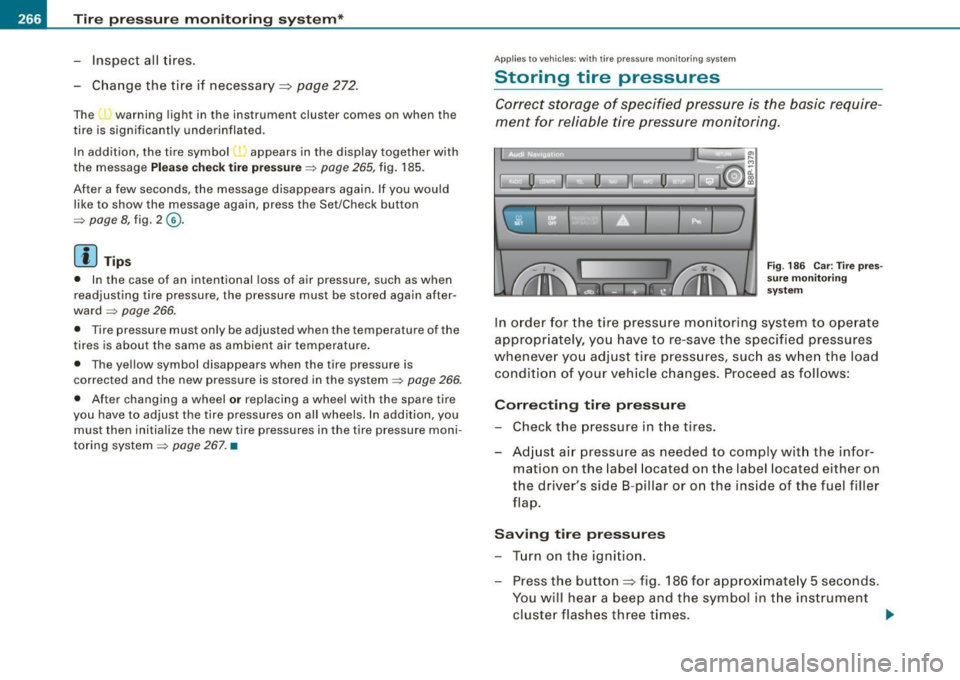
In order for the tire pressure monitoring system to operate
appropriately, you have to re-save the specified pressures
whenever you adjust tire pressures, such as when the load condition of your vehicle changes. Proceed as follows:
Correcting tire pressure
- Check the pressure in the tires.
- Adjust air pressure as needed to comply with the infor- mation on the label located on the label located either on
the driver's side 8 -pillar or on the inside of the fuel filler
flap .
Saving tire pressures
-Turn on the ignition.
- Press the button~ fig. 186 for approximately 5 seconds.
You will hear a beep and the symbol in the instrument
cluster flashes three times. ..,.
Page 269 of 324
__________________________________________ T_i_re _ p =----r_e _s _ s_ u_ r_e _ m_ o_n_ i_ t _o _r_ i_n -=g =-- s....: y:.... s_ te_ m_ * __ !II
•
All pressure warning indicators in the display will be canceled.
Fo llowing each intent ional change in specified pressures, tire pres
sures must be saved again .
After the pressures are saved, the tire pressure monitoring system
measures the current tire pressures and saves them as the new
specified pressures.
[ i] Tips
• The tire pressure is shown on the tire pressure label. The tire
pressure label is located either on the driver's side B -pillar or on the
inside of the fuel filler flap. The tire pressure label lists the recom
mended cold tire inflation pressures for the vehicle at its maximum
capacity weight and the tires that were on your vehicle at the time
it was manufactured. For recommended tire pressures for normal
load conditions, please see chapter~
page 247.
• The tire pressure monitoring system helps the driver monitor tire
pressures, but the driver is still responsible for maintaining the
correct tire pressure. •
Applies to vehicles: with tir e pressure monitor ing system
Wheel change
If a wheel is changed, the wheels that were exchanged
have to be reprogrammed.
- Turn on the ignition.
- Press the button=>
page 266, fig. 186 for approximately 5
seconds. You will hear a beep and the symbol in the
button flashes three times.
Programming is necessary:
• after the tires have been rotated on the vehicle, or the spare tire
is used, •
if tires with new wheel sensors are used.
All pressure warning indicators in the display will be canceled. The
system malfunction error message will not disappear until the
vehicle is underway. With pressing the button~
page 266, fig. 186,
the reprogramming of the new sensors and storing of actual pres
sures starts . This learning phase can take up to 10 minutes driving
time.
During the learning process the tire pressure monitoring system is
not available. •
Applies to vehic les: with tir e pr essure monitor ing system
Malfunctions *
A malfunction can have various causes.
Fig. 187 Display:
System malfunction
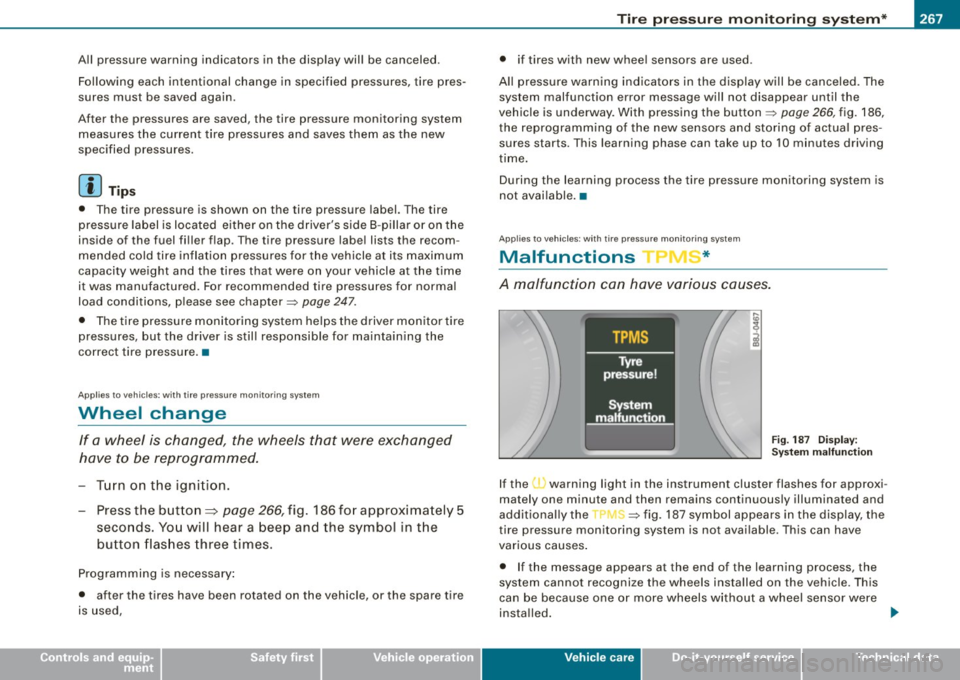
If the '-warning light in the instrument cluster flashes for approxi
mately one minute and then remains continuously illuminated and
additionally the
~ f ig. 187 symbol appears in the display, the
tire pressure monitoring system is not available . This can have
various causes.
• If the message appears at the end of the learning process, the
system cannot recognize the wheels installed on the vehicle . This
can be because one or more wheels without a wheel sensor were
installed. .,,_
Vehicle care I t •
Page 274 of 324
-L___:W:..:..:. h.:.: a::.. t:...:: d:.:o:::....:. l..: d::. O ::::....: n:..:.:: O:..:W :.:..:. ? ____________________________________________ _
& WARNING
Always store jacking equipment, spare wheel in the luggage
compartment. Tighten screw for the spare wheel securely. Under
no circumstances should you store the spare wheel or jack and
tools unsecured in the passenger compartment. This could cause
serious personal injury to passengers in the vehicle in case of a
collision.
• The compact spare tire is for temporary use only and is so
marked on the sidewalls.
• Do not drive at speeds exceeding 50 mph (80 km/hi with the
compact spare wheel mounted. Also rapid acceleration, hard
braking and hard cornering must be avoided to help prevent loss
of vehicle control.
• Any continuous road use of the compact spare tire may result
in tire failure, loss of vehicle control and injury to vehicle occu
pants.
• Do not put a snow chain on your compact spare tire. Due to the
smaller tire size, the chain will not fit properly and can thus
damage your vehicle. You could also lose the chain, as well as
control of the vehicle .
• If you have a flat front tire in road conditions which require
snow chains, first remove the undamaged rear wheel and mount
the compact spare wheel in its place. Then remove the damaged
front wheel, take the snow chains off it and attach them to the
wheel taken from the rear. This wheel can now be mounted on the
front with its snow chains. Check and adjust tire pressure promptly.
• Never use two or more compact spare tires at the same time.
0 Note
When using the compact spare wheel, note the following: •
After installing the compact spare wheel, the tire inflation pres
sure should be checked and, if necessary, increased to 60 psi (4 .2
barl.
• The load carrying capacity is marked on the tire sidewal ls and
must not be exceeded .
• After installing the compact spare wheel, make sure that you
remount the flat tire in its storage area properly .
• The compact spare tire should be properly remounted in its
storage area as soon as the standard road tire can be replaced.
• Because the compact spare tire was specifically designed for
your vehicle, it must not be used on any other vehicle . Likewise,
compact spare wheels from other vehic les must not be used on your
vehicle.
• The compact spare tire must not be mounted on any other
wheels, nor must standard tires, snow tires, wheel covers or trim
rings be used with the compact spare wheel. If such use is
attempted, damage to these items or other vehicle components
may occur.
[ i] Tips
Check the inflation pressure of the compact spare tire (60 psi/4 .2
bar) periodically to keep the tire ready for use .•
Wheel change
Before changing a wheel
Observe the following precautions for your own and your
passenger's safety when changing a wheel.
- After you experience a tire failure, pull the car well away
from moving traffic and try to reach level ground before
you stop
~ & . ~
Page 283 of 324

_________________________________________________ F_ u_ s_ e_s _ a_n _d_ b_ u _ lb_ s _ __._
The various electrical circuits are protected by fuses. The fuses are
clustered in a centralized unit. The unit is located behind the face
panel at the end of the instrument panel. The crank for operating
the sunroof in case of a power failure is a lso stored behind the face
panel
~ page 49.
Two spare fuses and a sticker identifying the fuses are located on
the inside of the fuse box cover.
You are well advised to keep a supply of spare fuses in your vehicle .
Fuses with the proper ampere ratings are available at your autho
rized Audi dealer.
& WARNING
Never replace a fuse with one that has a higher amperage rating.
• A fuse with a too high amperage could damage the electrical
part and cause a fire .
0 Note
• On no accoun t should fuses be repaired (e.g . patched up with tin
foil or wire) as this may cause serious damage elsewhere in the elec
trical circuit or cause fire.
• If a fuse blows repeatedly, do not keep replacing it. Instead, have
the cause for the repeated short circuit or overload tracked and
fixed. •
Fuse Location , Instrument Panel left
Fus es which can be replaced.
Fig . 201 Fuse carrier
behind the instrument
panel end face, cover
removed
Note that the following table is accurate at the time of going to
press and is subject to change. In the event of discrepancies , the
label on the inside of the cover always takes precedence .
The power seats are protected by circuit breakers, which automati
cally reset after a few seconds after the overload has been reme -
died. .._
Vehicle care Do-it-yourself service irechnical data
Page 285 of 324
_________________________________________________ F_ u_ s_ e_s _ a_n _d_ b_ u _ lb_ s _ __.ffllll
No . Equipm ent
37 Heated seats, front
38 Passe nger s ide power window, front
39 Special function interface
Starter
41 Rear window wiper
42 Windshield wiper (washer pump)
43 Convenience electronics (control module)
44 Trailer control module
45 Trailer control module
Not used
47 Cell phone package (VOA interface)
48 Not used
49 Not used
Au tom atic cir cuit br eake rs: Amps
20
30
5
40
15
15
20
20
15
5
The electric power windows and the electric seat adjusters are protected with circuit breakers which reset automatically after the
circu it overload has been corrected.
[ i J Tip s
• Whenever replacing a fuse, always consult the sticker on the
inside of the fuse panel cover. It contains the most up-to-date infor
mation regarding the fuse arrangement. If in doubt, ask your autho
rized Audi Service advisor.
• Some of the equipment items listed are optiona l or on ly avail
able on certain model configurations. •
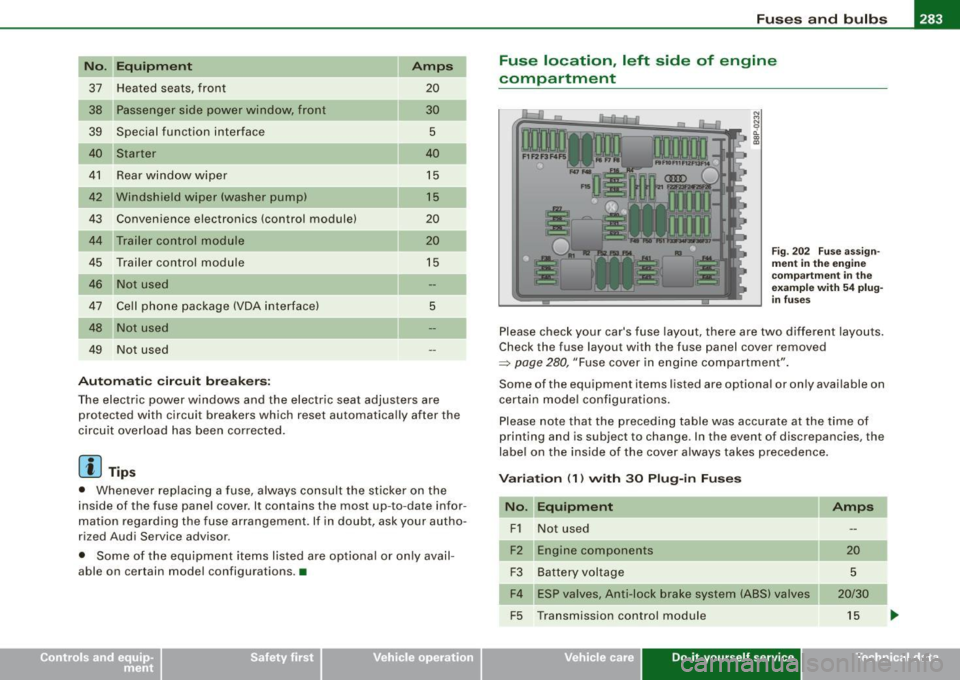
Fuse location , left side of engine
compartment
N M N
~ (X) 0)
Fig . 202 F use ass ign
m ent in th e e ngin e
co mpar tment in th e
e xampl e wit h
54 p lu g
in fu ses
Please check your car's fuse layout, there are two different layouts.
Check the fuse layout with the fuse panel cover removed
~ page 280, "Fuse cover in engine compartment" .
Some of the equipment items listed are optional or on ly available on
certain model configurations.
Please note that the preceding table was accurate at the time of
printing and is subject to change . In the event of discrepancies, the
label on the inside of the cover a lways takes precedence.
V ariation (1 ) with 30 Plu g-in F uses
No . Equipm ent
F1 Not used
Engine components
F3 Battery voltage
F4 ESP v alves, Anti -lock brake system (ABS) valves
F5 Transmission control module
Vehicle care Do-it-yourself service
Amps
20
5
20/30
15
Technical data
Page 323 of 324
It has always been Audi's po licy to con tinuously improve its prod
ucts. Audi, therefore, reserves the right to make changes in design
and specifications, and to make additions or improvements in its
products, without incurring any ob ligation to install them on prod
ucts previous ly manufactured .
Text, illustrations and specifications in this manual are based on the most up -to -date information available at the time of printing.
A ll rights reserved . May not be reproduced or translated in whole or
in part without the written consent of AUD I AG . Specifications are
subject to change without notice . "Audi", "quattro" and the four rings emblem are registered trade
marks of AUDI AG . "A3" is trademark of AUDI AG .
Editor ial dea dline: 08 /28 /2008
<£> For the sake of the environment
Printed on environmentally friendly paper (bleached without chlo
rine, recyc lable).
Printed in Germany
© 2008 AUDI AG