height AUDI S3 2009 User Guide
[x] Cancel search | Manufacturer: AUDI, Model Year: 2009, Model line: S3, Model: AUDI S3 2009Pages: 324, PDF Size: 76.02 MB
Page 129 of 324

________________________________________________ D_r_iv _ i _n_ g~ S_ a_ fe_ ly __ !II
Important things to do before driving
Safety is everybody's job! Vehicle and occupant safety
always depends on the informed and careful driver.
For your safety and the safety of your passengers, before
driving always:
-Make sure that all lights and signals are operat ing
correctly.
- Make sure that the tire pressure is correct.
- Make sure that all windows are clean and afford good
visibility to the outside.
- Secure all luggage and other items carefully =>
page 94.
-Make sure that noth ing can interfere w ith the pedals.
- Adjust front seat, head restraint and mirrors correctly for your height .
- Instruct passengers to adjust the head restraints
according to their height.
- Make sure to use the right ch ild restraint correctly to
protect children =>
page 169, "Child Safety ".
- Sit properly in your seat and make sure that your passen
gers do the same=>
page 74, "General recommenda
tions".
- Fasten your safety belt and wear it p roperly. Also instruct
your passengers to fasten the ir safety belts properly
=>
page 137. •
Controls and equip
ment Safety first
Vehicle operation
What impairs driving safety?
Safe driving is directly related to the condition of the
vehicle, the driver as well as the driver's ability to concen
trate on the road without being distracted.
The driver is responsible for the safety of the vehicle and all
of its occupants. If your ability to drive is impaired, safety
risks for everybody in the vehicle increase and you also
become a hazard to everyone else on the road =>& .There
fore:
Do not let yourself be distracted by passengers or by
using a cellular telephone .
NEVER drive when your driving ability is impaired (by
medications, alcohol, drugs, etc.).
- Observe all traffic laws, rules of the road and speed limits
and plain common sense .
- ALWAYS adjust your speed to road, traffic and weather
conditions.
- Take frequent breaks on long trips. Do not drive for more
than two hours at a stretch.
- Do NOT drive when you are tired, under pressure or when
you are stressed .
& WARNING
Impaired driving safety increases the risk of serious personal
injury and death whenever a vehicle is being used. •
Vehicle care Do-it-yourself service Technical data
Page 144 of 324

___ S_a_ f_ e_ t-= y_ b_e_ l_ t _s _______________________________________________ _
-Insert t he tongue into the correct b uckle of y our seat
unt il you h ea r it la tc h securely~ fig. 138.
Pull on t he belt to make sure that it is securely latched in
the buckle.
Aut om ati c sa fe ty belt re tra cto rs
Eve ry safety be lt is equipped with an automatic belt retractor on the
shoulder belt. This feature locks the belt when the belt is pulled out
fast, during hard braking and in an accident. The belt may a lso lock
when you drive up or down a steep hill or through a sharp curve .
During normal driving the belt lets you move free ly.
Safety belt prete nsi oners
The safety belts are equipped with a be lt pretensioner that he lps to
tighten the sa fety be lt and remove slack when the pretensioner is
activated. The function of the pretensioner is monitored by a
warning light=>
page 14 .
Swit chable locking fe ature
Every safety belt except the one on the driver sea t is equipped with
a switchab le locking feature that
must be used when the safety belt
is used to a ttach a chi ld safe ty sea t. Be sure to read the important
information about this feature=>
page 179.
& WARNING
Improper ly positioned safet y belts can cause seriou s inj ury in an
accident =>
page 14 2, "S afety belt po sitio n".
• Safet y belts offer opt imum protection on ly when the seat back
i s upright and belt s are properly po sition ed on t he bod y.
• Always make sure that the rear seat backrest to whi ch the
c enter r ear sa fet y belt i s atta ched i s sec ure ly lat ched whe nev er
the rear center saf ety belt i s being us ed. If the ba ckrest is not
s ecu rely lat ched, the pas senge r will mo ve fo rward with the back
rest dur ing sudden braking , in a sudden maneu ver and e spec iall y
in a cra sh.
& W AR N ING (continu ed )
• Never attach the safety belt to the buck le for anothe r seat .
Atta ch ing th e be lt to the wrong buckle will reduce safety belt
e ffe cti venes s and can ca use seriou s per son al injur y.
• A p assenger who i s not prope rly re str ained can be s eriousl y
injured by the saf ety belt it self wh en it m ove s from the stronger
p art s of the body into criti ca l area s like the abd omen .
• Alway s lock the convert ible lo ck ing retractor when you are
s ecu ring a ch ild safety se at in the ve hi cle =>
page 18 1. •
Safety belt position
Correct belt posi ti o n is the key to getting maximum
protecti on f rom safety be lts.
Fig . 1 3 9 He ad r est ra in t
an d safe ty belt p osi
tion a s seen from th e
sid e
Standard features on your vehicle help you adjust the position of
the safety belt to match your body size .
• belt height adjustment for the front seats,
• automatic belt height adjustment for the rear seats.
Page 146 of 324

___ S_a_ f_ e_ t-= y_ b_e_ l_ t _s _______________________________________________ _
& WARNING
Improperly positioned safety belts can cause serious personal
injury in an accident.
• Expectant mothers must always wear the lap portion of the
safety belt as low as possible across the pelvis and below the
rounding of the abdomen.
• Always read and heed all WARNINGS and other important infor
mation ~
& in "Fastening safety belts" on page 141. •
Unfastening safety belts
Unbuckle the safety belt with the red release button only
after the vehicle has stopped.
Fig . 141 Releasing the
tongue from the buckle
-Push the red release button on the buckle=> fig. 141. The
belt tongue will spring out of the buckle=>& .
- Let the be lt wind up on the retractor as you guide the belt
tongue to its stowed pos ition.
& WARNING
Never unfasten safety belt while the vehicle is moving. Doing so
will increase your risk of being injured or killed .•
Adjusting safety belt height
With the aid of the safety belt height adjustment, the three
point safety belt strap routing can be fitted to the shoulder area, according to body size.
Fig . 142 Safety belt
height adjustment for
the front seats -loop
around fittings
Push the loop -around fittings up => fig. 142 @ , or
- squeeze together the G) button , and push the loop
around f ittings
down @.
- Pull the belt to make sure that the upper attachment is
properly e ngaged .
& WARNING
Always read and heed all WARNINGS and other important informa
tion
~ page 140.
[ i ] Tips
• The shoulder belt part should route approximately over the
middle of you r shoulder -und er no circu mstanc es should it route
over your neck and throat area
~ & in "Safety belt position" on
pag e 142. ~
Page 147 of 324

_________________________________________________ S_ a_f _e _t .:..y _ b_ e_lt_ s __ llll
• With the front seats, the height adjustment of the seat can also
be used to adjust the position of the safety belts. •
Improperly worn safety belts
Incorrectly positioned safety belts can cause severe inju
ries.
Wearing safety belts improperly can cause serious injury or
death. Safety belts can only work when they are correctly positioned on the body. Improper seating posit ions reduce
the effectiveness of safety belts and w ill even increase the
risk of injury and death by moving the safety belt to critical
areas of the body . Improper seating positions also increase
the r isk of serious injury and death when an airbag deploys
and strikes an occupant who is not in the correct seating position. A driver is responsible for the safety of all vehicle
occupants and especially for children. Therefore:
-Never permit anyone to assume an incorrect sitting posi -
tion in the vehicle while traveling~& .
The following lists only some examples of improperly worn safety
bel ts that will increase the risk of serious injury and death. Our hope
is that these examples will make you more aware of seating posi
tions that are dangerous.
Therefore, whenever the vehicle is moving:
• never wear the shoulder belt under your arm
• never let the shoulder belt pass over your neck
• never wear the safety belt loosely
• never place the lap belt portion of the safety belt across your
abdomen ~& -
Controls and equip
ment Safety first Vehicle operation
& WARNING
Improperly worn
safety belts increase the risk of serious personal
injury and death whenever a vehicle is being used.
• Always make sure that all vehicle occupants are correctly
restrained and stay in a correct seating position whenever the
vehicle is being used.
• Always read and heed all WARNINGS and other important infor
mation ~
page 140. •
Safety belt pretensioners
How safety belt pretensioners work
In front, side and rear end collisions above a particular
severity, safety belts are tensioned automatically.
The safety belts are equipped with safety belt pretensioners . The
system is activated by sensors in front, side and rear -end collisions
of great severity . This tightens the belt and takes up belt slack~ &
in "Service and disposal of safety belt pretensioner " on
page 146.
Taking up the slack helps to reduce forward occupant movement
during a collision.
0 Note
Never let the belt remain over a rear seat back that has been folded
forward.
[ i] Tips
The safety belt pretensioners can only be activated once.
• In minor frontal and side collisions, in rear -end collisions, in a
rollover and in accidents involving very little impact force , the safety
belt pretensioner are not activated . .,_
Vehicle care Do-it-yourself service Technical data
Page 246 of 324
-~_T_ ir_e_ s_ a_ n_d _ w_ h_ e_e _l_s _________________________________________________ _
& WARNING (continued)
crashes and serious personal injuries . Have worn or damaged tires
replaced immediately.
• Tires age even if they are not being used and can fail suddenly,
especially at high speeds. Tires that are more than 6 years old can
only be used in an emergency and then with special care and at
low speed.
Glossary of tire and loading terminology
Accessory weight
means the combined weight (in excess of those standard items
which may be replaced) of automatic transmission, power steering,
power brakes, power windows, power seats, radio, and heater, to
the extent that these items are available as factory-installed equip
ment (whether installed or not).
Aspect ratio means the ratio of the height to the width of the tire in percent.
Numb ers of 55 or lower indicate a low sidewall for improved
steering response and better overall handling on dry pavement.
Bead
means the part of the tire that is made of steel wires, wrapped or reinforced by ply cords and that is shaped to fit the rim.
Bead separation means a breakdown of the bond between components in the bead.
Cord
means the strands forming the plies in the tire.
& WARNING (continued)
• Never mount used tires on your vehicle if you are not sure of
their "previous history." Old used tires may have been damaged
even though the damage cannot be seen that can lead to sudden
tire failure and loss of vehicle control.
• If you notice unusual vibration or if the vehicle pulls to one side
when driving, always stop as soon as it is safe to do so and check
the wheels and tires for damage . •
Cold tire inflation pressure
means the tire pressure recommended by the vehicle manufacturer
for a tire of a designated size that has not been driven for more than
a couple of miles (kilometers) at low speeds in the three hour period
before the tire pressure is measured or adjusted .
Curb weight means the weight of a motor vehicle with standard equipment
including the maximum capacity of fuel, oil, and coolant, air condi
tioning and additional weight of optional equipment.
Extra load tire
means a tire designed to operate at higher loads and at higher infla
tion pressures than the corresponding standard tire . Extra load tires
my be identified as "XL",
"xi", "EXTRA LOAD", or "RF" on the side
wall.
Gross Axle Weight Rating ("GAWR")
means the load-carrying capacity of a single axle system, measured
at the tire -ground interfaces .
Gross Vehicle Weight Rating ("GVWR"l
means the maximum total loaded weight of the vehicle.
Page 257 of 324
Tires and wheels -_______________ _____.
Incorrect wheel alignm ent
Inc orrect wheel alignment ca n cause excessive tire wear, impairing
the safety of the vehicle . If tires show excessive wear, have the
whee l alignment chec ked by an autho rized A udi deale r or qu alifie d
wor kshop .
All Wheel Drive
Vehicles with quattro® must always have tires of the same size,
co nst ructi on an d tread type . For detail s see =>
page 196 .
& WARNING
Sudden tire failure can lead to lo ss of control, a crash and serious
personal injury!
• Never drive a vehicle when the tread on any tire is worn down
to the wear indi cators.
• Worn tire s are a safety hazard , they do not grip well on wet
roads and increase your risk of "hydroplaning " and loss of control.
• Always keep chemicals that can cau se tire damage , such a s
grease , oil , gasoline and brake fluid away from tires.
• Tires age even if they are not being used and can fail suddenly ,
especially at high speeds . Tire s that are more than 6 years old can
only be used in an emergency and then with special care and at
lower speeds .
• Never mount used tire s on your vehicle if you are not sure of
their "previou s hi story. " Old used tires may have been damaged
even though the damage cannot be seen that can lead to sudden
tire failu re and loss of vehi cle control. •
New tires and replacing tires and wheels
N ew tires a nd wh eels hav e to be b ro ken in.
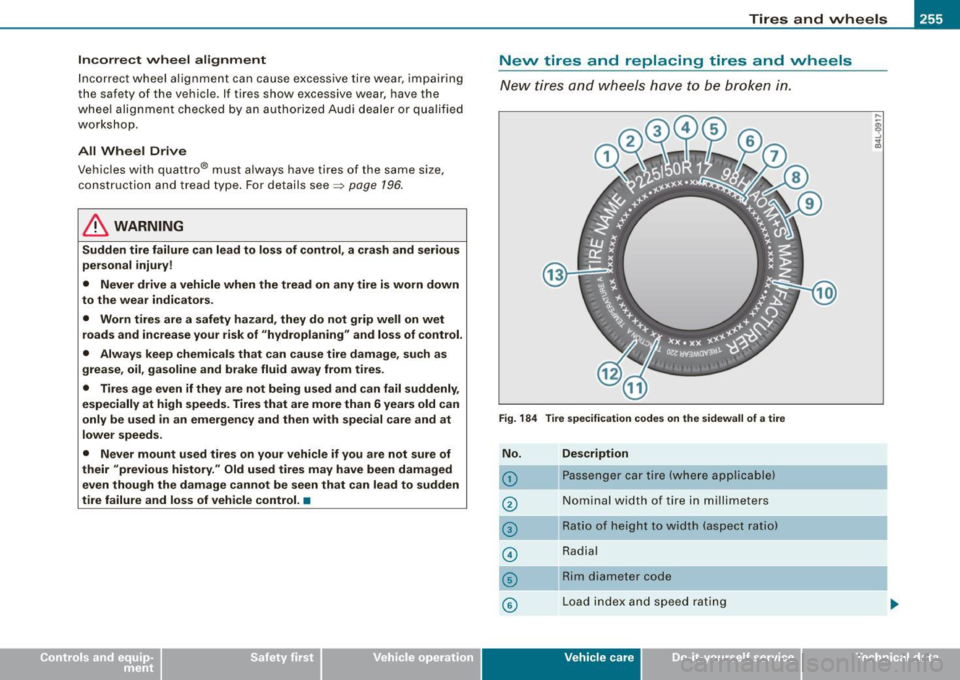
Fig. 184 T ire spe cificati on c od es on the sidewall of a tire
No .
©
0
©
©
©
©
Descr iption
Passenger car tire (where applicable)
Nominal width of tire in mi llimeters
Ratio of height to width (aspect ratio)
Radial
ii Rim diameter code
Load index an d spee d rating
Vehic le care I I irechnical data
Page 258 of 324
-~_T_ ir_e_ s_ a_ n_d _ w_ h_ e_e _l_s _________________________________________________ _
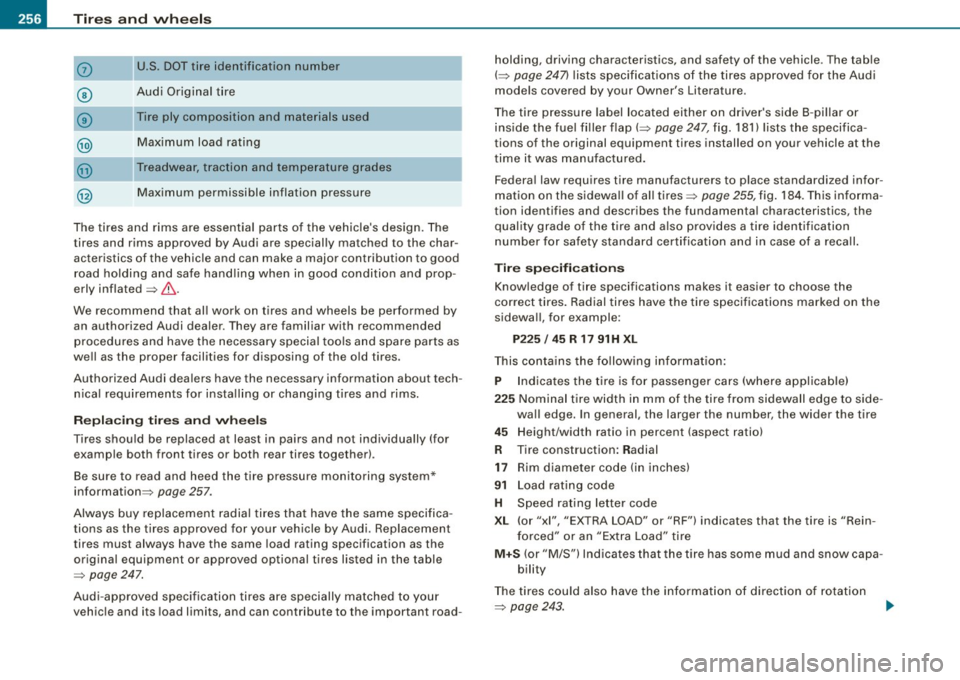
0
©
G)
@
U.S. DOT tire identification number
Audi Original tire
Tire ply composition and materials used Maximum load rating
Treadwear, traction and temperature grades Maximum permissible inflation pressure
The tires and rims are essential parts of the vehicle's design. The
tires and rims approved by Audi are specially matched to the char acteristics of the vehicle and can make a major contribution to good
road holding and safe handling when in good condition and prop
erly inflated =>& .
We recommend that al l work on tires and wheels be performed by
an authorized Audi dealer . They are familiar with recommended
procedures and have the necessary special tools and spare parts as
we ll as the proper facilities for disposing of the old tires .
Authorized Audi dealers have the necessary information about tech
nical requirements for insta lling or changing tires and rims .
Rep lac ing t ires a nd w heels
Tires should be replaced at least in pairs and not individually (for
example both front tires or both rear tires together) .
Be sure to read and heed the tire pressure monitoring system*
information :::>
page 257.
Always buy replacement radial tires t hat have the same specifica
tions as the tires approved for your vehicle by Audi . Replacement
tires must always have the same load rating specification as the
original equipment or approved optional tires listed in the table
=>
page 247.
Audi -approved specification tires are specially matched to your
vehic le and its load limits, and can contribute to the important road- holding, driving characteristics, and safety of the vehicle
. The table
( =>
page 247) lists specifications of the tires approved for the Audi
models covered by your Owner's Literature.
The tire pressure label located either on driver's side 8 -pi llar or
inside the fuel fi ller flap( =>
page 247, fig. 181 l lists the specifica
tions of the original equipment tires installed on your vehicle at the
time it was manufactured.
Federal law requires tire manufacturers to place standardized infor
mation on the sidewa ll of all tires=>
page 255, fig. 184. This informa
tion identifies and describes the fundamenta l characteristics, the
quality grade of the tire and also provides a tire identification
number for safety standard certification and in case of a recall.
T ire s pec ific ation s
Knowledge of tire specifications makes it easier to choose the
correct tires. Radial tires have the tire specifications marked on the
sidewal l, for example:
P 22 5 / 45 R 17 91H XL
This contains the following information:
P Ind icates the tire is for passenger cars (where applicable)
2 25 Nominal tire width in mm of the tire from sidewall edge to s ide -
wall edge. In general, the larger the number, the wider the tire
45 Height/width ratio in percent (aspect ratio)
R Tire construction: Radial
17 Rim diameter code (in inches)
91 Load rating code
H Speed rating letter code
XL (or "xi", "EXTRA LOAD" or "RF ") indicates that the tire is "Rein
forced" or an "Extra Load" tire
M +S (or "M/S"l Indicates that the tire has some mud and snow capa
bility
The tires cou ld also have the information of direction of rotation
=>
page 243 .
Page 264 of 324
_L_T~ir ~e :..:s~ a~n~ d~ w~ h ~e~e~ l~ s '.,_ ______________________________________________ _
Wheel bolts
W heel b olts mus t al wa ys be tigh te n ed to t he cor rect
to rqu e.
The design of wheel bolts is matched to the factory instal led rims . If
d ifferen t rims are fitted, the co rrect w heel bo lts wit h th e rig ht length
and correctly shaped bolt heads m ust be used. This ensures that
w hee ls are fitt ed s ecure ly a nd th at t he brake sys te m funct ions
correctly .
I n certain circums tances, yo u may no t use w heel b olts fr om a
differ ent vehicle -even if it is the same mode l.
&_ WARNING
Improperly tightened or maintained wheel bolts can become loose
causing loss of control, a collision and serious personal injury.
• Always keep the wheel bolts and the threads in the wheel hubs
clean so the wheel bolts can turn easily and be properly tightened.
• Never grease or oil the wheel bolts and the threads in the wheel
hubs. They can become loose while driving if greased or oiled,
even if tightened to the specified torque .
• Only use wheel bolts that belong to the rim being installed.
• Never use different wheels bolts on your vehicle.
• Always maintain the correct tightening torque for the wheel
bolts to reduce the risk of a wheel loss. If the tightening torque of
the wheel bolts is too low , they can loosen and come out when the
vehicle is moving . If the tightening torque is too high, the wheel
bolts and th reads can be damaged and the wheel can become
loose .
0 Note
The specified torque for the wheel bolts is 90 ft lb (120 Nm) with a
t ole ranc e of ± 7,4 ft lb(± 1 0 Nm). To rque whee l bolts diag onally.
After changing a wheel, the torque must be checked as soon as possible with a to
rque wrench -preferab ly by an authorized Audi
dea ler o r qu alif ied wo rksh op.•
Low aspect ratio tires
Yo ur Audi is fac tory-equip ped wi th l ow asp ect rati o tires. Th ese tires
have been thorough ly tested and been selected specifically for your
mod el for thei r su per b p erfo rma nce, road feel an d handl in g u nder
a variety of driving conditions . Ask your author ized Aud i dea ler for
mo re deta ils.
T he low aspec t ra tio o f th ese t ires is ind icate d by a numera l o f 55 or
less in the t ire's size designation. The numera l represents the ratio
of the ti re's s idewa ll height in re la ti on to its tread w idth e xpress ed
in percentage. Conventiona l tires have a height/width ratio of 60 or
mo re .
The performance of low -aspect -ratio t ires is part icularly sensitive to
improper inflation pressure . It is therefore important that low
aspect ratio tires are inflated to the specified pressure and that the
inflation pressure is regularly checked and maintained. Tire pres
sures should be checked at least once a month and alway s before a
long trip=>
page 250, "Checking tire p ressure".
What you can do to avoid tire and rim damage L ow a spect rati o tires can be damaged more easi ly by impact with
potho les, curbs, gull ies or ridges on the road, particu larly if the t ire
is underinflated.
In orde r to minimi ze the occurrence o f im pact da mage to th e tire s
of your vehicle, we recommend that you observe the fo llowing
p reca utions:
• Always ma intain reco mm ende d inflat io n pressu res . C heck your
tire p ressure every 2, 000 miles (3 ,000 km) and add ai r if neces sary .
• D rive car eful ly on roads with potholes, deep gullies or ridges.
Th e impact from d riving th ro ugh o r ove r such o bstac les can
dama ge you r tires . Impact w ith a curb may also cause da mage to
your tires . .,_
Page 304 of 324
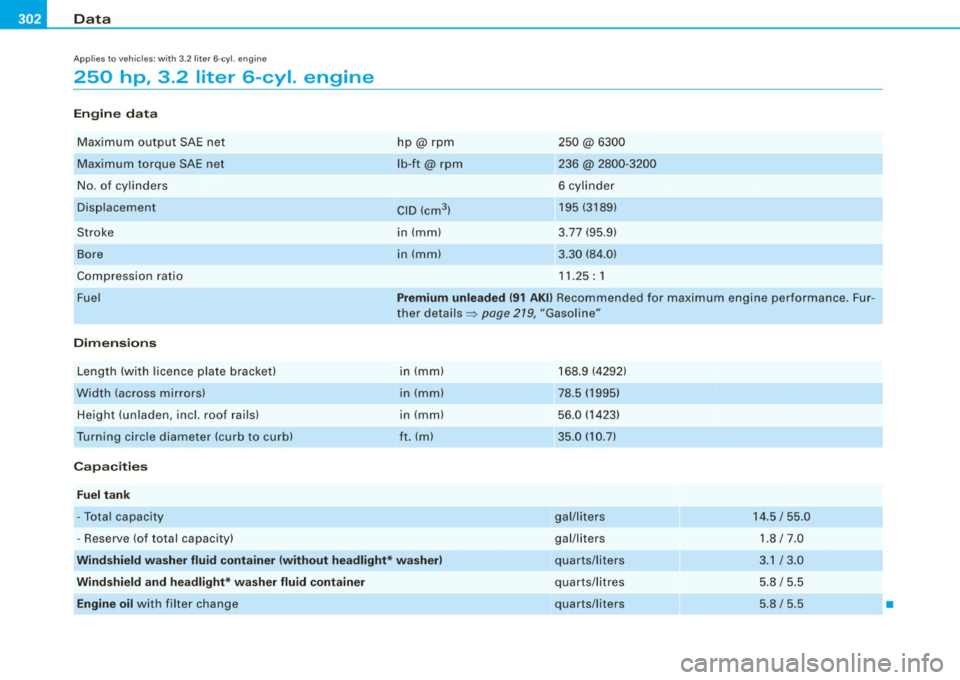
___ D_ a_t _a ________________________________________________________ _
Applies to vehicles : wit h 3.2 liter 6-c yl. en gine
250 hp, 3 .2 liter 6-cyl. engine
Engine data
Max imum output SAE net
Maximum torque SAE net
No. of cy linders
Disp lacement
Stroke
Bo re
Comp ress ion ratio
Fuel
Dimensions
Length (with licence plate brac ket)
Width (across mirrors) Height (unladen, incl. roof rails)
Turning c ircle diameter (curb to curb)
Capacities
Fuel tank
- Total capacity
- Reserve (of total capacity) hp@ rpm
lb-ft@ rpm
CID (cm
3
)
in (mm)
in (m m) 250@6300
236 @ 2800-3200
6 cylinder 195 (3189)
3 .77 (95 .9)
3 .30 (84 .0)
11 .25 : 1
Premium unleaded {91 AKll Recommended for maximum engine performance . Fur
ther details =:>
page 219, "Gasoline"
in (m m)
in (m m)
in (mm)
ft . (ml 168
.9 ( 429 2)
78.5 (1995)
56.0 ( 14 23)
35 .0 (10 .7)
ga l/lit ers
gal/l iters 14.5 / 55
.0
1 .8/7 .0
Windshield washer fluid container (without headlight* washer )
Windshield and headlight* washer fluid container quarts/liters
quarts/l it res 3.
1 / 3.0
5 .8 / 5.5
Engine oil with filter change quarts/liters 5.8 / 5.5 •
Page 319 of 324
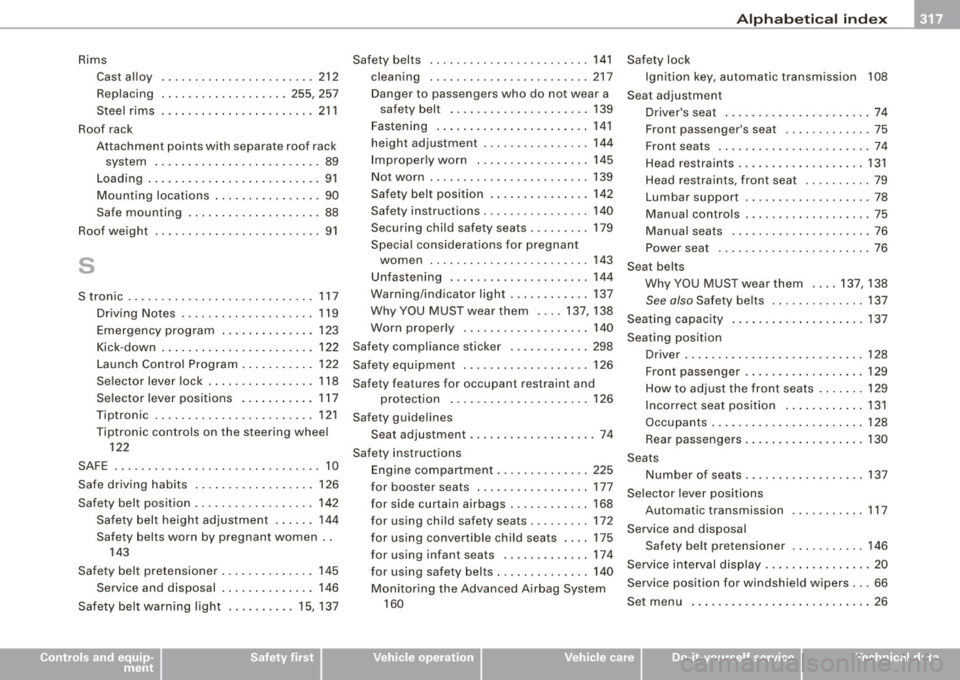
______________________________________________ A_ l_,_ p _h_ a_ b_e _t_i c_ a _ l _in _ d_e _ x __ lll
Rims
Cast alloy ..... .. ... ........ .... . 212
Rep lacing ......... ..... .... . 255 , 257
Steel rims .... ...... ..... ...... .. 211
Roof rack Attachment points with separate roof rack system ... .... .... .. ... ...... ... 89
Loading .. .. ..... .... .... .. . ... ... 91
Mounting locations . ..... ... .... ... 90
Saf e mounting ... .... .... .. . .... .. 88
Roof weight . ... .... ..... .. .... .... .. 91
s
Stronic .. ..... .. .... .... ... .... .... 117
Driving Notes . . . . . . . . . . . . . . . . . . . . 119
Emergency program ..... ... . ... .. 123
Kick -down .. ... ... .. .... ... . ... .. 122
Launch Control Program . .... ..... . 122
Selector lever lock .. ...... .. . .... . 118
Selector lever positions . ..... .... . 117
Tiptronic . .... .... .... ... .... .... 12 1
Tiptronic controls on the steering whe el
122
SAFE ...... ... ......... ....... ...... 10
Safe driving habits .... ..... ... ..... . 126
Safety belt position .... ... .... .... ... 142
Safety belt height adjustment . ..... 144
Safety belts worn by pregnant women .. 143
Safety belt pretensioner ... ...... .. ... 145
Service and disposal . .... ... .. ... . 146
Safety belt warning light .... .... .. 15, 137
Controls and equip
ment Safety first
Safety bel
ts ... .. .. .. ....... ... . .... 141 Safety lock
cleaning . .... ...... ........ ..... 217 Ignition key , automatic transmission 108
Dange r to passengers who do not wear a
Seat adjustment
safety belt ... .. .. . .... ... .... .. 139
Driver's seat . .... ... .. .. .... .... .. 74
Fastening .. ........ ..... ... .... . 141
Front passenger's seat .... .... .... . 75
height adjustment .... .... .... .... 144
Front seats .. ... ..... .. .. ... ... .. . 74
Improperly worn . .......... .... .. 145
Head restrain ts .. .. ...... ....... .. 131
Not worn . .... ...... ....... .... .. 139
Head restrain ts, front seat .. .... .... 79
Safety belt position ... ...... ...... 142
Lumbar suppor t .. .... .... .... ... .. 78
Safe ty ins tructions . ... .... ... . .. .. 140
Manual controls .. .... .... ... ... ... 75
Securing child safety seats ....... .. 179
Manual seats .... .... .... .... ... .. 76
Special considerations for pregnant Power seat .... ... .... .... .... .... 76
women . .... .... .... .... ... .... 143
Seat belts
Unfastening .. ... .... ...... ..... . 144
Warning /indicato r light ...... .... .. 137
Why YOU MUSTwearthem ... . 137,138
Worn properly ... .... ...... ...... 140
Safety compliance sticker . ..... .... .. 298 Why YOU MUST wear them
.... 137 , 138
See also Safety belts . ... .. .... .... 137
Seating capacity .. . ... .... .... .... .. 137
Seat ing position
Driver ... .. ... ... .... ... . ... .... . 128
Safety equipment ...... ..... .... .... 126
Sa fet y fea tures for occupant r estraint and
protection ... .. .. . ... .... .... .. 126
Safety guidelines Seat adjustment ......... ... .... ... 74 Front passenger .
...... .. . .... .. .. 129
How to adjust the front seats . .. .. . . 129
Incorrect seat position .. ...... .. . . 131
Occupants .. ...... .... .. . .... ... . 128
Rear passengers . ........ . ... .... . 130
Safety instructions Seats
Engine compartm ent . .... ..... ... . 225
Number of seats ........ .. ... ... .. 137
for booster seats . .... ...... ...... 177
for sid e curtain airbags . ..... .. .... 168 Selector lever positions
Automatic transmission ......... .. 117
for using child safety seats . ........ 172
for using convertible child sea ts .... 175
for using infant seats ........... .. 174
for using safety be lts . .... .... .... . 140
Monitoring the Advanced Airbag System Service and disposal
Safety b elt pretensioner ... .... .... 146
Service interval display ... .. .. .... .. . .. 20
Service position for windshield wipers ... 66
160 Set menu
... ...... .. ... ... ..... .. . .. 26
Vehicle operation Vehicle care Do-it-yourself service Technical data