height AUDI S3 2009 Owners Manual
[x] Cancel search | Manufacturer: AUDI, Model Year: 2009, Model line: S3, Model: AUDI S3 2009Pages: 324, PDF Size: 76.02 MB
Page 76 of 324
Seats and storage
Seats and storage
General recommendations
Why is your seat adjustment so important?
The safety belts and the airbag system can only provide
maximum protection if the front seats are correctly
adjusted.
There are several different ways you can adjust the driver's seat and
the front passenger's seat so that it conforms to your body size. It is
especially important that the seat be adjusted properly so that:
• you can easily and quickly reach all the switches and controls in
the instrument panel
• your body is properly supported thus reducing physical stress
and fatigue
• the safety belts and airbag system can offer maximum protec
tion=>
page 147
In the following chapters, you will see exactly how you can best
adjust your seats.
There are special regulations and instructions for installing a child safety seat on the front passenger's seat. Always heed the informa
tion regarding child safety provided in=>
page 769, "Child Safety".
L1}. WARNING
Incorrect seating position of the driver and all other passengers
can result in serious personal injury.
• Always keep your feet on the floor when the vehicle is in motion
- never put your feet on top of the instrument panel, out of the
window or on top of the seat cushion! This applies especially to
the passengers. If your seating position is incorrect you increase
the risk of injury in the case of sudden braking or an accident. If
& WARNING (continued)
the airbag inflates and the seating position is incorrect this could
result in personal injury or even death.
• It is important for both the driver and front passenger to keep
a distance of at least 10 inches (25 cm) between themselves and
the steering wheel and/or instrument panel. If you're sitting any closer than this, the airbag system cannot protect you properly. In
addition to this, the front seats and head restraints must be
adjusted to your body height so that they can give you maximum
protection.
• Always try to keep as much distance as possible between your
self and the steering wheel or instrument panel.
• Do not adjust the driver's or front passenger's seat while the
vehicle is moving . Your seat may move unexpectedly, causing
sudden loss of vehicle control and personal injury. If you adjust
your seat while the vehicle is moving, you are out of position. •
Driver's seat
The correct seat position is important for safe and relaxed
driving.
We recommend that you adjust the driver's seat in the
following manner:
- Adjust the seat in fore and aft direction so that you can easily push the pedals to the floor while keeping your
knees slightly bent=>
& in "Why is your seat adjustment
so important?".
- Adjust the seatback so that when you sit with your back
against the seatback, you can still grasp the top of the
steering wheel.
~
Page 77 of 324
- Position the head restraint according to the occupant's height=> page
79. For maximum protection, the top of
the head restraint should be at least at eye level, prefer
ably higher and ideally level with the top of the head
=> page 131 , fig. 130.
& WARNING
Never place any objects in the driver's footwell. An object could
get into the pedal area and interfere with pedal function. In case
of sudden braking or an accident, you would not be able to brake
or accelerate! •
Front passenger's seat
Always move the front passenger seat into the rearmost
position.
To avoid contact with the airbag while it is deploying, do not
sit any closer to the instrument panel than necessary and
always wear the three-point safety belt provided adjusted
correctly. We recommend that you adjust the passenger's
seat in the following manner :
- Move the front passenger seat into the rearmost position
of the fore and aft adjustment range=>
& in "Why is
your seat adjustment so important?" on page
74.
-Bring the backrest up to an (almost) upright position. Do
not ride with the seat reclined.
- The ideal position for the head restraint is with the upper
edge of the restraint level with the top of your head
=> page
79. You should not lower the top of the restraint
below the level of your eyes.
Con tro ls and eq uip
ment
Seats and storage
- Place your feet on the floor in front of the passenger's
seat. •
Adjusting front seats manually
Applies to vehicle s: wi th manua l seat ad justme nt
Adjustment controls
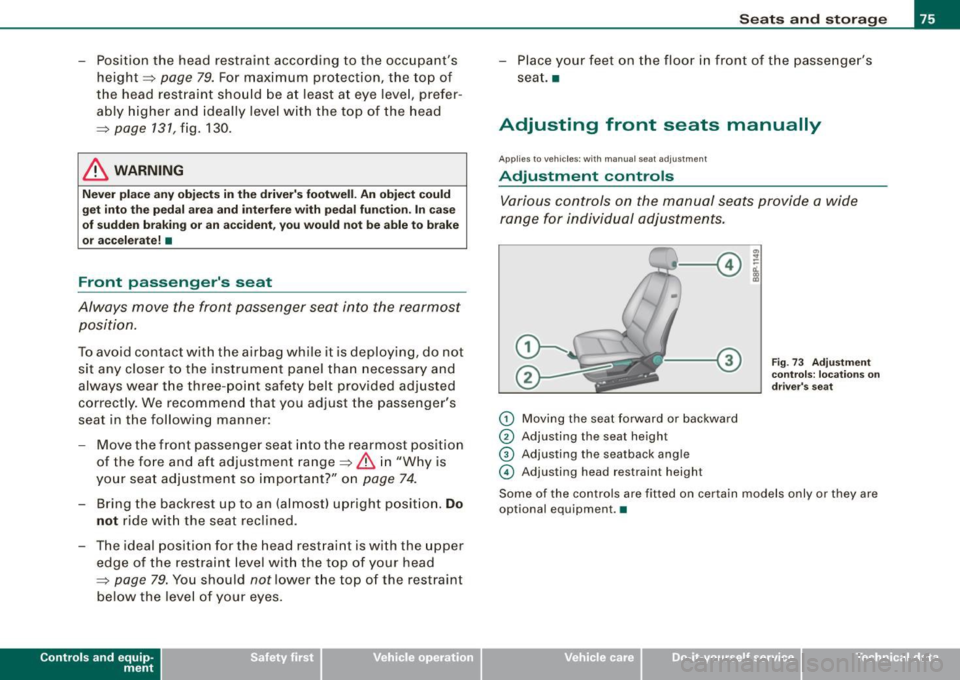
Various controls on the manual seats provide a wide
range for individual adjustments.
G) Moving the seat forward or backward
© Adjusting the seat height
© Adjusting the seatback angle
© Adjusting head restraint heigh t
Fig. 73 Adjustment
controls: locations on
driver's seat
Some of the controls are fitted on certain models only or they are
optional equipment. •
Vehicle care
I I irechnical data
Page 78 of 324
Seats and storage
Applies to vehicles : w ith m anual seat a djustm en t
Adjusting the manual seats
Po sition, angle and shape of the manual seats can be
adjusted to provide safe and comfortable seating.
Reed and heed all WARNINGS =:> & before you adjust your
seat.
Moving the front seats forward or backward
- Li ft the lever =:>
page 75, fig. 73 (D and slide the seat to
the desired p osition.
- Release the lever and then move the seat further until
you feel and hear it engage.
Adjusting the seat height
- Pull the lever @ up and pump it to raise the seat.
-Push the lever down and pump it to lower the seat .
Adjusting the seatback angle
- Lean forward to take your weight off the seatback.
- Turn the hand wheel© in the direction you want the
seatback to tilt.
& WARNING
• Never adjust the driver's or front passenger's seat while the
vehicle is moving . If you do this while the vehicle is moving , you
will be out of position . Always adjust the driver's or front
passenger's seat when the vehicle is not moving .
• Be careful when adjusting the seat height . Check to see that no
one is in the way, or serious injury could result!
& WARNING (continued)
• To reduce the risk of injury in the case of sudden braking or
accident, front passengers must never ride in a moving vehicle
with the seatback reclined. Safety belts and the airbag system
only offer maximum protection when the seatback is upright and
the safety belts are properly positioned on the body . The more the
seatback is reclined, the greater the risk of personal injury from an
incorrect seating position and improperly positioned safety
belts! •
Adjusting the power seat
Applies to vehi cles : wi th p ow er dr iv e r s eat
Adjustment switches
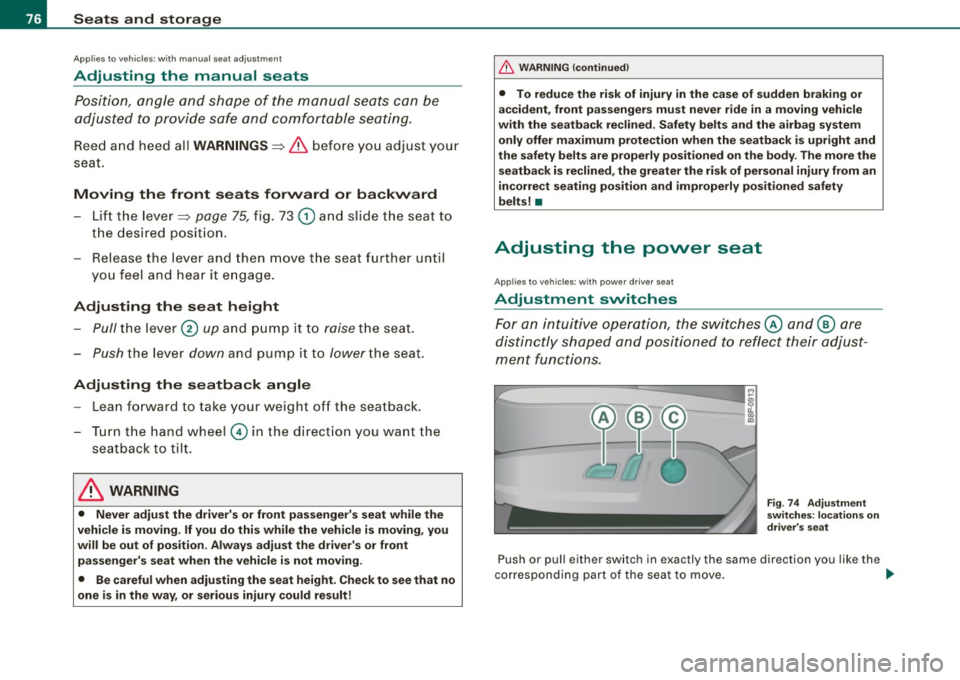
For an intuitive operation, the switches @ and @ are
distinctly shaped and posi tioned to reflect their adjust
ment functions.
Fig . 7 4 Adjustment
switches: locations on
driver's seat
Push or pul l either switch in exactly the same direction you like the
co rresponding part of the seat to move. .,,
Page 79 of 324
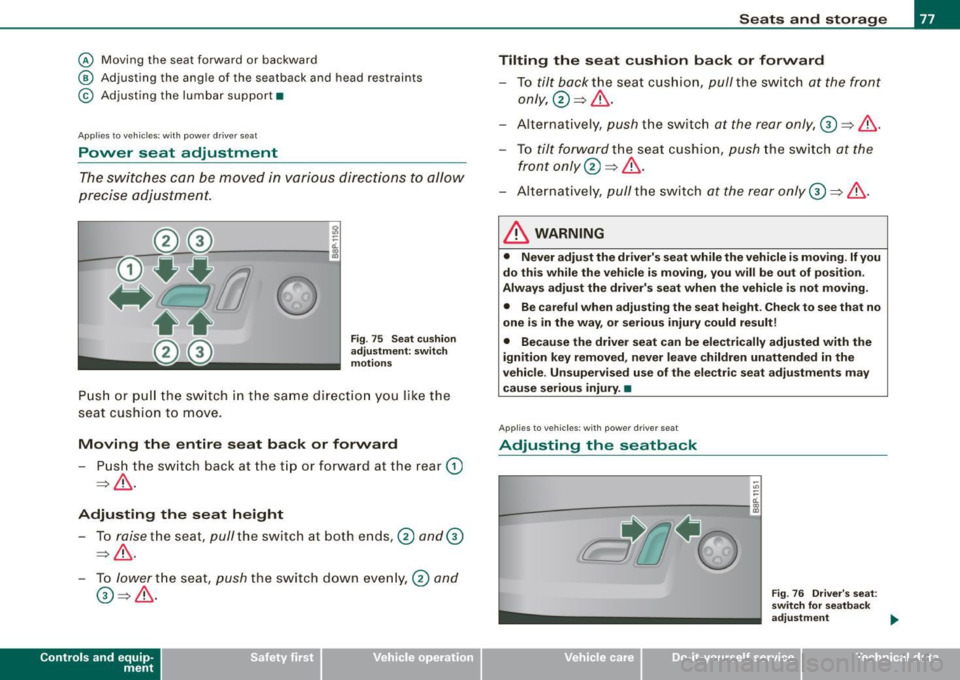
@ Moving the seat forward or backward
@ Adjusting the angle of the seatback and head restraints
© Adjusting the lumbar support•
Applies to ve hicl es : with power driver s eat
Power seat adjustment
The switches can be moved in various directions to allow
precise adjustment.
~
L----"'/ :,._..--,'~-~ ------- --i
Fig . 75 Seat cushion
adjustment: switch
motions
Push or pull the switch in the same direction you like the
seat cushion to move.
Moving the entire seat back or forward
- Push the switch back at the tip or forward at the rear G)
~& -
Adjusting the seat height
- To raise the seat, pull the switch at both ends,@ and (i)
=>& .
- To lower the seat, push the switch down evenly, @ and
0~& .
Con tro ls and eq uip
ment
Seats and storage
Tilting the seat cushion back or forward
-To tilt back the seat cushion, pull the switch at the front
only, @~& -
- Alternatively, push the switch at the rear only,
(i) => &.
- To tilt forward the seat cushion, push the switch at the
front only@=>& .
- Alternatively, pull the switch at the rear only
(i) ~ &.
& WARNING
• Never adjust the driver's seat while the vehicle is moving. If you
do this while the vehicle is moving, you will be out of position.
Always adjust the driver's seat when the vehicle is not moving.
• Be careful when adjusting the seat height. Check to see that no
one is in the way, or serious injury could result!
• Because the driver seat can be electrically adjusted with the
ignition key removed, never leave children unattended in the
vehicle . Unsupervised use of the electric seat adjustments may
cause serious injury. •
Applies to vehicles : with powe r driv e r seat
Adjusting the seatback
a'..
L------- --;:----- ~--- -,lll
CJ'1·~
Vehicle care I I
Fig. 76 Driver's seat:
switch for seatback
adjustment
~
irechnical data
Page 80 of 324
Seats and storage
-Push or pull the top of the switch in the same direction
you like the seatback to tilt~ fig . 76.
& WARNING
• Never adjust the seatback while the vehicle is moving . If you
adjust your seatback while the vehicle is moving, you will be out
of position. Always adjust the seatback when the vehicle is not
moving.
• To reduce the risk of injury in the case of sudden braking or
accident, front passengers must never ride in a moving vehicle
with the seatback reclined. Safety belts and the airbag system
only offer maximum protection when the seatback is upright and
the safety belts are properly positioned on the body. The more the
seatback is reclined , the greater the risk of personal injury from an
incorrect seating position and improperly positioned safety
belts! •
Applies to v ehicles : with lum bar support
Adjusting the lumbar support
The lumbar support can be adjusted to fit the natural
curvature of the occupant's spine.
N
"' ~
~
a:.
L-------- -,:g
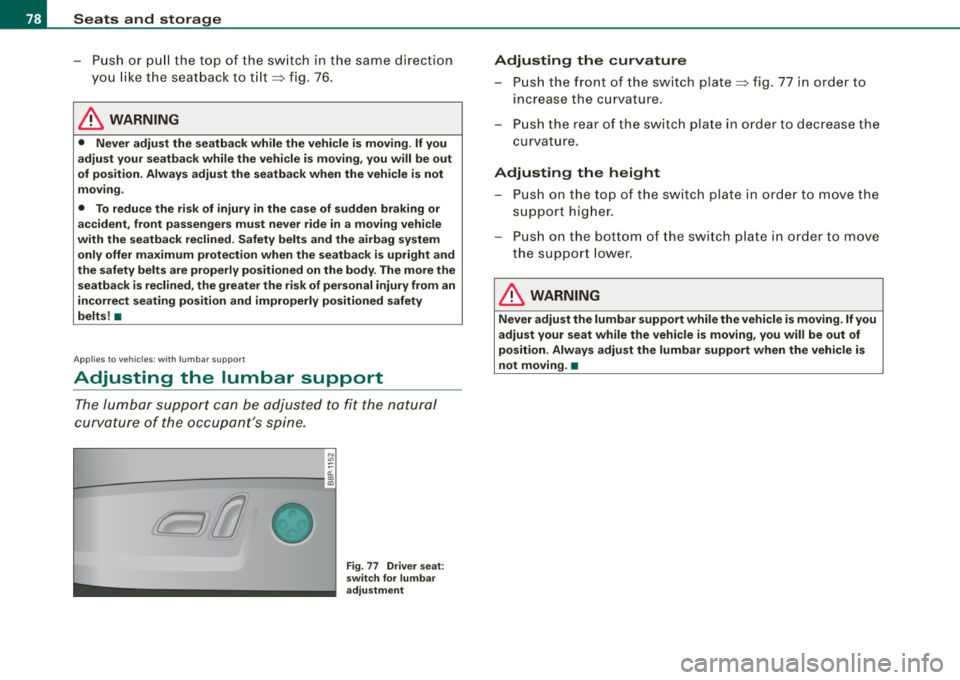
Fig. 77 Driver seat:
switch for lumbar
adjustment
Adjusting the curvature
- Push the front of the switch plate~ fig. 77 in order to
increase the curvature.
- Push the rear of the switch plate in order to decrease the
curvature.
Adjusting the height - Push on the to p of the switch plate in order to move the
support higher.
- Push on the bottom of the switch plate in order to move
the support lower.
& WARNING
Never adjust the lumbar support while the vehicle is moving. If you
adjust your seat while the vehicle is moving, you will be out of
position. Always adjust the lumbar support when the vehicle is
not moving .•
Page 81 of 324

Head restraints
Adjusting head restraints, front seats
The head restraints must be properly adjusted to the
occupants's height to provide optimal restraint in combi
nation with the seat restraints.
Fig . 78 Driver's seat
head restraint:
adjusting the height
The head restraints on the front seats can be adjusted to
provide safe support to head and neck at the optimum
height. Optimally adjusted, the top of the restraint should
be level with the top of the head.==>
page 131, "Proper
adjustment of head restraints".
Raising head restraint
-Grab the sides of the head restraint.
- Lift the head restraint ==>
page 79, fig. 78 until the top of
the restraint is even with the top of your head
==>
page 131
Lowering head restraint
- With one hand push down on the middle of the head
restraint.
Con tro ls and eq uip
ment
Seats and storage
- With the other hand press the release knob@
==> page 79, fig. 78 and push the head restraint down. You
should
not lower the top of the restraint below the level
of your eyes.
Removing the head restraint
-Pull the head restraint all the way up.
- Press the release button -arrow- ==>
page 79, fig. 78 and
pull the restraint straight up and out of the seat.
Installing the head restraint
- Insert the rods into the guides and push the restraint
back in until you hear it click.
Refer to~ page 131, "Proper adjustment of head restraints" for
guidelines on how to adjust the height of the front head restraints
to fit the occupant's body size.
& WARNING
• Driving without head restraints or with head restraints that are
not properly adjusted increases the risk of serious or fatal neck
injury dramatically.
• Read and heed all WARNINGS ~
page 131.
[ i] Tips
Correctly adjusted head restraints and safety belts are an extremely
effective combination of safety features. •
Vehicle care
I I irechnical data
Page 82 of 324

Seats and stor ag e
Rear head restraints (outer seating positions)
Fi g. 79 Ou te r re ar
h ea d re stra ints:
a dju sting th e heigh t
When t he rear seats a re no t occupied, you can l ower the
head rest raints (park p osition) and obtain better rearward
v1s 1on.
Moving the h ead r estraints to the "in-us e
position "
Grasp the sides of the head restraint with both hands .
- Move the head restraint to the uppermost pos ition
=> fig. 79 G) until it latches (in -use posit ion).
Moving the head restraints to the "park
position "
Press the re lease butto n
=> page 80, fig. 79 @ .
- Grasp the s ides of the head restraint with both hands.
- Press the head restraint down until it lies against the seat
back @ (park position) .
Removing the head restraints
- Move t he head restraint upward as far as it can go . - Press the button
@ => page 80, fig. 79 and pu
ll the head
restraint out a t the same t ime .
Installing head r estraints
- Pus h the rods for the head restraint into the guides until
they latch with an audible click .
Refer to=> page 131, "Proper adjustment of head restraints" for
guide lines on how to adjust the height of the outer head restraints
to fit the occupant's body size .
& WARNING
• Drivi ng w ithout head re str ai nt s or with head re str aint s tha t are
no t properly adju sted incr ease s the ri sk of seriou s or fatal n eck
i nj ury dr amatic ally .
• Read and h eed all WARNING S=>
page 13 1
[ i ] Tips
Correctly adjusted head restraints and safety belts are an extremely
effective combination of safety features .•
Rear head restraint (center seating position )
---o:, --~ - en - 0 -
he ad restra int:
a dju sting t he height ..
Page 83 of 324

When the rear seats are not occupied, you can lower the
head restraints (park position) and obtain better rearward
vision.
Moving the head restraints to the "in-use
position"
- Grasp the sides of the head restraint with both hands.
- Move the head restraint to the uppermost position
=> fig. 80 G) until it latches (in-use position).
Moving the head restraints to the "park
position"
- Press the release button => fig. 80 @.
- Grasp the sides of the head restraint with both hands.
- Press the head restraint down until it lies against the seat
back @ (park position) .
Removing the head restraints
-Take the screwdriver from the vehicle tool kit
=> page 270.
-Move the head restraint upward as far as it can go.
- Press the release button
@ => page 80, fig. 80 and pull
the head restraint upward as far as it can go at the same
time.
- Insert the screwdriver at position @ into the recess and
pull out the head restraint at the same time.
Installing head restraints
- Push the rods for the head restraint into the guides until
they latch with an audible click.
Con tro ls and eq uip
ment
Seats and storage
The height of the center head restraints is adjustable. They should
be adjusted to fit the occupant's body size. Correctly adjusted head
restraints and safety belts are an extremely effective safety feature
=> page 131.
& WARNING
Read and heed all WARNINGS=> page 131, "Proper adjustment of
head restraints". •
Center armrest
The front center armrest can be adjusted to several posi
tions and contains a storage bin.
Adjusting the armrest
-Push the armrest down.
Fig . 81 Between the
front seats: armrest
folded down
-Lift the armrest slowly until it is in a comfortable posi-
tion.
Opening the storage bin
- Pull the release button => fig. 81 upward.
Vehicle care I I irechnical data
Page 91 of 324
used. We recommend using roof racks from the Audi original acces
sories program.
• Th ese roof racks are the basis for a complete roof rack system .
For safety reasons, some additional attachments are necessary to
transport luggage, bicycles, surf boards, skis and small boats safely .
All these components are available at your authorized Audi dealer.
Vehicle with roof rails
• The vehicle is equipped with integrated roof railings, which can
be covered into roof rack by installing cross bars. Only install cross
bars specifically designed for this vehicle.
• Th ese bars are the basis for a complete roof rack system. Addi
tional attachments are necessary to safely transport luggage, bicy
cles, surf boards, skis or small boats.
• All necessary hardware for these systems is available from your
authorized Audi dealer.
When should the roof rack be removed?
• Before going through an automatic car wash (it is best to ask the
car wash operator)
• When not in use (reduce fuel consumption, reduce wind noise
and guard against theft)
& WARNING
• Use of an unapproved roof rack or incorrect mounting of an
approved roof rack can cause the roof rack or the items carried on
it to fall off the roof onto the road.
• Objects falling from the roof of a vehicle can cause a crash and
personal injury.
• Only mount the system between the markings shown in
~ fig. 94 or ~ page 90, fig. 95.
• The roof rack system must be installed exactly according to the
instructions provided .
Contro ls and eq uip
ment
Seats and storage
0 Note
• Any damage to the vehicle caused by using roof racks or other
types of cross bars that have not been approved by Audi for your
vehicle, or incorrect roof rack installation, is not covered by the
Warranty.
• Always check the roof rack mountings and hardware before each
trip and during a trip to make sure everything is securely tightened.
If necessary, retighten the mountings and check the entire system
from time to time.
• After mounting a roof rack system, or when you transport
objects on the roof of your vehicle, the height of the vehicle is natu
rally increased . Be careful when driving under low bridges or in park
garages for example . This could cause damage to the vehicle and
even the
load. a
Applies to veh icles: without roof rails
Attachment points without roof rails
The roof rack must be attached only at the locations
marked.
Fig . 94 Attachment
points for roof rack
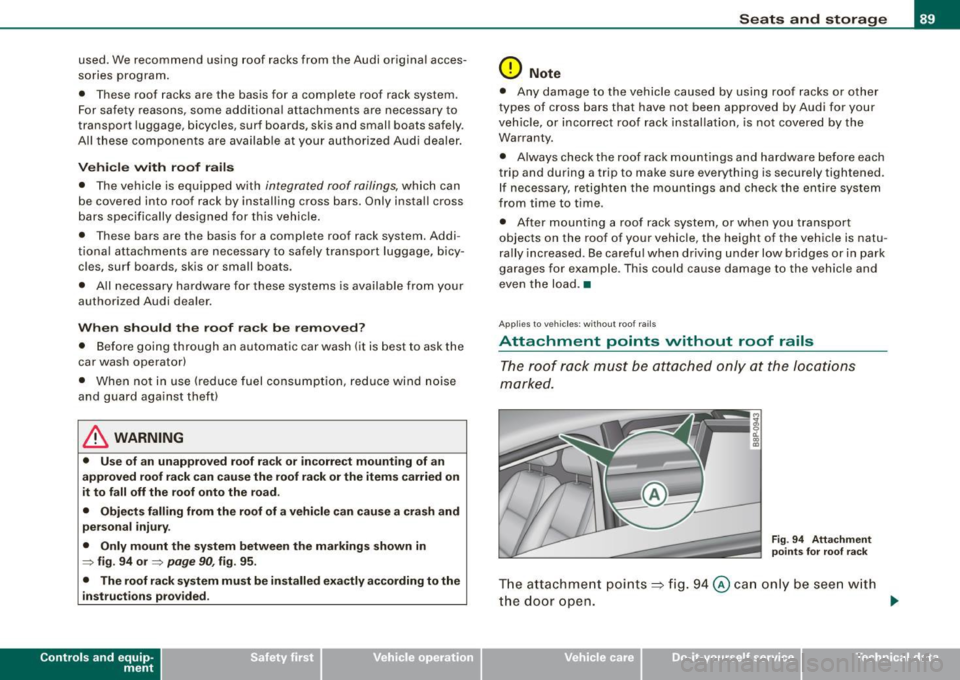
The attachment points=> fig. 94 @can only be seen with
the door open. .,
Vehicle care I I irechnical data
Page 128 of 324
___ o_ r_iv _ i _n....; g::;_ S_ a_f _e _ly=-- -------------------------------------------------
Driving Safely
General notes
Safe driving habits
Please remember -safety first!
This chapter contains important information, tips, instructions and
warnings that you need to read and observe for your own safety, the
safety of your passengers and others. We have summarized here
what you need to know about safety belts, airbags, child rest raints
as well as child safety. Your safety is for us
priority number 1. Always
observe the information and warnings in this section -for your own
safety as well as that of your passengers.
The information in this section applies to all model versions of your
vehicle. Some of the features described in this sections may be
standard equipment on some models, or may be optional equip
ment on others. If you are not sure, ask your authorized Audi dealer.
& WARNING
• Always make sure that you follow the instructions and heed
the WARNINGS in this Manual. It is in your interest and in the
interest of your passengers.
• Always keep the complete Owner's Literature in your Audi
when you lend or sell your vehicle so that this important informa
tion will always be available to the driver and passengers.
• Always keep the Owner's literature handy so that you can find
it easily if you have questions .•
Safety equipment
The safety features are part of the occupant restraint
system and work together to help reduce the risk of injury
in a wide variety of accident situations.
Your safety and the safety of your passengers should not be left to
chance. Advances in technology have made a variety of features
available to help reduce the risk of injury in an accident. The
following is a list of just a few of the safety features in your Audi:
• sophisticated safety belts for driver and all passenger seating
positions,
• safety belt pretensioners,
• safety belt force limiters for the front seats,
• safety belt height adjustment systems for the front seats,
• automatic safety belt height adjustment for the rear seats,
• front airbags,
• side airbags in the front seats and outer rear seats *,
• side curtain airbags,
• special LATCH anchorages for child restraints,
• head restraints for each seating position,
• adjustable steering column.
These individual safety features, can work together as a system to
help protect you and your passengers in a wide range of accidents.
These features cannot work as a system if they are not always
correctly adjusted and correctly used.
Safety is everybody's responsibility! •