maintenance AUDI S3 2009 User Guide
[x] Cancel search | Manufacturer: AUDI, Model Year: 2009, Model line: S3, Model: AUDI S3 2009Pages: 324, PDF Size: 76.02 MB
Page 233 of 324
Checkin g and fillin g ---------------~-!':WIii
•
Before you check a nything in the e ngine compartment,
alw ay s re ad and heed all WARNINGS ~
& in "Working in
the engine compartment" on
page 225.
- Unscrew the cap~ to the engine oil filli ng hole
~ page 230, fig . 173 or~ page 230, fig. 174 .
Carefully top off with the appropriate o il in 0 .5 liter doses .
- Check the oil level again after two minutes~
page 229.
-Top off t he o il a gai n, i f n ecessary .
- Screw the cap back on the filling hole and s lide the oil
dipstic k in as far as i t will go.
& WARNING
• While topping off , th e oil mu st n ot com e in c ont act with h ot
e ng ine part s -fire h aza rd!
• The oil fill er cap mu st b e prope rly sec ured to pre vent oil fr om
b ei ng spr ay ed on th e hot eng ine and e xha ust s yste m when th e
engine i s runni ng -fire haz ard!
• If you r skin h as come in co ntac t wi th th e engin e oil , you mus t
s ub sequ entl y c leanse it tho rou ghl y.
0 Note
• The oil level must not be above range @- danger of converter or
engine damage! Contact a qualified workshop to draw off oi l, if
necessary.
• Audi d oes no t r ecommend th e use of o il a ddit iv es . The y may
d am age the engin e and adver sely aff ect y our New Vehi cle Limited
Warr ant y.
<£' For the sak e of th e environment
• Under no circumstances can the oi l come in contact with the
sewage network or the soi l.
• Observe and follow legal regulations when disposing of empty
oi l containers. •
Changing the engine oil
We recommend that have your oil changed by an autho
rized Audi dealer or a qualified service station.
Before you check anything in the engine co mpart ment, always re ad
an d heed all WARN INGS=>
& in "Working in the engine compart
ment" on
page 225.
The engine oi l must be changed according to the interva ls specified
in your Warranty
& Maintenance booklet. This is very important
because the lubricat ing properties o f oi l d im inish g radua lly during
normal vehicle use.
Under some circumstances the engine oil shou ld be changed more
frequently . Change oil more often if you drive mostly short
distances, operate the vehicle in dusty areas or under predomi
nantly stop -and -go traffic conditions, or have your vehicle where
temperatures remain below freezing for extended periods .
Detergent additives in the oil w ill make fresh oi l look dark after the
engine has been running for a short time . This is normal and is not
a reason to change the oil more often than recommended .
Because of the problem of proper disposal, along with the spec ial
tools and necessary expertise required, we strong ly recommend
that you have your oi l changed by an authorized
Audi de aler or a
qualified service station .
If you choose to ch ang e yo ur oil your self , please note the following
important information : .,_
Vehicle care I t •
Page 239 of 324
_____________________________________________ C_h_ e_ c _ k_in -= g_a _ n_d _ f_il _li _n ..;::g =--____.•
N
~ a:. 00 m
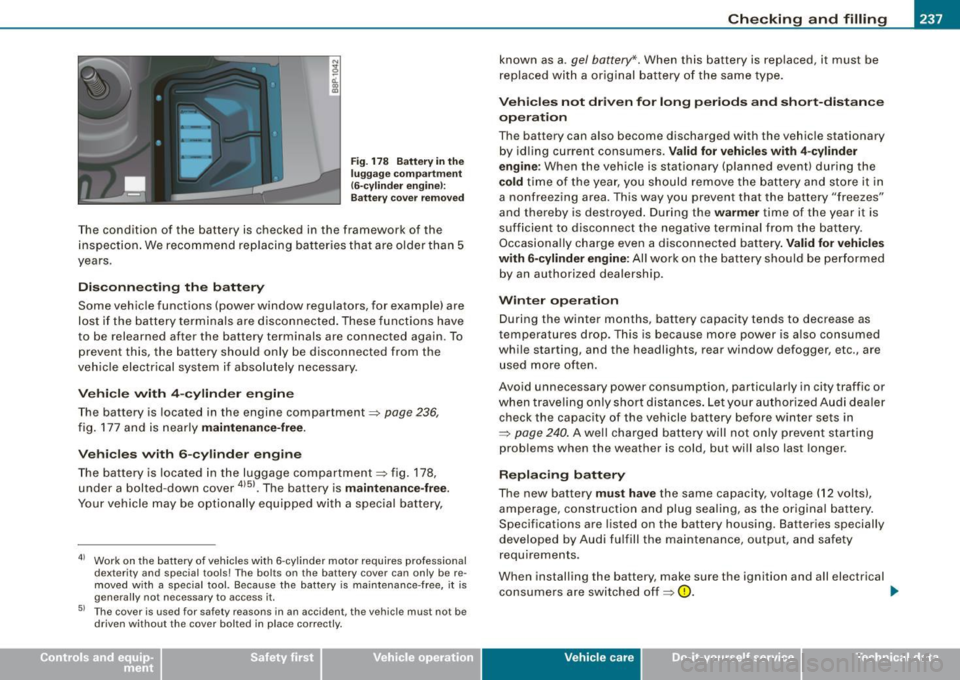
F ig . 178 Battery in the
lugg ag e co mpartme nt
(6-c ylind er eng ine !:
Ba tter y cove r remo ved
T he condition of the battery is checked in the framework of the
inspection . We recommend rep lacing bat teries that are older than 5
years .
Disconnecting the battery
Some vehic le functions (power window regu lators, for example) are
lost if the battery terminals are disconnected . These functions have
to be relearned after the battery terminals are connected again. To
prevent this, the battery should only be disconnected from the
veh icle electr ical system if absolutely necessary.
V ehicle with 4 -cylind er engin e
The battery is located in the engine compartment~ page 236,
fig. 177 and is nearly maintenance -free.
Vehi cle s with 6 -cylinder engine
The bat tery is loca ted in the luggage compartmen t=:> fig . 178,
under a bolted-down cover
4151 • The battery is maintenan ce -free .
Your ve hicle may be optionally equipped with a special battery,
41 Wor k on the battery of vehicles with 6-cy linder motor requires professional
dexterity and special tools! The bolts on the battery cover can only be re
m oved w ith a s pecial tool. Because the batte ry is ma in tenance -free, it is
genera lly not necessary to access it.
51 The cover is used for safety reasons in an acc ident, the vehicle must not be
driven without the cover bolted in place correctly.
known as a. gel battery* . When this battery is replaced, it must be
replaced wi th a or iginal bat tery o f th e same type.
Vehicles not dri ven for long periods and short-distance
operation
The battery can a lso become discharged with the vehicle stationary
by id ling current consumers .
Valid for vehicles with 4 -cylinder
engine :
When the vehic le is stationary (planned event) during the
cold time of the year, you sh ould remove the battery an d store it in
a nonfreezing area. This way you prevent that the battery "freezes"
and thereby is destroyed . During the
warmer time of the year it is
suff icient to disconnect the negative terminal from the battery .
Occasiona lly charge even a disconnected battery .
Valid for veh icles
with 6 -cylinder engine:
All wor k on the ba ttery should be per formed
by an authorized dealership.
Winter op eration
During the winter months, battery capacity tends to decrease as
temperatures drop. This is because more power is a lso consumed
while starting, and the headlights, rear window defogger, etc., are
use d more often .
Avoid unnecessary power consumption, particularly in city traffic or
wh en trave ling on ly shor t distances . Let you r au thor ize d Audi dea ler
check the capacity of the vehicle battery before winter sets in
~ page 240 . A well charged battery will not on ly prevent sta rting
problems when the weather is cold, but wi ll a lso last longer .
Replacing battery
The new battery must have the same capacity , vo ltage (12 volts),
a m perage, con struction and plug sea ling, as t he origina l battery.
Specifications are listed on the battery housing. Batteries specially
developed by Audi fulfill the maintenance, output, and safety
requirements.
When installing the battery , make sure the ignition and all electrical
co nsumers are switche d off ~
0. ..,
Vehicle care I I irechnical data
Page 240 of 324
-~_C_ h_e _c _ k_ i_n ...:::g::;...._ a_n_ d_ f_ i_ll _in -'g:::;.._ ___________________________________________ _
We recommend that you use maintenance-free or cycle-resis
tant/leak-proof batteries according to the standards TL 825 06 (from
December 1997) and VW 7 50 73 (from August 2001 ).
Replacing the battery on vehicles with the 6-cylinder engine (battery
in the luggage compartment) should be carried by a qualified work
shop. On vehicles with the 6 -cylinder engine, please follow the
instructions on the battery cover.
0 Note
• All work on the battery requires technical knowledge. Please
contact an Audi dealership or another authorized facility for ques
tions about the battery -danger of acid burns and explosion hazard!
• Th e battery must not be opened! Do not try to change the
battery's liquid level, otherwise detonating gas will escape from the
battery -explosion hazard!
• The AGM battery in the luggage compartment cannot leak,
because the electrolyte for this battery is absorbed into a special
glass mat. This leak-proof battery must not be replace with a
conventional battery .
• Make sure the ventilation hose on the side of the battery is
connected, otherwise fumes or battery acid can leak out.
• Battery holder and terminals always have to be secured correctly.
• Before all work on the battery follow the warnings below::::,
& in
"Wor king on the battery" on page
238.
W For the sake of the environment
Because of the problem of proper disposal of a battery, we recom
mend your authorized Audi dealer change the battery for you.
Batteries contain sulfuric acid and lead and must always be
disposed of properly in compliance with all environmental regula
tions . Disposing of vehicle batteries improperly is very dangerous to
the environment. Make sure that the removed battery cannot over
balance, otherwise sulfuric acid might escape! •
Working on the battery
All work on the battery requires technical knowledge! Be
especially careful when working on or near the battery!
Before you check anything in the engine compartment,
always
read and heed all WARNINGS :::;, & in "Working in
the engine compartment" on
page 225.
Always heed the safety warnings, when working on the vehicle
battery or the vehicle electrical system to prevent injury.
The following WARNINGS are very important when
working on the battery:
Always heed the following WARNING SYMBOLS and safety pre cautions when working on the battery.
@
Always wear eye protection.
Battery acid contains sulfuric acid. Always wear
gloves and eye protection.
No
- sparks
- flames
- smoking.
When a battery is charged, it produces hydrogen
gas which is explosive and could cause personal
injury.
Always keep the battery well out of reach of chil
dren .
& WARNING
Whenever working on the battery or on the electrical system,
there is the risk of injury, accident and even fire. Read and heed the
following WARNINGS:
~
Page 243 of 324
_____________________________________________ C_h_ e_ c _ k_in -= g_a _ n_d _ f_il _li _n ..;::g =-- ____.•
Ap plies t o vehicles: w ith 6 -cylin d er engine
Charging of battery 6 -cylinder engine )
All work on the battery requires specialized knowledge!
The battery is maintenance-free and is inspected regu
larly as part of vehicle service.
If starting problems occur because the battery charge is too low,
this may indicate a defective battery. In this case we recommend
having a qualified workshop inspect and charge the battery or
replace it if necessary. A discharged battery can
freeze at tempera
tures of only O °C. A thawed battery must be replaced, as the battery
housing may be cracked due to freezing and could therefore leak
acid.
Charging the battery
Battery charging should be performed by a qualified workshop,
since batteries employing a special technology are used which
require current-limited constant voltage charging.
0 Note
The vehicle may be optionally equipped with a gel battery, which can only be charged at a constant current-limited voltage.
• To prevent damage to the battery and the electronics system, a
gel battery that is connected must under no circumstances be
charged with a quick charger.
[ i] Tips
The vehicle battery must not be charged with a standard small
charger that plugs into the cigarette lighter or outlet. •
Windshield washer container
Using plain water is not adequate for filling the wind
shield washer system.
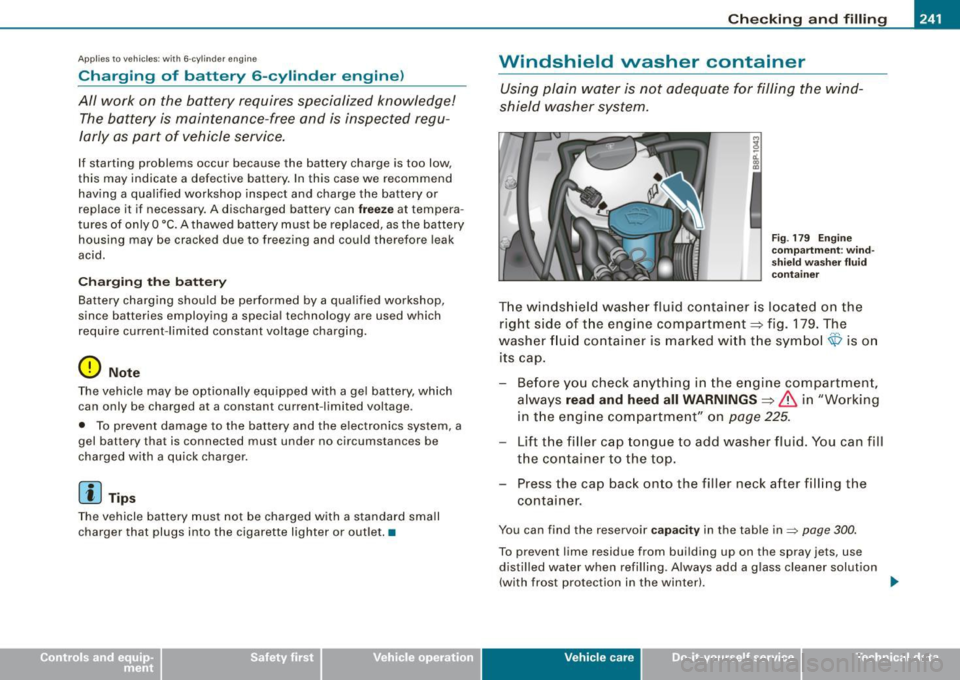
Fig . 179 Engine
compartment : wind
shield washer fluid
container
The windshield washer fluid container is located on the
right side of the engine compartment~ fig. 179. The
washer fluid container is marked with the symbol %Pis on
its cap.
- Before you check anything in the engine compartment,
always
read and heed all WARNINGS~ & in "Working
in the engine compartment" on
page 225.
-Lift the filler cap tongue to add washer fluid. You can fill
the container to the top.
- Press the cap back onto the filler neck after filling the
container.
You can find the reservoir capacity in the table in~ page 300.
To prevent lime residue from building up on the spray jets, use
distilled water when refilling. Always add a glass cleaner solution
(with frost protection in the winter}. .,._
Vehicle care I I irechnical data
Page 256 of 324
___ T_ i_ r_e _s_ a_ n_ d_ w_ h_ e_ e _ ls _________________________________________________ _
Tire service life
The service life of tires depends on a Jot of different things
including proper installation and balancing, correct tire
pressure and driving style .
(r
l \._ _____ ;)
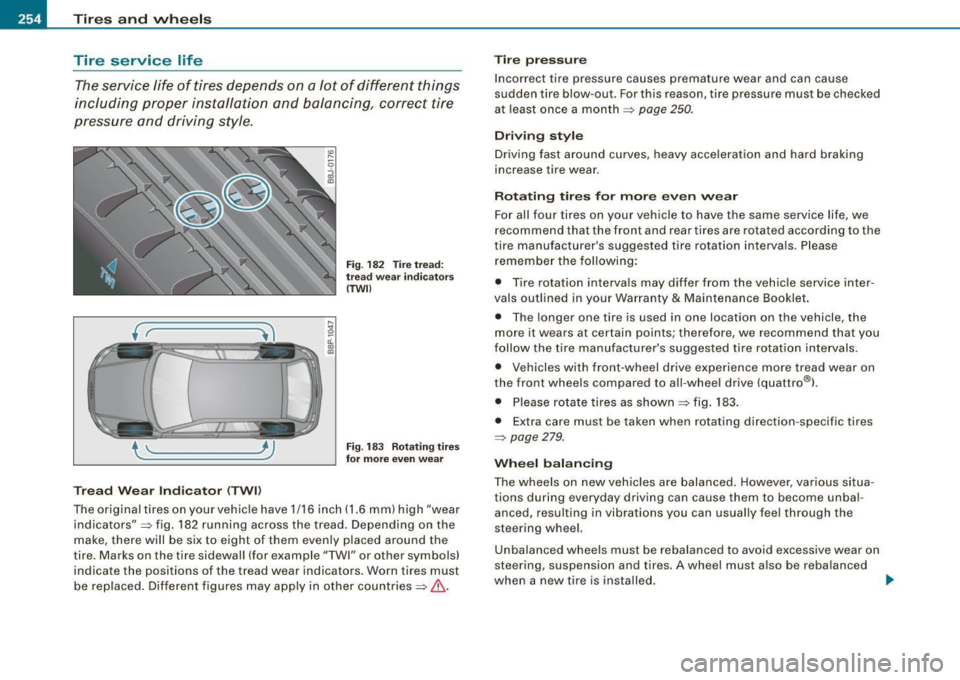
Tread Wear I nd ica tor ( TWll
Fig. 182 Tire tread:
tr ea d wea r ind ica tors
( TWIJ
Fi g. 1 83 Ro tati ng tir es
for mor e even wea r
The or iginal tires on your vehicle have 1/16 inch (1.6 mm) high "wear
indicators":::::, fig. 182 running across the tread . Depending on the
make, there will be six to eight of them evenly placed around the
tire . Marks on the tire sidewall (for example "TWI" or other symbols)
indicate the positions of the tread wear indicators . Worn tires must
be replaced. Dif ferent figures may apply in other countries:::::,&.
Tir e p re ss ure
Incorrect tire pressure causes premature wear and can cause
sudden tire blow-out . For this reason, tire pressure must be checked
at least once a month :::::,
page 250.
Drivin g sty le
Driving fast around curves, heavy acce leration and hard braking
increase tire wear .
Rotating tires for more even wear
For all four tires on your vehicle to have the same service life, we
recommend that the front and rear tires are rotated according to the
tire manufacturer's suggested tire rotation intervals . Please
r emember the following:
• Tire rotation interva ls may differ from the vehic le service inter
vals outlined in your Warranty
& Maintenance Booklet.
• The longer one tire is used in one location on the vehicle, the
more it wears at certain points; therefore, we recommend that you
follow the tire manufacturer's suggested tire rotation intervals.
• Vehicles with front -wheel drive experience mo re tread wear on
the front wheels compared to all-wheel drive (quattro®) .
• Please rotate tires as shown :::::, fig . 183.
• Extra care must be taken when rotating direction -specific tires
:::::, page 279.
Whe el b ala n cing
The wheels on new vehicles are balanced. However, various situa
tions during everyday driving can cause them to become unba l
anced, resulting in vibrations you can usual ly feel through the
steering wheel.
Unba lanced whee ls must be rebalanced to avoid excessive wear on
steering, suspension and tires. A wheel must a lso be reba lanced
when a new tire is installed.
~
Page 300 of 324
___ G_ e_ n_ e_r_ a _ l_ in_ f_ o _r_m _ a_ t_ i_ o _ n __________________________________________________ _
General information
Explanation of technical data
Some of the technical data listed in this manual requires
further explanation.
The technical data for your vehicle is listed in the charts starting on
~ page 300. This section provides general information, notes and
restrictions which apply to this data. •
Vehicle identification
The key data are given on the vehicle identification
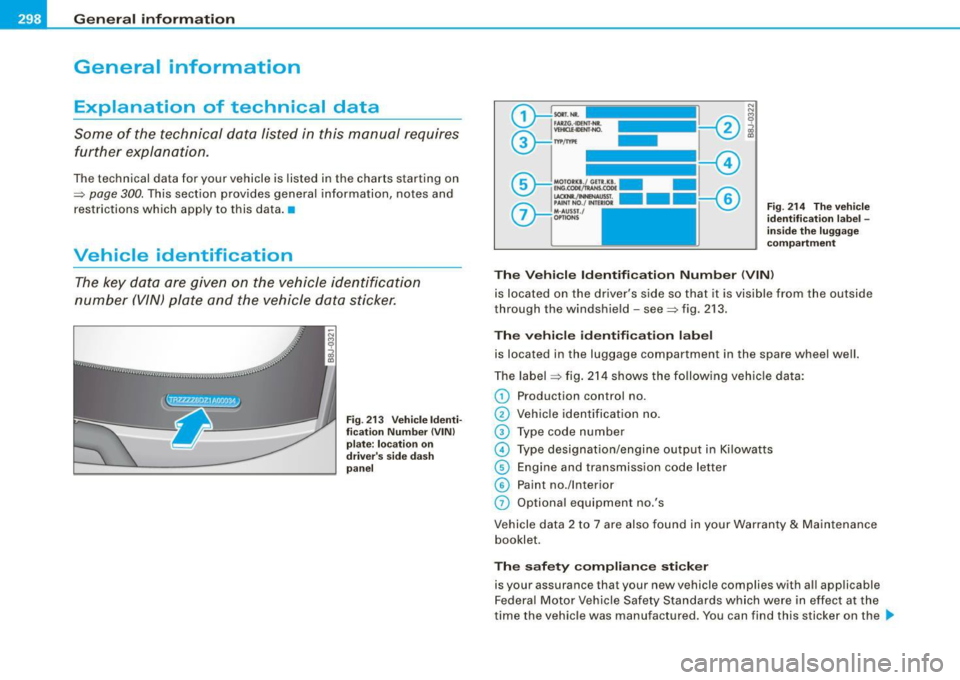
number (VIN) plate and the vehicle data sticker.
Fig. 213 Vehicle Identi
fication Number (VIN)
plate: location on
driver's side dash
panel Fig
. 214 The vehicle
identification label -
inside the luggage
compartment
The Vehicle Identification Number (VIN)
is located on the driver's side so that it is visible from the outside
through the windshield -see ~ fig. 213.
The vehicle identification label
is located in the luggage compartment in the spare wheel well.
The label ~ fig. 214 shows the following vehicle data:
© Production control no.
0 Vehicle identification no.
© Type code number
© Type designation/engine output in Kilowatts
© Engine and transmission code letter
© Paint no./lnterior
0 Optional equipment no.'s
Vehicle data 2 to 7 are also found in your Warranty
& Maintenance
booklet .
The safety compliance sticker
is your assurance that your new vehicle complies with all applicable
Federal Motor Vehicle Safety Standards which were in effect at the
time the vehicle was manufactured. You can find this sticker on the ._
Page 306 of 324
__ _.:C~ o'...'..n~ s~ u'..'..m ~ e~ r~ ln'....'...'.. f.::: o '...'..r ~m ~ a:_: t:.:. i.:::o '...'..n..:__ _____________________________________________ _
Maintenance
General
Your vehicle has been designed to help ke ep maintenance require
ments to a mi nim um .
Ho weve r, a certain a mount of regu lar maintenance is still necessary
to assure your vehicle's safety, economy and reliability.
For detailed vehicle maintenance consult your Warranty
& Main te
nance booklet.
Under d iffi cult op erating cond ition s, for example at extremely low
outside temperatures, in very dusty regions, when tow ing a trailer
very frequently, etc., some service work shou ld be performed
between the intervals specified. This app lies particularly to :
• oil changes, and
• clean ing or replac ing the air filter .
sion standards are maintained, thus minimizing adverse effects on
the environment .•
Important considerations for you and your
vehicle
The increasing use of electronics, sophisticated fuel injection and emission control systems, and the general ly increasing technical
complexity of today's automobi les, have steadily reduced the scope
of maintenance and repairs which can be carried out by vehicle
owners .
Also , safety and environm ental concerns p lace very s trict
limits on the nature of repairs and adjustments to engine and trans
mission parts which an owner can perform . Maintenance, adjustments and repairs usually require special tools,
t esting devices and other equipment availab le to special ly trained
workshop personne l in order to assure proper performance, reli
abi lity and safety of the vehicle and its many systems .
I mproper maintenance, adjustments and repa irs can impa ir the
operation and re liability of your vehicle and even void your vehic le
wa rranty. Therefore, proof of se rvic ing in accordance w ith the ma in
tenance schedule may be a condition for upholding a possible
war ranty claim made within the warranty period.
Above all, operational safety can be adverse ly affected, creating
unnecessary risks for you and your passengers .
I f in doubt about any servicing, have it done by your authori zed Audi
dea ler or any other properly equipped and qualified workshop . We
strongly urge you to give your authorized Audi dealer the opportu
nity to perform all schedu led maintenance and necessary repairs.
Your dealer has the facilities, origina l parts and trained special ists
to keep your vehicle running proper ly.
Performing limited ma intenan ce your self
The following pages describe a limited number of procedures which
can be performed on you r vehicle wi th ordinary too ls, should the
need arise and trained personnel be unavailab le . Before performing
any of the se procedu res, a lways thorough ly read a ll of the appli
cable text and carefu lly fo llow the instructions given . Always rigor
ous ly observe the
WARNINGS provided .
Before you check anything in the engine compartment , alway s re ad
and heed all WARNINGS=>
& and=> & in "Wo rking in the engine
compartment" on
page 225.
& WARNING
• Seriou s per son al injury may oc cur as a result of improperly
performed maintenan ce, adjustment s or repairs .
Page 317 of 324

Alphab eti ca l ind ex -
--------------------------'-----
Luggage
Stowing . .... .... .... ....... .... . 133
Luggage compartment Cargo net ..... .. .... .... ...... ... 85
Fastening eyes ... .... .... .... .... . 84
Increasing size ... .... ...... ...... . 83
Ligh t .. .... ... .. .......... .... ... 62
Retractable cover ....... ... .. ... ... 86
Ski sack . .... .... .... .... ..... .. .. 87
See also Loading the luggage
compartment .... ....... .... .... 133
Luggage compartment floor .. .... .... . 87
Lumbar support .. ...... ..... .... .... . 78
M
Maintenance ....................... 304
Malfunction Indicator Lamp (MIU .... 13, 21
Manual transmission ............. ... 116
Gearshift lever ...... ..... .... .... 116
Master key .. .... .... .... ... ... ... .. . 36
Battery replacement ............... 37
Master key remo te control . ...... .... .. 36
Menu button ... .... .... .... ..... .. .. 25
Menu display Driver Information Display .......... 23
Mirrors Activating the digita l compass ...... 72
Adjusting the anti -g lare . .... .... ... 69
Automatic dimming for the outside mirrors . .... .... .... ... ... ... .. . 71
Automatically dimming inside mirror . 69
Inside day -night mirror ... .... .... .. 69
Controls and equip ment Safety first Interior
mirror ..... .. ... .... ... .. . 69
Outside mirrors .. .... .... .... ... .. 70
Monitoring the Advanced Airbag System ..
158
Mounting hooks ..................... 85
N
Natural leather ...................... 214
New tires and whee ls ... .. .... .... ... 255
NHTSA Contacting ... ...... .... ... .. .... 135
Number of seats 137
0
Occupant seating positions 128
Octane rat ing ........ .... .... ....... 219
Odometer ......................... .. 10
Oil What kind of oi l should I put in my
engine? . .... ........ ..... .. .... 227
See also Engine oil . .... .... .... ... 227
Older children and safety belts ........ 178
On -Boa rd Diagnostic System ... .. .... .. 21
Electronic speed limiter ...... .... .. 21
Malfunction Indicato r Lamp (MIU .... 21
On -Board Diagnostic System
(080) ..... 21
Data Link Connector (DLCl .... ...... 21
Open door or front lid warning ..... .. .. 18
Operate your vehicle econom ical ly and m ini -
mize pollution .. .............. .. 199 Optional equipment
Marked with an asterisk ... .... .... .. 5
Outlets ...... ... .... .... ....... .. .. . 93
Outside air pollution How to prevent from enter ing the vehic le
103
Ou tside mirrors ...... .... .... .... .... 70
Outs ide temperature display ........... 18
Owner 's manual
How the Owner's Manua l is organized . 5
p
Paint
Touch -up ........................ 210
Paint no .. ...... .... .... ... .... .... 298
panoramic sliding sunroof .... .... ... .. 48
Comfort closing ....... .... ...... .. 49
Emergency operat ion . .... ... 49, 50, 51
to close ...... .... .... ... .... .... . 48
to open ...... .... .... ... .... .... . 48
Parking ............................ 110
Automatic transmission .... ... .... 119
Park ing a id
Audi parking system ...... .. ...... 112
Parking brake .. ...... ... .... .... .... 110
Setting an d releasing ... .. .... .... 110
Parking brake warning ... ....... ...... 30
Parking on a dec line (downhill) ... ... .. 110
Parking on an incline (uphill) .......... 110
parking system ...... .... ... .... .... 112
Par ts replacement . ....... ... .... .... 305
PASSENGER A IR BAG OFF light .... .... 159
Vehicle operation Vehicle care Do-it-yourself service Technical data