maintenance AUDI S3 2009 Owners Manual
[x] Cancel search | Manufacturer: AUDI, Model Year: 2009, Model line: S3, Model: AUDI S3 2009Pages: 324, PDF Size: 76.02 MB
Page 5 of 324
Braking .... ....... ... ..... ... .
E lectro -mechanical power assist .
Driving with your quattro® ..... .
Driving and enviro nment ..... .
The first 1,000 mi les (1,500 km) and
afterwards ................... .
Cata lytic converter .......... .. .
Avoid damaging the vehicle .... .
Ope rate your vehicle economically
and minimize pollution ........ .
Trailer towing ........... ...... .
Driv ing with a trailer ..... ...... .
Trailer tow ing tips ....... ... ... .
Vehicle care ... .......... . .
193
195
196
197
197
198
199
199
202
202
204
206 Tire pressure monitor ing
system* ....................... .
Genera l notes (l) ........ .• .. ... .
Introduct ion .................. .
Sign ifican t loss of air pressure
(l) .
Storing tire pressures .. ... ... .. .
Whee l cha nge .......... ....... .
Malfu nct io ns TP MS* ........... .
Cert ificat ion
Do-it-yourself service
W hat do I do now? ... ......... .
Jack, too ls and spare wheel .... .
Compact spare wheel .......... .
W hee l cha nge ... ... ... .. .. .. .. . 264
264
264
265
266
267
267
268
270
270
270
271
2
7 2
Table of contents
Weights . . . . . . . . . . . . . . . . . . . . . . . . 299
Dimensions . . . . . . . . . . . . . . . . . . . . 299
Data ............................ 300
200 hp, 2.0 liter 4-cyl. tu rbo eng ine 300
250 hp, 3.2 liter 6 -cyl. engine . . . . . 302
Co nsumer Info rma tio n ......... 303
Wa rranty cove rages . . . . . . . . . . . . . 303
Operating your vehicle outside the
U.S.A. or Canada . . . . . . . . . . . . . . . . 303
Audi Service Repair Manuals and
Li terature . . . . . . . . . . . . . . . . . . . . . . 303
Maintenance . . . . . . . . . . . . . . . . . . . 304
Additional accessories,
mod ifications and parts
rep lacemen t . . . . . . . . . . . . . . . . . . . . 305
Cleaning and protection . . . . . . . 206 Fuses and bulbs . . . . . . . . . . . . . . . 280 Alphabetical index ...... 308
Genera l info rmation ........... .
Care of exterior . ... ... .. .. ... . .
Care of interior ................ .
Fuel supply and fil ling your fue l
ta nk ........................... .
Gasoline ......... .. .... ...... .
Fuel tank ..... .......... ...... .
Checki ng and filling .. ........ . .
Engine hood .................. .
Engine compartment .......... .
Engine oil ............... ..... .
E ngine cooling system ......... .
Brake fluid ............... ..... .
Battery ....................... . 206
2
06
213
2 19
2 19
220
224
224
226
227
2 32
235
236
W indshield washer container . . . . 241
Tires and wheels
Tires ... ...... ..... ... ·. · · · · · · ·
Controls and equip
ment Safety first
243
243 Fuses . .
. . . . . . . . . . . . . . . . . . . . . . . 280
B ul bs . . . . . . . . . . . . . . . . . . . . . . . . . 28 5
Emergency situations . . . . . . . . . . 287
Genera l . . . . . . . . . . . . . . . . . . . . . . . . 287
Sta rting by pushing or towing . . . 287
Start ing with jumper cables . . . . . 287
Genera l information of sta rting
ass istance . . . . . . . . . . . . . . . . . . . . . 288
Use of jumper cab les (4 cylinder
eng ine) . . . . . . . . . . . . . . . . . . . . . . . . 289
Use of jumper cables (6 cylinder
engine) . . . . . . . . . . . . . . . . . . . . . . . . 290
Emergency towing with commercia l
tow truck . . . . . . . . . . . . . . . . . . . . . . 292
Lifting the vehicle . . . . . . . . . . . . . . 295
Technical data
General information
298
298
Explanation of technical data . . . . 298
Vehic le ide ntif ication . . . . . . . . . . . . 298
Vehicle operation Vehicle care Do-it-yourself service Technical data
Page 6 of 324
Vehi cle lite ratur e
Vehicle literature
In addition to this Owner 's Manual, your Audi comes with a
Warranty
& Maintenance booklet .
Moreover, depending on the model and the equipment, there may
be additional instruction booklets de livered with your vehicle (for
example, Operating Instructions for your Sound System, Navigation
System e tc .) .
If you are missing one of these pub lications or if you be lieve that the
information is not comp lete, contact your authorized Audi dealer for
assistance.
The Warranty & Maintenance booklet
exp lains how you can keep your Audi i n top driv ing condition by
having it serviced regu lar ly and contains detai led information about
the warranties cove ring your Audi . A lways have the book let with you
when you take your vehicle to an authorized Audi dealer for service.
Your Audi Service Adviser will record each scheduled service and
can answer any questions you may have regarding how to maintain
your vehic le .
In Canada,
the vehic le literature is also available in French . To obtain a copy,
contact your dealer or write to:
Au Canada , on peut se procurer un exemplaire en frarn;:ais de ce
document aupres du concess ionna ire ou de:
Volkswagen Canada, Inc .
Client Assistance
Assistance a la Clientele
777 Bay ly Street , West,
Ajax, Ontario L 1 S 7G7
If you sell your Audi
a ll l iterature should be left in the vehicle to make the Wa rranty terms
as wel l as all operating, safety, and maintenance information ava il
able to the next owner.
If you change your address or if you bought this
Audi used
be sure to send in a "Notice of Address Change" /"Notice of Used Car
Purchase " post card. This card can be found in the Warranty
& Main
tenance booklet or obtained from your authorized Audi dea ler .
It i s in your own int eres t that we are able t o contac t yo u sh o uld t he
need ari se .•
Page 100 of 324
Warm and cold
Warm and cold
Climate controls
Description
The air conditioner is fully automatic and is designed to
maintain a comfortable and uniform climate inside the
vehicle.
We recomme nd the following s ettings:
- Select and set a temperature between 64
°F (+22 °C) and
84 °F (+28 °C).
- Press the !AUTO
I button.
With this setting, you attain maximum comfort in the least amount
of time . Change this set ting, as desired, to mee t your pe rsonal
needs.
The climate controls are a combination of heating, venti lation and
cooling systems, which automatica lly reduce humidity and coo l the
air inside your vehic le .
The air temperature, air flow and air distribution are automatically
regu lated to achieve and maintain the desired passenger compart
ment temperature as quick ly as possible.
The system automatically compensates for changes in the outside
temperature and for the intensity of the sun light entering the
veh ic le. We recommend you use the
Automat ic mode=> page 101
for year -round comfort.
P lease note the following :
Turn on the air conditioner to reduce humidity in the vehic le. This
a lso prevent the window s from fogging up. When the outside temperature is high and the air is very humid,
c
ondensat ion from the evaporator may drip under the vehicle . T his
is normal and does not indicate a leak.
I f the outside temperature is low, the fan normally only switches to
a higher speed once the engine coola nt has war med u p sufficiently .
T he air conditioner temporarily sw itches off when you drive off from
a standstill using fu ll throttle to save engine power.
The comp ressor also swi tches off if the coolant temperatu re is to o
high so that the engine can be adequate ly cooled under extreme
lo ads .
Air pollutants filt er
The air po llutants fi lter (a combined partic le filter and activated
charcoal fi lter) reduces or eliminates outside air pollution (dust, or
p ollen) from en ter ing the vehic le .
The air po llutants fi lter must be changed at the intervals specified
in your Warranty
& Maintenance bo oklet, so that the ai r conditioner
can proper ly work.
I f you drive your vehicle in an area with high air pol lution, the filter
may need to be changed m ore freque ntly tha n specified in your
Audi Warranty
& Maintenance booklet. If in doubt, ask your autho
r iz ed Aud i Service Adviso r fo r a dvice .
& WARNING
Redu ced vi sibility i s dangerou s and can cause accidents .
• For saf e driving it is very important that all window s be free of
ice , sno w and conden sation.
• Fully familiarize yourself with the proper use and fun ction of
the heating and ventil ation sy stem and especially how to defog
and defrost the windows. ...
Page 164 of 324

___ A_ ir_ b_ a-g _ s_y _s_ t_ e_ m _________________________________________________ _
& WARN ING (continued )
• Always make sure that the side airbag can inflate without inter
fe rence :
- Never install seat covers or replacement upholstery over the
front seatback s that have not been spe cifically approved by
Audi.
- Never use additional seat cushions that cover the areas
where the side airbags inflate .
- Damage to the original seat covers or to the seam
in the area
of the side airbag module must always be repaired immedi
ately by an authorized Audi dealer .
• The airbag system can be activated only once. After an airbag
ha s inflated , it must be replaced by an authorized Audi de aler or
qualified technician who has the technical information , training
and special equipment necessary .
• The airbag system can be deployed only once. After an airbag
has been deployed , it must be repla ced with new repla cement
parts designed and approved especially for your Audi model
version . Replacement of complete airbag systems or airbag
components must be performed by qualified workshops only .
Make sure that any airbag service action is entered in your Audi
Warranty
& Maintenance booklet under AIRBAG REPLACEMENT
RECORD .
• Applies to vehicles with 6 -cylinder engine : For safety reasons in
severe accidents , the alternator and starter are separated from the
vehicle battery with a pyrotechnic circuit interrupter .
- Work on the pyrotechni c circuit interrupter must only be
performed by a qualified dealer -risk of an accident!
- If the vehi cle or the circuit inte rrupter is scrapped , all appli
cable safety precautions must be followed. •
Other things that can affect Advanced Airbag
performance
Changing the vehic le 's suspens ion system can change the way that
th e Adva nced Air bag Syste m performs in a c rash. Fo r example,
using tire -ri m co mbinations not approved by Audi, lowering the
veh ic le, c hang in g the st if f ness o f th e suspe nsio n, incl uding th e
spr ings, suspension struts, shock absorbers etc. can change the
f o rces t hat a re m easured by the a irba g se nsors and se nt to the elec
tronic control unit. Some suspension changes can, for example,
i ncrease the fo rce level s meas ure d by the senso rs and make the
a irbag system dep loy in crashes in which it wou ld not d ep loy if the
changes ha d no t been made . O th er ki nds of changes may red uce
th e force levels measured by the sensors and preve nt the airbag
fro m deploying w hen it sh ould.
Th e senso rs in th e sa fety belt buc kle fo r the dr iver a nd fro nt
passenger seat te ll the e lectronic control modu le if the safety belt is
l a tc h ed or not . If th e sa fe ty belt is being use d, th e front airbag wi ll
deploy at a slightly higher rate of vehic le dece leration than if the
sa fe ty be lt is n ot b ein g use d. Th ere fore, i n a partic ula r co llisi on, i t is
possible that an airbag wi ll not deploy at a seating position where
th e sa fe ty be lt is bei ng us ed bu t wi ll infl ate at the position w here the
safety be lt is not being used . It is important that nothing interfere
with the safety belt buc kles so that the sensors can send the co rrect
i nformation about safety be lt use to t he electronic contro l unit.
& WARNING
Changing the vehicle's suspension including use of unapproved
tire -rim combinations can change Advanced Airbag performance
and increase the risk of serious personal injury in a crash.
• Never install suspension components that do not have the
same pe rformance characteristics as the components originally
installed on your vehicle.
• Never use tire -rim combinations that have not been approved
by Audi. ..
Page 200 of 324
___ D_ r_iv _i _n-' g=- a _n_d_ e_ n_v _ i_r _o _n_ m_ e_ n_t _____________________________________________ _
New brake pads
--
Remember that new brake pads do not have a full braking
effect during the first 250 miles (400 kilometers) after they
are installed .
New brake pads have to be "burnished in" before they have optimal
grab =>& .
During the break -in period, you should avoid putting severe loads
on the brakes . Severe loads include, for examp le, sudden hard
braking, in particular at very high speeds or, for example, on moun
tain passes.
& WARNING
Until they develop the maximum "bite " for best stopping power,
the surfaces on new brake pads require some "breaking -in" during
the initial 100 to 150 miles (150 to 200 kilometers) of normal city
driving. You can compensate for this by pressing the brake pedal
more firmly . This applies whenever new pads are installed.•
Catalytic converter
It is very important that your emission control system
(catalytic converter) is functioning properly to ensure that
your vehicle is running in an environmentally sound
manner.
- Always use lead-free gasoline:=> page 219, "Fuel supply".
- Never run the tank down all the way to empty.
- Never put too much motor oil in your engine ==>
page 230,
"Adding engine oil 't=:;rl".
Never try to push- or tow-start your vehicle.
The catalytic converter is an efficient "clean-up" device built into the
exhaust system of the vehicle. The catalytic converter burns many
of the po llutants in the exhaust gas before they are released into the
atmosphere.
The exclusive use of unleaded fuel is critically important for the life
of the catalytic converter and proper functioning of the engine.
& WARNING
• Do not park or operate the vehicle in areas where the hot
exhaust system may come in contact with dry grass, brush, fuel
spill or other material which can cause a fire .
• Do not apply additional undercoating or rustproofing on or
near the exhaust manifold, exhaust pipes, catalytic converter or
heat shields. During driving, the substance used for undercoating
could overheat and cause a fire .
0 Note
• Be aware that just one tank filling with leaded fuel will alr eady
seriously degrade the performance of the catalytic converter.
• Do not exceed the correct engine oil level=>
page 230.
• Do not drive until the fuel tank becomes completely empty. The
engine could misfire. Unburned fuel could also get into the exhaust
system and this could cause the catalytic converter to overheat.
• Do not turn off the ignition while the vehicle is moving.
• Do not continue to operate your vehicle under these conditions,
as otherwise fuel can reach the catalytic converter. This could result
in overheating of the converter, requiring its replacement .
• To assure efficient operation of the Emission Control System:
- Have your vehicle maintained properly and in accordance with
the service recommendations in your Warranty
& Maintenance
booklet. •
Page 201 of 324
- Lack of proper maintenance as wel l as improper use of the
vehic le wi ll impair the func tion of the emission con tro l system
and could lead to damage.
<£> For the sake of th e envir onm ent
Even when the Emission Control System is operating properly, the
exhaust gas can have a su lfur -like exhaust gas smell under some
operating states . This depends on the sulfur content of the fuel
being used. Using a different brand of fue l may help, or filling the
tank with lead-free super grade gasoline. •
Avoid damaging the vehicle
When you are driving on poor roads, or over curbs, steep ramps,
etc., make certain that low- lying parts such as spoi lers and exhaust
system parts do not bottom out and get damaged.
This is especially true for vehicles with low-slung chassis (sports
chassis) and fully loaded vehicles. •
Operate your vehicle economically
and minimize pollution
General
Your personal style of driving will determine the economy
of your vehicle, as well as exhaust and noise levels.
Fuel economy, environmental impact, and wear on your engine,
brakes and tires largely depend on three factors:
• your personal driving style
• operating cond itions
• technica l limitations
Controls and equip
ment Safety first Vehicle operation
Dri
ving and environm ent
If you anticipate what you need to do next and drive economica lly,
you can easily cut your fuel consumpt ion by 10 -15 percent . This
section wil l give you some tips on how you can help the environ
ment and your pocketbook.
[ i ] Tips
The consumption estimates as published by ENV IRONMENTAL
PRO TEC TION AGENCY (EPA) and Transport Canada may not corre
spond to your actua l consumption on the road, which wi ll vary
depending upon vehic le load and speed, road and weather condi
tions, trip length, etc. •
Drive smoothly and keep a lookout ahead
Vehicles use the most fuel when they ore accelerating.
Avoid unnecessary accelerating and braking .
Vehicles use the most fuel when they are accelerating . If you antici
pate what is going to happen next, you wi ll need to brake less and,
thus, acce lerate less. Let the vehicle coast whenever possib le - for
examp le when you see that the next traffic light is red. •
Avoid full throttle
Driving at moderate speeds saves fuel and improves your
mileage.
-Try and keep well below your car's max imum speed.
Acce lerating gently reduces fue l consumption , engine wear, and
does not disturb the environment.
Fue l consumption, exhaust emissions and engine noise increase
disproportionately at high speeds . If you drive at approximate ly
three quarters of top speed, fuel consumption wil l be reduced by
Vehicle care Do-it-yourself service Technical data
Page 202 of 324
___ D_ r_i v_ in_... g"'- a_ n_ d_ e_ n_ v_i_r _ o _n_ m __ e_n _ t _______________________________________________ _
one half. Never drive faster than the posted speed limit and weather
conditions permit. •
Reducing unnecessary =citing
Even when your car is just idling it burns up fuel.
- Shut the eng ine off when you are not driving the vehicle .
- Do not warm up the vehicle by letting the engine run at
idle.
It makes sense to shut off the engine in traffic jams, when waiting
for trains to pass at rai lroad crossings , or at traffic lights that have
long waits on red. Turning the engine off for just 30 -40 seconds
saves more fuel than is burned starting the engine again .
It takes a long time for the engine to warm up fu lly when it is
running at idle. However, wear and noxious emissions are especially
high when the engine is warming up. So you should drive away as
soon as you start the engine and avoid running at high RPMs while
the engine is still warming up.
0 Note
Do not leave engine idling unattended after starting . If warning
lights should come on to indicate improper operation, they would
go unheeded. Extended idling also produces heat, which could result in overheating or other damage to the vehicle or other
property .•
Regu1ar ma1--.tenance
A badly tuned engine unnecessarily wastes a lot of fuel.
- Have your vehic le serviced at regular intervals . By having your vehicle regularly serviced by an authori
zed Audi
dea ler helps to ensure that it runs properly and economica lly. The
condition of your vehicle not only affects its safety and ability to
hold its value, it a lso affects
fu el con sumpti on.
C he ck your oil each time you fill your t ank .
The amount of oil used is related to engine load and speed.
It is norma l for the oil consumption of a new engine to reach its
lowest va lue after a certain mileage has been driven.
You must drive your vehicle about 3,000 miles (5,000 kilometers) before you can properly assess oil consumption .
T his also applies to fuel consumption and engine output .
0 Note
• Have your vehicle maintained properly and in accordance with
the service recommendations in your Warranty
& Maintenance
booklet. Lack of proper ma intenance as well as improper use of the
vehic le wi ll impair the function of the emission control system and
cou ld lead to damage.
• Do not alter or remove any component of the Emiss ion Control
System unless approved by the manufacturer.
• Do not alter or remove any device, such as heat shields,
switches, ignition wires, valves, which are designed to protect your
vehicle 's Em ission Control System and other important vehicle
components .•
Fewer short tr ips
Fuel consumption will always be relatively high on short
trips.
- Try to avoid driving short dista nces wi th a cold engine. _,
Page 229 of 324
_____________________________________________ C_h_ e_ c _ k_in -= g_a _ n_d _ f_il _li _n ..;::g =--____.•
© Brake fluid reservoir ( ) . ....... ... ............ .
© Battery .. ... ................................. .
& WARNING
Before you check anything in the engine compartment, always
read and heed all WARNINGS
~ & in "Working in the engine
compartment" on
page 225. •
3.2 liter , 6 -cylinder engine (250 hp)
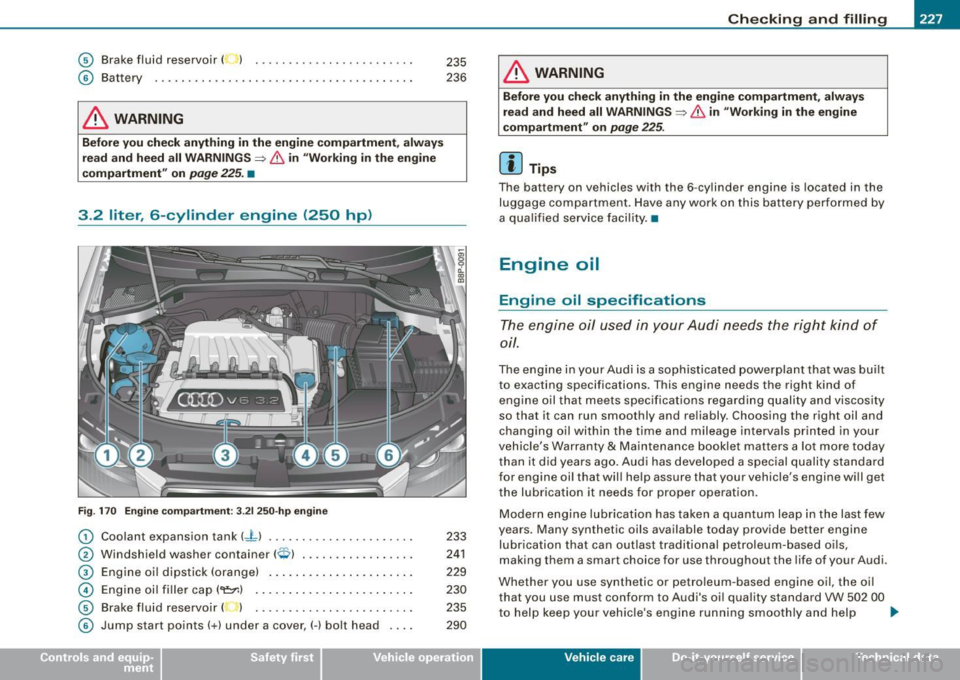
Fig. 170 Engine compartment: 3.21 250-hp engine
G) Coolant expansion tank (-L ) ................. .... .
@ Windshield washer container (,$ ) . ... ... .. .... ... .
@ Engine oil dipstick (orange) ...... ... ... .... .. ... .
© Engine oil filler cap ("1::r.) ..... .... .............. .
© Brake fluid reservoir ( ) . ...... ...... .......... .
© Jump start points(+) under a cover,(-) bolt head ... .
235
236
233
241
229
230
235
290
& WARNING
Before you check anything in the engine compartment, always
read and heed all WARNINGS
~ & in "Working in the engine
compartment" on
page 225.
[ i] Tips
The battery on vehicles with the 6-cylinder engine is located in the
luggage compartment. Have any work on this battery performed by
a qualified service facility.•
Engine oil
Engine oil specifications
The engine oil used in your Audi needs the right kind of
oil.
The engine in your Audi is a sophisticated powerplant that was built
to exacting specifications . This engine needs the right kind of
engine oil that meets specifications regarding quality and viscosity
so that it can run smoothly and reliably. Choosing the right oil and
changing oil within the time and mileage intervals printed in your
vehicle's Warranty
& Maintenance booklet matters a lot more today
than it did years ago. Audi has developed a special quality standard
for engine oil that will help assure that your vehicle's engine will get
the lubrication it needs for proper operation .
Modern engine lubrication has taken a quantum leap in the last few
years. Many synthetic oils available today provide better engine
lubrication that can outlast traditional petroleum-based oils,
making them a smart choice for use throughout the life of your Audi .
Whether you use synthetic or petroleum-based engine oil, the oil
that you use must conform to Audi's oil quality standard VW 502 00
to help keep your vehicle's engine running smoothly and help
ti,,,
Vehic le care I I irechnical data
Page 230 of 324
-~_C_ h_e _c _ k_ i_n ...:::g::;...._ a_n_ d_ f_ i_ll _in -'g:::;.._ ___________________________________________ _
prevent the formation of harmful deposits, sometimes called
"sludge," that over time can lead to expensive repairs.
At the time of printing, engine oils available in the U .S . and Canada
that meet the exacting specifications of Audi oil standard VW 502 00
are synthetic engine oils. This does not mean, however, that every
synthetic engine oil will meet Audi oil standard VW 502 00. So
always be sure that you use an approved oil.
To help prevent the formation of harmful deposits use only oil with
the following specifications printed on the oil container:
Audi oil standard VW 502 00
Oil container labels may carry the specification singly or in combi
nation with other designations and oil quality standards.
Viscosity
Engine oils are graded according to their viscosity. The proper
viscosity grade oil for your engine depends on climactic or seasonal conditions where you drive. You can use oil with a viscosity grade of
SAE 5W40 across all temperature ranges for normal driving condi
tions .
However, if engine oil viscosity grade SAE 5W40 is not available, you
can also use viscosity grade SAE 5W-30 or SAE 0W-40 as long as it
meets Audi oil quality standard VW 502 00 specifications.
Because engine oil that meets the Audi oil standard may not be
available everywhere when you need it, we strongly recommend
that you always carry with you an extra quart {liter) of oil that
expressly conforms to the VW 502 00 specification, in case you have
to top off the oil while on the road.
Only if the level of the oil is at or below the minimum mark on the
oil dipstick -and no oil that expressly conforms to Audi oil standard
VW 502 00 specifications is available -may you top off with a high
quality engine oil, preferably synthetic -based, that meets ACEA A3,
ACEA A5 or ACEA B5, API SL or ILSAC GF-3 specifications, but even
then, only in viscosity grades SAE 5W -40, SAE 5W -30, or SAE 0W -40 .
However, during the entire time between oil change intervals, never top off with more than a total of 0
.5 qt/liter engine oil that does not
conform to Audi oil specification VW 502 00.
For more information about engine oil that has been approved for
your vehicle, please contact either your authorized Audi dealer or
Audi Customer Relations at 1 (800) 822-2834 or visit our web site at
www.audiusa.com or www.audicanada.ca. Here you will also find a
current list of oils (manufacturers, brand names etc.) that conform
to Audi oil standard VW 502 00.
Changing the engine oil
The engine oil and oil filter must be changed according to the
mileage (kilometers) and time intervals specified in your vehicle 's
Warranty
& Maintenance booklet. Do not exceed these intervals -
harmful deposits from old engine oil can reduce engine perfor
mance and can lead to expensive engine repairs.
Changing the oil at the recommended intervals is so very important
because the lubricating properties of oil decrease gradually during
normal vehicle use. If you are not sure when you have your oil
changed, ask your authorized Audi Service Advisor.
Under some circumstances the engine oil should even be changed
more frequently . Change oil more often if you drive mostly short
distances, operate the vehicle in dusty areas or mostly under stop
and-go traffic conditions, or when you use your vehicle where
temperatures stay below freezing point for long periods.
Detergent additives in the oil will make fresh oil look dark after the
engine has been running for a short time. This is normal and is not
a reason to change the oil more often than recommended .
Damage or malfunctions due to lack of maintenance
It is essential that you change your oil at the recommended intervals
using only engine oil that complies with Audi oil standard
VW 502 00 . Your New Vehicle Limited Warranty does not cover
damage or malfunctions due to failure to follow recommended
maintenance and use requirements as set forth in the Audi Owner's
Manual and Warranty & Maintenance booklet. Your dealer will have
to deny warranty coverage unless you present to the dealer proof in
~
Page 231 of 324
___________________________________________ C_ h_e _c_ k_ i_n _g _ a_n _d_ f_il _li _n _g __ ffllll
•
the form of Service or Repair Orders that all schedu led maintenance
was performed in a time ly manner .•
Engine oil consumption
The engine in your vehicle depends on an adequate
amount of oil to lubricate and cool all of its moving parts.
In order to provide effective lubrication and cool ing of internal
engine components , all internal combustion engines consume a
certain amount of oil. Oil consumption varies from engine to engine
and may change significantly over the life of the engine. Typically,
engines with a specified break -in period (see~
page 197) consume
more oil during the break-in period than they consume af ter oi l
consumption has stabi lized .
Unde r normal conditions, the rate of oil consumption depends on
the quality and viscosity of the oil, the RPM (revolutions per minute)
at which the engine is operated, the ambient temperature and road
conditions . Further factors are the amount of oil dilution from water
condensation or fuel residue and the oxidation level of the o il. As
any engine is subject to wear as mileage builds up, the oil consump
tio n may increase over time unt il rep lacement of worn components
may become necessary.
W ith all these variables coming into play, no standard rate of oil
consu mption can be estab lished or specified. There is no a lternative
to regular and frequent checking of the oil level, see
Note .
If the yellow engi ne oil level warning symbol in the instrume nt
cluster lights up, you should check the oil level as soon as
poss ible
with the oil dipstick~ page 229 . Top off the oil at your
earliest convenience~
page 230.
& WARNING
Before you che ck anything in the eng ine comp artment , alw ay s
read and heed all WARNINGS
~ & in "Working in the engine
c ompartment " on
page 22 5.
0 Note
Driving with an insufficie nt o il level is l ikely to cause severe damage
to the engine.
[ i ] Tip s
• The oil pressure warning displ ay ce,. is not an indi cat or of the oil
level . Do not rely on it. Instead , check the oil level in your engine at
regular interv als , prefe rably ea ch time you refuel , and always before
going on a long trip.
• If you have the impression your engine consumes excessive
amoun ts of oil, we recommend that you consu lt your authorized
Audi dealer to have the cause of your concern proper ly diagnosed .
Keep in mind that the accura te m easuremen t of oil consumption
requires great care and may take some time . Your authorized Audi
dea ler has instructions about how to measu re oil consumption
accurately .•
Checking the engine oil level
Vehicle care I t •
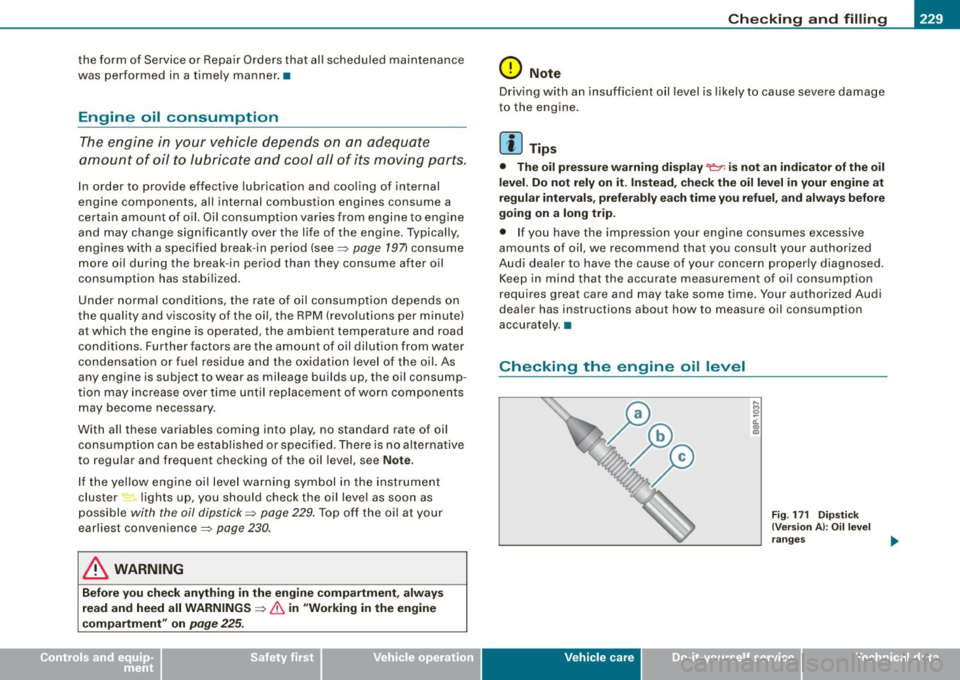
Fig . 171 Dip sti ck
( V ersio n A):
Oil le vel
ran ges