oil AUDI S3 2009 User Guide
[x] Cancel search | Manufacturer: AUDI, Model Year: 2009, Model line: S3, Model: AUDI S3 2009Pages: 324, PDF Size: 76.02 MB
Page 70 of 324
Clear vision
& W ARNIN G (con tinued )
example with in se cts , ca refully cle an the w iper bl ades w ith a
s ponge or a soft bru sh.
• For your sa fety , you should repla ce the wiper blades once or
twi ce a ye ar. S ee your authorized Audi d ealer for replacement
blades .
0 Note
• The wiper blades may only be changed=> page 66 in the service
position! Otherwise, you risk damaging the paint on the hood or the
windshield wiper motor .
• To prevent damage to the wiper system:
-Always loosen blades which are frozen to the windshield
before operating wipe rs.
- Do n ot use gasoline, kerosene , paint thinner, or other solvents
on or near the wiper blades.
- Do not attempt to move the wipers by hand.
[ i ] Tips
Commercial ho t waxes app lied by automatic car washes affect the
cleanability of the g lass surface.
• The front wiper b lades are differen t leng ths; the blade on the
driver's side is longer. •
Changing the rear wiper blade
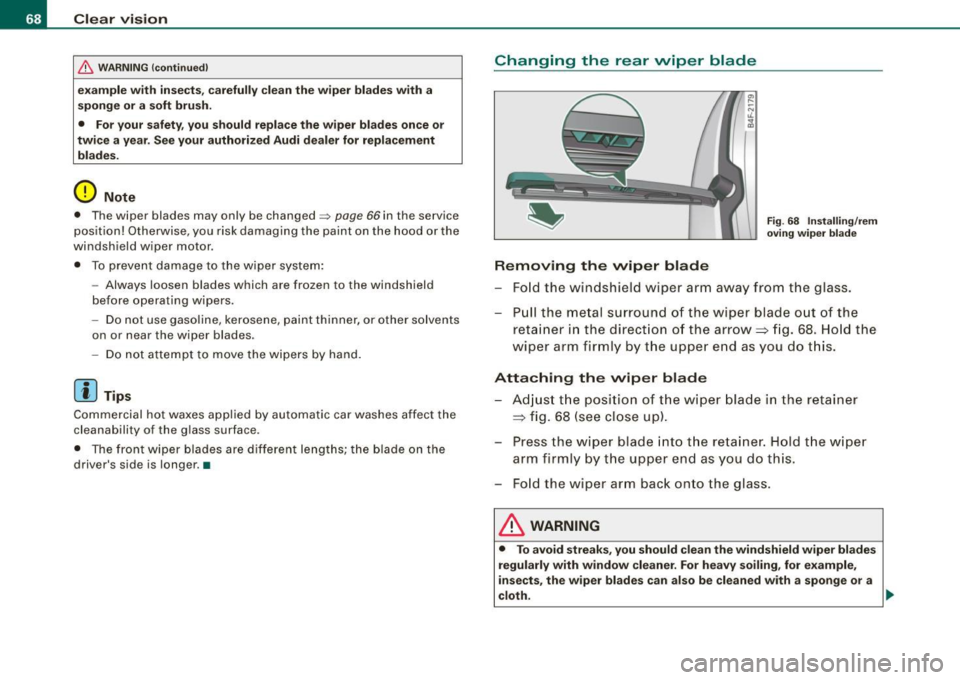
Removing the wiper bl ade
Fi g. 6 8 In st a lling /rem
o ving wip er b lad e
- Fold the windshield wiper arm away from the glass .
- Pull the metal surround of the wiper blade o ut of the
retainer in the direct ion o f the arrow => fig. 68 . Ho ld the
wiper arm f irmly by the upper end as you do t his.
Attaching the wiper blade
- Adjus t th e posi tion of t he wiper blade in th e retainer
=> fig . 68 (see close up) .
- Press the wiper blade into t he re tainer. Hold t he wiper
arm firmly by t he upper end as you do th is .
- Fold the wiper arm bac k on to the glass.
& WARNING
• To a void streak s, you sh o uld clean the wind sh ield wiper blade s
regularly with w indow cleaner . For heavy soiling, for example,
in se cts, the wiper blade s can a lso be cleaned w ith a sponge or a
cloth.
~
Page 111 of 324
___________________________________________________ O _n_ t_h _ e_ r_ o _ a_ d __ lfflll
Starting and stopping the engine
Starting the engine
The engine can only be started with on original Audi key
and the clutch pedal* depressed.
- Set the parking brake.
Move the selector lever to the neutral position (automatic
transmission): selector lever in P or N) =>
&.
- On vehicles with manual transmission, fully depress the
clutch pedal.
- Turn the ignition key to position@=>
page 108, fig. 113
- do not depress the gas pedal when starting the engine!
- Let go of the key as soon as the engine starts.
A cold engine may at first be loud after it has been started. This is
due to the hydraulic valves building up the oil pressure . This normal
and no need for concern.
If the engine does not star t immediately, stop trying after 10
seconds and then try to restart the engine about 30 seconds later.
& WARNING
Never start or let the engine run in a confined or enclosed area.
Exhaust fumes from the engine contain carbon monoxide, a color
less and odorless gas. Carbon monoxide can be fatal if inhaled .
• Never leave the engine idling unattended. An unattended
vehicle with a running engine poses a danger of personal injury or
theft.
Controls and equip
ment
0 Note
• Avoid high engine speeds, fast acceleration or heavy engine
loads while the engine is still cold. This could damage the engine!
• The engine cannot be started by pushing o r towing the vehicle.
~ For the sake of the environment
To avoid unnecessary engine wear and to reduce exhaust emis
sions, do not let your vehicle stand and warm up. Be ready to drive
off immediately after starting your vehicle. Maintain moderate
speed until the engine is completely warm. Remember, the engine
performs best at operating temperature. •
Stopping the engine
-Turn the ignition key to position@=> page 108 , fig. 113.
& WARNING
• Never turn off the engine until the vehicle has come to a
complete stop.
• The brake booster and servotronic only work when the engine
is running . With the ignition turned off, you have to apply more
force when steering or braking. Since you cannot steer and stop
normally, this can lead to accidents and serious injuries.
• The radiator fan can continue to run for up to 10 minutes even
after you have turned off the engine and removed the ignition key.
The radiator fan can also turn on again if the engine coolant heats
up because of intense sunlight or heat build-up in the engine
compartment. .,
I • •
Page 196 of 324
___ ln_ t _e_ ll-'"ig ...,_ e_ n_t _t_ e_ c_ h _ n_o _ l_o _,.g= y,_ __________________________________________ _
Low brake fluid level
Ma lfu ncti ons can occ ur in th e brake system if the bra ke flu id leve l is
too low. The brake fluid leve l is monitored e lectronically.
Brake lining wear status Bra ke lining wear may be checked by visual inspection of the condi
t ion of the brake pa ds through the o pen in g s in t he wheel. If neces
sary, the wheel may be removed for this inspection=>
page 272 ,
"Whee l change".
& WARNING
• You should perform braking maneuver s for the purpose of
cleaning the brake system only if road cond itions permit . Other
road u sers must not be put at risk -you may cause an accident !
• Before des cending a steep grade , reduce speed and shift trans
mission into a lower gear or lower driving range. Do not ride the
brake s or hold the pedal down too long or too often . This could
c ause the brakes to get hot and diminish braking efficiency.
• Do not "ride the brakes " by resting your foot on the pedal when
you do not intend to brake. This may cause the brakes to overheat, p rem ature wear and in creased stopping distance .
• Under certain climatic and operating conditions such as
passing through water , driv ing in heavy rain or after washing the
vehicle , the effectiveness of the brakes can be reduced. In winter ,
ice can accumulate on the brake pads , linings , discs and drums.
Carefully apply brakes for a test. Brakes will dry and ice coatings
will be cleaned off afte r a few careful b rake appli cations .
• Driving for an extended period of time on salt -covered roads
without using your brakes can also affe ct braking effic ien cy. Clean
off accumulated salt coating from brake discs and pads with a few
careful brake applications .
• If you damage the front spoiler , or if you install a different
spoiler , be sure the air flow to the front brakes is not obstru cted .
Otherwise the brake system could overheat reducing the effe ctive
ness of the entire brake system .
& WARNING (continued )
• Failure of one brake circuit will impair the braking capability
resulting in an increased stopping distance . Avoid driv ing the
vehicle and have it towed to the nearest authorized Audi dealer or
qu alified workshop. •
Brake booster
The bra ke boos ter adds e xtra bra king pow er.
Th e brake boost er wo rks wit h vacuum p ressu re wh ich is created
only when the engine is running=>& .
& WARNING
• Never let the vehicle roll to a stop with the engine shut off.
• If the brake booster is not working , for e xample when towing
your vehicle, or because the brake booster has somehow been damaged , the brake pedal must be pressed considerably harder to
make up for the lack of booster assistance . •
Functioning of Anti-Lock Brake System (ABS}
A BS p revents t he wheels from lockin g up unde r braking.
The ABS co ntrib utes effectively to ve hic le c ont ro l since it preven ts
the whee ls from
locking when the bra kes are app lied. Th is means
that the vehicle remains stee rable and is less l ikely to skid .
With ABS you do not need to
pump the brake. Just hold the brake
pedal down .
Ho wever , do not e xpect that t he ABS shor tens brak ing distance
under
all circumstances . When driv ing on gravel or on newly fa llen
snow on top of icy surfaces, b raki ng d istance may be even longer,
th ere for e, u nder these circumstances, it is esp ecially important t hat
you drive s lowly and w ith g reat ca re . ._
Page 200 of 324
___ D_ r_iv _i _n-' g=- a _n_d_ e_ n_v _ i_r _o _n_ m_ e_ n_t _____________________________________________ _
New brake pads
--
Remember that new brake pads do not have a full braking
effect during the first 250 miles (400 kilometers) after they
are installed .
New brake pads have to be "burnished in" before they have optimal
grab =>& .
During the break -in period, you should avoid putting severe loads
on the brakes . Severe loads include, for examp le, sudden hard
braking, in particular at very high speeds or, for example, on moun
tain passes.
& WARNING
Until they develop the maximum "bite " for best stopping power,
the surfaces on new brake pads require some "breaking -in" during
the initial 100 to 150 miles (150 to 200 kilometers) of normal city
driving. You can compensate for this by pressing the brake pedal
more firmly . This applies whenever new pads are installed.•
Catalytic converter
It is very important that your emission control system
(catalytic converter) is functioning properly to ensure that
your vehicle is running in an environmentally sound
manner.
- Always use lead-free gasoline:=> page 219, "Fuel supply".
- Never run the tank down all the way to empty.
- Never put too much motor oil in your engine ==>
page 230,
"Adding engine oil 't=:;rl".
Never try to push- or tow-start your vehicle.
The catalytic converter is an efficient "clean-up" device built into the
exhaust system of the vehicle. The catalytic converter burns many
of the po llutants in the exhaust gas before they are released into the
atmosphere.
The exclusive use of unleaded fuel is critically important for the life
of the catalytic converter and proper functioning of the engine.
& WARNING
• Do not park or operate the vehicle in areas where the hot
exhaust system may come in contact with dry grass, brush, fuel
spill or other material which can cause a fire .
• Do not apply additional undercoating or rustproofing on or
near the exhaust manifold, exhaust pipes, catalytic converter or
heat shields. During driving, the substance used for undercoating
could overheat and cause a fire .
0 Note
• Be aware that just one tank filling with leaded fuel will alr eady
seriously degrade the performance of the catalytic converter.
• Do not exceed the correct engine oil level=>
page 230.
• Do not drive until the fuel tank becomes completely empty. The
engine could misfire. Unburned fuel could also get into the exhaust
system and this could cause the catalytic converter to overheat.
• Do not turn off the ignition while the vehicle is moving.
• Do not continue to operate your vehicle under these conditions,
as otherwise fuel can reach the catalytic converter. This could result
in overheating of the converter, requiring its replacement .
• To assure efficient operation of the Emission Control System:
- Have your vehicle maintained properly and in accordance with
the service recommendations in your Warranty
& Maintenance
booklet. •
Page 202 of 324
___ D_ r_i v_ in_... g"'- a_ n_ d_ e_ n_ v_i_r _ o _n_ m __ e_n _ t _______________________________________________ _
one half. Never drive faster than the posted speed limit and weather
conditions permit. •
Reducing unnecessary =citing
Even when your car is just idling it burns up fuel.
- Shut the eng ine off when you are not driving the vehicle .
- Do not warm up the vehicle by letting the engine run at
idle.
It makes sense to shut off the engine in traffic jams, when waiting
for trains to pass at rai lroad crossings , or at traffic lights that have
long waits on red. Turning the engine off for just 30 -40 seconds
saves more fuel than is burned starting the engine again .
It takes a long time for the engine to warm up fu lly when it is
running at idle. However, wear and noxious emissions are especially
high when the engine is warming up. So you should drive away as
soon as you start the engine and avoid running at high RPMs while
the engine is still warming up.
0 Note
Do not leave engine idling unattended after starting . If warning
lights should come on to indicate improper operation, they would
go unheeded. Extended idling also produces heat, which could result in overheating or other damage to the vehicle or other
property .•
Regu1ar ma1--.tenance
A badly tuned engine unnecessarily wastes a lot of fuel.
- Have your vehic le serviced at regular intervals . By having your vehicle regularly serviced by an authori
zed Audi
dea ler helps to ensure that it runs properly and economica lly. The
condition of your vehicle not only affects its safety and ability to
hold its value, it a lso affects
fu el con sumpti on.
C he ck your oil each time you fill your t ank .
The amount of oil used is related to engine load and speed.
It is norma l for the oil consumption of a new engine to reach its
lowest va lue after a certain mileage has been driven.
You must drive your vehicle about 3,000 miles (5,000 kilometers) before you can properly assess oil consumption .
T his also applies to fuel consumption and engine output .
0 Note
• Have your vehicle maintained properly and in accordance with
the service recommendations in your Warranty
& Maintenance
booklet. Lack of proper ma intenance as well as improper use of the
vehic le wi ll impair the function of the emission control system and
cou ld lead to damage.
• Do not alter or remove any component of the Emiss ion Control
System unless approved by the manufacturer.
• Do not alter or remove any device, such as heat shields,
switches, ignition wires, valves, which are designed to protect your
vehicle 's Em ission Control System and other important vehicle
components .•
Fewer short tr ips
Fuel consumption will always be relatively high on short
trips.
- Try to avoid driving short dista nces wi th a cold engine. _,
Page 209 of 324
_____________________________________________ C_ l_ e _a_ n_ in_ g_a _ n_d_ p_ r_ o_ t _e_ c_t _io _ n __ !II
•
High temperatures, as from exposure to intense sunlight, intens ify
the corrosive effect particularly when humidity is high as well.
Under ce rtain circumstances ,
weekly washing may be necessary .
Under other conditions, a monthly washing and waxing may be
adequate.
After the winter, the
underside of the vehicle should be thoroughly
washed, preferably in a professional car wash.
& WARNING
Always read and heed all WARNINGS and other information
=>
page 206 . •
Automatic car wash
The vehicle can be washed in almost any modern auto
matic car wash.
The vehicle paint is so durable that the vehicle can normally be
washed without problems in an automatic car wash . However , the
effect on the paint depends to a large extent on the design of the
facility, the filtering of the wash water, the type of wash and care
material, etc. If the paint has a dull appearance after going through
the car wash or is scratched, bring this to the attention of the oper
ator immediately . If necessary, use a different car wash .
Before going through a car wash, be sure to take the usual precau
tions such as closing the windows and panoramic sliding sunroof *.
Remove antenna if applicable.
If you have installed additional accessories on the vehicle -such as
spoilers, roof rack , etc. -it is best to ask the car wash operator if
these should be removed .
& WARNING
Always read and heed all WARNINGS and other information
=> page 206. •
Washing the vehicle by hand
A lot of water is needed when washing a vehicle by hand.
-Before you start washing, make sure you have read and
understood the WARNINGS=:>
& in "General informa
tion" on
page 206 .
-First soak all dried dirt until it is soft, then rinse it off.
- As you clean your vehicle, start with the roof and work
your way down to the bottom , using a sponge, a sponge
glove or a clean brush.
- Rinse the sponge or the sponge glove often, flushing it
clean each time.
- Use special car shampoo only for very persistent dirt.
- Rinse the car thoroughly with water.
- Use a chamois leather to gently wipe the exterior dry.
Use a separate sponge for cleaning the wheels, door sills and other
regions exposed to road dirt. In this way , you will not scratch the
paint with coarse particles imbedded in the sponge the next time
you wash the car.
& WARNING
• Do not clean the underside of the chassis, fenders, wheel
covers, or other hard to reach parts without protecting your hands
and arms. You may cut yourself on sharp-edged metal parts . .,
Vehicle care
I t •
Page 212 of 324

-~_C_ l_ e _a _n_ in_g=- a _n_d__, p,__ ro_ t_e _c_ t_ i_o _n _____________________________________________ _
Plastic and vinyl
Plastic needs special care.
Use a clean, damp cloth or sponge to remove dust and light surface
dirt. For other soil, use a lukewarm all -purpose cleaning solution or
a mild saddle soap for vinyl trim. Remove water spots and traces of
soap with a clean, damp cloth or sponge . Use a clean, soft cloth to
rub dry .
Grease, tar or oil stains can be removed with a clean cloth or sponge
soaked with all-purpose cleaner or with a solvent designed espe
cially to clean vinyl.
Occasionally apply a colorless vinyl or leather preservative to retain
the material's luster and pliability.
& WARNING
Always read and heed all WARNINGS and other information
~ page206. •
Aluminum trim
Use only neutral-pH products to remove spots and deposits from
aluminum surfaces. Chrome care products and alkaline cleaners
will attack aluminum surfaces and can damage them over time.
& WARNING
Always read and heed all WARNINGS and other information
~ page206 .•
Touch-up paint
Minor paint damages should be touched up immediately.
-Use either a touch -up paint stick or spray paint to cover
minor scratches and nicks.
Your authorized Audi dealer has touch-up paint for minor scratches
and stone chips. Scratches should be touched up soon after they
occur to prevent corrosion.
If a spot starts to rust, however, a simple touch-up job will not be
enough. The affected surface must be sanded smooth and coated
with an anti-rust primer before the painted finish can be restored.
The number for the original vehicle paint can be found on the
vehicle identification label~
page 298 .
& WARNING
Always read and heed all WARNINGS and other information
~ page206.•
Windows
Clear vision to all sides.
Clean all windows regularly to remove road film and
carwash wax buildup.
- Remove snow from windows using a brush.
- Use a plastic ice scraper to remove ice from windows and
mirrors.
- Remove other residue on the windows with a spray-on
glass cleaner.
- Wipe the windows dry with a clean piece of cloth or
kitchen paper towel.
Page 213 of 324
____________________________________________ _:C ::,: l~ e :,: a~ n:....:..:..: in~ g~ a~n .:.:d:!...! p~ r ~o~ te~ c~t ~io ~ n'...._ __
•
The best way to remove snow from windows and mirrors is to use a
brush . Use a non -abrasive
pla stic ice scraper -better still, a spray
deicer -to remove
ice from w indows and mirrors .
The windows must not be cleaned with insect remover or wax since
these can inter fere with the function of the w inds hie ld w iper blades
(chatter).
Oil, grease o r sil icone residue can be removed with
glass cleaner or
s ilicone remover . However, wax residue requires the use of a
spec ially fo rmulated so lvent . Please contac t your authorized Audi
dea ler for advice on safe products for wax removal.
Windows should also be c leaned on the inside at regular interva ls .
Never dry windows with the same chamois that you use to dry
painted surfaces . Wax residue on the chamois can impair vision
t hrough the windows .
& WARNING
• The windshield mu st not be treated with water -repellent mate
rials. T hey c an incre ase gl are under poor v isibility conditions such
a s wetne ss, darkne ss, or when the sun i s low on the hori zon. In
addition , they can cause the wind shield wipers to chatter .
• Alway s read and heed all WARNINGS and other information
~ page 206.
0 Note
• Never use warm or hot water to remove snow and ice from
windows a nd mirrors . This cou ld cause the glass to crack.
• T o prevent damage to the wires of the rear defogger, do not p lace
any adhesive stickers on the inside of the rear window over the
wires .
• T o he lp prevent dirt from scratching the window, always scrape
in a forward direction -pushing the scraper away from you -never
back and forth. •
Weatherstrips
Complete car car e includes the we atherst rip s as well .
App ly a suitable rubbe r con ditioner to the weatherstr ips
f ro m time to time.
To be able sea l properly, the weatherstrips around the hood, doors,
rear lid, etc . must remain pliabl e. Spray the weatherstrips with sili
co ne or coat them w ith ta lcum powder or glycer ine to retain the
f lexibility of the rubber and to protect them against freezing in the
winte r.
& WARNING
Always read and heed all WARNINGS and other information
~ page 206.
[ i ] Tip s
Keep si licone sprays off the windshield to avoid wiper smear in
ra in .•
Ap plies to veh icles : with s tee l w hee ls (e .g . if ref itt e d w ith w inter tires )
Steel wheels
The wheels also h ave to be cleaned.
- Alw ays in clu de the hu b caps and whee l rims when
washing yo ur vehi cle to remove road dir t, sal t sprays an d
b rake dust.
If necessary, use a commercial whee l cleaner to remove accumu
lated brake dust.
The wheel rims are eas ier to keep clean if they are reg ula rly coa ted
with l iquid wax . ..
Vehicle care I t •
Page 216 of 324
___ C_ le_ a _ n_i_n ~g _ a_ n_ d __ p_r _o _t _e _c_ t_ i_o _n ___________________________________________ _
In the case of general soiling of the upho lstery and cover material,
we recommend hiring a s pecialis t tha t has the equ ip m ent to c lean
the seat covers and other fabric surfaces by shampooing and spray
e xtraction .
& WARNING
Always read and heed all WARNINGS and the information
~ page 206 .
[ i ] Tip s
Open Ve lcro fasteners on your clothing can damage the seat cover.
Please make sure that Velc ro fas tene rs a re c losed. •
Plastic parts and instrument panel
- Always use a clean c lo th moiste ned in clear wa ter.
A lways use a c lean cloth moistened in clear water to clean these
areas. For persistent d irt use a n Aud i approved
solvent -free plastic
cleaner/protectant .
& WARNING
Solvents can change the properties of some plastics and make it
harder for the airbag to deploy.
• Never clean the instrument panel or the surface of A irbag
modules with cleaning produ cts that contain solvents.
• Product s containing solvents will make the surface of this part
porous .
• Serious injuries can re sult if plastic parts come loose when the
airbag is deployed .
• Always read and heed all WARNINGS and the information
~ page 206.
0 Note
Cleaning agents co ntaini ng so lvents wil l attack t he ma ter ial and can
change the way it behaves .•
Ap plies t o ve hicles : w ith na tural leat her
Natural leather
Aud i makes great eff orts to maintain the pro per ties,
n atu ra l look and feel of in ter ior leather.
General
We offer many different types of leather on our vehicles. Most are different types o f nappa leather, which has a smooth surface and
comes in various co lors.
The intens ity of the color de termi nes the vis ual c h aracteris tics and
appearance. If the surface of the leather has a typica l natural look ,
t hen t he leather is a nap pa lea ther tha t has been left in a re lati ve ly
natural condition. This leather offers particu lar ly good comfor t and
breathes well. Fine veins, closed grains, insect bites, skin folds, and
subt le variations in color remain visib le. These character istics
demonstrate that the material is natura l.
N at ura l n ap pa leather is not covere d by a col or fin is h. It is the refor e
more sensitive to soiling and wear, which is something you need to
co nside r if chi ld ren, a nim als o r othe r factors m ight prove to be
particularly hard on the leather.
By contrast, leather types that are covered by a colored finish layer
ar e mo re du rable. T his has a positive ef fect on the leather's resis
tance to wear and soiling in daily use. On the other hand, the typical
cha ract erist ics of natura l leather are barely or n ot appa ren t.
However, th is does not mean that the leather itself is of inferior
quali ty.
Care and handling
Becaus e of th e exclusive nat ure of the ty pes o f lea ther tha t Audi
uses and their un ique properties (such as sens itivity to oi ls, grease, ..,_
Page 217 of 324
____________________________________________ ...:C :..: l:..: e :.: a::. n:....:..:..: in~ g~ a~n .:..:d::....! p::. r :..:o:::..::. te:::..::: c:..::t ..:..:io ::::.: n:...__IJIIII
•
soiling, etc.), you will need to be somewhat careful with these
leathers, and a certain type of care is required. For example, dark
clo thing materials can discolor leather sea ts (especially if such
clothing is damp and was not dyed correctly) . Dust and dirt particles
in pores , folds, and seams can have an abrasive effect and can
damage the leather surface as well as weaken seams.
The leather should be cleaned regularly as needed. After having
been used for a rela tiv ely long tim e, your lea ther seats will acquire
a rich aged finish. This is a characteristic of natural leather and a
sign of true quality.
In order to maintain the value of this natural product over the life of
your vehicle, you should follow the recommendations below:
0 Note
• To keep your leather from bleaching out, do not allow it to be
exposed to bright sunlight for long periods of time. If you have to
leave the vehicle parked outside for long periods, cover the leather
to protect it from direct exposure to sunlight.
• Sharp objects on clothing, such as zippers, rivets or sharp pieces
on belts can leave permanent scratches or scrape marks on the
surface of the leather.
[ i] Tips
• After each time you clean the leather and at regular intervals, use
a leather preservative creme that contains UV -blockers and that
works into the leather. This creme will nourish and moisturize the leather , helping it to breathe and stay supple . It also helps to build
up a protective coating on the surface.
• Clean the leather every 2 -3 months, and clean any areas that get
soiled.
• Remove fresh marks made by ballpoint pens, ink, lipstick, shoe
polish, etc . as soon as possible.
• Preserve the color of the leather as needed by using a special
colored leather care creme to touch up areas of uneven color .•
Ap plies to veh ic les : wi th n atural leat her
Cleaning and caring for leather upholstery
and trim
Natural leather requires special care and attention.
Normal cleaning
-Clean soiled areas with a slightly moistened cotton or
woolen cloth.
More stubborn dirt
- More stubborn dirt can be removed using a cloth satu
rated with a mild soap solution (2 tablespoons mild
liquid soap).
- Never allow the soap solution to saturate the leather, and
make certain that no water soaks into the seams.
Wipe off the soap solution with a soft, dry cloth.
Cleaning spots
- Remove fresh water-based spots (such as coffee, tea,
juices, blood) with an absorbent cloth or paper towel.
- Remove fresh grease or oil-based spots (such as butter,
mayonnaise, chocolate) with an absorbent cloth or paper
towel, or use the cleaner from the leather care kit if the
spot has not yet penetrated into the surface of the
leather.
- Use an oil/grease dissolving spray, if oil/grease spots
have dried on.
- Remove specific kinds of spots (ballpoint pen, felt
marker, fingernail polish, water-based paint, shoe polish,
etc.) with a spot remover specifically formulated for leather. ._.
Vehicle care I t •