oil AUDI S3 2009 Owner's Guide
[x] Cancel search | Manufacturer: AUDI, Model Year: 2009, Model line: S3, Model: AUDI S3 2009Pages: 324, PDF Size: 76.02 MB
Page 238 of 324
___ C_h_ e_ c_k _in --== g'-- a_n _d_ f_il _li _n ..:::g:::..- ___________________________________________ _
brake warning/indicator light will illuminate . Contact an authorized
Audi dealer
i m medi at ely.•
Changing brake fluid
Have the brake fluid changed by an experienced techni
cian.
Brake fluid absorbs moisture from the ai r. If the water content in the
brake fluid is too high, corrosion in the brake system may result
after a period of time. The boiling point of the brake fluid wil l also
decrease considerably and decrease braking performance .
Therefore, the brake fluid must be changed
e ver y two years. Always
use new brake fluid which conforms to Federa l Motor Vehicle Stan
dard "FMVSS 116 DOT 4" .
The brake fluid reservoir can be difficu lt to reach , therefore, we
recommend that you have the brake fluid changed by your autho
rized
Audi d ealer. Your dealer has the correct tools, the right brake
fluid and the know-how to do this for you.
& WARNING
• Bra ke fluid i s poisonous . It mu st be stored on ly in the close d
ori ginal container out of the rea ch of children!
• Bra ke fa ilure can result from old or inappropri ate brake fluid .
Observe the se pre caution s:
- Use o nly brake fluid that meets SAE spe cifi ca tion
J 170 3 and
c onform s to Fed era l Moto r Vehic le Sta nda rd 116 . Always c heck
w ith your authori zed Audi de aler to m ake sure you are using
the correct brake fluid. The corr ect type of brake fluid i s als o
indi cated o n the br ake fl uid reser vo ir.
- The br ake flu id mu st be ne w. Hea vy use of the brake s can
c au se a vap or lo ck if the bra ke fluid i s left in the system too
long. Thi s can seriou sly affect the efficienc y of the brake s as
we ll as your safet y. Thi s co uld re su lt in an acci dent .
0 Note
Brake fluid wi ll damage the paint of your vehicle .
<£' For the sake of the environment
Because o f the problem of prope r disposal of brake flu id as we ll as
the special tools required and the necessary expertise, we recom
mend that you have the brake fluid changed by your authorized Audi
dea ler. •
Battery
General information
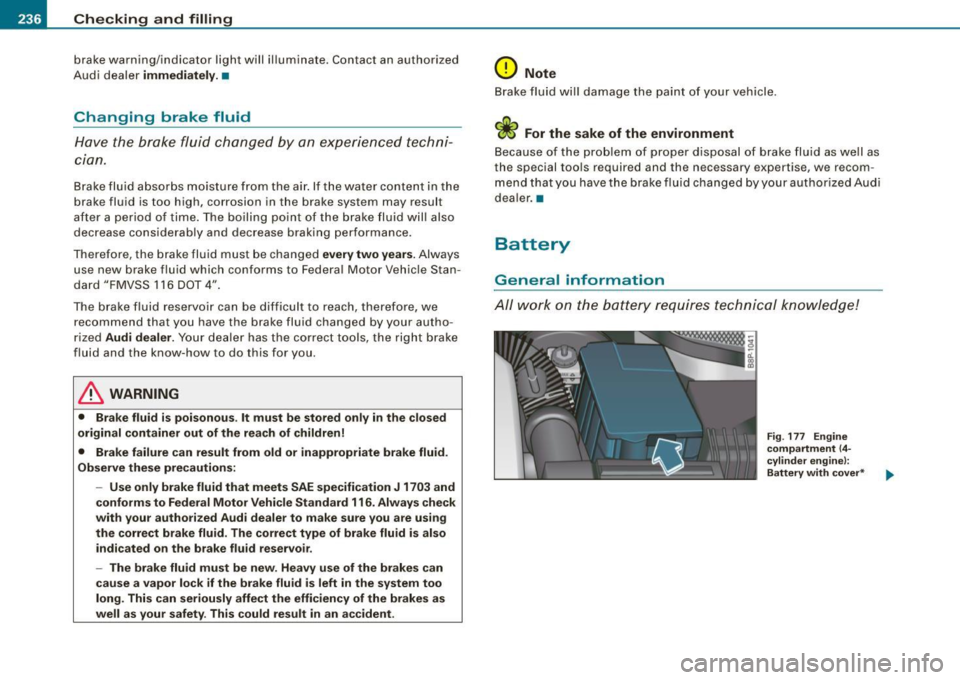
All w ork on the battery requires technical knowledge!
Fi g. 177 E ng ine
co mp artm ent (4 -
c yli nder engin e):
Bat tery w it h cove r"
Page 245 of 324
________________________________________________ T_ i _r_e _s_ a_n_ d_ w_ h_ e_e _ l_s __ __
•
Tires and wheels
Tires
General notes
Tires may be the least appreciated and most abused parts
of a motor vehicle.
Tires may be the least appreciated and most abused parts of a
motor vehicle. Tires are, however, one of the most important parts
of a vehicle, particularly considering the comparative ly sma ll patch
of rubber on each tire that assures that all- important contact
between you, your vehicle and the road .
Maintaining the correct tire pressure, making sure that your vehicle
and its tires do not have to carry more weight than they can safely
handle, avoiding damage from road hazards and regu lar ly
inspecting tires for damage inc luding cuts , slashes irregular wear
and overa ll condition are the most important things that you can do
to help avoid sudden tire failure including tread separation and
b lowouts .
Avoiding dama ge
If you have to drive over a curb or similar obstacle, drive very slow ly
and as close as possible at a right angle to the curb.
A lways keep chemica ls includ ing grease, oil, gasoline and brake
f luid off the tires.
I nspec t the tires regularly for damage (cuts, cracks or blis ters, etc.l.
Remove any foreign bodies embedded in the treads.
Storing tires
Mark tires when you remove them to indicate the direction of rota
tion . This ensu res you to be ab le to mount them correctly when you
reinstal l them. When removed, the wheels or tires shou
ld be stored in a coo l, dry
and preferably dark place.
St ore t ires in a vertical posit ion if they a re not mounted on rims, in
a horizontal position if they are mounted on rims.
New tire s
New tires have to be broken in~&.
The tread dep th of new tires may va ry, according to the type and
make of tire and the tread pattern.
Hidden d ama ge
Damage to tires and rims is often not readily visible. If you notice
unusua l vibration or the vehicle pul ls to one side, this may indicate
that one of the tires has been damaged . The tires must be checked
immed iately by an authorized Audi dealer or qualified workshop .
Unidire ction al tir es
A unidirectio nal tire can be iden tif ied by arrows on the s idewa ll, that
point in the direction the tire is designed to rotate. You must follow
the specified direction of ro tation . This is necessary so that these
tires can deve lop their optimum characteristics regarding grip, road
noise, wear and hydroplaning resistance . For more information
~ page 279.
in. WARNING
Ne w tire s or tire s that are old , worn or damaged cann ot pro vide
m aximum cont rol and braking ability.
• New tire s tend to be slippe ry and m ust be broken in . To redu ce
the risk of losing control, a colli sion and seriou s per sonal injurie s,
drive with speci al care for t he fi rst 350 m ile s ( 560 km l.
• Driving with worn or damaged t ire s can lead to lo ss of co ntrol ,
s udd en tire failure , in clu ding a blowout a nd sudden deflation , .,,_
Vehicle care
I t •
Page 246 of 324
-~_T_ ir_e_ s_ a_ n_d _ w_ h_ e_e _l_s _________________________________________________ _
& WARNING (continued)
crashes and serious personal injuries . Have worn or damaged tires
replaced immediately.
• Tires age even if they are not being used and can fail suddenly,
especially at high speeds. Tires that are more than 6 years old can
only be used in an emergency and then with special care and at
low speed.
Glossary of tire and loading terminology
Accessory weight
means the combined weight (in excess of those standard items
which may be replaced) of automatic transmission, power steering,
power brakes, power windows, power seats, radio, and heater, to
the extent that these items are available as factory-installed equip
ment (whether installed or not).
Aspect ratio means the ratio of the height to the width of the tire in percent.
Numb ers of 55 or lower indicate a low sidewall for improved
steering response and better overall handling on dry pavement.
Bead
means the part of the tire that is made of steel wires, wrapped or reinforced by ply cords and that is shaped to fit the rim.
Bead separation means a breakdown of the bond between components in the bead.
Cord
means the strands forming the plies in the tire.
& WARNING (continued)
• Never mount used tires on your vehicle if you are not sure of
their "previous history." Old used tires may have been damaged
even though the damage cannot be seen that can lead to sudden
tire failure and loss of vehicle control.
• If you notice unusual vibration or if the vehicle pulls to one side
when driving, always stop as soon as it is safe to do so and check
the wheels and tires for damage . •
Cold tire inflation pressure
means the tire pressure recommended by the vehicle manufacturer
for a tire of a designated size that has not been driven for more than
a couple of miles (kilometers) at low speeds in the three hour period
before the tire pressure is measured or adjusted .
Curb weight means the weight of a motor vehicle with standard equipment
including the maximum capacity of fuel, oil, and coolant, air condi
tioning and additional weight of optional equipment.
Extra load tire
means a tire designed to operate at higher loads and at higher infla
tion pressures than the corresponding standard tire . Extra load tires
my be identified as "XL",
"xi", "EXTRA LOAD", or "RF" on the side
wall.
Gross Axle Weight Rating ("GAWR")
means the load-carrying capacity of a single axle system, measured
at the tire -ground interfaces .
Gross Vehicle Weight Rating ("GVWR"l
means the maximum total loaded weight of the vehicle.
Page 254 of 324
-Tires and wheels
P'tr:1-------------------
and is more difficult to stop. Overloading can not only lead to loss
of vehicle control, but can also damage important parts of the
vehicle and can lead to sudden tire failure, including a blowout and
sudden deflation that can cause the vehicle to crash.
Your safety and that of your passengers also depends on making
sure that load limits are not exceeded. Vehicle load includes every
body and everything in and on the vehicle. These load limits are
technically referred to as the vehicle's
Gross Vehicle Weight Rating
("GVWR").
The "GVWR" includes the weight of the basic vehicle, all factory
installed accessories, a full tank of fuel, oil, coolant and other fluids
plus maximum load. The maximum load includes the number of
passengers that the vehicle is intended to carry ("seating capacity")
with an assumed weight of 150 lbs (68 kg) for each passenger at a
designated seating position and the total weight of any luggage in
the vehicle. If you tow a trailer, the weight of the trailer hitch and the
tongue weight of the loaded trailer must be included as part of the
vehicle load.
The
Gross Axle Weight Rating ("GAWR") is the maximum load that
can be applied at each of the vehicle's two axles.
The Gross Vehicle Weight Rating and the Gross Axle Weight Rating
are listed on the safety compliance sticker label located either on
the driver's side B-pillar or on the inside of the fuel filler flap. Your
Audi has 5 seating positions, 2 in the front and 3 in the rear for total
seating capacity of 5. Each seating position has a safety belt
=>
page 137, "Safety belts".
The fact that there is an upper limit to your vehicle's Gross Vehicle
Weight Rating means that the total weight of whatever is being
carried in the vehicle (including the weight of a trailer hitch and the
tongue weight of the loaded trailer) is limited. The more passengers
in the vehicle or passengers who are heavier than the standard
weights assumed mean that less weight can be carried as luggage.
The tire pressure label on your Audi also lists the maximum
combined weight of all of the occupants and luggage or other cargo that the vehicle can carry.
For the location of the label=>
page 247,
fig. 180.
& WARNING
Overloading a vehicle can cause loss of vehicle control, a crash or
other accident, serious personal injury, and even death.
• Carrying more weight than your vehicle was designed to carry
will prevent the vehicle from handling properly and increase the
risk of the loss of vehicle control.
• The brakes on a vehicle that has been overloaded may not be
able to stop the vehicle within a safe distance.
• Tires on a vehicle that has been overloaded can fail suddenly,
including a blowout and sudden deflation, causing loss of control
and a crash.
• Always make sure that the total load being transported -
including the weight of a trailer hitch and the tongue weight of a
loaded trailer -does not make the vehicle heavier than the
vehicle's Gross Vehicle Weight Rating. •
Determining correct load limit
Use the example below to calculate the
total weight of the passengers and luggage or other things that you plan to
transport so that you can make sure that
your vehicle will not be overloaded.
~
Page 257 of 324
Tires and wheels -_______________ _____.
Incorrect wheel alignm ent
Inc orrect wheel alignment ca n cause excessive tire wear, impairing
the safety of the vehicle . If tires show excessive wear, have the
whee l alignment chec ked by an autho rized A udi deale r or qu alifie d
wor kshop .
All Wheel Drive
Vehicles with quattro® must always have tires of the same size,
co nst ructi on an d tread type . For detail s see =>
page 196 .
& WARNING
Sudden tire failure can lead to lo ss of control, a crash and serious
personal injury!
• Never drive a vehicle when the tread on any tire is worn down
to the wear indi cators.
• Worn tire s are a safety hazard , they do not grip well on wet
roads and increase your risk of "hydroplaning " and loss of control.
• Always keep chemicals that can cau se tire damage , such a s
grease , oil , gasoline and brake fluid away from tires.
• Tires age even if they are not being used and can fail suddenly ,
especially at high speeds . Tire s that are more than 6 years old can
only be used in an emergency and then with special care and at
lower speeds .
• Never mount used tire s on your vehicle if you are not sure of
their "previou s hi story. " Old used tires may have been damaged
even though the damage cannot be seen that can lead to sudden
tire failu re and loss of vehi cle control. •
New tires and replacing tires and wheels
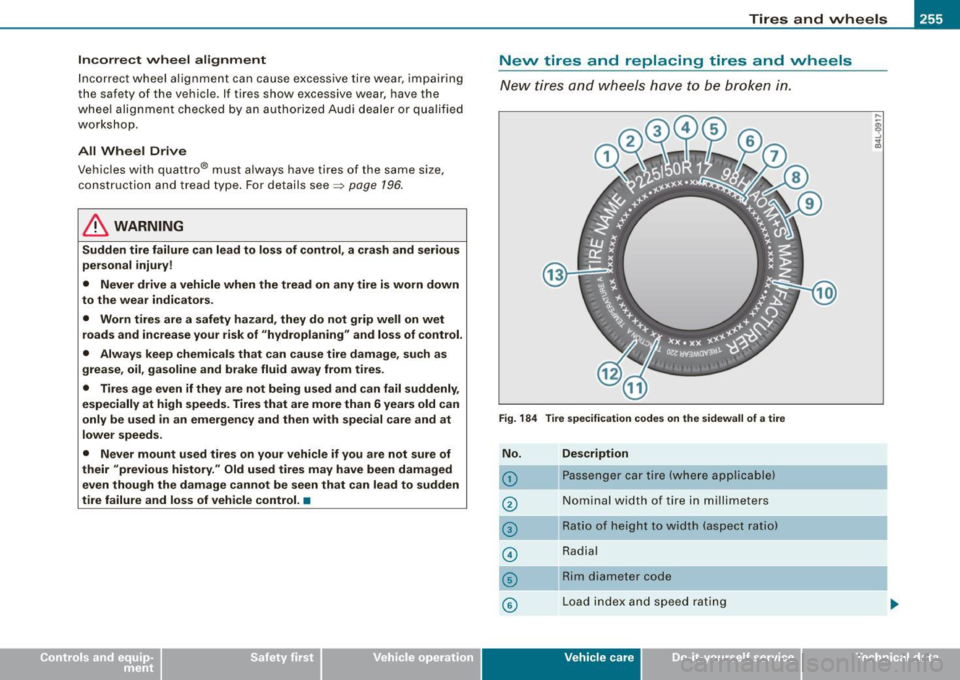
N ew tires a nd wh eels hav e to be b ro ken in.
Fig. 184 T ire spe cificati on c od es on the sidewall of a tire
No .
©
0
©
©
©
©
Descr iption
Passenger car tire (where applicable)
Nominal width of tire in mi llimeters
Ratio of height to width (aspect ratio)
Radial
ii Rim diameter code
Load index an d spee d rating
Vehic le care I I irechnical data
Page 264 of 324
_L_T~ir ~e :..:s~ a~n~ d~ w~ h ~e~e~ l~ s '.,_ ______________________________________________ _
Wheel bolts
W heel b olts mus t al wa ys be tigh te n ed to t he cor rect
to rqu e.
The design of wheel bolts is matched to the factory instal led rims . If
d ifferen t rims are fitted, the co rrect w heel bo lts wit h th e rig ht length
and correctly shaped bolt heads m ust be used. This ensures that
w hee ls are fitt ed s ecure ly a nd th at t he brake sys te m funct ions
correctly .
I n certain circums tances, yo u may no t use w heel b olts fr om a
differ ent vehicle -even if it is the same mode l.
&_ WARNING
Improperly tightened or maintained wheel bolts can become loose
causing loss of control, a collision and serious personal injury.
• Always keep the wheel bolts and the threads in the wheel hubs
clean so the wheel bolts can turn easily and be properly tightened.
• Never grease or oil the wheel bolts and the threads in the wheel
hubs. They can become loose while driving if greased or oiled,
even if tightened to the specified torque .
• Only use wheel bolts that belong to the rim being installed.
• Never use different wheels bolts on your vehicle.
• Always maintain the correct tightening torque for the wheel
bolts to reduce the risk of a wheel loss. If the tightening torque of
the wheel bolts is too low , they can loosen and come out when the
vehicle is moving . If the tightening torque is too high, the wheel
bolts and th reads can be damaged and the wheel can become
loose .
0 Note
The specified torque for the wheel bolts is 90 ft lb (120 Nm) with a
t ole ranc e of ± 7,4 ft lb(± 1 0 Nm). To rque whee l bolts diag onally.
After changing a wheel, the torque must be checked as soon as possible with a to
rque wrench -preferab ly by an authorized Audi
dea ler o r qu alif ied wo rksh op.•
Low aspect ratio tires
Yo ur Audi is fac tory-equip ped wi th l ow asp ect rati o tires. Th ese tires
have been thorough ly tested and been selected specifically for your
mod el for thei r su per b p erfo rma nce, road feel an d handl in g u nder
a variety of driving conditions . Ask your author ized Aud i dea ler for
mo re deta ils.
T he low aspec t ra tio o f th ese t ires is ind icate d by a numera l o f 55 or
less in the t ire's size designation. The numera l represents the ratio
of the ti re's s idewa ll height in re la ti on to its tread w idth e xpress ed
in percentage. Conventiona l tires have a height/width ratio of 60 or
mo re .
The performance of low -aspect -ratio t ires is part icularly sensitive to
improper inflation pressure . It is therefore important that low
aspect ratio tires are inflated to the specified pressure and that the
inflation pressure is regularly checked and maintained. Tire pres
sures should be checked at least once a month and alway s before a
long trip=>
page 250, "Checking tire p ressure".
What you can do to avoid tire and rim damage L ow a spect rati o tires can be damaged more easi ly by impact with
potho les, curbs, gull ies or ridges on the road, particu larly if the t ire
is underinflated.
In orde r to minimi ze the occurrence o f im pact da mage to th e tire s
of your vehicle, we recommend that you observe the fo llowing
p reca utions:
• Always ma intain reco mm ende d inflat io n pressu res . C heck your
tire p ressure every 2, 000 miles (3 ,000 km) and add ai r if neces sary .
• D rive car eful ly on roads with potholes, deep gullies or ridges.
Th e impact from d riving th ro ugh o r ove r such o bstac les can
dama ge you r tires . Impact w ith a curb may also cause da mage to
your tires . .,_
Page 283 of 324

_________________________________________________ F_ u_ s_ e_s _ a_n _d_ b_ u _ lb_ s _ __._
The various electrical circuits are protected by fuses. The fuses are
clustered in a centralized unit. The unit is located behind the face
panel at the end of the instrument panel. The crank for operating
the sunroof in case of a power failure is a lso stored behind the face
panel
~ page 49.
Two spare fuses and a sticker identifying the fuses are located on
the inside of the fuse box cover.
You are well advised to keep a supply of spare fuses in your vehicle .
Fuses with the proper ampere ratings are available at your autho
rized Audi dealer.
& WARNING
Never replace a fuse with one that has a higher amperage rating.
• A fuse with a too high amperage could damage the electrical
part and cause a fire .
0 Note
• On no accoun t should fuses be repaired (e.g . patched up with tin
foil or wire) as this may cause serious damage elsewhere in the elec
trical circuit or cause fire.
• If a fuse blows repeatedly, do not keep replacing it. Instead, have
the cause for the repeated short circuit or overload tracked and
fixed. •
Fuse Location , Instrument Panel left
Fus es which can be replaced.
Fig . 201 Fuse carrier
behind the instrument
panel end face, cover
removed
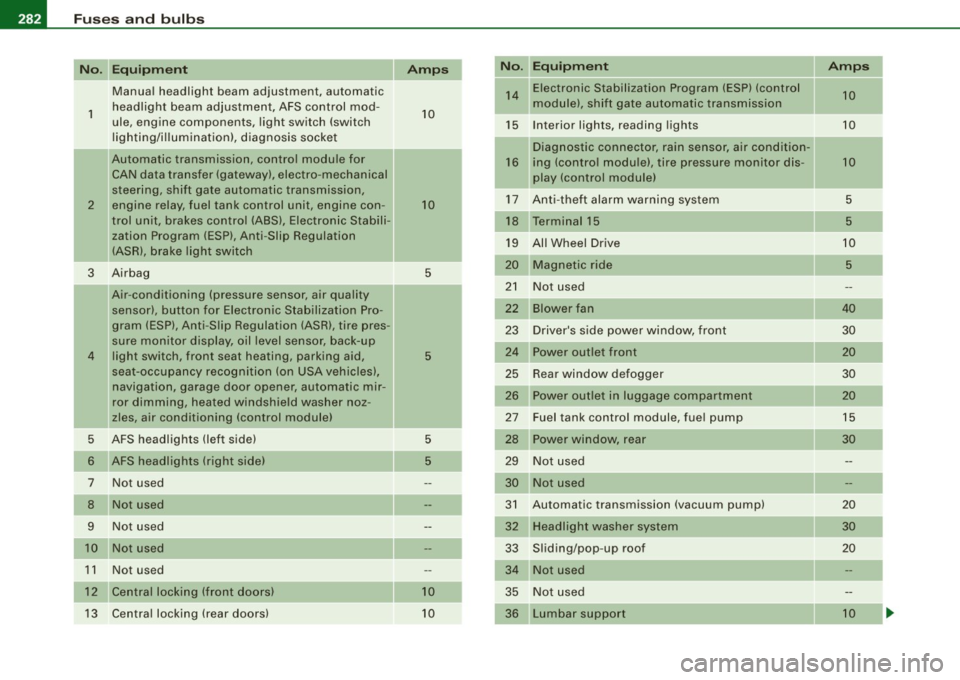
Note that the following table is accurate at the time of going to
press and is subject to change. In the event of discrepancies , the
label on the inside of the cover always takes precedence .
The power seats are protected by circuit breakers, which automati
cally reset after a few seconds after the overload has been reme -
died. .._
Vehicle care Do-it-yourself service irechnical data
Page 284 of 324
11111.___F_ u_ s _ e_s _ a_n _ d_ b_ u_lb _ s _______________________________________________ _
Equipment Amps No. Equipment Amps
Manual headlight beam adjustment, automatic 14 Electronic Stabilization Program (ESP) (control
10
1 headlight beam adjustment, AFS control mod-
10 module),
shift gate automatic transmission
ule, engine components, light switch (switch
15 Interior lights, reading lights 10
lighting/illumination), diagnosis socket
Diagnostic connector, rain sensor, a ir condit ion-
!! Automatic transmission, control module for
16 ing (control module), tire pressure monitor dis- 10
CAN data transfer (gateway), electro -mechanical
play (control module)
steering, shift gate automatic transmission, 17 Anti-theft alarm warning system 5
2 engine relay, fuel tank control unit, engine con
-10
trol unit, brakes control (ABS), Electronic Stabili- 18 Terminal 15
5
zation Program (ESP), Anti -Slip Regulation
19 All Wheel Drive
10
(ASR), brake light switch
-20 Magnetic ride 5
3 Airbag
5
-21 Not used
Air -conditioning (pressure sensor, air quality
sensor), button for Electronic Stabilization Pro- 22
Blower fan 40
gram (ESP), Anti -Slip Regulat ion (ASRl, tire pres -
23 Driver's side power window, front 30
sure mon itor display, oil level sensor, back-up
4 light switch, front seat heating, parking aid, 5 24 Power outlet front
20
seat-occupancy recognition (on USA vehicles), 25 Rear window defogger 30
navigation, garage door opener, automatic mir- 26 Power outlet in luggage compartment 20
ror dimming, heated windshield washer noz-
zles, air conditioning (control module) 27 Fuel tank control module, fuel pump 15
5 AFS headlights (left side)
5 28 Power
window, rear
30
6 AFS headlights (r ight side) 5 29 Not used
7 Not used 30 Not used
8 Not used 31 Automatic transmission (vacuum pump)
20
9 Not used 32 Headlight washer system 30
10 Not used
33 Sliding/pop-up roof
20
1 1 Not used 34 Not used
12 Central locking (front doors} 10 35 Not used
13 Central locking (rear doors) 10
36 Lumbar
support 10
Page 286 of 324

IIJII Fuses and bulbs i,.__....;,___;:,,;_,;,,.:_;__;;:_.:.:..:..=-=;____ ______________________ _
No. UEquipment Amps I No. Equipment Amps
F6 Steering wheel electronics, instrument cluster
5 F28
Not used
F7 Transmission control module 30 Fuse assignment in the left-side instrument
F29 50
F8 Navigation system, radio system 15/25 panel (special equipment)
Navigation system, digital radio, cell phone, TV F30 Power supply relay terminal
15 50
F9 equipment 5
F10 Engine control module, main relay 5/10 Variation
(2) with 54 Plug-in Fuses
F11 Not used No. Equipment
Amps
Control module for CAN data transfer (gateway) 5 F1
Vehicle
electrical system control unit (right)
30
F13 Engine control module 15/25 F2
ESP valves, Anti
-lock brake system (ABS) valves
20/30
F14 Ignition coils 20 F3 Not used
F15 Tank diagnosis, oxygen sensor 5/10 F4
Battery voltage
5
F16 Vehicle electrical system control unit (right) 30 F5 Horn
15
F17 Horn
15 F6 Engine components, fuel pump 15
F18 Audio amplifier 30 F7
Not used
F19 Front windshield wiper system 30 F8
Not used
F20 Water return
-flow pump, volume regulator valve F9 Engine components
10
F21 Oxygen sensor, vacuum pump 15 F10
Fuel tank control, mass air flow sensor
10
F22 Clutch pedal switch, brake light switch 5 F11 Oxygen sensors, in front of catalytic converter 10
F23 Engine relays, engine components
5/10/15 F12 Oxygen sensors, behind catalytic converter
10
F24 Engine components, water return-flow pump 10 F13 Automatic transmission
15
F25 Pump (ESP/ABS), ABS valve 30/40 F14 Not used
F26 Vehicle electrical system control unit (left)
30 F15 Water return-flow pump
10
F27 Secondary air pump 40 F16 Volume control valve
20
F17 Steering wheel electronics, instrument cluster
5
F18 Audio amplifier 30
F19 Navigation system, radio system 15/25
Page 287 of 324

_________________________________________________ F_ u_ s_ e_s _ a_n _ d_ b_ u_lb _ s __ ffllll
N "E .
o . qu1pm ent Amps I No. Equ ipment Amps
F20 Navigation system, digital radio, cell phone, TV
5 F44 Not used
equipm ent
F45 Not used
-
F21 Not used F46 Not used
Not used F47 Left-side lighting (electric system control unit)
30
F23 Engine control module, main re lay 10
Pump (ESP/ABS), ABS valve, Anti-lock brake sys-
F48 30/40
F24 Control module for CAN data transfer (gateway) 5 tern (ABS) valves
F25 Not used F49
Not used
Not us ed Not used
F27 Not used F51 Secondary air pump 40
Engine control module 15/25 F52 Power supply relay terminal 15 50
F29 Engine relays, eng ine components 5
F53 Fuse assign
ment in the left -side instrument
50
F30 Not used panel (special equipment)
F3 1 F
ront windshield wiper system
30
F54 Not use d •
F32 Not us ed
F33 Not used
Bulbs
F3 4 Not used
F35 Not used
Replacing light bulbs
F36 Not used F or your safety, we recommend that you have your autho -
rized Audi dealer replace burned out bulbs for you.
Not used
F37
F38 Eng ine components, ta nk diag nosis 10 It is becom ing increasingly more and more difficult to replace
vehic le light bu lbs since in many cases, other parts of the car must
F39 Clutch pedal switch, brake light switch 5 first be removed before you are able to get to the bulb . This applies
F40 Ignition coils 20 especia lly to the light bu lbs i n the front of your car which you can
only reach through the engine compartment .
F41 Not used
F42 Not used Sheet meta
l and bulb holders can have sharp edges t hat ca n cause
serious cuts, and parts must be correctly taken apart and then prop -
F43 Ignit ion coils 30 erly put back together
to he lp prevent breakage of parts and long
...
• Do-it -yourself service