spare tire AUDI S3 2009 User Guide
[x] Cancel search | Manufacturer: AUDI, Model Year: 2009, Model line: S3, Model: AUDI S3 2009Pages: 324, PDF Size: 76.02 MB
Page 266 of 324
___ T _i_r e_=- p_r_e _ s_ s_ u_r_ e _ m_ o_ n_i_t _o _r_ i _ n .,;:g ::;.._ s_ y=--- s_t _e _m_ * __________________________________________ _
Tire pressure monitoring system*
Applies to vehicles: with tire pressu re monitoring system
General notes ' J
Each tire, including the spare (if provided), should be checked
monthly when cold and inflated to the inflation pressure recom
mended by the vehicle manufacturer on the vehicle placard or tire
inflation pressure label. (If your vehicle has t ires of a d ifferent size
than the size indicated on the vehicle placard or tire inflation pres
sure label, you should determine the proper tire inflation pressure
for those ti res.)
As an added safety feature, your vehicle has been equipped with a
tire pressure monitoring system (TPMS) that i lluminates a low tire
pressure tellta le when one or more of your tires is significantly
under-inflated. Accord ingly, when the low tire pressure telltale illu
minates, you shou ld stop and check your tires as soon as possible,
and inflate them to the proper pressure. Driving on a significantly
under-inflated tire causes the tire to overheat and can lead to tire
failure . Under -inflat ion also reduces fuel efficiency and t ire tread
life, and may affect the vehic le's handling and stopping ability.
Please note that the TPMS is not a substitute for proper tire mainte
nance, and it is the driver's responsibi lity to maintain correct tire
pressure, even if under -inflation has not reached the level to trigger
il luminat ion of the TPMS low tire pressure te lltale.
Your vehicle has also been equipped with a TPMS ma lfunction indi
cator to indicate when the system is not operating proper ly . The
TPMS malfunction indicator is combined with the low tire pressure
telltale. When the system detects a malfunction, the tellta le wi ll
flash for approximately one minute and then remain continuously illuminated. This sequence will continue upon subsequent vehicle
start-ups as long as the malfunction exists .
When the ma lfunction indicator is illuminated, the system may not
be able to detect or signal low tire pressure as intended. TPMS
malfunctions may occur for a variety of reasons, including the insta
llation of replacement or alternate tires or wheels on the
vehic le that prevent the TPMS from functioning properly. Always
check the TPMS malfunction tellta le after replac ing one or more
tires or whee ls on your vehicle to ensure that the replacement or
a lternate tires and wheels a llow the TPMS t o continue to funct ion
properly. •
Applies to vehicles: with tire pressur e monitoring system
Introduction
The tire pressure monitoring system monitors air pressure
in all four road wheels while the vehicle is moving.
As soon as the tire p ressure monitoring system senses a significant
loss of air pressure in one or severa l tires, text messages and ye llow
sy mbo ls appear in the instrument cluster display to alert the driver.
The warning light in the instrument cluster comes on when the
tire is significantly underinflated
=> page 13 .
Th e warning light l also i lluminates in the case of a system
malfunction.
Be aware tha t tire pressure is a lso dependent on the temperature of
the tire . For every 18 °F (1 O °C) increase in tire temperature, tire pres
sure increases by about 1.5 psi (0 .1 ba r). The tire warms up while the
vehic le is moving and tire pressure rises. So you should adjust tire
pressure on ly when they are
cold, when the temperature of the tires
is roughly the same as the ambient air temperature.
I n order to keep the tire pressure monitoring system properly ca li
b rated, tire pressure on all four tires shou ld be checked a t regu lar
interva ls, adjusted if necessary, and saved in the proper setting
(reco mmended pressure) :::>
page 266.
The tire pressure is shown either on the driver's side 8 -pi llar or on
the inside of the fuel fi ller flap. _..
Page 267 of 324
__________________________________________ T_i_re _ p =----r_e _s _ s_ u_ r_e _ m_ o_n_ i_ t _o _r_ i_n -=g =-- s....: y:.... s_ te_ m_ * __ _
•
& WARNING
• When the t ire pres sure monitoring sy stem warning light is l it ,
one or more of your tire s is significantly underinflated . You should
stop and che ck your tires as soon as possible , and inflate them to
the proper pres sure as ind icated on the vehicle's tire pressure
label :::::,
page 247 . Driving on a signifi cantly unde rinflated tire
causes the tire to overheat and can lead to tire failure. Underinfla
tion also is likely to impair the vehicle's handling and stopping ability .
• Do not adju st tire pressure when tire temperature is e xcess ive.
This could lead to serious tire damage and even cause the tire to
burst , with the additional dan ger of an accident.
W For the sake of the environment
D riving with u nder inflated tires r educes fue l effi ciency and ti re
tread life.
[ i J Tip s
• Each tire, including the spare , should be checked monthly when
t he tempe rat ure of the t ires is a bout t he sa me as amb ient a ir
temperature and set to the recommended inflation pressure as
speci fied o n the ti re pre ssure label :::::,
page 247.
• The factory supplied spare whee l is equipped with a sensor for
t he ti re press ure m onit ori ng sys te m. As long as the spare w hee l is
not mounted, the t ire pressure of this tire wil l not be monitored .
• T he tire pressure mon itori ng system help s t he d river mo nitor ti re
pressures, but the driver is stil l responsible for maintaining the
c orrect tire press ure.
• T ire pressure must only be adjusted when the temperature of the
ti res is abou t th e sam e as ambie nt air te mperatu re.
• When t ires a re replaced, the sen so rs and valves shou ld not be
e xcha nged . T he va lve co re, nut, va lv e sea ling and sea l was her (replacement kit) needs to be replaced
. If necessary, the valve and
t he wheel electr onics have to be rep laced.
• I f you should put different whee ls and tires on your vehic le (e.g.
win ter w hee ls a nd tires), y ou must be certa in tha t the whee ls and
tires are compat ible with the tire pressure monitoring system .
Otherwise the sys te m will r egiste r a ma lfunc tion and a fau lt
message will be displayed . For more information, contact your
au thorized A udi dea le r.
• Adjust the tire pressure and store the pressure in the tire pres
su re moni tor ing sys tem to t he loa d you are carrying.
• F or Dec laration of Comp liance to United States FCC and Industry
Cana da regula tions :::::,
page 307 . •
A pplies to veh ic les : w ith tir e pressu re mon itor ing system
Significant loss of air pressure j'
Th e yellow symb ol app ear s i n the event o f a sig ni ficant
Jo ss of a ir pr es su re.
Fig . 185 Di sp lay :
yellow symbol with message
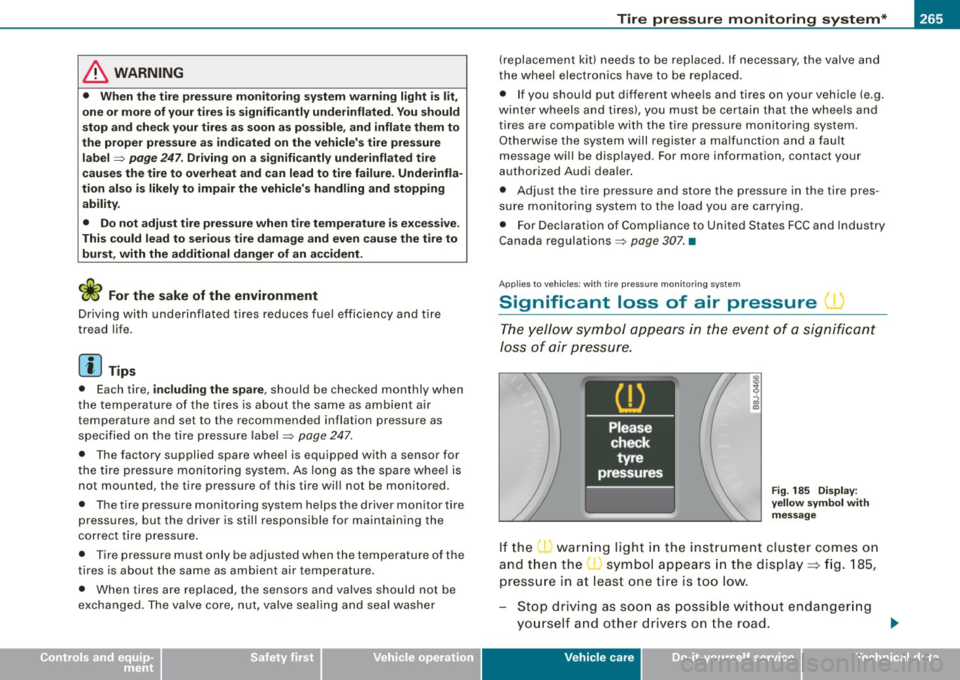
I f th e warning ligh t in the ins trumen t clu ste r com es o n
a nd t hen the s ymb ol appea rs in t he dis pla y~ fig. 1 85,
pre ssure in at least o ne tire is t oo l ow.
S to p drivi ng as soo n a s possib le wit h out e nda nge rin g
y o urs elf a nd other dr ivers on t he road. ._
Vehicle care I t •
Page 268 of 324
-Tire pressure monitoring system* __ ..:.._____:__..:...::....:..:..:..-=.:..: ..:..::.-=.:..~~.:.=.:..:.::...__ ____________________ _
-Inspect all tires.
- Change the tire if necessary~ page
272.
The warning light in the instrument cluster comes on when the
tire is significantly underinflated .
In addition, the tire symbol ,_, appears in the display together with
the message
Please check tire pressure=> page 265, fig. 185.
After a few seconds, the message disappears again. If you would
like to show the message again, press the Set/Check button
=>
page 8, fig. 2 @ .
[ i ] Tips
• In the case of an intentional loss of air pressure, such as when
readjusting tire pressure, the pressure must be stored again after
ward =>
page 266.
• Tire pressure must only be adjusted when the temperature of the
tires is about the same as ambient air temperature.
• The yellow symbol disappears when the tire pressure is
corrected and the new pressure is stored in the system=>
page 266.
• After changing a wheel or replacing a wheel with the spare tire
you have to adjust the tire pressures on all wheels. In addition, you must then initialize the new tire pressures in the tire pressure moni
toring system =>
page 267. •
Applies to vehicles: with tire pr essu re mon itoring system
Storing tire pressures
Correct storage of specified pressure is the basic require
ment for reliable tire pressure monitoring .
1 1 1 J
Fig. 186 Car: Tire pres
sure monitoring
system
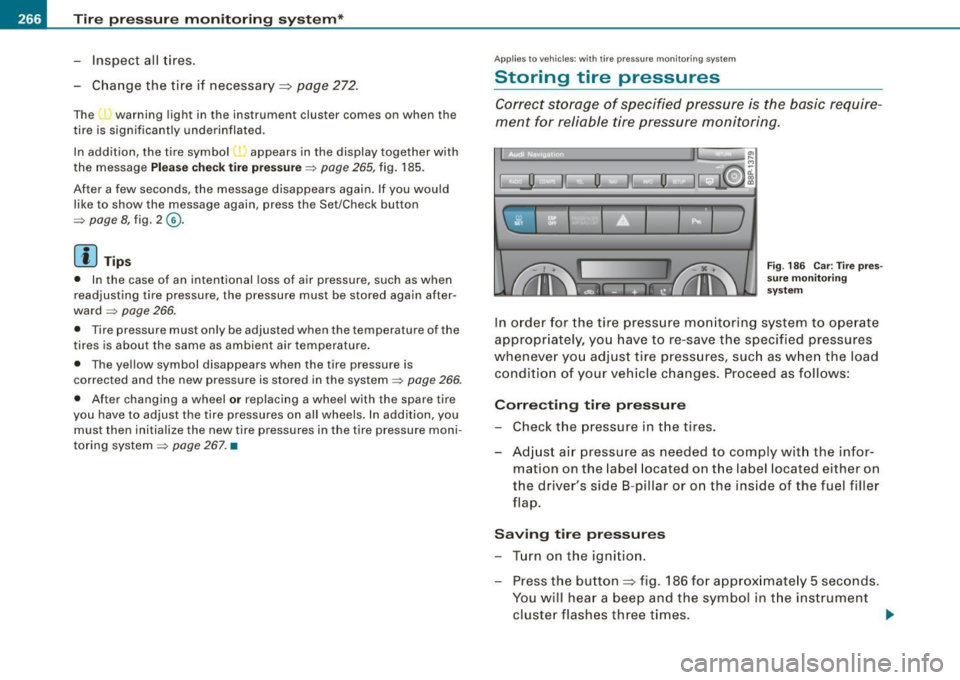
In order for the tire pressure monitoring system to operate
appropriately, you have to re-save the specified pressures
whenever you adjust tire pressures, such as when the load condition of your vehicle changes. Proceed as follows:
Correcting tire pressure
- Check the pressure in the tires.
- Adjust air pressure as needed to comply with the infor- mation on the label located on the label located either on
the driver's side 8 -pillar or on the inside of the fuel filler
flap .
Saving tire pressures
-Turn on the ignition.
- Press the button~ fig. 186 for approximately 5 seconds.
You will hear a beep and the symbol in the instrument
cluster flashes three times. ..,.
Page 269 of 324
__________________________________________ T_i_re _ p =----r_e _s _ s_ u_ r_e _ m_ o_n_ i_ t _o _r_ i_n -=g =-- s....: y:.... s_ te_ m_ * __ !II
•
All pressure warning indicators in the display will be canceled.
Fo llowing each intent ional change in specified pressures, tire pres
sures must be saved again .
After the pressures are saved, the tire pressure monitoring system
measures the current tire pressures and saves them as the new
specified pressures.
[ i] Tips
• The tire pressure is shown on the tire pressure label. The tire
pressure label is located either on the driver's side B -pillar or on the
inside of the fuel filler flap. The tire pressure label lists the recom
mended cold tire inflation pressures for the vehicle at its maximum
capacity weight and the tires that were on your vehicle at the time
it was manufactured. For recommended tire pressures for normal
load conditions, please see chapter~
page 247.
• The tire pressure monitoring system helps the driver monitor tire
pressures, but the driver is still responsible for maintaining the
correct tire pressure. •
Applies to vehicles: with tir e pressure monitor ing system
Wheel change
If a wheel is changed, the wheels that were exchanged
have to be reprogrammed.
- Turn on the ignition.
- Press the button=>
page 266, fig. 186 for approximately 5
seconds. You will hear a beep and the symbol in the
button flashes three times.
Programming is necessary:
• after the tires have been rotated on the vehicle, or the spare tire
is used, •
if tires with new wheel sensors are used.
All pressure warning indicators in the display will be canceled. The
system malfunction error message will not disappear until the
vehicle is underway. With pressing the button~
page 266, fig. 186,
the reprogramming of the new sensors and storing of actual pres
sures starts . This learning phase can take up to 10 minutes driving
time.
During the learning process the tire pressure monitoring system is
not available. •
Applies to vehic les: with tir e pr essure monitor ing system
Malfunctions *
A malfunction can have various causes.
Fig. 187 Display:
System malfunction
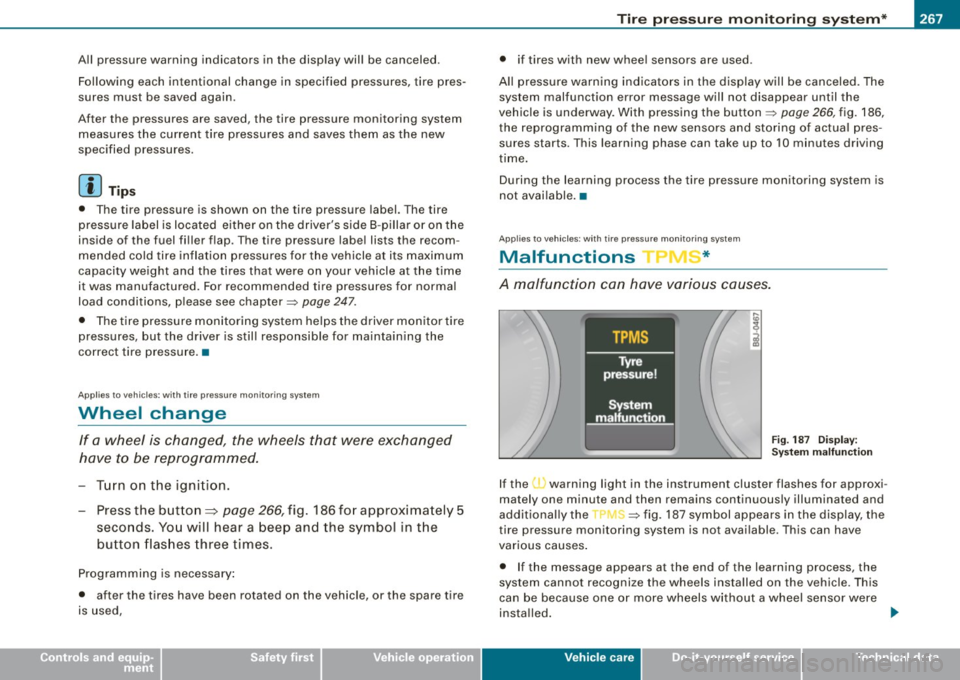
If the '-warning light in the instrument cluster flashes for approxi
mately one minute and then remains continuously illuminated and
additionally the
~ f ig. 187 symbol appears in the display, the
tire pressure monitoring system is not available . This can have
various causes.
• If the message appears at the end of the learning process, the
system cannot recognize the wheels installed on the vehicle . This
can be because one or more wheels without a wheel sensor were
installed. .,,_
Vehicle care I t •
Page 273 of 324
What do I do now? -
------------------
& WARNING !continued)
• Always make sure the spare tire and even a flat tire are secured
in place and not loose, otherwise they could fly forward, causing
personal injury to passengers in the vehicle in an accident or
sudden maneuver .
• Never use the jack supplied with your Audi on another vehicle,
particularly on a heavier one. The jack is only suitable for use on
the vehicle it came with. •
Ap plies to vehicles: w ith compact spare wheel
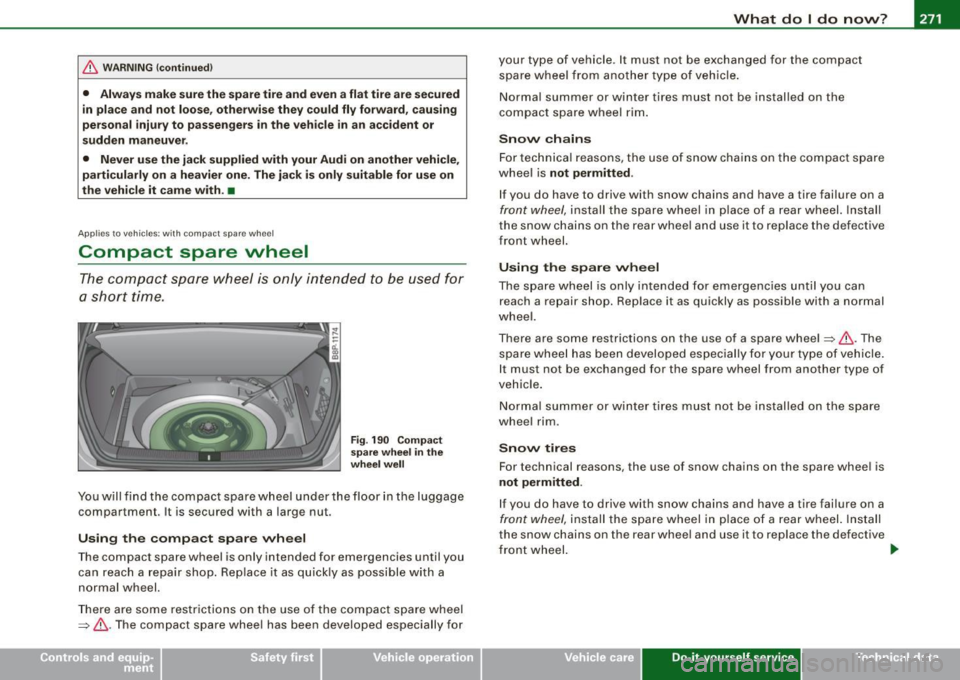
Compact spare wheel
The compact spare wheel is only intended to be used for
a short Nme.
Fig . 190 Compact
spare wheel in the
wheel well
You will find the compact spare wheel under the floor in the luggage
compartment. It is secured with a large nut.
Using the compact spare wheel
The compact spare wheel is only intended for emergencies until you
can reach a repair shop. Replace it as quickly as possible with a
normal wheel.
There are some restrictions on the use of the compact spare wheel
=>
& -The compact spare wheel has been developed especially for your type of vehicle
. It must not be exchanged for the compact
spare wheel from another type of vehicle.
Normal summer or winter tires must not be installed on the
compact spare wheel rim.
Snow chains
For technical reasons, the use of snow chains on the compact spare
wheel is
not permitted .
If you do have to drive with snow chains and have a tire failure on a
front wheel, install the spare wheel in place of a rear wheel. Install
the snow chains on the rear wheel and use it to replace the defective
front wheel.
Using the spare wheel
The spare wheel is only intended for emergencies until you can
reach a repair shop. Replace it as quickly as possible with a normal
wheel.
There are some restrictions on the use of a spare wheel =>& .The
spare wheel has been developed especially for your type of vehicle.
I t must not be exchanged for the spare wheel from another type of
vehicle.
Normal summer or winter tires must not be installed on the spare
wheel rim .
Snow tires
For technical reasons , the use of snow chains on the spare wheel is
not permitted .
If you do have to drive with snow chains and have a tire failure on a
front wheel, install the spare wheel in place of a rear wheel. Install
the snow chains on the rear wheel and use it to replace the defective
front wheel.
t,.
Vehicle care Do-it-yourself service irechnical data
Page 274 of 324
-L___:W:..:..:. h.:.: a::.. t:...:: d:.:o:::....:. l..: d::. O ::::....: n:..:.:: O:..:W :.:..:. ? ____________________________________________ _
& WARNING
Always store jacking equipment, spare wheel in the luggage
compartment. Tighten screw for the spare wheel securely. Under
no circumstances should you store the spare wheel or jack and
tools unsecured in the passenger compartment. This could cause
serious personal injury to passengers in the vehicle in case of a
collision.
• The compact spare tire is for temporary use only and is so
marked on the sidewalls.
• Do not drive at speeds exceeding 50 mph (80 km/hi with the
compact spare wheel mounted. Also rapid acceleration, hard
braking and hard cornering must be avoided to help prevent loss
of vehicle control.
• Any continuous road use of the compact spare tire may result
in tire failure, loss of vehicle control and injury to vehicle occu
pants.
• Do not put a snow chain on your compact spare tire. Due to the
smaller tire size, the chain will not fit properly and can thus
damage your vehicle. You could also lose the chain, as well as
control of the vehicle .
• If you have a flat front tire in road conditions which require
snow chains, first remove the undamaged rear wheel and mount
the compact spare wheel in its place. Then remove the damaged
front wheel, take the snow chains off it and attach them to the
wheel taken from the rear. This wheel can now be mounted on the
front with its snow chains. Check and adjust tire pressure promptly.
• Never use two or more compact spare tires at the same time.
0 Note
When using the compact spare wheel, note the following: •
After installing the compact spare wheel, the tire inflation pres
sure should be checked and, if necessary, increased to 60 psi (4 .2
barl.
• The load carrying capacity is marked on the tire sidewal ls and
must not be exceeded .
• After installing the compact spare wheel, make sure that you
remount the flat tire in its storage area properly .
• The compact spare tire should be properly remounted in its
storage area as soon as the standard road tire can be replaced.
• Because the compact spare tire was specifically designed for
your vehicle, it must not be used on any other vehicle . Likewise,
compact spare wheels from other vehic les must not be used on your
vehicle.
• The compact spare tire must not be mounted on any other
wheels, nor must standard tires, snow tires, wheel covers or trim
rings be used with the compact spare wheel. If such use is
attempted, damage to these items or other vehicle components
may occur.
[ i] Tips
Check the inflation pressure of the compact spare tire (60 psi/4 .2
bar) periodically to keep the tire ready for use .•
Wheel change
Before changing a wheel
Observe the following precautions for your own and your
passenger's safety when changing a wheel.
- After you experience a tire failure, pull the car well away
from moving traffic and try to reach level ground before
you stop
~ & . ~
Page 275 of 324
What do I do now? -__________________ __;__:....:....:..:: __ _
•
-All passengers should leave the car and move to a safe
location (for instance, behind the guardrail)~& .
- Apply the
parking brake firmly ~& .
- Move
selector lever to position Pon an automatic trans-
miss ion; put manual transmission in
first gear ~& .
-If you are towing a trailer : unhitch the trailer from your
vehicle.
- Take the
tool and the spare tire~ page 270 out of the
luggage compartment.
& WARNING
You or your passengers could be injured while changing a wheel if
you do not follow these safety precautions:
• If you have a flat tire, move a safe distance off the road. Turn off
the engine, turn the emergency flasher on and use other warning
devices to alert other motorists.
• Make sure that passengers wait
in a safe place away from the
vehicle and well away from the roadway and traffic.
• To help prevent the vehicle from moving suddenly and possibly
slipping off the jack, always fully set the parking brake and block
the wheel diagonally opposite the wheel being changed. When one
front wheel is lifted off the ground, placing the automatic trans
mission in "P" (Park), or engaging a gear in a manual transmission
will
not prevent the vehicle from moving.
• Before you change a wheel, be sure the ground is level and firm.
If necessary, use a sturdy board under the jack.
• After installing the spare wheel, make sure that you remount
the flat tire/wheel in its storage area properly and tighten the
knurled retaining screw securely. •
Changing a wheel
When you change a wheel, follow the sequence described
below step-by-step and exactly in that order.
1. Remove the decorative wheel cover*. For more details
see also
~ page 274, "Decorative wheel covers" or
~ page 275, "Wheels with cap-covered wheel bolts".
2. Loosen the
wheel bolts ~ page 276.
3. Locate the proper mounting point for the jack and align the jack below that point~
page 276.
4. Lift the car with the jack~ page 276.
5. Take the flat wheel off and then put the spare on
~ page 278.
6. Tighten all wheel bolts lightly .
7.
Lower the vehicle with the jack .
8. Use the wheel bolt wrench and
firmly tighten all wheel
bolts
~ page 276.
9. Put the decorative wheel cover* back on.
& WARNING
Always read and head all WARNINGS and information ::} & in
"Raising the vehicle" on
page 276 and ~ page 279. •
After changing a wheel
A wheel change is not complete without the following
actions.
- Store and secure the replaced wheel in the spare wheel
well. .,._
Do-it-yourself service
Page 276 of 324
llffl.___W_ h_ a_t _d_ o_ l _d _o_ n_ o_ vv_ ? ______________________________________________ _
- Put the tool case and the jack back in p lace in the luggage
compartment.
- Check the tire pre ssure on the spare whee l immediately
after mounting it.
- As soon as possible, have the tightening torque s on all
wheel bo lts checked with a torque wrench . The correct
tightening torque is 90 ft lb (120 Nm) .
- Have the flat tire replaced as soon as possible.
[ i ] Tip s
• If you notice while changing a tire that the wheel bolts are
corroded and difficult to turn, then they should be replaced before
you check the tightening torque .
• Drive at reduced speed until you have the tightening to rques
checked .a
Ap plies to ve hicles: w it h full whee l co vers
Full wheel covers
The wheel covers must be removed to access the wheel
bolts.
Remo va l
- Pull the full wheel cov er off manually.
Inst alla tion
- First press the full wheel cove r onto the rim at the cut -out
prov ided for the valve. Then engage the outer edge of the
f ull whe el cover in the steel rim. •
Applies to vehi cles : w it h deco ra tiv e wh eel co vers
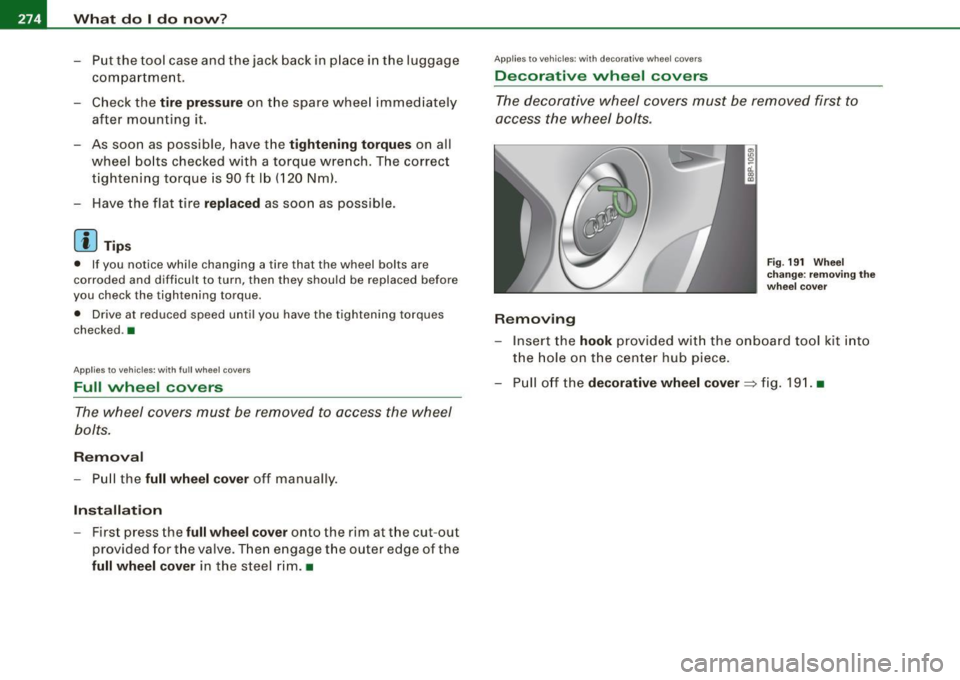
Decorative wheel covers
The decorative wheel covers must be removed first to
access the wheel bolts .
Removing
Fig. 19 1 Whee l
ch ange : remov in g th e
w hee l cover
- Inse rt the hook provid ed with the onboard tool kit into
t h e hole on the cen ter hub piece .
- P ull off the decorative wheel cover => fig . 19 1. •
Page 280 of 324
11111...__W_ h_ a _ t_d_ o_ l _d _o_ n_ o_ vv_ ? ______________________________________________ _
Taking the wheel off /putt ing the spare on
Follow these instructions step-by-step for changing the
wheel
M
"' ;;; u.
1li
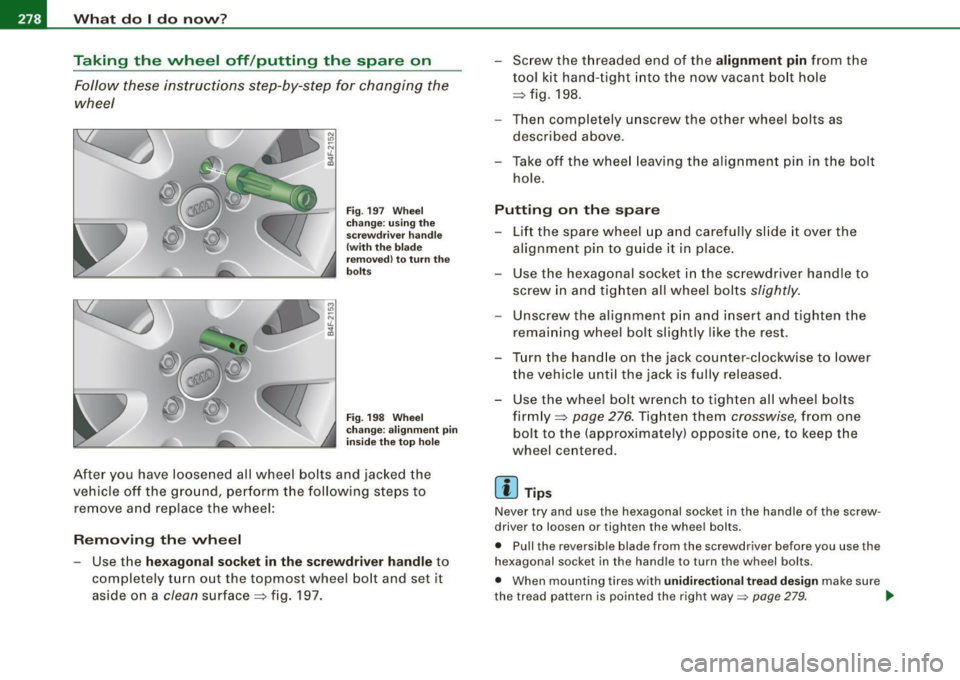
Fig . 197 Wheel
change : using the
screwdriver handle
(with the blade
removed) to turn the
bolts
Fig . 198 Wheel
change: alignment pin
inside the top hole
After you have loosened all wheel bolts and jacked the
vehicle off the ground, perform the following steps to
remove and replace the wheel:
Removing the wheel
- Use the hexagonal socket in the screwdriver handle to
completely turn out the topmost wheel bolt and set it
as ide on a
clean surface ~ fig. 197. - Screw the threaded end of the
alignment pin from the
tool kit hand-tight into the now vacant bolt hole
~ fig. 198.
- Then completely unscrew the other wheel bolts as
described above.
Take off the wheel leaving the alignment pin in the bolt
hole.
Putting on the spare
- Lift the spare wheel up and carefully slide it over the
alignment pin to guide it in place.
- Use the hexagonal socket in the screwdriver handle to
screw in and tighten all wheel bolts
slightly.
Unscrew the alignment pin and insert and tighten the
remaining wheel bolt slightly like the rest.
- Turn the handle on the jack counter -clockwise to lower
the vehicle until the jack is fully released.
- Use the wheel bolt wrench to tighten all wheel bolts firmly ~
page 276. Tighten them crosswise , from one
bolt to the (approximately) opposite one, to keep the
wheel centered.
[ i ] Tips
Never try and use the hexagonal socket in the handle of the screw
driver to loosen or tighten the wheel bolts.
• Pull the reversible blade from the screwdriver before you use the
hexagonal socket in the handle to turn the wheel bolts.
• When mounting tires with
unidirectional tread design make sure
the tread pattern is pointed the right way=>
page 279. ~
Page 281 of 324
_______________________________________________ W_ h_ a_t _ d_ o_ l _d _o_ n_ o _ w_ ? __ ffllll
•
• T he wheel bolts should be clean and easy to turn . Check for dirt
and corrosion on the mating surfaces of bo th the wheel and the
hub. Remove all dirt from these surfaces before remounting the
whee l.•
Tires with unidirectional tread design
Tires with unidirectional tread design must be mounted
with their tread pattern pointed in the right direction.
Using a spar e tir e with a tread pa ttern intended for u se
in a sp ecific direc tion
When using a spare tire with a tread pattern intended for use in a
specific direction , p lease note the following:
• T he direction of rotation is marked by an arrow on the sid e of the
tire .
• I f the spare tire has to be installed in the incorrec t direction in the
event of a flat tire , use the spare tire on ly temporarily since the tire
wi ll not be ab le to achieve its optimum performance characteristics
with regard to aquap laning, noise and wear .
• We recommend that particula r atten tion be pa id to this fact
dur ing wet weather and that you adjust your speed to match road
conditions.
• Replace the flat tire with a new one and have it installed on your
vehicle as soon as possible to restore the handling advantages of a p roper ly pointed d irection -dependent t ire. •
Notes on wheel change
Please read the information=> page 255, "New tires and replacing
tires and wheels" if you are going to use a spare tire which is
different from the tires on your veh ic le.
Aft er you change a tire :
• Che ck the ti re pre ss ure on the spare immed iately aft er
mounting .
• Have the wheel b olt t ight en ing to rque checked with a torque
wrench a s soon a s po ssible by your authorized Audi dea ler or a
q u alified service stat ion .
• On steel and a lloy wheel rims , the wheel bolt s are correctly tight
ened with a t orque of 90 ft lb (1 2 0 Nm l.
• If you noti ce w hile changing a tire that the wheel bolt s are
c o rroded and d iff ic ult to turn , then they should be repla ced befo re
you check the tightening torque.
• Repl ace the fl at t ir e w ith a new one and hav e it installed o n your
vehicle as soon as pos sib le . Remount the wheel cover .
Until then , drive wi th ext ra care and at redu ced speeds.
& WARNING
• If you are going to equip your v ehi cle wi th tire s or rim s wh ich
diffe r from tho se which were fa ctory installed , th en be sure to r ead
the infor mation
=> page 255, " New tires and repl acing tire s and
wheel s".
• Alway s ma ke sure the d amag ed w heel or e ven a flat t ire and
the jack and tool kit ar e properly secured in the lugg age comp art
ment and are not loose in the p asse nger co m partment .
• In an a ccident o r sudden maneu ver th ey could fl y fo rw ard ,
injur ing anyo ne in th e vehi cle .
• Alway s store damaged wheel , ja ck and tool s se curel y in
luggag e compartment . Oth erwi se, in an accid ent or sudd en
m aneuv er the y could fly fo rward, c au sing in jur y to pa ssenge rs in
the vehic le . •
Do-it-yourself service