transmission AUDI S3 2009 User Guide
[x] Cancel search | Manufacturer: AUDI, Model Year: 2009, Model line: S3, Model: AUDI S3 2009Pages: 324, PDF Size: 76.02 MB
Page 125 of 324
Transmission -_______________ ___.
- With your right foot, step on the accelerator to the wide
open throttle position or Kickdown. The engine speed
settles at about 3,200 rpm.
Take your left foot off the brake.
The S tronic® in your vehicle is electronically controlled. A special
Launch Control Program provides the best acceleration from a
standing start.
& WARNING
• Always adapt your driving to the traffic flow.
• Only use Launch Control when road and traffic conditions allow
it and other drivers will not be endangered or annoyed by your
driving and the acceleration of the vehicle.
• Make sure that ESP remains enabled . With the ESP disabled,
the vehicle could brake away, particularly on a slick and slippery road -risk of skidding!
• Once acceleration is finished, switch ASR on again by briefly
pushing the ESP button. •
Applies to veh ic le s: w ith S t ron ic ®
Back -up program
In the event of a system ma/function, there is an back-up
program.
In the event of system malfunction, the automatic transmission
switches to the fail-safe mode. All of the selector lever position
displays for the automatic transmission are highlighted with a light
background in the instrument cluster display. In some cases you
cannot drive in the reverse gear any more.
If the transmission switches to fail-safe mode, you should take the
vehicle to an authorized Audi dealership as soon as possibl e to have
the condition corrected. •
Contro ls and eq uip
ment
Ap plies to vehic les: w ith S tron ic ®
Emergency release for selector lever
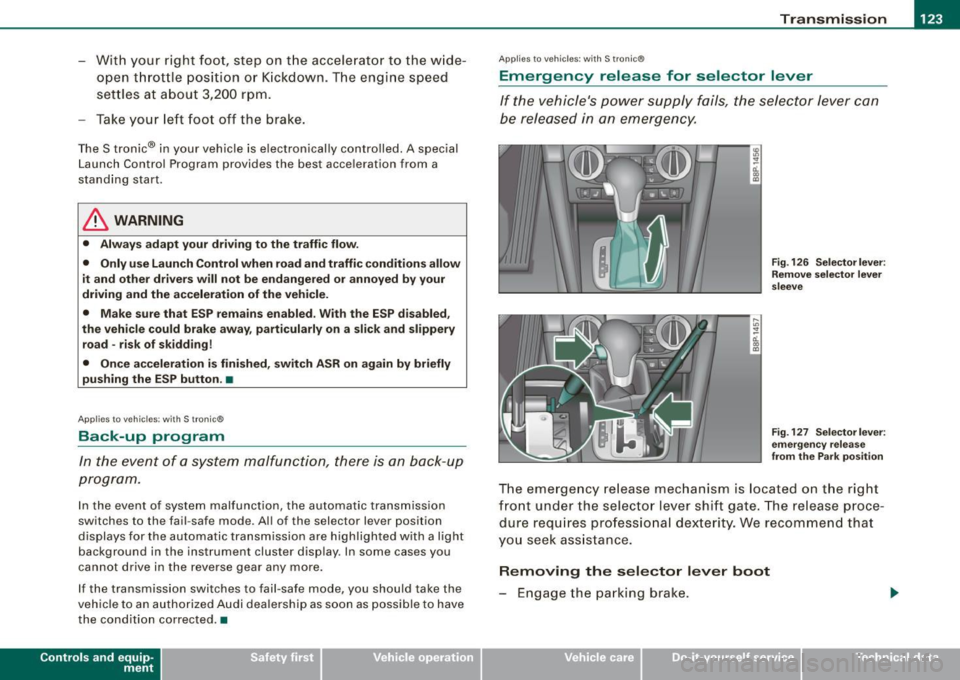
If the vehicle's power supply fails, the selector lever can
be released in an emergency.
~ ..
-ti. ., m
Fig. 126 Selector lever :
Remove selector lever
sleeve
Fig . 127 Selectorlever :
emergency release
from the Park position
The emergency release mechanism is located on the right
front under the selector lever shift gate. The release proce
dure requires professional dexterity. We recommend that
you seek assistance.
Removing the selector lever boot
- Engage the parking brake.
Vehicle care I I Technical data
Page 127 of 324

Transmission -
----------------
Controls and equip
ment I • •
Page 207 of 324
![AUDI S3 2009 User Guide [ i] Tips
• Do not tow a trailer during the break-in period of your vehicle.
• If you tow a trailer, your Audi may require more frequent mainte
nance due to the extr](/img/6/57546/w960_57546-206.png "AUDI S3 2009 User Guide [ i] Tips
• Do not tow a trailer during the break-in period of your vehicle.
• If you tow a trailer, your Audi may require more frequent mainte
nance due to the extr")
[ i] Tips
• Do not tow a trailer during the break-in period of your vehicle.
• If you tow a trailer, your Audi may require more frequent mainte
nance due to the extra load=>
page 304. •
Parking on a slope
-----------------
Do not park with a trailer on a slope. If it cannot be
avoided, do so only after doing the following:
When parking:
-Apply the foot brake.
- Have someone place chocks under both the vehicle and the trailer wheels .
- With chocks in place, slowly release the brakes until
wheel blocks absorb the load.
- Turn the wheels towards the curb.
- Apply the parking brake.
- Place an automatic transmission in
P, respectively a
manual transmission in first or reverse gear.
When restarting after parking:
- Start the engine.
- Shift transmission into gear.
- Release the parking brake and slowly pull out and away from the wheel blocks.
- Stop and have someone retrieve the wheel blocks.
Controls and equip
ment Safety first Vehicle operation
Trailer towing
[
i] Tips
If you move the selector lever of the automatic transmission to P
before applying the parking brake and before blocking the wheels,
you may have to use more force later to move the lever out of the
P
position .•
Vehicle care Do-it-yourself service Technical data
Page 219 of 324
_____________________________________________ C_ l_ e _ a_ n_ in--= g'--- a_n _d___, p_ r _o_ te_ c_t _io _ n __ fflllll
•
Safety belts
Only well-maintained safety belts work reliably when
needed.
- Keep belts clean.
- For cleaning, use a mild soap and water solution. Let
belts dry thoroughly and away from direct sunlight.
- Do not allow inertia reel safety belts to retract before
they are completely dry.
- Check the condition of your safety belts
regularly.
Heavily soiled safety belts may not retract properly.
& WARNING
Damaged safety belts can break in a crash .
• Anything that might damage your safety belts could mean that
you and your passengers would not be adequately protected in an
accident.
• Safety belt performance depends on correct installation. Never
remove belts from the vehicle to clean them .
• Do not use chemical cleaning agents, bleach or dyes. They have
corrosive properties which weaken the webbing.
• When cleaning your safety belts, inspect them for damage. If
you discover damage, see your authorized Audi dealer.
• Always read and heed all WARNINGS and other information
=:, page 206. •
Engine compartment
Be especially careful when cleaning the engine compart
ment.
Always switch off the ignition before cleaning the engine =:> &.
Plenum panel
Remove leaves from the plenum panel in front of the windshield
under the engine hood. This prevents the water drain holes from
becoming blocked, and it prevents debris from entering the vehicle
interior through the heating and ventilation ducts .
Corrosion protection
The engine compartment and transmission have been corrosion
protected at the factory.
Good anti-corrosion treatment is very important, particularly in the
winter. If the vehicle is frequently driven on salt treated roads, the
entire engine compartment and plenum panel should be thor
oughly cleaned at the end of winter and retreated to prevent salt
damage. At the same time, the underside of the vehicle should be
washed as well.
If the engine compartment is cleaned at any time with grease
removing solutions
3l, or if you have the engine washed , the anti
corrosion treatment is almost always removed as well . It is therefore
essential to have a long-lasting corrosion protection reapplied to all
surfaces, seams, joints and components in the engine compart
ment.
& WARNING
Be aware: The engine compartment of any motor vehicle is a
potentially hazardous area.
• Before working in the engine compartment, be sure to read the
information
=:> page 217 . .,,_
31 Use only the correct cleaning solutions. Never use gasoline or diesel fuel.
Vehicle care I t •
Page 227 of 324
Checking and filling -
--------------~-
•
Closing the engine hood
-Pull the hood dow n until the pressure fro m t he s trut is
r edu ce d .
- Let the hood
drop dow n and latch in p lace . Do not try to
pus h it shut ;
it ma y fail to enga ge => & .
& WARNING
A hood that is not completely latched could fly up and block your
view while driving.
• When you close the engine hood, check it to make sure the
safety catch has properly engaged. The hood should be flush with
the surrounding vehicle body parts .
• If you notice while driving that the hood is not secured prop
erly , stop at on ce and close it. •
Working in the engine compartment
B e e speci ally ca reful wh ene ver you work in th e e ng in e
co mpartmen t!
Whenever you must perform any work in the engine compartment ,
for example checking and filling different fluids , there is a ri sk of
injury , burns and accidents . To prevent personal injury always
observe the following WARNINGS . The engine compartment of any
vehicle is a hazardous area!
~ &
& WARNING
To help avoid injury , before you check anything under the hood :
• Turn off the engine.
• Remove the ignition key .
• Set the parking brake fully .
& WARNING (continued )
• Move selector lever of automatic transmission to "P" (Park) ;
put manual transmission in Neutral .
• Always let the engine cool down . Hot components will burn
skin on contact.
• To reduce the risk of being burned , never open the hood if you
see or hear steam or coolant escaping from the engine compart
ment . Wait until no steam or coolant can be seen or heard before
carefully opening the hood .
• Keep children away from the engine compartment .
• Never spill fluids on hot engine components . They can cause a
fire.
• Never touch the radiator fan. The auxiliary electric fan is
temperature controlled and can switch on suddenly.
• Never open the coolant reservoir cap when the engine is still
warm . The coolant system is pressurized and hot coolant could
spray out!
• Protect your face , hands and arm from steam or hot engine
coolant by placing a thick rag over the cap when you open the
coolant reservoir .
• If work on the fuel system or the electri cal system is necessary :
- Always disconnect the battery .
- Never smoke or work near heaters or open flames . Fluids in
the engine compartment could start a fire .
- Keep an approved fire extinguisher immediately available.
• To avoid electrical shock and personal injury while the engine
is running or being started , never touch :
- Ignition cables
- Other components of the high voltage electronic ignition
system .
• If you must perform a check or repair with the engine running : ..,
Vehicle care
I t •
Page 228 of 324
___ C_ h_ e _ c_k _in--= g'-- a_n _d_ f_il _li _n --=g==-- --------------------------------------------
& WARNING (continued )
-First, fully apply the park ing brake, move selector lever of
automatic transmission to "P " (Park ); put manual transmission
in Neutral.
- Alway s use extreme c aution to prevent clothing , jewel ry , or
long hair from gettin g caught in the radiator fan , V-belts or
other moving parts , or from contacting hot parts. Tie back hair
before starting , and do not wear clothing that will hang or
droop into the engine .
• Minimize exposure to emission and chemi cal hazard s
=> &.
& WARNING
Californ ia Proposition 65 Warning :
• Engine exhaust , some of its constituents , and certa in vehicle
component s contain or emit chemical s known to the State of Cali
fornia to cause cancer and birth defe cts and reproductive h arm . In
addition, certain fluid s contained in vehicles and certain products
of component wear contain or emit chem icals known to the State
of California to cause cancer and birth defects or other reproduc
tive harm.
• Battery posts , terminals and related ac cessories contain lead
and lead compounds , chem icals known to the State of California
to cause cancer and reproductive harms. Wash hand s after
handling .
0 Note
When adding fluids , always make sure that the y are pou red into the
proper conta iner or filler opening, otherw ise serious damage to
vehicle systems will occur .
<£' For the sake of the environment
To detect leaks in t ime , inspect the veh icle floor pan from unde r
neath regularly. If you see spots from oil or other veh ic le fluids, have
you r ve hicle i nsp ected by a n authori zed Audi dealer .•
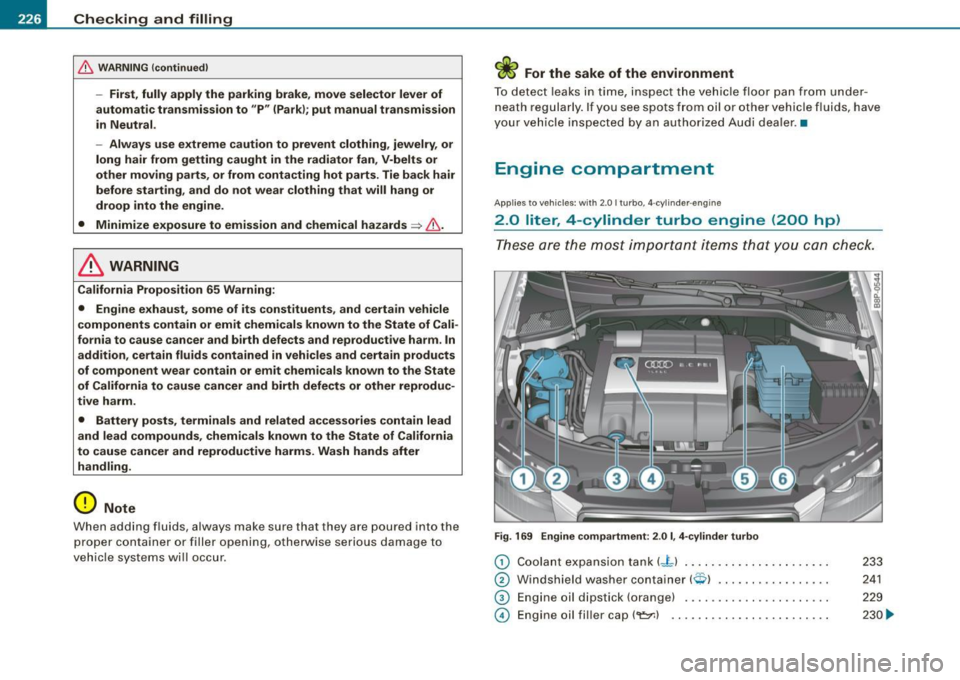
Engine compartment
A pp lies t o ve hicles: wit h 2.0 I tur bo, 4-cy linder •engi ne
2 .0 liter , 4 -cylinder turbo engine (200 hp )
These a re th e mo st imp ortan t items that you can check.
F ig . 169 Engine comp artment : 2.0 I , 4 -cylinder turbo
G) Coolant expans ion tank ( - f- ) ... .. .... ... .... ..... .
0 Windshie ld washe r con tainer ( Q ) .. ..... .... ..... .
© Engi ne oil dipstick (orange) .............. ... .... .
© Engin e oil filler cap ('e:r.) ............ ..... .... .. .
233
241
229
2 30 ..,,
Page 246 of 324
-~_T_ ir_e_ s_ a_ n_d _ w_ h_ e_e _l_s _________________________________________________ _
& WARNING (continued)
crashes and serious personal injuries . Have worn or damaged tires
replaced immediately.
• Tires age even if they are not being used and can fail suddenly,
especially at high speeds. Tires that are more than 6 years old can
only be used in an emergency and then with special care and at
low speed.
Glossary of tire and loading terminology
Accessory weight
means the combined weight (in excess of those standard items
which may be replaced) of automatic transmission, power steering,
power brakes, power windows, power seats, radio, and heater, to
the extent that these items are available as factory-installed equip
ment (whether installed or not).
Aspect ratio means the ratio of the height to the width of the tire in percent.
Numb ers of 55 or lower indicate a low sidewall for improved
steering response and better overall handling on dry pavement.
Bead
means the part of the tire that is made of steel wires, wrapped or reinforced by ply cords and that is shaped to fit the rim.
Bead separation means a breakdown of the bond between components in the bead.
Cord
means the strands forming the plies in the tire.
& WARNING (continued)
• Never mount used tires on your vehicle if you are not sure of
their "previous history." Old used tires may have been damaged
even though the damage cannot be seen that can lead to sudden
tire failure and loss of vehicle control.
• If you notice unusual vibration or if the vehicle pulls to one side
when driving, always stop as soon as it is safe to do so and check
the wheels and tires for damage . •
Cold tire inflation pressure
means the tire pressure recommended by the vehicle manufacturer
for a tire of a designated size that has not been driven for more than
a couple of miles (kilometers) at low speeds in the three hour period
before the tire pressure is measured or adjusted .
Curb weight means the weight of a motor vehicle with standard equipment
including the maximum capacity of fuel, oil, and coolant, air condi
tioning and additional weight of optional equipment.
Extra load tire
means a tire designed to operate at higher loads and at higher infla
tion pressures than the corresponding standard tire . Extra load tires
my be identified as "XL",
"xi", "EXTRA LOAD", or "RF" on the side
wall.
Gross Axle Weight Rating ("GAWR")
means the load-carrying capacity of a single axle system, measured
at the tire -ground interfaces .
Gross Vehicle Weight Rating ("GVWR"l
means the maximum total loaded weight of the vehicle.
Page 275 of 324
What do I do now? -__________________ __;__:....:....:..:: __ _
•
-All passengers should leave the car and move to a safe
location (for instance, behind the guardrail)~& .
- Apply the
parking brake firmly ~& .
- Move
selector lever to position Pon an automatic trans-
miss ion; put manual transmission in
first gear ~& .
-If you are towing a trailer : unhitch the trailer from your
vehicle.
- Take the
tool and the spare tire~ page 270 out of the
luggage compartment.
& WARNING
You or your passengers could be injured while changing a wheel if
you do not follow these safety precautions:
• If you have a flat tire, move a safe distance off the road. Turn off
the engine, turn the emergency flasher on and use other warning
devices to alert other motorists.
• Make sure that passengers wait
in a safe place away from the
vehicle and well away from the roadway and traffic.
• To help prevent the vehicle from moving suddenly and possibly
slipping off the jack, always fully set the parking brake and block
the wheel diagonally opposite the wheel being changed. When one
front wheel is lifted off the ground, placing the automatic trans
mission in "P" (Park), or engaging a gear in a manual transmission
will
not prevent the vehicle from moving.
• Before you change a wheel, be sure the ground is level and firm.
If necessary, use a sturdy board under the jack.
• After installing the spare wheel, make sure that you remount
the flat tire/wheel in its storage area properly and tighten the
knurled retaining screw securely. •
Changing a wheel
When you change a wheel, follow the sequence described
below step-by-step and exactly in that order.
1. Remove the decorative wheel cover*. For more details
see also
~ page 274, "Decorative wheel covers" or
~ page 275, "Wheels with cap-covered wheel bolts".
2. Loosen the
wheel bolts ~ page 276.
3. Locate the proper mounting point for the jack and align the jack below that point~
page 276.
4. Lift the car with the jack~ page 276.
5. Take the flat wheel off and then put the spare on
~ page 278.
6. Tighten all wheel bolts lightly .
7.
Lower the vehicle with the jack .
8. Use the wheel bolt wrench and
firmly tighten all wheel
bolts
~ page 276.
9. Put the decorative wheel cover* back on.
& WARNING
Always read and head all WARNINGS and information ::} & in
"Raising the vehicle" on
page 276 and ~ page 279. •
After changing a wheel
A wheel change is not complete without the following
actions.
- Store and secure the replaced wheel in the spare wheel
well. .,._
Do-it-yourself service
Page 284 of 324
11111.___F_ u_ s _ e_s _ a_n _ d_ b_ u_lb _ s _______________________________________________ _
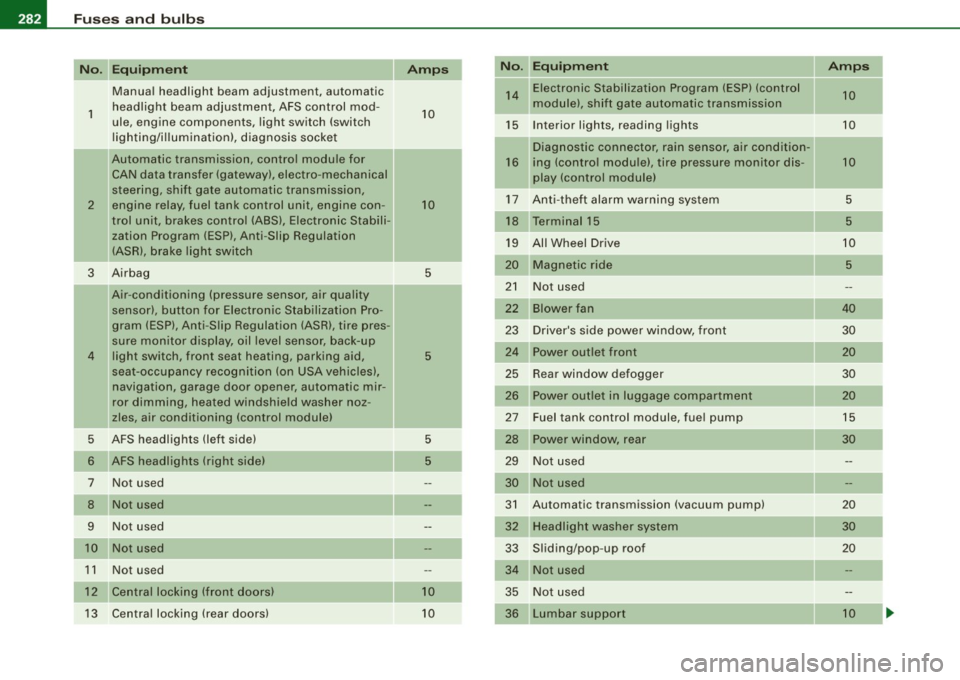
Equipment Amps No. Equipment Amps
Manual headlight beam adjustment, automatic 14 Electronic Stabilization Program (ESP) (control
10
1 headlight beam adjustment, AFS control mod-
10 module),
shift gate automatic transmission
ule, engine components, light switch (switch
15 Interior lights, reading lights 10
lighting/illumination), diagnosis socket
Diagnostic connector, rain sensor, a ir condit ion-
!! Automatic transmission, control module for
16 ing (control module), tire pressure monitor dis- 10
CAN data transfer (gateway), electro -mechanical
play (control module)
steering, shift gate automatic transmission, 17 Anti-theft alarm warning system 5
2 engine relay, fuel tank control unit, engine con
-10
trol unit, brakes control (ABS), Electronic Stabili- 18 Terminal 15
5
zation Program (ESP), Anti -Slip Regulation
19 All Wheel Drive
10
(ASR), brake light switch
-20 Magnetic ride 5
3 Airbag
5
-21 Not used
Air -conditioning (pressure sensor, air quality
sensor), button for Electronic Stabilization Pro- 22
Blower fan 40
gram (ESP), Anti -Slip Regulat ion (ASRl, tire pres -
23 Driver's side power window, front 30
sure mon itor display, oil level sensor, back-up
4 light switch, front seat heating, parking aid, 5 24 Power outlet front
20
seat-occupancy recognition (on USA vehicles), 25 Rear window defogger 30
navigation, garage door opener, automatic mir- 26 Power outlet in luggage compartment 20
ror dimming, heated windshield washer noz-
zles, air conditioning (control module) 27 Fuel tank control module, fuel pump 15
5 AFS headlights (left side)
5 28 Power
window, rear
30
6 AFS headlights (r ight side) 5 29 Not used
7 Not used 30 Not used
8 Not used 31 Automatic transmission (vacuum pump)
20
9 Not used 32 Headlight washer system 30
10 Not used
33 Sliding/pop-up roof
20
1 1 Not used 34 Not used
12 Central locking (front doors} 10 35 Not used
13 Central locking (rear doors) 10
36 Lumbar
support 10
Page 285 of 324
_________________________________________________ F_ u_ s_ e_s _ a_n _d_ b_ u _ lb_ s _ __.ffllll
No . Equipm ent
37 Heated seats, front
38 Passe nger s ide power window, front
39 Special function interface
Starter
41 Rear window wiper
42 Windshield wiper (washer pump)
43 Convenience electronics (control module)
44 Trailer control module
45 Trailer control module
Not used
47 Cell phone package (VOA interface)
48 Not used
49 Not used
Au tom atic cir cuit br eake rs: Amps
20
30
5
40
15
15
20
20
15
5
The electric power windows and the electric seat adjusters are protected with circuit breakers which reset automatically after the
circu it overload has been corrected.
[ i J Tip s
• Whenever replacing a fuse, always consult the sticker on the
inside of the fuse panel cover. It contains the most up-to-date infor
mation regarding the fuse arrangement. If in doubt, ask your autho
rized Audi Service advisor.
• Some of the equipment items listed are optiona l or on ly avail
able on certain model configurations. •
Fuse location , left side of engine
compartment
N M N
~ (X) 0)
Fig . 202 F use ass ign
m ent in th e e ngin e
co mpar tment in th e
e xampl e wit h
54 p lu g
in fu ses
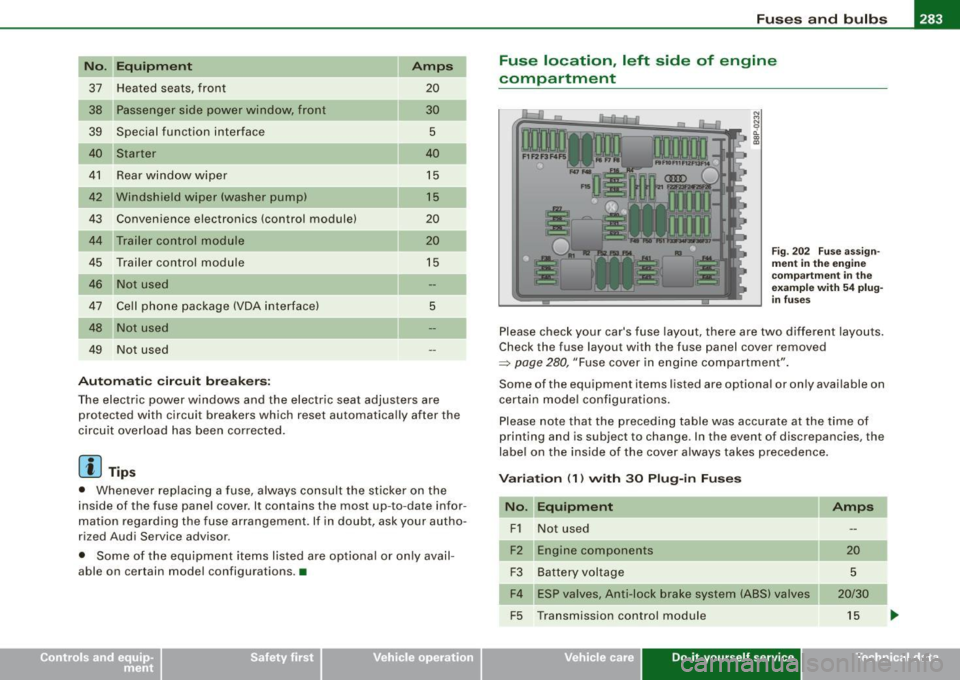
Please check your car's fuse layout, there are two different layouts.
Check the fuse layout with the fuse panel cover removed
~ page 280, "Fuse cover in engine compartment" .
Some of the equipment items listed are optional or on ly available on
certain model configurations.
Please note that the preceding table was accurate at the time of
printing and is subject to change . In the event of discrepancies, the
label on the inside of the cover a lways takes precedence.
V ariation (1 ) with 30 Plu g-in F uses
No . Equipm ent
F1 Not used
Engine components
F3 Battery voltage
F4 ESP v alves, Anti -lock brake system (ABS) valves
F5 Transmission control module
Vehicle care Do-it-yourself service
Amps
20
5
20/30
15
Technical data