transmission AUDI S3 2009 Owner's Manual
[x] Cancel search | Manufacturer: AUDI, Model Year: 2009, Model line: S3, Model: AUDI S3 2009Pages: 324, PDF Size: 76.02 MB
Page 286 of 324

IIJII Fuses and bulbs i,.__....;,___;:,,;_,;,,.:_;__;;:_.:.:..:..=-=;____ ______________________ _
No. UEquipment Amps I No. Equipment Amps
F6 Steering wheel electronics, instrument cluster
5 F28
Not used
F7 Transmission control module 30 Fuse assignment in the left-side instrument
F29 50
F8 Navigation system, radio system 15/25 panel (special equipment)
Navigation system, digital radio, cell phone, TV F30 Power supply relay terminal
15 50
F9 equipment 5
F10 Engine control module, main relay 5/10 Variation
(2) with 54 Plug-in Fuses
F11 Not used No. Equipment
Amps
Control module for CAN data transfer (gateway) 5 F1
Vehicle
electrical system control unit (right)
30
F13 Engine control module 15/25 F2
ESP valves, Anti
-lock brake system (ABS) valves
20/30
F14 Ignition coils 20 F3 Not used
F15 Tank diagnosis, oxygen sensor 5/10 F4
Battery voltage
5
F16 Vehicle electrical system control unit (right) 30 F5 Horn
15
F17 Horn
15 F6 Engine components, fuel pump 15
F18 Audio amplifier 30 F7
Not used
F19 Front windshield wiper system 30 F8
Not used
F20 Water return
-flow pump, volume regulator valve F9 Engine components
10
F21 Oxygen sensor, vacuum pump 15 F10
Fuel tank control, mass air flow sensor
10
F22 Clutch pedal switch, brake light switch 5 F11 Oxygen sensors, in front of catalytic converter 10
F23 Engine relays, engine components
5/10/15 F12 Oxygen sensors, behind catalytic converter
10
F24 Engine components, water return-flow pump 10 F13 Automatic transmission
15
F25 Pump (ESP/ABS), ABS valve 30/40 F14 Not used
F26 Vehicle electrical system control unit (left)
30 F15 Water return-flow pump
10
F27 Secondary air pump 40 F16 Volume control valve
20
F17 Steering wheel electronics, instrument cluster
5
F18 Audio amplifier 30
F19 Navigation system, radio system 15/25
Page 291 of 324
______________________________________________ E_ m_ e_r .;::g ;...e _ n_ c __,c. y_ s_it _u_ a_ ti_o _ n_ s _ __.ffllll
Use of jumper cables (4 cylinder
engine)
Make sure to connect the jumper cable clamps in exactly
the order described below!
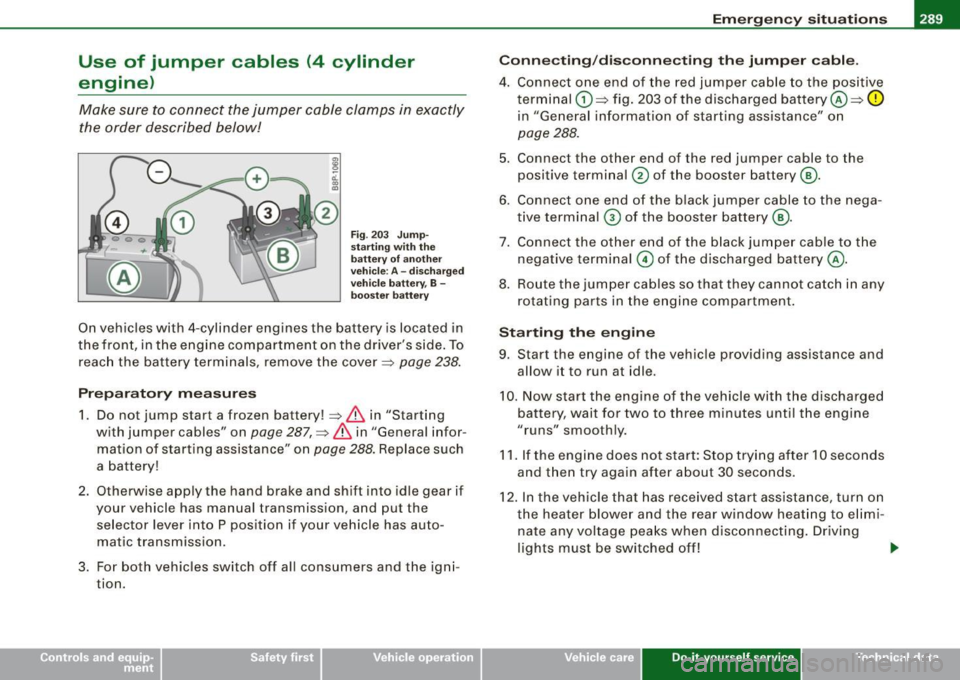
Fig . 203 Jump
starting with the
battery of another
vehicle: A -discharged
vehicle battery, B -
booster battery
On vehicles with 4-cylinder engines the battery is located in
the front, in the engine compartment on the driver's side. To
reach the battery terminals, remove the cover=>
page 238.
Preparatory measures
1. Do not jump start a frozen battery!=> & in "Starting
with jumper cables" on
page 287, => & in "General infor
mat ion of starting assistance" on
page 288. Replace such
a battery!
2. Otherwise apply the hand brake and shift into idle gear if your vehicle has manual transmission, and put the selector lever into P position if your vehicle has automatic transmission.
3. For both vehicles switch off all consumers and the igni
tion.
Connecting/disconnecting the jumper cable.
4. Connect one end of the red jumper cable to the positive
terminal
G) => fig. 203 of the discharged battery©=> 0
in "General information of starting assistance" on
page 288.
5. Connect the other end of the red jumper cable to the
positive terminal
@ of the booster battery ®·
6. Connect one end of the black jumper cable to the nega tive terminal
G) of the booster battery ®·
7. Connect the other end of the black jumper cable to the negative terminal
© of the discharged battery@.
8. Route the jumper cables so that they cannot catch in any
rotating parts in the engine compartment.
Starting the engine
9. Start the engine of the vehicle providing assistance and
allow it to run at idle.
10. Now start the engine of the vehicle with the discharged
battery, wait for two to three minutes until the engine
"runs " smoothly.
11. If the engine does not start: Stop trying after 10 seconds
and then try again after about 30 seconds.
12. In the vehicle that has received start assistance, turn on
the heater blower and the rear window heating to elimi nate any voltage peaks when disconnecting. Driving
lights must be switched off! ._
Vehicle care Do-it-yourself service irechnical data
Page 293 of 324
Emergency situations -____________________________ ___,::,:.___:_ ___ _
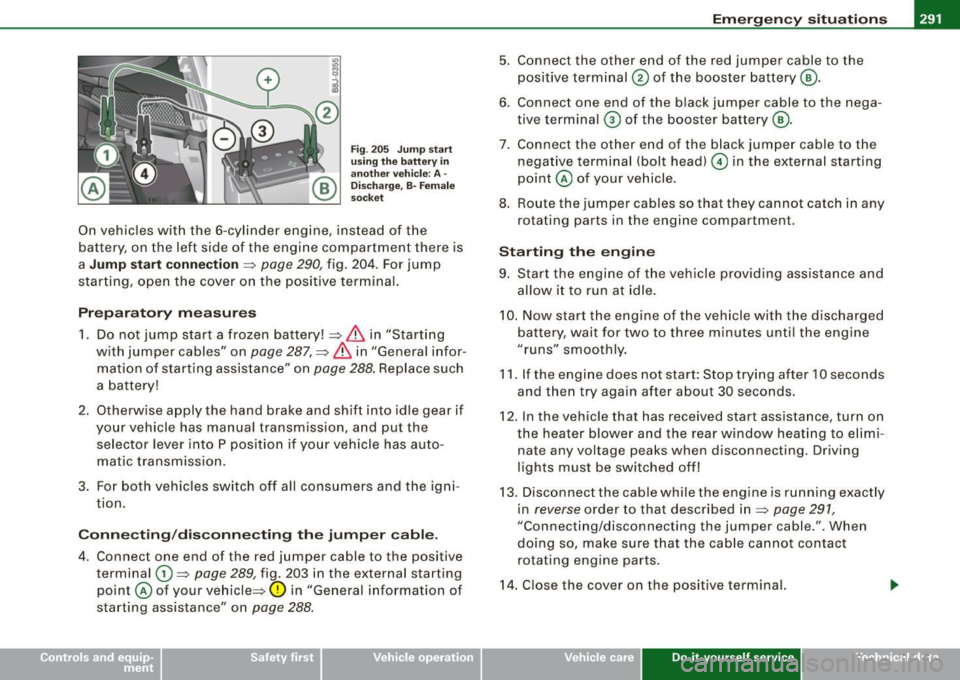
Fig. 205 Jump start
using the battery in
another vehicle: A -
Discharge, B- Female
socket
On vehicles with the 6-cylinder engine, instead of the
battery, on the left side of the engine compartment there is
a
Jump start connection => page 290, fig. 204. For jump
starting, open the cover on the positive terminal.
Preparatory measures
1. Do not jump start a frozen battery!=> & in "Starting
with jumper cables" on page
287, => & in "General infor
mation of starting assistance" on page
288. Replace such
a battery!
2. Otherwise apply the hand brake and shift into idle gear if
your vehicle has manual transmission, and put the selector lever into P position if your vehicle has auto
matic transmission.
3. For both vehicles switch off all consumers and the igni
tion.
Connecting/disconnecting the jumper cable.
4. Connect one end of the red jumper cable to the positive
terminal
G) => page 289, fig. 203 in the external starting
point @of your vehicle =>
0 in "General information of
starting assistance" on page
288.
5. Connect the other end of the red jumper cable to the
positive terminal
® of the booster battery @.
6. Connect one end of the black jumper cable to the nega tive terminal
0 of the booster battery @.
7. Connect the other end of the black jumper cable to the
negative terminal (bolt head)
© in the external starting
point @ of your vehicle.
8. Route the jumper cables so that they cannot catch in any
rotating parts in the engine compartment.
Starting the engine
9. Start the engine of the vehicle providing assistance and allow it to run at idle.
10. Now start the engine of the vehicle with the discharged battery, wait for two to three minutes until the engine
"runs" smoothly.
11. If the engine does not start: Stop trying after 10 seconds and then try again after about 30 seconds.
12. In the vehicle that has received start assistance, turn on the heater blower and the rear window heating to elimi
nate any voltage peaks when disconnecting. Driving
lights must be switched off!
13. Disconnect the cable while the engine is running exactly in reverse order to that described in=> page 291,
"Connecting/disconnecting the jumper cable .". When
doing so, make sure that the cable cannot contact
rotating engine parts.
14. Close the cover on the positive term inal. .,_
Vehicle care Do-it-yourself service irechnical data
Page 294 of 324
-L~E=m~e::,r~g~e~n~c::.y!'....:s~i:,.::t~u=.,::a:=.:t:!i.:::o:.:.n.:.:s~ ---------------------------------------------
15. Turn the hea ter blowe r and th e rear wind ow heat er off
aga in.
The battery is ve nted to the outs ide to preve nt gases from e nter ing
the veh icle interior.
M ake sure tha t th e jum per c lamps are well co nnected w ith their
metal parts in full contact with the battery terminals .
& WARNING
To avoid serious personal injury and damage to the vehicle , heed
all warnings and instructions of the jumper cable manufacturer. If
in doubt , call for road service .
• Jumper cables must be long enough so that the vehicles do not
tou ch .
• When connecting jumper cables , make sure that they cannot
get caught in any moving parts in the engine compa rtment .
• Before you check anything in the engine compartment , always
read and heed all WARNINGS=>
page 217, "Engine compartment ".
0 Note
Improperly connected jumper cab les can damage or destroy the
ge nerator.
• Always connec t POSI TIVE (+) to P OSITIV E(+), and NEGATIVE (-l to
N EGA TIVE( -) te rmi nal.
• Chec k th at a ll screw plugs o n the ba ttery cel ls are screwe d in
fi rm ly. If not, t ighten plu gs prio r to connect ing cla mp on neg ative
batte ry te rmina l.
• Please note that the procedure for connecting a jumper cab le as
de scribed abo ve applies specifical ly to the case of y our vehicle
being ju mp s tarted. W hen you ar e giving a jump start to anoth er
vehic le, do
not connect the mi nus( -) ca ble to the m inus( -) te rmina l
on the disc ha rged battery ©=>
page 28 9, fi g. 203. Ins tead, secu re ly
connect the minus( -) cable to either a massive metal component that is firm
ly bolted to the engine b lock or to the engine block itself.
I f t he b att ery t hat is bei ng c harge d does not vent t o th e ou ts id e,
escap ing battery gas cou ld ignite and explode !
[ i ] Tips
In the Aud i A3 with the 6 -cy linder engine, the battery is located
b el ow the luggage c ompartmen t fl oor, pro tec ted by a me ta l sh rou d.
Access requ ires pro fess io na l skill and special tools. •
Emergency towing with commercial
tow truck
General hints
You r Audi req uir es s pec ial ha ndl ing fo r t owin g.
T he fo llo wi ng infor matio n is to b e used by com merc ial tow t ru ck
operators who know how to operate the ir equ ipment safe ly.
• Never tow your Audi , towing will cause damage to the engine
and transmission .
• Never wrap the safety chains or winch cables around the brake
lines .
• To prevent unnecessary damage, your Audi must be transported
with a car carrier (flat bed truck) .
• To load the vehicle on to the flat bed , use the towing loop found
in the vehicle tools and attach to the front or rear anchorage
=> p ag e 293 and => page 293.
& WARNING
A vehicle being towed is not safe for passengers. Never allow
anyone to ride in a vehicle being towed , for any reason . •
Page 297 of 324
________________________________________________ E_ m_ e_r .::g :...e_ n _ c_,y'-- s_ i_t _u _a_ t_ i_o _n_ s _---JIIII
Lifting the vehicle
Important safety precautions
Be aware of the following hazards before lifting the vehicle with a
workshop hoist or floor jack:
• The vehicle should never be lifted or jacked up from underneath
the engine oil pan, the transmission housing, the front or rear axle
or the body side members. This could lead to serious damage.
• Use lifting equipment with padded contact surfaces to avoid
damage to the underbody or chassis frame.
• Alternatively, cover the contact surfaces on workshop hoist or
floor jack with rubber pads before lifting .
• Before driving over a workshop hoist, check that the vehicle
weight does not exceed the permissible lifting capacity of the hoist .
• Before driving over a workshop hoist, ensure that there is suffi
cient clearance between the hoist and low parts of the vehicle .
& WARNING
To reduce the risk of serious injury and vehicle damage:
• Always lift the vehicle only at the special workshop hoist and
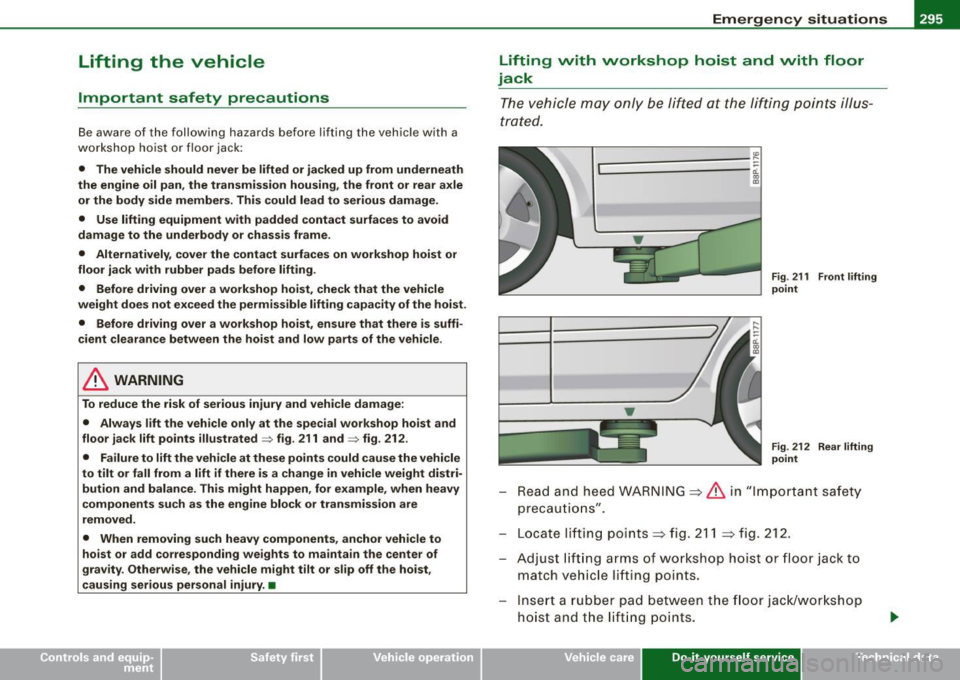
floor jack lift points illustrated=> fig. 211 and=> fig. 212 .
• Failure to lift the vehicle at these points could cause the vehicle
to tilt or fall from a lift if there is a change in vehicle weight distri
bution and balance. This might happen, for example, when heavy
components such as the engine block or transmission are
removed .
• When removing such heavy components, anchor vehicle to
hoist or add corresponding weights to maintain the center of
gravity . Otherwise , the vehicle might tilt or slip off the hoist,
causing serious personal injury. •
Lifting with workshop hoist and with floor
jack
The vehicle may only be lifted at the lifting points illus
trated.
.... L===========::::==:: ~ 0:.
Fig . 211 Front lifting
point
Fig . 212 Rear lifting
point
Read and heed WARNING~ & in "Important safety
precautions ".
Locate lifting points~ fig. 211
~ fig. 212.
Adjust lift ing arms of workshop hoist or floor jack to
match vehicle lifting points.
Inse rt a rubber pad between the floor jack/workshop
hoist and the lifting points.
Vehicle care Do-it-yourself service irechnical data
Page 298 of 324
11111.___E_ m _ e _r-==g :...e_ n_ c...:y _ s_ i_t _u _a _t_ i_o _n_ s _______________________________________________ _
If you mu st lift your veh icle with a floor jack to work underneath , be
sure the vehicle is safely supported on stands intended for this
purpose .
Front lifting point
T he lifting point is located on the floor pan reinforcement about at
t he same leve l as t he jac k mou nti ng poi nt=>
pag e 295, fig. 2 11. Do
not lift the vehicle at the vertical sill reinforcement .
Rear lifting point
T he lifting point is located on the vertical reinforcement of the lower
sill for the o n board jack=>
page 295, fi g. 212 .
Lifting with vehicle jack
Refe r to=> page 276.
0 Note
• Be aware of the fo llo wi ng po ints before l ifting t he ve hicle :
- The vehicle should never be lifted or jacked up from under
neath the engine oil pan , the transmission housing , the front or
rear axle or the body side members . This could lead to serious
damage.
- To avoid damage to the underbody or chassis frame , a rubber
pad must be inserted between the floor jack and the lift points .
- Before driving over a workshop hoist, check that the vehi cle
weight does not exceed the permissible lifting capacity of the
hoist .
- Before driving over a workshop hoist , ensure that there is
sufficient clearance between the hoist and low parts of the
vehicle. •
Page 300 of 324
___ G_ e_ n_ e_r_ a _ l_ in_ f_ o _r_m _ a_ t_ i_ o _ n __________________________________________________ _
General information
Explanation of technical data
Some of the technical data listed in this manual requires
further explanation.
The technical data for your vehicle is listed in the charts starting on
~ page 300. This section provides general information, notes and
restrictions which apply to this data. •
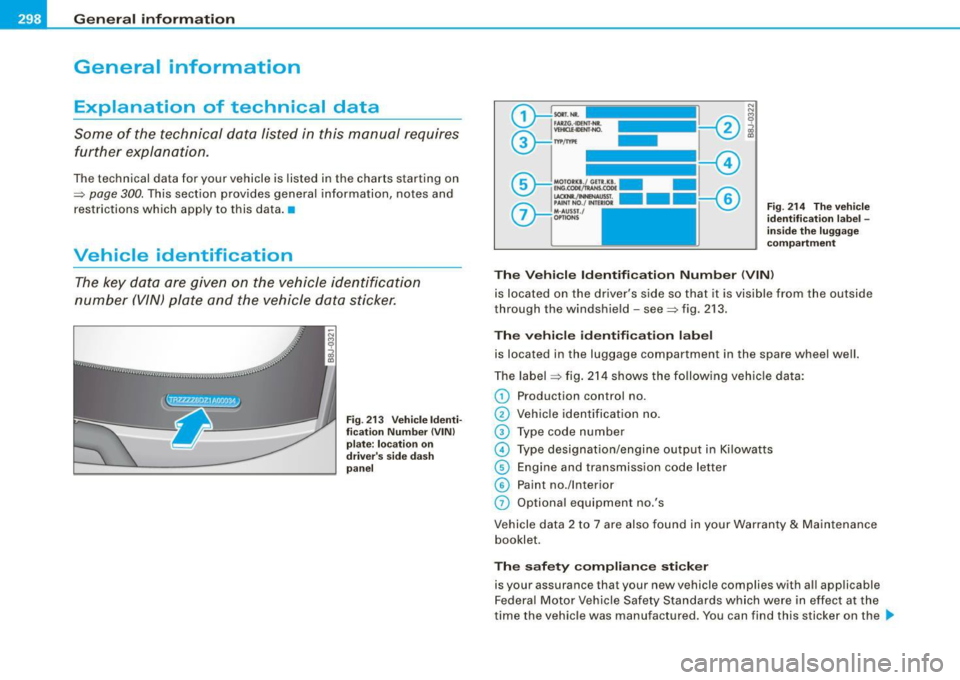
Vehicle identification
The key data are given on the vehicle identification
number (VIN) plate and the vehicle data sticker.
Fig. 213 Vehicle Identi
fication Number (VIN)
plate: location on
driver's side dash
panel Fig
. 214 The vehicle
identification label -
inside the luggage
compartment
The Vehicle Identification Number (VIN)
is located on the driver's side so that it is visible from the outside
through the windshield -see ~ fig. 213.
The vehicle identification label
is located in the luggage compartment in the spare wheel well.
The label ~ fig. 214 shows the following vehicle data:
© Production control no.
0 Vehicle identification no.
© Type code number
© Type designation/engine output in Kilowatts
© Engine and transmission code letter
© Paint no./lnterior
0 Optional equipment no.'s
Vehicle data 2 to 7 are also found in your Warranty
& Maintenance
booklet .
The safety compliance sticker
is your assurance that your new vehicle complies with all applicable
Federal Motor Vehicle Safety Standards which were in effect at the
time the vehicle was manufactured. You can find this sticker on the ._
Page 307 of 324
------------------------------------------------=C :..:o=. n :..:..: s:..:u::.: m:...:..:. e::.:.. r..:l~ n .:..:f:..: o:.: r :..:m~ a::.:. ti:.:o::. n:....:__ _11111
& WA RNIN G (continu ed )
• Alway s be extremely careful when working on the v ehicle .
Alway s follo w commonly accepted safety pr actice s and general
c ommon sen se . Never risk per sonal inju ry .
• Do n ot attempt any of the m aint enance , check s or rep air s
de scribed on the following pages if you are not fully famili ar with
the se or othe r procedures with respect to the vehicle , or are u ncer
t a in ho w to pro ceed .
• Do not do any work w ithout the proper tool s and equipment .
Have the necessary work done by your authorized Audi de aler or
anothe r properly equipped and qual ified work shop .
• The engine compartment of any motor vehicle i s a potentially
h azardou s are a. Ne ver rea ch into the are a around or touch the
radiator fan. It is te mperature controlled and can switch on
s uddenly · even when the engine is off and the ignition key has
been remo ved . The radi ator fan switches on automat icall y when
the coolant reaches a certain temperature and will continue to run
until the coolant t emper ature drops .
• Alway s remo ve the ignition key befor e anyone get s under the
v ehi cle .
• Alway s support your vehicle with safety sta nd s if it i s nece s
sary to work underneath the vehicle . The ja ck supplied with the
vehi cle is not adequate for this p urpo se a nd co uld coll apse
c au sing ser iou s person al in jur y.
• If you m ust w ork under neath the vehi cle with the wheel s on
the ground , alway s make sure the vehicle is on lev el ground , that
the wheels are alway s secu rel y blocked and that the engine
c annot be started .
• Alway s make sure the t ran sm iss ion selector lever (automat ic
tran smi ssion ) is in "P " (Park position ) (automati c transmis sion) or
Neutr al ( ma nual transmission ) and the h and brake i s firmly
appli ed .
Controls and equip ment Safety first Vehicle operation
<£' For the sake of the environment
•
Changing the engine settings will adverse ly affect em ission
levels. This is detrimental to the environment and increases fuel
consu mption.
• Always observe environmenta l regulations when disposing of
old engine oil, used brake fluid, d irty engine coolant, spent batteries
or worn out tires .
• Undeployed airbag modules and pretensioners might be classi
fied as Perch lorate Material -special handling may apply, see
www.dtsc.ca.gov/hazardouswaste/perchlo rate. When the vehicle or
parts of the restraint system including airbag modules safety be lts
with pretensioners are scrapped, a ll applicable laws and regu la
tions must be observed. Your authorized Audi dealer is familiar with
these requirements and we recommend that you have your dea ler
perform this service for you. •
Additional accessories,
modifications and parts replacement
Additional accessories and parts
replacement
Al ways consult an authorized Au di de aler befo re
purchasing accessories.
Your vehicle incorporates the latest safety design features ensuring
a high standard of act ive and passive sa fety.
This safety could be compromised by non -approved changes to the
vehic le . Fo r th is reason, if par ts have t o be re p laced, please observe
the fo llowing points when insta lling additional accessories:
Approved Audi accessories and genuine Audi parts are available
from autho rized Audi dealers . .,_
Vehicle care Do-it-yourself service Tec hn ica l da ta
Page 311 of 324
______________________________________________ A_ l_,_ p _h_ a_ b_e _t_i c_ a _ l _in _ d_e _ x __ lll
Asterisk
What does it mean when something is marked with an asterisk? ... .. .. .. .. 5
Audi magnet ic ride .. .... .... ..... 12, 115
Description ...................... 115
Ind icator light .. ...... .... .... .... . 12
Audi parking system ................. 112
Audi Service Repair Manuals and Literature 303
AUTO Climate controls ...... .... ... .... . 101
Switching on .................... 101
When should I use AU TO? . ....... . 10 1
Au to Safety Ho tline ... .. .... .... .... . 135
Automatic air recircu lation ........... 102
A utomatic belt retracto r ...... .... .... 1 41
Automa tic car wash
See Washing ...... .... ... .. .. .... 207
Automatic headlight control ....... .... 53
Automat ic headlights
defective ... .. .... .... ... .... .... . 34
Automat ic Transmission
Au tomatic Transmission . ...... .... 120
Automatic transmission . ............. 117
Driving Notes . . . . . . . . . . . . . . . . . . . . 119
Emergency program . ........... .. 123
Emergency release . . . . . . . . . . . . . . . 123
I gn ition key safety lock ....... .... . 108
Kick-down ... .... .... .... ... .... . 122
L aunch Co ntrol Program ...... ..... 122
Se lector lever lock .. ...... ...... .. 1 18
Se lecto r lever posi tions .. ...... ... 11 7
Controls and equip
ment Safety first
T
iptronic ... .... . .. .. ... ... .. .... 121
Tiptronic controls on the steering whee l
122
Average fuel mileage ................ . 22
Average speed ... .... ..... ... .... ... . 22
Avo id damagi ng the v ehicle ...... .... . 199
B
Battery ... .. .... ... .... .... .... .... 236
charg ing (4-cy lind er engine) . ....... 240
c harging (6 -cy li n der engine) ... ..... 241
Disconnecting and c onnecting .. ... 237
I mpo rtant warnings when working on the
battery . .... .... .... .... .... ... 238
Replaci ng the battery .. ... .... .... 237
Winter operation ... .. .... .... .... 237
Working on the battery .. ...... .... 238
Battery voltage ...................... 33
Before driving . ....... .. .... .... .... 127
Bi -Xenon headlights .. ........ .... ... . 58
Blended gasoline . ... ... ..... .... .... 219
Body cavity sealing ...... ...... ... .. . 212
Booster seats .... .... .... .... .... ... 177
How do I properly install a booster seat i n
my vehicle? .. ... .... .... .... ... 177
Safety instructions ................ 177
Brake assistan t ..... .... .... .... .... 195
Brake booster .......... ...... ..... .. 194
Brake fluid Changing the brake fluid .. ........ 236
Checking the brake fluid leve l .. .... 235
Reservoir ........................ 235 What is
the correct brake fluid leve l? 235
What should I do if the brake fluid warning
light c omes on? ... .. .... .... .... 235
Brake pads ... ... .... ....... .... ... . 198
Brake system ....................... 235
Anti -lock brake system (ABS) .. .... .. 16
Brake fluid ....................... 235
Brake f luid specifications for refi ll and
r eplacement ... .. .... .... ...... . 236
Brake light defective . ........ .... .. 33
General information .. .... .... .... 193
How does moisture or road salt affect the
b rakes? .. ............... .... ... 193
Ma lfunct io n . .... .... .... .... ..... 30
Warning/indica tor lights .... .... .... 15
Worn brake pads symbo l ...... .... . 32
Break -in period ...... .... .... .... ... 197
Brake pads ....... ........ ....... 198
Tires ... .. .... .... .... ... .... .... 197
Bu lbs .... .... .... .... ... ....... .... 285
C
California Proposition 65 Warning . .... 226
Battery specific ...... ... .. ... ..... 239
Capac it ies . .... ... ... .... ... .... .... 300
Car care . .... ........ ....... .... .... 206
In ter ior . ...... .... .... ... .... .... 213
P last ic a nd vinyl . ...... .... .... ... 210
Weatherstrips ... .. .... ...... ... .. 211
Care of exterior .... ... .. .... .... .... 206
Ca rgo area
See Loading the luggage compartment
133
Vehicle operation Vehicle care Do-it-yourself service Technical data
Page 316 of 324
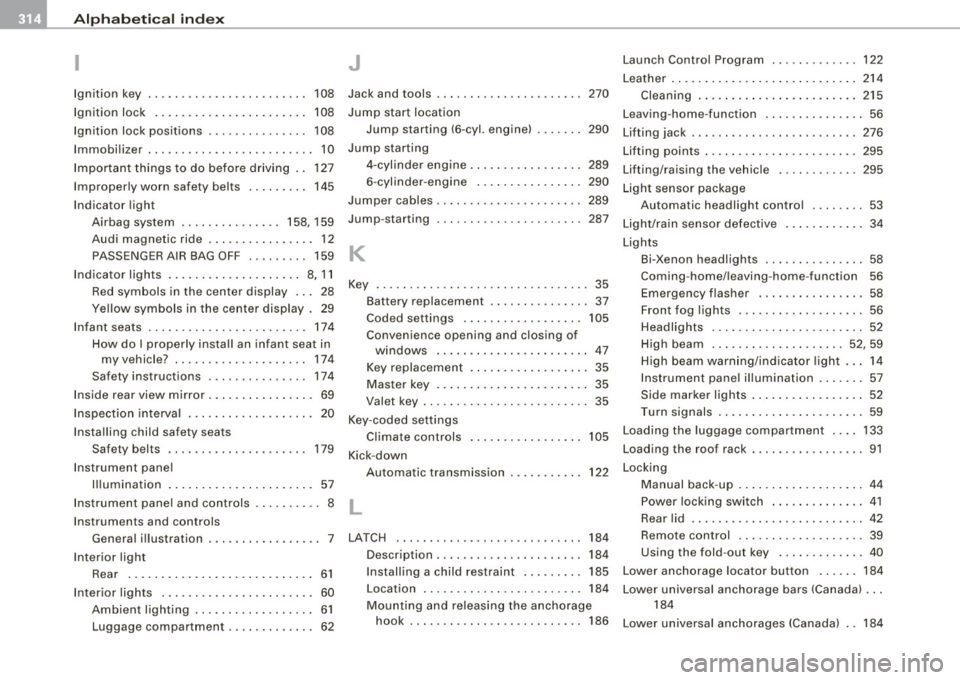
___ A_l.:,. p _h_ a_ b_e _t _ic _ a_l _in _ d_e _x ____________________________________________ _
I
Ignition key 108
Ignition lock ...... ...... .... ...... . 108
Ignition lock posit ions ............... 108
Immobilizer .. .... .... ....... .... .... 10
Important things to do before driving . . 127
Im properly worn safety belts . . . . . . . . . 145
Indicator light
Airbag system . . . . . . . . . . . . . . . 158 , 159
Audi magnetic ride ................ 12
PASSENGER AIR BAG OFF ......... 159
Indicator lights ........... ...... ... 8, 11
Red symbols in the center display . .. 28
Ye llow symbols in the center display . 29
lnfantseats . ........... .... .... .... 174
How do I properly install an infant seat in
my vehicle? .................... 174
Safety instructions ............... 174
Inside rear view mirror .... ... .... ..... 69
Inspection interval ................... 20
Installing child safety seats Safety belts . . . . . . . . . . . . . . . . . . . . . 179
Instrument pane l
I llum ination ........ ... .. .... .... . 57
Instrument pane l and controls .......... 8
Instruments and controls General illustration ........... .... .. 7
Interior light
Rear ................. ........ ... 61
Interior lights ....... ........... .... . 60
Ambient lighting .................. 61
Luggage compartment ............. 62
J
Jack and tools ...................... 270
Jump start location Jump starting (6 -cyl. engine) ....... 290
Jump starting 4-cylinder engine ...... .... .... ... 289
6 -cylinder -engine .... .... ... .. ... 290
Jumper cables .... .... .... .... .... .. 289
Jump -starting 287
K
Key ......... ............ .... ... .... 35
Battery replacement . . . . . . . . . . . . . . . 37
Coded settings .................. 105
Convenience opening and closing of
windows .......... ...... .... ... 47
Key replacement . . . . . . . . . . . . . . . . . . 35
Master key . . . . . . . . . . . . . . . . . . . . . . . 35
Valet key . . . . . . . . . . . . . . . . . . . . . . . . . 35
Key-coded settings Climate controls ...... .... ..... .. 105
Kick-down Automatic transmission 122
L
LATCH 184
Description .......... .......... .. 184
Installing a child restraint ...... ... 185
Location . . . . . . . . . . . . . . . . . . . . . . . . 184
Mounting and releasing the anchorage
hook ...... ............... ..... 186 Launch
Control Program ...... .... ... 122
Leather ...... .... .... .... ...... ... . 214
Cleaning ..................... ... 215
Leaving-home-function .... ... .... .... 56
Lifting jack ... .... .... .... ... .... ... 276
Lifting points ... .. .... .... .... .... .. 295
Lifting/raising the vehicle . ... ... .... . 295
Light sensor package
Automatic headlight control ........ 53
Light/rain sensor defective .. ...... .... 34
Lights Bi-Xenon headlights ....... .... .... 58
Coming-home/ leaving-home-function 56
Emergency flasher .... ........ .... 58
Front fog lights ................... 56
Headlights .... .... ....... .... .... 52
High beam ..... .. .... .... ..... 52, 59
High beam warning/indicator light .. . 14
Instrument panel illumination . ...... 57
Side marker lights ...... ........... 52
Turn signals . ...... .... ...... ... .. 59
Loading the luggage compartment .... 133
Loading the roof rack . ............ .... 9 1
Locking Manual back-up .. ............. .... 44
Power locking switch ...... .... .... 41
Rear lid ..... ...... .... ........... 42
Remote control ................... 39
Using the fold -out key ............. 40
Lower anchorage locator button ...... 184
Lower universal anchorage bars (Canada) ...
184
Lower universal anchorages (Canada) .. 184