wheel AUDI S3 2009 User Guide
[x] Cancel search | Manufacturer: AUDI, Model Year: 2009, Model line: S3, Model: AUDI S3 2009Pages: 324, PDF Size: 76.02 MB
Page 78 of 324
Seats and storage
Applies to vehicles : w ith m anual seat a djustm en t
Adjusting the manual seats
Po sition, angle and shape of the manual seats can be
adjusted to provide safe and comfortable seating.
Reed and heed all WARNINGS =:> & before you adjust your
seat.
Moving the front seats forward or backward
- Li ft the lever =:>
page 75, fig. 73 (D and slide the seat to
the desired p osition.
- Release the lever and then move the seat further until
you feel and hear it engage.
Adjusting the seat height
- Pull the lever @ up and pump it to raise the seat.
-Push the lever down and pump it to lower the seat .
Adjusting the seatback angle
- Lean forward to take your weight off the seatback.
- Turn the hand wheel© in the direction you want the
seatback to tilt.
& WARNING
• Never adjust the driver's or front passenger's seat while the
vehicle is moving . If you do this while the vehicle is moving , you
will be out of position . Always adjust the driver's or front
passenger's seat when the vehicle is not moving .
• Be careful when adjusting the seat height . Check to see that no
one is in the way, or serious injury could result!
& WARNING (continued)
• To reduce the risk of injury in the case of sudden braking or
accident, front passengers must never ride in a moving vehicle
with the seatback reclined. Safety belts and the airbag system
only offer maximum protection when the seatback is upright and
the safety belts are properly positioned on the body . The more the
seatback is reclined, the greater the risk of personal injury from an
incorrect seating position and improperly positioned safety
belts! •
Adjusting the power seat
Applies to vehi cles : wi th p ow er dr iv e r s eat
Adjustment switches
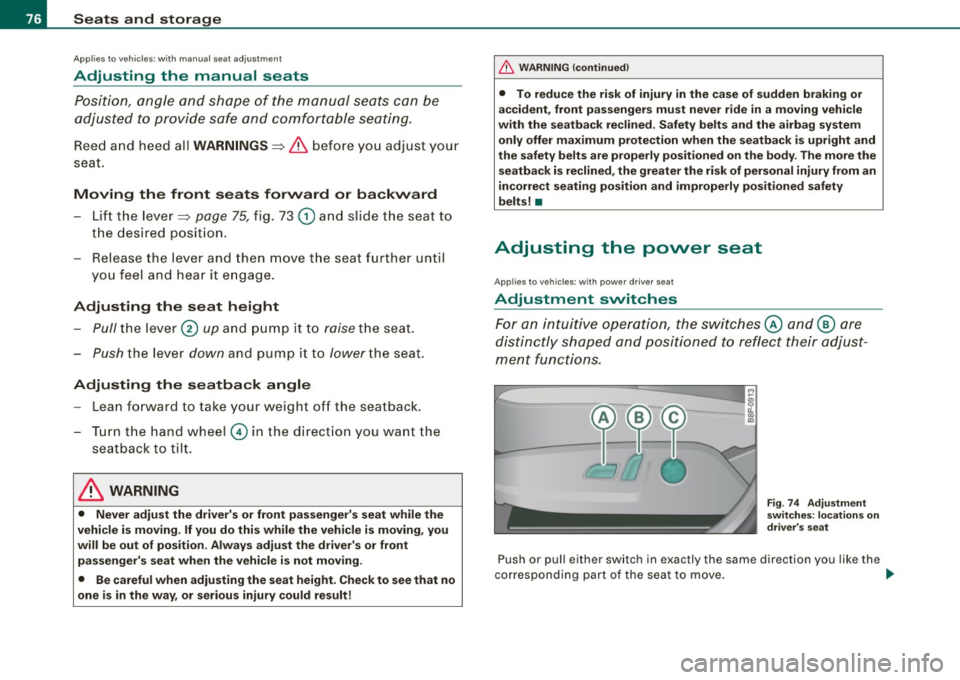
For an intuitive operation, the switches @ and @ are
distinctly shaped and posi tioned to reflect their adjust
ment functions.
Fig . 7 4 Adjustment
switches: locations on
driver's seat
Push or pul l either switch in exactly the same direction you like the
co rresponding part of the seat to move. .,,
Page 106 of 324
![AUDI S3 2009 User Guide • ..__w_ a_ r_m _ a_ n_d_ c_ o_ ld __________________________________________________ _
Air d ir ected to the dri ver/ front passe nger[~]
All the air is directed to outlets @, G) and Â](/img/6/57546/w960_57546-105.png "AUDI S3 2009 User Guide • ..__w_ a_ r_m _ a_ n_d_ c_ o_ ld __________________________________________________ _
Air d ir ected to the dri ver/ front passe nger[~]
All the air is directed to outlets @, G) and Â")
• ..__w_ a_ r_m _ a_ n_d_ c_ o_ ld __________________________________________________ _
Air d ir ected to the dri ver/ front passe nger[~]
All the air is directed to outlets @, G) and © in the instrument
panel. Air also is directed through the center console in the rear.
Air dir ected to th e footw ells ~
All the air is directed to outlets © and to the outlets under the front
seats .•
Air outlets
, _ ,
,~
---- 1
'
Fig . 10 9 Instr ume nt pan el: a ir out let loca tio ns a nd airfl ow direc tions
T he air out lets G) and 0 on top of t he instrument pane l are
fixed . Outlets 0 and 0 can be adjusted .
Adjusting air outlets 0 and 0
- Turn the vertical thumbwheel beside the outlet to
increase, reduce or shut down t he airflow from that
outle t. - Move t
he smal l tab in the center of the o utlet lo uver side
ways and up or dow n to ad just the level an d direc tion of
airflow.
The supply of air to the outlets is controlled either automatically or manually depending on the operation mode selected . The airflow
from al l outlets can be hea ted, unheated or cooled.
The heater out lets for the rear footwells are located under the front
seats. When you select outlets©, air is also directed to the rear
footwells.
[ i ] Tips
• When defrosting/defogging the windows, air flows from outlets
G), ® and G). To defrost or defog the windows as rapidly as
possible, air out lets
G) should be opened fully with the adjuster
whee ls.
• When the air conditioner is working, cooled air wi ll flow primarily
from outlets ®·
G) and ©-To assure adequate cooling, out lets G)
and © should never be completely closed. •
Using the climate controls economically
Using the climate controls prudently can help save fuel.
When you use the air conditioner, engine power is reduced
and fuel consumption increases. To save fuel, you should
use the a ir conditioner only when necessary . Also please
note the following points:
- If you want to save fuel, sw itch off the air conditioner.
- If you are going to drive w ith the wi ndows open, switc h
off the a ir condit io n er.
~
Page 108 of 324
• .___w __ a _r _m _ a _n_d_ c_ o _ ld __________________________________________________ _
-Roll the th umbwheel G) (driver's seat) or@ (front
passenger's seat) f rom posit io n
(0 ) upward in order to
activate the heating elements.
- Selec t the desired temperature setting from positions 1
thro ugh 6 .
When the heating element is activated, the numbers on the thumb
whee l wil l il luminate.
0 Note
To prevent possible damage to the heating elements, do not knee l
on the seats or apply a heavy load to relative ly sma ll areas of the
seat. •
Page 109 of 324
___________________________________________________ O_ n_ t_h _e_ r_o _a_ d _ ___._
On the road
Steering
Adjusting the steering wheel column
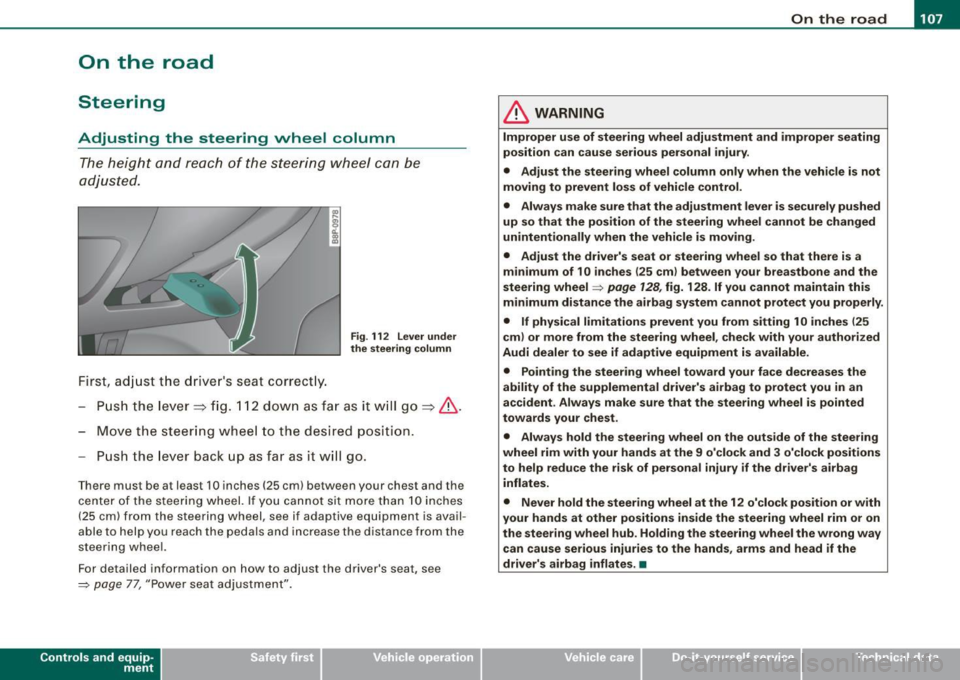
The heigh t an d reac h of th e ste er ing wheel can b e
adjusted .
Fir st, adju st the dr iver 's se at corre ctly.
Fig . 112 Lever under
the steering column
- Push t he leve r~ fig. 112 down as far as it will go~& .
- Move the steering w heel to the desi red po sitio n.
Pu sh t he lever back up as f ar as it will g o.
The re m ust be at least 1 0 inches ( 25 cm) between your chest and the
c e nt er of t he stee ring wh eel. If you c ann ot si t mo re than 1 0 inche s
( 25 cm) from the stee rin g w hee l, see if adaptiv e equi pment is ava il
abl e to h elp you r each th e peda ls a nd incr ease the distanc e from th e
st eerin g whe el.
Fo r deta ile d informat ion o n how to a djust the drive r's seat, see
=> p age 77 , "Po wer seat ad ju stm ent".
Con tro ls and eq uip
ment
& WARNING
Improper use of steering wheel adjustment and improper seating
position can cause serious personal injury .
• Adjust the steering wheel column only when the vehicle is not
moving to prevent loss of vehicle control .
• Always make sure that the adjustment lever is securely pushed
up so that the position of the steering wheel cannot be changed
unintentionally when the vehicle is moving .
• Adjust the driver's seat or steering wheel so that there is a
minimum of 10 inches {25 cm ) between your breastbone and the
steering wheel=>
page 128 , fig. 128. If you cannot maintain this
minimum distance the airbag system cannot protect you properly.
• If physical limitations prevent you from sitting 10 inches (25
cm) or more from the steering wheel, check with your authorized
Audi dealer to see if adaptive equipment is available.
• Pointing the steering wheel toward your face decreases the
ability of the supplemental driver's airbag to protect you
in an
accident . Always make sure that the steering wheel is pointed
towards your chest.
• Always hold the steering wheel on the outside of the steering
wheel rim with your hands at the 9 o'clock and 3 o'clock positions
to help reduce the risk of personal injury if the driver's airbag
inflates.
• Never hold the steering wheel at the 12 o'clock position or with
your hands at other positions inside the steering wheel rim or on
the steering wheel hub. Holding the steering wheel the wrong way
can cause serious injuries to the hands, arms and head if the
driver's airbag inflates. •
Vehicle care
I I irechnical data
Page 110 of 324
• ..__O_ n_ t_h _ e_ r_ o_ a_ d ____________________________________________________ _
Ignition lock and ignition switch
Ignition lock
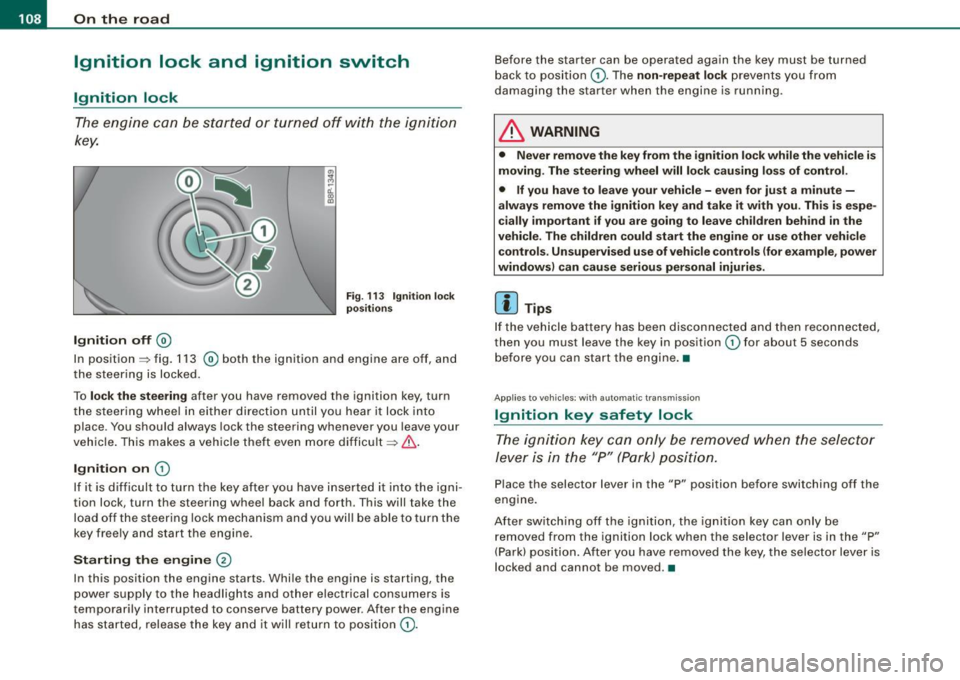
The engine can be s tar ted or tu rned off with the ignition
key.
Ignition off ®
Fig . 11 3 Ignit ion lock
po sition s
In position => fig. 113 ® both the ignit ion and engine are off, and
the steering is locked .
To
lo ck the stee ring after you have removed the ignition key, turn
t he steering whee l in either direction until you hear i t lock into
place . You should always lock the steering whenever you leave your
vehic le . This makes a vehicle theft even more difficult => & .
Ignition on G)
If it is difficult to turn the key af ter you have inserted i t into the igni
tion lock, turn the steering wheel back and forth . This will take the
load off the steering lock mechanism and you wil l be able to turn the
key freely and start the engine .
Starting the engine @
In this position the engine starts . Whi le the engine is starting, the
power supply to the headlights and o ther elec trical consumers is
temporari ly interrupted to conserve battery power . After the engine
has started, release the key and it will return to position
G).
Before the starter can be operated again the key must be turned
back to posi tion
G) . The non -repeat lock prevents you from
damaging the starter when the engine is running.
& WARNING
• Never remove the key from the ign ition lo ck w hile the veh icle is
moving. The steering wheel will lo ck causing lo ss of control .
• If you h ave to leave your vehicle -even for just a minute -
alway s remove the ignition key and take it w ith you . Thi s is es pe
c ially important if you are going to leave ch ildren behind in the
vehicle. The children could start the engine or u se other vehi cle
c ontrol s. Unsupervi sed u se of veh icle cont rol s ( for e xamp le , powe r
window s) can cau se serious per sonal injurie s.
[ i ] Tips
If the veh icle battery has been disconnected and then reconnected,
then you must leave the key in position
G) for about 5 seconds
before you can start the engine .•
Ap plies to ve hicl es: w ith a utom at ic tra nsmi ss io n
Ignition key safety lock
The ign ition key can only be rem oved when the selec tor
le ver i s in the "P" (Par k) p osition.
Place the selector lever in the "P" position before switching off the
engine .
After switching off the ignition, the ignition key can only be
removed from the ignition lock when the se lector lever is in the "P"
(Park) position. A fter you have removed the key , the selector lever is
locked and cannot be moved .•
Page 113 of 324
On the road -
----------------
-Switch off the engine a nd rem ove the igni tion k ey from
t h e ign iti on loc k.
Wha t el se you should do when parking your vehic le on
a n in cline o r de cline
Turn the steering whee l so that if the vehicle shou ld start to rol l, it
wil l ro ll into the curb.
I f you are parking on a
de cline (the front of your vehic le facing
downh ill), turn the front wheels to the right so that they po int
toward the curb.
If you are parking on an
in cline (the fon t of your vehicle facing
uphill), turn the front whee ls to the left so that they point away from
the cu rb.
Move the selector lever into the
P pos it ion (a utomatic tran smiss ion )
or move the gearshift lever into 1st. gear (manual trans mission) .
& WARNING
This is how you can reduce the r isk of injury when leaving your
v ehi cle .
• Never p ark the vehicle where it can come in contact with dry
gr ass, s pilled fuel or any other fl ammable mater ial s.
• Never allow anyone -espec ially small ch ildren -to remain in the
v ehi cle when it i s loc ked . Lo cked door s make it more diffi cult f or
rescuer s to acce ss the pa ssenger compartm ent in the event of an
eme rgen cy. Dang er to life!
• Never l eave children un supervi sed in the vehicle. Children
c ould relea se the p ark ing br ake or move the ge ars h ift le ver out of
gear. The vehicle could start to roll away and cau se an a ccident.
• No matter wh at the se ason i s, the temperat ure in a p arked
vehicle can reach dangerou s levels. •
Controls and equip
ment
Ap plies to vehic les: with hill hol d ass is t
Starting on hills
Hi ll hold assist makes it easier t o sta rt on hills .
The system is activated when the brake pedal is depressed
for a fe w
s econds .
After re leas ing the brake peda l, the brake power is held for a brief
moment to prevent the vehic le from rolling back when starting . At
t his time, you can easily beg in to m ove your vehicle.
& WARNING
• If you did not begin mov ing immediately afte r relea sing the
brake pedal , unde r certain circumst ances , the v ehi cle would begin
to roll ba ckw ard . Depres s the brak e pedal immedi ately or engag e
the hand brake .
• Should the engi ne stall , depres s the brake ped al immedi ately
or eng age the hand bra ke.
• In order to pre vent the vehi cle from rolling ba ck unintentionally
when starting in stop-and-go traffic , ke ep th e brake pedal
depre ssed for a few second s before driving off .
[ i ] Tips
You can find out if your vehicle is equipped with "Hill hold assist" at
an authorized Audi dealership .•
I • •
Page 124 of 324

-Tr
ansmi ssio n
..__ ______________ _
Applies to vehic les: with S Ironic® and with Tip tronic contro ls on the steering whee l
Steering wheel with Tiptronic ® controls
The selector paddles allow the driver to keep both hands
on the steering wheel when shifting gears.
Shifting up
Fig . 125 S port
s teer ing wheel w it h
se lector padd les
- Pu ll the right paddle, marked G) => fig . 125 briefly
towards you.
Shiftin g down
Pu ll the left paddle, marked O => fig. 125 briefly towards
you .
The selector paddles on the steering wheel are activated when the
selector lever on the center console is in
D, S, or in the manual posi
tion (Tiptronic mode).
You can also shift gears in the Tiptronic mode using the selector
lever on the center console.
[ i ] Tips
With the gear selector lever in either "D" or "S" the transmission wi ll
switch back to the automatic mode if you do not use the paddles
within approx . 30 seconds .•
Ap plies to vehicles: wi th S tronic®
Kick-down feature
The kick-down feature allows maximum acceleration .
If you depress the accelerator pedal fu lly beyond the full -throt tle
position, the transmission automatically downshifts one gear,
depending on vehic le speed and engine rpm. The upshift into the
next higher gear takes place as soon as the maximum specified
engine speed is reached.
& WARNING
Pleas e n ote t hat th e dr ive whee ls ca n sp in if th e kick -do wn i s used
o n a s mooth slipp ery road -ris k of skiddin g!•
Ap plies to vehic les: with S tron ic®
Launch Control Program
The Launch Control Program permits maximum accelera
tion.
In order to use Launch Control, the ASR (Anti-Slip Regu la
tion) must be disabled. When ASR is disabled, the ESP
warning/indicator light in the instrument cluster illumi
nates . So that Launch Control can be used, the engine must
be at operating temperature and the steering wheel must
not be turned.
- With the engine running, briefly press the ESP button.
The message "ASR off" appears in the instrument cluster
d isplay.
- Shift the gear lever to "S" or the tiptronic® position.
- Step on t he brake pedal with your left foot a nd keep the
brake pedal fully depressed fo r at least one second. _,,,
Page 130 of 324

___ D_ r _i_v _i_n -=g =--- S_ a_ f_ e____, ly'----------------------------------------------------
Proper occupant seating positi ·ons
Proper seating position for the driver
The proper driver seating position is important for safe,
relaxed driving.
Fig . 128 The correct
distance between
driver and steering
wheel
Fig . 129 Correct head
restraint position for
driver
For your own safety and to reduce the risk of injury in the
event of an accident, we recommend that you adjust the
driver's seat to the following position:
- Adjust the driver's seat so that you can easily push the
pedals all the way to the floor while keeping your knee(s)
slightly bent=:>& . - Adjust the angle of the seatback so that
it is in an upright
position so that your back comes in full contact with it
when you drive.
- Adjust the steering wheel so that there is a distance of at
least 10 inches (25 cm) between the steering wheel and
your breast bone=:> fig. 128. If not possible, see your
authorized Audi dealership about adaptive equipment.
- Adjust the steering wheel so that the steering wheel and
airbag cover points at your chest and not at your face.
- Grasp the top of the steering wheel with your elbow(s)
slightly bent.
- Adjust the head restraint so that the upper edge is as
even with the top of your head as possible but no lower
than eye level and so that it is as close to the back of your
head as possible=:> fig. 129.
- Fasten and wear safety belts correctly=:>
page 141.
- Always keep both feet in the footwell so that you are in
control of the vehicle at all times.
For detailed information on how to adjust the driver's seat, see
=>
page 75, "Adjusting front seats manua lly" or=> page 76,
"Adjusting the power seat".
& WARNING
Drivers who are unbelted, out of position or too close to the airbag
can be seriously injured by an airbag as it unfolds. To help reduce
the risk of serious personal injury:
• Always adjust the driver's seat and the steering wheel so that
there are at least 10 inches (25 cm} between your breastbone and
the steering wheel. .,_
Page 131 of 324

________________________________________________ D_r_iv _ i _n_ g~ S_ a_ fe_ ly __ lllll
& WARNING (continued)
• Always hold the steering wheel on the outside of the steering
wheel rim with your hands at the 9 o'clock and 3 o'clock positions
to help reduce the risk of personal injury if the driver's airbag
inflates.
• Never hold the steering wheel at the 12 o'clock position or with
your hands at other positions inside the steering wheel rim or on
the steering wheel hub. Holding the steering wheel the wrong way
can cause serious injuries to the hands, arms and head if the
driver's airbag deploys .
• Pointing the steering wheel toward your face decreases the
ability of the supplemental driver's airbag to protect you in a colli
sion.
• Always sit in an upright position and never lean against or
place any part of your body too close to the area where the airbags
are located.
• Before driving, always adjust the front seats and head
restraints properly and make sure that all passengers are properly
restrained .
• Never adjust the seats while the vehicle is moving. Your seat
may move unexpectedly and you could lose control of the vehicle .
• Never drive with the backrest reclined or tilted far back! The
farther the backrests are tilted back, the greater the risk of injury
due to incorrect positioning of the safety belt and improper
seating position.
• Children must always ride in child safety seats~
page 169.
Special precautions apply when installing a child safety seat on
the front passenger seat~
page 147. •
Controls and equip ment Safety first
Vehicle operation
Proper seating position for the front
passenger
The proper front passenger seating position is important
for safe, relaxed driving.
For your own safety and to reduce the ris k of injury in the
event of an accident, we recommend that you adjust the
seat for the front passenger to the following pos ition:
- Adjust the angle of the seatback so that it is in an upright
position and your back comes in full contact with it
whenever the vehicle is mov ing.
- Adjust the head restraint so that the upper edge is as
even with the top of your head as possible but not lower
than eye level and so that it is as close to the back of your
head as possible::::;,
page 131.
Keep both feet flat on the floor in front of the front
passenger seat.
- Fasten and wear safety belts correctly::::;,
page 141.
For detailed information on how to adjust the front passenger's
seat, see~ page
74.
& WARNING
Front seat passengers who are unbelted, out of position or too
close to the airbag can be seriously injured or killed by the airbag
as it unfolds. To help reduce the risk of serious personal injury :
• Passengers must always sit in an upright position and never
lean against or place any part of their body too close to the area
where the airbags are located.
• Passengers who are unbelted, out of position or too close to the
airbag can be seriously injured by an airbag as it unfolds with
great force in the blink of an eye. ..
Vehicle care Do-it-yourself service Technical data
Page 141 of 324

Because the passengers of this vehicle are not using safety belts
=:> page 138, fig. 133, they will keep moving at the same speed the
vehicle was moving just before the crash, until something stops
them -here, the wall
=:> page 138, fig. 134.
The same principles apply to people sitting in a vehicle that is involved in a frontal collision. Even at city speeds of 20 to 30 mph
(30 to 50 km/h), the forces acting on the body can reach one ton
(2,000 lbs. or 1,000 kg) or more . At greater speeds, these forces are
even higher.
People who do not use safety belts are also not attached to their
vehicle. In a frontal collision they will also keep moving forward at
the speed their vehicle was travelling just before the crash. Of course, the laws of physics don't just apply to frontal collisions, they
determine what happens in all kinds of accidents and collisions. •
What happens to occupants not wearing
safety belts?
In crashes unbelted occupants cannot stop themselves
from flying forward and being injured or killed. Always
wear your safety belts!
Safety first
Fig . 135 A driver not
wearing a safety belt is
violently thrown
forward
Safety belts
Fig . 136 A rear
passenger not wearing
a safety belt will fly
forward and strike the
driver
Unbelted occupants are not able to resist the tremendous forces of
impact by holding tight or bracing themselves. Without the benefit
of safety restraint systems, the unrestrained occupant will slam
violently into the steering wheel, instrument panel, windshield, or
whatever else is in the way=:> fig. 135. This impact with the vehicle
interior has all the energy they had just before the crash.
Never rely on airbags alone for protection. Even when they deploy,
airbags provide only additional protection. Airbags are not
supposed to deploy in all kinds of accidents. Although your Audi is
equipped with airbags, all vehicle occupants, including the driver,
must wear safety belts correctly in order to minimize the risk of
severe injury or death in a crash.
Remember too, that airbags will deploy only once and that your
safety belts are always there to offer protection in those accidents
in which airbags are not supposed to deploy or when they have
already deployed. Unbelted occupants can also be thrown out of the
vehicle where even more severe or fatal injuries can occur.
It is also important for the rear passengers to wear safety belts
correctly . Unbelted passengers in the rear seats endanger not only
themselves but also the driver and other passengers=:> fig. 136. In a
frontal collision they will be thrown forward violently, where they can hit and injure the driver and/or front seat passenger. •
Vehicle care I I Technical data