air condition AUDI S3 2009 Owner's Manual
[x] Cancel search | Manufacturer: AUDI, Model Year: 2009, Model line: S3, Model: AUDI S3 2009Pages: 324, PDF Size: 76.02 MB
Page 202 of 324
___ D_ r_i v_ in_... g"'- a_ n_ d_ e_ n_ v_i_r _ o _n_ m __ e_n _ t _______________________________________________ _
one half. Never drive faster than the posted speed limit and weather
conditions permit. •
Reducing unnecessary =citing
Even when your car is just idling it burns up fuel.
- Shut the eng ine off when you are not driving the vehicle .
- Do not warm up the vehicle by letting the engine run at
idle.
It makes sense to shut off the engine in traffic jams, when waiting
for trains to pass at rai lroad crossings , or at traffic lights that have
long waits on red. Turning the engine off for just 30 -40 seconds
saves more fuel than is burned starting the engine again .
It takes a long time for the engine to warm up fu lly when it is
running at idle. However, wear and noxious emissions are especially
high when the engine is warming up. So you should drive away as
soon as you start the engine and avoid running at high RPMs while
the engine is still warming up.
0 Note
Do not leave engine idling unattended after starting . If warning
lights should come on to indicate improper operation, they would
go unheeded. Extended idling also produces heat, which could result in overheating or other damage to the vehicle or other
property .•
Regu1ar ma1--.tenance
A badly tuned engine unnecessarily wastes a lot of fuel.
- Have your vehic le serviced at regular intervals . By having your vehicle regularly serviced by an authori
zed Audi
dea ler helps to ensure that it runs properly and economica lly. The
condition of your vehicle not only affects its safety and ability to
hold its value, it a lso affects
fu el con sumpti on.
C he ck your oil each time you fill your t ank .
The amount of oil used is related to engine load and speed.
It is norma l for the oil consumption of a new engine to reach its
lowest va lue after a certain mileage has been driven.
You must drive your vehicle about 3,000 miles (5,000 kilometers) before you can properly assess oil consumption .
T his also applies to fuel consumption and engine output .
0 Note
• Have your vehicle maintained properly and in accordance with
the service recommendations in your Warranty
& Maintenance
booklet. Lack of proper ma intenance as well as improper use of the
vehic le wi ll impair the function of the emission control system and
cou ld lead to damage.
• Do not alter or remove any component of the Emiss ion Control
System unless approved by the manufacturer.
• Do not alter or remove any device, such as heat shields,
switches, ignition wires, valves, which are designed to protect your
vehicle 's Em ission Control System and other important vehicle
components .•
Fewer short tr ips
Fuel consumption will always be relatively high on short
trips.
- Try to avoid driving short dista nces wi th a cold engine. _,
Page 206 of 324

___ T_ r _a_ il_e _r_ t_ o_ vv_ in__... g,_ __________________________________________________ _
Weig ht dis tributi on
Towing a loaded trailer with an empty car resu lts in a high ly
unstable distribution of weight . If this cannot be avoided drive at
very low speeds on ly to avoid the risk of losing steering control.
A "ba lanced" rig is easier to operate and control. This means that
the tow vehicle should be loaded to the extent possible and permis
sib le while keeping the trai ler as light as possib le under the circum
stances. Whenever possible, transfer some cargo to the luggage
compartment of the tow vehicle while observing tongue load requirements and vehicle loading considerations .
Speed
The higher the speed, the more difficult it becomes for the driver to
control the rig . Do not drive at the maximum permissible speed.
Reduce your speed even more under unfavorable load, weather or
wind conditions -particularly when going downhill.
Reduce vehicle speed
imm ed ia tely if the trailer shows the sl ightest
sign of swaying. Do not try to s top the s wayi ng by a ccelerating .
Observe speed limits . In some areas speeds for vehicles towing
trai lers are lower than for regular vehicles.
Always app ly brakes early. When driving downhill, shift into lower
gear to use the engine braking effect to slow down the vehicle. Use
of the brakes alone can cause them to overheat and fail.
C oo la nt tempe ra tu re
The coolant temperature gauge ~ page 9 must be observed care
ful ly. If the needle moves close to the upper end of the scale, reduce
speed immediately and/or switch off the air condit ioner.
If the coolant temperature warning light in the instrument cluster
starts flashing -~-, pull off the road, stop and let the engine
idle for
about two minutes to prevent heat build -up .
& WARNING
An yone not p rope rly res train ed in a mo ving vehi cle is a t a mu ch
gre ater risk in a n accident. Neve r let an yone ride in your car who
is not p rop erly we ari ng th e res tra int s pro vide d b y Aud i.
c
Trailer towing tips
Important to know
Your vehicle handles different ly when towing a trailer because of
the additional weight and weight distribution . Safety, performance
and economy w ill great ly depend on how carefu lly you load your
trailer and operate your rig.
Before you actually tow you r trailer, practice turn ing, stopping and
backing up in an area away from traffic. Keep practicing unti l you
have complete ly become familiar with the way your vehicle -trailer
combination behaves and responds .
Backing up is difficult and requires practice. Backing up with a
trailer genera lly requires steering ac tion opposite of that when
backing up your vehicle without a trailer .
Maintain a greater distance between your vehicle and the one in
front of you. You will need more room to stop.
T o compensate for the trailer, you wi ll need a larger than normal
turning radius .
When passing, remember that you cannot accelerate as fast as you n ormal ly wou ld because of the added load . Make su re you have
enough room to pass. After passing, al low plenty of room for your
trailer before changing lanes again .
Avoid jerky starts, sharp turns o r rapid lane changes.
Page 208 of 324

___ C _l_e _a _ n_ in_g ~_ a_n _ d ___ p ___ r_ o _t _e _c_ t_ i_o _ n _____________________________________________ _
Cleaning and protection
General information
Regular care p rese rves vehicle value .
Any automobile is exposed to industrial fumes, corrosive road salt ,
muddy dog feet, e tc. A wel l cared fo r Audi can look l ike new many
years after purchase . Regu lar and correct care will contribute to
maintaining the beauty and va lue of your Audi .
Furthermo re , g ood care ma y be a conditi on for sub sta ntiating a
warr anty cla im should corro sion damage or paint defect s occur .
Your authorized Audi dealer has a var iety of dedi cat ed vehicle -care
product s
and can advise which ones to use for cleaning the exterior
and interio r of your vehicle.
Whether you use products recommended by Audi or other commer
cially availab le cleaning agen ts, please make su re you apply them
correctly .
& WARNING
• Cleaning agents m ay be poi sonou s. Keep them out of the re ach
of childr en.
• Heed all cau tion label s.
• Alway s read direction s on the container before u sing any
produ ct. Follo w the dire ction s carefull y.
• Most chemi cal cle aner s are concentr ated and h ave to be
d iluted .
• Use spot remo ving fl uid s onl y
in well ventila ted are as.
• Do not use gasoline , kero sene , diesel fuel , nail poli sh remover
or other vol atil e fluid s. They may be to xic , fl ammab le or h azardou s
in other wa ys. Do not wa sh , wax or dry the vehicle w ith the igni
tion on or the engine ru nning .
& WARNING (continu ed )
• Do not clean the unders ide s of cha ssi s, fenders , wheel cover s,
et c. without pr ote cting y our hands and arm s. You may cut your self
on sh arp-edged metal part s.
• Moisture and i ce on brakes may impair br aking eff icien cy
~ page 1 93, "General information ". Test the brake s carefully each
time you wash the vehicle .
'£> For the sake of the environment
Select only environmenta lly friend ly c leaning products. Leftover
clean ing products should not disposed of in the household waste .•
Care of exterior
Washing
F requent washing protects the vehicle.
The best protection against environmental influences is frequent
washing a nd waxing.
How often this is required depends on :
• How much the vehicle is used
• Where the vehicle is parked (garage, in the open under trees ,
etc.)
• The seasonal and weather conditions
• Environmenta l influences
The longer bird droppings, insects, tree resin, road and industrial
gri me, tar, soot, road salt and other materials remain on the vehicle
body , the more lasting their destructive effects will be. .,_
Page 213 of 324
____________________________________________ _:C ::,: l~ e :,: a~ n:....:..:..: in~ g~ a~n .:.:d:!...! p~ r ~o~ te~ c~t ~io ~ n'...._ __
•
The best way to remove snow from windows and mirrors is to use a
brush . Use a non -abrasive
pla stic ice scraper -better still, a spray
deicer -to remove
ice from w indows and mirrors .
The windows must not be cleaned with insect remover or wax since
these can inter fere with the function of the w inds hie ld w iper blades
(chatter).
Oil, grease o r sil icone residue can be removed with
glass cleaner or
s ilicone remover . However, wax residue requires the use of a
spec ially fo rmulated so lvent . Please contac t your authorized Audi
dea ler for advice on safe products for wax removal.
Windows should also be c leaned on the inside at regular interva ls .
Never dry windows with the same chamois that you use to dry
painted surfaces . Wax residue on the chamois can impair vision
t hrough the windows .
& WARNING
• The windshield mu st not be treated with water -repellent mate
rials. T hey c an incre ase gl are under poor v isibility conditions such
a s wetne ss, darkne ss, or when the sun i s low on the hori zon. In
addition , they can cause the wind shield wipers to chatter .
• Alway s read and heed all WARNINGS and other information
~ page 206.
0 Note
• Never use warm or hot water to remove snow and ice from
windows a nd mirrors . This cou ld cause the glass to crack.
• T o prevent damage to the wires of the rear defogger, do not p lace
any adhesive stickers on the inside of the rear window over the
wires .
• T o he lp prevent dirt from scratching the window, always scrape
in a forward direction -pushing the scraper away from you -never
back and forth. •
Weatherstrips
Complete car car e includes the we atherst rip s as well .
App ly a suitable rubbe r con ditioner to the weatherstr ips
f ro m time to time.
To be able sea l properly, the weatherstrips around the hood, doors,
rear lid, etc . must remain pliabl e. Spray the weatherstrips with sili
co ne or coat them w ith ta lcum powder or glycer ine to retain the
f lexibility of the rubber and to protect them against freezing in the
winte r.
& WARNING
Always read and heed all WARNINGS and other information
~ page 206.
[ i ] Tip s
Keep si licone sprays off the windshield to avoid wiper smear in
ra in .•
Ap plies to veh icles : with s tee l w hee ls (e .g . if ref itt e d w ith w inter tires )
Steel wheels
The wheels also h ave to be cleaned.
- Alw ays in clu de the hu b caps and whee l rims when
washing yo ur vehi cle to remove road dir t, sal t sprays an d
b rake dust.
If necessary, use a commercial whee l cleaner to remove accumu
lated brake dust.
The wheel rims are eas ier to keep clean if they are reg ula rly coa ted
with l iquid wax . ..
Vehicle care I t •
Page 216 of 324
___ C_ le_ a _ n_i_n ~g _ a_ n_ d __ p_r _o _t _e _c_ t_ i_o _n ___________________________________________ _
In the case of general soiling of the upho lstery and cover material,
we recommend hiring a s pecialis t tha t has the equ ip m ent to c lean
the seat covers and other fabric surfaces by shampooing and spray
e xtraction .
& WARNING
Always read and heed all WARNINGS and the information
~ page 206 .
[ i ] Tip s
Open Ve lcro fasteners on your clothing can damage the seat cover.
Please make sure that Velc ro fas tene rs a re c losed. •
Plastic parts and instrument panel
- Always use a clean c lo th moiste ned in clear wa ter.
A lways use a c lean cloth moistened in clear water to clean these
areas. For persistent d irt use a n Aud i approved
solvent -free plastic
cleaner/protectant .
& WARNING
Solvents can change the properties of some plastics and make it
harder for the airbag to deploy.
• Never clean the instrument panel or the surface of A irbag
modules with cleaning produ cts that contain solvents.
• Product s containing solvents will make the surface of this part
porous .
• Serious injuries can re sult if plastic parts come loose when the
airbag is deployed .
• Always read and heed all WARNINGS and the information
~ page 206.
0 Note
Cleaning agents co ntaini ng so lvents wil l attack t he ma ter ial and can
change the way it behaves .•
Ap plies t o ve hicles : w ith na tural leat her
Natural leather
Aud i makes great eff orts to maintain the pro per ties,
n atu ra l look and feel of in ter ior leather.
General
We offer many different types of leather on our vehicles. Most are different types o f nappa leather, which has a smooth surface and
comes in various co lors.
The intens ity of the color de termi nes the vis ual c h aracteris tics and
appearance. If the surface of the leather has a typica l natural look ,
t hen t he leather is a nap pa lea ther tha t has been left in a re lati ve ly
natural condition. This leather offers particu lar ly good comfor t and
breathes well. Fine veins, closed grains, insect bites, skin folds, and
subt le variations in color remain visib le. These character istics
demonstrate that the material is natura l.
N at ura l n ap pa leather is not covere d by a col or fin is h. It is the refor e
more sensitive to soiling and wear, which is something you need to
co nside r if chi ld ren, a nim als o r othe r factors m ight prove to be
particularly hard on the leather.
By contrast, leather types that are covered by a colored finish layer
ar e mo re du rable. T his has a positive ef fect on the leather's resis
tance to wear and soiling in daily use. On the other hand, the typical
cha ract erist ics of natura l leather are barely or n ot appa ren t.
However, th is does not mean that the leather itself is of inferior
quali ty.
Care and handling
Becaus e of th e exclusive nat ure of the ty pes o f lea ther tha t Audi
uses and their un ique properties (such as sens itivity to oi ls, grease, ..,_
Page 230 of 324
-~_C_ h_e _c _ k_ i_n ...:::g::;...._ a_n_ d_ f_ i_ll _in -'g:::;.._ ___________________________________________ _
prevent the formation of harmful deposits, sometimes called
"sludge," that over time can lead to expensive repairs.
At the time of printing, engine oils available in the U .S . and Canada
that meet the exacting specifications of Audi oil standard VW 502 00
are synthetic engine oils. This does not mean, however, that every
synthetic engine oil will meet Audi oil standard VW 502 00. So
always be sure that you use an approved oil.
To help prevent the formation of harmful deposits use only oil with
the following specifications printed on the oil container:
Audi oil standard VW 502 00
Oil container labels may carry the specification singly or in combi
nation with other designations and oil quality standards.
Viscosity
Engine oils are graded according to their viscosity. The proper
viscosity grade oil for your engine depends on climactic or seasonal conditions where you drive. You can use oil with a viscosity grade of
SAE 5W40 across all temperature ranges for normal driving condi
tions .
However, if engine oil viscosity grade SAE 5W40 is not available, you
can also use viscosity grade SAE 5W-30 or SAE 0W-40 as long as it
meets Audi oil quality standard VW 502 00 specifications.
Because engine oil that meets the Audi oil standard may not be
available everywhere when you need it, we strongly recommend
that you always carry with you an extra quart {liter) of oil that
expressly conforms to the VW 502 00 specification, in case you have
to top off the oil while on the road.
Only if the level of the oil is at or below the minimum mark on the
oil dipstick -and no oil that expressly conforms to Audi oil standard
VW 502 00 specifications is available -may you top off with a high
quality engine oil, preferably synthetic -based, that meets ACEA A3,
ACEA A5 or ACEA B5, API SL or ILSAC GF-3 specifications, but even
then, only in viscosity grades SAE 5W -40, SAE 5W -30, or SAE 0W -40 .
However, during the entire time between oil change intervals, never top off with more than a total of 0
.5 qt/liter engine oil that does not
conform to Audi oil specification VW 502 00.
For more information about engine oil that has been approved for
your vehicle, please contact either your authorized Audi dealer or
Audi Customer Relations at 1 (800) 822-2834 or visit our web site at
www.audiusa.com or www.audicanada.ca. Here you will also find a
current list of oils (manufacturers, brand names etc.) that conform
to Audi oil standard VW 502 00.
Changing the engine oil
The engine oil and oil filter must be changed according to the
mileage (kilometers) and time intervals specified in your vehicle 's
Warranty
& Maintenance booklet. Do not exceed these intervals -
harmful deposits from old engine oil can reduce engine perfor
mance and can lead to expensive engine repairs.
Changing the oil at the recommended intervals is so very important
because the lubricating properties of oil decrease gradually during
normal vehicle use. If you are not sure when you have your oil
changed, ask your authorized Audi Service Advisor.
Under some circumstances the engine oil should even be changed
more frequently . Change oil more often if you drive mostly short
distances, operate the vehicle in dusty areas or mostly under stop
and-go traffic conditions, or when you use your vehicle where
temperatures stay below freezing point for long periods.
Detergent additives in the oil will make fresh oil look dark after the
engine has been running for a short time. This is normal and is not
a reason to change the oil more often than recommended .
Damage or malfunctions due to lack of maintenance
It is essential that you change your oil at the recommended intervals
using only engine oil that complies with Audi oil standard
VW 502 00 . Your New Vehicle Limited Warranty does not cover
damage or malfunctions due to failure to follow recommended
maintenance and use requirements as set forth in the Audi Owner's
Manual and Warranty & Maintenance booklet. Your dealer will have
to deny warranty coverage unless you present to the dealer proof in
~
Page 231 of 324
___________________________________________ C_ h_e _c_ k_ i_n _g _ a_n _d_ f_il _li _n _g __ ffllll
•
the form of Service or Repair Orders that all schedu led maintenance
was performed in a time ly manner .•
Engine oil consumption
The engine in your vehicle depends on an adequate
amount of oil to lubricate and cool all of its moving parts.
In order to provide effective lubrication and cool ing of internal
engine components , all internal combustion engines consume a
certain amount of oil. Oil consumption varies from engine to engine
and may change significantly over the life of the engine. Typically,
engines with a specified break -in period (see~
page 197) consume
more oil during the break-in period than they consume af ter oi l
consumption has stabi lized .
Unde r normal conditions, the rate of oil consumption depends on
the quality and viscosity of the oil, the RPM (revolutions per minute)
at which the engine is operated, the ambient temperature and road
conditions . Further factors are the amount of oil dilution from water
condensation or fuel residue and the oxidation level of the o il. As
any engine is subject to wear as mileage builds up, the oil consump
tio n may increase over time unt il rep lacement of worn components
may become necessary.
W ith all these variables coming into play, no standard rate of oil
consu mption can be estab lished or specified. There is no a lternative
to regular and frequent checking of the oil level, see
Note .
If the yellow engi ne oil level warning symbol in the instrume nt
cluster lights up, you should check the oil level as soon as
poss ible
with the oil dipstick~ page 229 . Top off the oil at your
earliest convenience~
page 230.
& WARNING
Before you che ck anything in the eng ine comp artment , alw ay s
read and heed all WARNINGS
~ & in "Working in the engine
c ompartment " on
page 22 5.
0 Note
Driving with an insufficie nt o il level is l ikely to cause severe damage
to the engine.
[ i ] Tip s
• The oil pressure warning displ ay ce,. is not an indi cat or of the oil
level . Do not rely on it. Instead , check the oil level in your engine at
regular interv als , prefe rably ea ch time you refuel , and always before
going on a long trip.
• If you have the impression your engine consumes excessive
amoun ts of oil, we recommend that you consu lt your authorized
Audi dealer to have the cause of your concern proper ly diagnosed .
Keep in mind that the accura te m easuremen t of oil consumption
requires great care and may take some time . Your authorized Audi
dea ler has instructions about how to measu re oil consumption
accurately .•
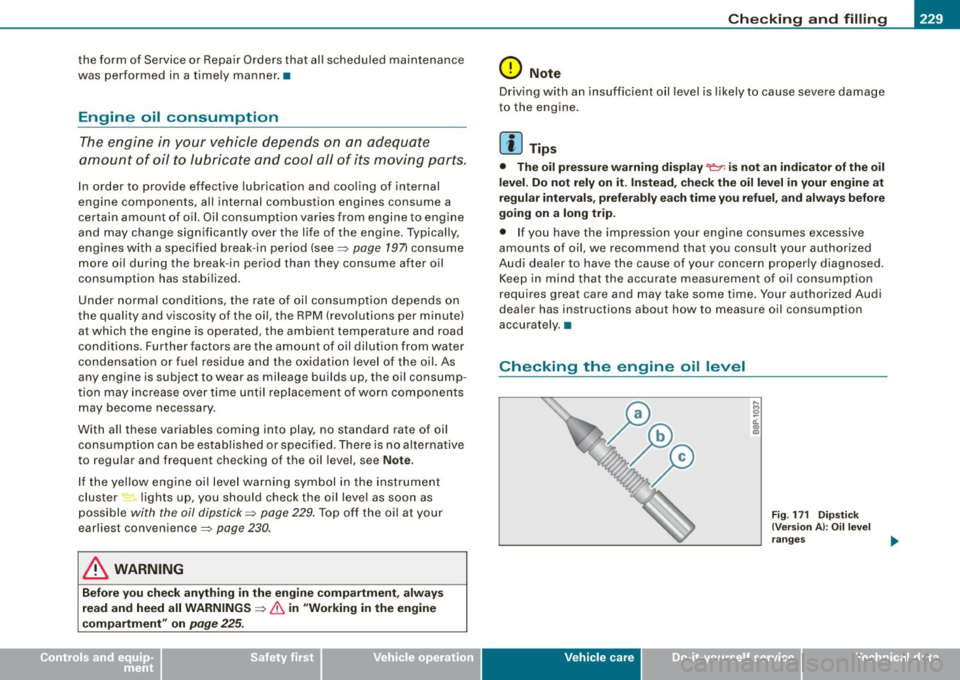
Checking the engine oil level
Vehicle care I t •
Fig . 171 Dip sti ck
( V ersio n A):
Oil le vel
ran ges
Page 235 of 324
Checking and filling -
---------------------=----"=---------
0 Note
• Before winter sets in, have the coolant checked to see if the
coolant additive in your vehicle is sufficient to meet the climate
conditions. This is especially important if you live in a region where
the winter is extremely cold. If necessary, increase the proportion of
coolant additive to 60%.
• When adding coolant additive to your cooling system,
remember:
-We recommend using only coolant additive G12+ + (check the
label) for your vehicle. This coolant additive is available at autho
rized Audi dealers. Other types of antifreeze can significantly
reduce corrosion protection . The resulting corrosion can cause a
loss of coolant and serious engine damage .
• Do not add any type of radiator leak sealant to your vehicle's
engine coolant. Adding radiator repair fluid may adversely affect the
function and performance of your cooling system and could result
in damage not covered by your New Vehicle Limited Warranty .•
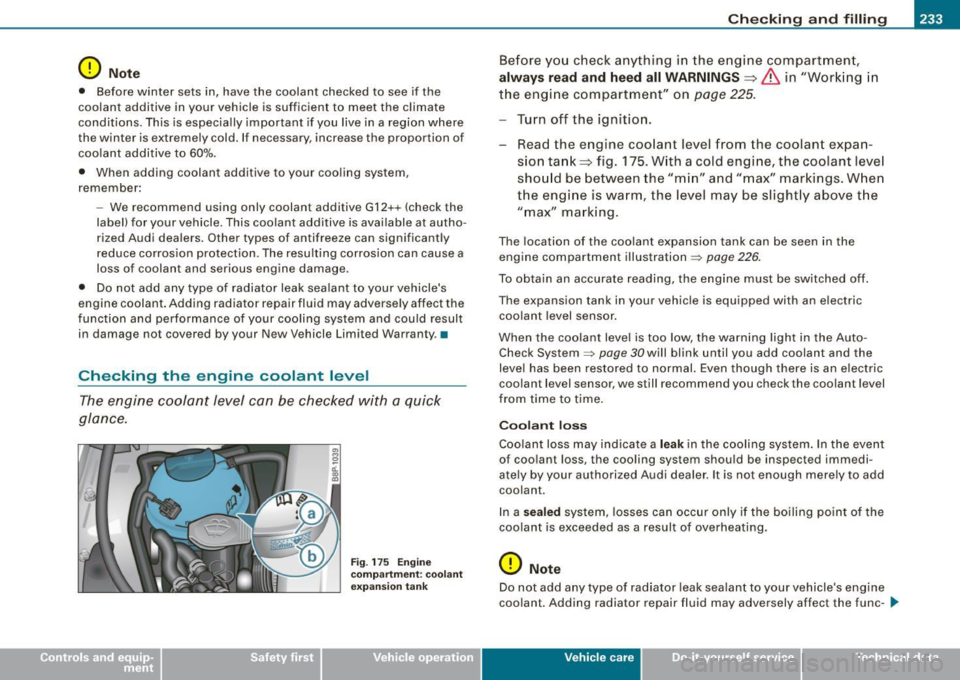
Checking the engine coolant level
The engine coolant level can be checked with a quick
glance.
Fig . 175 Engine
compartment : coolant
expansion tank
Before you check anything in the engine compartment,
always read and heed all WARNINGS==> & in "Working in
the engine compartment" on
page 225.
Turn off the ignition.
Read the engine coolant level from the coolant expan
sion tank==> fig. 175. With a cold engine, the coolant level
should be between the "min" and "max" markings. When
the engine is warm, the level may be slightly above the
" max" marking.
The location of the coolant expansion tank can be seen in the
engine compartment illustration=>
page 226.
To obtain an accurate reading, the engine must be switched off.
The expansion tank in your vehicle is equipped with an electric
coolant level sensor.
When the coolant level is too low, the warning light in the Auto
Check System =>
page 30will blink until you add coolant and the
level has been restored to normal. Even though there is an electric
coolant level sensor, we still recommend you check the coolant level
from time to time.
Coolant loss
Coolant loss may indicate a leak in the cooling system. In the event
of coolant loss, the cooling system should be inspected immedi
ately by your authorized Audi dealer. It is not enough merely to add
coolant.
In a
sealed system, losses can occur only if the boiling point of the
coolant is exceeded as a result of overheating.
0 Note
Do not add any type of radiator leak sealant to your vehicle's engine
coolant. Adding radiator repair fluid may adversely affect the tune- _..
Vehicle care I I Technical data
Page 250 of 324
-~_T_ ir_e_ s_ a_ n_d _ w_ h_ e_e _l_s _________________________________________________ _
vehicle at its maximum capacity weight and tires that were on your
vehicle at the time it was manufactured.
If you wish to improve comfort when operating the vehicle at
normal load (up to 3 occupants), you can adjust tire pressures to
those specified for normal vehicle load. Before operating the vehicle at maximum load, you must increase the tire pressures to those
specified for maximum vehicle load
=> &.
Bear in mind that the tire pressure monitoring system* can only
monitor the tire pressures you have stored. The system does not
recognize the load condition of your vehicle.
The effectiveness of the tire pressure monitoring system* will be impaired if you store normal load pressures but then operate the
vehicle at its maximum load=>&. See
the illustrat ion=>
page 247, fig. 180 for the location of the label
either on driver's side B -pillar or inside the fuel filler flap (color of
the actual label and exact location on the vehicle will vary slightly).
Note that the following table is accurate at the time of going to
press and is subject to change . In the event of discrepancies, the tire
pressure label (on USA vehicles, the tire pressure label is loc ated on
driver's side B-pillar; on Canada vehicles, the tire pressure label is
loca ted either on the driver's side B-pillar or inside the fue l filler
flap.I always takes precedence.
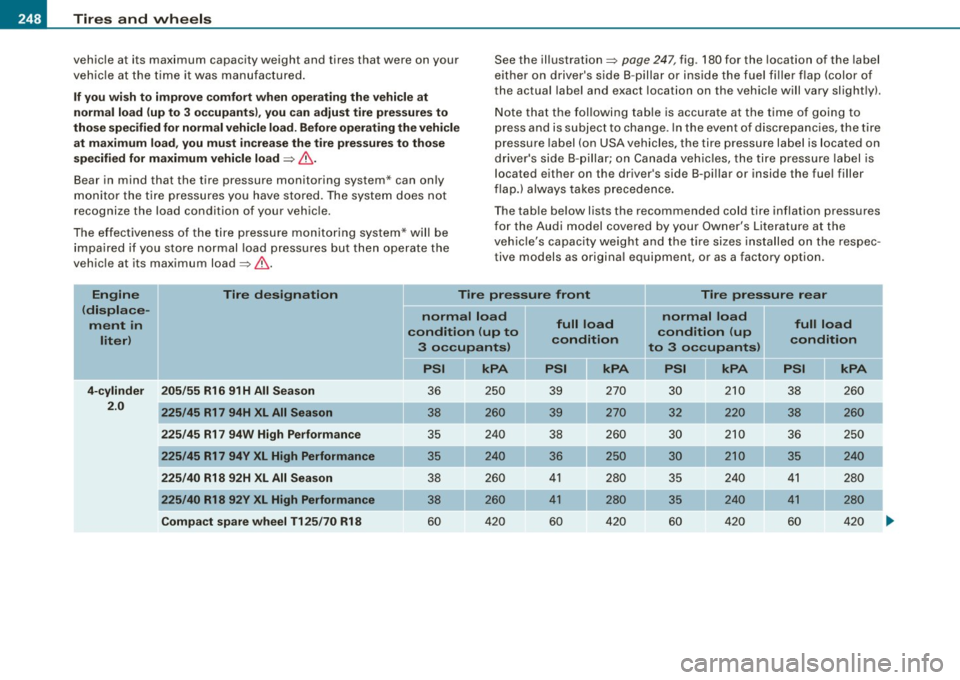
The table below lists the recommended cold tire inflation pressures
for the Audi model covered by your Owner's Literature at the
vehicle's capacity weight and the tire sizes installed on the respec
tive models as original equipment, or as a factory option.
Engine
(displace
ment in
liter)
Tire designation Tire pressure front
Tire pressure rear
4-cylinder
2.0
205/55 R16 91 H All Season
225/45 R17 94H XL All Season
225/45 R17 94W High Performance
225/45 R17 94Y XL High Performance
225/40 R18 92H XL All Season
225/40 R18 92Y XL High Performance
Compact spare wheel T125/70 R18 normal load
condition (up to
3 occupants)
PSI
36 250
38 260
35 240
35 240
38 260
38 260
60 420
full load
condition
kPA
39 270
39 270
38 260
36 250
41 280
41 280
60 420
normal load
full load
condition (up
condition to 3 occupants)
kPA kPA
30 210
38 260
32 220 38 260
30 210
36 250
30 210
35 240
35 240 41 280
35 240 41 280
60 420
60 420
Page 258 of 324
-~_T_ ir_e_ s_ a_ n_d _ w_ h_ e_e _l_s _________________________________________________ _
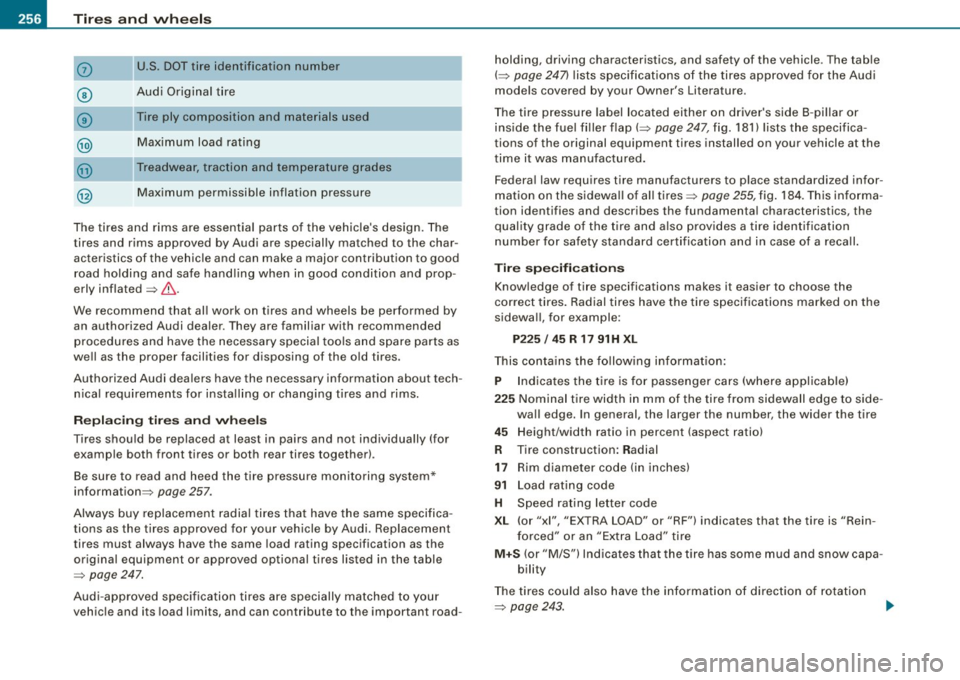
0
©
G)
@
U.S. DOT tire identification number
Audi Original tire
Tire ply composition and materials used Maximum load rating
Treadwear, traction and temperature grades Maximum permissible inflation pressure
The tires and rims are essential parts of the vehicle's design. The
tires and rims approved by Audi are specially matched to the char acteristics of the vehicle and can make a major contribution to good
road holding and safe handling when in good condition and prop
erly inflated =>& .
We recommend that al l work on tires and wheels be performed by
an authorized Audi dealer . They are familiar with recommended
procedures and have the necessary special tools and spare parts as
we ll as the proper facilities for disposing of the old tires .
Authorized Audi dealers have the necessary information about tech
nical requirements for insta lling or changing tires and rims .
Rep lac ing t ires a nd w heels
Tires should be replaced at least in pairs and not individually (for
example both front tires or both rear tires together) .
Be sure to read and heed the tire pressure monitoring system*
information :::>
page 257.
Always buy replacement radial tires t hat have the same specifica
tions as the tires approved for your vehicle by Audi . Replacement
tires must always have the same load rating specification as the
original equipment or approved optional tires listed in the table
=>
page 247.
Audi -approved specification tires are specially matched to your
vehic le and its load limits, and can contribute to the important road- holding, driving characteristics, and safety of the vehicle
. The table
( =>
page 247) lists specifications of the tires approved for the Audi
models covered by your Owner's Literature.
The tire pressure label located either on driver's side 8 -pi llar or
inside the fuel fi ller flap( =>
page 247, fig. 181 l lists the specifica
tions of the original equipment tires installed on your vehicle at the
time it was manufactured.
Federal law requires tire manufacturers to place standardized infor
mation on the sidewa ll of all tires=>
page 255, fig. 184. This informa
tion identifies and describes the fundamenta l characteristics, the
quality grade of the tire and also provides a tire identification
number for safety standard certification and in case of a recall.
T ire s pec ific ation s
Knowledge of tire specifications makes it easier to choose the
correct tires. Radial tires have the tire specifications marked on the
sidewal l, for example:
P 22 5 / 45 R 17 91H XL
This contains the following information:
P Ind icates the tire is for passenger cars (where applicable)
2 25 Nominal tire width in mm of the tire from sidewall edge to s ide -
wall edge. In general, the larger the number, the wider the tire
45 Height/width ratio in percent (aspect ratio)
R Tire construction: Radial
17 Rim diameter code (in inches)
91 Load rating code
H Speed rating letter code
XL (or "xi", "EXTRA LOAD" or "RF ") indicates that the tire is "Rein
forced" or an "Extra Load" tire
M +S (or "M/S"l Indicates that the tire has some mud and snow capa
bility
The tires cou ld also have the information of direction of rotation
=>
page 243 .