air condition AUDI S3 2009 Owner's Guide
[x] Cancel search | Manufacturer: AUDI, Model Year: 2009, Model line: S3, Model: AUDI S3 2009Pages: 324, PDF Size: 76.02 MB
Page 259 of 324
________________________________________________ T_ i _r_e _s_ a_n_ d_ w_ h_ e_e _ l_s __ !II
•
T ire manu fact uring da te
The manufacturing date is a lso indicated on the tire sidewall
(possibly only on the
inner side of the wheell:
"DOT ... 2207 ... " means, for example, that the tire was produced in
the 22nd week of 2007 .
Speed ratin g (let te r cod e)
The speed rating letter code on the wheels indicates the maximum
permissible road speeds=>
& in "Winter tires" on page 260.
P up to 93 mph (150 km/h)
Q up to 99 mph (158 km/h)
R upto106mph(170km/h)
S upto110mph(180km/h)
T upto118mph(190km/h)
U up to 124 mph (200 km/h)
H upto 130mph(210km/h)
V up to 149 mph (240 km/h)6>
Z over 149 mph (240 km/h)6>
W up to 168 mph (270 km/h)6>
Y up to 186 mph (298 km/h)61
Your vehicle is normally factory equipped with tires, which possess
excel lent driving characteris tics and give your Audi optimum
driving comfort. An e lectronic speed limiter=> page
21 will normally
prevent your vehicle from going faster than the tire speed rating
=> & .
U.S . D OT T ire Ident ifi cation Nu mber (TIN ) and tire
m anu fac ture date
This is the tire's "seria l number" . It begins with the letters "DOT"
and indicates that the tire meets all federal standards . The next two
numbers or letters indicate the plant where it was manufactured,
and the last four numbers represent the week and year of manufac-
61 For tires with a maximum speed capability over 149 mph (240 km/h), tire
manufacturers sometimes use the letters "ZR."
ture. For example, the numbers 2207 mean that the tire was
produced in the 22nd week of 2007. The other numbers are
marketing codes that may or may not be used by the tire manufac
turer. This information is used to contact consumers if a tire defect
requires a recall.
Audi Origin al tire
Tires with the identification" AO" or "RO" have been specially
matched with your Audi. We recommend using only these tires
because they meet the highest standards regarding safety and
driving characteristics when used correctly . Your authorized Audi
dea ler will glad ly provide you with more information .
Maximum L oad Rating
This number indicates the maximum load in kilograms and pounds
that can be carried by the tire.
Tir e qu ality gra din g for tr eadw ear, trac tion, a nd
t emper atu re resi stan ce
Tread wear, traction and temperature grades=> page 259.
Max imum P ermi ssibl e Inf latio n Pre ssure
This number is the greatest amount of air pressure that should ever
be put in the tire under normal driv ing conditions .
Repla cing tires or rims on vehicl es equipp ed with tir e
pre ssure monit oring sy stem *
The wheels on your vehicle are equipped with a sensor which
constant ly monitors the air pressure ins ide the t ire, and then trans
mits this information to the tire pressure monitoring system *. If you
are going to replace the wheel rims on your vehic le, make sure the
new rims also have these sensors . The sensors must be compatible
with the tire pressure monitoring system* on your veh ic le.
If you instal l rims that do not have the sensors or have sensors
which are not compatible, then the tire pressure monitoring
system* wil l not work properly. In this case, the tire pressure moni -..
Vehicle care I t •
Page 262 of 324
-~_T_ ir_e_ s_ a_ n_d _ w_ h_ e_e _l_s _________________________________________________ _
Safety Standard No. 109. Grades Band A represent higher leve ls of
performa nce on th e la boratory test w hee l tha n the minim um
requ ired by law .
& WARNING
The traction grade assigned to this t ire is based on straight-ahead
braking traction tests , and does not include acceleration ,
cornering , hydroplaning or peak traction characteristi cs.
& WARNING
The temperature grade for this tire is established for a tire th at is
properly inflated and not overloaded. Exces sive speed , underinfla
tion, or excessive loading, either separately or in combination , can
cause heat buildup and possible tire failure. •
Winter tires
Win ter tires can im prove veh icle ha ndl ing on sno w and
i c e. A t te mp eratu res belo w 4 5 °F (7 ° C) w e r eco mme nd
c ha ng in g to winter tir e s.
In some heavy snow areas, local governments may require true
winter o r "snow" tire s, those with ve ry deeply cut tread. These tires
should only be used in pairs and be insta lled on a ll four wheels .
M ake s ure you p urchase snow ti res that are the same s ize and
construct ion type as the other ti res on your vehicle.
If your vehic le is equipped with al l-wheel drive *, this will improve
t rac tion dur ing winter dr iv in g, eve n with the standard tires .
However, we strongly recommend that you a lways equip all four
whee ls on y our vehicle with correc tly fitted winte r tires or all-seas on
tires, when winter road conditions are expected . Th is a lso improves
t he ve hic le 's brak ing perfo rmance an d reduces s top ping distances .
Summer ti res p rovide less grip on ice and snow. Winter tires (snow tires) must always be fitted on all four whee
ls .
Compatible ti re pr essu re monitoring sensors* must be insta lled on
a ll four winter tires for the t ire pressure monitoring system* to func
tion proper ly :::::> page
257.
Ask your aut hori zed Audi deale r or quali fied w orksho p for perm itte d
winter tire size s. Use only radial winter tires.
Wi nter tires lose thei r effec tiveness when the tread is worn down t o
a depth of 0. 157 inch (4 mm).
On ly drive with winter tires under winter conditions. Summer tires
h an dle better when there is no s now or ice on t he roads a nd th e
temperature is above 45 °F (7 °C) .
I f you have a flat tire, see n otes on spare w hee l :::::> page
255.
Please a lways remembe r that w inte r tires may have a lower speed
r ating than the tires original ly instal led on your vehic le at the time
i t was manu fac tured. Please see:::::> page
257, "Speed ra ting (letter
code)" for a listing of the speed rating letter codes and the
m ax imum speed at which t he ti res ca n be drive n.
T he speed rating letter code(:::::, page
257! is on the side wa ll of the
ti re :::::> page
255.
& WARNING
Winter tires have maximum speed limits that may be lower than
your veh icle's ma ximum speed . Always know the maximum speed
before driving off . Never drive faster than the speed permitted for
your specific winter tires . This will cause damage to the tires
leading to an accident and serious personal injury to you and your
pa ssengers.
& WARNING
Driving faster than the ma ximum speed for whi ch the winter tires
on your vehicle were designed can cause tire failure including a
blowout and sudden deflation , los s of control , crashes and serious _.,
Page 265 of 324
__________________________________________________ T_ ir_e_ s_ a_ n_d _ w_ h_ e_ e_l_s __ lllll
•
• After any impact, immediately inspect your tires or have them
inspected by the nearest authorized Audi dealer. Replace a
damaged tire as soon as possible .
• Inspect your tires every 2,000 miles (3,000 km) for damage and
wear . Damage is not always easy to see. Damage can lead to loss of
air and underinflation, which could eventua lly cause tire fai lure. If
you believe that a tire may have been damaged, replace the tire as
soon as possible .
• These tires may wear more quickly than others.
• Please a lso remember that, whi le these tires deliver responsive
handling, they may ride less comfortably and make more noise than
other choices.
R edu ced p erform an ce in w in te r/ c o ld sea son
co nditi ons
All tires are designed for certain purposes. The low aspect ratio,
ultra high performance tires originally installed on your vehicle are
intended for maximum dry and wet road performance and hand ling.
They are not suitable for cold, snowy or icy weather conditions . If
you drive under those circumstances, you should equip your vehicle
with al l- season or winter tires, which offer better traction under
those conditions . We suggest you use the recommended snow or
a ll- season tires specified for your vehicle, or their equivalent .
Refer to=>
page 260 for more detai led in formation regarding winter
tires. •
Vehicle care I t •
Page 268 of 324
-Tire pressure monitoring system* __ ..:.._____:__..:...::....:..:..:..-=.:..: ..:..::.-=.:..~~.:.=.:..:.::...__ ____________________ _
-Inspect all tires.
- Change the tire if necessary~ page
272.
The warning light in the instrument cluster comes on when the
tire is significantly underinflated .
In addition, the tire symbol ,_, appears in the display together with
the message
Please check tire pressure=> page 265, fig. 185.
After a few seconds, the message disappears again. If you would
like to show the message again, press the Set/Check button
=>
page 8, fig. 2 @ .
[ i ] Tips
• In the case of an intentional loss of air pressure, such as when
readjusting tire pressure, the pressure must be stored again after
ward =>
page 266.
• Tire pressure must only be adjusted when the temperature of the
tires is about the same as ambient air temperature.
• The yellow symbol disappears when the tire pressure is
corrected and the new pressure is stored in the system=>
page 266.
• After changing a wheel or replacing a wheel with the spare tire
you have to adjust the tire pressures on all wheels. In addition, you must then initialize the new tire pressures in the tire pressure moni
toring system =>
page 267. •
Applies to vehicles: with tire pr essu re mon itoring system
Storing tire pressures
Correct storage of specified pressure is the basic require
ment for reliable tire pressure monitoring .
1 1 1 J
Fig. 186 Car: Tire pres
sure monitoring
system
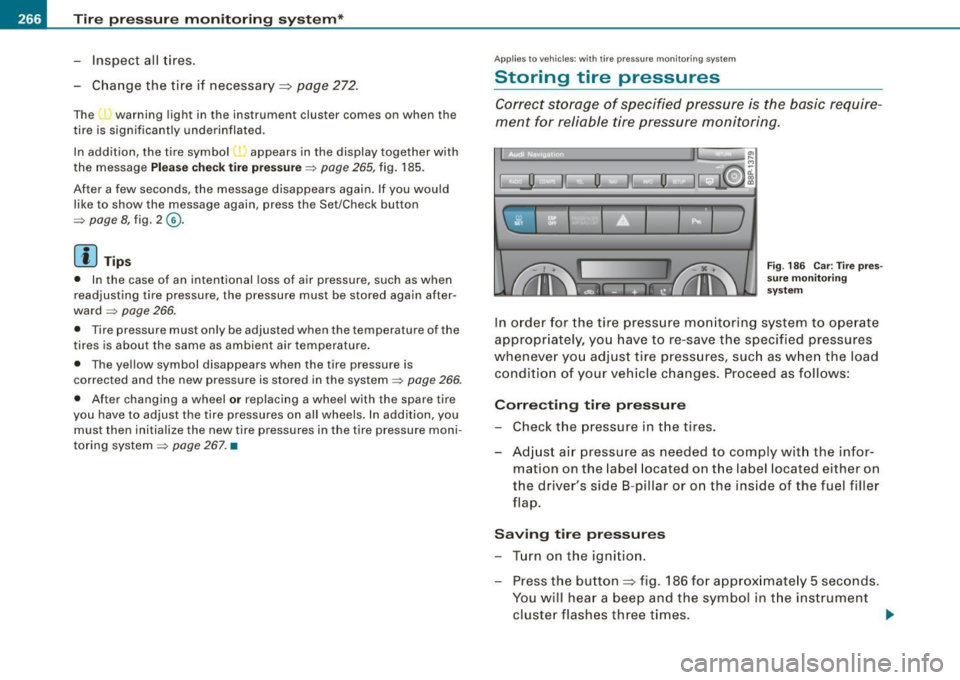
In order for the tire pressure monitoring system to operate
appropriately, you have to re-save the specified pressures
whenever you adjust tire pressures, such as when the load condition of your vehicle changes. Proceed as follows:
Correcting tire pressure
- Check the pressure in the tires.
- Adjust air pressure as needed to comply with the infor- mation on the label located on the label located either on
the driver's side 8 -pillar or on the inside of the fuel filler
flap .
Saving tire pressures
-Turn on the ignition.
- Press the button~ fig. 186 for approximately 5 seconds.
You will hear a beep and the symbol in the instrument
cluster flashes three times. ..,.
Page 284 of 324
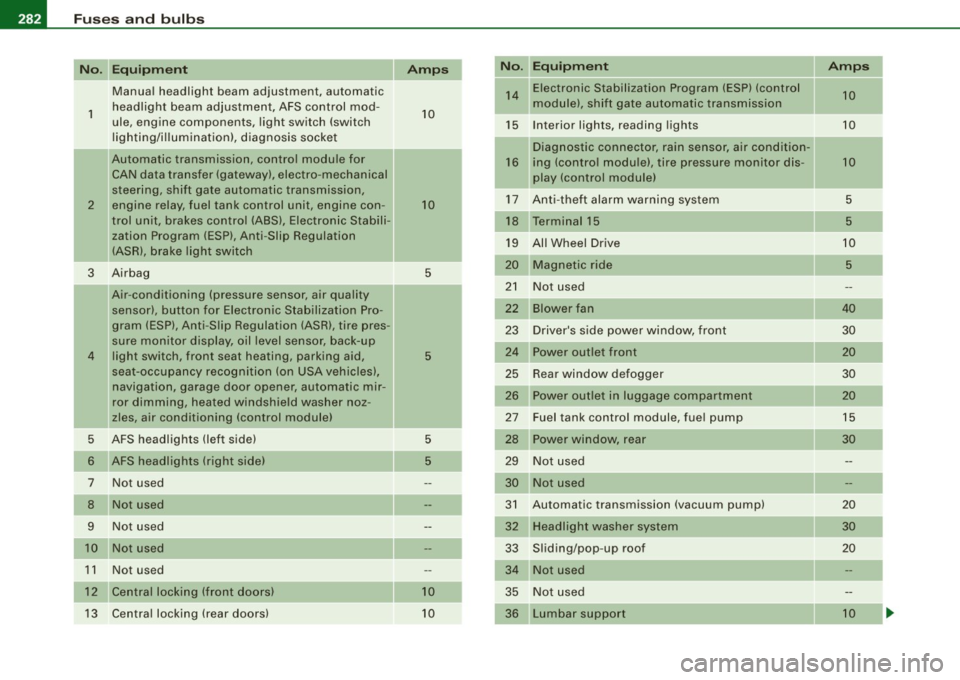
11111.___F_ u_ s _ e_s _ a_n _ d_ b_ u_lb _ s _______________________________________________ _
Equipment Amps No. Equipment Amps
Manual headlight beam adjustment, automatic 14 Electronic Stabilization Program (ESP) (control
10
1 headlight beam adjustment, AFS control mod-
10 module),
shift gate automatic transmission
ule, engine components, light switch (switch
15 Interior lights, reading lights 10
lighting/illumination), diagnosis socket
Diagnostic connector, rain sensor, a ir condit ion-
!! Automatic transmission, control module for
16 ing (control module), tire pressure monitor dis- 10
CAN data transfer (gateway), electro -mechanical
play (control module)
steering, shift gate automatic transmission, 17 Anti-theft alarm warning system 5
2 engine relay, fuel tank control unit, engine con
-10
trol unit, brakes control (ABS), Electronic Stabili- 18 Terminal 15
5
zation Program (ESP), Anti -Slip Regulation
19 All Wheel Drive
10
(ASR), brake light switch
-20 Magnetic ride 5
3 Airbag
5
-21 Not used
Air -conditioning (pressure sensor, air quality
sensor), button for Electronic Stabilization Pro- 22
Blower fan 40
gram (ESP), Anti -Slip Regulat ion (ASRl, tire pres -
23 Driver's side power window, front 30
sure mon itor display, oil level sensor, back-up
4 light switch, front seat heating, parking aid, 5 24 Power outlet front
20
seat-occupancy recognition (on USA vehicles), 25 Rear window defogger 30
navigation, garage door opener, automatic mir- 26 Power outlet in luggage compartment 20
ror dimming, heated windshield washer noz-
zles, air conditioning (control module) 27 Fuel tank control module, fuel pump 15
5 AFS headlights (left side)
5 28 Power
window, rear
30
6 AFS headlights (r ight side) 5 29 Not used
7 Not used 30 Not used
8 Not used 31 Automatic transmission (vacuum pump)
20
9 Not used 32 Headlight washer system 30
10 Not used
33 Sliding/pop-up roof
20
1 1 Not used 34 Not used
12 Central locking (front doors} 10 35 Not used
13 Central locking (rear doors) 10
36 Lumbar
support 10
Page 306 of 324
__ _.:C~ o'...'..n~ s~ u'..'..m ~ e~ r~ ln'....'...'.. f.::: o '...'..r ~m ~ a:_: t:.:. i.:::o '...'..n..:__ _____________________________________________ _
Maintenance
General
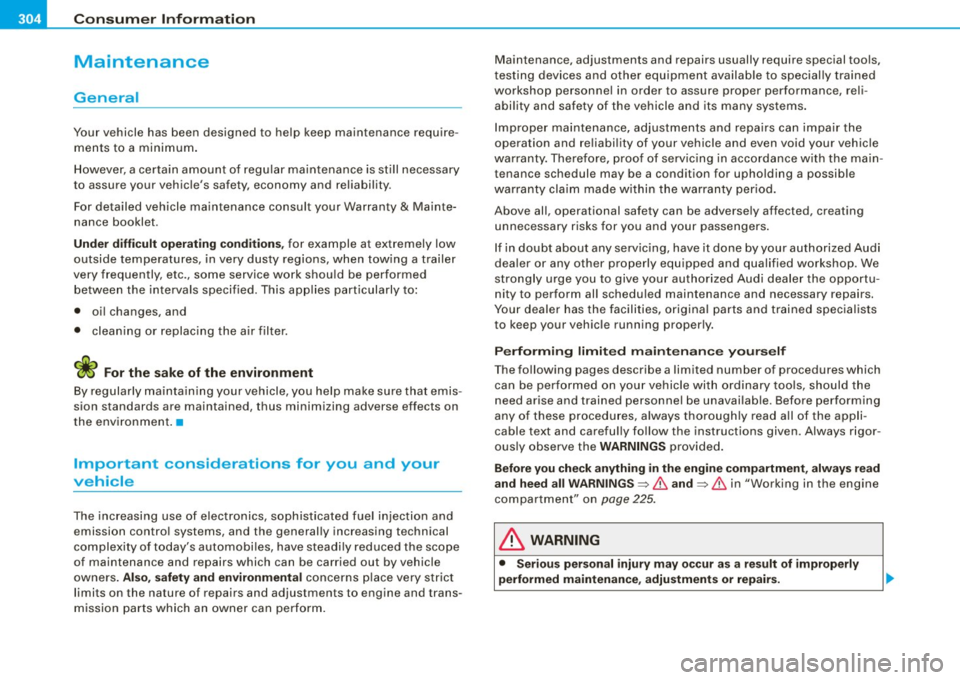
Your vehicle has been designed to help ke ep maintenance require
ments to a mi nim um .
Ho weve r, a certain a mount of regu lar maintenance is still necessary
to assure your vehicle's safety, economy and reliability.
For detailed vehicle maintenance consult your Warranty
& Main te
nance booklet.
Under d iffi cult op erating cond ition s, for example at extremely low
outside temperatures, in very dusty regions, when tow ing a trailer
very frequently, etc., some service work shou ld be performed
between the intervals specified. This app lies particularly to :
• oil changes, and
• clean ing or replac ing the air filter .
sion standards are maintained, thus minimizing adverse effects on
the environment .•
Important considerations for you and your
vehicle
The increasing use of electronics, sophisticated fuel injection and emission control systems, and the general ly increasing technical
complexity of today's automobi les, have steadily reduced the scope
of maintenance and repairs which can be carried out by vehicle
owners .
Also , safety and environm ental concerns p lace very s trict
limits on the nature of repairs and adjustments to engine and trans
mission parts which an owner can perform . Maintenance, adjustments and repairs usually require special tools,
t esting devices and other equipment availab le to special ly trained
workshop personne l in order to assure proper performance, reli
abi lity and safety of the vehicle and its many systems .
I mproper maintenance, adjustments and repa irs can impa ir the
operation and re liability of your vehicle and even void your vehic le
wa rranty. Therefore, proof of se rvic ing in accordance w ith the ma in
tenance schedule may be a condition for upholding a possible
war ranty claim made within the warranty period.
Above all, operational safety can be adverse ly affected, creating
unnecessary risks for you and your passengers .
I f in doubt about any servicing, have it done by your authori zed Audi
dea ler or any other properly equipped and qualified workshop . We
strongly urge you to give your authorized Audi dealer the opportu
nity to perform all schedu led maintenance and necessary repairs.
Your dealer has the facilities, origina l parts and trained special ists
to keep your vehicle running proper ly.
Performing limited ma intenan ce your self
The following pages describe a limited number of procedures which
can be performed on you r vehicle wi th ordinary too ls, should the
need arise and trained personnel be unavailab le . Before performing
any of the se procedu res, a lways thorough ly read a ll of the appli
cable text and carefu lly fo llow the instructions given . Always rigor
ous ly observe the
WARNINGS provided .
Before you check anything in the engine compartment , alway s re ad
and heed all WARNINGS=>
& and=> & in "Wo rking in the engine
compartment" on
page 225.
& WARNING
• Seriou s per son al injury may oc cur as a result of improperly
performed maintenan ce, adjustment s or repairs .
Page 309 of 324

_______________________________________________ C _o_ n _ s_u _ m_ e_ r_l_n _f_o _ r_ m_ a_ t _i _o _ n __ PII
Authorized Audi dealers will perform this work in a professional and
competent manner or, in special cases, refer you to a professional
company that specializes in such modifications.
& WARNING
Improper repairs and modifications can change the way vehicle
systems work and cause serious personal injury.
0 Note
If emergency repairs must be performed elsewhere, have the
vehicle examined by an authorized Audi dealership as soon as
possible. •
Declaration of Compliance ,
Telecommunications and Electronic Systems
Radio Frequency Devices and Radiocommunication
Equipment User Manual Notice.
The manufacturer is not responsible for any radio or TV interference
caused by unauthorized modifications to this equipment.
Devices
The following devices each comply with FCC Part 15.19, FCC Part
15.21 and RSS-Gen Issue 1:
• Cell phone package
• Electronic immobilizer
• Homelink® universal remote control
• Remote control key
• Tire pressure monitoring system*
FCC Part 1 5.19
This device complies with part 15 of the FCC Rules. Operation is
subject to the following two conditions:
Controls and equip ment Safety first Vehicle operation
(1)
This device may not cause harmful interference, and
(2) this device must accept any interference received, including
interference that may cause undesired operation.
FCC Part 1 5.21
CAUTION:
Changes or modifications not expressly approved by the party
responsible for compliance could void the user's authority to
operate the equipment.
RSS-Gen Issue 1
Operation is subject to the following two conditions:
(1) this device may not cause interference, and
(2) this device must accept any interference, including interference
that may cause undesired operation of the device. •
Vehicle care Do-it-yourself service Tec hn ica l da ta
Page 310 of 324
___ A_l.:,. p _h_ a_ b_e _t _ic _ a_l _in _ d_e _x ____________________________________________ _
A
ABS
See Anti-lock brake system
ABS (Anti-lock brake system) 194
Wa rning/indicato r lights .. ... .... .. 16
Accessori es . . . . . . . . . . . . . . . . . . . . . . . . 305
Adapter for anti-theft wheel bo lts . . . . . 275
Adaptive Light Air conditioning
Switching on and off
Air distribution 101
Climate controls .. ...... .... ... .. 103
Air outlets
Adjusting the outlets for rapid Side airbags
... .... .... ... .. ..... 163
Side curtain airbags ....... .... .. . 166
When must the system be inspected? ...
158
All Whee l Drive . ...... .... .......... 196
Alloy wheels ....... ... .... ...... ... 212
defrosting/defogging .... .... ... .
104 All -whe el drive
Climate controls .. .... .... .... ... 104
Winter tires ... ... ... .. ...... .... 260
Air quality sensor . . . . . . . . . . . . . . . . . . . 102
Alternator
defective ....................... . 34 Air recirculation
....... .. .... ....... 103
See Generator . . . . . . . . . . . . . . . . . . . . 14
Adaptive light . . . . . . . . . . . . . . . . . . . . . . . 55
Adding Engine coolant ... .... .... ....... 234
Engine oil . ................... ... 230
Windshield washer fluid .... ...... 241
Additiona l accessories .... ...... ... .. 305
Additives Engine oil .... .... ... ... ... .. .... 230
Adjustable steering whee l column ..... 107
Adjusting Steering wheel column .... ... .... 107
Adjusting front seats ............. ... . 74
Advanced Airbag System Children . ... .. .... .... ..... ..... 170
Components ...... .... ......... . 154
Front airbags ......... .... ....... 152
How the components work together 155
Monitoring . . . . . . . . . . . . . . . . . . . . . . 158
PASSENGER AIR BAG OFF ligh t .. ... 159
W eight -sensing mat .. .. .. .... .... 170
Air conditioner . . . . . . . . . . . . . . . . . . . . . 101
See also Climate controls . . . . . . . . . . . 98 Climate controls
.... . ......... ... 102
When should I use the air recirculation?
102
Air r ecirculation mode
Clima te controls .. ...... .... ... . . 102
Airbag Warning /indicator lights ....... .... 14
Airbag system .... .... .... .... .. 147, 164
Advanced Airbag System .......... 151
Care . . . . . . . . . . . . . . . . . . . . . . . . . . . . 161
Child restraints .. ... ... .... .... .. 171
Components (front airbags) ..... ... 154
Danger of fitting a chi ld safety seat on the
front passenger seat . .... .... ... 149
Disposal . .... .... ...... .... ... .. 161
Front airbags . ... .. ..... ... .. ... . 151 Aluminum alloy wheels
...... .... .... 212
Amb ient lighting .. ... .... .... .... .... 61
Anti-glare inside day-night mirror .... .. 69
An ti-lock brake system
How the ABS system works ........ 194
Anti -lock brake system (ABS )
Warning /indicator lights ... .... .... . 16
Anti-Slip Regulation System (ASR) How the system works . . . . . . . . . . . . 192
An ti-theft sys tems
An ti-Theft Alarm System .. . .. .. .... 45
Anti -theft wheel bolts ..... .... .... ... 275
Armrest Center armrest ....... .. .. .. ..... .. 81
Rear armrest ................. .. .. 82
How do the front ai rrbags work? . . . . 156 Ashtray
How many airbags does my vehicle have?
154
Important things to know . ... .. ... 147
Indicator ligh t .... ... .. ..... .. ... 158
Monitoring . . . . . . . . . . . . . . . . . . . . . . 158
Repairs . . . . . . . . . . . . . . . . . . . . . . . . . 161 Rea
r .... ... .. .. ... ... .. .. ... ... .. 93
ASR How the Anti -Slip Regulation System
works ... .... .... .... ... .... ... 192
Page 312 of 324
___ A_l.:,. p _h_ a_ b_e _t _ic _ a_l _in _ d_e _x ____________________________________________ _
Cargo net .... .... ...... .. ... ..... ... 85
Catalytic converter . . . . . . . . . . . . . . . . . . 198
Center armrest . . . . . . . . . . . . . . . . . . . . . . 81
Centigrade Switching between Centigrade and Fahrenheit ..................... 103
Central locking panoramic sliding sunroof closing .. . 49
Certification . . . . . . . . . . . . . . . . . . . 268, 307
Changing a flat tire ...... .... ....... 272
Changing engine oi l .. .... .... .... ... 231
Chassis Undercoating . . . . . . . . . . . . . . . . . . . . 213
See also Audi magnetic ride
Checking 115
Engine coolant level .. .... .... .... 233
Checking tire pressure ...... ........ . 250
Child restraint
Danger of using child restraints in the
front seat . . . . . . . . . . . . . . . . . . . . . . 149
Child restraints What types of child restraint anchors are available? ... .... .... ......... . 182
Where can I get additional information
about child restraints? ... .... .... 183
Child safety ...... ... .... .... ... 169, 174
Additional information .... .... .... 186
Booster seats . . . . . . . . . . . . . . . . . . . . 177
Convertible child safety seats . . . . . . 175
Convertible locking retractor . . . . . . . 179
Important safety instructions for using child safety seats .. ......... .... 172 Important things to know when driving
with children ................... 169
Infant seats ..................... 174
Installing a child restraint using the
LATCH system . . . . . . . . . . . . . . . . . . 185
Lower anchorages . . . . . . . . . . . . . . . . 184
Mounting and releasing the anchorage
hook .... .... ... ........ .... ... 186
Older children and safety belts . .... 178
Safety belts and ol dler children .... . 178
Tether anchors .... .... .... ... ... 186
Tether strap .... ... .... .... .... .. 187
Which restraint system should my o lder
child wear? .. .... .... .... ...... 178
Child safety lock ..................... 44
child safety seat LATCH system . .... .... .... .... .. 185
Child safety seats ... ........... ..... 174
Convertible locking retractor . ...... 179
How do I properly install a child safety
seat in my vehicle? .. ...... .... .. 172
Installing .... ...... ... .... .... .. 179
Safety instructions . . . . . . . . . . . . . . . 172
Cleaning Alcantara (synthetic suede) . .... ... 216
Engine compartment ... .... ...... 217
Fabrics and fabric coverings ..... .. 213
Instrument panel .. ... .. .... .... .. 214
Interior .. .... .... ..... .... .... .. 213
Leather .. .... ... .......... ...... 215
Plastic and vinyl ................. 210
Plastic parts ............... ... ... 214
Safety belts .. .... .... ... ..... ... 217 Trim
strips .... ........ .. . .. .. .. . 209
trim strips .. .... .... ... .... .... .. 210
Cleaning and protection ............. 206
Climate controls .. ........ .... .... ... 98
Air distribution .... .... ... .... ... 103
Air outlets ... .. .... .... .... ...... 104
Air recirculation ... ...... ... ...... 103
Air recirculation mode (manual) ... . 102
AUTO (standard setting) .. .... ... .. 101
Automatic air recirculation ........ 102
Controls . ........... .. .... .... .. 100
Defrosting/defogging .. ........ ... 101
Description .... ........ ....... .... 98
Fan ........ ... .. .... .... .... ... 103
Key-coded setting ..... ... . ....... 105
Recommended settings .... .... .... 98
Setting the temperature .... .... ... 101
Switching between Fahrenheit and
Centigrade ... .... .... ... .... ... 103
Switching the air conditioning on and off 101
Using the climate control economically . .
104
Warm and cold ... .... .... .... ... . 98
Clock . .... .... ............... ........ 9
Coat hooks . . . . . . . . . . . . . . . . . . . . . . . . . . 97
Co ld tire inflation pressure . ..... ... .. 247
Coming -home -function .. ...... ... ... . 56
Compartments in the door trims ... ... . 96
Compass mirror .. .... ....... .... .... 72
Compliance ........................ 307
Consumer Information .......... . 135, 303
Contacting NHTSA ... .... .... .... ... 135
Page 318 of 324
___ A_l.:,. p _h_ a_ b_e _t _ic _ a_l _in _ d_e _x ____________________________________________ _
Passive safety system . . . . . . . . . . . . . . . 126
Pedals . .... ... .. .... .... .... ...... 132
Physical p rinciples of a frontal collision 138
Polish ing ... ... ... .. ... .... .... .... 209
Power locking switch .. ... .... ...... .. 41
Rear center console ... ........ .... 42
Power locking system . . . . . . . . . . . . . . . . 37
Convenience close/open feature .. ... 47
Locking and unlocking the vehicle from inside ... .... ... .... .... ..... .. . 41
Opening and closing the windows .. . 47
Operating locks from with k ey . ..... 40
Rear lid .. .. .. .. .. .... .... ...... .. 42
Remo te control . . . . . . . . . . . . . . . . 36, 39
Un locking and locking vehicle .. ... .. 39
Power outlets . . . . . . . . . . . . . . . . . . . . . . . 93
Power seat Adjusting the seatback ..... ........ 77
Adjustment . ...... .... .... ... .... 76
Power steering
See Electro-mechanical power assist . 16 ,
195
Power sunroof
See panoramic sliding sunroof .... .. 48
Power window switches . . . . . . . . . . . . . . 46
In the driver's door ................ 46
Reactivating the system . . . . . . . . . . . . 48
Pregnant wom en
Special considerations when wearing a safety belt . . . . . . . . . . . . . . . . . . . . . 143
Proper occupant sea ting posi tions .... 128
Proper safety belt position . . . . . . . . . . . 142 Proper seating position
Front passenger . . . . . . . . . . . . . . . . . 129
Occupants .... ...... .... ... .. ... 128
Rear passengers 130
a
Quartz clock ...... ..... .. .... .... .... . 9
quattro®
See All Wheel Drive . . . . . . . . . . . . . . . 196
Question
R
What happens to unbelted occupants? ..
139
Why safety belts? . . . . . . . . . . . . . . . . 137
Radiato r fan . .... .... ...... .... .... . 235
Radio Replacing . .... ... .... .... .... ... 306
Rain sensor defective ... ... .... ... .... 34
Reading light
Rea r ..... ..... ...... .... .... .... . 61
Reading lights
Front ..... ..... ... .... ... .... .... 60
Rea r ... ... .... ... ... .. ...... ..... 60
Rear armrest .... ... .. .... .. .. ... .... 82
Rea r ashtray . .... ...... .... ... .. .... 93
Rear lid
Emergency release .... .... .... .... 43
Lock ing/unlocking . ... .. ....... ... . 42
Rear light defective . . . . . . . . . . . . . . . . . . 33
Rear power locking switch ... .... .... . 42 Rear seat bottom
...... .. .... .... .. . . 83
Rear view mirror
Inside rear view mirror ............ . 69
Rear window defogger with air-conditioning ... ... .. ..... 105
Refuelling ....... .... .... ...... ..... 221
Release lever for engine hood ..... .... 224
Remo te con trol . ...... .. .. ... ..... .. . 36
Resetting remote control ... .... .... 40
Un locking and locking . .... .... ... . 39
Remote mast er key
Ba ttery replacement ............... 36
Check light .... .... .... ..... .. ... . 36
Repair manuals ... .... ... .... .... .. . 303
Repairs Airbag system .... .... .... .... ... 161
Replacing Wheel rims . ... .... .... .... .. 255, 257
Replacing a fuse ... ... ....... .... ... 280
Replacing a sound system . .... .... ... 306
Replacing light bulbs . ...... .. .... ... 285
Replacing tires and wheels ........... 256
Reporting Safety Defects .. ....... 135, 136
Reset but ton . . . . . . . . . . . . . . . . . . . . . . . . 10
Resetting remote control ...... .... .... 40
Retractor . . . . . . . . . . . . . . . . . . . . . . . . . . 141
Reverse Automatic transmission .... .... .. . 117
Reversible cargo area floo r ........ .... 87