battery AUDI S3 2009 Owner's Manual
[x] Cancel search | Manufacturer: AUDI, Model Year: 2009, Model line: S3, Model: AUDI S3 2009Pages: 324, PDF Size: 76.02 MB
Page 229 of 324
_____________________________________________ C_h_ e_ c _ k_in -= g_a _ n_d _ f_il _li _n ..;::g =--____.•
© Brake fluid reservoir ( ) . ....... ... ............ .
© Battery .. ... ................................. .
& WARNING
Before you check anything in the engine compartment, always
read and heed all WARNINGS
~ & in "Working in the engine
compartment" on
page 225. •
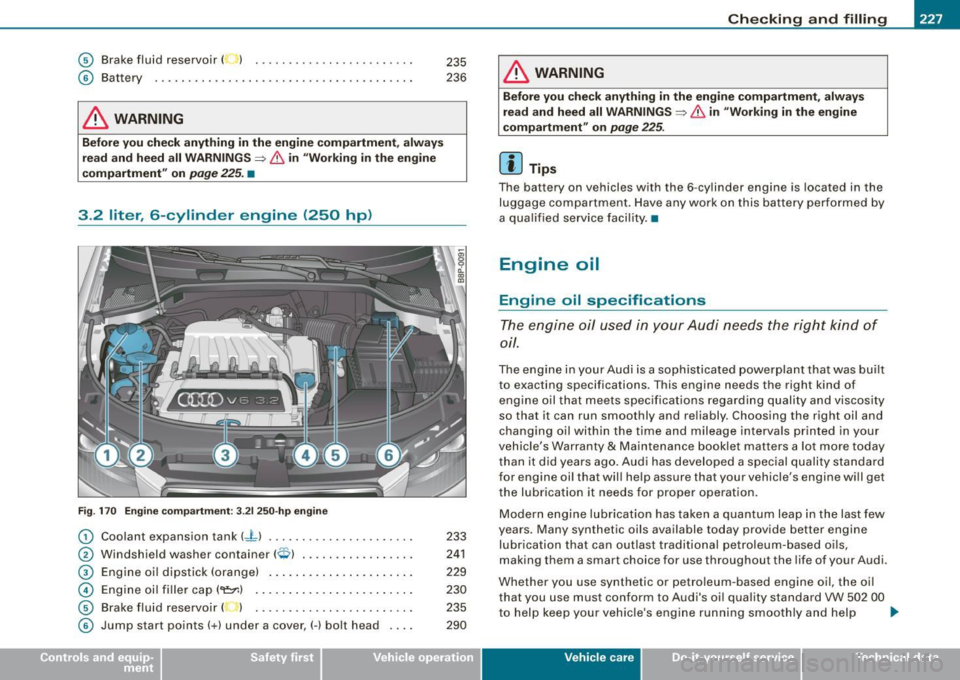
3.2 liter , 6 -cylinder engine (250 hp)
Fig. 170 Engine compartment: 3.21 250-hp engine
G) Coolant expansion tank (-L ) ................. .... .
@ Windshield washer container (,$ ) . ... ... .. .... ... .
@ Engine oil dipstick (orange) ...... ... ... .... .. ... .
© Engine oil filler cap ("1::r.) ..... .... .............. .
© Brake fluid reservoir ( ) . ...... ...... .......... .
© Jump start points(+) under a cover,(-) bolt head ... .
235
236
233
241
229
230
235
290
& WARNING
Before you check anything in the engine compartment, always
read and heed all WARNINGS
~ & in "Working in the engine
compartment" on
page 225.
[ i] Tips
The battery on vehicles with the 6-cylinder engine is located in the
luggage compartment. Have any work on this battery performed by
a qualified service facility.•
Engine oil
Engine oil specifications
The engine oil used in your Audi needs the right kind of
oil.
The engine in your Audi is a sophisticated powerplant that was built
to exacting specifications . This engine needs the right kind of
engine oil that meets specifications regarding quality and viscosity
so that it can run smoothly and reliably. Choosing the right oil and
changing oil within the time and mileage intervals printed in your
vehicle's Warranty
& Maintenance booklet matters a lot more today
than it did years ago. Audi has developed a special quality standard
for engine oil that will help assure that your vehicle's engine will get
the lubrication it needs for proper operation .
Modern engine lubrication has taken a quantum leap in the last few
years. Many synthetic oils available today provide better engine
lubrication that can outlast traditional petroleum-based oils,
making them a smart choice for use throughout the life of your Audi .
Whether you use synthetic or petroleum-based engine oil, the oil
that you use must conform to Audi's oil quality standard VW 502 00
to help keep your vehicle's engine running smoothly and help
ti,,,
Vehic le care I I irechnical data
Page 238 of 324
___ C_h_ e_ c_k _in --== g'-- a_n _d_ f_il _li _n ..:::g:::..- ___________________________________________ _
brake warning/indicator light will illuminate . Contact an authorized
Audi dealer
i m medi at ely.•
Changing brake fluid
Have the brake fluid changed by an experienced techni
cian.
Brake fluid absorbs moisture from the ai r. If the water content in the
brake fluid is too high, corrosion in the brake system may result
after a period of time. The boiling point of the brake fluid wil l also
decrease considerably and decrease braking performance .
Therefore, the brake fluid must be changed
e ver y two years. Always
use new brake fluid which conforms to Federa l Motor Vehicle Stan
dard "FMVSS 116 DOT 4" .
The brake fluid reservoir can be difficu lt to reach , therefore, we
recommend that you have the brake fluid changed by your autho
rized
Audi d ealer. Your dealer has the correct tools, the right brake
fluid and the know-how to do this for you.
& WARNING
• Bra ke fluid i s poisonous . It mu st be stored on ly in the close d
ori ginal container out of the rea ch of children!
• Bra ke fa ilure can result from old or inappropri ate brake fluid .
Observe the se pre caution s:
- Use o nly brake fluid that meets SAE spe cifi ca tion
J 170 3 and
c onform s to Fed era l Moto r Vehic le Sta nda rd 116 . Always c heck
w ith your authori zed Audi de aler to m ake sure you are using
the correct brake fluid. The corr ect type of brake fluid i s als o
indi cated o n the br ake fl uid reser vo ir.
- The br ake flu id mu st be ne w. Hea vy use of the brake s can
c au se a vap or lo ck if the bra ke fluid i s left in the system too
long. Thi s can seriou sly affect the efficienc y of the brake s as
we ll as your safet y. Thi s co uld re su lt in an acci dent .
0 Note
Brake fluid wi ll damage the paint of your vehicle .
<£' For the sake of the environment
Because o f the problem of prope r disposal of brake flu id as we ll as
the special tools required and the necessary expertise, we recom
mend that you have the brake fluid changed by your authorized Audi
dea ler. •
Battery
General information
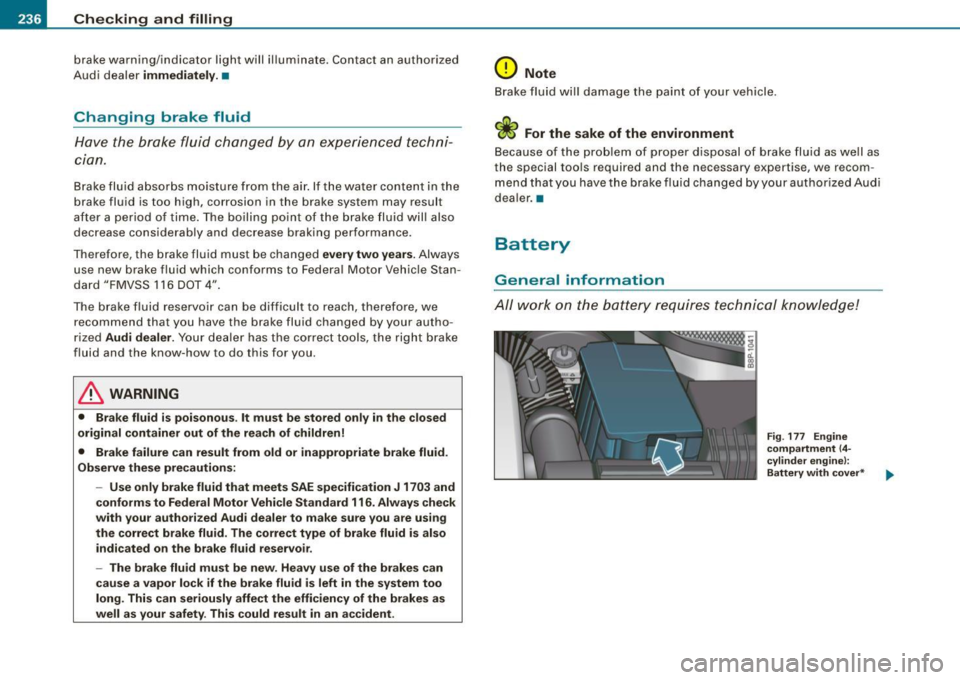
All w ork on the battery requires technical knowledge!
Fi g. 177 E ng ine
co mp artm ent (4 -
c yli nder engin e):
Bat tery w it h cove r"
Page 239 of 324
_____________________________________________ C_h_ e_ c _ k_in -= g_a _ n_d _ f_il _li _n ..;::g =--____.•
N
~ a:. 00 m
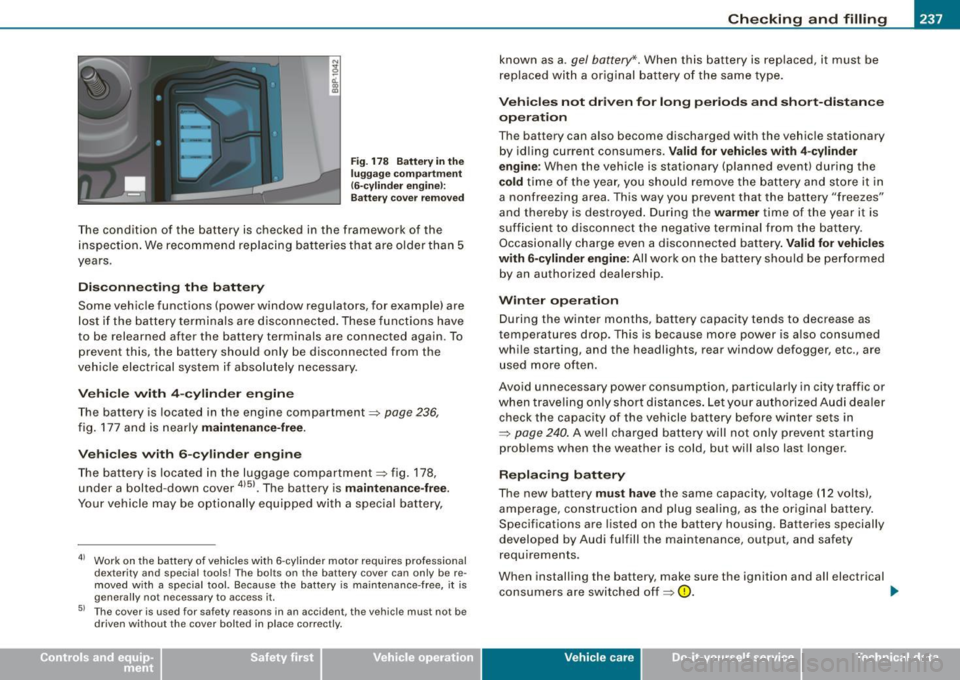
F ig . 178 Battery in the
lugg ag e co mpartme nt
(6-c ylind er eng ine !:
Ba tter y cove r remo ved
T he condition of the battery is checked in the framework of the
inspection . We recommend rep lacing bat teries that are older than 5
years .
Disconnecting the battery
Some vehic le functions (power window regu lators, for example) are
lost if the battery terminals are disconnected . These functions have
to be relearned after the battery terminals are connected again. To
prevent this, the battery should only be disconnected from the
veh icle electr ical system if absolutely necessary.
V ehicle with 4 -cylind er engin e
The battery is located in the engine compartment~ page 236,
fig. 177 and is nearly maintenance -free.
Vehi cle s with 6 -cylinder engine
The bat tery is loca ted in the luggage compartmen t=:> fig . 178,
under a bolted-down cover
4151 • The battery is maintenan ce -free .
Your ve hicle may be optionally equipped with a special battery,
41 Wor k on the battery of vehicles with 6-cy linder motor requires professional
dexterity and special tools! The bolts on the battery cover can only be re
m oved w ith a s pecial tool. Because the batte ry is ma in tenance -free, it is
genera lly not necessary to access it.
51 The cover is used for safety reasons in an acc ident, the vehicle must not be
driven without the cover bolted in place correctly.
known as a. gel battery* . When this battery is replaced, it must be
replaced wi th a or iginal bat tery o f th e same type.
Vehicles not dri ven for long periods and short-distance
operation
The battery can a lso become discharged with the vehicle stationary
by id ling current consumers .
Valid for vehicles with 4 -cylinder
engine :
When the vehic le is stationary (planned event) during the
cold time of the year, you sh ould remove the battery an d store it in
a nonfreezing area. This way you prevent that the battery "freezes"
and thereby is destroyed . During the
warmer time of the year it is
suff icient to disconnect the negative terminal from the battery .
Occasiona lly charge even a disconnected battery .
Valid for veh icles
with 6 -cylinder engine:
All wor k on the ba ttery should be per formed
by an authorized dealership.
Winter op eration
During the winter months, battery capacity tends to decrease as
temperatures drop. This is because more power is a lso consumed
while starting, and the headlights, rear window defogger, etc., are
use d more often .
Avoid unnecessary power consumption, particularly in city traffic or
wh en trave ling on ly shor t distances . Let you r au thor ize d Audi dea ler
check the capacity of the vehicle battery before winter sets in
~ page 240 . A well charged battery will not on ly prevent sta rting
problems when the weather is cold, but wi ll a lso last longer .
Replacing battery
The new battery must have the same capacity , vo ltage (12 volts),
a m perage, con struction and plug sea ling, as t he origina l battery.
Specifications are listed on the battery housing. Batteries specially
developed by Audi fulfill the maintenance, output, and safety
requirements.
When installing the battery , make sure the ignition and all electrical
co nsumers are switche d off ~
0. ..,
Vehicle care I I irechnical data
Page 240 of 324
-~_C_ h_e _c _ k_ i_n ...:::g::;...._ a_n_ d_ f_ i_ll _in -'g:::;.._ ___________________________________________ _
We recommend that you use maintenance-free or cycle-resis
tant/leak-proof batteries according to the standards TL 825 06 (from
December 1997) and VW 7 50 73 (from August 2001 ).
Replacing the battery on vehicles with the 6-cylinder engine (battery
in the luggage compartment) should be carried by a qualified work
shop. On vehicles with the 6 -cylinder engine, please follow the
instructions on the battery cover.
0 Note
• All work on the battery requires technical knowledge. Please
contact an Audi dealership or another authorized facility for ques
tions about the battery -danger of acid burns and explosion hazard!
• Th e battery must not be opened! Do not try to change the
battery's liquid level, otherwise detonating gas will escape from the
battery -explosion hazard!
• The AGM battery in the luggage compartment cannot leak,
because the electrolyte for this battery is absorbed into a special
glass mat. This leak-proof battery must not be replace with a
conventional battery .
• Make sure the ventilation hose on the side of the battery is
connected, otherwise fumes or battery acid can leak out.
• Battery holder and terminals always have to be secured correctly.
• Before all work on the battery follow the warnings below::::,
& in
"Wor king on the battery" on page
238.
W For the sake of the environment
Because of the problem of proper disposal of a battery, we recom
mend your authorized Audi dealer change the battery for you.
Batteries contain sulfuric acid and lead and must always be
disposed of properly in compliance with all environmental regula
tions . Disposing of vehicle batteries improperly is very dangerous to
the environment. Make sure that the removed battery cannot over
balance, otherwise sulfuric acid might escape! •
Working on the battery
All work on the battery requires technical knowledge! Be
especially careful when working on or near the battery!
Before you check anything in the engine compartment,
always
read and heed all WARNINGS :::;, & in "Working in
the engine compartment" on
page 225.
Always heed the safety warnings, when working on the vehicle
battery or the vehicle electrical system to prevent injury.
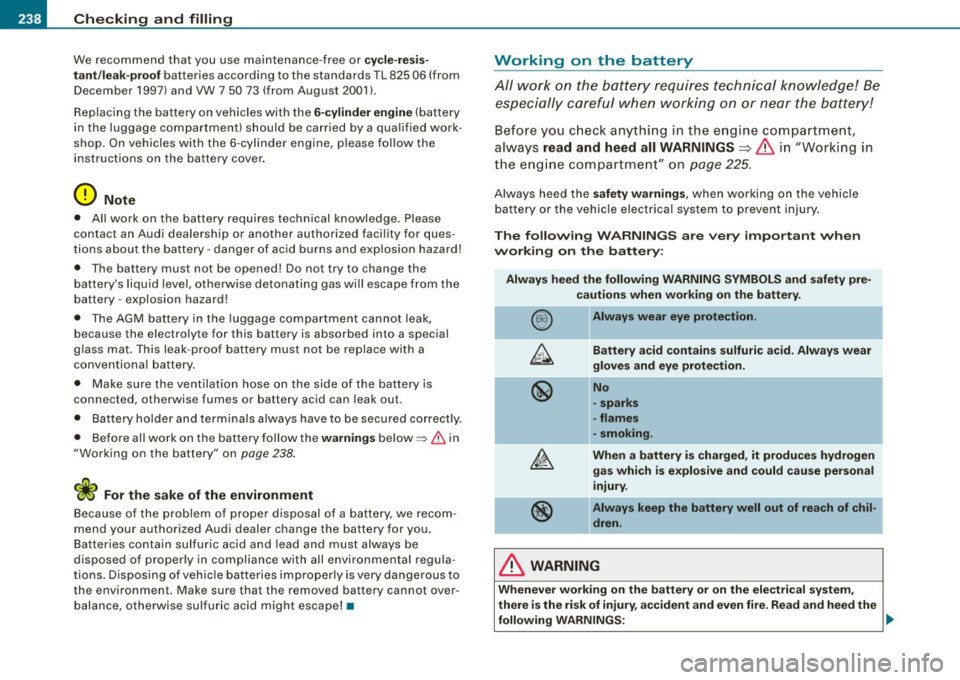
The following WARNINGS are very important when
working on the battery:
Always heed the following WARNING SYMBOLS and safety pre cautions when working on the battery.
@
Always wear eye protection.
Battery acid contains sulfuric acid. Always wear
gloves and eye protection.
No
- sparks
- flames
- smoking.
When a battery is charged, it produces hydrogen
gas which is explosive and could cause personal
injury.
Always keep the battery well out of reach of chil
dren .
& WARNING
Whenever working on the battery or on the electrical system,
there is the risk of injury, accident and even fire. Read and heed the
following WARNINGS:
~
Page 241 of 324
___________________________________________ C_ h_e _c_ k_ i_n _g _ a_n _d_ f_il _li _n _g __ lR
•
& W ARNING (continu ed )
• Always wear eye protection. Do not let battery acid or any lead
particles get on your skin or clothing . Shield your eyes. Explosive
gases can cause blindness or other injury !
• Battery acid contains sulfuric acid . Sulfuric ac id can cause
blindness and severe burns .
- Always wear gloves and eye protection. Do not tilt the
battery because acid could leak out of the ventilation openings.
- If you get battery acid in your eyes or on your skin , immedi
ately rinse with cold water for several minutes and get medical
attention .
- If you should ingest any battery acid , seek medical attention
immediately .
• Do not expose the battery to an open flame , electric sparks or
an open l ight .
• Do not smoke.
• Do not interchange the positive and negative cables .
• When working on the batte ry , be sure not to short -circuit the
terminals with tools or other metal objects . This would cause the
battery to heat up very quickly , whi ch could lead to damage or
explosion and personal injury .
• When a battery is charged , it produces hydrogen gas which is
explosive and could cause personal injury .
• Always keep the battery well out of the reach of children .
• Before work is done on the electrical system, disconnect the
negat ive ground cable .
• Before performing any work on the electrical system , switch off
the engine and ignition as well as any electrical equipment . The
negative cable on the battery must be disconnected . If you are just
going to replace a light bulb , then it is enough to switch off the
lights.
• Before disconnecting the battery , sw itch off the anti-theft
alarm sy stem! Otherwise you will set off the alarm.
& W ARNING (continued )
• When disconnecting the battery, first disconnect the negative
cable and then the positive cable.
• Before reconnecting the battery , make sure all electrical
consumers are switched off. Reconnect the positive cable first and
then the negative cable . Never interchange the cables -this could
start a fire!
• Never charge a frozen or a thawed -out battery. It could
explode!
If a battery has frozen , then it must be replaced . A
discharged battery can freeze over at 32 °F (0 °CI.
• Make sure the vent hose is always atta ched to the opening on
the side of the battery.
• Never use batteries which are damaged . There is the danger of
an explosion! Always replace a damaged battery .
& WARNING
California Proposition 65 Warning:
• Battery posts , terminals and related accessories contain lead
and lead compounds , chemicals known to the State of Californi a
to cause cancer and reproductive problems . Wash hands after
handling.
0 Note
• D o not d iscon nect the veh ic le bat tery w hen the ign it io n i s
switched on or when the engine is ru nning, otherwise, you wi ll
da mag e ele ctro nic c ompo nents in the e lectr ical system.
• Appl ies to vehic les with 4 -cylinde r engine: When working on the
eng ine, protec t th e batter y hous ing from ultrav iolet ( UV) rays by not
parking the vehicle in direct sun light .
• If y our veh icl e is goi ng to sta nd for a lo ng period o f time with out
being dr iven, protect the battery from "freezing", otherwise it will
b e dama ged and w ill t hen ha ve to be replaced .•
Vehicle care
I t •
Page 242 of 324
-~_C_ h_e _c _ k_ i_n ...:::g::;...._ a_n_ d_ f_ i_ll _in -'g:::;.._ ___________________________________________ _
Applies to vehicles: w ith 4-cy linder engine
Charging of battery (4 -cylinder engine)
All work on the battery requires technical knowledge!
A charged battery ensures good star ting performance. A
discha rged battery can
freeze at temperatures of only O °C.
A thawed battery must be replaced, as the battery housing may be cracked due to freez ing and could therefore leak
acid .
-Always read and heed all WARNINGS below=> & and
=> & in "Working on the battery" on
page 238.
-Sw itch off the ignit ion and all e lectr ica l co nsumers .
- Make s ure the a rea is we ll ven tilated when y ou c harge
the batte ry.
- Connec t cha rger cab les.
Charger cable s mu st alway s be
conne cted POSITIVE
G) to POSITIVE G) and NEGATIVE Q
to NEGATIVE Q.
- Switch on the charger.
- Make sure the charging rate is not over 6 amps.
- Turn off th e ch arge r=> & .
- Disconnect the c harger cables.
- Connect both battery cables to the battery if necessary -
first plus, then minus .
The battery must not be opened!=> 0 in "General information" on
page 236.
It is not necessary to remove the battery from the engine compart
ment, and it is also not necessary to disconnect the cables .
Normally, a battery shou ld be charged at no more than 10 percent
of its rated capacity. For example, a charging
current of 4.5 amps would be used on a
b attery rated at 45 Ah. Rated capacity of the battery in your vehic le
is listed on the battery housing.
The battery caps should
not be opened when charging a battery .
& WARNING
Charging a battery c an be dangerou s.
• Never ch ar ge a fro zen batt ery. It m ay ex pl ode be cause of g as
trapped in the i ce. Allow a fro zen battery to thaw out fir st.
• Do not reu se b atteries whic h w ere fro zen . The batter y housing
ma y hav e cra cked and weakened when the batter y fro ze.
• Charge the b atter y in a w ell vent ila ted area . K eep away from
open flame or e le ctric al s p a rk . Do not smoke . Hydrogen g as gener
a ted by t he b attery i s ex plo sive .
• To redu ce the dang er of e xplo sion , never connect o r di sconnect
c h arger cables while t he ch arger is operating .
• Fas t ch ar ging a batte ry is dang erou s and should only be
att empted by a comp etent techni cian with the proper equipment .
• Batter y ac id that m ay spill durin g ch arging should be wa shed
off with a solution of warm water and baking soda to neutr alize
the acid.
0 Note
Never use a fast charger as a booster to start the engine. This will
seriously damage sensitive electronic components, such as control
units, re lays, radio, etc ., as well as the battery charger.
[ i ] T ips
The veh icle battery must not be charged with a standard sma ll
charger that plugs into the cigarette lighter or out let. •
Page 243 of 324
_____________________________________________ C_h_ e_ c _ k_in -= g_a _ n_d _ f_il _li _n ..;::g =-- ____.•
Ap plies t o vehicles: w ith 6 -cylin d er engine
Charging of battery 6 -cylinder engine )
All work on the battery requires specialized knowledge!
The battery is maintenance-free and is inspected regu
larly as part of vehicle service.
If starting problems occur because the battery charge is too low,
this may indicate a defective battery. In this case we recommend
having a qualified workshop inspect and charge the battery or
replace it if necessary. A discharged battery can
freeze at tempera
tures of only O °C. A thawed battery must be replaced, as the battery
housing may be cracked due to freezing and could therefore leak
acid.
Charging the battery
Battery charging should be performed by a qualified workshop,
since batteries employing a special technology are used which
require current-limited constant voltage charging.
0 Note
The vehicle may be optionally equipped with a gel battery, which can only be charged at a constant current-limited voltage.
• To prevent damage to the battery and the electronics system, a
gel battery that is connected must under no circumstances be
charged with a quick charger.
[ i] Tips
The vehicle battery must not be charged with a standard small
charger that plugs into the cigarette lighter or outlet. •
Windshield washer container
Using plain water is not adequate for filling the wind
shield washer system.
Fig . 179 Engine
compartment : wind
shield washer fluid
container
The windshield washer fluid container is located on the
right side of the engine compartment~ fig. 179. The
washer fluid container is marked with the symbol %Pis on
its cap.
- Before you check anything in the engine compartment,
always
read and heed all WARNINGS~ & in "Working
in the engine compartment" on
page 225.
-Lift the filler cap tongue to add washer fluid. You can fill
the container to the top.
- Press the cap back onto the filler neck after filling the
container.
You can find the reservoir capacity in the table in~ page 300.
To prevent lime residue from building up on the spray jets, use
distilled water when refilling. Always add a glass cleaner solution
(with frost protection in the winter}. .,._
Vehicle care I I irechnical data
Page 247 of 324
________________________________________________ T_ i _r_e _s_ a_n_ d_ w_ h_ e_e _ l_s __ _
•
Groove
means the space between two adjacent tread ribs.
Load ra ting (code)
means the maximum load that a tire is rated to carry for a given
inflation pressure. You may not find this information on all tires
because it is not required by law.
M ax im um l oad ra tin g
means the load rating for a tire at the maximum permissib le infla
tion pressure for that tire.
Ma ximum l oaded v ehi cle weigh t
means the sum of:
(a) Curb weight
(b) Accessory weight
(c) Vehic le capacity weight, and
(ct) Production options weight
M ax im um (p er mi ssibl e) infl ati on pr essur e
means the maximum cold inflation pressure to wh ich a tire may be
inflated. Also ca lled "maximum inflation pressure."
Normal occ upa nt wei ght
means 150 lbs. (68 kilograms) times the number of occupants
seated in the vehicle up to the to tal seating capacity of your vehicle.
O ccupant di stributi on
means distribution of occupants in a vehicle .
Outer di am eter
means the overall diameter of an inflated new tire.
O ve rall wi dth
means the linear distance between the exteriors of the sidewa lls of
an inflated tire, includ ing elevations due to labeling, decorations, or
protective bands or ribs.
Pl y
means a layer of rubber -coated para lle l cords.
P rodu ction opt io ns wei ght
means the combined weight of those installed regular production
options weighing over 5 lbs . (2.3 kg) in excess of those standard
i t ems wh ich they replace, not previously considered in curb weigh t
or accessory weight, including heavy duty brakes, ride levelers, roof
rack, heavy duty battery, and specia l trim .
Radi al p ly tire
means a pneumatic tire in which the ply cords that extend to the
beads are laid at substantially 90 degrees to the centerline of the
tread .
Reco mm ended infl ati on pr essu re
see => page 244, "Cold tire inflation pressure".
Rein force d tir e
means a tire designed to operate at higher loads and at higher infla
tion pressures than the corresponding standard tire. Reinforced
t ires my be identified as "XL", "xi", "EXTRA LOAD", or "RF" on the
sidewall.
R im
means a metal support for a tire or a tire and tube assembly upon
wh ich the t ire beads are seated.
Rim di amet er
means nominal diameter of the bead seat. If you change your whee l
size, you wi ll have to purchase new tires to match the new rim diam
eter .
Rim siz e de sig nation
means rim diameter and width.
Rim wid th
means nominal distance between rim flanges.
Vehicle care I t •
Page 260 of 324
-~_T_ ir_e_ s_ a_ n_d _ w_ h_ e_e _l_s _________________________________________________ _
toring system* would not be able to monitor the tire pressure or
warn yo u if it is n ece ssa ry .
• The battery inside of t he ti re pressure sensor has a l imited
service life.
• Always driv e with the valv e stem caps s ecurely mount ed. We
r ecomme nd u sing fact ory insta lled valve s tem caps . As k your autho
rized Audi d ealer to replace lost va lve stem caps.
T he installation of rep lacement tires with steel cord body p lies in
the t ir e si dewa ll may caus e malf unc tio n of th e tir e pre ssure mo ni
toring system*, and is not recommended (cord material informat ion
in mo lded o n th e tire s idewa ll).
Always check your tire pressu re monitoring system* indicator after
r eplacing one o r more tir e s on yo ur veh icle . If the ti re p ressure
monito ring sy ste m* in dicato r flas hes or is illum inated, you r syste m
is not working p ro perl y. Yo ur replacement ti re might be incompat
i b le with you r tire p ressu re mo nitoring sys tem*, or some compo
nent of the tire pressure monitori ng system* may be damaged.
& WARNING
• Using incorrect or unmatched tires and I or wheels or improper
tire and wheel combinations can lead to loss of control , collision
and serious personal injury .
• Always use tires , rims and wheel bolts that meet the specifica
tions of original factory-installed tires or other combinations that
have been specifically approved by the vehicle manufacturer.
• Tires age even if they are not being used and can fail suddenly,
especially at high speeds . Tires that are more than 6 years old can
only be used in an emergency and then with special care and at
lower speeds .
• Never mount used tires on your vehicle if you are not sure of
their "previous history ." Old used tires may have been damaged
even though the damage cannot be seen that can lead to sudden
tire failure and loss of vehicle control.
& WARNING (continued)
• All four wheels must be fitted with radial tires of the same type,
size (rolling circumference ) and the same tread pattern. Driving
with different tires reduces vehicle handling and can lead to a loss
of control.
• If the spare tire is not the same as the tires that are mounted
on the vehicle - for e xample with winter tires - only use the spare
tire for a short period of time and drive with extra care . Refit the
normal road wheel as soon as safely possible.
• Never drive faster than the maximum speed for which the tires
on your vehicle are rated because tires that are driven faster than
their rated speed can fail suddenly .
• Overloading tires cause heat build-up , sudden tire failure ,
including a blowout and sudden deflation and loss of control .
• Temperature grades apply to tires that are properly inflated and
not over or underinflated .
• For te chnical reasons it is not always possible to use wheels
from other vehicles -in some cases not even wheels from the
same vehicle model.
• If you install wheel trim discs on the vehicle wheels, make sure
that the air flow to the brakes is not blocked. Redu ced airflow to
the brakes can them to overheat , increasing stopping distances
and causing a collision.
• Run flat tires may only be used on vehicles that were equipped
with them at the fa ctory . The vehicle must have a chassis designed
for run flat tires and a factory-installed tire pressure monitoring
system * that indicates a loss of tire pressure . Incorre ct use of run
flat tires can lead to vehicle damage or accidents . Check with an
authorized Audi dealer or t ire specialist to see if your vehicle can
be equipped with run flat tires .
If run flat tires are used, they must
be installed on all four wheels . Mixing tire types is not permitted. .,
Page 285 of 324
_________________________________________________ F_ u_ s_ e_s _ a_n _d_ b_ u _ lb_ s _ __.ffllll
No . Equipm ent
37 Heated seats, front
38 Passe nger s ide power window, front
39 Special function interface
Starter
41 Rear window wiper
42 Windshield wiper (washer pump)
43 Convenience electronics (control module)
44 Trailer control module
45 Trailer control module
Not used
47 Cell phone package (VOA interface)
48 Not used
49 Not used
Au tom atic cir cuit br eake rs: Amps
20
30
5
40
15
15
20
20
15
5
The electric power windows and the electric seat adjusters are protected with circuit breakers which reset automatically after the
circu it overload has been corrected.
[ i J Tip s
• Whenever replacing a fuse, always consult the sticker on the
inside of the fuse panel cover. It contains the most up-to-date infor
mation regarding the fuse arrangement. If in doubt, ask your autho
rized Audi Service advisor.
• Some of the equipment items listed are optiona l or on ly avail
able on certain model configurations. •
Fuse location , left side of engine
compartment
N M N
~ (X) 0)
Fig . 202 F use ass ign
m ent in th e e ngin e
co mpar tment in th e
e xampl e wit h
54 p lu g
in fu ses
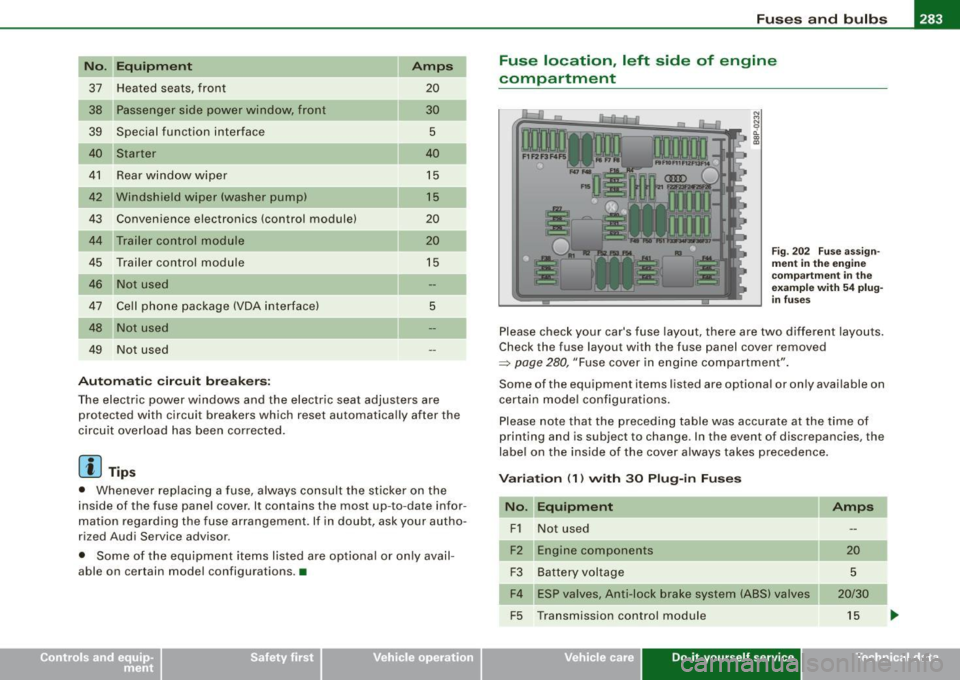
Please check your car's fuse layout, there are two different layouts.
Check the fuse layout with the fuse panel cover removed
~ page 280, "Fuse cover in engine compartment" .
Some of the equipment items listed are optional or on ly available on
certain model configurations.
Please note that the preceding table was accurate at the time of
printing and is subject to change . In the event of discrepancies, the
label on the inside of the cover a lways takes precedence.
V ariation (1 ) with 30 Plu g-in F uses
No . Equipm ent
F1 Not used
Engine components
F3 Battery voltage
F4 ESP v alves, Anti -lock brake system (ABS) valves
F5 Transmission control module
Vehicle care Do-it-yourself service
Amps
20
5
20/30
15
Technical data