brake light AUDI S3 2009 Owner's Manual
[x] Cancel search | Manufacturer: AUDI, Model Year: 2009, Model line: S3, Model: AUDI S3 2009Pages: 324, PDF Size: 76.02 MB
Page 194 of 324
___ ln_ t _e_ ll-'"ig ...,_ e_ n_t _t_ e_ c_ h _ n_o _ l_o _,.g= y,_ __________________________________________ _
How the system works
The EDL operates automatically. It monitors the rotational speed of
the drive wheels on an axle with the help of the ABS sensors
=:,
page 194. If a noticeable difference in rotational speed between
the drive wheels on one axle is detected (e.g. on slippery ground
on
one side),
the spinning wheel is braked, thereby transferring power
to the other drive wheel or wheels (all-wheel drivel. This is done up
to a speed of about 60 mph (100 km/h). Noises from the brake
system signal that wheel spin is being controlled.
Driving off
When driving off, always be sure to keep road conditions in mind as
you accelerate. If one drive wheel spins because it is on a surface
with less grip, gradually increase the pressure on the accelerator
pedal until the car starts to move. The wheel less able to transfer
power spins.
Overheating of brakes
To prevent the disc brake of the braked wheel from overheating if
subjected to excessive loads, the EDL cuts out temporarily . The
vehicle remains operational and behaves in the same way as a
vehicle without EDL.
As soon as the brake has cooled down, EDL switches on again auto
matically.
& WARNING
• When accelerating on slippery surfaces, such as on ice or snow,
always be careful when depressing the accelerator pedal. Even
with the EDL working, the drive wheels can spin and reduce your ability to control your car. -Risk of crash!
• The increased safety afforded by EDL does not mean that you
can take safety risks. Always adapt your driving style to the road
conditions and traffic situation.
[ i] Tips
If a fault occurs in the ABS, the EDL is also not functioning . This is
indicated by the ABS warning light=:,
page 16. •
Anti-Slip Regulation System (ASR)
The Anti-Slip Regulation System prevents the driven
wheels from spinning when the car is accelerating.
General notes
The Anti-Slip Regulation System (ASR) is integrated in the electronic
stabilization program (ESP). When the vehicle starts up and acceler
ates, the wheels are prevented from spinning by adjusting the
engine power to match the amount of grip available from the road
surface.
How the system works
ASR performs automatically, i.e. without the driver's intervention.
With the aid of the ABS sensors=:,
page 194, ASR monitors the
speed of the driven wheels. If the wheels start to spin, the engine
torque is reduced automatically until the tires find enough grip to
lock onto the road surface. The system is active across the entire
speed range.
The ASR works in conjunction with the ABS. If a malfunction should
occur in the ABS, the ASR will also be out of action .
Activating
The ESP is automatically activated when the engine is started and it
performs a self -test . You can activate a deactivated ASR if required
by pressing the =:,
page 190, fig. 163 button . When it is activated,
the message
ESP/ASR on appears briefly in the display.
Deactivating
You can deactivate the ASR if required by pressing the button (for
less than 3 seconds)=:,
page 190, fig . 163. With the ASR deactivated, .,
Page 195 of 324
•
the ESP check light comes on, see~ page 13. The message ASR off
appears in the display as well.
The ASR should normally be activated all the time . Only in certain
exceptional situations when some slip is desirable does it make
sense to deactivate the ASR. Examples:
• when driving with tire chains
• when driving in deep snow or on loose ground and
• when rocking the vehicle loose after it has become stuck.
When the abnormal situation is over, you should activate the ASR
again.
& WARNING
The increased safety afforded by ASR does not mean that you can
take safety risks. Always adapt your driving style to the road
conditions and traffic situation.
[ i] Tips
To ensure that the ASR works properly, all four wheels must be fitted
with identical tires. Any differences in rolling radius of the tires can
cause the system to reduce engine power when this is not desired.
See also ~
page 255, "New tires and replacing tires and wheels". •
Braking
General information
What affects braking efficiency?
Operating conditions and driving habits
The brakes on today's automobiles are still subject to wear,
depending largely on operating conditions and driving habits~& .
On vehicles that are either driven mostly in stop-and-go city traffic
or are driven hard, the brake pads should be checked by your autho-
Intelligent technology
rized Audi dealer more often than specified in the Warranty & Main
tenance booklet.
Failure to have your brake pads inspected can
result in reduced brake performance.
On steep slopes, you should use the braking effect of the engine.
This way, you prevent unnecessary wear on the brake system. If you
must use your brakes, do not hold the brakes down continuously.
Pump the brakes at intervals.
Moisture or road salt
If you are driving faster than 50 mph (80 km/h) and the windshield
wipers are on, the brake pads will briefly touch the brake discs in
regular intervals so as to improve reaction time when braking on
wet surfaces. You, the driver, will not notice anything.
Under certain conditions, for example, when driving through water
or very heavy rain, or even after washing your vehicle, the braking
effect can be reduced due to moisture (or in freezing conditions ice)
on the brake pads. A few cautious brake applications should dry off
the brake pads or remove any ice coatings.
The effectiveness of the brakes can be reduced when the vehicle is
driven on a salt-covered road and the brakes are not used . Likewise,
you clean off accumulated salt coating from brake discs and pads
with a few cautious applications of the brake~&.
Corrosion
There may be a tendency for dirt to build up on the brake pads and
corrosion to form on the discs if the car is not driven regularly or
only for short trips with little use of the brakes .
If the brakes are not used frequently, or if corrosion has formed on
the discs, it is advisable to clean off the pads and discs by braking
firmly a few times from a moderately high speed~& .
Faults in the brake system
If you should notice a sudden increase in brake pedal travel, then
one of the two brake circuits may have failed~&. ..,
I t •
Page 197 of 324

How the ABS system works
An aut omatic check is made whe n a speed of ab out 4 mph (6 km/h)
is reached. When this happens, a pumping noise can be heard.
I f an individua l wheel begins to rotate too slowly in relation to
ve hicle speed and ten ds to lock, the A BS automatical ly reduces
brake pressure to prevent that wheel from locking.
T his auto matic adjust ment p rocess wil l cause a
slight vibration o f
the brake peda l and some noises to alert you that veh ic le speed
must be ada pted to e xisting roa d and traff ic c onditions.
& WARNING
Although the ABS is very effective , always remember that braking
c apability is limited by tire tra ction . Always adjust your driving
speed according to the road and traffic conditions. Do not let the
extra safety afforded by the ABS tempt you into taking e xtra risks .
The ABS cannot overcome the laws of physics.
[ i ) Tips
• I f ABS is not functioning properly, a warning light wil l come on.
See
=> page 16.
• I f a fau lt occurs in the ABS, the E DL is als o not fu ncti onin g. This
is indicated by the ABS warning light. •
Brake assistant
The brake a ssi st ant is de sig ned to a chieve th e opti mum
b ra kin g eff ec t.
The brake assistant helps to increase the effective braking power
and thus to ac hieve a s horte r stop ping dis tance. If the drive r
presses the brake pedal very quick ly, the brake assistant automati
ca lly b oosts the braki ng force to the maximu m level, up to th e point
where the anti -loc k brake function (A BS) intervenes to stop the
whee ls from loc king. You should then keep the brake pedal pressed
Controls and equip
ment Safety first Vehicle operation
Intelligent technology
until
the vehicle has braked to the required speed . The brake assis
t an t swi tc h es itse lf o ff as s oon as you r eleas e the b rake pe dal.
The brake assistant wi ll not be operative if there is a malfunction in
the ABS .
& WARNING
Please remember that the accident risk always increases if you
drive too fast , espe cially in corners or on a slippery road , or if you
follow the vehicle ahead of you too closely . An increased accident
risk cannot be compensated even by the brake assistant , so
always maintain a safe speed. •
ciectro-mechanical power assist
Th e e le ctr o-me ch anic al pow er assis t helps the driv e r
w hen steerin g.
The degree of powe r ass ist is electronically matched to veh icle
speed .
The power steering system assists the driver so that he can steer the
ve hicle with re d uced p hysi ca l eff ort.
Power steering w ill not work if the eng ine is off . As a result, the
stee ring whee l wi ll be ha rd to turn .
& WARNING
If the system develops a problem , you must seek qualified profe s
sional assistance .
0 Note
If there is an electronic ma lfunction, servotronic will still function
like a conventi onal power s teer ing sy stem , pr ovi din g a constant
steerin g support force that is no longer proportionate to the vehicle
Vehicle care Do-it-yourself service Technical data
Page 201 of 324
- Lack of proper maintenance as wel l as improper use of the
vehic le wi ll impair the func tion of the emission con tro l system
and could lead to damage.
<£> For the sake of th e envir onm ent
Even when the Emission Control System is operating properly, the
exhaust gas can have a su lfur -like exhaust gas smell under some
operating states . This depends on the sulfur content of the fuel
being used. Using a different brand of fue l may help, or filling the
tank with lead-free super grade gasoline. •
Avoid damaging the vehicle
When you are driving on poor roads, or over curbs, steep ramps,
etc., make certain that low- lying parts such as spoi lers and exhaust
system parts do not bottom out and get damaged.
This is especially true for vehicles with low-slung chassis (sports
chassis) and fully loaded vehicles. •
Operate your vehicle economically
and minimize pollution
General
Your personal style of driving will determine the economy
of your vehicle, as well as exhaust and noise levels.
Fuel economy, environmental impact, and wear on your engine,
brakes and tires largely depend on three factors:
• your personal driving style
• operating cond itions
• technica l limitations
Controls and equip
ment Safety first Vehicle operation
Dri
ving and environm ent
If you anticipate what you need to do next and drive economica lly,
you can easily cut your fuel consumpt ion by 10 -15 percent . This
section wil l give you some tips on how you can help the environ
ment and your pocketbook.
[ i ] Tips
The consumption estimates as published by ENV IRONMENTAL
PRO TEC TION AGENCY (EPA) and Transport Canada may not corre
spond to your actua l consumption on the road, which wi ll vary
depending upon vehic le load and speed, road and weather condi
tions, trip length, etc. •
Drive smoothly and keep a lookout ahead
Vehicles use the most fuel when they ore accelerating.
Avoid unnecessary accelerating and braking .
Vehicles use the most fuel when they are accelerating . If you antici
pate what is going to happen next, you wi ll need to brake less and,
thus, acce lerate less. Let the vehicle coast whenever possib le - for
examp le when you see that the next traffic light is red. •
Avoid full throttle
Driving at moderate speeds saves fuel and improves your
mileage.
-Try and keep well below your car's max imum speed.
Acce lerating gently reduces fue l consumption , engine wear, and
does not disturb the environment.
Fue l consumption, exhaust emissions and engine noise increase
disproportionately at high speeds . If you drive at approximate ly
three quarters of top speed, fuel consumption wil l be reduced by
Vehicle care Do-it-yourself service Technical data
Page 204 of 324
___ T_ r _a_ il_e _r_ t_ o_ vv_ in__... g,_ __________________________________________________ _
Trailer towing
Driving with a trailer
General information
Your Audi was designed primarily for passenger transpor
tation.
If you plan to tow a trailer, please remember that the additional load
wi ll affect durability, economy and performance.
Trai ler towing not on ly p laces more stress on the vehicle, it a lso ca lls
for more concentration from the driver.
For this reasons, always fo llow the operating and driving instruc
tions provided and use common sense. •
Technical requirements
Traile r hit ch
Use a weight -carrying hitch conforming to the gross trailer weight.
The hitch must be suitab le for your vehicle and tra iler and must be
mounted secure ly on the vehicle's chassis at a
technically sound
location . Use only a trailer hitch w ith removable ball mount. A lways
check with the trai ler hitch manufacturer to make sure that you are
using the correct hitch .
Do not use a bumper hit ch .
The hitch must be installed in such a way that it does not interfere
w ith the impact-absorbing bumper system . No modifications
should be made to the vehicle exhaust and brake systems. From
time to time, check that all hitch mount ing bolts remain securely
fastened.
When you are not towing a trailer, remove the trailer hitch ball
mount. This prevents the hitch from causing damage should your
vehic le be struck from behind
=:> & .
Tire pre ssure
When towing a trailer, inflate the tires of your vehic le to the cold tire
pressure listed under "Full load"on the sticker on the right door
jamb. Inflate trai ler tires to trai ler and tire manufacturers' specifica
tions.
Lights
The head ligh t settings should be checked wit h the trai ler attached
before driving off. Have the head lights adjusted as necessary so
t hat you can see the road ahead but not blind oncoming traffic.
Check to make sure both vehicle and trailer lights are working prop
erly.
Engin e cool ing sy stem
Towing a t rai ler makes the engine wo rk ha rder . It is important that
the cooling system's performance stands up to the additiona l
strain. Make sure that the coo ling syste m has enoug h fluid.
Traile r br akes
If your traile r is equipped wi th a braking system, check to be sure
that it conforms to al l regu lations.
T he trailer hydraulic brake system must not be directly connected to
the vehic le's hydrau lic brake sys tem.
Safety chai ns
Be sure trailer safety chains are properly connected from the trailer
to the h itch on the vehicle. Leave enough slack in the chains to
permit turning corners. When you install safety chains, make sure
they will not drag on the road when you are driving.
The chains should cross under the trailer tongue to prevent it from
dropping in case of separation from the hitch. _.
Page 205 of 324

Trailer lights
Trailer lights must meet all regulations. Be sure to check with your
authorized Audi dealer for correct wiring, switches and relays.
Mirrors
If you are unable to see the traffic behind you using the regular
outside mirrors, then you
must install extended mirrors. It is impor
tant that you
always have clear vision to the rear .
& WARNING
After removing the trailer hitch, do not store it in your vehicle. In
case of sudden braking, the hitch could fly forward and injure you
or your passengers .
.1
Operating instructions
Maximum trailer weight
A trailer for your vehicle is limited to a typical class 1 or class 2
trailer.
Trailer load distribution
Be sure the load in the trailer is held securely in place to guard
against shifting, be it forward, backward or sideways.
Never allow a passenger to ride in a trailer:::::, & in "Driving instruc
tions".
Tire pressure
When towing a trailer, inflate the tires of your vehicle to the cold tire
pressure listed under "Full load" on the sticker on the right door
jamb. Inflate trailer tires to trailer and tire manufacturers' specifica
tions.
Controls and equip ment Safety first Vehicle operation
Trailer towing
Lights
The
headlight settings should be checked with the trailer attached
before driving off. Adjust as necessary so that you can see the road
ahead but not blind oncoming traffic.
Check proper working of vehicle and trailer lights.
Safety chains
Be sure trailer safety chains are properly connected from the trailer
to the hitch on the vehicle. Leave enough slack in the chains to
permit turning corners. When you install safety chains, make sure
they will not drag on the road when you are driving.
The chains should cross under the trailer tongue to prevent it from
dropping in case of separation from the hitch. •
Driving instructions
Driving with a trailer always requires extra care and
consideration.
To obtain the best possible handling of vehicle and trailer,
please note the following:
Do not tow a loaded trailer when your car itself is not
loaded.
- Be especially careful when passing other vehicles.
Observe speed limits.
Do not drive at the maximum permissible speed.
- Always apply brakes early.
Monitor the temperature gauge.
Vehicle care Do-it-yourself service Technical data
Page 206 of 324

___ T_ r _a_ il_e _r_ t_ o_ vv_ in__... g,_ __________________________________________________ _
Weig ht dis tributi on
Towing a loaded trailer with an empty car resu lts in a high ly
unstable distribution of weight . If this cannot be avoided drive at
very low speeds on ly to avoid the risk of losing steering control.
A "ba lanced" rig is easier to operate and control. This means that
the tow vehicle should be loaded to the extent possible and permis
sib le while keeping the trai ler as light as possib le under the circum
stances. Whenever possible, transfer some cargo to the luggage
compartment of the tow vehicle while observing tongue load requirements and vehicle loading considerations .
Speed
The higher the speed, the more difficult it becomes for the driver to
control the rig . Do not drive at the maximum permissible speed.
Reduce your speed even more under unfavorable load, weather or
wind conditions -particularly when going downhill.
Reduce vehicle speed
imm ed ia tely if the trailer shows the sl ightest
sign of swaying. Do not try to s top the s wayi ng by a ccelerating .
Observe speed limits . In some areas speeds for vehicles towing
trai lers are lower than for regular vehicles.
Always app ly brakes early. When driving downhill, shift into lower
gear to use the engine braking effect to slow down the vehicle. Use
of the brakes alone can cause them to overheat and fail.
C oo la nt tempe ra tu re
The coolant temperature gauge ~ page 9 must be observed care
ful ly. If the needle moves close to the upper end of the scale, reduce
speed immediately and/or switch off the air condit ioner.
If the coolant temperature warning light in the instrument cluster
starts flashing -~-, pull off the road, stop and let the engine
idle for
about two minutes to prevent heat build -up .
& WARNING
An yone not p rope rly res train ed in a mo ving vehi cle is a t a mu ch
gre ater risk in a n accident. Neve r let an yone ride in your car who
is not p rop erly we ari ng th e res tra int s pro vide d b y Aud i.
c
Trailer towing tips
Important to know
Your vehicle handles different ly when towing a trailer because of
the additional weight and weight distribution . Safety, performance
and economy w ill great ly depend on how carefu lly you load your
trailer and operate your rig.
Before you actually tow you r trailer, practice turn ing, stopping and
backing up in an area away from traffic. Keep practicing unti l you
have complete ly become familiar with the way your vehicle -trailer
combination behaves and responds .
Backing up is difficult and requires practice. Backing up with a
trailer genera lly requires steering ac tion opposite of that when
backing up your vehicle without a trailer .
Maintain a greater distance between your vehicle and the one in
front of you. You will need more room to stop.
T o compensate for the trailer, you wi ll need a larger than normal
turning radius .
When passing, remember that you cannot accelerate as fast as you n ormal ly wou ld because of the added load . Make su re you have
enough room to pass. After passing, al low plenty of room for your
trailer before changing lanes again .
Avoid jerky starts, sharp turns o r rapid lane changes.
Page 214 of 324
-Cleaning and prot
ection
-~--------------
Paint scratches should be touched up as soon as possible to prevent
corrosion => page 210, "Touch -up pain t" .
& WARNING
• Moi sture and i ce on brak es may affect b raking efficiency -
=> page 193 , "Gene ral inform ation ". Te st the brakes caref ully a fter
e ac h veh icle was h.
• Alway s read and heed all WARNING S and t he infor mation
=> page 206. •
App lies to vehi cles : w ith Cast a lloy whee ls
Cast (light) alloy wheels
Cast (light) alloy wheels require special care.
- Wash the wheels with a spo nge or hose brush every
o ther week .
- For deep cleaning afte rwards, use only a dedicated
a cid
free
cast alloy whee l cleaner.
- Rub a coat of
liquid wa x onto the rims every t hree month .
Be sure to reach and treat all parts of the rim.
To preserve the decorative appearance of the cast alloy wheels,
some special care is necessary. In addition to road dirt and salt, brake dust is also corrosive . If left on for too long, brake dust can
cause pitting.
Use on ly specia l acid -free cleaners formu lated for a lloy rims . Safe
products are available at your authorized Audi dealer. Never leave
the cleaner on the rims longer than specified on the label. If not rinsed off promptly, the acid contained in some cleaners can attack
t he threads on the wheel bolts. Never use abrasive or metal po
lishing cleaning agents . If the protec
t ive coating has been chipped, e.g . by kicked up road dirt, touch it
up as soon as possib le.
& WARNING
• Moisture a nd ice on br akes m ay affect braking efficien cy
=> page 193, "Gen eral inf or mation ". Te st the brake s carefully each
ti m e you wa sh th e vehi cle .
• Always read and heed all WARNINGS and other informa tion
=> page 206 . •
Body cavity sealing
T he body cavity se aling does not need to be checked.
All body cavities which could be affected by corrosion have been
thorough ly protected a t the factory .
This sealing does not require any inspection or additional treat
ment . If any wax should seep out of the cavi ty when the amb ient
temperature is high, it can be removed with a p lastic scraper and a
suitable solvent .
& WARNING
Solvents can be dangerous .
• Ben zin e is flamm able and to xic. If you use b en zi ne for re moving
the wax, keep spark s, flame and lighted cigarette s away . Never
dump ben zine on the ground , into open st ream s or do wn sewage
dr ain s.
• Be sure to ob serve all safet y and env ironmental regul atio ns .
Follow all in stru ction s on the c ont ainer .
• Always read and heed all WARNINGS and ot her info rm ation
=> page 206 . •
Page 237 of 324
Checking and filling -
---------------------=----"=---------
Radiator fan
The radiator fa n switches on au toma tically by i tself.
T he e lectric radiator fan is control led bythermoswitches that switch
on and off depending on coolan t and engine compar tm ent temper
atures .
An auxiliary e lectric radiator fan * switches on and off depending on
coolant temperature and other vehicle operation conditions.
After switching off the engine , the auxiliary fan -even with the igni
tio n off -ca n co ntinue runni ng for u p to 10 minutes. It can even
switch on again later by itself=>&, if
• the temperat ure of the engine coolant rises due to the heat
build -up from the engine in the engine compartment, or
• t he engine co mpart men t heats up because the vehicle is parked
in intense sunlight.
& WARNING
• To reduce the risk of personal injury never tou ch the r ad iator
fan .
• The auxiliary electric fan is temperature controlled and can
switch on suddenly even when the engine i s not running .
• The auxiliary radiator fan switches on automatically when the
engine cool ant reache s a certain temperature and will continue to
run until the coolant temperature drop s. •
Brake fluid
Checking brake fluid level
The bra ke flu id l evel can be che cke d wi th a q uick gla nce.
Fig . 17 6 Engine
c o mpartment : brake
fluid re ser vo ir
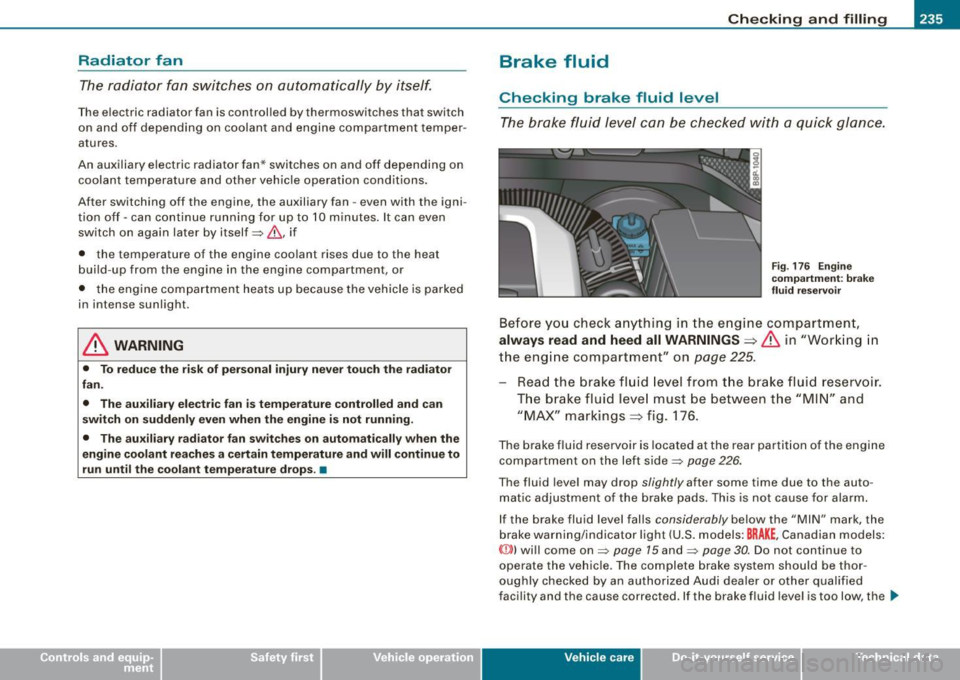
Be fore yo u check anythin g in the e ng ine compar tm ent,
always read and heed all WARNINGS=> & in "Working in
t h e eng ine compartment" on
page 225.
Read t he brake fl uid lev el from t he brake flui d res ervoir .
T he b rak e fluid l eve l must b e between the
"MI N" and
"M AX" markings => fig. 176.
The brake f luid reservoir is located at the rear pa rtit ion of the engine
compartment on the left side=> page 226.
T he fluid leve l may drop slightly after some time due to the auto
ma tic adjustment o f the brake pads. Th is is not cause for alarm .
I f the brake flu id leve l falls considerably below the "MIN" mark, the
brake warning/indicator light (U.S . models :
BRAKE, Canadian models:
ID ) will come on=> page 15 and=> page 30. Do not continue to
operate the vehic le . The complete brake system should be thor
oughly checked by an au thorized Audi dealer or other qualified
facility and the cause corrected. If the brake fluid leve l is too low, the .,,_
Vehicle care I I irechnical data
Page 238 of 324
___ C_h_ e_ c_k _in --== g'-- a_n _d_ f_il _li _n ..:::g:::..- ___________________________________________ _
brake warning/indicator light will illuminate . Contact an authorized
Audi dealer
i m medi at ely.•
Changing brake fluid
Have the brake fluid changed by an experienced techni
cian.
Brake fluid absorbs moisture from the ai r. If the water content in the
brake fluid is too high, corrosion in the brake system may result
after a period of time. The boiling point of the brake fluid wil l also
decrease considerably and decrease braking performance .
Therefore, the brake fluid must be changed
e ver y two years. Always
use new brake fluid which conforms to Federa l Motor Vehicle Stan
dard "FMVSS 116 DOT 4" .
The brake fluid reservoir can be difficu lt to reach , therefore, we
recommend that you have the brake fluid changed by your autho
rized
Audi d ealer. Your dealer has the correct tools, the right brake
fluid and the know-how to do this for you.
& WARNING
• Bra ke fluid i s poisonous . It mu st be stored on ly in the close d
ori ginal container out of the rea ch of children!
• Bra ke fa ilure can result from old or inappropri ate brake fluid .
Observe the se pre caution s:
- Use o nly brake fluid that meets SAE spe cifi ca tion
J 170 3 and
c onform s to Fed era l Moto r Vehic le Sta nda rd 116 . Always c heck
w ith your authori zed Audi de aler to m ake sure you are using
the correct brake fluid. The corr ect type of brake fluid i s als o
indi cated o n the br ake fl uid reser vo ir.
- The br ake flu id mu st be ne w. Hea vy use of the brake s can
c au se a vap or lo ck if the bra ke fluid i s left in the system too
long. Thi s can seriou sly affect the efficienc y of the brake s as
we ll as your safet y. Thi s co uld re su lt in an acci dent .
0 Note
Brake fluid wi ll damage the paint of your vehicle .
<£' For the sake of the environment
Because o f the problem of prope r disposal of brake flu id as we ll as
the special tools required and the necessary expertise, we recom
mend that you have the brake fluid changed by your authorized Audi
dea ler. •
Battery
General information
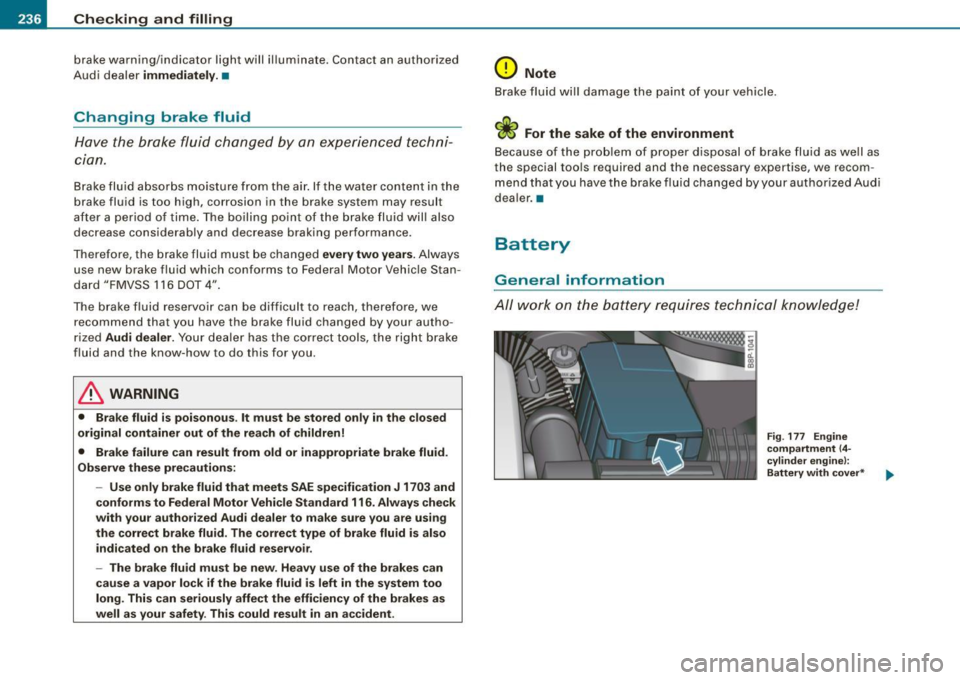
All w ork on the battery requires technical knowledge!
Fi g. 177 E ng ine
co mp artm ent (4 -
c yli nder engin e):
Bat tery w it h cove r"