check engine light AUDI S3 2009 Owner's Manual
[x] Cancel search | Manufacturer: AUDI, Model Year: 2009, Model line: S3, Model: AUDI S3 2009Pages: 324, PDF Size: 76.02 MB
Page 236 of 324
-~_C_ h_e _c _ k_ i_n ...:::g::;...._ a_n_ d_ f_ i_ll _in -'g:::;.._ ___________________________________________ _
tion and performance of your cooling system and could resu lt in
d am age not co vered by yo ur Ne w Vehicle Li mited Warranty .•
Adding coolant
B e very caref ul whe n addin g engine c oo lant.
Before you check a nything in the e ngine compartmen t,
always read and heed all WARNINGS=> & in "Work ing in
the en gine compartmen t" on
pa ge 225.
- Turn off the engine.
- Le t the engin e coo l down.
Place a thi ck ra g o ver th e c oolan t expansio n ta nk
=> pa ge 233, fi g. 1 75 a nd carefully twi st th e cap coun te r
cl ockwi se
=> &.
- Add cool ant.
- Twist the cap on aga in
tightly.
Replacement engine coolant must conform to exact specifications
~ page 232, "Coola nt". Even in a n eme rge ncy, if co olant add itive
G 12++. G12+ or G 12 is not availab le, do
not use a diffe rent additive.
Use plain water instead unt il you ca n get the c orrect additive and
can restore the correct ratio . This should be done as soon as
possible.
If you have lost a considerable amount of coo lant, then you should
add co ld antifreeze and cold water only when the engine is cold.
A lways use
new e n gin e c oolan t wh en refi llin g.
Do not fi ll coo lant above the "MAX" mark. Excess coolant will be
f o rced ou t through the pressure re lief va lve in the cap when the
engine becomes hot.
& WARNING
• The cooling system is under pressure and can get very hot .
Redu ce the risk of scalding from hot coolant by following these
steps .
- Turn off the engine and allow it to cool down.
- Protect your face , hands and arms from e scaping fluid and
steam by covering the cap with a large, thick rag.
- Turn the cap slowly and very carefully in a counter -clockwise
direction while applying light , downward pressure on the top
of the cap.
- To avoid being burned , do not spill antifreeze or coolant on
the e xhaust system o r hot engine parts . Under certain condi
tions , the ethylene glycol in engine coolant can catch fire.
• Antifreeze is poisonous . Always store antifreeze in its original
container and well out of the rea ch of children.
• If you drain the coolant , it must be caught and safely stored in
a proper container clearly marked "poison".
0 Note
• Coo la n t po llutes t he environ ment and cou ld cause a n engine
fire . Excess coolant will be forced out through the pressure re lief
va lve in t he cap when t he eng in e b ecomes hot .
• I f, in an emergency, on ly water can be added, the correct ratio
be tween wa ter and antifree ze~
page 232 mus t be restore d as soon
as possib le .
'£> For the sake of the environment
D rained coolant should not be reused. Always d ispose of used
coo la nt whi le observing all e nvi ro n men tal reg ulat ions .•
Page 237 of 324
Checking and filling -
---------------------=----"=---------
Radiator fan
The radiator fa n switches on au toma tically by i tself.
T he e lectric radiator fan is control led bythermoswitches that switch
on and off depending on coolan t and engine compar tm ent temper
atures .
An auxiliary e lectric radiator fan * switches on and off depending on
coolant temperature and other vehicle operation conditions.
After switching off the engine , the auxiliary fan -even with the igni
tio n off -ca n co ntinue runni ng for u p to 10 minutes. It can even
switch on again later by itself=>&, if
• the temperat ure of the engine coolant rises due to the heat
build -up from the engine in the engine compartment, or
• t he engine co mpart men t heats up because the vehicle is parked
in intense sunlight.
& WARNING
• To reduce the risk of personal injury never tou ch the r ad iator
fan .
• The auxiliary electric fan is temperature controlled and can
switch on suddenly even when the engine i s not running .
• The auxiliary radiator fan switches on automatically when the
engine cool ant reache s a certain temperature and will continue to
run until the coolant temperature drop s. •
Brake fluid
Checking brake fluid level
The bra ke flu id l evel can be che cke d wi th a q uick gla nce.
Fig . 17 6 Engine
c o mpartment : brake
fluid re ser vo ir
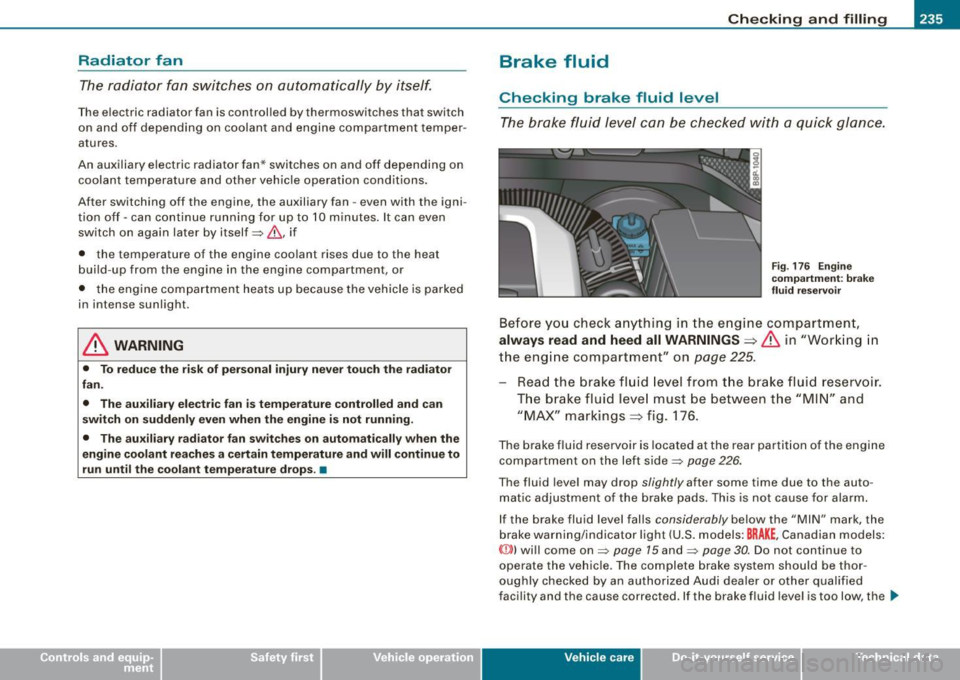
Be fore yo u check anythin g in the e ng ine compar tm ent,
always read and heed all WARNINGS=> & in "Working in
t h e eng ine compartment" on
page 225.
Read t he brake fl uid lev el from t he brake flui d res ervoir .
T he b rak e fluid l eve l must b e between the
"MI N" and
"M AX" markings => fig. 176.
The brake f luid reservoir is located at the rear pa rtit ion of the engine
compartment on the left side=> page 226.
T he fluid leve l may drop slightly after some time due to the auto
ma tic adjustment o f the brake pads. Th is is not cause for alarm .
I f the brake flu id leve l falls considerably below the "MIN" mark, the
brake warning/indicator light (U.S . models :
BRAKE, Canadian models:
ID ) will come on=> page 15 and=> page 30. Do not continue to
operate the vehic le . The complete brake system should be thor
oughly checked by an au thorized Audi dealer or other qualified
facility and the cause corrected. If the brake fluid leve l is too low, the .,,_
Vehicle care I I irechnical data
Page 239 of 324
_____________________________________________ C_h_ e_ c _ k_in -= g_a _ n_d _ f_il _li _n ..;::g =--____.•
N
~ a:. 00 m
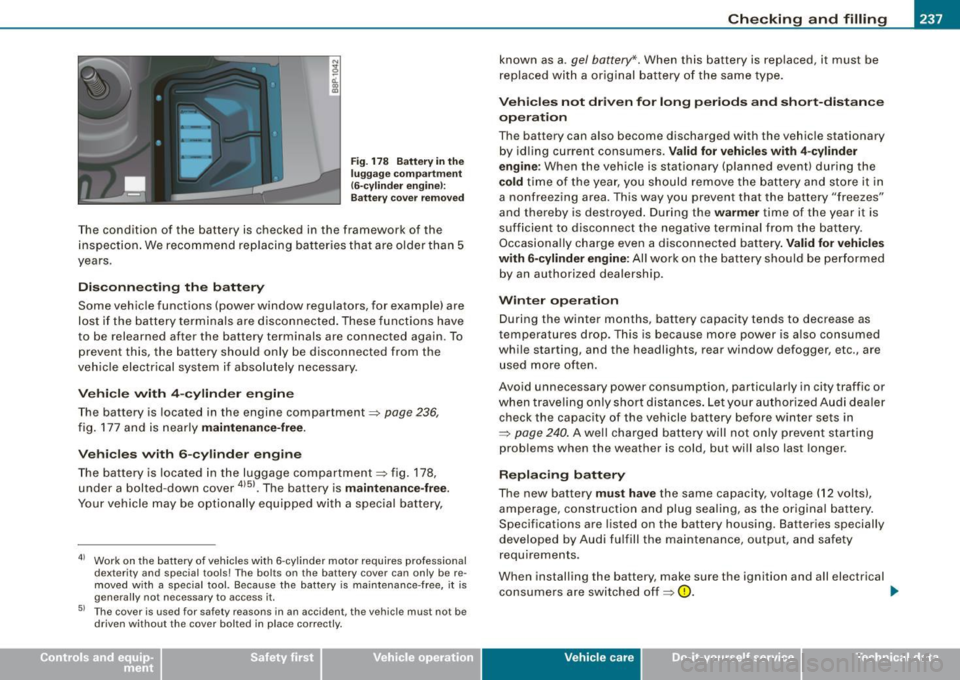
F ig . 178 Battery in the
lugg ag e co mpartme nt
(6-c ylind er eng ine !:
Ba tter y cove r remo ved
T he condition of the battery is checked in the framework of the
inspection . We recommend rep lacing bat teries that are older than 5
years .
Disconnecting the battery
Some vehic le functions (power window regu lators, for example) are
lost if the battery terminals are disconnected . These functions have
to be relearned after the battery terminals are connected again. To
prevent this, the battery should only be disconnected from the
veh icle electr ical system if absolutely necessary.
V ehicle with 4 -cylind er engin e
The battery is located in the engine compartment~ page 236,
fig. 177 and is nearly maintenance -free.
Vehi cle s with 6 -cylinder engine
The bat tery is loca ted in the luggage compartmen t=:> fig . 178,
under a bolted-down cover
4151 • The battery is maintenan ce -free .
Your ve hicle may be optionally equipped with a special battery,
41 Wor k on the battery of vehicles with 6-cy linder motor requires professional
dexterity and special tools! The bolts on the battery cover can only be re
m oved w ith a s pecial tool. Because the batte ry is ma in tenance -free, it is
genera lly not necessary to access it.
51 The cover is used for safety reasons in an acc ident, the vehicle must not be
driven without the cover bolted in place correctly.
known as a. gel battery* . When this battery is replaced, it must be
replaced wi th a or iginal bat tery o f th e same type.
Vehicles not dri ven for long periods and short-distance
operation
The battery can a lso become discharged with the vehicle stationary
by id ling current consumers .
Valid for vehicles with 4 -cylinder
engine :
When the vehic le is stationary (planned event) during the
cold time of the year, you sh ould remove the battery an d store it in
a nonfreezing area. This way you prevent that the battery "freezes"
and thereby is destroyed . During the
warmer time of the year it is
suff icient to disconnect the negative terminal from the battery .
Occasiona lly charge even a disconnected battery .
Valid for veh icles
with 6 -cylinder engine:
All wor k on the ba ttery should be per formed
by an authorized dealership.
Winter op eration
During the winter months, battery capacity tends to decrease as
temperatures drop. This is because more power is a lso consumed
while starting, and the headlights, rear window defogger, etc., are
use d more often .
Avoid unnecessary power consumption, particularly in city traffic or
wh en trave ling on ly shor t distances . Let you r au thor ize d Audi dea ler
check the capacity of the vehicle battery before winter sets in
~ page 240 . A well charged battery will not on ly prevent sta rting
problems when the weather is cold, but wi ll a lso last longer .
Replacing battery
The new battery must have the same capacity , vo ltage (12 volts),
a m perage, con struction and plug sea ling, as t he origina l battery.
Specifications are listed on the battery housing. Batteries specially
developed by Audi fulfill the maintenance, output, and safety
requirements.
When installing the battery , make sure the ignition and all electrical
co nsumers are switche d off ~
0. ..,
Vehicle care I I irechnical data
Page 243 of 324
_____________________________________________ C_h_ e_ c _ k_in -= g_a _ n_d _ f_il _li _n ..;::g =-- ____.•
Ap plies t o vehicles: w ith 6 -cylin d er engine
Charging of battery 6 -cylinder engine )
All work on the battery requires specialized knowledge!
The battery is maintenance-free and is inspected regu
larly as part of vehicle service.
If starting problems occur because the battery charge is too low,
this may indicate a defective battery. In this case we recommend
having a qualified workshop inspect and charge the battery or
replace it if necessary. A discharged battery can
freeze at tempera
tures of only O °C. A thawed battery must be replaced, as the battery
housing may be cracked due to freezing and could therefore leak
acid.
Charging the battery
Battery charging should be performed by a qualified workshop,
since batteries employing a special technology are used which
require current-limited constant voltage charging.
0 Note
The vehicle may be optionally equipped with a gel battery, which can only be charged at a constant current-limited voltage.
• To prevent damage to the battery and the electronics system, a
gel battery that is connected must under no circumstances be
charged with a quick charger.
[ i] Tips
The vehicle battery must not be charged with a standard small
charger that plugs into the cigarette lighter or outlet. •
Windshield washer container
Using plain water is not adequate for filling the wind
shield washer system.
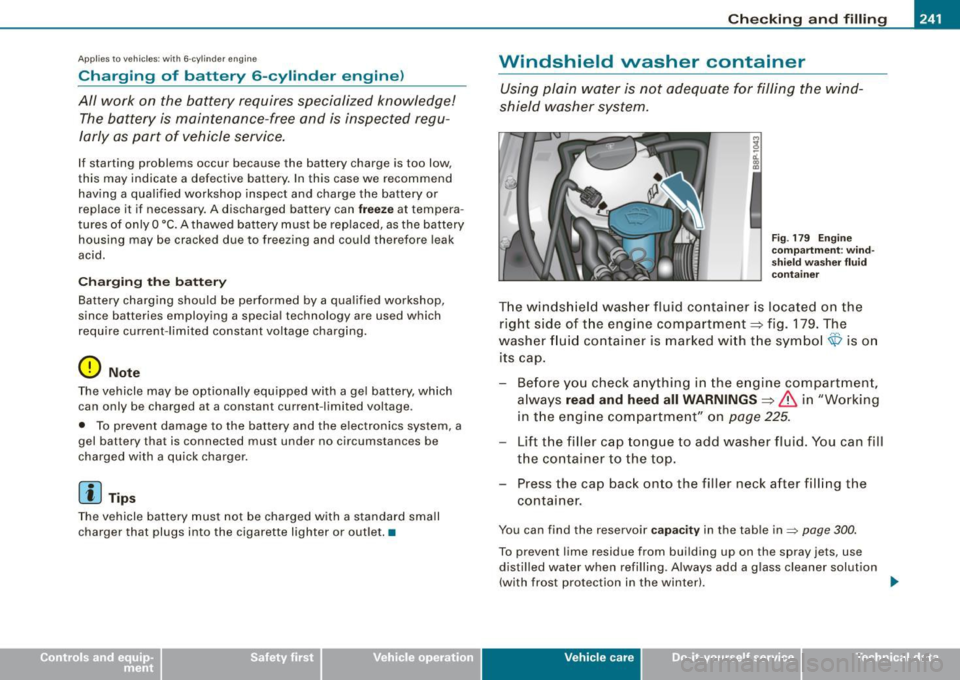
Fig . 179 Engine
compartment : wind
shield washer fluid
container
The windshield washer fluid container is located on the
right side of the engine compartment~ fig. 179. The
washer fluid container is marked with the symbol %Pis on
its cap.
- Before you check anything in the engine compartment,
always
read and heed all WARNINGS~ & in "Working
in the engine compartment" on
page 225.
-Lift the filler cap tongue to add washer fluid. You can fill
the container to the top.
- Press the cap back onto the filler neck after filling the
container.
You can find the reservoir capacity in the table in~ page 300.
To prevent lime residue from building up on the spray jets, use
distilled water when refilling. Always add a glass cleaner solution
(with frost protection in the winter}. .,._
Vehicle care I I irechnical data
Page 311 of 324
______________________________________________ A_ l_,_ p _h_ a_ b_e _t_i c_ a _ l _in _ d_e _ x __ lll
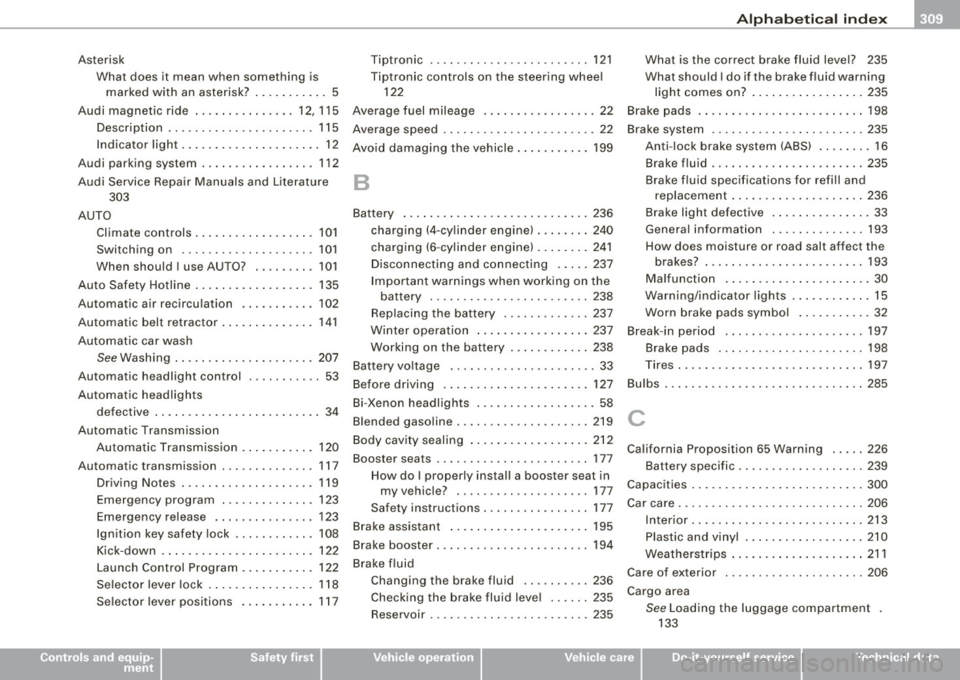
Asterisk
What does it mean when something is marked with an asterisk? ... .. .. .. .. 5
Audi magnet ic ride .. .... .... ..... 12, 115
Description ...................... 115
Ind icator light .. ...... .... .... .... . 12
Audi parking system ................. 112
Audi Service Repair Manuals and Literature 303
AUTO Climate controls ...... .... ... .... . 101
Switching on .................... 101
When should I use AU TO? . ....... . 10 1
Au to Safety Ho tline ... .. .... .... .... . 135
Automatic air recircu lation ........... 102
A utomatic belt retracto r ...... .... .... 1 41
Automa tic car wash
See Washing ...... .... ... .. .. .... 207
Automatic headlight control ....... .... 53
Automat ic headlights
defective ... .. .... .... ... .... .... . 34
Automat ic Transmission
Au tomatic Transmission . ...... .... 120
Automatic transmission . ............. 117
Driving Notes . . . . . . . . . . . . . . . . . . . . 119
Emergency program . ........... .. 123
Emergency release . . . . . . . . . . . . . . . 123
I gn ition key safety lock ....... .... . 108
Kick-down ... .... .... .... ... .... . 122
L aunch Co ntrol Program ...... ..... 122
Se lector lever lock .. ...... ...... .. 1 18
Se lecto r lever posi tions .. ...... ... 11 7
Controls and equip
ment Safety first
T
iptronic ... .... . .. .. ... ... .. .... 121
Tiptronic controls on the steering whee l
122
Average fuel mileage ................ . 22
Average speed ... .... ..... ... .... ... . 22
Avo id damagi ng the v ehicle ...... .... . 199
B
Battery ... .. .... ... .... .... .... .... 236
charg ing (4-cy lind er engine) . ....... 240
c harging (6 -cy li n der engine) ... ..... 241
Disconnecting and c onnecting .. ... 237
I mpo rtant warnings when working on the
battery . .... .... .... .... .... ... 238
Replaci ng the battery .. ... .... .... 237
Winter operation ... .. .... .... .... 237
Working on the battery .. ...... .... 238
Battery voltage ...................... 33
Before driving . ....... .. .... .... .... 127
Bi -Xenon headlights .. ........ .... ... . 58
Blended gasoline . ... ... ..... .... .... 219
Body cavity sealing ...... ...... ... .. . 212
Booster seats .... .... .... .... .... ... 177
How do I properly install a booster seat i n
my vehicle? .. ... .... .... .... ... 177
Safety instructions ................ 177
Brake assistan t ..... .... .... .... .... 195
Brake booster .......... ...... ..... .. 194
Brake fluid Changing the brake fluid .. ........ 236
Checking the brake fluid leve l .. .... 235
Reservoir ........................ 235 What is
the correct brake fluid leve l? 235
What should I do if the brake fluid warning
light c omes on? ... .. .... .... .... 235
Brake pads ... ... .... ....... .... ... . 198
Brake system ....................... 235
Anti -lock brake system (ABS) .. .... .. 16
Brake fluid ....................... 235
Brake f luid specifications for refi ll and
r eplacement ... .. .... .... ...... . 236
Brake light defective . ........ .... .. 33
General information .. .... .... .... 193
How does moisture or road salt affect the
b rakes? .. ............... .... ... 193
Ma lfunct io n . .... .... .... .... ..... 30
Warning/indica tor lights .... .... .... 15
Worn brake pads symbo l ...... .... . 32
Break -in period ...... .... .... .... ... 197
Brake pads ....... ........ ....... 198
Tires ... .. .... .... .... ... .... .... 197
Bu lbs .... .... .... .... ... ....... .... 285
C
California Proposition 65 Warning . .... 226
Battery specific ...... ... .. ... ..... 239
Capac it ies . .... ... ... .... ... .... .... 300
Car care . .... ........ ....... .... .... 206
In ter ior . ...... .... .... ... .... .... 213
P last ic a nd vinyl . ...... .... .... ... 210
Weatherstrips ... .. .... ...... ... .. 211
Care of exterior .... ... .. .... .... .... 206
Ca rgo area
See Loading the luggage compartment
133
Vehicle operation Vehicle care Do-it-yourself service Technical data
Page 314 of 324
-Al
phab eti ca l ind ex
_.:_.__ ____ _...::.:...::..;.:___ ________________ _
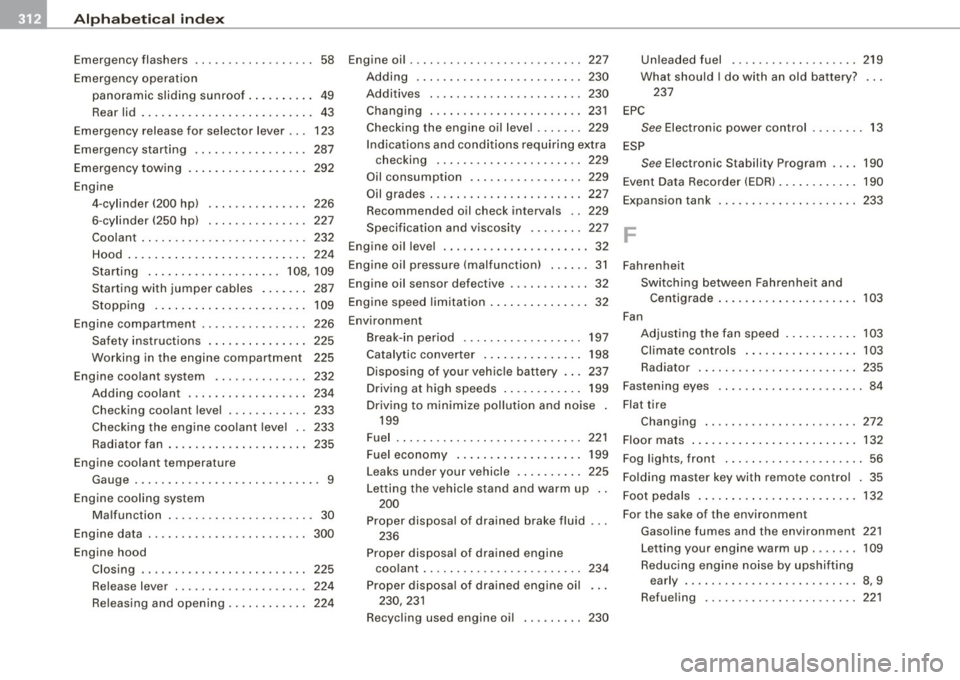
Emergency flashers . . . . . . . . . . . . . . . . . . 58
Eme rgency operation
panoramic sliding sunroof . .... ..... 49
Rear lid . .... ... .. .... .... ...... .. 43
Emergency release for selector lever . . . 123
Emergency starting . . . . . . . . . . . . . . . . . 287
Emergency towing . . . . . . . . . . . . . . . . . . 292
Engine 4-cylinder (200 hp) ..... ... .... ... 226
6 -cylinder (250 hp) ............... 227
Coolant .......... .... ....... .... 232
Hood .... ... .. ...... .... ... .... . 224
Starting .... .... .... .... .... 108, 109
Starting with jumper cables ...... . 287
Stopping ... .... .... .... ........ 109
E . ngine compartment . .... .... .... .. .
Safety instructions ...... .... .... .
226
225
Working in the engine compar tment 225
Engine coolant system .............. 232
Adding coolant .... .... .......... 234
Checking coolant level .... .... .... 233
Checking the engine coolant leve l .. 233
Radiator fan . . . . . . . . . . . . . . . . . . . . . 235
Engine coolant temperature
Gauge .............. .............. 9
Engine cooling system
Malfunction ...... .... ....... .... . 30
E . d ngine ata ...... .... ........... .. . 300
Engine hood Closing ......................... 225
Release lever . ............... .... 224
R I . d . e easing an opening .... ... ... .. 224 Engine
oil .... ...... ........ ... .... . 227
Adding ...... ... .. .... .... ...... 230
Additives ....................... 230
Changing .. ............. ........ 231
Check ing the engine oil level .... ... 229
Indications and conditions requiring extra checking .......... ...... ...... 229
Oil consumption ................. 229
Oil grades . .... ...... ... .. .... ... 227
Recommended oil check intervals .. 229
Specification and viscosity ........ 227
Engine oil level ... ..... .. ...... ...... 32
Engine oil pressure (malfunction) ... .. . 31
Engine oil sensor defective ............ 32
Engine speed limitation .. .... .... .... . 32
Environment
B k. . d
rea -in peno .... .... .... .... . . 197
Catalytic converter . . . . . . . . . . . . . . . 198
Disposing of your vehic le battery ... 237
Driving at high speeds . . . . . . . . . . . . 199
Driving to minimize pollution and noise .
199
Fuel ............................ 221
Fuel economy . . . . . . . . . . . . . . . . . . . 199
Leaks under your vehicle . .... ..... 225
Letting the vehicle stand and warm up ..
200
Proper disposal of drained brake fluid
236
Proper disposa l of
di ra ined engine
coo lant .. .... ... .... .... .... ... 234
Proper disposa l of drained engine oil
230,231
Recycling used engine oil .. .... ... 230 Unleaded fuel
...... ... .. ... .... . 219
What should I do with an old battery?
237
EPC
See Electronic power control . . . . . . . . 13
ESP
See Electronic Stability Program .... 190
Event Data Recorder (EDR) ... .... .... . 190
Expans ion tank 233
F
Fahrenheit
Switching between Fahrenheit and Centigrade . .... .. ... ... .... .... 103
Fan Adjusting the fan speed .. .... .. .. . 103
Cl imate controls ...... ...... .... . 103
Radiator .... .... .... ... .. .... .. . 235
Fastening eyes ... ........ .... .... ... 84
Flat tire Changing ....................... 272
Floor mats . ....... ..... ... .... .... . 132
Fog lights, front ...... .... ... ... ... .. 56
Folding master key with remote control . 35
Foot pedals . ... .. .... .... ...... .... 132
For the sake of the environment
Gasoline fumes and the environment 221
Letting your engine warm up . ..... . 109
Reducing engine noise by upshifting
early ... .. .... .... ... .... .... .. 8, 9
Refueling .. ........... ........ .. 221
Page 315 of 324

Alphabetical index -
-------------=----
Saving fuel by upshifting early ... .. 8, 9
Using the rear window defogger .... 105
Front airbags
Description ... ....... .... .. . .... . 151
How th ey work . . . . . . . . . . . . . . . . . . . 156
Front seats ......... .... ... .... ...... 74
Adjusting ................... .... 129
Adjusting the manual seats .. .. .... . 76
Child restraints in the front seat .. .. 149
Heated seats . . . . . . . . . . . . . . . . . . . . . 105
Fronta l collisions and the laws of physics
138
Fuel Current fuel mileage ........... .... 22
Fuel gauge ...... .... .... ...... ... 10
Fuel supply too low ...... .... .... .. 32
Fuel filler f lap
Unlocking the fuel filler flap by hand 223
Fuel gaug e .... .... ...... .. .... ..... . 10
Fuel range .. .... .... .... .... ... .... . 22
Fuel supply Additives . .... .... .... ... ..... ... 219
Blended gasoline ... .. ........ .... 219
Fuel filler neck ... .... .... ........ 220
Fuel gauge ...... .... .... ........ . 10
Fuel tank capacity ........... .. 10, 220
Gasoline ... .. .... .... ........... 219
Gasoline additives . ... .... ....... . 220
Octane rating . .... .... ... .... .... 219
Recommendation . .. .. .. .... .... . 219
Refu elling .... ..... ... ..... .. ... . 221
Unlocking the fuel filler flap by hand 223
Controls and equip ment Safety first Fuel
tank
Capacity . .... ...... ........ ..... 220
Capacity (gal lons/liters) ...... ... .. .. 10
Fuse arrangemen t ... .. .. .... ... .... . 281
G
Gas discharge lamps .. .. ..... .. .... . 285
Gauges Engine coolant temperature .. ..... ... 9
Fuel gauge ... .. .... .... .. .. .... .. 10
Speedometer ... ...... .... .... .... 10
Tachometer .......... .... ... .... .. 8
Trip odometer . ................... 10
Gear recommendation ..... ...... .... . 19
Gearshift indicator .. ...... .... .... ... 19
Gearshift lever ........ ... .... ....... 116
Genera l illustration
Instruments and controls . .... .... ... 7
Generator Warning /indicato r lights .. .. .... .... 14
Glossary of tire and loading terminology .. .
244
G love compartment ... .. .... ... .... .. 95
Light .... ... ... .. .... .... ........ 60
Gross Vehicle Weight Rating (GVWR) ... 299
H
Head restraints ........ ...... ... .... 131
Adjusting ... ... ................. 131
Rear seats ... ... .. ........ ........ 80 Headlight
defective . .... .... .... ...... ... .. . 33
Head light range control
defective ..... .... .... .. . ......... 33
Headlights ... ... ...... ..... .. ...... . 52
adaptive light ..... .... ....... ..... 55
Front fog lights . ..... .. ............ 56
Switching off . ... .... .... .... .. .. . 52
Switching on ...... .... .. .. .... .... 52
Washer system .. ...... ... .... .. . .. 66
Heated rear window ..................... 105
Heated outside mirrors ... .... ... ... ... 70
Heated washer jets
Wiper and washer system ........... 63
Heavy clothing and safety be lts .... .... 140
High beam ... .... ..... .. .... ..... 5 2, 59
Warning/indicator lights .. .... .... .. 14
High vo ltage warning label . ...... .... 298
Hi ll Descent Assist .... ... .... .... .... 120
Hill hold assist Starting on hills ... ... ... .... .... . 111
hood
See Engine hood ..... .... .... .... 224
Hood re lease .... ..... .. .... .... .... 224
Horn ... .... .... .... ... .... .... ..... . 7
How many airbags does my vehicle have? ..
154
How often shou ld I check my tire pressures?
251
How safety belt pretensioners work .. .. 145
Hydroplaning ...... .. ...... .... .... . 255
Vehicle operation Vehicle care Do-it-yourself service Technical data
Page 318 of 324
___ A_l.:,. p _h_ a_ b_e _t _ic _ a_l _in _ d_e _x ____________________________________________ _
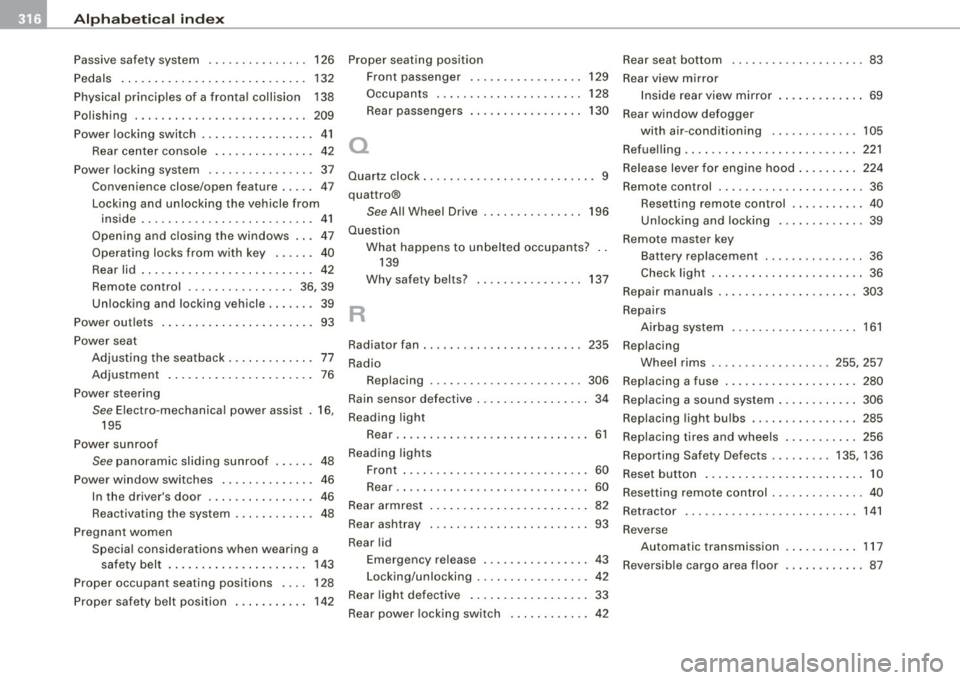
Passive safety system . . . . . . . . . . . . . . . 126
Pedals . .... ... .. .... .... .... ...... 132
Physical p rinciples of a frontal collision 138
Polish ing ... ... ... .. ... .... .... .... 209
Power locking switch .. ... .... ...... .. 41
Rear center console ... ........ .... 42
Power locking system . . . . . . . . . . . . . . . . 37
Convenience close/open feature .. ... 47
Locking and unlocking the vehicle from inside ... .... ... .... .... ..... .. . 41
Opening and closing the windows .. . 47
Operating locks from with k ey . ..... 40
Rear lid .. .. .. .. .. .... .... ...... .. 42
Remo te control . . . . . . . . . . . . . . . . 36, 39
Un locking and locking vehicle .. ... .. 39
Power outlets . . . . . . . . . . . . . . . . . . . . . . . 93
Power seat Adjusting the seatback ..... ........ 77
Adjustment . ...... .... .... ... .... 76
Power steering
See Electro-mechanical power assist . 16 ,
195
Power sunroof
See panoramic sliding sunroof .... .. 48
Power window switches . . . . . . . . . . . . . . 46
In the driver's door ................ 46
Reactivating the system . . . . . . . . . . . . 48
Pregnant wom en
Special considerations when wearing a safety belt . . . . . . . . . . . . . . . . . . . . . 143
Proper occupant sea ting posi tions .... 128
Proper safety belt position . . . . . . . . . . . 142 Proper seating position
Front passenger . . . . . . . . . . . . . . . . . 129
Occupants .... ...... .... ... .. ... 128
Rear passengers 130
a
Quartz clock ...... ..... .. .... .... .... . 9
quattro®
See All Wheel Drive . . . . . . . . . . . . . . . 196
Question
R
What happens to unbelted occupants? ..
139
Why safety belts? . . . . . . . . . . . . . . . . 137
Radiato r fan . .... .... ...... .... .... . 235
Radio Replacing . .... ... .... .... .... ... 306
Rain sensor defective ... ... .... ... .... 34
Reading light
Rea r ..... ..... ...... .... .... .... . 61
Reading lights
Front ..... ..... ... .... ... .... .... 60
Rea r ... ... .... ... ... .. ...... ..... 60
Rear armrest .... ... .. .... .. .. ... .... 82
Rea r ashtray . .... ...... .... ... .. .... 93
Rear lid
Emergency release .... .... .... .... 43
Lock ing/unlocking . ... .. ....... ... . 42
Rear light defective . . . . . . . . . . . . . . . . . . 33
Rear power locking switch ... .... .... . 42 Rear seat bottom
...... .. .... .... .. . . 83
Rear view mirror
Inside rear view mirror ............ . 69
Rear window defogger with air-conditioning ... ... .. ..... 105
Refuelling ....... .... .... ...... ..... 221
Release lever for engine hood ..... .... 224
Remo te con trol . ...... .. .. ... ..... .. . 36
Resetting remote control ... .... .... 40
Un locking and locking . .... .... ... . 39
Remote mast er key
Ba ttery replacement ............... 36
Check light .... .... .... ..... .. ... . 36
Repair manuals ... .... ... .... .... .. . 303
Repairs Airbag system .... .... .... .... ... 161
Replacing Wheel rims . ... .... .... .... .. 255, 257
Replacing a fuse ... ... ....... .... ... 280
Replacing a sound system . .... .... ... 306
Replacing light bulbs . ...... .. .... ... 285
Replacing tires and wheels ........... 256
Reporting Safety Defects .. ....... 135, 136
Reset but ton . . . . . . . . . . . . . . . . . . . . . . . . 10
Resetting remote control ...... .... .... 40
Retractor . . . . . . . . . . . . . . . . . . . . . . . . . . 141
Reverse Automatic transmission .... .... .. . 117
Reversible cargo area floo r ........ .... 87