tire pressure AUDI S3 2009 Owner's Manual
[x] Cancel search | Manufacturer: AUDI, Model Year: 2009, Model line: S3, Model: AUDI S3 2009Pages: 324, PDF Size: 76.02 MB
Page 254 of 324
-Tires and wheels
P'tr:1-------------------
and is more difficult to stop. Overloading can not only lead to loss
of vehicle control, but can also damage important parts of the
vehicle and can lead to sudden tire failure, including a blowout and
sudden deflation that can cause the vehicle to crash.
Your safety and that of your passengers also depends on making
sure that load limits are not exceeded. Vehicle load includes every
body and everything in and on the vehicle. These load limits are
technically referred to as the vehicle's
Gross Vehicle Weight Rating
("GVWR").
The "GVWR" includes the weight of the basic vehicle, all factory
installed accessories, a full tank of fuel, oil, coolant and other fluids
plus maximum load. The maximum load includes the number of
passengers that the vehicle is intended to carry ("seating capacity")
with an assumed weight of 150 lbs (68 kg) for each passenger at a
designated seating position and the total weight of any luggage in
the vehicle. If you tow a trailer, the weight of the trailer hitch and the
tongue weight of the loaded trailer must be included as part of the
vehicle load.
The
Gross Axle Weight Rating ("GAWR") is the maximum load that
can be applied at each of the vehicle's two axles.
The Gross Vehicle Weight Rating and the Gross Axle Weight Rating
are listed on the safety compliance sticker label located either on
the driver's side B-pillar or on the inside of the fuel filler flap. Your
Audi has 5 seating positions, 2 in the front and 3 in the rear for total
seating capacity of 5. Each seating position has a safety belt
=>
page 137, "Safety belts".
The fact that there is an upper limit to your vehicle's Gross Vehicle
Weight Rating means that the total weight of whatever is being
carried in the vehicle (including the weight of a trailer hitch and the
tongue weight of the loaded trailer) is limited. The more passengers
in the vehicle or passengers who are heavier than the standard
weights assumed mean that less weight can be carried as luggage.
The tire pressure label on your Audi also lists the maximum
combined weight of all of the occupants and luggage or other cargo that the vehicle can carry.
For the location of the label=>
page 247,
fig. 180.
& WARNING
Overloading a vehicle can cause loss of vehicle control, a crash or
other accident, serious personal injury, and even death.
• Carrying more weight than your vehicle was designed to carry
will prevent the vehicle from handling properly and increase the
risk of the loss of vehicle control.
• The brakes on a vehicle that has been overloaded may not be
able to stop the vehicle within a safe distance.
• Tires on a vehicle that has been overloaded can fail suddenly,
including a blowout and sudden deflation, causing loss of control
and a crash.
• Always make sure that the total load being transported -
including the weight of a trailer hitch and the tongue weight of a
loaded trailer -does not make the vehicle heavier than the
vehicle's Gross Vehicle Weight Rating. •
Determining correct load limit
Use the example below to calculate the
total weight of the passengers and luggage or other things that you plan to
transport so that you can make sure that
your vehicle will not be overloaded.
~
Page 255 of 324
Steps for Determining Correct Load Limit
1. Locate the statement "THE COMBINED
WEIGHT OF OCCUPANTS AND CARGO SHOULD NEVER EXCEED XXX KG OR XXX
LBS"on your vehicle's placard (tire infla
tion pressure label)=>
page 247, fig. 180.
2. Determine the combined weight of the
driver and passengers that will be riding
in your vehicle.
3. Subtract the combined weight of the
driver and passengers from
"XXX" kilo
grams or
"XXX" pounds shown on the
sticker=>
page 247, fig. 180.
4. The resulting figure equals the available
amount of cargo and luggage load capacity. For example, if the
"XXX"
amount equals 1400 lbs. and there will
be five
150 lbs. passengers in your
vehicle, the amount of available cargo
and luggage load capacity is
650 lbs.
( 1400- 750 (5 x 150) = 650 I bs.)
Tires and wheels 111111
5. Determine the combined weight of luggage and cargo being loaded on the
vehicle. That weight may not safely exceed the available cargo and luggage
load capacity calculated in Step
4.
6.
If your vehicle will be towing a trailer,
load from your trailer will be transferred
to your vehicle. Consult this manual to
determine how this reduces the avail
able cargo and luggage load capacity of
your vehicle.
- Check the tire sidewall (=>
page 255,
fig. 184) to determine the designated
load rating for a specific tire. •
Vehicle care I • •
Page 256 of 324
___ T_ i_ r_e _s_ a_ n_ d_ w_ h_ e_ e _ ls _________________________________________________ _
Tire service life
The service life of tires depends on a Jot of different things
including proper installation and balancing, correct tire
pressure and driving style .
(r
l \._ _____ ;)
Tread Wear I nd ica tor ( TWll
Fig. 182 Tire tread:
tr ea d wea r ind ica tors
( TWIJ
Fi g. 1 83 Ro tati ng tir es
for mor e even wea r
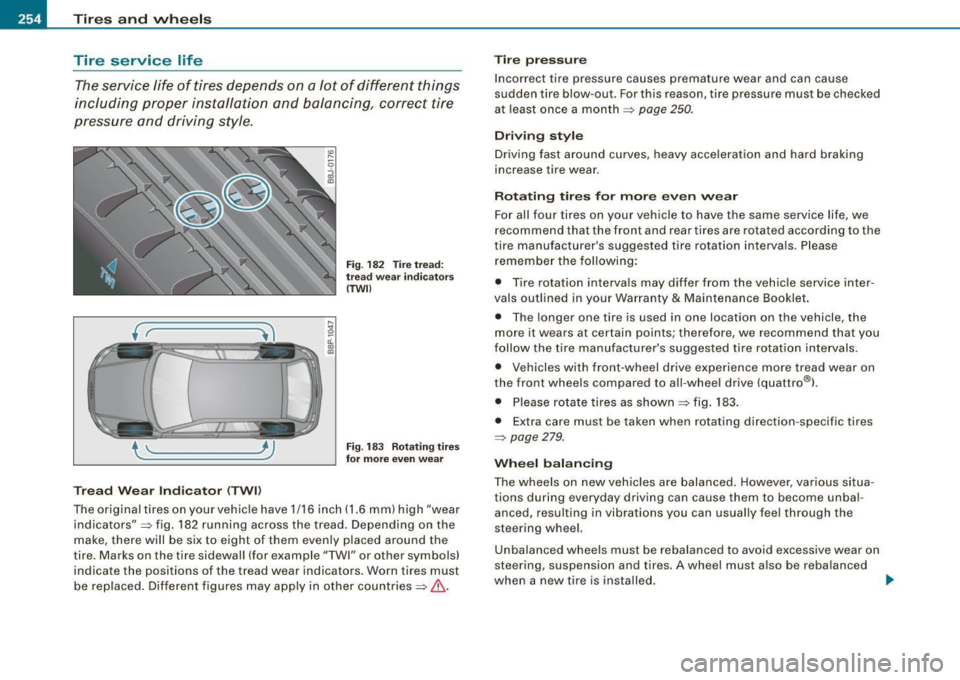
The or iginal tires on your vehicle have 1/16 inch (1.6 mm) high "wear
indicators":::::, fig. 182 running across the tread . Depending on the
make, there will be six to eight of them evenly placed around the
tire . Marks on the tire sidewall (for example "TWI" or other symbols)
indicate the positions of the tread wear indicators . Worn tires must
be replaced. Dif ferent figures may apply in other countries:::::,&.
Tir e p re ss ure
Incorrect tire pressure causes premature wear and can cause
sudden tire blow-out . For this reason, tire pressure must be checked
at least once a month :::::,
page 250.
Drivin g sty le
Driving fast around curves, heavy acce leration and hard braking
increase tire wear .
Rotating tires for more even wear
For all four tires on your vehicle to have the same service life, we
recommend that the front and rear tires are rotated according to the
tire manufacturer's suggested tire rotation intervals . Please
r emember the following:
• Tire rotation interva ls may differ from the vehic le service inter
vals outlined in your Warranty
& Maintenance Booklet.
• The longer one tire is used in one location on the vehicle, the
more it wears at certain points; therefore, we recommend that you
follow the tire manufacturer's suggested tire rotation intervals.
• Vehicles with front -wheel drive experience mo re tread wear on
the front wheels compared to all-wheel drive (quattro®) .
• Please rotate tires as shown :::::, fig . 183.
• Extra care must be taken when rotating direction -specific tires
:::::, page 279.
Whe el b ala n cing
The wheels on new vehicles are balanced. However, various situa
tions during everyday driving can cause them to become unba l
anced, resulting in vibrations you can usual ly feel through the
steering wheel.
Unba lanced whee ls must be rebalanced to avoid excessive wear on
steering, suspension and tires. A wheel must a lso be reba lanced
when a new tire is installed.
~
Page 258 of 324
-~_T_ ir_e_ s_ a_ n_d _ w_ h_ e_e _l_s _________________________________________________ _
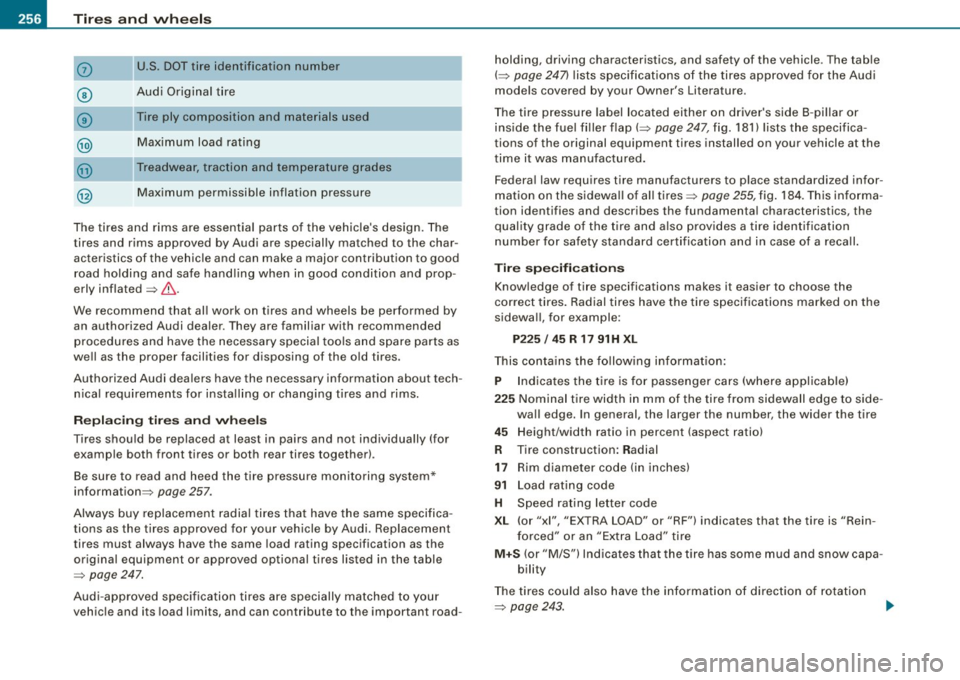
0
©
G)
@
U.S. DOT tire identification number
Audi Original tire
Tire ply composition and materials used Maximum load rating
Treadwear, traction and temperature grades Maximum permissible inflation pressure
The tires and rims are essential parts of the vehicle's design. The
tires and rims approved by Audi are specially matched to the char acteristics of the vehicle and can make a major contribution to good
road holding and safe handling when in good condition and prop
erly inflated =>& .
We recommend that al l work on tires and wheels be performed by
an authorized Audi dealer . They are familiar with recommended
procedures and have the necessary special tools and spare parts as
we ll as the proper facilities for disposing of the old tires .
Authorized Audi dealers have the necessary information about tech
nical requirements for insta lling or changing tires and rims .
Rep lac ing t ires a nd w heels
Tires should be replaced at least in pairs and not individually (for
example both front tires or both rear tires together) .
Be sure to read and heed the tire pressure monitoring system*
information :::>
page 257.
Always buy replacement radial tires t hat have the same specifica
tions as the tires approved for your vehicle by Audi . Replacement
tires must always have the same load rating specification as the
original equipment or approved optional tires listed in the table
=>
page 247.
Audi -approved specification tires are specially matched to your
vehic le and its load limits, and can contribute to the important road- holding, driving characteristics, and safety of the vehicle
. The table
( =>
page 247) lists specifications of the tires approved for the Audi
models covered by your Owner's Literature.
The tire pressure label located either on driver's side 8 -pi llar or
inside the fuel fi ller flap( =>
page 247, fig. 181 l lists the specifica
tions of the original equipment tires installed on your vehicle at the
time it was manufactured.
Federal law requires tire manufacturers to place standardized infor
mation on the sidewa ll of all tires=>
page 255, fig. 184. This informa
tion identifies and describes the fundamenta l characteristics, the
quality grade of the tire and also provides a tire identification
number for safety standard certification and in case of a recall.
T ire s pec ific ation s
Knowledge of tire specifications makes it easier to choose the
correct tires. Radial tires have the tire specifications marked on the
sidewal l, for example:
P 22 5 / 45 R 17 91H XL
This contains the following information:
P Ind icates the tire is for passenger cars (where applicable)
2 25 Nominal tire width in mm of the tire from sidewall edge to s ide -
wall edge. In general, the larger the number, the wider the tire
45 Height/width ratio in percent (aspect ratio)
R Tire construction: Radial
17 Rim diameter code (in inches)
91 Load rating code
H Speed rating letter code
XL (or "xi", "EXTRA LOAD" or "RF ") indicates that the tire is "Rein
forced" or an "Extra Load" tire
M +S (or "M/S"l Indicates that the tire has some mud and snow capa
bility
The tires cou ld also have the information of direction of rotation
=>
page 243 .
Page 259 of 324
________________________________________________ T_ i _r_e _s_ a_n_ d_ w_ h_ e_e _ l_s __ !II
•
T ire manu fact uring da te
The manufacturing date is a lso indicated on the tire sidewall
(possibly only on the
inner side of the wheell:
"DOT ... 2207 ... " means, for example, that the tire was produced in
the 22nd week of 2007 .
Speed ratin g (let te r cod e)
The speed rating letter code on the wheels indicates the maximum
permissible road speeds=>
& in "Winter tires" on page 260.
P up to 93 mph (150 km/h)
Q up to 99 mph (158 km/h)
R upto106mph(170km/h)
S upto110mph(180km/h)
T upto118mph(190km/h)
U up to 124 mph (200 km/h)
H upto 130mph(210km/h)
V up to 149 mph (240 km/h)6>
Z over 149 mph (240 km/h)6>
W up to 168 mph (270 km/h)6>
Y up to 186 mph (298 km/h)61
Your vehicle is normally factory equipped with tires, which possess
excel lent driving characteris tics and give your Audi optimum
driving comfort. An e lectronic speed limiter=> page
21 will normally
prevent your vehicle from going faster than the tire speed rating
=> & .
U.S . D OT T ire Ident ifi cation Nu mber (TIN ) and tire
m anu fac ture date
This is the tire's "seria l number" . It begins with the letters "DOT"
and indicates that the tire meets all federal standards . The next two
numbers or letters indicate the plant where it was manufactured,
and the last four numbers represent the week and year of manufac-
61 For tires with a maximum speed capability over 149 mph (240 km/h), tire
manufacturers sometimes use the letters "ZR."
ture. For example, the numbers 2207 mean that the tire was
produced in the 22nd week of 2007. The other numbers are
marketing codes that may or may not be used by the tire manufac
turer. This information is used to contact consumers if a tire defect
requires a recall.
Audi Origin al tire
Tires with the identification" AO" or "RO" have been specially
matched with your Audi. We recommend using only these tires
because they meet the highest standards regarding safety and
driving characteristics when used correctly . Your authorized Audi
dea ler will glad ly provide you with more information .
Maximum L oad Rating
This number indicates the maximum load in kilograms and pounds
that can be carried by the tire.
Tir e qu ality gra din g for tr eadw ear, trac tion, a nd
t emper atu re resi stan ce
Tread wear, traction and temperature grades=> page 259.
Max imum P ermi ssibl e Inf latio n Pre ssure
This number is the greatest amount of air pressure that should ever
be put in the tire under normal driv ing conditions .
Repla cing tires or rims on vehicl es equipp ed with tir e
pre ssure monit oring sy stem *
The wheels on your vehicle are equipped with a sensor which
constant ly monitors the air pressure ins ide the t ire, and then trans
mits this information to the tire pressure monitoring system *. If you
are going to replace the wheel rims on your vehic le, make sure the
new rims also have these sensors . The sensors must be compatible
with the tire pressure monitoring system* on your veh ic le.
If you instal l rims that do not have the sensors or have sensors
which are not compatible, then the tire pressure monitoring
system* wil l not work properly. In this case, the tire pressure moni -..
Vehicle care I t •
Page 260 of 324
-~_T_ ir_e_ s_ a_ n_d _ w_ h_ e_e _l_s _________________________________________________ _
toring system* would not be able to monitor the tire pressure or
warn yo u if it is n ece ssa ry .
• The battery inside of t he ti re pressure sensor has a l imited
service life.
• Always driv e with the valv e stem caps s ecurely mount ed. We
r ecomme nd u sing fact ory insta lled valve s tem caps . As k your autho
rized Audi d ealer to replace lost va lve stem caps.
T he installation of rep lacement tires with steel cord body p lies in
the t ir e si dewa ll may caus e malf unc tio n of th e tir e pre ssure mo ni
toring system*, and is not recommended (cord material informat ion
in mo lded o n th e tire s idewa ll).
Always check your tire pressu re monitoring system* indicator after
r eplacing one o r more tir e s on yo ur veh icle . If the ti re p ressure
monito ring sy ste m* in dicato r flas hes or is illum inated, you r syste m
is not working p ro perl y. Yo ur replacement ti re might be incompat
i b le with you r tire p ressu re mo nitoring sys tem*, or some compo
nent of the tire pressure monitori ng system* may be damaged.
& WARNING
• Using incorrect or unmatched tires and I or wheels or improper
tire and wheel combinations can lead to loss of control , collision
and serious personal injury .
• Always use tires , rims and wheel bolts that meet the specifica
tions of original factory-installed tires or other combinations that
have been specifically approved by the vehicle manufacturer.
• Tires age even if they are not being used and can fail suddenly,
especially at high speeds . Tires that are more than 6 years old can
only be used in an emergency and then with special care and at
lower speeds .
• Never mount used tires on your vehicle if you are not sure of
their "previous history ." Old used tires may have been damaged
even though the damage cannot be seen that can lead to sudden
tire failure and loss of vehicle control.
& WARNING (continued)
• All four wheels must be fitted with radial tires of the same type,
size (rolling circumference ) and the same tread pattern. Driving
with different tires reduces vehicle handling and can lead to a loss
of control.
• If the spare tire is not the same as the tires that are mounted
on the vehicle - for e xample with winter tires - only use the spare
tire for a short period of time and drive with extra care . Refit the
normal road wheel as soon as safely possible.
• Never drive faster than the maximum speed for which the tires
on your vehicle are rated because tires that are driven faster than
their rated speed can fail suddenly .
• Overloading tires cause heat build-up , sudden tire failure ,
including a blowout and sudden deflation and loss of control .
• Temperature grades apply to tires that are properly inflated and
not over or underinflated .
• For te chnical reasons it is not always possible to use wheels
from other vehicles -in some cases not even wheels from the
same vehicle model.
• If you install wheel trim discs on the vehicle wheels, make sure
that the air flow to the brakes is not blocked. Redu ced airflow to
the brakes can them to overheat , increasing stopping distances
and causing a collision.
• Run flat tires may only be used on vehicles that were equipped
with them at the fa ctory . The vehicle must have a chassis designed
for run flat tires and a factory-installed tire pressure monitoring
system * that indicates a loss of tire pressure . Incorre ct use of run
flat tires can lead to vehicle damage or accidents . Check with an
authorized Audi dealer or t ire specialist to see if your vehicle can
be equipped with run flat tires .
If run flat tires are used, they must
be installed on all four wheels . Mixing tire types is not permitted. .,
Page 262 of 324
-~_T_ ir_e_ s_ a_ n_d _ w_ h_ e_e _l_s _________________________________________________ _
Safety Standard No. 109. Grades Band A represent higher leve ls of
performa nce on th e la boratory test w hee l tha n the minim um
requ ired by law .
& WARNING
The traction grade assigned to this t ire is based on straight-ahead
braking traction tests , and does not include acceleration ,
cornering , hydroplaning or peak traction characteristi cs.
& WARNING
The temperature grade for this tire is established for a tire th at is
properly inflated and not overloaded. Exces sive speed , underinfla
tion, or excessive loading, either separately or in combination , can
cause heat buildup and possible tire failure. •
Winter tires
Win ter tires can im prove veh icle ha ndl ing on sno w and
i c e. A t te mp eratu res belo w 4 5 °F (7 ° C) w e r eco mme nd
c ha ng in g to winter tir e s.
In some heavy snow areas, local governments may require true
winter o r "snow" tire s, those with ve ry deeply cut tread. These tires
should only be used in pairs and be insta lled on a ll four wheels .
M ake s ure you p urchase snow ti res that are the same s ize and
construct ion type as the other ti res on your vehicle.
If your vehic le is equipped with al l-wheel drive *, this will improve
t rac tion dur ing winter dr iv in g, eve n with the standard tires .
However, we strongly recommend that you a lways equip all four
whee ls on y our vehicle with correc tly fitted winte r tires or all-seas on
tires, when winter road conditions are expected . Th is a lso improves
t he ve hic le 's brak ing perfo rmance an d reduces s top ping distances .
Summer ti res p rovide less grip on ice and snow. Winter tires (snow tires) must always be fitted on all four whee
ls .
Compatible ti re pr essu re monitoring sensors* must be insta lled on
a ll four winter tires for the t ire pressure monitoring system* to func
tion proper ly :::::> page
257.
Ask your aut hori zed Audi deale r or quali fied w orksho p for perm itte d
winter tire size s. Use only radial winter tires.
Wi nter tires lose thei r effec tiveness when the tread is worn down t o
a depth of 0. 157 inch (4 mm).
On ly drive with winter tires under winter conditions. Summer tires
h an dle better when there is no s now or ice on t he roads a nd th e
temperature is above 45 °F (7 °C) .
I f you have a flat tire, see n otes on spare w hee l :::::> page
255.
Please a lways remembe r that w inte r tires may have a lower speed
r ating than the tires original ly instal led on your vehic le at the time
i t was manu fac tured. Please see:::::> page
257, "Speed ra ting (letter
code)" for a listing of the speed rating letter codes and the
m ax imum speed at which t he ti res ca n be drive n.
T he speed rating letter code(:::::, page
257! is on the side wa ll of the
ti re :::::> page
255.
& WARNING
Winter tires have maximum speed limits that may be lower than
your veh icle's ma ximum speed . Always know the maximum speed
before driving off . Never drive faster than the speed permitted for
your specific winter tires . This will cause damage to the tires
leading to an accident and serious personal injury to you and your
pa ssengers.
& WARNING
Driving faster than the ma ximum speed for whi ch the winter tires
on your vehicle were designed can cause tire failure including a
blowout and sudden deflation , los s of control , crashes and serious _.,
Page 264 of 324
_L_T~ir ~e :..:s~ a~n~ d~ w~ h ~e~e~ l~ s '.,_ ______________________________________________ _
Wheel bolts
W heel b olts mus t al wa ys be tigh te n ed to t he cor rect
to rqu e.
The design of wheel bolts is matched to the factory instal led rims . If
d ifferen t rims are fitted, the co rrect w heel bo lts wit h th e rig ht length
and correctly shaped bolt heads m ust be used. This ensures that
w hee ls are fitt ed s ecure ly a nd th at t he brake sys te m funct ions
correctly .
I n certain circums tances, yo u may no t use w heel b olts fr om a
differ ent vehicle -even if it is the same mode l.
&_ WARNING
Improperly tightened or maintained wheel bolts can become loose
causing loss of control, a collision and serious personal injury.
• Always keep the wheel bolts and the threads in the wheel hubs
clean so the wheel bolts can turn easily and be properly tightened.
• Never grease or oil the wheel bolts and the threads in the wheel
hubs. They can become loose while driving if greased or oiled,
even if tightened to the specified torque .
• Only use wheel bolts that belong to the rim being installed.
• Never use different wheels bolts on your vehicle.
• Always maintain the correct tightening torque for the wheel
bolts to reduce the risk of a wheel loss. If the tightening torque of
the wheel bolts is too low , they can loosen and come out when the
vehicle is moving . If the tightening torque is too high, the wheel
bolts and th reads can be damaged and the wheel can become
loose .
0 Note
The specified torque for the wheel bolts is 90 ft lb (120 Nm) with a
t ole ranc e of ± 7,4 ft lb(± 1 0 Nm). To rque whee l bolts diag onally.
After changing a wheel, the torque must be checked as soon as possible with a to
rque wrench -preferab ly by an authorized Audi
dea ler o r qu alif ied wo rksh op.•
Low aspect ratio tires
Yo ur Audi is fac tory-equip ped wi th l ow asp ect rati o tires. Th ese tires
have been thorough ly tested and been selected specifically for your
mod el for thei r su per b p erfo rma nce, road feel an d handl in g u nder
a variety of driving conditions . Ask your author ized Aud i dea ler for
mo re deta ils.
T he low aspec t ra tio o f th ese t ires is ind icate d by a numera l o f 55 or
less in the t ire's size designation. The numera l represents the ratio
of the ti re's s idewa ll height in re la ti on to its tread w idth e xpress ed
in percentage. Conventiona l tires have a height/width ratio of 60 or
mo re .
The performance of low -aspect -ratio t ires is part icularly sensitive to
improper inflation pressure . It is therefore important that low
aspect ratio tires are inflated to the specified pressure and that the
inflation pressure is regularly checked and maintained. Tire pres
sures should be checked at least once a month and alway s before a
long trip=>
page 250, "Checking tire p ressure".
What you can do to avoid tire and rim damage L ow a spect rati o tires can be damaged more easi ly by impact with
potho les, curbs, gull ies or ridges on the road, particu larly if the t ire
is underinflated.
In orde r to minimi ze the occurrence o f im pact da mage to th e tire s
of your vehicle, we recommend that you observe the fo llowing
p reca utions:
• Always ma intain reco mm ende d inflat io n pressu res . C heck your
tire p ressure every 2, 000 miles (3 ,000 km) and add ai r if neces sary .
• D rive car eful ly on roads with potholes, deep gullies or ridges.
Th e impact from d riving th ro ugh o r ove r such o bstac les can
dama ge you r tires . Impact w ith a curb may also cause da mage to
your tires . .,_
Page 266 of 324
___ T _i_r e_=- p_r_e _ s_ s_ u_r_ e _ m_ o_ n_i_t _o _r_ i _ n .,;:g ::;.._ s_ y=--- s_t _e _m_ * __________________________________________ _
Tire pressure monitoring system*
Applies to vehicles: with tire pressu re monitoring system
General notes ' J
Each tire, including the spare (if provided), should be checked
monthly when cold and inflated to the inflation pressure recom
mended by the vehicle manufacturer on the vehicle placard or tire
inflation pressure label. (If your vehicle has t ires of a d ifferent size
than the size indicated on the vehicle placard or tire inflation pres
sure label, you should determine the proper tire inflation pressure
for those ti res.)
As an added safety feature, your vehicle has been equipped with a
tire pressure monitoring system (TPMS) that i lluminates a low tire
pressure tellta le when one or more of your tires is significantly
under-inflated. Accord ingly, when the low tire pressure telltale illu
minates, you shou ld stop and check your tires as soon as possible,
and inflate them to the proper pressure. Driving on a significantly
under-inflated tire causes the tire to overheat and can lead to tire
failure . Under -inflat ion also reduces fuel efficiency and t ire tread
life, and may affect the vehic le's handling and stopping ability.
Please note that the TPMS is not a substitute for proper tire mainte
nance, and it is the driver's responsibi lity to maintain correct tire
pressure, even if under -inflation has not reached the level to trigger
il luminat ion of the TPMS low tire pressure te lltale.
Your vehicle has also been equipped with a TPMS ma lfunction indi
cator to indicate when the system is not operating proper ly . The
TPMS malfunction indicator is combined with the low tire pressure
telltale. When the system detects a malfunction, the tellta le wi ll
flash for approximately one minute and then remain continuously illuminated. This sequence will continue upon subsequent vehicle
start-ups as long as the malfunction exists .
When the ma lfunction indicator is illuminated, the system may not
be able to detect or signal low tire pressure as intended. TPMS
malfunctions may occur for a variety of reasons, including the insta
llation of replacement or alternate tires or wheels on the
vehic le that prevent the TPMS from functioning properly. Always
check the TPMS malfunction tellta le after replac ing one or more
tires or whee ls on your vehicle to ensure that the replacement or
a lternate tires and wheels a llow the TPMS t o continue to funct ion
properly. •
Applies to vehicles: with tire pressur e monitoring system
Introduction
The tire pressure monitoring system monitors air pressure
in all four road wheels while the vehicle is moving.
As soon as the tire p ressure monitoring system senses a significant
loss of air pressure in one or severa l tires, text messages and ye llow
sy mbo ls appear in the instrument cluster display to alert the driver.
The warning light in the instrument cluster comes on when the
tire is significantly underinflated
=> page 13 .
Th e warning light l also i lluminates in the case of a system
malfunction.
Be aware tha t tire pressure is a lso dependent on the temperature of
the tire . For every 18 °F (1 O °C) increase in tire temperature, tire pres
sure increases by about 1.5 psi (0 .1 ba r). The tire warms up while the
vehic le is moving and tire pressure rises. So you should adjust tire
pressure on ly when they are
cold, when the temperature of the tires
is roughly the same as the ambient air temperature.
I n order to keep the tire pressure monitoring system properly ca li
b rated, tire pressure on all four tires shou ld be checked a t regu lar
interva ls, adjusted if necessary, and saved in the proper setting
(reco mmended pressure) :::>
page 266.
The tire pressure is shown either on the driver's side 8 -pi llar or on
the inside of the fuel fi ller flap. _..
Page 267 of 324
__________________________________________ T_i_re _ p =----r_e _s _ s_ u_ r_e _ m_ o_n_ i_ t _o _r_ i_n -=g =-- s....: y:.... s_ te_ m_ * __ _
•
& WARNING
• When the t ire pres sure monitoring sy stem warning light is l it ,
one or more of your tire s is significantly underinflated . You should
stop and che ck your tires as soon as possible , and inflate them to
the proper pres sure as ind icated on the vehicle's tire pressure
label :::::,
page 247 . Driving on a signifi cantly unde rinflated tire
causes the tire to overheat and can lead to tire failure. Underinfla
tion also is likely to impair the vehicle's handling and stopping ability .
• Do not adju st tire pressure when tire temperature is e xcess ive.
This could lead to serious tire damage and even cause the tire to
burst , with the additional dan ger of an accident.
W For the sake of the environment
D riving with u nder inflated tires r educes fue l effi ciency and ti re
tread life.
[ i J Tip s
• Each tire, including the spare , should be checked monthly when
t he tempe rat ure of the t ires is a bout t he sa me as amb ient a ir
temperature and set to the recommended inflation pressure as
speci fied o n the ti re pre ssure label :::::,
page 247.
• The factory supplied spare whee l is equipped with a sensor for
t he ti re press ure m onit ori ng sys te m. As long as the spare w hee l is
not mounted, the t ire pressure of this tire wil l not be monitored .
• T he tire pressure mon itori ng system help s t he d river mo nitor ti re
pressures, but the driver is stil l responsible for maintaining the
c orrect tire press ure.
• T ire pressure must only be adjusted when the temperature of the
ti res is abou t th e sam e as ambie nt air te mperatu re.
• When t ires a re replaced, the sen so rs and valves shou ld not be
e xcha nged . T he va lve co re, nut, va lv e sea ling and sea l was her (replacement kit) needs to be replaced
. If necessary, the valve and
t he wheel electr onics have to be rep laced.
• I f you should put different whee ls and tires on your vehic le (e.g.
win ter w hee ls a nd tires), y ou must be certa in tha t the whee ls and
tires are compat ible with the tire pressure monitoring system .
Otherwise the sys te m will r egiste r a ma lfunc tion and a fau lt
message will be displayed . For more information, contact your
au thorized A udi dea le r.
• Adjust the tire pressure and store the pressure in the tire pres
su re moni tor ing sys tem to t he loa d you are carrying.
• F or Dec laration of Comp liance to United States FCC and Industry
Cana da regula tions :::::,
page 307 . •
A pplies to veh ic les : w ith tir e pressu re mon itor ing system
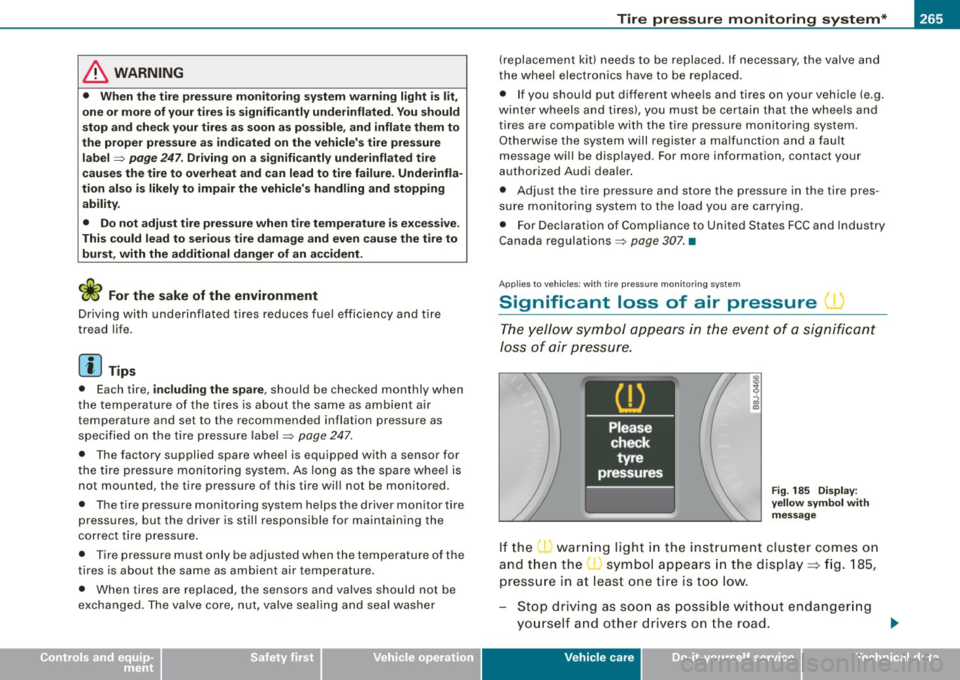
Significant loss of air pressure j'
Th e yellow symb ol app ear s i n the event o f a sig ni ficant
Jo ss of a ir pr es su re.
Fig . 185 Di sp lay :
yellow symbol with message
I f th e warning ligh t in the ins trumen t clu ste r com es o n
a nd t hen the s ymb ol appea rs in t he dis pla y~ fig. 1 85,
pre ssure in at least o ne tire is t oo l ow.
S to p drivi ng as soo n a s possib le wit h out e nda nge rin g
y o urs elf a nd other dr ivers on t he road. ._
Vehicle care I t •