tow AUDI S3 2009 Owner's Guide
[x] Cancel search | Manufacturer: AUDI, Model Year: 2009, Model line: S3, Model: AUDI S3 2009Pages: 324, PDF Size: 76.02 MB
Page 205 of 324

Trailer lights
Trailer lights must meet all regulations. Be sure to check with your
authorized Audi dealer for correct wiring, switches and relays.
Mirrors
If you are unable to see the traffic behind you using the regular
outside mirrors, then you
must install extended mirrors. It is impor
tant that you
always have clear vision to the rear .
& WARNING
After removing the trailer hitch, do not store it in your vehicle. In
case of sudden braking, the hitch could fly forward and injure you
or your passengers .
.1
Operating instructions
Maximum trailer weight
A trailer for your vehicle is limited to a typical class 1 or class 2
trailer.
Trailer load distribution
Be sure the load in the trailer is held securely in place to guard
against shifting, be it forward, backward or sideways.
Never allow a passenger to ride in a trailer:::::, & in "Driving instruc
tions".
Tire pressure
When towing a trailer, inflate the tires of your vehicle to the cold tire
pressure listed under "Full load" on the sticker on the right door
jamb. Inflate trailer tires to trailer and tire manufacturers' specifica
tions.
Controls and equip ment Safety first Vehicle operation
Trailer towing
Lights
The
headlight settings should be checked with the trailer attached
before driving off. Adjust as necessary so that you can see the road
ahead but not blind oncoming traffic.
Check proper working of vehicle and trailer lights.
Safety chains
Be sure trailer safety chains are properly connected from the trailer
to the hitch on the vehicle. Leave enough slack in the chains to
permit turning corners. When you install safety chains, make sure
they will not drag on the road when you are driving.
The chains should cross under the trailer tongue to prevent it from
dropping in case of separation from the hitch. •
Driving instructions
Driving with a trailer always requires extra care and
consideration.
To obtain the best possible handling of vehicle and trailer,
please note the following:
Do not tow a loaded trailer when your car itself is not
loaded.
- Be especially careful when passing other vehicles.
Observe speed limits.
Do not drive at the maximum permissible speed.
- Always apply brakes early.
Monitor the temperature gauge.
Vehicle care Do-it-yourself service Technical data
Page 206 of 324

___ T_ r _a_ il_e _r_ t_ o_ vv_ in__... g,_ __________________________________________________ _
Weig ht dis tributi on
Towing a loaded trailer with an empty car resu lts in a high ly
unstable distribution of weight . If this cannot be avoided drive at
very low speeds on ly to avoid the risk of losing steering control.
A "ba lanced" rig is easier to operate and control. This means that
the tow vehicle should be loaded to the extent possible and permis
sib le while keeping the trai ler as light as possib le under the circum
stances. Whenever possible, transfer some cargo to the luggage
compartment of the tow vehicle while observing tongue load requirements and vehicle loading considerations .
Speed
The higher the speed, the more difficult it becomes for the driver to
control the rig . Do not drive at the maximum permissible speed.
Reduce your speed even more under unfavorable load, weather or
wind conditions -particularly when going downhill.
Reduce vehicle speed
imm ed ia tely if the trailer shows the sl ightest
sign of swaying. Do not try to s top the s wayi ng by a ccelerating .
Observe speed limits . In some areas speeds for vehicles towing
trai lers are lower than for regular vehicles.
Always app ly brakes early. When driving downhill, shift into lower
gear to use the engine braking effect to slow down the vehicle. Use
of the brakes alone can cause them to overheat and fail.
C oo la nt tempe ra tu re
The coolant temperature gauge ~ page 9 must be observed care
ful ly. If the needle moves close to the upper end of the scale, reduce
speed immediately and/or switch off the air condit ioner.
If the coolant temperature warning light in the instrument cluster
starts flashing -~-, pull off the road, stop and let the engine
idle for
about two minutes to prevent heat build -up .
& WARNING
An yone not p rope rly res train ed in a mo ving vehi cle is a t a mu ch
gre ater risk in a n accident. Neve r let an yone ride in your car who
is not p rop erly we ari ng th e res tra int s pro vide d b y Aud i.
c
Trailer towing tips
Important to know
Your vehicle handles different ly when towing a trailer because of
the additional weight and weight distribution . Safety, performance
and economy w ill great ly depend on how carefu lly you load your
trailer and operate your rig.
Before you actually tow you r trailer, practice turn ing, stopping and
backing up in an area away from traffic. Keep practicing unti l you
have complete ly become familiar with the way your vehicle -trailer
combination behaves and responds .
Backing up is difficult and requires practice. Backing up with a
trailer genera lly requires steering ac tion opposite of that when
backing up your vehicle without a trailer .
Maintain a greater distance between your vehicle and the one in
front of you. You will need more room to stop.
T o compensate for the trailer, you wi ll need a larger than normal
turning radius .
When passing, remember that you cannot accelerate as fast as you n ormal ly wou ld because of the added load . Make su re you have
enough room to pass. After passing, al low plenty of room for your
trailer before changing lanes again .
Avoid jerky starts, sharp turns o r rapid lane changes.
Page 207 of 324
![AUDI S3 2009 Owners Guide [ i] Tips
• Do not tow a trailer during the break-in period of your vehicle.
• If you tow a trailer, your Audi may require more frequent mainte
nance due to the extr](/img/6/57546/w960_57546-206.png "AUDI S3 2009 Owners Guide [ i] Tips
• Do not tow a trailer during the break-in period of your vehicle.
• If you tow a trailer, your Audi may require more frequent mainte
nance due to the extr")
[ i] Tips
• Do not tow a trailer during the break-in period of your vehicle.
• If you tow a trailer, your Audi may require more frequent mainte
nance due to the extra load=>
page 304. •
Parking on a slope
-----------------
Do not park with a trailer on a slope. If it cannot be
avoided, do so only after doing the following:
When parking:
-Apply the foot brake.
- Have someone place chocks under both the vehicle and the trailer wheels .
- With chocks in place, slowly release the brakes until
wheel blocks absorb the load.
- Turn the wheels towards the curb.
- Apply the parking brake.
- Place an automatic transmission in
P, respectively a
manual transmission in first or reverse gear.
When restarting after parking:
- Start the engine.
- Shift transmission into gear.
- Release the parking brake and slowly pull out and away from the wheel blocks.
- Stop and have someone retrieve the wheel blocks.
Controls and equip
ment Safety first Vehicle operation
Trailer towing
[
i] Tips
If you move the selector lever of the automatic transmission to P
before applying the parking brake and before blocking the wheels,
you may have to use more force later to move the lever out of the
P
position .•
Vehicle care Do-it-yourself service Technical data
Page 212 of 324

-~_C_ l_ e _a _n_ in_g=- a _n_d__, p,__ ro_ t_e _c_ t_ i_o _n _____________________________________________ _
Plastic and vinyl
Plastic needs special care.
Use a clean, damp cloth or sponge to remove dust and light surface
dirt. For other soil, use a lukewarm all -purpose cleaning solution or
a mild saddle soap for vinyl trim. Remove water spots and traces of
soap with a clean, damp cloth or sponge . Use a clean, soft cloth to
rub dry .
Grease, tar or oil stains can be removed with a clean cloth or sponge
soaked with all-purpose cleaner or with a solvent designed espe
cially to clean vinyl.
Occasionally apply a colorless vinyl or leather preservative to retain
the material's luster and pliability.
& WARNING
Always read and heed all WARNINGS and other information
~ page206. •
Aluminum trim
Use only neutral-pH products to remove spots and deposits from
aluminum surfaces. Chrome care products and alkaline cleaners
will attack aluminum surfaces and can damage them over time.
& WARNING
Always read and heed all WARNINGS and other information
~ page206 .•
Touch-up paint
Minor paint damages should be touched up immediately.
-Use either a touch -up paint stick or spray paint to cover
minor scratches and nicks.
Your authorized Audi dealer has touch-up paint for minor scratches
and stone chips. Scratches should be touched up soon after they
occur to prevent corrosion.
If a spot starts to rust, however, a simple touch-up job will not be
enough. The affected surface must be sanded smooth and coated
with an anti-rust primer before the painted finish can be restored.
The number for the original vehicle paint can be found on the
vehicle identification label~
page 298 .
& WARNING
Always read and heed all WARNINGS and other information
~ page206.•
Windows
Clear vision to all sides.
Clean all windows regularly to remove road film and
carwash wax buildup.
- Remove snow from windows using a brush.
- Use a plastic ice scraper to remove ice from windows and
mirrors.
- Remove other residue on the windows with a spray-on
glass cleaner.
- Wipe the windows dry with a clean piece of cloth or
kitchen paper towel.
Page 217 of 324
____________________________________________ ...:C :..: l:..: e :.: a::. n:....:..:..: in~ g~ a~n .:..:d::....! p::. r :..:o:::..::. te:::..::: c:..::t ..:..:io ::::.: n:...__IJIIII
•
soiling, etc.), you will need to be somewhat careful with these
leathers, and a certain type of care is required. For example, dark
clo thing materials can discolor leather sea ts (especially if such
clothing is damp and was not dyed correctly) . Dust and dirt particles
in pores , folds, and seams can have an abrasive effect and can
damage the leather surface as well as weaken seams.
The leather should be cleaned regularly as needed. After having
been used for a rela tiv ely long tim e, your lea ther seats will acquire
a rich aged finish. This is a characteristic of natural leather and a
sign of true quality.
In order to maintain the value of this natural product over the life of
your vehicle, you should follow the recommendations below:
0 Note
• To keep your leather from bleaching out, do not allow it to be
exposed to bright sunlight for long periods of time. If you have to
leave the vehicle parked outside for long periods, cover the leather
to protect it from direct exposure to sunlight.
• Sharp objects on clothing, such as zippers, rivets or sharp pieces
on belts can leave permanent scratches or scrape marks on the
surface of the leather.
[ i] Tips
• After each time you clean the leather and at regular intervals, use
a leather preservative creme that contains UV -blockers and that
works into the leather. This creme will nourish and moisturize the leather , helping it to breathe and stay supple . It also helps to build
up a protective coating on the surface.
• Clean the leather every 2 -3 months, and clean any areas that get
soiled.
• Remove fresh marks made by ballpoint pens, ink, lipstick, shoe
polish, etc . as soon as possible.
• Preserve the color of the leather as needed by using a special
colored leather care creme to touch up areas of uneven color .•
Ap plies to veh ic les : wi th n atural leat her
Cleaning and caring for leather upholstery
and trim
Natural leather requires special care and attention.
Normal cleaning
-Clean soiled areas with a slightly moistened cotton or
woolen cloth.
More stubborn dirt
- More stubborn dirt can be removed using a cloth satu
rated with a mild soap solution (2 tablespoons mild
liquid soap).
- Never allow the soap solution to saturate the leather, and
make certain that no water soaks into the seams.
Wipe off the soap solution with a soft, dry cloth.
Cleaning spots
- Remove fresh water-based spots (such as coffee, tea,
juices, blood) with an absorbent cloth or paper towel.
- Remove fresh grease or oil-based spots (such as butter,
mayonnaise, chocolate) with an absorbent cloth or paper
towel, or use the cleaner from the leather care kit if the
spot has not yet penetrated into the surface of the
leather.
- Use an oil/grease dissolving spray, if oil/grease spots
have dried on.
- Remove specific kinds of spots (ballpoint pen, felt
marker, fingernail polish, water-based paint, shoe polish,
etc.) with a spot remover specifically formulated for leather. ._.
Vehicle care I t •
Page 254 of 324
-Tires and wheels
P'tr:1-------------------
and is more difficult to stop. Overloading can not only lead to loss
of vehicle control, but can also damage important parts of the
vehicle and can lead to sudden tire failure, including a blowout and
sudden deflation that can cause the vehicle to crash.
Your safety and that of your passengers also depends on making
sure that load limits are not exceeded. Vehicle load includes every
body and everything in and on the vehicle. These load limits are
technically referred to as the vehicle's
Gross Vehicle Weight Rating
("GVWR").
The "GVWR" includes the weight of the basic vehicle, all factory
installed accessories, a full tank of fuel, oil, coolant and other fluids
plus maximum load. The maximum load includes the number of
passengers that the vehicle is intended to carry ("seating capacity")
with an assumed weight of 150 lbs (68 kg) for each passenger at a
designated seating position and the total weight of any luggage in
the vehicle. If you tow a trailer, the weight of the trailer hitch and the
tongue weight of the loaded trailer must be included as part of the
vehicle load.
The
Gross Axle Weight Rating ("GAWR") is the maximum load that
can be applied at each of the vehicle's two axles.
The Gross Vehicle Weight Rating and the Gross Axle Weight Rating
are listed on the safety compliance sticker label located either on
the driver's side B-pillar or on the inside of the fuel filler flap. Your
Audi has 5 seating positions, 2 in the front and 3 in the rear for total
seating capacity of 5. Each seating position has a safety belt
=>
page 137, "Safety belts".
The fact that there is an upper limit to your vehicle's Gross Vehicle
Weight Rating means that the total weight of whatever is being
carried in the vehicle (including the weight of a trailer hitch and the
tongue weight of the loaded trailer) is limited. The more passengers
in the vehicle or passengers who are heavier than the standard
weights assumed mean that less weight can be carried as luggage.
The tire pressure label on your Audi also lists the maximum
combined weight of all of the occupants and luggage or other cargo that the vehicle can carry.
For the location of the label=>
page 247,
fig. 180.
& WARNING
Overloading a vehicle can cause loss of vehicle control, a crash or
other accident, serious personal injury, and even death.
• Carrying more weight than your vehicle was designed to carry
will prevent the vehicle from handling properly and increase the
risk of the loss of vehicle control.
• The brakes on a vehicle that has been overloaded may not be
able to stop the vehicle within a safe distance.
• Tires on a vehicle that has been overloaded can fail suddenly,
including a blowout and sudden deflation, causing loss of control
and a crash.
• Always make sure that the total load being transported -
including the weight of a trailer hitch and the tongue weight of a
loaded trailer -does not make the vehicle heavier than the
vehicle's Gross Vehicle Weight Rating. •
Determining correct load limit
Use the example below to calculate the
total weight of the passengers and luggage or other things that you plan to
transport so that you can make sure that
your vehicle will not be overloaded.
~
Page 255 of 324
Steps for Determining Correct Load Limit
1. Locate the statement "THE COMBINED
WEIGHT OF OCCUPANTS AND CARGO SHOULD NEVER EXCEED XXX KG OR XXX
LBS"on your vehicle's placard (tire infla
tion pressure label)=>
page 247, fig. 180.
2. Determine the combined weight of the
driver and passengers that will be riding
in your vehicle.
3. Subtract the combined weight of the
driver and passengers from
"XXX" kilo
grams or
"XXX" pounds shown on the
sticker=>
page 247, fig. 180.
4. The resulting figure equals the available
amount of cargo and luggage load capacity. For example, if the
"XXX"
amount equals 1400 lbs. and there will
be five
150 lbs. passengers in your
vehicle, the amount of available cargo
and luggage load capacity is
650 lbs.
( 1400- 750 (5 x 150) = 650 I bs.)
Tires and wheels 111111
5. Determine the combined weight of luggage and cargo being loaded on the
vehicle. That weight may not safely exceed the available cargo and luggage
load capacity calculated in Step
4.
6.
If your vehicle will be towing a trailer,
load from your trailer will be transferred
to your vehicle. Consult this manual to
determine how this reduces the avail
able cargo and luggage load capacity of
your vehicle.
- Check the tire sidewall (=>
page 255,
fig. 184) to determine the designated
load rating for a specific tire. •
Vehicle care I • •
Page 272 of 324
1111...__W_ h_ a _ t_d_ o_ l _d _o_ n_ o_ vv_ ? ______________________________________________ _
What do I do now?
Jack, tools and spare wheel
Jack and tools
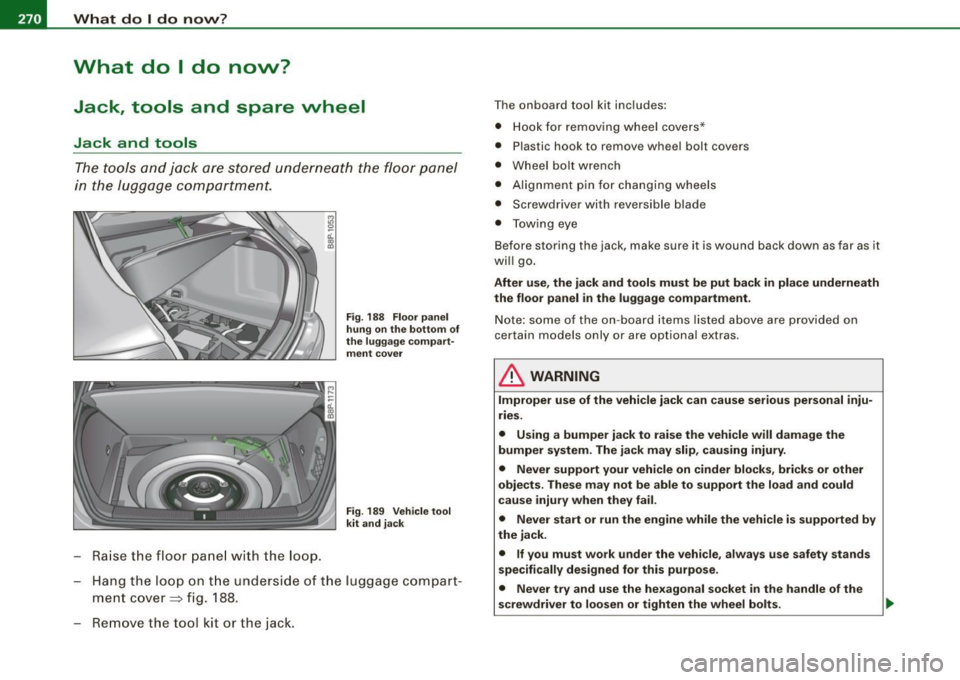
The tools and jack are stored underneath the floor panel
in the luggage compartment.
Raise the floor panel with the loop.
Fig. 188 Floor panel
hung on the bottom of
the luggage compart
ment cover
Fig . 189 Vehicle tool
kit and jack
- Hang the loop on the underside of the luggage compart
ment cover ~ fig. 188.
Remove the tool kit or the jack.
The onboard tool kit includes:
• Hook for removing wheel covers*
• Plasti c hook to remove wheel bolt covers
• Wheel bolt wrench
• Alignment pin for changing wheels
• Screwdriver with reversible blade
• Towing eye
Before storing the jack, make sure it is wound back down as far as it
will go.
After use, the jack and tools must be put back in place underneath
the floor panel in the luggage compartment.
Note: some of the on-board items listed above are provided on
certain models only or are optional extras.
& WARNING
Improper use of the vehicle jack can cause serious personal inju
ries.
• Using a bumper jack to raise the vehicle will damage the
bumper system. The jack may slip, causing injury.
• Never support your vehicle on cinder blocks, bricks or other
objects. These may not be able to support the load and could
cause injury when they fail.
• Never start or run the engine while the vehicle is supported by
the jack.
• If you must work under the vehicle, always use safety stands
specifically designed for this purpose.
• Never try and use the hexagonal socket
in the handle of the
screwdriver to loosen or tighten the wheel bolts.
Page 275 of 324
What do I do now? -__________________ __;__:....:....:..:: __ _
•
-All passengers should leave the car and move to a safe
location (for instance, behind the guardrail)~& .
- Apply the
parking brake firmly ~& .
- Move
selector lever to position Pon an automatic trans-
miss ion; put manual transmission in
first gear ~& .
-If you are towing a trailer : unhitch the trailer from your
vehicle.
- Take the
tool and the spare tire~ page 270 out of the
luggage compartment.
& WARNING
You or your passengers could be injured while changing a wheel if
you do not follow these safety precautions:
• If you have a flat tire, move a safe distance off the road. Turn off
the engine, turn the emergency flasher on and use other warning
devices to alert other motorists.
• Make sure that passengers wait
in a safe place away from the
vehicle and well away from the roadway and traffic.
• To help prevent the vehicle from moving suddenly and possibly
slipping off the jack, always fully set the parking brake and block
the wheel diagonally opposite the wheel being changed. When one
front wheel is lifted off the ground, placing the automatic trans
mission in "P" (Park), or engaging a gear in a manual transmission
will
not prevent the vehicle from moving.
• Before you change a wheel, be sure the ground is level and firm.
If necessary, use a sturdy board under the jack.
• After installing the spare wheel, make sure that you remount
the flat tire/wheel in its storage area properly and tighten the
knurled retaining screw securely. •
Changing a wheel
When you change a wheel, follow the sequence described
below step-by-step and exactly in that order.
1. Remove the decorative wheel cover*. For more details
see also
~ page 274, "Decorative wheel covers" or
~ page 275, "Wheels with cap-covered wheel bolts".
2. Loosen the
wheel bolts ~ page 276.
3. Locate the proper mounting point for the jack and align the jack below that point~
page 276.
4. Lift the car with the jack~ page 276.
5. Take the flat wheel off and then put the spare on
~ page 278.
6. Tighten all wheel bolts lightly .
7.
Lower the vehicle with the jack .
8. Use the wheel bolt wrench and
firmly tighten all wheel
bolts
~ page 276.
9. Put the decorative wheel cover* back on.
& WARNING
Always read and head all WARNINGS and information ::} & in
"Raising the vehicle" on
page 276 and ~ page 279. •
After changing a wheel
A wheel change is not complete without the following
actions.
- Store and secure the replaced wheel in the spare wheel
well. .,._
Do-it-yourself service
Page 289 of 324
________________________________________________ E _m_ e_r.:g :;,. e_ n_c ...: y:.- s_ i_ t _u _a_ t_ i_ o _ n_ s __ lll
•
Emergency situations
General
This chapter is intended for trained emergency crews and working
pe rsonnel who have the necessary tools and equ ipment to perform
these operations. •
Starting by pushing or towing
(D Note
Vehicles with an automatic transmis sion cannot be started by
push ing or towing . •
Starting with jumper cables
Ju mpe r cabl e: Note the man ufa ct ure r's in for matio n.
If the battery is discharged, another veh icle can provide starting
assistance. For this you require a jumper cable. Both batteries must
h ave t he same vo ltage (V) and a s im ilar capacity (Ah).
Jumper cables
Use
only jumper cables of sufficiently large cross section to safely
car ry the starter current . Refer to the manufactu rer's specifications.
Use only j um per ca bles with
isolated term in al cl am ps and pr operly
marked for distinction :
plus
(+) cable in mo st c ases c olored red
minus( -) cable i n most cas es co lor ed black .
& WARNING
Batteries contain electricity, acid , and gas. Any of the se can cause
very ser ious or fatal injury . Follow the instructions below for safe
handling of your vehicle 's battery .
• Always shield your eyes and avoid leaning over the battery
whenever possible .
• A discharged battery can already freeze at temperatures just
below 32 °F (0 °C l. Never attempt to provide starting assistance on
a frozen or thawed out battery- Danger of explosion and chemical
burns! Replace a battery if it has been frozen.
• Do not allow battery acid to contact eyes or skin. Flush any
contacted area with water immediately .
• Improper use of a booster battery to start a vehicle may cause
an explosion .
• Vehicle batteries generate explosive gases . Keep sparks, flame
and lighted cigarettes away from batteries .
• Do not try to jump start any vehicle with a low acid level in the
battery .
• The voltage of the booster battery must also have a 12 -Volt
rating . The capacity (Ah ) of the booster battery should not be
lower than that of the discharged battery . Use of batteries of
different voltage or substantially different "Ah " rating may cause
an explosion and personal injury .
• Never charge a frozen battery . Gas trapped in the ice may cause
an explosion.
• Never charge or use a battery that has been frozen . The battery
case may have be weakened .
• Use of batter ies of different voltage or substantially different
capacity (Ah) rating may cau se an e xplosion and inju ry . The
c apacity (Ah ) of the booster battery should not be lower than that
of the discharged battery. .,.
Do-it -yourself service