battery AUDI S3 2010 User Guide
[x] Cancel search | Manufacturer: AUDI, Model Year: 2010, Model line: S3, Model: AUDI S3 2010Pages: 320, PDF Size: 75.34 MB
Page 51 of 320

Reactivating the system after battery
disconnection Reactivating the convenience close/open feature
If the vehicle battery is disconnected and then reconnected,
the automatic closing and opening function will not work until it is reactivated. To reactivate this feature, perform the
following steps:
Reactivating close/open feature
-Pull and hold the power window switch until the window
is completely closed.
- Release the switch .
- Pull the switch again for one second. The automatic
closing/opening is now reactivated. •
Panoramic sliding sunroof
Applies to veh icles: with pano ram ic slid ing sunroof
Description
The panoramic sliding sunroof is operated with the toggle switch
=> fig. 39 wh en the ignition in on .
The panoramic sliding sunroof can still be opened or closed for
about 10 minutes after the ignition has been switched off. However,
as soon as the driver's or passenger's door is opened, the switch for
the roof is inoperative. •
Con tro ls and eq uip
ment
Opening and closing
Applies to veh icles: wit h pano ram ic sliding sunroof
Opening and closing panoramic sliding
sunroof
.... ........... ...... ....................... .
;;;;;;;;;; ;;;;;::: ::::· ::;:;;::;;;;;;;;;; ;;;;i
1·············~1
.............. . ............. . ............. . .............. . ............ ..
• •
Fig. 39 Section of the
roof liner Toggle switch
for the panoramic
sliding sunroof
The panoramic sliding sunroof is opened in two stages.
First, the roof lifts up and then it can be opened.
Lifting
- Tap the switch G) ~ fig. 39 briefly, and the roof lifts auto
matically (pop-up position) .
Opening automatically (independent operation)
-Tap the switch G)~ fig. 39 briefly, and the roof moves to
the lift position .
- Tap the switch
G) briefly a second time, and the roof
moves to the low wind noise comfort position .
- Press the switch
G) until the roof is fully open. In this
position increased wind noise may occur.
Opening manually (manual operation)
- Press the switch G) ~ fig. 39, starting from the "lift posi -
tion" unt il the roof has reached the desired position.
~
Vehicle care I I Technical data
Page 57 of 320

on the next time automatic headlights are switched on. To use the
high beams, you first have to pull the high beam lever back and then
push the lever forward again.
• In cool or damp weather, the inside of the headlights, turn
signals and tail lights can fog over due to the temperature differ
ence between the inside and outside. They will clear shortly after
switching them on. This does not affect the service life of the
lighting.
• Frequent use of the coming home/leaving home function for
approaching and departing a vehicle parked in the dark will strain
the battery . This applies particularly if only short distances are
driven between stops. Occasionally drive longer distances to make
sure the battery is recharged sufficiently. •
Applies to vehicles: with Adap tive Light
Adaptive light
When driving around bends, the relevant area of the road
is better illuminated.
Fig. 48 Adaptive light
when driving
The benefit of adaptive light is that the curve and the edge of the
road are better illuminated::::} fig . 48 . The adaptive light is controlled
automatically, depending on vehicle speed and steering wheel
angle.
Con tro ls and eq uip
ment
Clear vision
When driving around bends, the headlights are controlled
according to steering wheel angle. So that there is no black area
ahead of the vehicle, the two main beams pivot at different angles .
[ i] Tips
The system works above a speed of about 6 mph (10 km/hl. •
Front fog lights !O
Use the light switch to turn on the front fog lights.
Fig. 49 Fog light acti
vation: light switch
position on vehicles
WITHOUT sensor light
Switching on the front fog lights !D
Do not turn the light switch ·'ti-·~ fig. 49 toward the fog
light symbol
Turn the light switch to
~oo: or to io.
Pull the light switch to the first stop G).
When the front fog lights are on, the symbol }O next to the light
switch will illuminate.•
Vehicle care I I Technical data
Page 60 of 320

Clear vision
0 Note
Do not use the high beam or headlight flasher if you know that these
could be blinding oncoming traffic. •
Interior lights
Interior lights and glove compartment light
The interior lights include the both reading lights for the
driver and the front passenger.
Fig. 53 Control panel
above windshield : inte
rior light switches
Light switch => fig. 53 has the following functions:
Door contact activation
-Move the sw itch to the center position. The forward
dome light is turned on/off by the contact switches on
any of the doors .
Forward dome light on
-Move the switch to position I. The forward dome light
goes on and stays on regardless of door position.
Forward dome light off
- Move the sw itch to position 0 . The light w ill not go on
regardless of door position.
Glove compartment light
-Open the glove compartment -the light in the glove
compartment automatically illuminates as long as the
side marker lights or headlights are on. When you close
the glove compartment, the light goes off .
With the interior light switch at the door contact (center) position,
the forward dome light illuminates whenever you unlock the vehicle or op en a door . The dome light goes out after approximately 30
seconds after you have closed the door. Likewise , when you lock
your vehicl e or switch on the ignition, th e dome light goes out .
If you leave a door open, the dome light will go out after ten minutes
to conserve battery charge.
A dimmer automatically controls the brightn ess of th e lights when
they are switched on. •
Page 61 of 320

Applies to vehi cle s: wi th lig ht pac kag e
Interior lights and forward reading lights
The interior lights include the both reading lights for the
driver and the front passenger.
!: ........ : .. : ..... : ... ..... .......... ... : ... :. ~ .... ...... ............. ............. .......... =
® ;i~!;J';i~L '!
~ [;] ) B
• •
Fig . 54 Control panel
above windshield : inte·
rior light switches
Light switch @~ page 58, fig. 53 has the following func
tions:
Door contact activation
- Move the switch to the center position. The forward
dome light is turned on/off by the contact switches on
any of the doors.
Forward dome light on
-Move the switch to position I. The forward dome light
goes on and stays on regardless of door position.
Forward dome light off
- Move the switch to position 0. The light will not go on
regardless of door position.
Con tro ls and eq uip
ment
Clear vision
Forward reading lights
~
- Press the left or right switch ® to switch the left or right
forward reading light on or off.
Glove compartment light
Open the glove compartment -the light in the glove
compartment automatically illuminates as long as the
side marker lights or headlights are on. When you close
the glove compartment, the light goes off.
With the interior light switch at the door contact (center) position,
the forward dome light illuminates whenever you unlock the vehicle or open a door . The dome light goes out after approximately 30
seconds after you have closed the door. Likewise, when you lock
your vehicle or switch on the ignition , the dome light goes out.
If you leave a door open, the dome light will go out after ten minutes
to conserve battery charge.
A dimmer automatically controls the brightness of the lights when
they are switched on. •
Vehicle care I I irechnical data
Page 108 of 320
• ..__O_ n_ t_h _ e_ r_ o_ a_ d ____________________________________________________ _
Ignition lock and ignition switch
Ignition lock
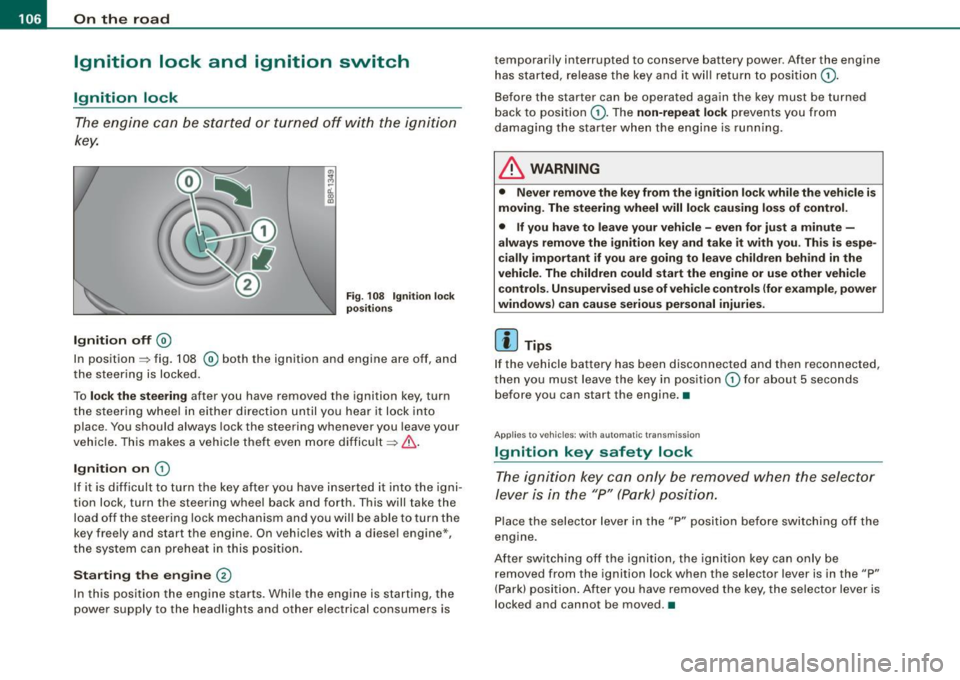
The engine can be started or turned off with the ignition
key.
Ignition off ®
Fi g. 108 Ignit ion lock
p os ition s
In position => fig. 108 ® both the ignit ion and engine are off, and
the steering is locked .
To
lo ck the stee ring after you have removed the ignition key, turn
t he steering whee l in either direction until you hear it lock into
place . You should always lock the steering whenever you leave your
vehic le . This makes a vehicle theft even more difficult =>
& -
Ignition on CD
If it is difficult to turn the key after you have inserted i t into the igni
tion lock, turn the steering wheel back and forth . This will take the
load off the steering lock mechanism and you will be able to turn the
key freely and start the engine . On vehicles with a diesel engine*,
t he system can preheat in this pos ition.
St arting the engine
@
In this position the engine starts . Whi le the engine is starting, the
power supply to the headlights and other electrical consumers is temporarily interrupted to conserve battery power
. After the engine
has started, release the key and it will return to position
CD .
Before the starter can be operated again the key must be turned
back to position
CD -The non-repeat lock prevents you from
damaging the star ter when the engine is runn ing.
& WARNING
• Never remo ve the key from the ignition lo ck w hile the veh icle i s
moving. The steering whe el will lo ck caus ing lo ss of control .
• If you hav e to lea ve your vehicle -even fo r ju st a min ute -
alway s remove the ignition key and take it with you. Th is is espe
ci ally important if you are g oing to lea ve children behind in the
vehicle . The childr en co uld start the eng ine or u se other vehi cle
c on trols . Un supe rvis ed u se of veh icle c ont ro ls ( for e xamp le , po wer
windows) c an cause seriou s per sonal injuries .
[ i ] Tips
If the vehicle battery has been disconnected and then reconnected,
then you must leave the key in position
CD for about 5 seconds
before you can start the engine. •
Applies t o vehi cles : w ith autom atic trans mission
Ignition key safety lock
The ignition key can only be removed when the selector
le ver is in the "P" (Park) p osition.
Place the selector lever in the "P" posi tion be fore switching off the
engine .
After switching off the ignition, the ignition key can only be
removed from the ignition lock when the selector lever is in the "P"
(Park) position . After you have re moved the key, the selector lever is
l ocked and cannot be moved .•
Page 123 of 320
Transmission -_______________ ___.
- Remove the screwdriver from the vehicle tool kit. Use the
flat side of the reversible screwdriver blade~
page 268.
-Carefully pry the cover out with the screwdriver and pull
it ~
page 120, fig. 120 toward the shifter knob in the
direction of the arrow. The screwdriver must grip at the
lower edge of the cover to loosen it.
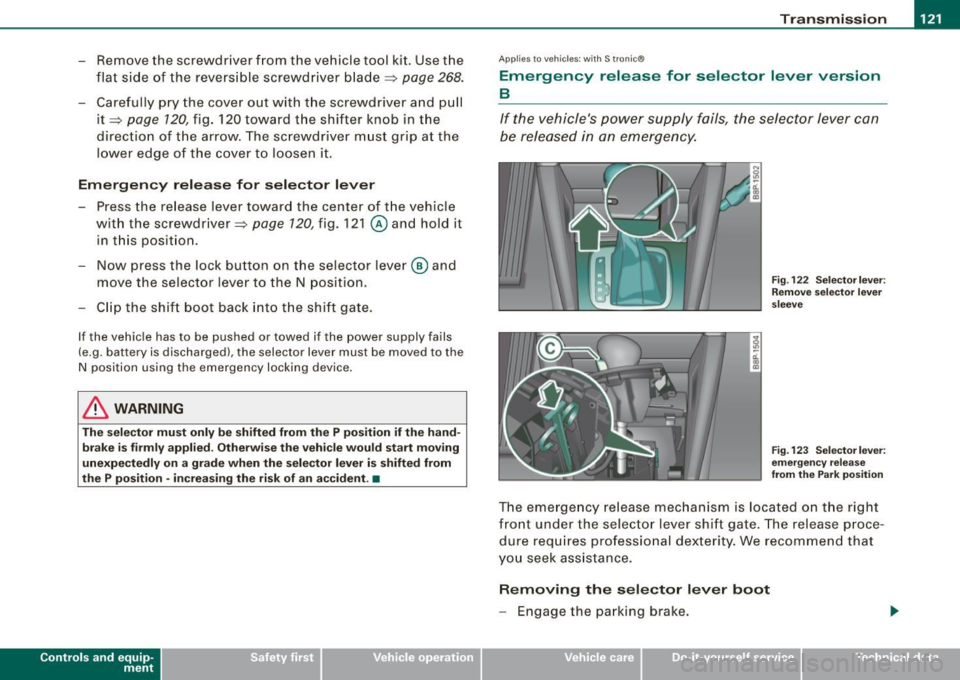
Emergency release for selector lever
-Press the release lever toward the center of the vehicle
with the screwdriver ~
page 120, fig. 121 @and hold it
in this position.
- Now press the lock button on the selector lever @ and
move the selector lever to the N position.
- Clip the shift boot back into the shift gate.
If the vehicle has to be pushed or towed if the power supply fails
(e.g. battery is discharged) , the selector lever must be moved to the
N position using the emergency locking device.
& WARNING
The selector must only be shifted from the P position if the hand
brake is firmly applied . Otherwise the vehicle would start moving
unexpectedly on a grade when the selector lever is shifted from
the P position -increasing the risk of an accident . •
Con tro ls and eq uip
ment
Ap plies to vehic les: with S tron ic®
Emergency release for selector lever version
B
If the vehicle's power supply fails, the selector lever can
be released in an emergency.
Fig . 122 Selector lever :
Remove selector lever
sleeve
Fig. 123 Selector lever:
emergency release
from the Park position
The emergency release mechanism is located on the right
front under the selector lever shift gate. The release proce
dure requires professional dexterity. We recommend that
you seek assistance.
Removing the selector lever boot
- Engage the parking brake.
Vehicle care I I irechnical data
Page 124 of 320
-Transmission --------------------
-
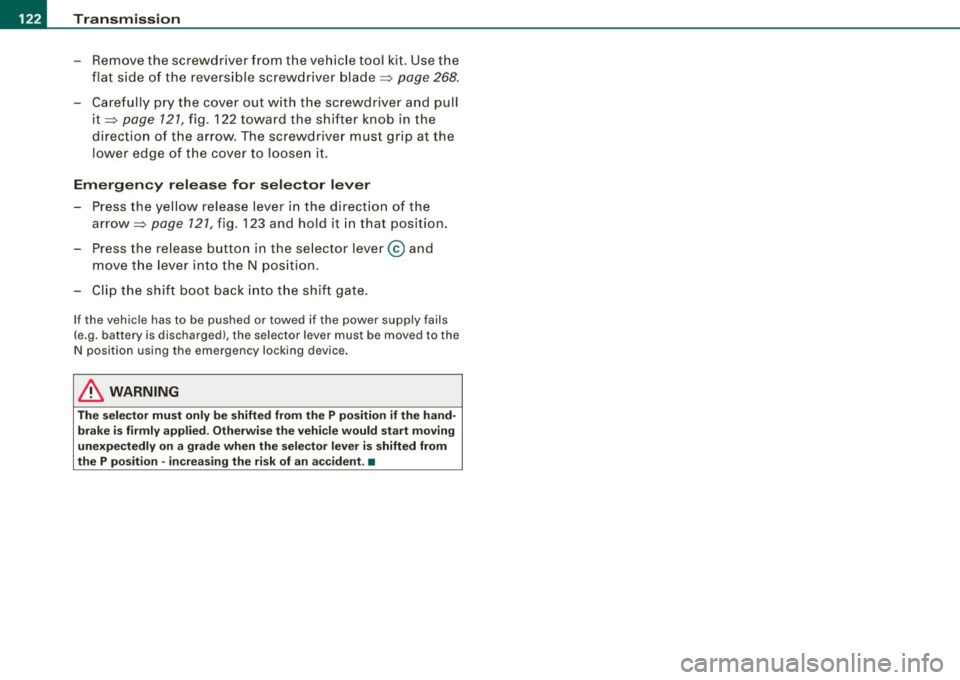
Remove the screwdriver from the vehicle tool kit. Use the
flat side of the reversible screwdriver blade
~ page 268.
- Carefully pry the cover out with the screwdriver and pull
it~
page 121, fig. 122 toward the shifter knob in the
direction of the arrow. The screwdriver must grip at the
lower edge of the cover to loosen it.
Emergency release for selector lever
-Press the yellow release lever in the direction of the
arrow ~
page 121, fig. 123 and hold it in that position.
- Press the release button in the selector lever@ and
move the lever into the N position .
- Clip the shift boot back into the shift gate.
If the vehicle has to be pushed or towed if the power supply fails
(e.g . battery is discharged), the selector lever must be moved to the
N position using the emergency locking device.
& WARNING
The selector must only be shifted from the P position if the hand
brake is firmly applied. Otherwise the vehicle would start moving
unexpectedly on a grade when the selector lever is shifted from
the P position -increasing the risk of an accident. •
Page 226 of 320
-~_C_ h_e _c _ k_ i_n ...:::g::;...._ a_n_ d_ f_ i_ll _in -'g:::;.._ ___________________________________________ _
Closing the engine hood
- Pull the hood down until the pressure from the strut is
reduced.
- Let the hood
drop down and latch in place. Do not try to
push it shut;
it may fail to engage~& .
& WARNING
A hood that is not completely latched could fly up and block your
view while driving.
• When you close the engine hood, check it to make sure the
safety catch has properly engaged. The hood should be flush with
the surrounding vehicle body parts.
• If you notice while driving that the hood is not secured prop
erly, stop at once and close it. •
Working in the engine compartment
Be especially careful whenever you work in the engine
compartment!
Whenever you must perform any work in the engine compartment,
for example checking and filling different fluids, there is a risk of injury, burns and accidents. To prevent personal injury always
observe the following WARNINGS. The engine compartment of any
vehicle is a hazardous area!
=> &
& WARNING
To help avoid injury, before you check anything under the hood :
• Turn off the engine.
• Remove the ignition key.
• Set the parking brake fully .
& WARNING (continued)
• Move selector lever of automatic transmission to "P" {Park);
put manual transmission in Neutral.
• Always let the engine cool down. Hot components will burn
skin on contact.
• To reduce the risk of being burned, never open the hood if you
see or hear steam or coolant escaping from the engine compart
ment. Wait until no steam or coolant can be seen or heard before
carefully opening the hood .
• Keep children away from the engine compartment.
• Never spill fluids on hot engine components. They can cause a
fire.
• Never touch the radiator fan. The auxiliary electric fan is
temperature controlled and can switch on suddenly.
• Never open the coolant reservoir cap when the engine is still
warm. The coolant system is pressurized and hot coolant could
spray out!
• Protect your face, hands and arm from steam or hot engine
coolant by placing a thick rag over the cap when you open the
coolant reservoir.
• If work on the fuel system or the electrical system is necessary:
- Always disconnect the battery .
- Never smoke or work near heaters or open flames. Fluids in
the engine compartment could start a fire.
- Keep an approved fire extinguisher immediately available.
• To avoid electrical shock and personal injury while the engine
is running or being started, never touch :
- Ignition cables
- Other components of the high voltage electronic ignition
system.
• If you must perform a check or repair with the engine running: .,_
Page 227 of 320
_____________________________________________ C_h_ e;::..:. c:..:..k :..:..in ;..:..= g:.....:.; a:..:..n :....:d :..:....:. f.:.:il .:.:li :..:..n :.::g:!-_ ___,JIJIII
& WARNING !continued )
-First, fully apply the parking brake, move selector lever of
automatic transmission to "P" (Park); put manual transmission
in Neutral.
- Always use extreme caution to prevent clothing, jewelry, or
long hair from getting caught in the radiator fan, V-belts or
other moving parts, or from contacting hot parts. Tie back hair
before starting, and do not wear clothing that will hang or
droop into the engine .
• Minimize exposure to emission and chemical hazards
:=> &.
& WARNING
California Proposition 65 Warning :
• Engine exhaust , some of its constituents, and certain vehicle
components contain or emit chemicals known to the State of Cali
fornia to cause cancer and birth defects and reproductive harm . In
addition, certain fluids contained in vehicles and certain products
of component wear contain or emit chemicals known to the State
of California to cause cancer and birth defects or other reproduc
tive harm.
• Battery posts, terminals and related accessories contain lead
and lead compounds , chemicals known to the State of California
to cause cancer and reproductive harms. Wash hands after
handling.
0 Note
When adding fluids , always make sure that they are poured into the
proper container o r filler opening, otherwise serious damage to
vehicle systems will occur .
ffi For the sake of the environment
To detect leaks in time, inspect the vehicle floor pan from under
neath regularly. If you see spots from oil or other vehicle fluids, have
your vehicle inspected by an authorized Audi dealer .•
Engine compartment
Ap plie s to veh icl es: wit h 2.0 I tur bo, 4-cy lind er•e ng ine
2.0 liter , 4-cylinder turbo gasoline engine (200
hp)
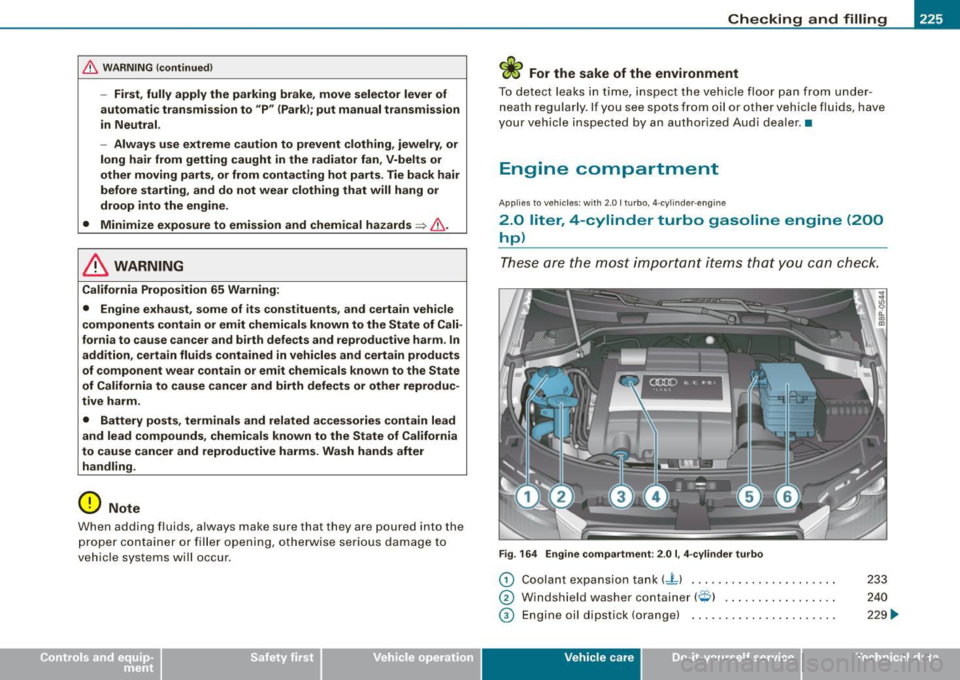
These are the most important items that you can check.
Fig. 164 Engine compartment : 2 .0 I , 4-cy linder turbo
G) Coolan t expansion tank (- L l .... ... .... .... ... .. . .
0 Windshield washer container (W ) ... .... ... ... ... .
© Eng ine oil d ipstick (orange) .. ...... ........ ..... .
Vehic le care I I
233
240
229 ~
irechnical data
Page 228 of 320
___ C_h_ e_ c_k _in --== g'-- a_n _d_ f_il _li _n ..:::g:::..- ___________________________________________ _
© Engine oil filler cap ("t=:?:) .... ........ .... ... ... . .
© Brake fluid reservoir ( l .......... ... .. ...... .. .
© Battery ...... .. ........ ....... ......... .. .... .
& WARNING
Before you check anything in the engine compartment , always
read and heed all WARNINGS ~
& in "Working in the engine
compartment" on
page 224. •
Applies to veh icles : with 2.0 I TO I, 4-cyl inder diese l-engine
230
235
236
2 .0 liter , 4-cylinder turbo diesel engine (140
hp)
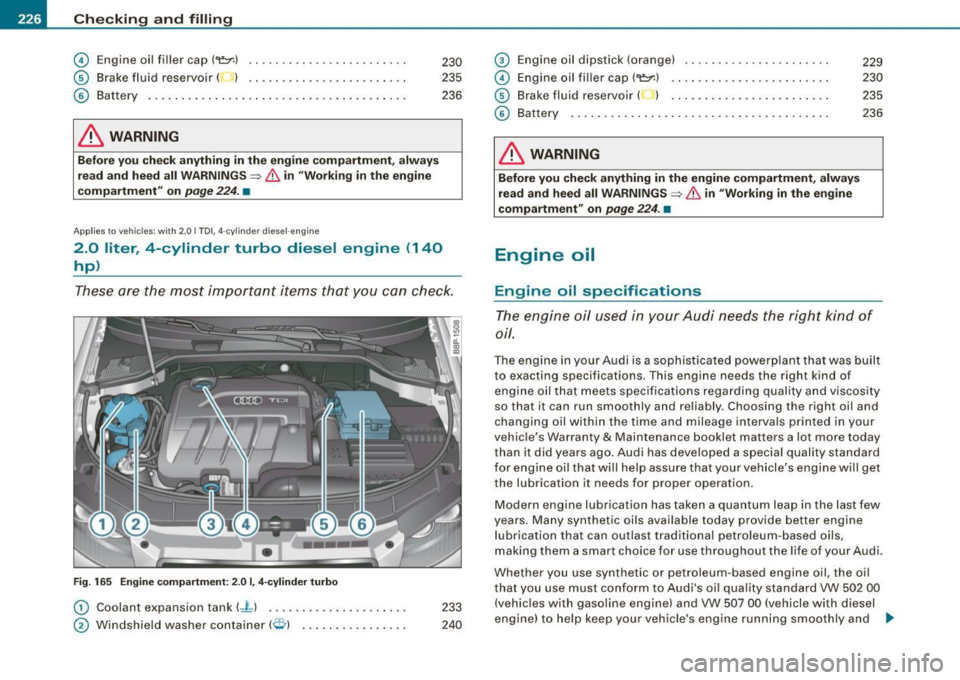
These are the most important items that you can check.
Fig. 165 Engine compartment: 2.0 I, 4-cylinder turbo
G) Coolant expansion tank ( J_ ) ....... ... .... .... .. .
0 Windshield washer container ('C,;> ) •••• •• •••• ••• •• •
233
240
© Engine oil dipstick (orange) ..... ... ...... .... ... .
© Engine oil filler cap ("t=:?:) .. ...... ..•........... ..
G) Brake fluid reservoir ( ) ..... ....... ...... .... . .
© Battery . .................. ..... .............. .
& WARNING
Before you check anything in the engine compartment, always
read and heed all WARNINGS
~ & in "Working in the engine
compartment" on
page 224. •
Engine oil
Engine oil specifications
229
230
235
236
The engine oil used in your Audi needs the right kind of
oil.
The engine in your Audi is a sophisticated powerp lant that was built
to exacting specifications. This engine needs the right kind of
engine oil that meets specifications rega rding quality and viscosity
so that it can run smoothly and reliably. Choosing the right oil and
changing oil within the time and mileage intervals printed in your
vehic le's Warranty
& Maintenance booklet matters a lot more today
than it did years ago. Audi has developed a special quality standard
for engine oi l that will help assure that your vehicle's engine will get
the lubrication it needs for proper operation.
Modern engine lubrication has taken a quantum leap in the last few
years. Many synthetic oils available today provide better engine
lubrication that can outlast traditional petroleum -based oils,
making them a smart choice for use throughout the life of your Audi.
Whether you use synthetic or petroleum -based engine oil, the oil
that you use must conform to Audi's oi l quality standard VW 502 00
(vehicles with gasoline engine) and VW 507 00 (vehicle with diesel
engine) to help keep your vehicle's engine running smoo thly and _,..