flat tire AUDI S3 2010 User Guide
[x] Cancel search | Manufacturer: AUDI, Model Year: 2010, Model line: S3, Model: AUDI S3 2010Pages: 320, PDF Size: 75.34 MB
Page 253 of 320

Tires and wheels -
----------------
•
and is more difficult to stop. Overloading can not only lead to loss
of ve hicle control, but can a lso damage important parts of the
vehicle and can lead to sudden tire failure, inc luding a blowout and
sudden deflation that can cause the vehic le to crash.
Your safety and that of your passengers also depends on making
sure that load limits are not exceeded. Vehicle load includes every
body and everything in and on the veh icle . These load limits are
technically referred to as the vehicle's
Gross Vehicle Weight Rating
("GVWR"l.
The "GVWR" includes the weight of the basic vehicle, al l factory
insta lled accessories, a full tank of fuel, oil, coolant and other fluids
plus maximum load. The maximum load includes the number of
passengers that the vehicle is intended to carry ("seating capacity")
with an assumed weight of 150 lbs (68 kg) for each passenger at a
designated seating position and the total weight of any luggage in
the vehicle. If you tow a trailer, the weight of the trailer hitch and the
tongue weight of the loaded trai ler must be included as part of the
vehicle load .
The
Gross Axle Weight Rating ("GAWR") is the maximum load that
can be applied at each of the vehic le's two axles .
The Gross Vehicle Weight Rating and the Gross Axle Weight Rating
are listed on the safety compliance sticker label located either on
the driver's side B-pillar or on the inside of the fuel filler flap. Your
Audi has 5 seating positions, 2 in the front and 3 in the rear for total
seating capacity of 5. Each seating position has a safety belt
=> page 135, "Safety belts".
The fact that there is an upper limit to your vehicle's Gross Vehicle
Weight Rating means that the total weight of whatever is being
carried in the vehicle (including the weight of a trailer hitch and the
tongue weight of the loaded trailer) is limited. The more passengers
in the vehicle or passengers who are heavier than the standard
weights assumed mean that less weight can be carried as luggage .
T he tire pressure label on your Audi also lists the maximum
combined weight of all of the occupants and luggage or other cargo that the vehicle can carry.
For the location of the label
=> page 246,
fig. 173.
& WARNING
Overloading a vehicle can cause loss of vehicle control, a crash or
other accident, serious personal injury , and even death .
• Carrying more weight than your vehicle was designed to carry
will prevent the vehicle from handling properly and increase the
risk of the loss of vehicle control.
• The brakes on a vehicle that has been overloaded may not be
able to stop the vehicle within a safe distance.
• Tires on a vehicle that has been overloaded can fail suddenly,
including a blowout and sudden deflation, causing loss of control
and a crash.
• Always make sure that the total load being transported -
including the weight of a trailer hitch and the tongue weight of a
loaded trailer -does not make the vehicle heavier than the
vehicle's Gross Vehicle Weight Rating .•
Determining correct load limit
Use the example below to calculate the
total weight of the passengers and
luggage or other things that you plan to
transport so that you can make sure that
your vehicle will not be overloaded.
~
Vehicle care I t •
Page 257 of 320
Tires a nd wh eels -
----------------
•
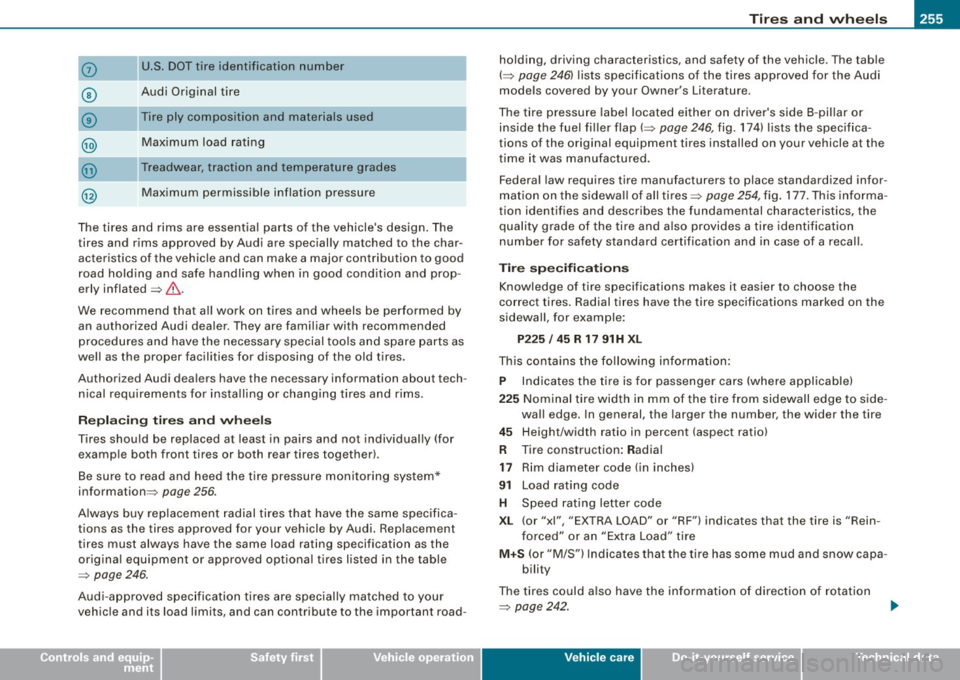
0
-
©
®
U.S. DOT tire identification number
Audi Original tire
Tire ply composition and materials used Maximum load rating
Treadwear, traction and temperature grades
@ Maximum permissible inflation pressure
The tires and rims are essential parts of the vehicle 's design. The
tires and rims approved by Audi are specially matched to the char
acteristics of the vehicle and can make a major contribution to good
road hold ing and safe handling when in good cond ition and prop
erly inflated =>& .
We recommend that a ll work on tires and wheels be performed by
an authorized Audi dealer. They are familiar with recommended
procedures and have the necessary special tools and spare parts as
well as the proper facilities for disposing of the old tires.
Authorized Audi dea lers have the necessary info rmation about tech
nical requirements for insta lling or changing tires and rims.
R epl ac ing tires and wheels
Tires shou ld be replaced at least in pairs and not individual ly (for
examp le both front tires or both rear tires together).
Be sure to read and heed the tire pressure monitoring sys tem*
information=>
page 256.
A lways buy replacement radial tires that have the same specifica
tions as the tires approved for your vehicle by Audi. Rep lacement
tires must always have the same load rating specification as the
origina l equipment or approved optional t ires listed in the table
=>
page 246.
Audi -appr oved spec ification tires are spec ially matched to your
vehicle and its load limits, and can contribute to the important road- holding, driving characteristics, and safety of the vehicle
. The table
( =>
page 246) lists specifications of the tires approved for the Audi
models covered by your Owner's Literature.
The tire pressure labe l located either on driver's side 8 -pi llar or
inside the fuel fi ller flap(=>
page 246, fig. 174) lists the specifica
tions of the original equipment tires installed on your vehicle at the
ti me it was manufactured.
Federa l law requires tire manufacturers to place standardized infor
mation on the sidewa ll of all tires =>
page 254, fig . 177. This informa
t ion identifies and describes the fundamental characteristics, the
qua lity grade of the ti re and also provides a tire identification
number for safety standard certificat ion and in case of a recal l.
Tire specificat ions
Knowledge of tire specifications makes it easier to choose the
co rrect t ires . Radial tires have the tire specifications marked on the
sidewall, for example :
P225 / 45 R 17 91H XL
This contains the fo llowing informa tion:
P Indicates the ti re is for passenger cars (where applicab le)
225 No minal tire width i n mm of the tire fro m sidewall edge to side -
wa ll edge. In general, the larger the number, the wider the tire
45 Height/width ratio in percent (aspect ratio)
R Tire construction: Radial
17 Rim diameter code (in inches)
91 Load rating code
H Speed rating lette r code
XL (or "xi", "EX TRA LOA D" or "RF") indicates that the tire is "Rein
forced" or an "Extra Load" ti re
M +S (o r "M/S") Indicates that the tire has some mud and snow capa
bility
The tires could a lso have the information of direct ion of rotation
=>
page 242.
Vehicle care I t •
Page 259 of 320
________________________________________________ T_ i _r_e _s_ a_n_ d_ w_ h_ e_e _ l_s __ !II
•
to ring s yst em * would not b e ab le to moni tor the tire pr essur e or
war n yo u if i t is nec essa ry.
• T he battery ins ide of the tire pressure s ensor has a l imited
service life.
• Always driv e with the va lv e stem caps s ecure ly m ounted. We
r e co mm end usi ng fact ory insta lled valve stem cap s. Ask y our a utho
rized Audi d ealer to replac e lost valve stem caps .
T he installat ion of replacement tires with steel cord body plies in
t he ti re s id ew all m ay ca use ma lfun ction o f th e tire press ure m oni
toring system *, and is not recommended (co rd mater ial information
i n mo lded on t he tire sid ewa ll).
Always check your t ire pressure mo nitoring system* indicator after
r eplaci ng o ne or more tir es o n you r veh ic le . If t he ti re p ressu re
mo nito ring syste m* in dicato r flashes o r is ill um in ated, your s ystem
is not working p rope rly . Yo ur replacement t ire might be inco mpat
i b le with you r tir e p ressure mon itori ng sys te m *, or so me comp o
nent of the tire pressure monitoring system * may be damaged .
& WARNING
• Using incorrect or unmatched tires and / or wheels or improper
tire and wheel combinations can lead to loss of control , collision
and serious personal injury .
• Always use tires , rims and wheel bolts that meet the specifica
tions of original factory-installed tires or other combinations that
have been specifically approved by the vehicle manufacturer .
• Tires age even if they are not being used and can fail suddenly,
espe cially at high speeds . Tires that are more than 6 years old can
only be used in an emergency and then with special care and at
lower speeds.
• Never mount used tires on your vehicle if you are not sure of
their "previous history. " Old used tires may have been damaged
even though the damage cannot be seen that can lead to sudden
tire failure and loss of vehicle control.
& WARNING (continued )
• All four wheels must be fitted with radial tires of the same type,
size {rolling circumference ) and the same tread pattern. Driving
with different tires reduces vehicle handling and can lead to a loss
of control.
• If the spare tire is not the same as the tires that are mounted
on the vehicle -for example with winter tires -only use the spare
tire for a short period of time and drive with extra care . Refit the
normal road wheel as soon as safely possible.
• Never drive faster than the maximum speed for which the tires
on your vehicle are rated because tires that are driven faster than
their rated speed can fail suddenly .
• Overloading tires cause heat build-up , sudden tire failure ,
including a blowout and sudden deflation and loss of control.
• Temperature grades apply to tires that are properly inflated and
not over or underinflated.
• For technical reasons it is not always possible to use wheels
from other vehicles -in some cases not even wheels from the
same vehicle model.
• If you install wheel trim discs on the vehicle wheels , make sure
that the air flow to the brakes is not blocked . Reduced airflow to
the brakes can them to overheat , increasing stopping distances
and causing a collision .
• Run flat tires may only be used on vehicles that were equipped
with them at the factory . The vehicle must have a chassis designed
for run flat tires and a factory-installed tire pressure monitoring
system* that indicates a loss of tire pressure . Incorrect use of run
flat tires can lead to vehicle damage or accidents . Check with an
authorized Audi dealer or tire specialist to see if your vehicle can
be equipped with run flat tires . If run flat tires are used , they must
be installed on all four wheels . Mi xing tire types is not permitted. _,.
Vehicle care
I t •
Page 261 of 320

________________________________________________ T_ i _r_e _s_ a_n_ d_ w_ h_ e_e _ l_s __ lfll
•
Safety Standard No. 109. Grades Band A represent higher levels of
performance on the laboratory test wheel than the minimum
required by law.
& WARNING
The traction grade assigned to this tire is based on straight-ahead
braking traction tests, and does not include acceleration,
cornering, hydroplaning or peak traction characteristics.
& WARNING
The temperature grade for this tire is established for a tire that is properly inflated and not overloaded. Excessive speed, underinfla
tion , or excessive loading, either separately or in combination, can
cause heat buildup and possible tire failure. •
Winter tires
Winter tires can improve vehicle handling on snow and
ice. At temperatures below 45 °F (7 °C) we recommend
changing to winter tires.
In some heavy snow areas, local governments may require true
winter or "snow" tires, those with very deeply cut tread. These tires
should only be used in pairs and be installed on all four wheels.
Make sure you purchase snow tires that are the same size and
construction type as the other tires on your vehicle.
I f your vehicle is equipped with all-wheel drive*, this will improve
traction during winter driving, even with the standard tires.
However, we strongly recommend that you always equip all four
wheels on your vehicle with correctly fitted winter tires or all-season
tires, when winter road conditions are expected . This also improves
the vehicle's braking performance and reduces stopping distances.
Summer tires provide less grip on ice and snow . Winter tires (snow tires) must always be fitted on all four wheels
.
Compatible tire pressure monitoring sensors* must be installed on
all four winter tires for the tire pressure monitoring system* to func
tion properly ~
page 256.
Ask your authorized Audi dealer or qualified workshop for permitted
winter tire sizes . Use only radial winter tires.
Winter tires lose their effectiveness when the tread is worn down to
a depth of 0.157 inch (4 mm) .
Only drive with winter tires under winter conditions. Summer tires
handle better when there is no snow or ice on the roads and the
temperature is above 45 °F (7 °C).
If you have a flat tire, see notes on spare wheel
~ page 254.
Please always remember that winter tires may have a lower speed
rating than the tires originally installed on your vehicle at the time
it was manufactured . Please see~
page 256, "Speed rating (letter
code)" for a listing of the speed rating letter codes and the
maximum speed at which the tires can be driven.
The speed rating letter code(~
page 256) is on the side wall of the
tire
~ page 254.
& WARNING
Winter tires have maximum speed limits that may be lower than
your vehicle's maximum speed. Always know the maximum speed
before driving off. Never drive faster than the speed permitted for
your specific winter tires. This will cause damage to the tires leading to an accident and serious personal injury to you and your
passengers.
& WARNING
Driving faster than the maximum speed for which the winter tires
on your vehicle were designed can cause tire failure including a
blowout and sudden deflation, loss of control, crashes and serious _,,
Vehicle care
I t •
Page 263 of 320
Tires and wheels 1111111 ________________________________ ::..:..:....::.=.....::.:..:..:..::..:___:__ _ ___:,___
•
Wheel bolts
Wheel bolts mus t alwa ys be tighte ned to t he correct
to rq ue .
The design of wheel bo lts is matched to the factory installed rims. If
di fferent r ims are fitted , th e cor rect whe el bo lts wi th the rig ht l ength
and c orrec tly shaped bolt heads must be used . This ens ures that
w he els a re fitted se cur ely and th at the bra ke syste m functi ons
correctl y.
In cer ta in c ircums tances, yo u ma y not use w hee l bolts fr om a
differ ent vehicle - even if it is the same mo del.
& WARNING
Improperly tightened or maintained wheel bolts can become loose
causing loss of control, a collision and serious personal injury.
• Always keep the wheel bolts and the threads in the wheel hubs
clean so the wheel bolts can turn easily and be properly tightened .
• Never grease or oil the wheel bolts and the threads in the wheel
hubs. They can become loose while driving if greased or oiled,
even if tightened to the specified torque .
• Only use wheel bolts that belong to the rim being installed .
• Never use different wheels bolts on your vehicle.
• Always maintain the correct tightening torque for the wheel
bolts to reduce the risk of a wheel loss .
If the tightening torque of
the wheel bolts is too low, they can loosen and come out when the
vehicle is moving . If the tightening torque is too high, the wheel
bolts and threads can be damaged and the wheel can become
loose .
0 Note
The s pecified torque for the wheel bolts is 90 ft lb ( 120 N m) with a
to lerance o f± 7,4 ft lb(± 1 0 Nm). Torque whee l bolt s diago nally.
After chang ing a whee l, the torque must be checked as soon as possible with a torque wrench
-preferably by an authorized Audi
d e aler o r qua lifi ed wo rksho p.•
Low aspect ratio tires
You r A ud i is fac tory-eq uippe d w ith low aspect ra tio tire s. T hese tire s
have been thorough ly t ested and b een se lected specifica lly for your
mod el for thei r su p erb pe rf or manc e, r oad f eel an d ha nd ling under
a variety of driving con ditions . As k your authorized Audi d ealer for
m ore de ta ils.
The low aspect rat io o f th ese t ires is indicated by a numer al of 55 or
less in the t ire's size designation. The numeral rep resents the ratio
o f t he t ire's s idewa ll he ig ht in rel ati on to it s tread w idt h ex pressed
in percentage . Conventiona l tires have a height/width ratio of 60 or
mo re.
The performan ce of low -aspe ct-ratio tires is particularly sensitive to
improper inflation pressure . It is therefore important that low
aspect ratio tires are inflated to the specified pressure and that the
inflat ion pressure is regularly checked and ma intained. Tire pres
sures should be checked at least once a month and always before a
long trip=> page 249, "Checking tire pressure" .
What you can do to avoid tire and rim damage L ow aspect ratio tires can be damaged mo re easily by impact with
po tho les, cu rbs, gull ies o r rid ges o n th e road, particular ly if the t ire
is underinf lated .
I n or der to mini mize th e occurrence of i mpac t da mag e to t he tires
of your vehicle, we recommend that you observe the fol lowing
pr ecaut ions :
• Always ma intain recom mended inflatio n pr essu res . C heck you r
ti re p ressu re eve ry 2,000 mi les (3,000 k m) and add a ir if neces sary .
• D rive carefully on roads with potho les, deep gullies or ridges.
T he impact from d riving th rough or ove r such obstac les can
da mage y our tires. I mpact with a cu rb m ay a lso cause damage to
your tire s. ..,
Vehicle care
I t •
Page 264 of 320

-~_T_ ir_e_ s_ a_ n_d _ w_ h_ e_e _l_s _________________________________________________ _
• After any impact, immediately inspect your tires or have them
inspected by the nearest authorized Audi dealer. Replace a
damaged tire as soon as possib le .
• Inspect your tires every 2,000 miles (3,000 km) for damage and
wear. Damage is not always easy to see. Damage can lead to loss of
air and underinflation, which could eventua lly cause tire failure. If
you believe that a tire may have been damaged, replace the tire as soon as possible .
• These tires may wear more quickly than others.
• Please a lso remember that, whi le these tires deliver responsive
handling, they may ride less comfortably and make more noise than
other choices.
R educ ed p erform an ce in win ter/c old s eason
c ondi tio ns
All tires are designed for certain purposes. The low aspect ratio,
u ltra high performance tires originally ins tal led o n your vehicle are
intended for maximum dry and wet road performance and hand ling.
They are no t suitable for cold, snowy or icy weather conditions . If
you drive under those circumstances, you should equip your vehicle
with al l- season or winter tires, which offer better traction under
those conditions. We suggest you use the recommended snow or
a ll-season tires specified for your vehicle, or their equiva lent.
Refer to~
page 259for more detai led information regarding winter
tires. •
Page 265 of 320

__________________________________________ T_i_r e _ p =----r_e _s _ s_ u_ r_e _ m_ o_n_ i_ t _o _r_ i_n -=g =-- s....: y:.... s_ te_ m_ * __ lffllll
•
Tire pressure monitoring system *
Applies to vehicles: with tire pressu re mon ito ring system
General notes _J
Each tire, including the spare (if provided), should be checked
month ly when cold and inflated to the inflation pressure recom
mended by the vehicle manufacturer on the vehicle placard or tire
inflation pressure label. (If your vehicle has tires of a different size
than the size indicated on the vehicle placard or tire inflation pres
sure label, you should determine the proper tire inflation pressure
for those tires.)
As an added safety feature, your vehicle has been equipped with a
tire pressure monitoring system (TPMS) that illuminates a low tire
pressure tellta le when one or more of your tires is significantly
under-inflated. Accord ingly, when the low t ire pressure te llta le i llu
minates, you should stop and check your tires as soon as possible,
and inflate them to the proper pressure . Driving on a significantly
under-inflated tire causes the tire to overheat and can lead to tire
failure . Under -inflation also reduces fue l efficiency and tire tread
life, and may affect the vehicle's handling and stopping ability.
Please note that the TPMS is not a substitute for proper tire mainte
nance, and it is the driver's responsibi lity to maintain correct tire
pressure, even if under -inflation has not reached the leve l to trigger
illumination of the TPMS low tire pressure te lltale.
Your vehicle has also been equipped with a TPMS malfunction indi
cator to indica te when the system is not opera ting proper ly . The
T PMS malfunction indicator is combined with the low tire pressure
t elltale. When the system detects a ma lfunction, the telltale w ill
flash for approximately one minute and then remain continuously illuminated. This sequence will continue upon subsequent vehicle
start-ups as long as the malfunction exists .
When the malfunction indicator is illuminated, the system may not
be ab le to detect or signa l low tire pressure as intended. TPMS
malfunctions may occur for a variety of reasons, inc luding the insta
llation of replacement or alternate tires or wheels on the
vehicle that prevent the TPMS from functioning properly . A lways
check the TPMS malfunction telltale after replac ing one or more
tires or whee ls on your vehicle to ensure that the replacement or
alternate tires and wheels allow the TP MS to continue to function
proper ly. •
App lies to veh ic les: w ith tire pressure monitoring system
Introduction
The tire pressure monitoring system monitors air pressure
in all four road wheels while the vehicle is moving .
As soon as the tire pressure monitor ing syste m senses a signi ficant
loss of air pressure in one or severa l tires, text messages and yellow
symbols appear in the ins trument c luster dis play to alert the d river .
The warning light in the instrument cluster comes on when the
t ire is sig nificantly unde rinflated
~ page 12 .
The warn ing light { also i lluminates in the case of a system
malfunction.
Be aware that tire p ressu re is also dependent on the tempe ra ture of
the tire . For every 18 °F (1 O °Cl increase in tire temperature, tire pres
su re increases by about 1 .5 psi (0 .1 bar). The ti re wa rms up wh ile the
vehicle is moving and tire pressure rises. So you should adjust tire pressure only when they are
cold, when the temperature of the tires
is roughly the same as the ambient air temperature.
I n order to keep the tire pressure monitoring system properly cali
brated, tire pressure on all fou r tires sh ould be checked at regular
interva ls, adjusted if necessary, and saved in the proper setting
(recommended pressure)~
page 265.
The tire pressure is shown either on the driver's side B-pil lar or on
the inside of the fuel filler f lap . _..
Vehicle care I t •
Page 266 of 320

___ T _i_re _=- p_r_e _ s_ s_ u_r_ e _ m_ o_ n_i_t _o _r_ i _ n .,;:g ::;.._ s_ y=--- s_t _e _m_ * __________________________________________ _
& WARNING
• When the tire pressure monitoring system warning light is lit,
one or more of your tires is significantly underinflated. You should
stop and check your tires as soon as possible , and inflate them to
the proper pressure as indicated on the vehicle's tire pressure
label =>
page 246 . Driving on a significantly underinflated tire
causes the tire to overheat and can lead to tire failure. Underinfla
tion also is likely to impair the vehicle's handling and stopping
ability.
• Do not adjust tire pressure when tire temperature is excessive.
This could lead to serious tire damage and even cause the tire to
burst, with the additional danger of an accident.
~ For the sake of the environment
Driving with underinflated tires reduces fuel efficiency and tire
tread life.
[ i] Tips
• Each tire, including the spare , should be checked monthly when
the temperature of the tires is about the same as ambient air
temperature and set to the recommended inflation pressure as
specified on the tire pressure label=> page 246.
• Th e factory supplied spare wheel is equipped with a sensor for
the tire pressure monitoring system. As long as the spare wheel is
not mounted, the tire pressure of this tire will not be monitored.
• The tire pressure monitoring system helps the driver monitor tire
pressures, but the driver is still responsible for maintaining the
correct tire pressure.
• Tir e pressure must only be adjusted when the temperature of the
tires is about the same as ambient air temperature.
• When tires are replaced, the sensors and valves should not be
exchanged. The valve core, nut, valve sealing and seal washer (replacement kit) needs
to be replaced. If necessary, the valve and
the wheel electronics have to be replaced.
• Th e tire pressure monitoring system on your Audi was calibrated
using tires with the "AO" or "RO" identification. We recommend
using these tires.
• If you should put different wheels and tires on your vehicle (e.g.
winter wheels and tires), you must be certain that the wheels and
tires are compatible with the tire pressure monitoring system.
Otherwise the system will register a malfunction and a fault
message will be displayed. For more information, contact your
authorized Audi dealer.
• Adjust the tire pressure and store the pressure in the tire pres
sure monitoring system to the load you are carrying .
• For Declaration of Compliance to United States FCC and Industry
Canada regulations => page
302. •
Applies to vehic les: wi th tire pressure mon itoring sy s tem
Significant loss of air pressure
The yellow symbol appears in the event of a significant
loss of air pressure.
Fig. 178 Display:
yellow symbol with
message
Page 268 of 320

___ T _i_r e_=- p_r_e _ s_ s_ u_r_ e _ m_ o_ n_i_t _o _r_ i _ n .,;:g ::;.._ s_ y=--- s_t _e _m_ * __________________________________________ _
All pressure warning indicators in the display will be canceled.
Following each intentional change in specified pressures, tire pres
sures must be saved again .
After the pressures are saved, the tire pressure monitoring system measures the current tire pressures and saves them as the new
specified pressures.
[ i ] Tip s
• The tire pressure is shown on the tire pressure label. The tire
pressure label is located either on the driver's side 8 -pillar or on the
inside of the fuel filler flap . The tire pressure label lists the recom
mended cold tire inflation pressures for the vehicle at its maximum
capacity weight and the tires that were on your vehicle at the time
it was manufactured. For recommended tire pressures for normal
load conditions, p lease see chapter=>
page 246.
• The tire pressure monitoring system helps the driver monitor t ire
pressures, but the driver is still responsible for mainta ining the
correct tire pressure. •
Applie s to v ehic les : wi th tir e pr essure monito ring syst em
Wheel change
If a wheel is changed, the wheels that were exchanged
have to be reprogrammed.
- Turn o n the igniti on.
- Press the button=>
page 265, fig. 179 for approximately 5
seco nds . You will he ar a beep and the symbol in the
button flas hes three times .
Programming is necessary :
• after the tires have been rotated on the vehicle, or the spare tire
is used, •
if tires with new wheel sensors are used .
All pressure warning indicators in the disp lay wil l be canceled . The
system malfunction error message will not disappear until the
vehic le is underway. With pressing the button=>
page 265, fig. 179,
t he reprogramming of the new sensors a nd storing of actua l pres
sures starts. This learning phase can take up to 10 minutes driving
time .
During the learning process the tire pressure monitoring system is
no t avai lable. •
Applies t o vehicl es: with tire pr essur e mon itoring syst em
Malfunctions *
A mal functi on can have various c auses.
Fig . 18 0 Di sp lay:
Syst em m alfunction
If the I warning l ight in the instrument clus ter flashes for approxi
mately one minute and then remains continuously illuminated and
additiona lly the
T M => fig. 180 symbol appears in the display, the
tire pressure monitoring system is not available. This can have
various causes .
• I f the message appears at the end of the learning process, the
system cannot recognize the wheels installed on the vehicle . This
can be because one or more whee ls without a whee l sensor were
insta lled. ..,_
Page 271 of 320
_______________________________________________ W_ h_ a _ t_d_ o_ l _d _o_ n_ o_ w_ ? _ __.ffllll
& WARNING !continued)
• Always make sure the spare tire and even a flat tire are secured
in place and not loose, otherwise they could fly forward, causing
personal injury to passengers in the vehicle in an accident or
sudden maneuver .
• Never use the jack supplied with your Audi on another vehicle,
particularly on a heavier one. The jack is only suitable for use on
the vehicle it came with. •
Ap plies to vehicles: w ith compact spare wheel
Compact spare wheel
The compact spare wheel is only intended to be used for
a short Nme.
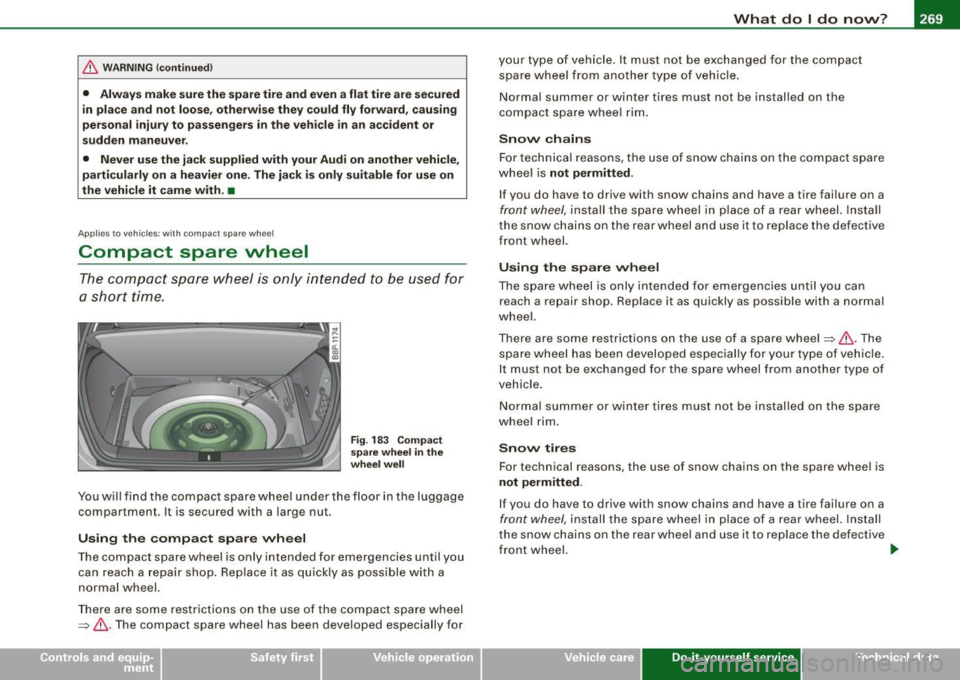
Fig . 183 Compact
spare wheel in the
wheel well
You will find the compact spare wheel under the floor in the luggage
compartment. It is secured with a large nut.
Using the compact spare wheel
The compact spare wheel is only intended for emergencies until you
can reach a repair shop. Replace it as quickly as possible with a
normal wheel.
There are some restrictions on the use of the compact spare wheel
=>
& -The compact spare wheel has been developed especially for your type of vehicle
. It must not be exchanged for the compact
spare wheel from another type of vehicle.
Normal summer or winter tires must not be installed on the
compact spare wheel rim.
Snow chains
For technical reasons, the use of snow chains on the compact spare
wheel is
not permitted .
If you do have to drive with snow chains and have a tire failure on a
front wheel, install the spare wheel in place of a rear wheel. Install
the snow chains on the rear wheel and use it to replace the defective
front wheel.
Using the spare wheel
The spare wheel is only intended for emergencies until you can
reach a repair shop. Replace it as quickly as possible with a normal
wheel.
There are some restrictions on the use of a spare wheel =>& .The
spare wheel has been developed especially for your type of vehicle.
I t must not be exchanged for the spare wheel from another type of
vehicle.
Normal summer or winter tires must not be installed on the spare
wheel rim .
Snow tires
For technical reasons , the use of snow chains on the spare wheel is
not permitted .
If you do have to drive with snow chains and have a tire failure on a
front wheel, install the spare wheel in place of a rear wheel. Install
the snow chains on the rear wheel and use it to replace the defective
front wheel.
t,.
Vehicle care Do-it-yourself service irechnical data