fuel AUDI S3 2010 User Guide
[x] Cancel search | Manufacturer: AUDI, Model Year: 2010, Model line: S3, Model: AUDI S3 2010Pages: 320, PDF Size: 75.34 MB
Page 31 of 320
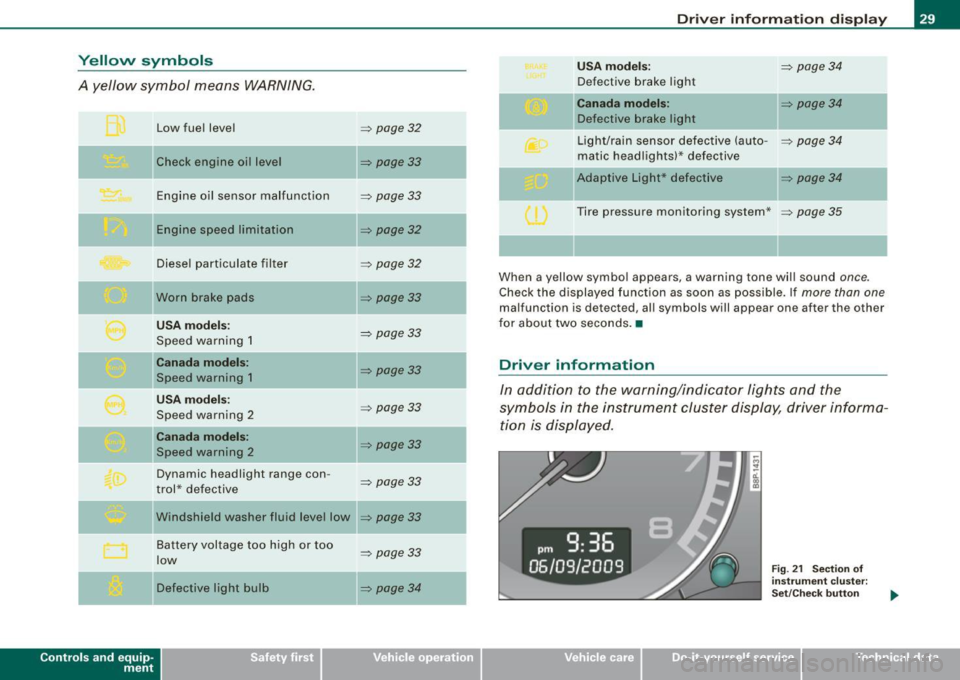
Yellow symbols
A yellow symbol means WARNING.
Contro ls and eq uip
ment Low fuel level
Check engine oi l level
Engine oil sensor malfunction
Engine speed limitation
Diesel particulate filter
Worn brake pads
USA models:
Speed warning 1
Canada models:
Speed warning 1
USA models:
Speed warning 2
Canada models:
Speed warning 2
Dynamic headlight range con -
trol * defective
W indshield washer fluid level low
Battery voltage too high or too
low
Defective light bulb
=> page 32
=> page33
-
=> page33
=> page32
=> page32
=> page33
=> page 33
=> page33
=> page33
=> page33
=> page33
=> page33
...
=> page 33
=> page34
-
-
-
Driver information display
USA models: => page34
Defective brake light
Canada models: => page 34
Defective brake light
Light/rain sensor defective (auto-
=> page 34
matic headlights)* defective
-Adaptive Light * defective => page34
Tire pressure monitoring system * => page 35
When a yellow symbol appears, a warning tone will sound once.
Check the displayed function as soon as possible. If more than one
malfunction is d etected, all symbols will appear one after the other
for about two seconds. •
Driver information
In addition to the warning/indicator lights and the
symbols in the instrument cluster display, driver informa tion is displayed .
Vehicle care I I
Fig. 21 Section of
instrument cluster:
Set/Check button
irechnical data
Page 34 of 320
![AUDI S3 2010 User Guide Driver information display
[ i ] Tips
• The engine oil p re ss ure symbol 9:::r. is not an indicator for a low
engine oil level. Do not rely on it . In stead , check the oil lev](/img/6/57545/w960_57545-33.png "AUDI S3 2010 User Guide Driver information display
[ i ] Tips
• The engine oil p re ss ure symbol 9:::r. is not an indicator for a low
engine oil level. Do not rely on it . In stead , check the oil lev")
Driver information display
[ i ] Tips
• The engine oil p re ss ure symbol 9:::r. is not an indicator for a low
engine oil level. Do not rely on it . In stead , check the oil level in your
engine at regular interval s, preferably each time you refuel , and
alway s before going on a l ong trip.
• The yellow oil level warning indication · require s oil refill or
workshop service w ithout delay . Do not wait until the red oil pres
s ure warning symbol
9:::r. s tarts to flash before you respond to the
l ow oil level warning . By then , yo ur engine may already have
s uffered serious damage. •
Fuel supply too low f
When the symbol illuminates, t his mea ns there are about 2.6
gallons (10 liters) of fuel left in the fuel tank. Time to refuel!
~ page 279.
If the symbol lights up, even when there is ample fuel in the tank,
and the te xt
Tank system malfunction! Please contact workshop
appears in the disp lay, there is a fault in the syste m. Contact a qual
ified workshop to have the fault rectified .•
App lies t o vehic les: with engine sp eed lim itat ion
Engine speed limitation I
I Engine speed ma ximum XXXX RPM
The . symbo l illuminates when there is an engine control malfunc
t ion. T he ind icat or l ight
'IC in the instrument cluste r also il lum i
nates . T he engine speed is limited to the speed displayed in the
driver in for mation sys tem . Keep in mind tha t the engi ne s peed wi ll
not exceed the va lue d isplayed in the driver information system, for
exam ple when downshifting.
P lease go to an authorized Audi deale r or other qua lified workshop
to have the malfunction repaired. •
Applies to vehicles: with diese l engi ne and d iesel particu late filte r
Diesel particulate filter clogged
Particulate filter ! See owner's manual
If the indicator light in the instrument c luster comes on, the
diesel particulate fi lte r has become blocked with soot as the resul t
of constant short -distance driving . When the symbol illumi -
nates, you can alte r yo ur driving style to assist the filter self
clean ing process. Drive for app roxi mately 15 m inutes in 4th or 5th
gea r (automatic transmission with the selector lever in the S posi
t ion) at a minimum s peed of 37 mph (60 km/h) and an e ngine speed
of approximately 2 ,000 R PM . T he temperature increase that wil l
r esu lt from this ca n burn o ff the soot in the fil te r. The symbo l w ill
switc h off when the cleaning is successful.
I f the sy mbo l d oes not swi tch off, see you r aut hor ized deale r or
other qua lif ied workshop to have the prob lem correc ted .
As long as the indicator light remains on (diesel particulate filter
plugged), you can e xpect i ncreased fue l co nsu mption a nd possibly
a lso a loss of engine performance.
A message may a lso be displayed in the ins tru me nt cluste r
informing you or prompting necessary act ion .
For more information on the diese l particulate filter, refer to
~ page 797.
& WARNING
Always adapt your speed to the current weather, road and traffic
conditions. You should never disobey traffic laws in order to follow
driving recommendation s. •
Checking the engine oil level ~
· Ple ase add max. 1 qt of engine oil!
Page 89 of 320
used. We recommend using roof racks from the Audi original acces
sories program.
• Th ese roof racks are the basis for a complete roof rack system .
For safety reasons, some additional attachments are necessary to
transport luggage, bicycles, surf boards, skis and small boats safely .
All these components are available at your authorized Audi dealer.
Vehicle with roof rails
• The vehicle is equipped with integrated roof railings, which can
be covered into roof rack by installing cross bars. Only install cross
bars specifically designed for this vehicle.
• Th ese bars are the basis for a complete roof rack system. Addi
tional attachments are necessary to safely transport luggage, bicy
cles, surf boards, skis or small boats.
• All necessary hardware for these systems is available from your
authorized Audi dealer.
When should the roof rack be removed?
• Before going through an automatic car wash (it is best to ask the
car wash operator)
• When not in use (reduce fuel consumption, reduce wind noise
and guard against theft)
& WARNING
• Use of an unapproved roof rack or incorrect mounting of an
approved roof rack can cause the roof rack or the items carried on
it to fall off the roof onto the road.
• Objects falling from the roof of a vehicle can cause a crash and
personal injury.
• Only mount the system between the markings shown in
~ page 87, fig. 89 or ~ page 88, fig. 90.
• The roof rack system must be installed exactly according to the
instructions provided .
Con tro ls and eq uip
ment
Seats and storage
0 Note
• Any damage to the vehicle caused by using roof racks or other
types of cross bars that have not been approved by Audi for your
vehicle, or incorrect roof rack installation, is not covered by the
Warranty.
• Always check the roof rack mountings and hardware before each
trip and during a trip to make sure everything is securely tightened.
If necessary, retighten the mountings and check the entire system
from time to time.
• After mounting a roof rack system, or when you transport
objects on the roof of your vehicle, the height of the vehicle is natu
rally increased . Be careful when driving under low bridges or in park
garages for example . This could cause damage to the vehicle and
even the load.a
Applies to veh icles: without roof rails
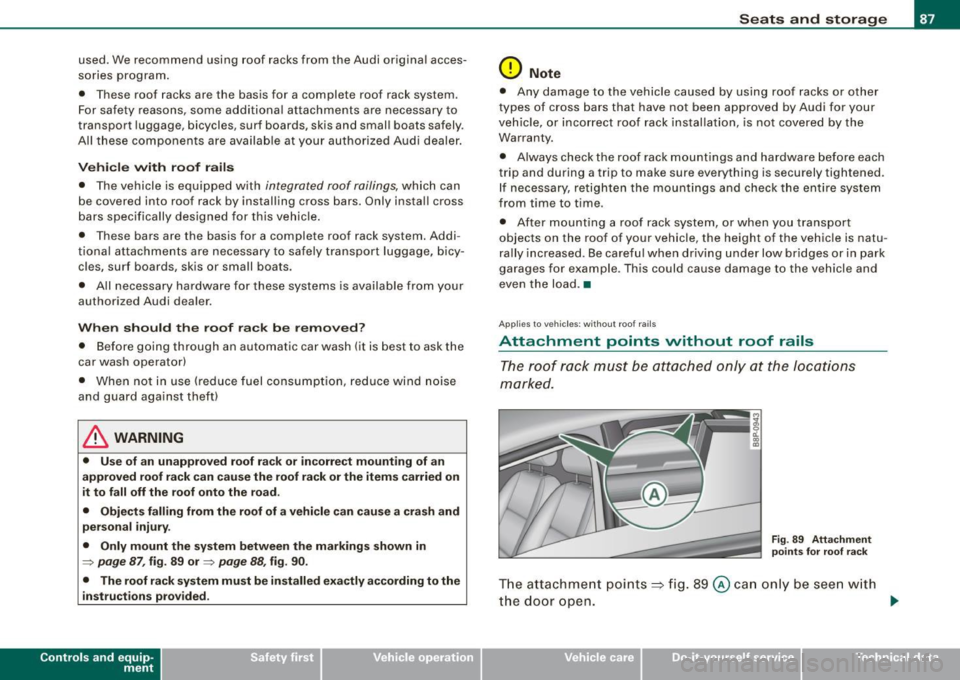
Attachment points without roof rails
The roof rack must be attached only at the locations
marked.
Fig . 89 Attachment
points for roof rack
The attachment points=> fig. 89 @ can only be seen with
the door open. .,
Vehicle care I I irechnical data
Page 100 of 320

Warm and cold
Controls
This overview will help y ou to familiarize yourself with the
air conditioning controls.
F ig. 10 3 Air cond it io ning co ntrols
The display shows the tempera ture selected and the blower setting.
You can set the temperature for the driver's side using the left rotary
switch © and the temperature for the passenger 's side with the
r ight switch
@ .
Functions are turned on and off by touching the buttons. The diode
in the butt ons il luminates when the function is active.
The grille between the buttons
8 / 8 and [AUTO I must remain
unobstructed; there are measurement sensors behind it.
• Do not seal off the grille .
• Do not clean the grille with a vacuum cleaner, otherwise the
sensors could be damaged.
But
t o n(s ) Function
Page
-
Switching the cooling system on/o ff => page 98
[AUTO I A utomatic operation
GG Blower speed setting
(in the
center)
Automatic recirculation mode
Defrost
Air direc ted to the windows
Air from the outlets
Air directed to the footwell
Rear window de fogge r
=> page 99
=> page 101
=> page 100
=> page 100
=> page 99
=> page 101
=> page 101
=> page 101
=> page 103
The buttons for setting the ai r flow direction~'~ and~ can also
be pushed in combination .•
App lies to vehicle s: wi th automat ic air condi tioner
Switching the air conditioner on /off !AC)
Press the [AC] button to switch the air cond itioner on or
off.
When the air conditioner is switched on, the indicator light in the
b utton is lit.
When the air conditioner is switched off, the cooling system is
switched off -the heating and ventilation system is regulated auto
matically. Sw itch ing of f the coo ling sys tem (compressor) saves fuel. ._
Page 104 of 320
![AUDI S3 2010 User Guide • ..__w_ a_ r_m _ a_ n_d_ c_ o_ ld __________________________________________________ _
Air d ir ected to the dri ver/ front passe nger[~]
All the air is directed to outlets @, G) and Â](/img/6/57545/w960_57545-103.png "AUDI S3 2010 User Guide • ..__w_ a_ r_m _ a_ n_d_ c_ o_ ld __________________________________________________ _
Air d ir ected to the dri ver/ front passe nger[~]
All the air is directed to outlets @, G) and Â")
• ..__w_ a_ r_m _ a_ n_d_ c_ o_ ld __________________________________________________ _
Air d ir ected to the dri ver/ front passe nger[~]
All the air is directed to outlets @, G) and © in the instrument
panel. Air also is directed through the center console in the rear.
Air dir ected to th e footw ells ~
All the air is directed to outlets © and to the outlets under the front
seats .•
Air outlets
, _ ,
,~
---- 1
'
Fig . 104 I nstrume nt pan el: a ir out let loca tio ns a nd airfl ow direc tions
T he air out lets G) and 0 on top of t he instrument pane l are
fixed . Outlets 0 and 0 can be adjusted .
Adjusting air outlets 0 and 0
- Turn the vertical thumbwheel beside the outlet to
increase, reduce or shut down t he airflow from that
outle t. - Move t
he smal l tab in the center of the o utlet lo uver side
ways and up or dow n to ad just the level an d direc tion of
airflow.
The supply of air to the outlets is controlled either automatically or manually depending on the operation mode selected . The airflow
from al l outlets can be hea ted, unheated or cooled.
The heater out lets for the rear footwells are located under the front
seats. When you select outlets©, air is also directed to the rear
footwells.
[ i ] Tips
• When defrosting/defogging the windows, air flows from outlets
G), ® and G). To defrost or defog the windows as rapidly as
possible, air out lets
G) should be opened fully with the adjuster
whee ls.
• When the air conditioner is working, cooled air wi ll flow primarily
from outlets ®·
G) and ©-To assure adequate cooling, out lets G)
and © should never be completely closed. •
Using the climate controls economically
Using the climate controls prudently can help save fuel.
When you use the air conditioner, engine power is reduced
and fuel consumption increases. To save fuel, you should
use the a ir conditioner only when necessary . Also please
note the following points:
- If you want to save fuel, sw itch off the air conditioner.
- If you are going to drive w ith the wi ndows open, switc h
off the a ir condit io n er.
~
Page 105 of 320

___________________________________________________ W_ a_ r_m _ a_ n_d_ c_ o_ ld _ __.11111
<£> For the s ake of th e envir onm ent
By reducing the amount of fue l you use, you a lso reduce the amount
of pollutants emitted into the air. •
Key coded settings
When the ignition is switched on, the air conditioner
settings are automatically assigned to the key being used.
The air conditioner settings selected are automatically stored and
assigned to the key being used. When the vehicle is started, the air
conditioner automatical ly selects the settings assigned to that key .
This way every driver will maintain his/her own personal settings and does not have to reset them manually.
[ i ] Tip s
If a different driver uses your key and changes the air conditioner
sett ings, the latest adjustments wil l erase and replace the settings
you hav e stored. •
Rear vvindovv defogger QiP
The rear window defogger clears the rear window of
condensation.
Con tro ls and eq uip
ment
F ig . 105 Sw itch for
rear window defogge r
w ith air-co nditionin g
Press the CiiP switch to switch the rear wind ow defogger
on a nd off.
The defogger works only with the engine runn ing. When the
defogger is switched on, an indicator light in the switch comes on .
The rear window defogger switches off automatically after about 20 minutes.
<£> For the sake of the environment
Turn the defogger off when the rear window is c lear . When you save
electricity, you save fuel. •
Applie s to v ehic le s: wi th di ese l e ngin e
Additional heater
-Switch the Additional h eater to AUTO .
Vehicles with diesel engines are equipped with an additional heater
to warm the interior of the vehicle more quickly. The additional
heater switches itself on and off automatically when the outside
temperature is below 50 °F (10 °C) and the engine is running ,
depending on the coolant temperature, interior temperature and
the selected temperature. •
Vehicle care I I irechnical data
Page 109 of 320
___________________________________________________ O_ n_ t_h _e_ r_o _a_ d _ ___._
Starting and stopping the engine
Starting the engine
The engine can only be st arted with your origin al Audi
key.
V ehi cle s with a gas oline engin e:
- Set the parking bra ke.
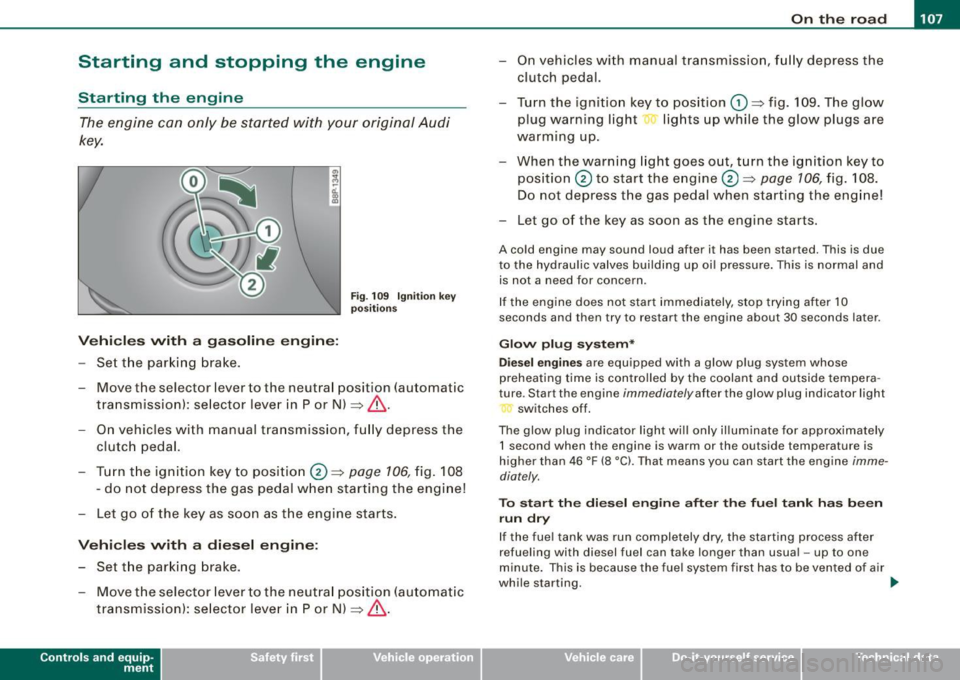
Fi g. 109 I gnit ion ke y
pos it io ns
- Move the selector lever to the neutra l position (automatic
transmission) : se lector lever in P or N) =>
&.
- On vehicles with manual transmission, fu lly depress the
c lutch pedal.
- Turn t he ign ition key to position@ =>
page 106, fig. 108
- do not depress the gas pedal when starting the engine!
- Let go of the key as s oon as the engine s tarts .
Vehicle s with a di esel engine :
- Set the parking brake .
- Move the selector lever to the neutra l position (automatic
transmission): se lector lever in P or N) =>
&.
Con tro ls and eq uip
ment
- On vehicles with manual tra nsm ission, f ully depress the
clutch pedal.
- Turn the ign ition key to position
G) => fig. 109 . The g low
plug warning light lig hts up while the glow plugs are
warming up .
- When the warning light goes out, turn the ignition ke y to
position @ to start the engine@=>
page 106, fig. 108 .
Do not depress the gas pedal when star ting the eng ine!
- Let go of the key as soon as the engine starts.
A co ld engine may sound loud after it has been started. This is due
to the hydrau lic va lves building up oi l pressure . This is normal and
is not a need for concern .
I f the engine does not start i mmediately, stop trying after 10
seconds and then try to res tart the engine about 30 seconds la ter .
Glow plug system *
D ie sel engin es
are equ ipped wi th a glow p lug system whose
preheating time is controlled by the coolant and outside tempera
ture . S tar t the engine
immediately after the glow plug indicator l ight
switches off .
The glow plug indicator light wi ll only il luminate for approximately
1 s econd when the engin e is warm or the outside temp erature is
higher than 46 °F (8 °C). That means you can start the engine
imme
diately .
To st art the di esel engin e after the fuel t ank ha s be en
run dr y
If the fue l tank was run completely dry, the starting process after
refuel ing with diesel fuel can take longer than usual -up to one
minute. This is because the fue l system first has to be vented o f air
while starting. _,.
Vehicle care I I irechnical data
Page 111 of 320
_________________________________________________ O _n_ t_h _e _ r_o _a _d __ lfflll
R elea sing th e parking br ake
- Pu ll the parking brake lever up slight ly and press the
release button at the same time~
page 108, fig. 110
-arrow-.
- Keep the release button pressed and lower the parking brake ~& .
If you should drive off with the parking brake sti ll set, a warning tone
will sound and the fo llowing wil l appear in the instrument cluster to
remind you to re lease the parking brake:
Parking brak e set
The parking brake warning comes on only after you have driven for
longer than 3 seconds and faster than 5 mph (5 km/h).
The parking b rake warning light Brake (USA)/ «D>
(CDN) illuminates
when the parking brake is set and you switch on the ignition .
& WARNING
Alway s re leas e the par king br ake completely . A p artiall y engaged
br ake w ill overheat the r ear brake s, reduce their effective ness and
ca use e xcessive w ear. T his co uld le ad to brake failur e and an acc i
dent .
0 Note
Only after the vehicle has come to co mplete stop, should you firm ly
set the parking brake and either move the gearshift lever into 1st .
gear (manual transmission) or move the selector lever into "P"
(Automatic transmission). •
Controls and equip
ment
Parking
To prevent a parked vehicle from rolling away, there are a
few things you should do.
When you park your vehic le, do the fo llowi ng:
- Stop the vehicle using the brake pedal.
- Set the parking bra ke firm ly .
- Move the selector lever into the
P pos ition ( automatic
tran smi ssion)
or m ove the gea rshi ft lever into 1s t. gear
(manual transmission ) ~ &.
- Switch off the engine and remove the ignitio n key from
t h e igniti on loc k.
Wh at else you should d o wh en p arking your vehicle o n
a n i ncline or dec line
Turn the steering wheel so that if the vehicle should start to roll, it
will ro ll into the curb.
I f you are parking on a
declin e (the front of your vehic le facing
downhill!, turn the front wheels to the right so that they point
toward the curb .
If you are parking on an incline (the font of your vehicle fac ing
uphill!, turn the front whee ls to the left so that they point
away from
the curb.
Move the selector lever into the P position ( autom atic tran sm iss ion)
or move the gearshift leve r into 1st. gear (manual tr ansmi ssion ).
& WARNING
Thi s is how you can redu ce the r isk of injury when leaving y our
vehi cle .
• Never p ark the vehi cle where it can come in conta ct with dr y
gra ss, spi lled fuel or any other fl amm able m ater ials . .,_
I • •
Page 115 of 320

Transmission -_______________ ___.
Transmission
Manual transmission
Applies to vehicles: with manual transmission
Gearshift lever
The clutch pedal must be depressed all the way before
you can start the engine.
The manual transmission in your Audi is equipped with an
interlock-feature.
- Depress the clutch pedal all the way.
- Start the engine with the gearshift lever in Neutral and
the clutch pedal depressed.
0 Note
Always depress the clutch pedal fully when changing gears. Do not
hold the vehicle on a hill with the clutch pedal partially depressed.
This may cause premature clutch wear or damage.
[ i J Tips
• Resting your hand on the gearshift lever knob while driving will
cause premature wear in the transmission.
• The back-up lights go on when you shift into Reverse with the
ignition on. •
Contro ls and eq uip
ment
App lies to vehicles: with 6-speed manual transmission
Gearshift pattern (6-speed manual
transmission )
Fig. 113 Gearshift
pattern: 6-speed
manual transmission
Drive in 6th gear for optimum fuel economy when cruising.
However, if more acceleration is required (when passing, for
example), shift down.
Engaging reverse gear (R)
- Move the shift lever all the way to the left, press it down,
then push it forward.
Especially after driving forward, stop the vehicle completely, shift
into
Neutral and rest the shift lever briefly in Neutral before shifting
into
Reverse. •
Vehicle care I I irechnical data
Page 134 of 320

-Driving
Safely ------=-------=----------------
& WARNING
Improperly stored luggage or other items can fly through the
vehicle causing serious personal injury in the event of hard braking or an accident. To help reduce the risk of serious personal injury:
• Always put objects, for example, luggage or other heavy items
in the luggage compartment.
• Always secure objects in the luggage compartment using the
tie-down eyelets and suitable straps.
& WARNING
Heavy loads will influence the way your vehicle handles. To help
reduce the risk of a loss of control leading to serious personal
injury :
• Always keep in mind when transporting heavy objects, that a
change in the center of gravity can also cause changes in vehicle
handling:
-Always distribute the load as evenly as possible.
- Place heavy objects as far forward in the luggage compart-
ment as possible.
• Never exceed the Gross Axle Weight Rating or the Gross
Vehicle Weight Rating specified on the safety compliance sticker on the left door jamb. Exceeding permissible weight standards
can cause the vehicle to slide and handle differently.
• Please observe information on safe driving~
page 124.
& WARNING
To help prevent poisonous exhaust gas from being drawn into the
vehicle, always keep the rear lid closed while driving.
• Never transport objects larger than those fitting completely
into the luggage area because the rear lid cannot be fully closed.
& WARNING (continued)
• If you absolutely must drive with the rear lid open, observe the
following notes to reduce the risk of poisoning :
- Close all windows,
- Close the power roof*,
- Open all air outlets in the instrument panel,
- Switch off the air recirculation,
- Set the fresh air fan to the highest speed.
& WARNING
Always make sure that the doors , all windows, the power roof*
and the read lid are securely closed and locked to reduce the risk
of injury when the vehicle is not being used.
• After closing the rear lid, always make sure that it is properly
closed and locked .
• Never leave your vehicle unattended especially with the rear lid
left open. A child could crawl into the vehicle through the luggage
compartment and close the rear lid becoming trapped and unable
to get out . Being trapped in a vehicle can lead to serious personal
injury.
• Never let children play in or around the vehicle.
• Never let passengers ride in the luggage compartment . Vehicle
occupants must always be properly restrained in one of the
vehicle's seating positions.
[ i] Tips
The tire pressure must correspond to the load -see the tire pressure
sticker on the fuel filler door. •