headlights AUDI S3 2010 User Guide
[x] Cancel search | Manufacturer: AUDI, Model Year: 2010, Model line: S3, Model: AUDI S3 2010Pages: 320, PDF Size: 75.34 MB
Page 65 of 320

The rain sensor wiper intervals depend on the sensitivity setting as
well as vehicle speed . During brief stops, wiper motion will adjust in
re lation to the amount of rain on the windshield.
Automatic wiper/washer : To eliminate water drop lets, the wind
sh ield wiper perfor ms one afterwipe operation a fter several
seconds while driving. You can switch this function off by moving
the lever to pos it ion © within 10 seconds of the afterw ipe opera
tion. The afterwipe func tion is reactivated the next time the ignition
is sw itch.
When the ignition is turned on , the washer jets are heated *.
& WARNING
• Wiper bl ade s are cru cial for safe driving! Only when they are in
good condition are they able to clear the windows properly to
provide un comp romised visibility . Worn or damaged wipe r blade s
are a safety hazard::::;,
page 65, "Replacing front wiper blade s"!
• The light /ra in se ns or* is only de signed to a ssis t and suppo rt
the driver. It remain s entirely the driver' s re spon sibility to monitor
outsi de w eather conditions and to manually a cti vate the wiper s as
soon a s rain or drizzle reduces vi sibility through the windshield .
• The windshield mu st not be treated with water -repellent m ate
rial s. They can in crea se glare under poor v isib ility condition s such
as wetne ss , dar kne ss, or when the sun is lo w on the horizon . In
addition , they can cau se the windshield wipers to chatter .
0 Note
In freezing or near freezing conditions:
• Always check that the wiper blades are not frozen to the glass
bef ore you turn the wipe rs on . Loosen a wiper blade which is frozen
in p lace before operating the wipers to prevent damage to the wiper
b lade or the wiper moto r.
• Do not use the wipers to clear a frosted window . Using the
wipe rs as a convenient ice scrape r will destr oy t he wipe r blades .
Controls and equip
ment
Cl ea r vision
• Before you take your vehicle to an automatic car wash, make sure
you have the w indshield wiper system switched off (lever in p ositi on
OJ, otherwise the windshield wiper system could get damaged in the
car wash if it should suddenly come on .
[ i ] Tips
• The windshie ld wipers are switched off when the ignition is
turned off . Activate the windshield wipers after the ign ition is
switched back on by moving the windshield wiper lever to any posi
tion.
• Wor n or dirty windshield wiper b lades cause smea ring, which
can affect the opera tion of the l ight/rain sensor*. Check the cond i
tion of your windshield wiper blades regula rly.
• The rain sensor is part of the interva l wiping system . T urning off
the ignition will also deactivate the rain sensor . To reac tivate the
sensor, switch off the interval w iping funct ion, then sw itc h it back
on again .
• App lies to vehicles with light/ rain sensor : When the wipers are
swi tched on manually and in ra in conditions, the automatic head
lights* turn on::::;,
page 53, "Switching the headlights on and off ·'A ·"
or off during the day when the wipers are no longer operating. The
automatic headl ights* function is ava ilable in this case only whe n
the light switch is in the "AUTO" position::::;,
page 53, fig. 46 .
• Make sure the washer fluid reservo ir in the engine compart ment
is topped off before going on a long trip . Look up::::;,
page 240 for
check ing and filling the washer conta iner.
• The wipers only o perate with the hood comp lete ly closed .•
I • •
Page 70 of 320

Clear vision
Disabling auto dimming
-Press b utto n © => page 6 7, fig. 66 briefly, -th e gr ee n
i nd ica to r li ght @ goes out .
Activating/reactivating auto dimming
Press butto n© br iefly, -the gr een in dicator l ight®
goes on.
Automatic dimming function
The au tomat ic dim ming f uncti on is act iva ted every tim e th e ignit ion
i s tur ned on . The green indi cator light is lit to i ndicate auto dimming
i s ac tive.
When d immin g is activat ed, the inside m irror will darken automati
cally in re spo nse to th e am ount of li ght striki ng the m irror (suc h as
headlights from rearward approachin g vehicles). Even in dimm ing
mod e, the m irror su rface turns br ig ht whe n :
• the interior lig ht is swi tc he d on
• r eve rse gea r is en gage d.
& WARNING
Broken glass of automatic dimming mirror can cause electrolyte
fluid leakage . Electrolyte fluid can irritate skin , eyes , and respira
tory system .
• Repeated or prolonged exposure to electrolyte can cause irrita
tion to the respiratory system, especially among people with asthma or other respiratory conditions . Get fresh air immediately
by leaving the vehicle or , if that is not possible, open windows and
doors all the way.
• If electrolyte gets into the eyes , flush them thoroughly with
large amounts of clean water for at least 15 minutes; medical
attention is recommended .
• If electrolyte contacts skin, flush affected area with clean water
for at least 15 minutes and then wash affected area with soap and
& WARNING (continued)
water; medical attention is recommended . Thoroughly wash
affected clothing and shoes before reuse .
• If swallowed and person is conscious , rinse mouth with water
for at least 15 minutes . Do not induce vomiting unless instructed
to do so by med ical professional. Get medical attention immedi
ately.
0 Note
Liq uid ele ctro lyte leak ed fro m a broke n mirror g lass will d am ag e any
plastic surfaces i t com es in contact with. Clean up sp ill e d e lectroly te
im med iately wi th cle ar w ater and a spo nge.
[ i ] Tips
• If you switch off the automatic dimming function on the inside
mirror, automatic dimming of the outside mirrors will likewise be
disabled .
• Check to make sur e there are no ob jects preventin g light from
r ea ch in g th e insi de mirr or.
• Do not attach any stickers to the windshield in front of the light
s en sor , as this wou ld interfer e w ith th e aut om atic operatio n of t he
headlights and the automatic d imming of the insid e mirror.
• B e aware th at automa tic d imming of the in side mi rror ca n only
operate pro perly if the rea r w indow sun blind* is retracted. •
Page 71 of 320

Outside mirrors
The outside mirrors a re electrically adjuste d (power
mirrors)
Adjusting the outside mirrors
l8 ::: ci. ., m
Fig . 67 Forwa rd
s e ctio n of dri ver 's
a rm re st : po wer m irr or
c ontrol s
Turn the adjust ing knob to=> fig. 67 © (driver 's side
outside m irror) to @ (front passenger's outside mirror) .
- Press the knob in the appropr iate direction to move the
mirror surface so that you have a good view to the rear.
Heat ed mirrors*
- T urn t he ro tary kno b to @ .
Folding both exterior mirrors*
- Rotate the knob to position @.
Depending on outside tempera ture and v ehic le speed, the mirror
surfaces are heated until the ignition is swi tched off -even if the
ro tary knob is no longer in position @.
Yo u are well -advised to fold * the outside mi rrors in when maneu
vering in tight spaces or when leaving the car parked c lose to other
vehic les .
Con tro ls and eq uip
ment
Clear vision
0 Note
• Curved mirro r surfaces (convex or spherica l* ) increase your fie ld
of view. Remember that vehicles or other objects will appear smaller
and far ther away than when seen in a flat mirror. If you use th is
mirror to estimate distances of fo llowing vehic les when changing
lanes, you cou ld estimate incorrectly and cause an accident .
[ i ] Tips
If the re shoul d be a malfunctio n in the electrical system, yo u ca n
still adjust the outside mirrors by pressing the edge of the mirror .•
Ap plies to vehi cles: with automa tic dim m in g for ou tsi de m irro rs
Automatic dimming for outside mirrors
The outside mirr ors are dimmed t ogether wi th the automatic
dimming of the inside mirror. When the ignition is switched on , the
mir ro rs darken automat ically depending on the light s triking the m
(e.g . headlights from the rear) .
When the interior lighting is switched on and when reverse gear is engaged, the mir rors are switched back to their o riginal b rightness
(not dimmed).
& WARNING
Broken glass of automati c dimming mirror can cause electrolyte
fluid leakage . Electrolyte fluid c an irritate skin , eyes , and respi ra
tory system .
• Repeated or prolonged e xpo sure to elect ro lyte can c au se irrita
tion to the respiratory system , e spe cially among people with
asthma or o ther re spiratory condition s. Get fresh air immediately
b y le aving the vehi cle or , if that i s not possibl e, open windows and
doors all the way . .,
Vehicle care I I Technical data
Page 95 of 320

Glove compartment
The glove compartment is illuminated and can be Jocked.
"' 10 ., ~ a:. ., 03
To open glove compartment
Fig. 96 Glove compart
ment
Pull the handle=> fig. 96 in the direction of the arrow
push down lid to the fully open position.
To close glove compartment - Push the glove compartment lid upward until the lock
engages.
The light will illuminate when the parking/headlights are turned on
and the glove compartment is open.
In the glove compartment lid, you will find a place to store a pen and
a pad of paper.
& WARNING
To reduce the risk of personal injury in an accident or sudden stop,
always keep the glove compartment closed while driving . •
Con tro ls and eq uip
ment
Seats and storage
Ap plies to veh ic les: w it h stora ge compar tmen t in cente r console
Storage compartment for small objects Ca
I, __] II 0
l
l
I~ u
I
'
Fig . 97 Center console
storage compartment
To open the compartment, press the cover ta=> fig. 97.
To close the compartment, push the drawer all the way in
until it clicks in place.
An additional storage compartment21 for relatively small objects is
located in the center console next to the brake lever. •
2> Not available on vehicles with Audi Nav igat ion System.
Vehicle care I I irechnical data
Page 108 of 320
• ..__O_ n_ t_h _ e_ r_ o_ a_ d ____________________________________________________ _
Ignition lock and ignition switch
Ignition lock
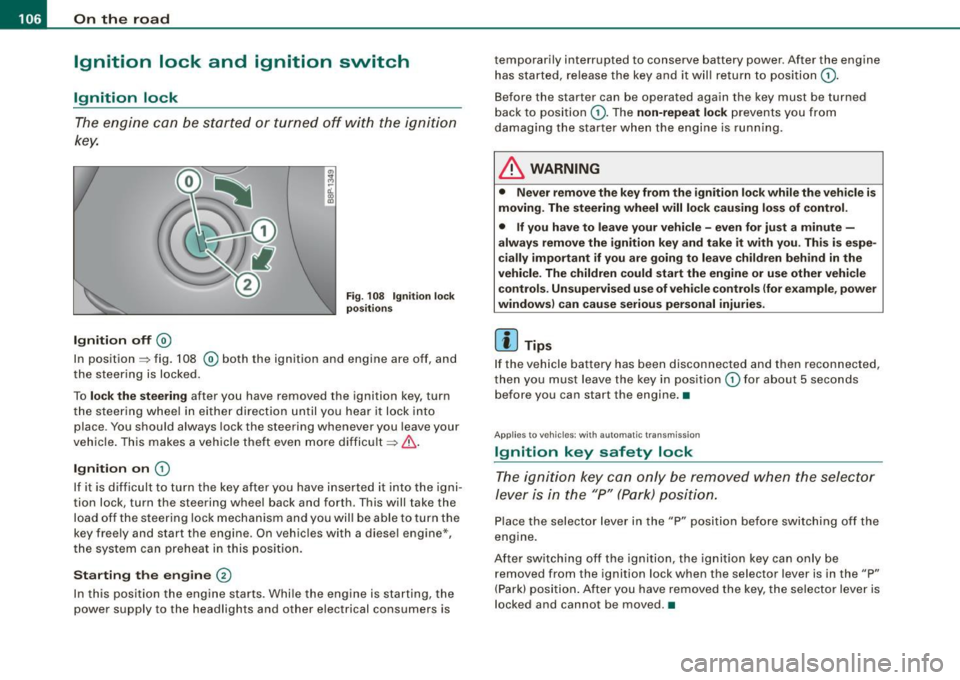
The engine can be started or turned off with the ignition
key.
Ignition off ®
Fi g. 108 Ignit ion lock
p os ition s
In position => fig. 108 ® both the ignit ion and engine are off, and
the steering is locked .
To
lo ck the stee ring after you have removed the ignition key, turn
t he steering whee l in either direction until you hear it lock into
place . You should always lock the steering whenever you leave your
vehic le . This makes a vehicle theft even more difficult =>
& -
Ignition on CD
If it is difficult to turn the key after you have inserted i t into the igni
tion lock, turn the steering wheel back and forth . This will take the
load off the steering lock mechanism and you will be able to turn the
key freely and start the engine . On vehicles with a diesel engine*,
t he system can preheat in this pos ition.
St arting the engine
@
In this position the engine starts . Whi le the engine is starting, the
power supply to the headlights and other electrical consumers is temporarily interrupted to conserve battery power
. After the engine
has started, release the key and it will return to position
CD .
Before the starter can be operated again the key must be turned
back to position
CD -The non-repeat lock prevents you from
damaging the star ter when the engine is runn ing.
& WARNING
• Never remo ve the key from the ignition lo ck w hile the veh icle i s
moving. The steering whe el will lo ck caus ing lo ss of control .
• If you hav e to lea ve your vehicle -even fo r ju st a min ute -
alway s remove the ignition key and take it with you. Th is is espe
ci ally important if you are g oing to lea ve children behind in the
vehicle . The childr en co uld start the eng ine or u se other vehi cle
c on trols . Un supe rvis ed u se of veh icle c ont ro ls ( for e xamp le , po wer
windows) c an cause seriou s per sonal injuries .
[ i ] Tips
If the vehicle battery has been disconnected and then reconnected,
then you must leave the key in position
CD for about 5 seconds
before you can start the engine. •
Applies t o vehi cles : w ith autom atic trans mission
Ignition key safety lock
The ignition key can only be removed when the selector
le ver is in the "P" (Park) p osition.
Place the selector lever in the "P" posi tion be fore switching off the
engine .
After switching off the ignition, the ignition key can only be
removed from the ignition lock when the selector lever is in the "P"
(Park) position . After you have re moved the key, the selector lever is
l ocked and cannot be moved .•
Page 239 of 320

___________________________________________ C_ h_e _c_ k_ i_n _g _ a_n _d_ f_il _li _n _g __ fflllll
•
Di sco nnecting the batt ery
Some vehic le functions (power window regulators, for example) are
lost if the battery termina ls are disconnected. These functions have
to be relearned after the battery terminals are connected again . To
prevent this, the battery should only be disconnected from the
vehicle el ectrical system if absolutely necessary.
Vehic les not driven f or lo ng peri o ds a nd sho rt -di stan ce
o pera tion
The battery can a lso become discharged with the veh ic le stationary
by id ling current consumers . When the vehic le is sta tionary
(planned event) during the
cold t ime of the year, you should remove
the battery and store it in a nonfreezing area . This way you prevent
that the battery "freezes" and thereby is destroyed . During the
w arm er time of the year it is sufficient to disconnect the negative
terminal from the battery . Occasionally charge even a disconnected
battery .
Wint er opera ti on
During the winter months, battery capacity tends to decrease as
tempera tures drop . This is because more power is a lso consumed
while starting, and the headlights, rear window defogger, etc., are
used more often .
Avoid unnecessary power consumption, particularly in city traffic or
when trave ling only short distances. Let your authorized Audi dea ler
check the capacity of the vehicle battery before w inter sets in
=>
page 239. A well charged battery will not only prevent starting
problems when the weather is cold, but w ill also last longer.
Replacin g battery
The new battery m ust h ave the same capacity , voltage (12 volts),
amperage, construction and p lug sea ling, as the orig inal battery.
Specif ications are listed on the battery housing. Batteries special ly
developed by Audi fulfil l the maintenance, output, and safety
requirements.
When instal ling the battery, make sure the ignition and all electrica l
consumers are switched off=>
(D.
We recommend that you use maintenance -free or c y c le -resis
tant /leak -proof
batte ries according to the sta ndards TL 825 06 (from
December 1997) and VW 7 50 73 (from August 2001).
(D Note
• All work on the battery requires technical knowledge . Please
contact an Audi dealership or another authorized fac ility for ques
tions about the battery- danger of acid burns and exp losion hazard!
• The battery must not be opened! Do not try to change the
battery's liquid level, otherwise detonating gas wil l escape from the
bat tery -explosion hazard!
• The AGM battery in the luggage compartment cannot leak,
because the electrolyte for this battery is abso rbed in to a special
glass mat . This leak-proof battery must not be replace with a
conventiona l battery.
• Make sure the ventilation hose on the side of the battery is
connected, otherwise fumes or battery acid can leak out.
• Battery holder and terminals always have to be secured correctly .
• Before all work on the ba ttery follow the
warning s below=> & in
"Working on the battery" on
page 238.
mend your authorized Audi deale r change the battery for you .
Batteries contain sulfuric acid and lead and must always be
disposed of properly in comp liance with a ll environmental regula
tions . D isposing of vehicle batteries improperly is very dangerous to
the environment. Make sure that the removed batte ry cannot over
balance , otherwise sulfuric acid might escape! •
Vehicle care I t •
Page 282 of 320

1111.___F_ u_ s _ e_s _ a_n _ d_ b_ u_lb _ s _______________________________________________ _
Equipment Amps No. Equipment Amps
Manual headlight beam adjustment, automatic
14 Electronic Stabilization Program (ESP) (control 10
1
headlight beam adjustment, AFS control mod-10
module), shift gate automatic transmission
ule, engine components, light switch (switch
15 Interior lights, reading lights 10
lighting/illumination), diagnosis socket
Diagnostic connector, rain sensor, air condition-
Automatic transmission, control module for
16 ing (control module), tire pressure monitor dis-10
CAN data transfer (gateway), electro -mechanical
play (control module)
2 steering, shift gate automatic transmission, 10 17 Anti-theft alarm warning system 5 engine relay, fuel tank control unit, engine con -
trol unit, brakes control (ABS), Electronic Stabili-
18 Diagnose Starter 5
zation Program (ESP), Anti -Slip Regulation (ASR) 19 All Wheel Drive 10
3
Airbag 5 20 Not used
!! Air-conditioning (pressure sensor, air quality
sensor), button for Electronic Stabilization Pro -
21 Not used
gram (ESP), Anti-Slip Regulat ion (ASR), tire pres-
22 Blower fan 40
sure monitor display, oil level sensor, back -up 23 Driver's side power window, front 30
4 light switch, front seat heating , parking aid, 5
seat-occupancy recognition (on USA vehicles), 24 Power outlet front 20
garage door opener, automatic mirror dimming, 25 Rear window defogger 30
headlight assistant, heated windshield washer
26 Power outlet in luggage compartment 20 nozzles, air conditioning (control module)
-27 Fuel tank control module, fuel pump 15
5 AFS headlights (left side) 5
AFS headlights (right side) 5 28 Power window, rear 30
7
Not used 29 Not used
Not used
30 Not used
9 Navigation system, radio system 15 31 Not used
10 digital
radio, cell phone, TV equipment 7,5 32 Not used
11 Automa tic mirror dimming, headlight assistan t 10 33 Sliding/pop-up roof 20
Central locking (front doors) 10 34 Not used
13 Central locking (rear doors) 10 35 Not used
36 Lumbar support 10
Page 286 of 320

lllffl.___F_ u_ s _ e_s _ a_n _ d_ b_ u_lb _ s _______________________________________________ _
For your safety, we recommend that you have your authoriz ed Audi
de ale r rep lace any b ulbs fo r you, sin ce y our d ealer has the p roper
tools, the correct bu lbs and the exp ertise .
Gas discharge lamps (Xenon lights) *:
D ue to th e hi gh e lectrica l v o lt age, have th e bul bs rep lace d by a qual
ified techn ic ian . Headlights with Xenon light can be identified by the
hi gh v oltage st icker .
& WARNING
Contact with high -voltage components of the electrical system
and improper replacement of gas discharge (Xenon ) headlight
bulbs can cause serious personal injury and death.
• Xenon bulbs are pressurized and can explode when being
changed.
• Changing Xenon lamps requires the special training, instruc
t ions and equipment .
• Only an authorized Audi dealer or other qualified workshop
should change the bulbs in gas discharge lamps .
& WARNING
There are parts with sharp edges on the openings and on the bulb
holders that can cause serious cuts.
• If you are uncertain about what to do , have the work performed
by an authorized Audi dealer or other qualified workshop. Serious
personal injury may result from improperly performed work .
[ i] Tips
• If you must replace the light bulbs yourself, always remember
th at th e engine c ompartme nt of any vehicl e is a haza rdous area to
work i n. Always read and heed all WARNINGS=>
page 215, "Engine
compa rtment" =>& . • I
t is best to ask your authorized Audi dealer whenever you n eed
t o cha nge a bul b. •
Page 307 of 320
______________________________________________ A_ l:.!: p :...:h..:. a= b..:e :...: t:..:..i c.::....:.: a..:..l ..:.in :....:..:: d:.:e :.: x-=---•
Ashtray
Rear . ........ .... ....... ...... ... 91
ASR How the Anti -Slip Regulation System
works .. .... .... .... ... .... .... 190
Ast erisk
Wha t does it m ean wh en something is
marked with an asterisk? ... .. .... .. 5
Audi Service Repair Manuals and Literature 298
AUTO Climate controls .. .... .... ... .... .. 99
Switching on . ... .... .... .. . .. .. .. 99
When should I use AUTO? ... ..... .. 99
Auto Safety Hotline ... .. .. .. .... .... . 133
Automatic air recircu lation ..... .. .... 100
Automatic belt retractor .. .... .... .... 139
Automatic car wash
See Washing .. ..... ... ..... .. .... 205
Automatic headlights defective ... .. .... .... ... .... .... . 34
Automatic Transmission Automa tic Transm ission . .... .. .... 117
Automat ic transmission .. .... .... .... 114
Driving Notes . . . . . . . . . . . . . . . . . . . . 116
Emergency program . ............. 120
Emergency release ..... .. .... 120, 12 1
Ign ition key safety lock ... .... .... . 106
Kick -down ... .... .... .... ... .... . 119
L aunch Control Program ...... .... . 119
Se lector lever lock .. ...... .. . .... . 1 15
Selec tor lever positions .. ...... ... 114
Controls and equip
ment Safety first
Tiptronic .
... ... . .. .. .... .. .. .... 118
Tiptronic controls on the s teering whee l
119
Average fuel mileage .......... .... ... 22
Average sp eed ... .... .... .... .... ... . 22
Avo id damaging the v ehicle .... .. .... . 198
B
Battery ... .. .... ... .... .... .... .... 236
chargi ng ..... .... .... .... .... ... 239
Disconnecting and c onnecting . ... . 237
I mportant warnings when work ing o n the
battery . .... .... .... ...... ..... 238
Replacing the battery .. ... .... .... 237
Winter operation . ..... ... .... .... 237
Working on the battery .... .... .... 238
Battery vo ltage ....... .... ........... 33
Before driving . .... . .. .. .... .... .... 125
Blended gasoline . ..... .. ...... ...... 217
Body cavity sealing .. .... ...... ..... . 21
O
Booster seats .... .... .... .... .... ... 175
Brake assistant ..... .... .... .. .. .... 1 93
Brake booster .. ...... .... .... ... .... 192
Brake fluid
Changing the brake fluid ...... .... 236
Checking the bra ke fl uid leve l ...... 235
Reservoir .. ...... ... .... .... .... . 235
What is the correct brake f luid level? 235
What should I do if the brake fluid warning
light comes on? . .... ...... .... .. 235
Brake pads .. ..... ... .... .... .... ... 196 Brake system
..... .. .. .. .... .... .... 235
Anti -lock brake system (ABS) .. .. .. .. 16
Brake fluid ............ .... ..... .. 235
Brake f luid specif ications for re fill and
replacement ... .. .... .... ... .. .. 236
Brake light defective ... ...... .... .. 34
General information . ........ ... .. 191
How does moistur e or road salt aff ect the
br akes? ..... .... .... .. .. ... .. . . 1 91
Ma lfunct ion ... .. .... .... .... .. . .. 30
Warning /indica tor lights .. .. .... ... . 15
Worn brake pads symbo l ...... .... . 33
Break -in period .. ...... ...... .... ... 195
Brake pads . ...... .... ... .... .. .. 196
Tires ... .. .... .... .... ... .. .... .. 1 95
Bu lbs ...... ........ ... .. ...... .... . 283
C
California Proposition 65 Warning . .... 225
Battery specific ... .... .... .... .... 239
Capacities .. ... ... ... .... ... .... .... 296
Car care ... . .... .. .. .... .... .... .. . . 204
In ter ior . ...... .... .... ... .... .. .. 211
P last ic a nd vinyl . ...... .... .... ... 208
Weathers trips ... .. .... .. . .... .. .. 209
Care of exterior . .... ..... ... .... .... 204
Cargo area
See Loading the luggage compartm ent .
13 1
Cargo net .. ... ... .. .. .. .... .... ..... 83
Catalytic converter ...... .... .... ... . 196
Center armrest ......... .... ... .. ..... 80
Vehicle operation Vehicle care Do-it-yourself service Technical data
Page 311 of 320
Alphab eti ca l ind ex 1111111
-------------------------------------=--------
Reducing engine noise by upshifting
ear ly . ... .. .. .. ... ... .... . ... .. 8, 9
Refueling .. ..... .... .... .. . .... . 220
Saving fuel by upshifting early ..... 8, 9
Using the rear window defogger . ... 103
Front airbags Descrip tion . ..... .... .... .. . .... . 149
How they work . . . . . . . . . . . . . . . . . . . 154
Fron t seats . ..... .. .... .... ..... .... . 72
Adjusting ..... .. .... ..... .. .... . 127
Adjusting the manual seats .... .... . 74
Child restraints in the front seat .... 1 47
Heated seats . . . . . . . . . . . . . . . . . . . . . 104
Fronta l collisions and th e laws of physics
136
Fuel Current fuel mileage ... ... .... ... .. 22
Fuel gauge .. .... .... .... ... .... .. 10
Fuel supply too low . ... .. .... .... .. 32
Fuel fi ller flap
Unlocking the fuel filler flap by hand 222
Fuel gauge ... ....... .... .... .... .... 10
Fuel range . ......... ....... .... ... .. 22
Fu el supply
Addi tives ............ ....... .... . 217
Blended gasoline ......... ... .... . 217
Fuel fi ller neck ... ...... ........ .. 219
Fuel gauge .. .... .. ...... ....... .. 10
Fuel tank capacity ... .... .... .. 10, 219
Gasoline ... .. ...... .. ... .. .... .. 217
Gasoline additives . ... .... .. . ..... 218
Octane rating ... .... .. ... ...... .. 217
Recommendation ... .... .... .... . 217
Controls and equip
ment Safety first
Refuel
ling .... ....... .... ... . .... 220
Unlocking the fuel filler flap by hand 222
Fuel tank Capacity ..... ...... .. .... ...... . 219
Capacity (gal lons/liters) ..... ... ... .. 10
Fuse arrangement . .... .... ..... .... . 279
G
Gas discharge lamps .. .. ..... .. .... . 283
Gauges Engine coolan t temperature .. ... ... .. 9
Fuel gauge . .... .... .... ...... ... . 10
Speedometer . .... .... .... .... ... . 10
Tachometer ..... .. .. .... .... .... .. 8
Trip odometer ...... ...... .... .... 10
Gear recommenda tion ................ 19
Gearshift indicator .... .. .... ... .... .. 19
Gearsh ift lever ... .... .... .... ... .... 113
General il lustra tion
Ins trumen ts and controls . .... .... ... 7
Genera tor
Warning/indicator lights ...... .... .. 14
G lossary of tire and loading terminology .. .
243
Glove compartment ... .. .... ... .... .. 93
Light .... ... ... .. .... .... .. . .. 58, 59
Glow plug system Indicato r ligh t ... .... .... ...... ... . 13
Wa rning ligh t ...... ........... .... 13
Gross Vehicle Weight Rating (GVWR) ... 295
H
Head restrain ts .. ....... ... .... .... . 129
Adjusting .. ... ... .... ....... .... . 129
Rear seats .... .... .... ... .... .. 78, 79
Headlight defe ctiv e .... ... .. .... ...... .... .. 34
Head light range control
defective ..... .... .... .. . .... .... . 33
Headlights ... ... ...... ....... ...... . 53
adaptive light ..... .... ... .... .. .. . 55
Front fog l ights . ..... .. ... .... ... .. 55
Switching off . ... .... .... .... .. ... 53
Switching on ...... .... .. .... ...... 53
Xenon headlights ...... .. .. .... .... 53
Heated rear window ... .... ... .... .... ... 103
Heat ed outs id e mirrors ... .... ..... .. .. 69
Hea ted washer jets
Wiper and washer system ...... .... . 62
Heavy clothing and safety belts .... .... 138
High beam . ...... .... ... .. .. .... . 53, 57
Warning/indicator lights ..... ...... . 14
High vo ltage warning la b el . ...... ... . 294
Hi ll Descen t Assist .... ... ... ... .. .... 117
Hi ll hold assist
Starting on hills ....... ... .... .... 1 10
hood
See Eng ine hood ..... .... .... ... . 223
Hood re lease ..... .. .. .. .... .... .... 223
Horn . ...... .... .... ... .... .... .. . ... 7
How a re child restrain t system anchors relat-
ed to ch ild safety .... .... .... .... 180
Vehicle operation Vehicle care Do-it-yourself service Technical data