heating AUDI S3 2010 User Guide
[x] Cancel search | Manufacturer: AUDI, Model Year: 2010, Model line: S3, Model: AUDI S3 2010Pages: 320, PDF Size: 75.34 MB
Page 201 of 320
long waits on red. Turning the engine off for just 30 -40 seconds
saves more f ue l than i s bu rned star ting the engine again.
It takes a long time for the engine to warm up fully when it is
running at idle. However , wear and noxious em issions are especial ly
h ig h w hen the eng ine is warming up. So y ou should dr ive away as
soon as you start the engine and avoid running at high RPMs whi le
the eng ine is still warming up.
0 Note
Do not leave en gine idling unattended after starting. If warn ing
lights should come on to indicate improper operation, they would
go unheeded . Extended idling also produces heat, wh ich cou ld
result in overheating or other damage to the vehicle or other
property .
Regular maintenance
A badly tuned engine unnecessarily wastes a lot of fuel.
- Have your vehicle serviced at regu lar intervals.
By having your vehicle regu lar ly serviced by an authorized Audi
dea ler he lps to ensure that it runs properly and econo mically . The
condition of your vehicle not only affects its safety and abi lity to
hold i ts va lue, it a lso affects fuel consumpt ion .
Che ck yo ur oil ea ch t ime you fill your t ank.
T he amount of oil used is related to engine load and speed.
It is nor mal for the oil consumption of a new engine to reach its
lowest va lue after a certain mi leage has been driven.
You must drive your vehicle about 3,000 mi les (5,000 kilometers)
before you can proper ly assess oil consumption .
T his also applies to fuel consumption and engine output.
Controls and equip ment Safety first Vehicle operation
Dri
ving and environm ent
0 Note
• Have your vehicle maintained properly and in accordance with
the service recommendations in your Warranty
& Maintenance
booklet. Lack of proper maintenance as we ll as improper use of the
vehic le wi ll impair the function of the emission control system and
cou ld lead to damage .
• Do not alter or remove any component of the Emission Control
System unless approved by the manufacturer .
• Do not alter or remove any device, such as heat shields,
sw itches, ignition wires, valves, which are designed to protect your
vehic le's Emission Control System and other important vehicle
components. •
Fewer short trips
Fuel consump tion will always be relatively hi gh on shor t
trips.
- Try to avo id driving short dista nces wi th a cold en gine.
The engine and cata lytic c onverter have to reach their optima l oper
ating temperature to reduce fuel consumption and noxious emis
sions effective ly .
• Just after starting, a cold engine in a mid-size car burns the fuel
at a poor rate of 6 -8 miles per gallon (30 -40 11100km). Half a mi le
down the road, the mileage improves to 12 MPG (20 1/100 km). It wi ll
take the engine no less than
two and a half miles (4 km) of driving to
warm up to its proper operat ing temperature and operate at a n
economic mileage . This exp lains why taking the car for short trips is
a ra ther waste ful convenience .
• The outs ide temperat ure is also critical in this regard. Your car
consumes more fuel in the winter than in the summer .•
Vehicle care Do-it-yourself service Technical data
Page 217 of 320

Cleaning and protection -
----------------=-----=------
•
Safety belts
Only well-maintained safety belts work reliably when
needed.
-Keep belts clean.
- For cleaning, use a mild soap and water solution. Let
belts dry thoroughly and away from direct sunlight.
- Do not allow inertia reel safety belts to retract before
they are completely dry.
- Check the condition of your safety belts
regularly.
Heavily soiled safety belts may not retract properly.
& WARNING
Damaged safety belts can break in a crash .
• Anything that might damage your safety belts could mean that
you and your passengers would not be adequately protected in an
accident.
• Safety belt performance depends on correct installation. Never
remove belts from the vehicle to clean them .
• Do not use chemical cleaning agents, bleach or dyes. They have
corrosive properties which weaken the webbing.
• When cleaning your safety belts, inspect them for damage. If
you discover damage, see your authorized Audi dealer.
• Always read and heed all WARNINGS and other information
=:, page 204. •
Engine compartment
Be especially careful when cleaning the engine compart
ment.
Always switch off the ignition before cleaning the engine =:> &.
Plenum panel
Remove leaves from the plenum panel in front of the windshield
under the engine hood. This prevents the water drain holes from
becoming blocked, and it prevents debris from entering the vehicle
interior through the heating and ventilation ducts .
Corrosion protection
The engine compartment and transmission have been corrosion
protected at the factory.
Good anti-corrosion treatment is very important, particularly in the
winter. If the vehicle is frequently driven on salt treated roads, the
entire engine compartment and plenum panel should be thor
oughly cleaned at the end of winter and retreated to prevent salt
damage. At the same time, the underside of the vehicle should be
washed as well.
If the engine compartment is cleaned at any time with grease
removing solutions
3l, or if you have the engine washed , the anti
corrosion treatment is almost always removed as well . It is therefore
essential to have a long-lasting corrosion protection reapplied to all
surfaces, seams, joints and components in the engine compart
ment.
& WARNING
Be aware: The engine compartment of any motor vehicle is a
potentially hazardous area.
• Before working in the engine compartment, be sure to read the
information
=:> page 215 . .,_
31 Use only the correct cleaning solutions. Never use gasoline or diesel fuel.
Vehicle care I t •
Page 221 of 320
•
labeled ask the station operator what fuel is being dispensed before
filling up your vehic le .
Service stations offering diesel fuel are generally located on truck
routes or major highways. Directories of diesel fuel stations are
usually available at diese l fuel stations.
Some states in the USA require permits to purchase diesel fuel.
Check with your State Motor Vehicle Department.
Diesel fuel may not be available outside the USA and Canada . Be
su re to check before traveling to other countries .
Winte r ope ra ti on
At temperatures be low 20° F (- 7° Cl, Diesel fuel No. 2 loses its fluidity
due to wax separation, which may c log the fuel filter or tank filter
and keep the engine from running.
To he lp the filter from being clogged by wax, the fue l filter in your
vehic le is automatically preheated. Preheating the fuel fi lter makes
operation of your vehicle poss ible with Diese l fue l No. 2 down to -
10° F (- 24° Cl.
If you expect tempe ratures below 5° F ( -15° C) ask your fuel dealer
whether their Diesel fuel No. 2 is sufficiently winterized for the prevai ling and expected temperatures .
If not winterized or insufficiently winterized diesel fuel has already
thickened to the extent that the engine will not start, warm the
vehicle up by leaving it in a heated garage.
It is normal that the engine noise level (dieseling) is louder during
the warm -up per iod in winter. It is also normal when whitish -blue
smoke comes out of the tailpipe after starting and dur ing warm-up.
The amount of smoke depends on the outside temperature .
Do not let your diese l eng ine idle unnecessarily after a cold start.
Driving off slowly will shorten the warm -up period.
F ue l supply and fillin g you r fu el tank
& WARNING
• Never use "s tarting a ssis t f luid s." They m ay be pot entiall y
explo sive or c au se a " run-away " engine condition. Thi s cou ld
re sult in serious e ngin e da ma ge a nd pe rsonal injury.
• Never use fu el line anti -free ze offer ed f or ga soline engine s.
0 Note
• Your diesel engine has been speci fically designed to operate
only on Ultra Low Sulfur Diese l fuel. Therefore, never use home
heating oi l or regular gaso line . The properties of these fuels may
cause serious damage to the fuel injection system and to the
engine . Using these fuels can cause expensive engine repairs and
wi ll also adversely affect your New Vehic le Limited Warranty.
• I f diese l fue l should get on any rubber hose, it must be wiped off
immediately . Then wash the contaminated hose portion with soap
and warm water. Do not allow diesel fuel to remain on connecting
hoses. They may develop leaks and cause serious damage. •
Fuel tank
Fuel filler neck
The fuel filler neck is located o n the right rear s ide panel behind the
fuel filler f lap.
I f the powe r locking system should fa il, you can still open the flap
manually - for detailed instructions see:::::,
page 222.
You can find the fuel tank capacity of your vehicle in Techni cal Data
:::::, page 296 .
The label on the inside of the fuel filler flap tells you the correct fuel
for your vehicle. F or more informa tion about fue l specifications, see
=:> page 217. _,,
Vehicle care I t •
Page 234 of 320

___ C_ h_ e_c _k _in -= g_ a_ n_d _ fi_ll _in --= g __________________________________________ _
& WARNING
Fa ilure to use eng ine o il for your die sel eng ine th at ex pre ssly
c onform s to Audi oil specification VW 50 7 00 can cau se engine
f a ilure on the high way that can ca us e a cra sh and seriou s per sona l
injury.
• N ever u se any a mount of eng ine o il in the die sel eng ine th at
does not conform to Audi oil spec ification VW 507 0 0.
• Alwa ys carry with you an e xtra q uart lliter l of eng in e oil that
c onform s to Audi oil spe cification VW 507 00 in case you mu st top
o ff the oi l while on the road .
& WARNING
Improperly stored item s ca n be come air borne mi ssiles , fl ying
through the veh icl e cau sing serious per sonal injury in t he event of
h ard br aking or an acc ident . To help r educe the risk of ser ious
personal in jury :
• Alw ays s tore e xtr a qu art lliter ) of eng ine o il for your diesel
engine in its original oil container that is securely clo sed in the
lugg age comp artment . M ak e sur e the cont ainer is secu re ly stored
and mounted.
0 Note
• If you use eng ine oi l tha t does not expressly conform to Audi oil
specification VW 507 00, very serious and very expensive damage to
your vehicle's engine wil l occu r. Engine damage caused by using
the wrong engine oi l is not covered by your New Vehicle Limited
Warranty .
• Not a ll commercia lly available oils conform to this very rigid Audi
oi l quality standard even though they may be synthe tic -based and
have the same viscosity. •
Engine cooling system
Coolant
The engine coolant perf orms two functions: it keeps the
engine from overheating an d it protects the engine from
freezing in the winter.
The cooling system is sealed and general ly requires litt le attention.
The coo ling system has been fi lled at the factory with a permanent
coo lant which does not need to be changed. The coolant consists of
a mixture of water and the manufacturer's glycol -basedcoolant
additive G12+ + antifreeze with anti corrosion additives (50% for USA
models; 60% for Canadian mode ls) . This mixture both assures the
necessary frost protection and protects metal components in the
engine's cooling system from corrosion and scaling. It also raises
the boil ing point o f the coolant.
Do not reduce the concentration of the coo lant in the summer by
adding pla in water. The proporti on of coolant additive mu st b e at
l e as t 50 % but not more than 60 % to maintain antifreeze protection
and cooling efficiency . If the coolant frost protect ion is too low, the
coo lant could freeze and damage the vehicle heating and engine
coo ling system.
For year-round driving, antifreeze is added at the factory for temper
atures down to :
• -31 °F ( -35 °C) USA
• -40 °F ( -40 °C) Canada .
You can mix the G12 ++ coolan t additive with other additives G12 + or
G12. Always check with your authorized Audi dealer.
& WARNING
Bef ore you che ck anything in the engine compartment , alwa ys
read and heed all WARNING S
~ & in "Working in the engine
c ompartment " on
page 22 4.
Page 235 of 320

Checking and filling -
---------------------=----"=---------
0 Note
• Before winter sets in, have the coolant checked to see if the
coolant additive in your vehicle is sufficient to meet the climate
conditions. This is especially important if you live in a region where
the winter is extremely cold. If necessary, increase the proportion of
coolant additive to 60%.
• When adding coolant additive to your cooling system,
remember:
-We recommend using only coolant additive G12+ + (check the
label) for your vehicle. This coolant additive is available at autho
rized Audi dealers. Other types of antifreeze can significantly
reduce corrosion protection . The resulting corrosion can cause a
loss of coolant and serious engine damage .
• Do not add any type of radiator leak sealant to your vehicle's
engine coolant. Adding radiator repair fluid may adversely affect the
function and performance of your cooling system and cou ld result
in damage not covered by your New Vehicle Limited Warranty .•
Checking the engine coolant level
The engine coolant level can be checked with a quick
glance.
Fig . 169 Engine
compartment : coolant
expansion tank
Before you check anything in the engine compartment,
always read and heed all WARNINGS==> & in "Working in
the engine compartment" on
page 224.
Turn off the ignition .
Read the engine coolant level from the coolant expan
sion tank==> fig. 169. With a cold engine, the coolant level
should be between the "min" and "max" markings. When
the engine is warm, the level may be slightly above the
" max" marking .
The location of the coolant expansion tank can be seen in the
engine compartment illustration=>
page 225.
To obtain an accurate reading, the engine must be switched off .
The expansion tank in your vehicle is equipped with an electric
coolant level sensor.
When the coolant level is too low, the warning light in the Auto
Check System =>
page 30will blink until you add coolant and the
level has been restored to normal. Even though there is an electric
coolant level sensor, we still recommend you check the coolant level
from time to time.
Coolant loss
Coolant loss may indicate a leak in the cooling system. In the event
of coolant loss, the cooling system should be inspected immedi
ately by your authorized Audi dealer. It is not enough merely to add
coolant.
In a
sealed system, losses can occur only if the boiling point of the
coolant is exceeded as a result of overheating.
0 Note
Do not add any type of radiator leak sea lant to your vehicle's engine
coolant. Adding radiator repair fluid may adversely affect the tune- _..
Vehicle care I I Technical data
Page 282 of 320

1111.___F_ u_ s _ e_s _ a_n _ d_ b_ u_lb _ s _______________________________________________ _
Equipment Amps No. Equipment Amps
Manual headlight beam adjustment, automatic
14 Electronic Stabilization Program (ESP) (control 10
1
headlight beam adjustment, AFS control mod-10
module), shift gate automatic transmission
ule, engine components, light switch (switch
15 Interior lights, reading lights 10
lighting/illumination), diagnosis socket
Diagnostic connector, rain sensor, air condition-
Automatic transmission, control module for
16 ing (control module), tire pressure monitor dis-10
CAN data transfer (gateway), electro -mechanical
play (control module)
2 steering, shift gate automatic transmission, 10 17 Anti-theft alarm warning system 5 engine relay, fuel tank control unit, engine con -
trol unit, brakes control (ABS), Electronic Stabili-
18 Diagnose Starter 5
zation Program (ESP), Anti -Slip Regulation (ASR) 19 All Wheel Drive 10
3
Airbag 5 20 Not used
!! Air-conditioning (pressure sensor, air quality
sensor), button for Electronic Stabilization Pro -
21 Not used
gram (ESP), Anti-Slip Regulat ion (ASR), tire pres-
22 Blower fan 40
sure monitor display, oil level sensor, back -up 23 Driver's side power window, front 30
4 light switch, front seat heating , parking aid, 5
seat-occupancy recognition (on USA vehicles), 24 Power outlet front 20
garage door opener, automatic mirror dimming, 25 Rear window defogger 30
headlight assistant, heated windshield washer
26 Power outlet in luggage compartment 20 nozzles, air conditioning (control module)
-27 Fuel tank control module, fuel pump 15
5 AFS headlights (left side) 5
AFS headlights (right side) 5 28 Power window, rear 30
7
Not used 29 Not used
Not used
30 Not used
9 Navigation system, radio system 15 31 Not used
10 digital
radio, cell phone, TV equipment 7,5 32 Not used
11 Automa tic mirror dimming, headlight assistan t 10 33 Sliding/pop-up roof 20
Central locking (front doors) 10 34 Not used
13 Central locking (rear doors) 10 35 Not used
36 Lumbar support 10
Page 284 of 320

IIIJl1.--___;;F...; u::. s .::..:: e~s :.....:: a..:..n .:..; d::....; b.:..:. u..:..lb ;:..:: s _______________________________________________ _
No. UEquipment Amps I No. Equipment
Amps
F6 Steering wheel electronics
5 F28
Not used
F7 Not used F29 Fuse assignment in the
left-side instrument
50
F8 Not used panel (special equipment)
F9 Not used F30 Power supply relay terminal
15 50
F10 Engine control module, main relay 5/10
Variation
(2) with 54 Plug-in Fuses
F11 Not used No. Equipment Amps
F12 Control module for CAN data
transfer (gateway)
5
Body control module (right)
F1 30
F13 Engine control module 15/25/30
20/30
F2 ESP valves, Anti-lock brake system (ABS) valves
F14 Ignition coils, engine components (diesel
20 F3 Terminal 30 40
engine)
Preheating control module/engine component, F4
Battery voltage
5
F15 tank diagnosis, oxygen sensor 5/10
F5 Horn 15
F16 Body control module (right)
30 F6 Not used
F17 Horn 15
F7 Not used
Audio amplifier 30 F8 Not used
F19 Front windshield wiper system 30
F9 Engine components 10
F20 Water pump, volume regulator valve 10/20
F10 Fuel tank control, mass air flow sensor
10
F21 Oxygen sensor, vacuum pump 10/15
F11 Oxygen sensors, in front of catalytic converter 10
F22 Clutch pedal switch, brake light switch 5
F12 Oxygen sensors, behind catalytic converter 10
F23 engine components, water pump 5/10/15
F13 Automatic transmission 15
Engine components, water pump 10 F14 Not used
F25 Pump (ESP/ABS), ABS valve
40
F15 Water pump 10
F26 Body control module (left) 30
F16 Volume control valve 20
F27 Secondary air pump, preheating control module 40 F17 Steering wheel electronics 5
F18 Audio amplifier 30
F19 Not used
Page 289 of 320
______________________________________________ E_ m_ e_r .;::g ;...e _ n_ c __,c. y_ s_it _u_ a_ ti_o _ n_ s _ __._
Use of jumper cables
Make sure to connect the jumper cable clamps in exactly
the order described below!
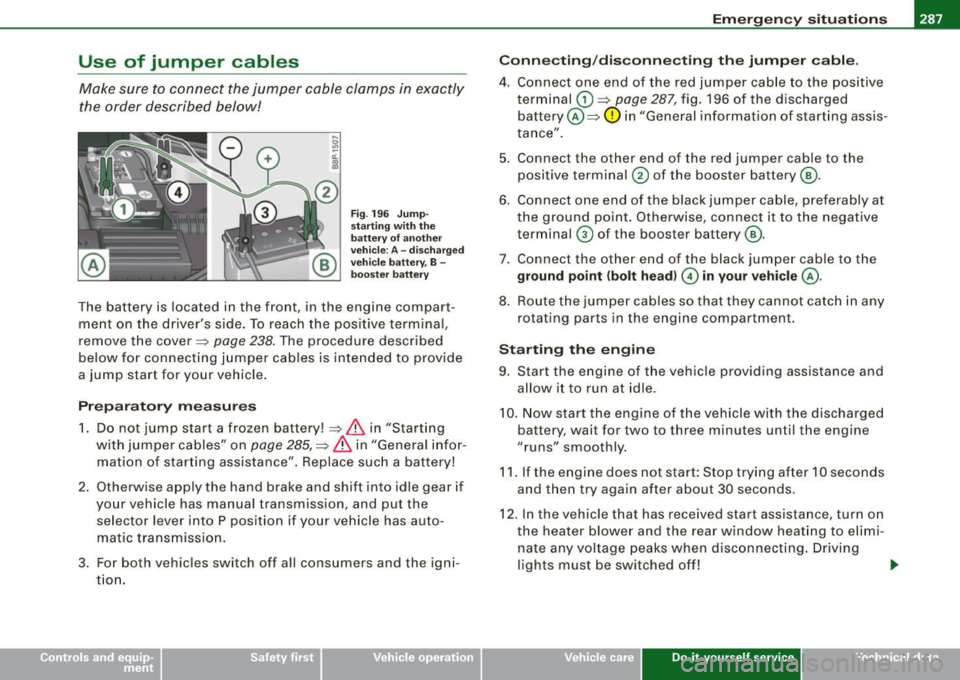
Fig . 196 Jump
starting with the
battery of another
vehicle : A -discharged
vehicle battery , B -
booster battery
The battery is located in the front, in the engine compart
ment on the driver's side. To reach the positive terminal,
remove the cover=>
page 238. The procedure described
below for connecting jumper cables is intended to provide
a jump start for your vehicle.
Preparatory measures
1. Do not jump start a frozen battery ! => & in "Sta rting
with jumper cables" on
page 285, => & in "General infor
mation of starting assistance" . Replace such a battery!
2. Otherwise apply the hand brake and shift into idle gear if
your vehicle has manual transmiss ion, and put the
selector lever into P position if your vehicle has auto
matic transmission.
3. For both veh ic les switch o ff a ll co nsumers and the igni
tion.
Connecting/disconnecting the jumper cable.
4. Connect one end of the red jumper cable to the positive
terminal
(D => page 287, fig . 196 of the discharged
battery @=> (Din "General information of starting assis
tance".
5. Connect the other end o f the red jumper cable to the
positive terminal
@ of th e boost er battery ®·
6. Connect one end of the black jumper cable, preferably at the ground point. Otherwise, connect it to the negat ive
terminal
0 of the booster battery ®·
7. Connect the other end of the black jumper cable to the
ground point (bolt head) © in your vehicle @.
8. Route the jumper cables so that they cannot catch in any
rotating parts in the engine compartment.
Starting the engine
9. Start the engine of the veh icle providing ass istance and
allow it to run at idle.
10. Now start the engine of the vehicle with the discharged
battery , wait for two to three minutes unt il the eng ine
" runs " smoothly.
11. If the engine does not start: Stop t rying after 10 seconds
and then try again after about 30 seconds.
12. In the vehicle that has received start assistance, turn on the heater blower and the rear window heating to elimi
nate any voltage peaks when disconnecting. Driving lights must be switched off! .,
Vehicle care Do-it-yourself service irechnical data
Page 290 of 320

11111.___E_ m _ e _r-==g :...e_ n_ c...:y _ s_ i_t _u _a _t_ i_o _n_ s _______________________________________________ _
13. Disconnect the cable while the engine is running exactly
in
reverse order to that described in~ page 287,
11Connecting/disconnecting the jumper cable.11
• When
doing so, make sure that the cable cannot contact rotating engine parts.
14. Turn the heater blower and the rear window heating off again.
The battery is vented to the outside to prevent gases from entering
the vehicle interior.
Make sure that the jumper clamps are well connected with their
metal ports in full contact with the battery terminals .
& WARNING
To avoid serious personal injury and damage to the vehicle, heed
all warnings and instructions of the jumper cable manufacturer. If
in doubt, call for road service.
• Jumper cables must be long enough so that the vehicles do not
touch .
• When connecting jumper cables, make sure that they cannot
get caught in any moving parts in the engine compartment.
• Before you check anything in the engine compartment, always
read and heed all WARNINGS =>
page 215, "Engine compartment" .
0 Note
Improperly connected jumper cables can damage or destroy the
generator.
• Do not use the battery negative terminal for jump starting or a
malfunction could occur in the vehicle electrical system.
• Always connect POSITIVE(+) to POSITIVE(+), and NEGATIVE( -) to
NEGATIVE (-l terminal. •
Check that all screw plugs on the battery cells are screwed in
firmly. If not, tighten plugs prior to connecting clamp on negative battery terminal.
• Please note that the procedure for connecting a jumper cable as
described above applies specifically to the case of your vehicle
being jump started. When you are giving a jump start to another
vehicle, do
not connect the minus(-) cable to the minus 1-l terminal
on the discharged battery@=>
page 287, fig. 196. Instead, securely
connect the minus(-) cable to either a massive metal component
that is firmly bolted to the engine block or to the engine block itself.
If the battery that is being charged does not vent to the outside,
escaping battery gas could ignite and explode! •
Emergency towing with commercial
tow truck
General hints
Your Audi requires special handling for towing.
The following information is to be used by commercial tow truck
operators who know how to operate their equipment safely.
• Never tow your Audi, towing will cause damage to the engine
and transmission.
• Never wrap the safety chains or winch cables around the brake
lines.
• To prevent unnecessary damage, your Audi must be transported
with a car carrier (flat bed truck).
• To load the vehicle on to the flat bed, use the towing loop found
in the vehicle tools and attach to the front or rear anchorage
=>
page 289 and => page 289 . .,_