manual transmission AUDI S3 2010 User Guide
[x] Cancel search | Manufacturer: AUDI, Model Year: 2010, Model line: S3, Model: AUDI S3 2010Pages: 320, PDF Size: 75.34 MB
Page 205 of 320
![AUDI S3 2010 User Guide [ i] Tips
• Do not tow a trailer during the break-in period of your vehicle.
• If you tow a trailer, your Audi may require more frequent mainte
nance due to the extr](/img/6/57545/w960_57545-204.png "AUDI S3 2010 User Guide [ i] Tips
• Do not tow a trailer during the break-in period of your vehicle.
• If you tow a trailer, your Audi may require more frequent mainte
nance due to the extr")
[ i] Tips
• Do not tow a trailer during the break-in period of your vehicle.
• If you tow a trailer, your Audi may require more frequent mainte
nance due to the extra load=> page 299 . •
Parking on a slope
-----------------
Do not park with a trailer on a slope. If it cannot be
avoided, do so only after doing the following:
When parking:
-Apply the foot brake.
- Have someone place chocks under both the vehicle and the trailer wheels .
- With chocks in place, slowly release the brakes until
wheel blocks absorb the load.
- Turn the wheels towards the curb.
- Apply the parking brake.
- Place an automatic transmission in
P, respectively a
manual transmission in first or reverse gear.
When restarting after parking:
- Start the engine.
- Shift transmission into gear.
- Release the parking brake and slowly pull out and away from the wheel blocks.
- Stop and have someone retrieve the wheel blocks.
Controls and equip
ment Safety first Vehicle operation
Trailer towing
[
i] Tips
If you move the selector lever of the automatic transmission to P
before applying the parking brake and before blocking the wheels,
you may have to use more force later to move the lever out of the
P
position .•
Vehicle care Do-it-yourself service Technical data
Page 226 of 320
-~_C_ h_e _c _ k_ i_n ...:::g::;...._ a_n_ d_ f_ i_ll _in -'g:::;.._ ___________________________________________ _
Closing the engine hood
- Pull the hood down until the pressure from the strut is
reduced.
- Let the hood
drop down and latch in place. Do not try to
push it shut;
it may fail to engage~& .
& WARNING
A hood that is not completely latched could fly up and block your
view while driving.
• When you close the engine hood, check it to make sure the
safety catch has properly engaged. The hood should be flush with
the surrounding vehicle body parts.
• If you notice while driving that the hood is not secured prop
erly, stop at once and close it. •
Working in the engine compartment
Be especially careful whenever you work in the engine
compartment!
Whenever you must perform any work in the engine compartment,
for example checking and filling different fluids, there is a risk of injury, burns and accidents. To prevent personal injury always
observe the following WARNINGS. The engine compartment of any
vehicle is a hazardous area!
=> &
& WARNING
To help avoid injury, before you check anything under the hood :
• Turn off the engine.
• Remove the ignition key.
• Set the parking brake fully .
& WARNING (continued)
• Move selector lever of automatic transmission to "P" {Park);
put manual transmission in Neutral.
• Always let the engine cool down. Hot components will burn
skin on contact.
• To reduce the risk of being burned, never open the hood if you
see or hear steam or coolant escaping from the engine compart
ment. Wait until no steam or coolant can be seen or heard before
carefully opening the hood .
• Keep children away from the engine compartment.
• Never spill fluids on hot engine components. They can cause a
fire.
• Never touch the radiator fan. The auxiliary electric fan is
temperature controlled and can switch on suddenly.
• Never open the coolant reservoir cap when the engine is still
warm. The coolant system is pressurized and hot coolant could
spray out!
• Protect your face, hands and arm from steam or hot engine
coolant by placing a thick rag over the cap when you open the
coolant reservoir.
• If work on the fuel system or the electrical system is necessary:
- Always disconnect the battery .
- Never smoke or work near heaters or open flames. Fluids in
the engine compartment could start a fire.
- Keep an approved fire extinguisher immediately available.
• To avoid electrical shock and personal injury while the engine
is running or being started, never touch :
- Ignition cables
- Other components of the high voltage electronic ignition
system.
• If you must perform a check or repair with the engine running: .,_
Page 227 of 320
_____________________________________________ C_h_ e;::..:. c:..:..k :..:..in ;..:..= g:.....:.; a:..:..n :....:d :..:....:. f.:.:il .:.:li :..:..n :.::g:!-_ ___,JIJIII
& WARNING !continued )
-First, fully apply the parking brake, move selector lever of
automatic transmission to "P" (Park); put manual transmission
in Neutral.
- Always use extreme caution to prevent clothing, jewelry, or
long hair from getting caught in the radiator fan, V-belts or
other moving parts, or from contacting hot parts. Tie back hair
before starting, and do not wear clothing that will hang or
droop into the engine .
• Minimize exposure to emission and chemical hazards
:=> &.
& WARNING
California Proposition 65 Warning :
• Engine exhaust , some of its constituents, and certain vehicle
components contain or emit chemicals known to the State of Cali
fornia to cause cancer and birth defects and reproductive harm . In
addition, certain fluids contained in vehicles and certain products
of component wear contain or emit chemicals known to the State
of California to cause cancer and birth defects or other reproduc
tive harm.
• Battery posts, terminals and related accessories contain lead
and lead compounds , chemicals known to the State of California
to cause cancer and reproductive harms. Wash hands after
handling.
0 Note
When adding fluids , always make sure that they are poured into the
proper container o r filler opening, otherwise serious damage to
vehicle systems will occur .
ffi For the sake of the environment
To detect leaks in time, inspect the vehicle floor pan from under
neath regularly. If you see spots from oil or other vehicle fluids, have
your vehicle inspected by an authorized Audi dealer .•
Engine compartment
Ap plie s to veh icl es: wit h 2.0 I tur bo, 4-cy lind er•e ng ine
2.0 liter , 4-cylinder turbo gasoline engine (200
hp)
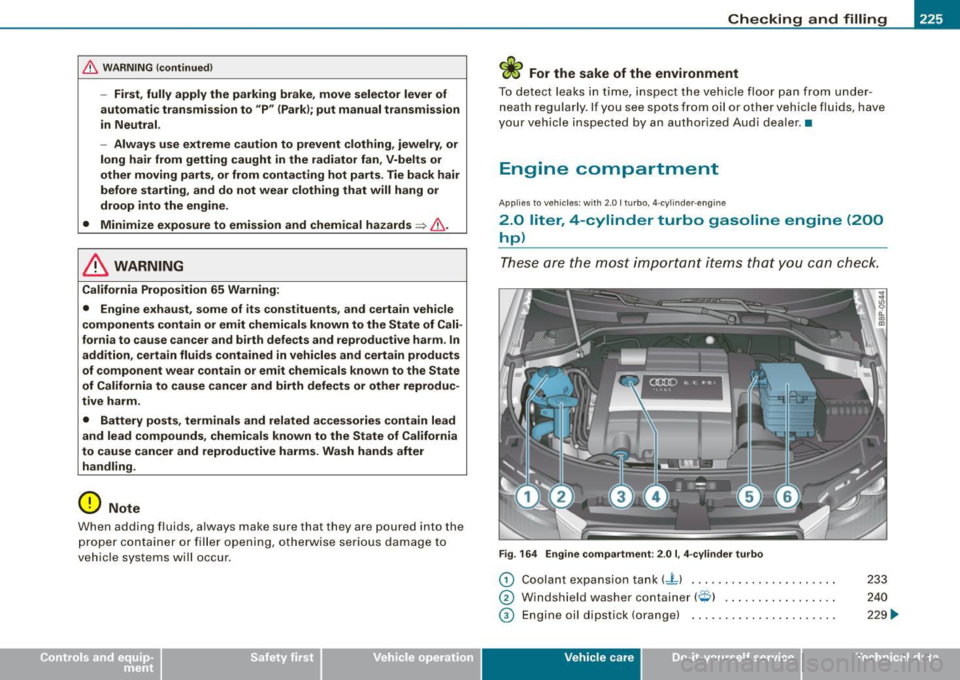
These are the most important items that you can check.
Fig. 164 Engine compartment : 2 .0 I , 4-cy linder turbo
G) Coolan t expansion tank (- L l .... ... .... .... ... .. . .
0 Windshield washer container (W ) ... .... ... ... ... .
© Eng ine oil d ipstick (orange) .. ...... ........ ..... .
Vehic le care I I
233
240
229 ~
irechnical data
Page 273 of 320
What do I do now? -__________________ __;__:....:....:..:: __ _
•
-All passengers should leave the car and move to a safe
location (for instance, behind the guardrail)~& .
- Apply the
parking brake firmly ~& .
- Move
selector lever to position Pon an automatic trans-
miss ion; put manual transmission in
first gear ~& .
-If you are towing a trailer : unhitch the trailer from your
vehicle.
- Take the
tool and the spare tire~ page 268 out of the
luggage compartment.
& WARNING
You or your passengers could be injured while changing a wheel if
you do not follow these safety precautions:
• If you have a flat tire, move a safe distance off the road. Turn off
the engine, turn the emergency flasher on and use other warning
devices to alert other motorists.
• Make sure that passengers wait
in a safe place away from the
vehicle and well away from the roadway and traffic.
• To help prevent the vehicle from moving suddenly and possibly
slipping off the jack, always fully set the parking brake and block
the wheel diagonally opposite the wheel being changed. When one
front wheel is lifted off the ground, placing the automatic trans
mission in "P" (Park), or engaging a gear in a manual transmission
will
not prevent the vehicle from moving.
• Before you change a wheel, be sure the ground is level and firm.
If necessary, use a sturdy board under the jack.
• After installing the spare wheel, make sure that you remount
the flat tire/wheel in its storage area properly and tighten the
knurled retaining screw securely. •
Changing a wheel
When you change a wheel, follow the sequence described
below step-by-step and exactly in that order.
1. Remove the decorative wheel cover*. For more details
see also
~ page 272, "Decorative wheel covers" or
~ page 273, "Wheels with cap-covered wheel bolts".
2. Loosen the
wheel bolts~ page 274.
3. Locate the proper mounting point for the jack and align
the jack below that point~
page 274.
4. Lift the car with the jack~ page 274.
5. Take the flat wheel off and then put the spare on
~ page 276.
6. Tighten all wheel bolts lightly .
7.
Lower the vehicle with the jack .
8. Use the wheel bolt wrench and
firmly tighten all wheel
bolts ~
page 274.
9. Put the decorative wheel cover* back on.
& WARNING
Always read and head all WARNINGS and information ::} & in
"Raising the vehicle" on
page 274 and ~ page 277. •
After changing a wheel
A wheel change is not complete without the following
actions.
- Store and secure the replaced wheel in the spare wheel
well. .,._
Do-it-yourself service
Page 277 of 320
What do I do now? -
------------------
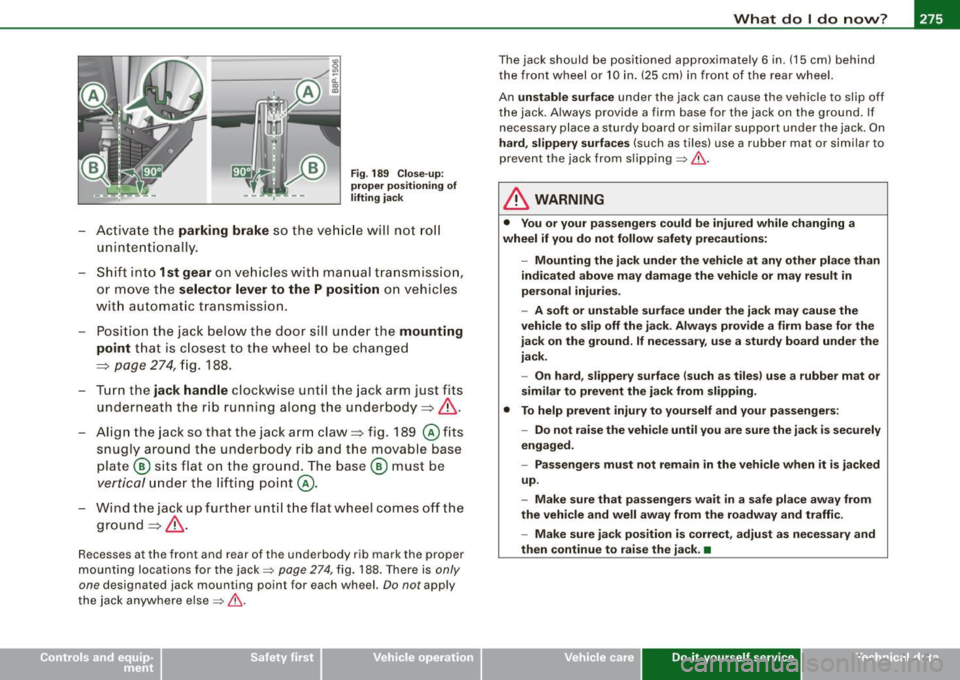
Fig. 189 Close-up:
proper positioning of
lifting jack
-Activate the parking brake so the vehicle will not roll
unintentionally.
- Shift into
1st gear on vehicles with manual transmission,
or move the
selector lever to the P position on vehicles
with automatic transmission.
- Position the jack below the door sill under the
mounting
point
that is closest to the wheel to be changed
=> page 274, fig. 188.
- Turn the
jack handle clockwise until the jack arm just fits
underneath the rib running along the underbody
=> &.
- Align the jack so that the jack arm claw => fig . 189 @ fits
snugly around the underbody rib and the movable base
plate @ sits flat on the ground. The base @ must be
vertical under the lifting point@.
- Wind the jack up further until the flat wheel comes off the
ground =>& .
Recesses at the front and rear of the underbody rib mark the proper
mounting locations for the jack ~
page 274, fig. 188. There is only
one
designated jack mounting point for each wheel. Do not apply
the jack anywhere else~& . The
jack should be positioned approximately 6 in. (15 cm) behind
the front wheel or 10 in. (25 cm) in front of the rear wheel.
An unstable surface under the jack can cause the vehicle to slip off
the jack. Always provide a firm base for the jack on the ground. If
necessary place a sturdy board or similar support under the jack. On
hard, slippery surfaces (such as tiles) use a rubber mat or similar to
prevent the jack from slipping ~& .
& WARNING
• You or your passengers could be injured while changing a
wheel if you do not follow safety precautions:
-Mounting the jack under the vehicle at any other place than
indicated above may damage the vehicle or may result in
personal injuries.
- A soft or unstable surface under the jack may cause the
vehicle to slip off the jack. Always provide a firm base for the
jack on the ground. If necessary, use a sturdy board under the
jack.
- On hard, slippery surface (such as tiles) use a rubber mat or
similar to prevent the jack from slipping.
• To help prevent injury to yourself and your passengers:
- Do not raise the vehicle until you are sure the jack is securely
engaged.
- Passengers must not remain in the vehicle when it is jacked
up.
- Make sure that passengers wait in a safe place away from
the vehicle and well away from the roadway and traffic.
- Make sure jack position is correct, adjust as necessary and
then continue to raise the jack. •
Vehicle care Do-it-yourself service irechnical data
Page 282 of 320

1111.___F_ u_ s _ e_s _ a_n _ d_ b_ u_lb _ s _______________________________________________ _
Equipment Amps No. Equipment Amps
Manual headlight beam adjustment, automatic
14 Electronic Stabilization Program (ESP) (control 10
1
headlight beam adjustment, AFS control mod-10
module), shift gate automatic transmission
ule, engine components, light switch (switch
15 Interior lights, reading lights 10
lighting/illumination), diagnosis socket
Diagnostic connector, rain sensor, air condition-
Automatic transmission, control module for
16 ing (control module), tire pressure monitor dis-10
CAN data transfer (gateway), electro -mechanical
play (control module)
2 steering, shift gate automatic transmission, 10 17 Anti-theft alarm warning system 5 engine relay, fuel tank control unit, engine con -
trol unit, brakes control (ABS), Electronic Stabili-
18 Diagnose Starter 5
zation Program (ESP), Anti -Slip Regulation (ASR) 19 All Wheel Drive 10
3
Airbag 5 20 Not used
!! Air-conditioning (pressure sensor, air quality
sensor), button for Electronic Stabilization Pro -
21 Not used
gram (ESP), Anti-Slip Regulat ion (ASR), tire pres-
22 Blower fan 40
sure monitor display, oil level sensor, back -up 23 Driver's side power window, front 30
4 light switch, front seat heating , parking aid, 5
seat-occupancy recognition (on USA vehicles), 24 Power outlet front 20
garage door opener, automatic mirror dimming, 25 Rear window defogger 30
headlight assistant, heated windshield washer
26 Power outlet in luggage compartment 20 nozzles, air conditioning (control module)
-27 Fuel tank control module, fuel pump 15
5 AFS headlights (left side) 5
AFS headlights (right side) 5 28 Power window, rear 30
7
Not used 29 Not used
Not used
30 Not used
9 Navigation system, radio system 15 31 Not used
10 digital
radio, cell phone, TV equipment 7,5 32 Not used
11 Automa tic mirror dimming, headlight assistan t 10 33 Sliding/pop-up roof 20
Central locking (front doors) 10 34 Not used
13 Central locking (rear doors) 10 35 Not used
36 Lumbar support 10
Page 289 of 320
______________________________________________ E_ m_ e_r .;::g ;...e _ n_ c __,c. y_ s_it _u_ a_ ti_o _ n_ s _ __._
Use of jumper cables
Make sure to connect the jumper cable clamps in exactly
the order described below!
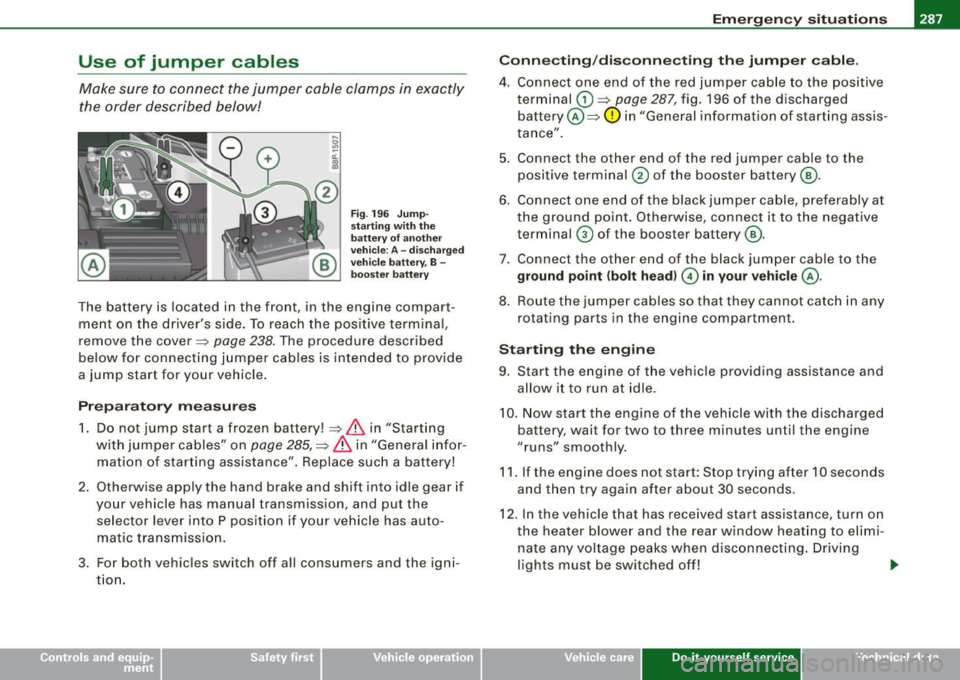
Fig . 196 Jump
starting with the
battery of another
vehicle : A -discharged
vehicle battery , B -
booster battery
The battery is located in the front, in the engine compart
ment on the driver's side. To reach the positive terminal,
remove the cover=>
page 238. The procedure described
below for connecting jumper cables is intended to provide
a jump start for your vehicle.
Preparatory measures
1. Do not jump start a frozen battery ! => & in "Sta rting
with jumper cables" on
page 285, => & in "General infor
mation of starting assistance" . Replace such a battery!
2. Otherwise apply the hand brake and shift into idle gear if
your vehicle has manual transmiss ion, and put the
selector lever into P position if your vehicle has auto
matic transmission.
3. For both veh ic les switch o ff a ll co nsumers and the igni
tion.
Connecting/disconnecting the jumper cable.
4. Connect one end of the red jumper cable to the positive
terminal
(D => page 287, fig . 196 of the discharged
battery @=> (Din "General information of starting assis
tance".
5. Connect the other end o f the red jumper cable to the
positive terminal
@ of th e boost er battery ®·
6. Connect one end of the black jumper cable, preferably at the ground point. Otherwise, connect it to the negat ive
terminal
0 of the booster battery ®·
7. Connect the other end of the black jumper cable to the
ground point (bolt head) © in your vehicle @.
8. Route the jumper cables so that they cannot catch in any
rotating parts in the engine compartment.
Starting the engine
9. Start the engine of the veh icle providing ass istance and
allow it to run at idle.
10. Now start the engine of the vehicle with the discharged
battery , wait for two to three minutes unt il the eng ine
" runs " smoothly.
11. If the engine does not start: Stop t rying after 10 seconds
and then try again after about 30 seconds.
12. In the vehicle that has received start assistance, turn on the heater blower and the rear window heating to elimi
nate any voltage peaks when disconnecting. Driving lights must be switched off! .,
Vehicle care Do-it-yourself service irechnical data
Page 296 of 320

___ G_ e_ n_ e_r_ a _ l_ in_ f_ o _r_m _ a_ t_ i_ o _ n __________________________________________________ _
General information
Explanation of technical data
Some of the technical data listed in this manual requires
further explanation.
The technical data for your vehicle is listed in the charts starting on
~ page 296. This section provides general information, notes and
restrictions which apply to this data. •
Vehicle identification
The key data are given on the vehicle identification
number (VIN) plate and the vehicle data sticker.
Fig. 204 Vehicle Identi
fication Number (VIN)
plate: location on
driver's side dash
panel Fig
. 205 The vehicle
identification label -
inside the luggage
compartment
The Vehicle Identification Number (VIN)
is located on the driver's side so that it is visible from the outside
through the windshield -see ~ fig. 204.
The vehicle identification label
is located in the luggage compartment in the spare wheel well.
The label ~ fig. 205 shows the following vehicle data:
© Production control no.
0 Vehicle identification no.
© Type code number
© Type designation/engine output in Kilowatts
© Engine and transmission code letter
© Paint no./lnterior
0 Optional equipment no.'s
Vehicle data 2 to 7 are also found in your Warranty
& Maintenance
booklet .
The safety compliance sticker
is your assurance that your new vehicle complies with all applicable
Federal Motor Vehicle Safety Standards which were in effect at the
time the vehicle was manufactured. You can find this sticker on the ._
Page 302 of 320
___ C_ o_n_ s_ u_m _ e_ r_ ln_ f_o _r_m _ a_ t_ i_o _n ______________________________________________ _
& WARN ING (continued )
• Always be extremely careful when working on the vehicle.
Alway s follow commonly a ccepted safety practices and general
c ommon sen se . Never risk per sonal injury .
• Do not attempt any of the maintenance, checks or repairs
described on the following pages if you are not fully familiar with
the se or other procedures with re spect to the vehicle , or are uncer
tain how to proceed .
• Do not do any work without the proper tools and equipment.
Have the necessary work done by your authorized Audi dealer or
another properly equipped and qualified work shop .
• The engine compartment of any motor vehicle is a potentially
hazardous area . Never reach into the a rea around or touch the
radiator fan. It is temperature controlled and can switch on
suddenly · even when the engine is off and the ignition key has
been removed . The radiator fan switches on automatically when
the coolant reaches a certain temperature and will continue to run
until the coolant temperature drops .
• Always remove the ign ition key before anyone gets under the
vehicle .
• Always support your vehicle with safety stands if it is neces
sary to work underneath the vehicle. The jack supplied with the
vehicle is not adequate for this purpose and could collap se
c ausing serious personal injury .
• If you must work underneath the vehicle with the wheel s on
the ground , always make sure the vehicle is on level ground , that
the wheels are always securely blocked and that the engine c annot be started .
• Always make sure the tr ansmission selecto r lever (automatic
transmission ) is in "P" (Park position ) (automatic transmission ) or
Neutral (manual transmi ssion) and the hand brake is firmly
applied .
W For the sake of the environment
• Cha nging t he en gine setti ngs will adversely a ffec t emi ssio n
l evels. This is detrimenta l to the environment and increases fuel
consumptio n.
• Always o bse rve enviro nmenta l regu lations when dis posing of
o ld eng ine o il, used brake flu id, d irty eng ine coola nt, spe nt batter ies
or worn out tires .
• Undeployed airbag modules and pretensioners might be classi
fied as Pe rchlorate Mate rial -specia l handl ing may apply, see
www .dtsc.ca.gov/ hazardouswaste/perchlora te. W hen t he veh icle or
parts of the restraint system including airbag modu les safety belts
w ith pretens ione rs are sc rapped, all appl icab le laws and regu la
tions must be observed. Your authorized Audi dea ler is familiar with
th ese requi reme nts a nd we reco mme nd t hat you have your dealer
perform this service for you. •
Additional accessories,
modifications and parts replacement
Additional accessories and parts
replacement
A lways co ns ult an author ized Audi d eal er befor e
purc hasing accessorie s.
Your vehicle incorporates the latest safety design features ensuring
a h igh s tanda rd of act ive and pass ive sa fety.
T his safety could be compromised by non -approved changes to the
veh ic le . Fo r thi s reason, if pa rts have to be re place d, please o bserve
the fo llowing points w hen insta lli ng additional accessories:
Approved Audi accessories and genuine Audi parts are avai lable
from autho rized Aud i dea lers.
~
Page 307 of 320
______________________________________________ A_ l:.!: p :...:h..:. a= b..:e :...: t:..:..i c.::....:.: a..:..l ..:.in :....:..:: d:.:e :.: x-=---•
Ashtray
Rear . ........ .... ....... ...... ... 91
ASR How the Anti -Slip Regulation System
works .. .... .... .... ... .... .... 190
Ast erisk
Wha t does it m ean wh en something is
marked with an asterisk? ... .. .... .. 5
Audi Service Repair Manuals and Literature 298
AUTO Climate controls .. .... .... ... .... .. 99
Switching on . ... .... .... .. . .. .. .. 99
When should I use AUTO? ... ..... .. 99
Auto Safety Hotline ... .. .. .. .... .... . 133
Automatic air recircu lation ..... .. .... 100
Automatic belt retractor .. .... .... .... 139
Automatic car wash
See Washing .. ..... ... ..... .. .... 205
Automatic headlights defective ... .. .... .... ... .... .... . 34
Automatic Transmission Automa tic Transm ission . .... .. .... 117
Automat ic transmission .. .... .... .... 114
Driving Notes . . . . . . . . . . . . . . . . . . . . 116
Emergency program . ............. 120
Emergency release ..... .. .... 120, 12 1
Ign ition key safety lock ... .... .... . 106
Kick -down ... .... .... .... ... .... . 119
L aunch Control Program ...... .... . 119
Se lector lever lock .. ...... .. . .... . 1 15
Selec tor lever positions .. ...... ... 114
Controls and equip
ment Safety first
Tiptronic .
... ... . .. .. .... .. .. .... 118
Tiptronic controls on the s teering whee l
119
Average fuel mileage .......... .... ... 22
Average sp eed ... .... .... .... .... ... . 22
Avo id damaging the v ehicle .... .. .... . 198
B
Battery ... .. .... ... .... .... .... .... 236
chargi ng ..... .... .... .... .... ... 239
Disconnecting and c onnecting . ... . 237
I mportant warnings when work ing o n the
battery . .... .... .... ...... ..... 238
Replacing the battery .. ... .... .... 237
Winter operation . ..... ... .... .... 237
Working on the battery .... .... .... 238
Battery vo ltage ....... .... ........... 33
Before driving . .... . .. .. .... .... .... 125
Blended gasoline . ..... .. ...... ...... 217
Body cavity sealing .. .... ...... ..... . 21
O
Booster seats .... .... .... .... .... ... 175
Brake assistant ..... .... .... .. .. .... 1 93
Brake booster .. ...... .... .... ... .... 192
Brake fluid
Changing the brake fluid ...... .... 236
Checking the bra ke fl uid leve l ...... 235
Reservoir .. ...... ... .... .... .... . 235
What is the correct brake f luid level? 235
What should I do if the brake fluid warning
light comes on? . .... ...... .... .. 235
Brake pads .. ..... ... .... .... .... ... 196 Brake system
..... .. .. .. .... .... .... 235
Anti -lock brake system (ABS) .. .. .. .. 16
Brake fluid ............ .... ..... .. 235
Brake f luid specif ications for re fill and
replacement ... .. .... .... ... .. .. 236
Brake light defective ... ...... .... .. 34
General information . ........ ... .. 191
How does moistur e or road salt aff ect the
br akes? ..... .... .... .. .. ... .. . . 1 91
Ma lfunct ion ... .. .... .... .... .. . .. 30
Warning /indica tor lights .. .. .... ... . 15
Worn brake pads symbo l ...... .... . 33
Break -in period .. ...... ...... .... ... 195
Brake pads . ...... .... ... .... .. .. 196
Tires ... .. .... .... .... ... .. .... .. 1 95
Bu lbs ...... ........ ... .. ...... .... . 283
C
California Proposition 65 Warning . .... 225
Battery specific ... .... .... .... .... 239
Capacities .. ... ... ... .... ... .... .... 296
Car care ... . .... .. .. .... .... .... .. . . 204
In ter ior . ...... .... .... ... .... .. .. 211
P last ic a nd vinyl . ...... .... .... ... 208
Weathers trips ... .. .... .. . .... .. .. 209
Care of exterior . .... ..... ... .... .... 204
Cargo area
See Loading the luggage compartm ent .
13 1
Cargo net .. ... ... .. .. .. .... .... ..... 83
Catalytic converter ...... .... .... ... . 196
Center armrest ......... .... ... .. ..... 80
Vehicle operation Vehicle care Do-it-yourself service Technical data