oil change AUDI S3 2010 User Guide
[x] Cancel search | Manufacturer: AUDI, Model Year: 2010, Model line: S3, Model: AUDI S3 2010Pages: 320, PDF Size: 75.34 MB
Page 281 of 320

_________________________________________________ F_ u_ s_ e_s _ a_n _d_ b_ u _ lb_ s _ __.ffllll
The various electrical circuits are protected by fuses. The fuses are
clustered in a centralized unit. The unit is located behind the face
panel at the end of the instrument panel. The crank for operating
the sunroof in case of a power failure is a lso stored behind the face
panel
~ page 50.
Two spare fuses and a sticker identifying the fuses are located on
the inside of the fuse box cover.
You are well advised to keep a supply of spare fuses in your vehicle .
Fuses with the proper ampere ratings are available at your autho
rized Audi dealer.
& WARNING
Never replace a fuse with one that has a higher amperage rating.
• A fuse with a too high amperage could damage the electrical
part and cause a fire .
0 Note
• On no account should fuses be repaired (e.g . patched up with tin
foil or wire) as this may cause serious damage elsewhere in the elec
trical circuit or cause fire.
• If a fuse blows repeatedly, do not keep replacing it. Instead, have
the cause for the repeated short circuit or overload tracked and
fixed. •
Fuse Location , Instrument Panel left
Fus es which can be replaced.
Fig. 194 Fuse carrier
behind the instrument
panel end face, cover
removed
Note that the following table is accurate at the time of going to
press and is subject to change. In the event of discrepancies , the
label on the inside of the cover always takes precedence .
The power seats are protected by circuit breakers, which automati
cally reset after a few seconds after the overload has been reme -
died. .._
Vehicle care Do-it-yourself service irechnical data
Page 293 of 320
________________________________________________ E_ m_ e_r .::g :...e_ n _ c_,y'-- s_ i_t _u _a_ t_ i_o _n_ s _---J_
Lifting the vehicle
Important safety precautions
Be aware of the following hazards before lifting the vehicle with a
workshop hoist or floor jack:
• The vehicle should never be lifted or jacked up from underneath
the engine oil pan, the transmission housing, the front or rear axle
or the body side members. This could lead to serious damage.
• Use lifting equipment with padded contact surfaces to avoid
damage to the underbody or chassis frame.
• Alternatively, cover the contact surfaces on workshop hoist or
floor jack with rubber pads before lifting .
• Before driving over a workshop hoist, check that the vehicle
weight does not exceed the permissible lifting capacity of the hoist .
• Before driving over a workshop hoist, ensure that there is suffi
cient clearance between the hoist and low parts of the vehicle .
& WARNING
To reduce the risk of serious injury and vehicle damage:
• Always lift the vehicle only at the special workshop hoist and
floor jack lift points illustrated
=> fig. 202 and => fig. 203 .
• Failure to lift the vehicle at these points could cause the vehicle
to tilt or fall from a lift if there is a change in vehicle weight distri
bution and balance. This might happen, for example, when heavy
components such as the engine block or transmission are
removed .
• When removing such heavy components, anchor vehicle to
hoist or add corresponding weights to maintain the center of
gravity . Otherwise , the vehicle might tilt or slip off the hoist,
causing serious personal injury. •
Lifting with workshop hoist and with floor
jack
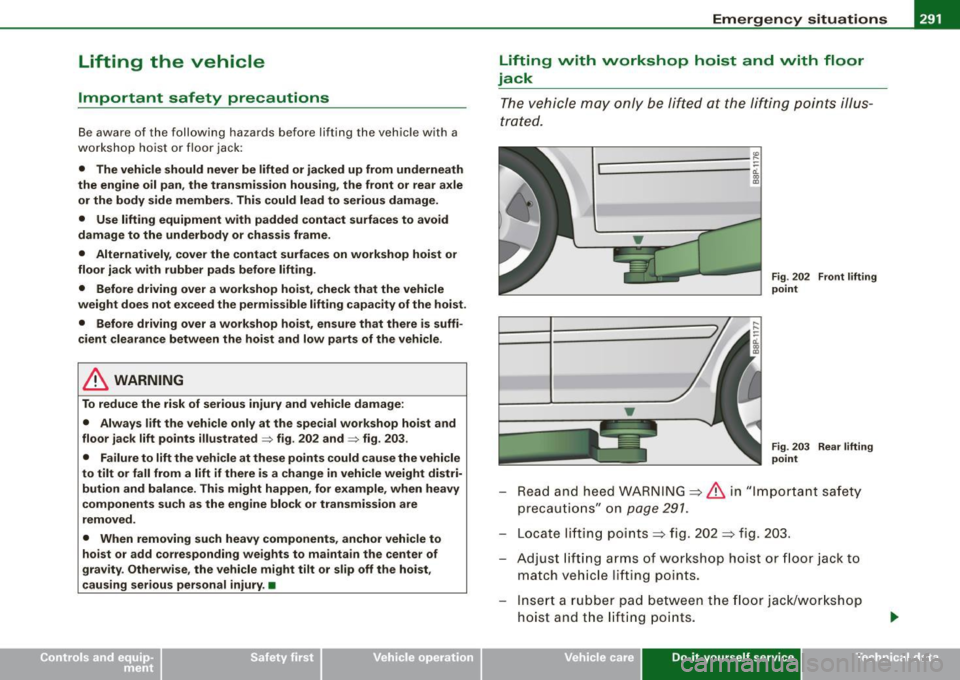
The vehicle may only be lifted at the lifting points illus
trated.
.... L===========::::==:: ~ 0:.
Fig . 202 Front lifting
point
Fig . 203 Rear lifting
point
Read and heed WARNING ~ & in "Important safety
precautions " on
page 291.
Locate lifting points~ fig. 202 ~ fig. 203.
Adjust lift ing arms of workshop hoist or floor jack to
match vehicle lifting points.
Inse rt a rubber pad between the floo r jack/workshop
hoist and the lifting poin ts.
Vehicle care Do-it-yourself service irechnical data
Page 298 of 320
___ D_ a_ ta ______________________________________________________ _
Data
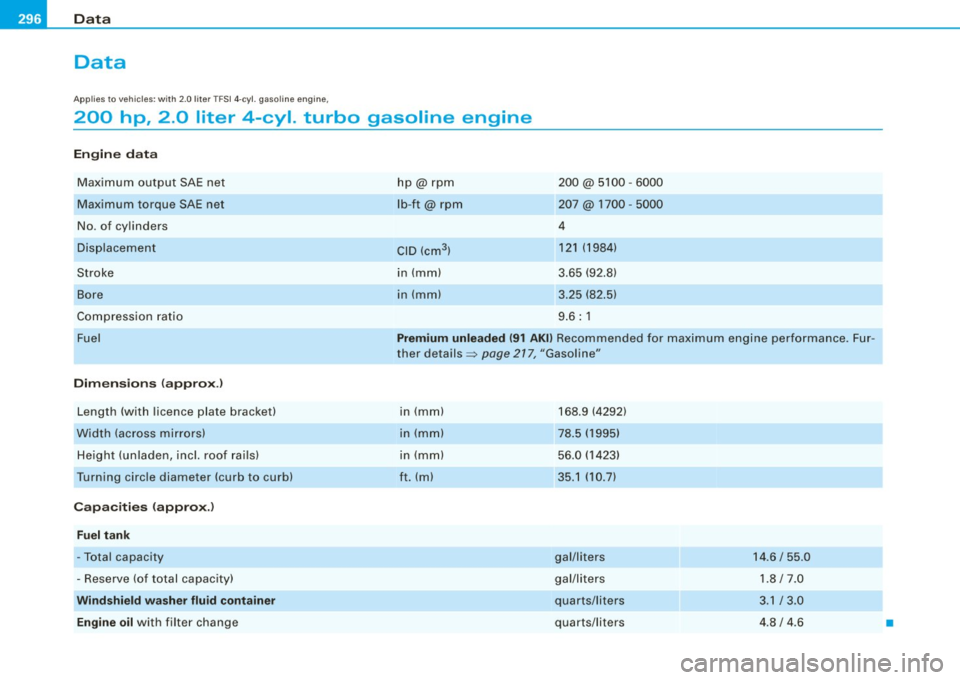
Applies to vehi cles: with 2.0 lite r TFS I 4-cyl. g asoline eng ine ,
200 hp, 2.0 liter 4-cyl. turbo gasoline engine
Engin e data
Maximum output SAE net
Maximum torque SAE net
No. of cy linders
Disp lacement
Stroke
Bore
Compression ratio
Fuel
D im ensio ns (a pprox.)
Length (with licence plate bracket)
Width (across mirrors)
Height (unladen, incl. roof rails)
Turning circle diameter (curb to cu rb)
Ca pacitie s (a pprox.)
F u el t ank
-Total capacity
- Reserve (of total capacity)
W ind shi eld was her fluid cont ain er
Engine oil
with filter change hp@rpm
lb
-ft@ rpm
CID (cm
3 )
in (mm)
in (mm)
200@ 5100 -6000
207 @ 1700 -5000
4 121 (1984)
3.65 (92.8)
3 .25 (82 .5)
9 .6 : 1
Premium unleaded (91 AKI) Recommended for maximum engine performance . Fur
ther det ails =:>
page 277, "Gasol ine"
in (mm)
in (mm)
in (mm)
ft. (ml
168.9 (4292)
78 .5 (1995)
56.0 (1423)
35.1 (10.7)
gal/liters
gal/liters
quarts/liters
quarts/liters 14 .6 / 55.0
1 .8/7.0
3 .1 / 3 .0
4 .8 / 4.6
•
Page 299 of 320
___________________________________________________ D_a_ t_ a __ !II
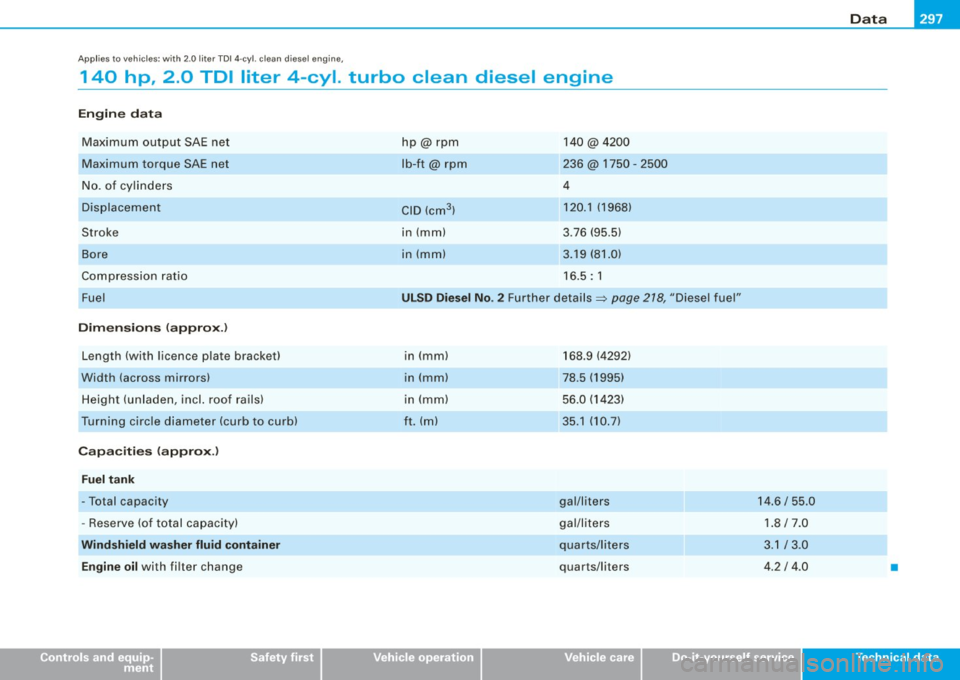
A pp lies to veh ic les : w it h 2 .0 liter TDI 4 -cyl. c le an di esel e ngin e,
140 hp , 2 .0 TOI liter 4-cyl. turbo clean diesel engine
Engine data
Maximum output SAE net
Maximum torque SAE net
N o. o f cy linders
Displacement
Stroke
Bore
Co mpression ratio
Fuel
Dimensions (approx .)
Length (with licence p late bracket)
Width (across mirrors) H eight (unla den, incl. roof ra ils)
Turning circle diameter (curb to curb)
Capacities (approx .)
Fuel tank
-Total capacity
- Reserve (of t otal capacity)
Wind shield wa sher fluid container
Engine oil
with filter change
Controls and equip ment Safety first
hp@rpm
lb-ft@ rpm
CID (cm
3
)
in (mm)
in (mm)
14 0 @4200
236 @ 1750 · 2500
4
120.1 (1968)
3 .76 (95 .5)
3.19 (81 .0)
16. 5: 1
ULSD Diesel No . 2 Further details=> page 218, "Diesel fue l"
in (mm)
in (mm)
in ( mm)
ft. (ml
Vehicle operation
168.9 (4292)
78.5 (1995) 56.0 (14 23)
35.1 (10.7)
gal/liters
gal/li te rs
quarts/liters
quarts/liters
Vehicle care
14.6 / 55.0 1.8/7.0
3.1 / 3_0
4.2 I 4 .0
Do-it-yourself service
•
T ec hn ica l da ta
Page 301 of 320
Consumer Information I'll _________________________________ __::..::....:...:...::...:.:..:....:....:.:;__ _____ _
Maintenance
General
Your vehicle has been designed to help keep maintenance require
ments to a minimum.
However, a certain amount of regular maintenance is still necessary
to assure your vehicle's safety, economy and reliability.
For detailed vehicle maintenance consult your Warranty
& Mainte
nance booklet.
Under difficult operating conditions, for example at extremely low
outside temperatures, in very dusty regions, when towing a trailer
very frequently, etc., some service work should be performed
between the intervals specified. This applies particularly to:
• oil changes, and
• cleaning or replacing the air filter.
ci> For the sake of the environment
By regularly maintaining your vehicle, you help make sure that emis
sion standards are maintained, thus minimizing adverse effects on
the environment. •
Important considerations for you and your
vehicle
The increasing use of electronics, sophisticated fuel injection and
emission control systems, and the generally increasing technical
complexity of today's automobiles, have steadily reduced the scope
of maintenance and repairs which can be carried out by vehicle
owners.
Also, safety and environmental concerns place very strict
limits on the nature of repairs and adjustments to engine and trans
mission parts which an owner can perform.
Controls and equip
ment Safety first Vehicle operation
Maintenance, adjustments and repairs usually require special tools,
testing devices and other equipment available to specially trained
workshop personnel in order to assure proper performance, reli ability and safety of the vehicle and its many systems.
Improper maintenance, adjustments and repairs can impair the
operation and reliability of your vehicle and even void your vehicle
warranty. Therefore, proof of servicing in accordance with the main tenance schedule may be a condition for upholding a possible
warranty claim made within the warranty period.
Above all, operational safety can be adversely affected, creating unnecessary risks for you and your passengers.
If in doubt about any servicing, have it done by your authorized Audi
dealer or any other properly equipped and qualified workshop. We
strongly urge you to give your authorized Audi dealer the opportu
nity to perform all scheduled maintenance and necessary repairs.
Your dealer has the facilities, original parts and trained specialists
to keep your vehicle running properly .
Performing limited maintenance yourself
The following pages describe a limited number of procedures which
can be performed on your vehicle with ordinary tools, should the
need arise and trained personnel be unavailable. Before performing
any of these procedures, always thoroughly read all of the appli
cable text and carefully follow the instructions given. Always rigor
ously observe the
WARNINGS provided.
Before you check anything in the engine compartment, always read
and heed all WARNINGS=>
& and=> & in "Working in the engine
compartment" on
page 224.
& WARNING
• Serious personal injury may occur as a result of improperly
performed maintenance, adjustments or repairs.
Vehicle care Do-it-yourself service Tec hn ica l da ta