oil level AUDI S3 2010 User Guide
[x] Cancel search | Manufacturer: AUDI, Model Year: 2010, Model line: S3, Model: AUDI S3 2010Pages: 320, PDF Size: 75.34 MB
Page 229 of 320
___________________________________________ C_ h_e _c_ k_ i_n _g _ a_n _d_ f_il _li _n _g __ fflllll
•
help prevent the formation of harmful deposits, sometimes called
"s ludge," that over time can lead to expensive repairs.
At the time of printing, engine oi ls available in the U .S . and Canada
that meet the exacting specifications of Audi oil standard VW 502 00
(vehicles with gasoline engine) and VW 507 00 (vehicles with diesel
engine) are synthetic engine oils. This does not mean, however, that
every synthe tic engine oil wi ll meet Audi o il standard VW 502 00
(gasoline engines) and VW 507 00 (diesel engines). So always be
sure that you use an approved oil.
To help p reve nt th e for matio n of ha rmful d epo sit s use only oil wit h
the following sp ecific ati ons print ed on th e oil contain er:
• Gas oline engine s: Audi oil sta ndard VW 502 00
• Dies el en gin es: Aud i oil stand ard VW 507 00
O il container labels may carry the speci fication singly or in combi
nation with other designations and oil qua lity standards.
Vi sc osity
Engine o ils are graded according to their viscosity. The proper
viscosity grade oil for your engine depends on climactic or seasona l
conditions where you drive . You can use o il with a v iscosity grade o f
SAE 5W-40 across all temperature ranges for normal driving condi
tions.
However, if engine oil viscosity grade SAE 5W-40 is not avai lab le,
you can also use viscosity grade SAE 5W -30 or SAE 0W -40 as long as
it meets Audi oil quality standard VW 502 00 (vehicles with gaso line
engine) or VW 507 00 (vehicles with diesel engine) specifications.
Because engine oil that meets the Aud i o il standard may not be
avai lable everywhere when you need it, we strong ly recommend
that you a lways carry with you an extra quart (liter) of oil that
expressly conforms to the VW 502 00 (vehic les with gaso line engine)
or VW 507 00 (vehicles with diesel engine) specification, in case you
have to top off the oil while on the road.
Ap plie s to veh icles with g asoline eng ine onl y: Only if the level of the
oi l is at or below the min imum mark on the oil dipstick -and no oil that expressly conforms to Audi oi
l standard VW 502 00 specifica
tions is availab le -may you top off with a high quality e ngine oi l,
preferably synthetic-based, that meets ACEA A3, ACEA A5 or
ACEA 85 or AP I SL specifications, but even then, on ly in viscos ity
grades SAE 5W-40, SAE 5W -30, or SAE 0W-40. However, during the
entire time between oil change intervals, never top off with more
than a total of 0.5 qt/liter engine oil that does not con form to Audi
oi l specification VW 502 00 .
Applies to veh icle s with die sel eng ine only: Only if the level of the
oi l is at or below the minimum mark on the oi l dipstick -and no oil
that expressly confo rms to Aud i oi l standard VW 507 00 specifica
tions is available -may you top off with a high quality engine oil, that
meets ACEA C3 or API CF specifications, but even then, only in
v iscosity grades SAE 5W -40, SAE 5W -30 , or SAE 0W-40. However,
during the entire time between oi l change interva ls, never top off
with more than a total of 0.5 qt/liter engine oil that does not conform to Audi oil specification VW 507 00.
For more information abo ut engine oi l that has been app roved for
your vehicle, p lease contact either your authorized Audi dea ler or
Audi Custo mer Relations at 1 (800) 822 -2834 or visit our web site at
www.audiusa.com or www.audicanada.ca . Here you will a lso find a
current list of oils (manufacturers, brand names etc.) that conform
to Audi oi l standard VW 502 00 (vehicles with gaso line engine) or
VW 507 00 (vehicles with diese l engine) .
Changin g the engine oil
The engine oil and oil filter must be changed according to the
mi leage (ki lometers) and time in tervals specified in your vehic le's
Warranty
& Maintenance book let. Do not exceed these intervals -
harmful deposits from old engine oil can reduce engine perfor
mance and can lead to expensive engine repairs.
Changing the oil at the recommended intervals is so very important
because the lub ricating prope rties of oi l decrease gradua lly during
normal vehicle use . If you are not sure when you have your oil
changed, ask your authorized Audi Service Advisor . ..,.
Vehicle care I t •
Page 230 of 320
-~_C_ h_e _c _ k_ i_n ...:::g::;...._ a_n_ d_ f_ i_ll _in -'g:::;.._ ___________________________________________ _
Under some circumstances the engine oil should even be changed
more frequently. Change oil more often if you drive mostly short
distances, operate the vehicle in dusty areas or mostly under stop
and -go traffic conditions, or when you use your vehicle where
temperatures stay below freezing point for long periods .
Detergent additives in the oil will make fresh oil look dark after the
engine has been running for a short time. This is normal and is not
a reason to change the oil more often than recommended .
Damage or malfunctions due to lack of maintenance
It is essential that you change your oi l at the recommended intervals
using only engine oil that complies with Audi oil standard
VW 502 00 (vehicles with gasoline engine) or VW 507 00 (vehicles
with diesel engine). Your Limited New Vehicle Warranty does not
cover damage or malfunctions due to failure to follow recom
mended maintenance and use requirements as set forth in the Audi
Owner's Manual and Warranty
& Maintenance booklet. Your dealer
will have to deny warranty coverage unless you present to the dealer proof in the form of Service or Repair Orders that all scheduled
maintenance was performed in a timely manner .•
Engine oil consumption
The engine in your vehicle depends on an adequate
amount of oil to lubricate and cool all of its moving parts.
In order to provide effective lubrication and cooling of interna l
engine components, all internal combustion engines consume a
certain amount of oil. Oil consumption varies from engine to engine
and may change significant ly over the life of the engine. Typically,
engines with a specified break -in period (see=>
page 195) consume
more oil during the break-in period than they consume after oil
consumption has stabilized.
Under normal conditions, the rate of oil consumption depends on
the quality and viscosity of the oil, the RPM (revolutions per minute)
at which the engine is operated, the ambient temperature and road
conditions. Further factors are the amount of oil dilution from water condensation or fuel residue and the oxidation level of the oil. As
any
engine is subject to wear as mileage builds up, the oil consump
tion may increase over time until replacement of worn components
may become necessary .
With all these variables coming into play, no standard rate of oi l
consumption can be established or specified. There is no alternative
to regular and frequent checking of the oil level, see
Note.
If the yellow engine oil level warning symbol in the instrument
cluster lights up, you should check the oil level as soon as
possible
with the oil dipstick=> page 229. Top off the oi l at your
earliest convenience =>
page 230.
& WARNING
Before you check anything in the engine compartment, always
read and heed all WARNINGS
=> &. in "Work ing in the engine
compartment" on
page 224.
0 Note
Driving with an insufficient oil level is likely to cause severe damage
to the engine.
[ i ] Tips
• The oil pressure warning display~ is not an indicator of the oil
level. Do not rely on it. Instead, check the oil level in your engine at
regular intervals , preferably each time you refuel, and always before
going on a long trip.
• If you have the impression your engine consumes excessive
amounts of oil, we recommend that you consu lt your authorized
Audi dealer to have the cause of your concern properly diagnosed .
Keep in mind that the accurate measurement of oil consumption
requires great care and may take some time. Your authorized Audi
dealer has instructions about how to measure oil consumption
accurately. •
Page 231 of 320

_____________________________________________ C_h_ e_ c _ k_in -= g_a _ n_d _ f_il _li _n ..;::g =--____.""
Checking th e engine oil level
Fig . 166 Dipstick
(Version Al: Oil level
ranges
Fig . 167 Dipstick
(Version Bl: Oil level
ranges
Before you check anything in the engine compartment,
always read and heed all WARNINGS=> & in "Working in
the engine compartment" on
page 224.
Determining oil level
- Park your vehicle so that it is horizontally level.
- While at operating state temperature, briefly let the
engine run at idle and then shut it off.
- Wait approx. two minutes. - Pull out the
oil dipstick. Wipe off the oil dipstick with a
clean cloth, and slide it back in as far as it will go.
- Pull it back out and read off the oil level=> fig. 166 or
=> fig. 167. Top off the engine oil, if applicable
=> page 230.
Oil level within range @
- Do not add oil.
Oil level within range
@
- You can add oil. Afterwards, the oil level should be within
range @.
Oil level within range
©
- You must add oil. Afterwards, the oil level should be
within range @.
The oil level needs to be checked at regular intervals . The best times
to do this are whenever you refuel and prior to long trips.
Depending on the way the vehicle is driven and the operating condi
tion s, oil consumption can be up to 1 quart per 1.200 miles (1 liter
per 2.000 km). Consumption may be higher within the first 3.000
miles (5.000 km) .•
Vehic le care I I irechnical data
Page 232 of 320
___ C_h_ e_ c_k _in --=:: g;__ a_n _d_ f_il _li _n ..:g:a.- ___________________________________________ _
Adding engine oil ~
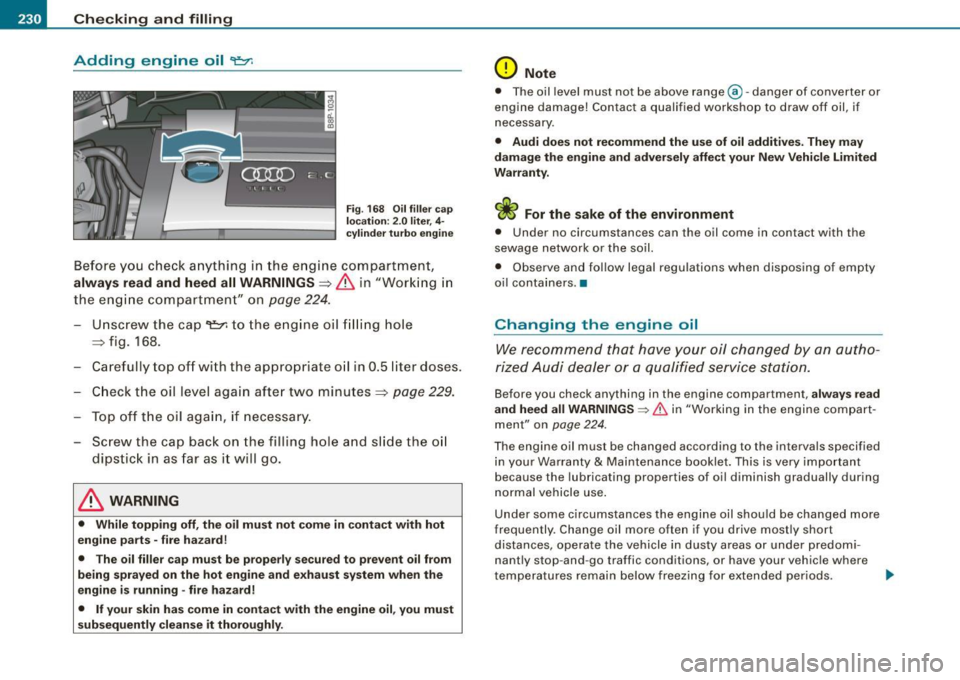
Fig. 168 Oil filler cap
location : 2.0 liter, 4-
cylinder turbo engine
Before you check anything in the engine compartment,
always read and heed all WARNINGS::::,
& in "Working in
the engine compartment" on
page 224.
- Unscrew the cap ce::,; to the e ngine oil filling hole
::::> fig. 168.
Carefully top off with the appropriate oil in 0.5 liter doses.
- Check the oil level again after two minutes::::,
page 229.
Top off the oil again, if necessary.
- Screw the cap back on the filling hole and slide the oil
d ips tick in as far as it will go.
& WARNING
• While topping off, the oil must not come in contact with hot
engine parts -fire hazard!
• The oil filler cap must be properly secured to prevent oil from
being sprayed on the hot engine and exhaust system when the
engine is running -fire hazard!
• If your skin has come in contact with the engine oil, you must
subsequently cleanse it thoroughly.
0 Note
• The oil level must not be above range @-danger of converter or
engine damage! Contact a qualified workshop to draw off oil, if
necessary .
• Audi does not recommend the use of oil additives. They may
damage the engine and adversely affect your New Vehicle Limited
Warranty .
<£> For the sake of the environment
• Under no circumstances can the oil come in contact with the
sewage network or the soil.
• Observe and fol low legal regulations when disposing of empty
oi l containers. •
Changing the engine oil
We recommend that hove your oil changed by an autho
rized Audi dealer or a qualified service station.
Before you check anything in the engine compartment, always read
and heed all WARNINGS~
& in "Working in the engine compart
ment" on
page 224.
T he engine oil must be changed according to the intervals specified
in your Warranty
& Maintenance booklet. This is very important
because the lubricating properties of oil diminish gradually during
normal vehicle use.
Under some circumstances the engine oil shou ld be changed more
frequently. Change oil more often if you drive most ly short
distances , operate the vehicle in dusty areas or under predomi
nantly stop -and -go traffic conditions, or have your vehicle where
temperatures remain below freezing for extended periods . .,_
Page 233 of 320

Checking and filling ---------------~-!':WIii
•
Detergent additives in the oil will make fresh oil look dark after the
engine has been running for a short time. This is normal and is not
a reason to change the oil more often than recommended.
Because of the problem of proper disposal, along with the special
tools and necessary expertise required, we strongly recommend
that you have your oil changed by an authorized
Audi dealer or a
qualified service station.
If you choose to change your oil yourself, please note the following
important information:
& WARNING
To reduce the risk of personal injury if you must change the engine oil in your vehicle yourself :
• Wear eye protection.
• To reduce the risk of burns from hot engine oil, let the engine
cool down to the touch.
• When removing the oil drain plug with your fingers, stay as far
away as possible. Always keep your forearm parallel to the ground
to help prevent hot oil from running down your arm.
• Drain the oil into a container designed for this purpose, one
large enough to hold at least the total amount of oil in your engine.
• Engine oil is poisonous. Keep it well out of the reach of children.
• Continuous contact with used engine oil is harmful to your
skin. Always protect your skin by washing oil off thoroughly with
soap and water.
0 Note
Never mix oil additives with your engine oil. These additives can
damage your engine and adversely affect your Audi New Vehicle
Limited Warranty.
<£' For the sake of the environment
• Before changing your oil, first make sure you know where you
can properly dispose of the used oil.
• Always dispose of used engine oil properly. Do not dump it on
garden soil, wooded areas, into open streams or down sewage
drains.
• Recycle used engine oil by taking it to
a used engine oil collec
tion facility in your area, or contact a service station. •
Applies to veh icles: with diesel engine
Important information for vehicles with diesel
engine when adding or changing engine oil
On vehicles with a diesel engine always use engine oil that conforms to Audi oil specification VW 507 00 when
adding or changing engine oil.
Vehicles with diesel engines require and must always use special
engine oil that conforms to Audi oil specification
VW 507 00.
Never use any other kind of engine oil in your vehicle, not even to
top off the oil level.
At the time of printing, we are aware that Castrol® produces engine
oil that conforms to Audi oil specification VW 507 00. This oil may
not yet be available throughout North America. Other oil manufac
turers may offer engine oil that conforms to Audi oil specification
VW 507 00 at this time or some future date.
Please be sure to consult with your authorized Audi dealer for infor
mation and availability of the proper engine oil for your vehicle's
diesel engine and for the latest technical information.
Because this special engine oil may not be available when need it,
we strongly recommend that you always carry with you extra quart
!liter! of oil that conforms to Audi oil specification VW 507 00, in
case you have to top off oil while on the road. .,_
Vehicle care I t •
Page 235 of 320

Checking and filling -
---------------------=----"=---------
0 Note
• Before winter sets in, have the coolant checked to see if the
coolant additive in your vehicle is sufficient to meet the climate
conditions. This is especially important if you live in a region where
the winter is extremely cold. If necessary, increase the proportion of
coolant additive to 60%.
• When adding coolant additive to your cooling system,
remember:
-We recommend using only coolant additive G12+ + (check the
label) for your vehicle. This coolant additive is available at autho
rized Audi dealers. Other types of antifreeze can significantly
reduce corrosion protection . The resulting corrosion can cause a
loss of coolant and serious engine damage .
• Do not add any type of radiator leak sealant to your vehicle's
engine coolant. Adding radiator repair fluid may adversely affect the
function and performance of your cooling system and cou ld result
in damage not covered by your New Vehicle Limited Warranty .•
Checking the engine coolant level
The engine coolant level can be checked with a quick
glance.
Fig . 169 Engine
compartment : coolant
expansion tank
Before you check anything in the engine compartment,
always read and heed all WARNINGS==> & in "Working in
the engine compartment" on
page 224.
Turn off the ignition .
Read the engine coolant level from the coolant expan
sion tank==> fig. 169. With a cold engine, the coolant level
should be between the "min" and "max" markings. When
the engine is warm, the level may be slightly above the
" max" marking .
The location of the coolant expansion tank can be seen in the
engine compartment illustration=>
page 225.
To obtain an accurate reading, the engine must be switched off .
The expansion tank in your vehicle is equipped with an electric
coolant level sensor.
When the coolant level is too low, the warning light in the Auto
Check System =>
page 30will blink until you add coolant and the
level has been restored to normal. Even though there is an electric
coolant level sensor, we still recommend you check the coolant level
from time to time.
Coolant loss
Coolant loss may indicate a leak in the cooling system. In the event
of coolant loss, the cooling system should be inspected immedi
ately by your authorized Audi dealer. It is not enough merely to add
coolant.
In a
sealed system, losses can occur only if the boiling point of the
coolant is exceeded as a result of overheating.
0 Note
Do not add any type of radiator leak sea lant to your vehicle's engine
coolant. Adding radiator repair fluid may adversely affect the tune- _..
Vehicle care I I Technical data
Page 282 of 320

1111.___F_ u_ s _ e_s _ a_n _ d_ b_ u_lb _ s _______________________________________________ _
Equipment Amps No. Equipment Amps
Manual headlight beam adjustment, automatic
14 Electronic Stabilization Program (ESP) (control 10
1
headlight beam adjustment, AFS control mod-10
module), shift gate automatic transmission
ule, engine components, light switch (switch
15 Interior lights, reading lights 10
lighting/illumination), diagnosis socket
Diagnostic connector, rain sensor, air condition-
Automatic transmission, control module for
16 ing (control module), tire pressure monitor dis-10
CAN data transfer (gateway), electro -mechanical
play (control module)
2 steering, shift gate automatic transmission, 10 17 Anti-theft alarm warning system 5 engine relay, fuel tank control unit, engine con -
trol unit, brakes control (ABS), Electronic Stabili-
18 Diagnose Starter 5
zation Program (ESP), Anti -Slip Regulation (ASR) 19 All Wheel Drive 10
3
Airbag 5 20 Not used
!! Air-conditioning (pressure sensor, air quality
sensor), button for Electronic Stabilization Pro -
21 Not used
gram (ESP), Anti-Slip Regulat ion (ASR), tire pres-
22 Blower fan 40
sure monitor display, oil level sensor, back -up 23 Driver's side power window, front 30
4 light switch, front seat heating , parking aid, 5
seat-occupancy recognition (on USA vehicles), 24 Power outlet front 20
garage door opener, automatic mirror dimming, 25 Rear window defogger 30
headlight assistant, heated windshield washer
26 Power outlet in luggage compartment 20 nozzles, air conditioning (control module)
-27 Fuel tank control module, fuel pump 15
5 AFS headlights (left side) 5
AFS headlights (right side) 5 28 Power window, rear 30
7
Not used 29 Not used
Not used
30 Not used
9 Navigation system, radio system 15 31 Not used
10 digital
radio, cell phone, TV equipment 7,5 32 Not used
11 Automa tic mirror dimming, headlight assistan t 10 33 Sliding/pop-up roof 20
Central locking (front doors) 10 34 Not used
13 Central locking (rear doors) 10 35 Not used
36 Lumbar support 10
Page 310 of 320
___ A_ l..:,. p _ h_ a_ b_e _t_ic _ a_l _in _ d_e_ x ____________________________________________ _
Engine
4-cylinder diesel (140 hp) ... ... ... . 226
4 -cylinder gaso line (200 hpl .... .... 225
Coolant .. ...... ..... .... .... .... 232
Hood ...... ....... .... ... .... ... 223
Starting .................... 106, 107
Starting with jumper cables .. .... . 285
Stopping ... .. .... .... .... .... .. 108
Engine compartment . .... .... ...... . 225
Safety instructions . . . . . . . . . . . . . . . 224
Working in the engine compartment 224
Engine coolant system ... .... ....... 232
Adding coolant .... ....... ..... .. 234
Checking coolant level . . . . . . . . . . . . 233
Checking the engine coolant level .. 233
Radiator fan . . . . . . . . . . . . . . . . . . . . . 235
Engine coolant temperature
Gauge .... .... .... .... ... .... .... . 9
Engine cooling system Malfunction ........ ... .. .... .... . 30
Engine data ........ ............... . 296
Engine fault Warning light . . . . . . . . . . . . . . . . . . . . . 13
Engine hood Closing . .... ... .. .... .... ...... . 224
Release lever ...... .... .... ...... 223
Re leasing and opening ......... ... 223
Engine ma lfunction (diesel engine)
Warning light . . . . . . . . . . . . . . . . . . . . . 13
Engine oil .. ............. .. .... .... 226
Adding . .... ... .. .... ...... ... .. 230
Additives . . . . . . . . . . . . . . . . . . . . . . . 230
Changing ............... ........ 230 Checking the engine oil
level ... .... 229
Diesel engine .. ..... .. ...... ..... 231
Indications and conditions requiring extra checking ... ....... ...... ...... 229
Oil consumption ................. 228
Oil grades . .... ........ .... ...... 226
Recommended oil check intervals .. 229
Specification and viscosity ...... .. 226
Specifications Diesel engine ....... 231
Specifications gaso line engine ..... 226
Engine oi l level ................... 32, 33
Engine oi l pressure (malfunction) .. .... 31
Engine oil sensor defective .. ... .... ... 33
Engine speed limitation .. ...... .... ... 32
Environment Break -in period . . . . . . . . . . . . . . . . . . 195
Catalytic converter . . . . . . . . . . . . . . . 196
Diesel particulate filter ............ 197
Disposing of your vehic le battery ... 237
Driving at high speeds . . . . . . . . . . . . 198
Driving to minimize pollution and noise .
198
Fuel ............................ 220
Fuel economy . . . . . . . . . . . . . . . . . . . 198
Leaks under your vehicle . .... ... .. 224
Letting the vehicle stand and warm up ..
198
Proper disposal of drained brake fluid
236
Proper disposa l of drained engine
coo lant .. .... ... .... .... .... ... 234
Proper disposa l of dra ined engine oil 230
Recycling used eng ine oil ...... ... 230 Unleaded fuel
..... ... .... .... .. . 217
What should I do with an old battery?
237
EPC
See Electronic power control . . . . . . . . 13
ESP
See Electronic Stability Program .... 188
Event Data Recorder (EDRJ ............ 188
Expansion tank 233
F
Fahrenheit
Switching between Fahrenheit and Centigrade . ...... .............. 101
Fan Adjusting the fan speed .. ...... ... 101
Climate controls ...... .... ....... 101
Radiator ........ .... ... .. .... ... 235
Fastening Booster seats . . . . . . . . . . . . . . . . . . . . 175
Convertible chi ld safety seats ...... 173
Infant seats
Fastening eyes
Flat ti re 172
.. .... .... .... ... .. ... 82
Changing .. .... .... ... ........ .. 270
Floor mats . . . . . . . . . . . . . . . . . . . . . . . . . 130
Fog lights, front .. .... .... ........... 55
Folding master key with remote control . 36
Foot pedals ........................ 130
For the sake of the environment
Gaso line fumes and the environment 220
Letting your engine warm up . ..... . 107