change wheel AUDI S3 2010 Owners Manual
[x] Cancel search | Manufacturer: AUDI, Model Year: 2010, Model line: S3, Model: AUDI S3 2010Pages: 320, PDF Size: 75.34 MB
Page 9 of 320
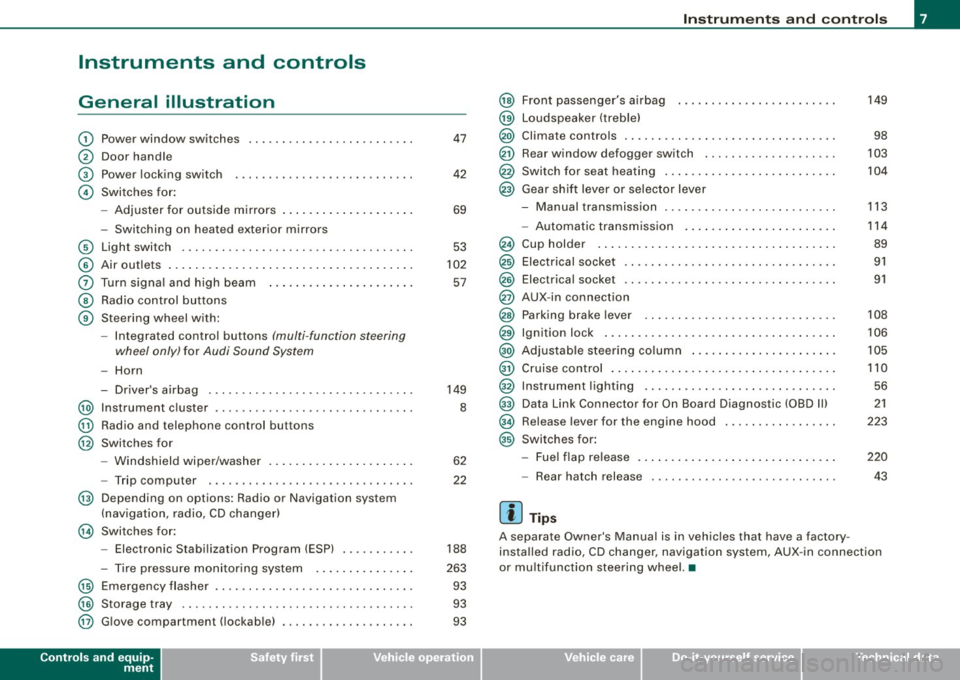
Instruments and controls
General illustration
G)
0
©
©
Power window switches
Door handle
Power locking switch
Switches for:
- Adjuster for outside mirrors .. ........ ... ...... .
- Switching on heated exterior mirrors
© Light switch .................................. .
© Air outlets .... .... ... .. ............... ........ .
0 Turn signa l and high beam ...... ............. .. .
@ Radio control buttons
@ Steering wheel with:
-Integra ted control buttons (multi -function steering
wheel only) for Audi Sound System
-Horn
- Driver's airbag .............................. .
@ Instrument cluster .................... ...... ... .
@ Radio and telephone control buttons
@ Switches for
- Windshield wiper/washer .... ... .. ...... ... ... .
- Trip computer .... ................... ....... .
@ Depending on options: Radio or Navigation system
(navigation, radio, CD changer)
@ Switches for:
- Electronic Stabilization Program (ESP) .......... .
- Tire pressure monitoring system .. ... .. .... ... .
@ Emergency flasher ............................. .
@) Storage tray .. ... .... ... ... ... .. .. .... ........ .
@ G love compartment ( lockab le) ..... ........ .... .. .
Controls and equip
ment
47
42
69
53
102
57
149
8
62
22
188
263 93
93
93
Instruments and controls
@
@
@
@
@
@
Front passenger's airbag
Loudspeaker (treble)
Climate controls .. ..... .. ..... ........... ...... .
Rear window defogger switch ...... ............ . .
Switch for seat heating .. ...... .... .... ......... .
Gear shift lever or selector lever
M I .. - anua transm1ss1on . ........... ....... .... .. .
- Automatic transmission ... ... ...... .... .... .. .
Cup holder ...... ...... ....... ...... .......... .
Electrical socket ............................... .
Elect rical socket ............................... .
AUX-in connection
Parking brake lever ............................ .
Ignition lock ........ ................ .... ...... .
Adjustable steering column ...... .... .... ..... .. .
Cruise control .. ........ ....... ...... .... ...... .
Instrument lighting ............................ .
Data Link Connector for On Board Diagnostic (OBD Ill
Release lever for the engine hood
Switches for:
- Fuel flap release .......... ...... .... ......... .
- Rear hatch release
[ i ] Tips
149
98
103
104
113
114
89
91
91
108
106
105
110 56
21
223
220
43
A separate Owner's Manual is in vehic les that have a factory
insta lled radio, CD changer, navigation system, AUX -in connection
or multifunction steering wheel. •
I • •
Page 59 of 320

[ i J Ti ps
You should switch on the emergency flasher when:
• you are the last vehicle standing in a traffic jam so that any other
vehicles coming can see you, or when
• your vehicle has broken down or you are in an emergency s itua
tion, or when
• your vehicle is being towed by a tow truck or if you are towing
another vehicle behind you .•
Turn signals -¢ ¢ and high beam ~D lever
The lever on the left side of the steering column is used to
operate the turn signals and the high beam as well as the
headlight flasher .
-"' M
-w ... m
Fig. 52 Tu rn sign al and
hig h beam l ever
The turn signal and high beam lever has the following func
tions:
Turn sign als
¢ ¢
- Lift the lever up all the way:::::, fig. 52 G), to use the right
turn s ignals, or push the lever down all the way@ to use
the left turn signals.
Con tro ls and eq uip
ment
C lea r v is ion
Auto-blink
- Move the lever (up or down) just to the point of resis
tance to use the turn signals for as long as you need
them, for example when changing lanes .
- Briefly move the lever up or down just to the point of resistance and then release it to flash the turn signals
three times in succession. This feature allows to indicate
lane changes clearly and with minimum effort when
driving on highways.
Hi gh b eam
~D
- Push the lever forward 0 to switc h on the high beam.
- P ull the lever back towards y ou to sw itch off the high
beam.
H eadlight flasher
~D
Pu ll the lever toward the steering wheel G) to use the
headlight flasher .
Note s on these features
• The turn signals only work with the ignition switched on. The
indicator lights
¢i or ¢ in the instrument cluster:::::, page 11 also
blink .
• After you have turned a corner, the turn signal switches off auto
matically.
• The high beam works only when the headlights are on . The indi
cator light ~Din the instrument cluster illuminates when the high
beams are on.
• The headlight flasher works only as long as you hold the lever -
even if there are no lights switched on. The indicator light ~D in the
instrument cluster illuminates when you use the headlight flasher . .,
Vehicle care I I Technical data
Page 64 of 320

Clear vision
- P lace th e su n bl ind aga inst the sp ring f orc e in to the
c e n te r br ac ke t :::::,
page 67, fi g. 6 0 @ of th e p arcel s helf.
& WARNING
The sun blind must not be u sed to secure cargo . The luggage
compartment cover is not a luggage ra ck . Objects placed on the
c over pose a danger for all vehicle occupant s during sudden
b rak ing or in an accident . •
Wiper and washer system
tY -.
Wind shi eld wip er ~
The win dshield wi per lever c ontrols both the windshield
w ip ers and the was her sys tem.
Fig. 61 Wiper le ver ;
windshi eld wip er l eve r
po sit io n s
The win dshield wiper le ver :::::, fig. 6 1 has t he foll owing posi
t io ns:
Intermittent wiping \\7 ! (activating rain sensor) *
- Move the lever up to position G) .
Move the in te rva l set switch @, to change the inte rva ls.
Low wiper speed
- Move t he lever u p to pos ition ® ·
High wiper speed
- Mov e the lever up t o po sition G) .
One -touch wiping
- Move the lever to posi tion ©, when you wa nt to wipe the
windshield
briefly.
Automatic w iper /washer
- Pull the lever to pos ition G) (towar d th e ste ering wheel)
and hold.
- Re lease t he lever. The was her stops a nd th e w ipers kee p
g oing f or ab out fo ur secon ds.
Turning off the wipers
- Move t he lever bac k to positio n ®·
The windshield wipers and washer only work when the ignition is
turned on . If you sw itch off the ignitio n with the windshield wiper
lever still in the interval wipe position and then come back a while
l ater and drive off, the rain sensor wil l reactivate i tse lf after the
vehic le speed has exceeded 4 mp h (6 km/h).
The rain sensor * is only activated with the wiper lever set to posi
tion @. When i t star ts to rain, the rain s ensor wil l automatically ac ti
vate the int ermi tte nt wiping mode.
To reduce the sensi tiv ity of the sensor, move switch
@ down . To
increase the sensitivity, move the switch up . The higher you adjust
the sensitivity, the fas ter the sensor will react whe n it senses mois -
ture on the windshield. .,
Page 107 of 320
___________________________________________________ O _n_ t_h _ e_ r_ o _ a_ d __ llll
On the road
Steering
Adjustable steering wheel
The height and reach of the steering wheel can be
adjusted.
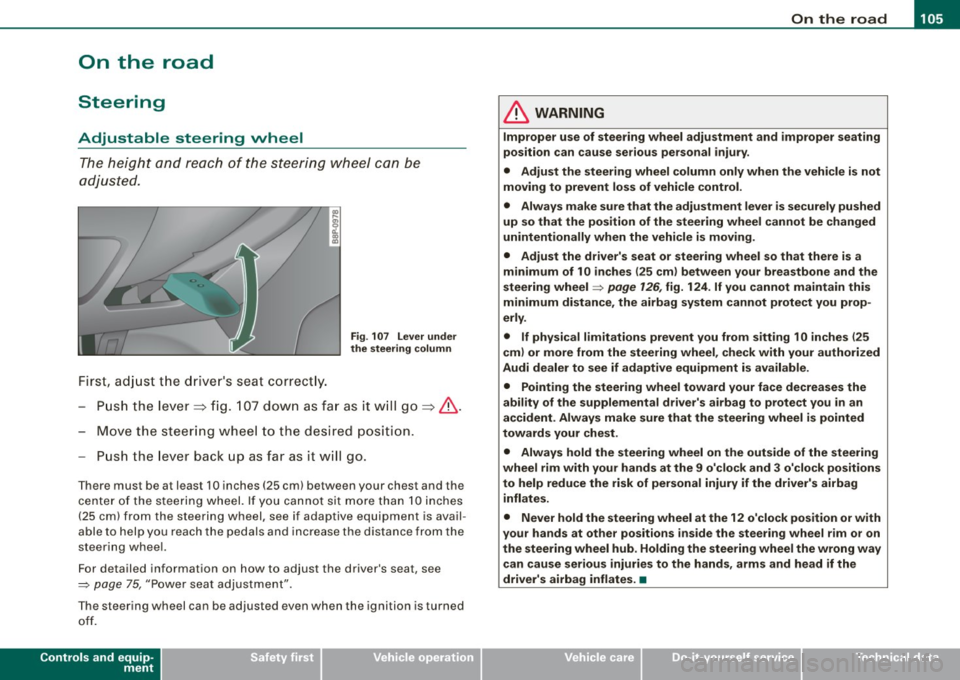
First, adjust the driver's seat correctly.
Fig. 107 Lever under
the steering column
-Push the leve r~ fig. 107 down as far as it will go~&.
- Move the steering wheel to the desired positi on.
- Push the leve r back up as fa r as it will go.
There must be at least 10 inches (25 cm) between your chest and the
center of the steering wheel. If you cannot sit more than 10 inches
(25 cm) from the steering wheel, see if adaptive equipment is avail
able to help you reach the pedals and increase the distance from the
steering wheel.
Fo r detailed information on how to adjust the driver 's seat, see
=> page
75, "Power seat adjustment".
T he steering wheel can be adjusted even when the ignition is turned
off.
Controls and equip
ment
& WARNING
Improper use of steering wheel adjustment and improper seating
position can cause serious personal injury.
• Adjust the steering wheel column only when the vehicle is not
moving to prevent loss of vehicle control.
• Always make sure that the adjustment lever is securely pushed
up so that the position of the steering wheel cannot be changed
unintentionally when the vehicle is moving .
• Adjust the driver's seat or steering wheel so that there is a
minimum of 10 inches (25 cm ) between your breastbone and the
steering wheel=> page 126 , fig. 124 . If you cannot maintain this
minimum distance, the airbag system cannot protect you prop
erly .
• If physical limitations prevent you from sitting 10 inches {25
cm ) or more from the steering wheel , check with your authorized
Audi dealer to see if adaptive equipment is available.
• Pointing the steering wheel toward your face decreases the
ability of the supplemental driver's airbag to protect you in an
accident . Always make sure that the steering wheel is pointed
towards your chest.
• Always hold the steering wheel on the outside of the steering
wheel rim with your hands at the 9 o'clock and 3 o'clock positions
to help reduce the risk of personal injury if the driver's airbag
inflates .
• Never hold the steering wheel at the 12 o'clock position or with
your hands at other positions inside the steering wheel rim or on
the steering wheel hub. Holding the steering wheel the wrong way
can cause serious injuries to the hands, arms and head if the
driver's airbag inflates. •
I • •
Page 161 of 320

__________________________________________________ A_ i_ r _b _a...; g::- s_ y=--- s_t _e _m __ lffl!III
& W ARNING (continued )
seating position and have the airbag system inspected by your
authorized Audi dealer.
• A tight tether or other str ap on a rearward-fac ing child restr aint
attached to the front pas senger seat can put too much pressure
on the weight-sensing mat in the seat and reg ister more weight
than i s actually on the seat. The heavier weight registered can
make the system work as though an adult were on the seat and
deploy the Advanced Airbag when it must be suppressed causing
s erious or even fatal injury to the child .
• If, in exceptional circumstances , you mu st in stall a forward
fac ing child restra int on the front passenger seat , always move the
seat into its rearmost position in the seat's fore and aft ad just
ment range , as far away from the airbag as possible . The backrest
must be adjusted to an upright position . Make sure that the
PASSENGER AIR BAG OFF light comes on and stay s on all the time
whenever the ignition is switched on .
& WARNING
• If the PASSENGER AIR BAG OFF light does not go out when an
adult is sitting on the front passenger seat after taking the steps
described above, make sure the adult is properly seated and
restrained at one of the rear seating positions .
• Have the airbag system inspected by your authorized Audi
dealer before transporting anyone on the front passenger seat .
[ i ] Tips
If the weight -sensing mat in the front passenger seat detects an
e mp ty seat, the fro nt air b ag on the pa ssenge r sid e will be t urned
off, and the PASSENGER AIR BAG OFF l ight will stay on .
a
Controls and equip
ment Safety first
Vehicle operation
Repair, care and disposal of the airbags
Parts of the airbag system are insta lled at many different places on
your Au di. In stal lin g, re moving, ser vic in g or re pair in g a part in an
area of the vehicle can damage a part of an a irbag system and
pre ven t that system from wo rki ng p rope rly in a co llision .
There are some important things you have to know to make sure
that the effectiveness of the system will not be impai red an d that
d iscarded co mponents do not cause inju ry or po llute t he e nv iron
ment .
& WARNING
Improper care , servicing and repair procedures can increase the
risk of personal injury and death by preventing an airbag from
deploying when needed or deploying an airbag unexpectedly:
• Never cover , obstruct , or change the steering wheel horn pad
or airbag cover or the instrument panel or modify them in any way .
• Never attach any obje cts su ch as cup holders or telephone
mountings to the surfaces covering the airbag units.
• For cleaning the horn pad or instrument panel, use only a soft ,
dry cloth or one moi stened with plain water . Solvents or cleaners
c ould damage the airbag cover or change the stiffness or strength
of the material so that the airbag cannot deploy and protect prop
erly .
• Never repair , adjust , or change any parts of the airbag system.
• All work on the steering wheel , instrument panel , front seats or
electrical system (including the installation of audio equipment ,
c ellular telephones and CB radios , etc .I must be performed by a
qualified technician who has the training and special equipment
necessary .
• For any work on the airbag system , we strongly recommend
that you see your authorized Audi dealer or qualified workshop .
• Never modify the front bumper or parts of the vehicle body .
Vehicle care Do-it-yourself service Technical data
Page 194 of 320

-Intelligent technology
---""'------------ ....::....:...:~---------------------------
Brake lining wear status
Brake lining wear may be checked by visual inspection of the condi
tion of the brake pads through the openings in the wheel. If neces sary, the wheel may be removed for this inspection=> page
270,
"Wheel change" .
L1}. WARNING
• You should perform braking maneuvers for the purpose of
cleaning the brake system only if road conditions permit. Other
road users must not be put at risk -you may cause an accident!
• Before descending a steep grade, reduce speed and shift trans
mission into a lower gear or lower driving range. Do not ride the
brakes or hold the pedal down too long or too often. This could
cause the brakes to get hot and diminish braking efficiency.
• Do not "ride the brakes" by resting your foot on the pedal when
you do not intend to brake. This may cause the brakes to overheat,
premature wear and increased stopping distance.
• Under certain climatic and operating conditions such as
passing through water, driving in heavy rain or after washing the
vehicle, the effectiveness of the brakes can be reduced. In winter,
ice can accumulate on the brake pads, linings, discs and drums.
Carefully apply brakes for a test. Brakes will dry and ice coatings
will be cleaned off after a few careful brake applications.
• Driving for an extended period of time on salt-covered roads
without using your brakes can also affect braking efficiency. Clean
off accumulated salt coating from brake discs and pads with a few
careful brake applications.
• If you damage the front spoiler, or if you install a different
spoiler, be sure the air flow to the front brakes is not obstructed.
Otherwise the brake system could overheat reducing the effective
ness of the entire brake system.
• Failure of one brake circuit will impair the braking capability
resulting in an increased stopping distance. Avoid driving the
& WARNING (continued)
vehicle and have it towed to the nearest authorized Audi dealer or
qualified workshop. •
Brake booster
The brake booster adds extra braking power.
The brake booster works with vacuum pressure which is created
only when the engine is running=>& .
L1}. WARNING
• Never let the vehicle roll to a stop with the engine shut off.
• If the brake booster is not working, for example when towing
your vehicle, or because the brake booster has somehow been
damaged, the brake pedal must be pressed considerably harder to
make up for the lack of booster assistance. •
Func ... ion=ng of Anti-Lock Brake System (ABS)
ABS prevents the wheels from locking up under braking.
The ABS contributes effectively to vehicle control since it prevents
the wheels from locking when the brakes are applied. This means
that the vehicle remains steerable and is less likely to skid.
With ABS you do not need to pump the brake. Just hold the brake
pedal down.
However, do not expect that the ABS shortens braking distance
under
all circumstances . When driving on gravel or on newly fallen
snow on top of icy surfaces, braking distance may be even longer,
therefore, under these circumstances, it is especially important that
you drive slowly and with great care. .,_
Page 246 of 320

-~_T_ ir_e_ s_ a_ n_d _ w_ h_ e_e _l_s _________________________________________________ _
Groove
means the space between two adjacent tread ribs.
Load rating (code)
means the maximum load that a tire is rated to carry for a given
inflation pressure . You may not find this information on all tires
because it is not required by law.
Maximum load rating
means the load rating for a tire at the maximum permissible infla
tion pressure for that tire.
Maximum loaded vehicle weight
means the sum of:
(a) Curb weight
(b) Accessory weight
(c) Vehicle capacity weight, and
(d) Production options weight
Maximum (permissible) inflation pressure
means the maximum cold inflation pressure to which a tire may be
in flated. Also called "maximum inflation pressure ."
Normal occupant weight
means 150 lbs. (68 kilograms) times the number of occupants
seated in the vehicle up to the total seating capacity of your vehicle.
Occupant distribution
means distribution of occupants in a vehicle .
Outer diameter
means the overall diameter of an inflated new tire.
Overall width
means the linear distance between the exteriors of the sidewalls of
an inflated tire, including elevations due to labeling, decorations, or
protective bands or ribs .
Ply
means a layer of rubber -coated parallel cords.
Production options weight
means the combined weight of those installed regular production
options weighing over 5 lbs. (2.3 kg) in excess of those standard
items which they replace, not previously considered in curb weight
or accessory weight, including heavy duty brakes, ride levelers, roof rack, heavy duty battery, and special trim.
Radial ply tire
means a pneumatic tire in which the ply cords that extend to the
beads are laid at substantially 90 degrees to the centerline of the
tread.
Recommended inflation pressure
see =:> page 243, "Cold tire inflation pressure".
Reinforced tire
means a tire designed to operate at higher loads and at higher infla
tion pressures than the corresponding standard tire. Reinforced
tires my be identified as "XL", "xi", "EXTRA LOAD", or "RF" on the
sidewall.
Rim
means a metal support for a tire or a tire and tube assembly upon
which the tire beads are seated .
Rim diameter
means nominal diameter of the bead seat. If you change your wheel
size, you will have to purchase new tires to match the new rim diam
eter.
Rim size designation
means rim diameter and width.
Rim width
means nominal distance between rim flanges .
Page 249 of 320

________________________________________________ T_ i _r_e _s_ a_n_ d_ w_ h_ e_e _ l_s __ !II
•
vehicle at its maximum capacity weight and tires that were on your
vehicle at the time it was manufactured .
If yo u w is h to impr ove co mfort w hen op erati ng th e vehicle at
n or mal load (u p to 3 occup ants), y ou ca n adj us t t ire pr essures to
tho se spe cified for normal vehicle load. Before oper ating the vehicle
a t m aximum lo ad , you mu st in cre as e t he t ire pre ssure s to t hose
s pecified for ma ximum vehi cle load =>
&.
Bear in mind that the tire pressure monitoring system * can only
monitor the tire pressu res you have stored. The syste m does not
recognize the load condition of your vehicle .
The effectiveness of the tire pressure monitoring system * will be
impaired if you store normal load pressures but then operate the
vehicle at its maximum load=>& . See the
illustration=>
page 246, fig. 173 for the location of the label
either o n driver's side 8 -p illar or inside the fue l filler flap (color of
the actual label and exact location on the vehicle will vary slight ly).
Note that the following tab le is accurate at the time of going to
press and is subject to change . In the event of discrepancies, the t ire
pressure label (on USA vehicles, the tire pressure label is located on
driver's side 8-pillar; on Canada vehic les, the tire pressure label is
located either on the driver's side 8-pi llar or inside the fuel filler
flap.) always takes precedence .
The table below lists the recommended cold tire inflation pressures
for the Audi mode l covered by your Owner's Literature at the
vehic le's capacity weight and the tire sizes installed on the respec
tive models as original equipment, or as a factory option.
Engin e
(displ ace
ment in
liter )
Tire d es ig nation Tir e pr essur e front Tir e pr essur e rear
4-cylinde r
2 .0 TF SI (ga s
o line) 2
05 /55 R16 91H All Se aso n
225 /45 R17 91W High Performanc e
22 5/45 R1 7 94H XL All Season
2 2 5/45 R17 94V XL High Performan ce
2 25 /40 R18 92V XL High Performance
Comp act spare wheel T12 5/70 R18
norm al lo ad
condit ion (up to
3 o ccup ants )
36 250
35 240
38 260
35 240
38 260
60 420 full lo
ad
condition
PSI kPA
39 270
38 260 39 270
36 250
41 280
60 420
Vehicle care
norm
al lo a d
full load
condition (up
condition
to 3 o ccup ants )
kPA kPA
30 210
38 260
30 2 10 36 250
32 220 38 260
30 2
10
35 240
35 240 41 280
60 420
60 420
I t •
Page 250 of 320
-~_T_ ir_e_ s_ a_ n_d _ w_ h_ e_e _l_s _________________________________________________ _
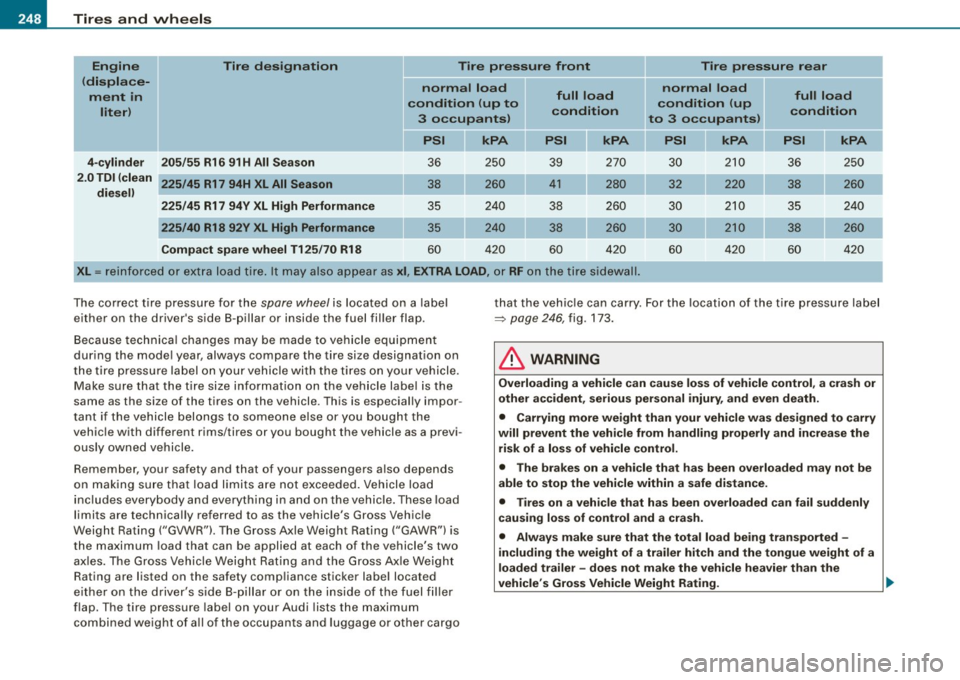
Engine Tire designation Tire pressur e front Tire pressure rear
(displace- normal load normal load
ment in full load
full load
liter) condition (up to
condition c
ondition (up
condition
3 o ccupants ) to 3 occupants)
PSI kPA PSI kPA kPA kPA
4-cylinder 205 /55 R16 91H All Season 36 250
39 270 3
0 210
36 250
2
.0 TDI (clean 225 /45 R17 94H XL All Season 38 260 41
280 32 220 38 260 diesel)
225/45 R17 94Y XL High Performance
35 240 38 260 30 2 10 3 5 24 0
225 /40 R18 92Y XL High Performan ce 35 240
38 260 30 210 38 260
Compact spare wheel T125
/70 R18 60 420
60 420
60 420
60 420
XL
= reinfo rced or ext ra load t ire . It may als o appea r as xi , EXTRA LOAD , or RF on the tire s idewall.
The correct t ire pressure for the
spare wheel is located on a label
either on the driver's side B-pillar or inside the fue l filler flap.
Because technica l changes may be made to vehicle equipment
during the mode l year, always compare the tire size designat ion on
the tire pressure la bel on y our vehicle with the tires on your vehicle.
Make sure tha t the t ire size information on the veh icle labe l is the
same as the size of the tires on the vehicle. This is especially impor
t ant if the vehicle belongs to someone e lse or you boug ht the
vehic le with different rims/tires or you bought the vehicle as a previ
ously owned vehicle.
Remember, your safety and that of your passengers a lso depends
on making su re tha t load limits a re not exceeded . Vehicle load
inc ludes everybody and everything in and on the vehicle. These load
limits are technically referred to as the vehicle's Gross Vehicle
Weight Rating ("GVWR"). The Gross Axle Weight Rating ("GAWR") is
the maximum load that can be applied at each of the vehicle's two
ax les. The Gross Vehicle We ight Rat ing and the Gross Ax le Weight
Rating are listed on the safety comp liance sticker labe l located
e it he r on the d river's side B-pillar o r on the i nside of the fuel f iller
flap. The tire pressure label on your Audi lists the maximum
combined we igh t of all o f th e occupa nts and luggage o r other cargo t
hat the vehic le can carry. For the location o f the tire pressure labe l
=> page 246, fig. 173.
& WARNING
Overloading a vehi cle can cause los s of vehicle control , a crash or
other accident, serious per sonal injury, and even death .
• Carrying more weight th an your vehicle was de signed to carry
will prevent the vehicle from handling properly and increase the
risk of a loss of vehicle control.
• The brakes on a vehicle that has been overloaded may not be
able to stop the vehicle within a safe distance .
• Tires on a vehicle that has been overloaded c an fail suddenly
cau sing loss of control and a crash .
• Alway s make sur e that the total load being tran sported -
including the weight of a trailer hitch and the tongue weight of a
loaded trailer -does not make the vehicle heavier than the
vehicle 's Gross Vehicle Weight Rating . _.,
Page 252 of 320

-~_T_ ir_e_ s_ a_ n_d _ w_ h_ e_e _l_s _________________________________________________ _
• The tire pressures should only be checked and adjusted when
t he tires are cold . The s lig htly raised pressures of warm tires must
not be reduced .
• Adjust the ti re pressure to t he loa d you are carrying.
• Reinstal l the valve stem cap on the valve.
When should I c heck the tire pressure?
The correct ti re p re ssure is especially impo rtant at h ig h speeds . The
pressure should the re fore be checked a t le ast once a month and
a lways before starting a journey. Do not forget to check the tire pres
sure for the spare whee l
::::> page 269.
When should
I adjust the tire pressure s?
Adjust the tire pressure to the load you are carrying. A fter chang ing
a wheel
or r eplac ing whee ls you have to adjus t th e tire pre ssures on
a ll whee ls. In addit io n, you must the n initia lize the new t ire pres
sures in the tire pressure monitoring system* =>
page 263.
& WARNING
Incorrect tire pressures and/or underinflation can lead sudden tire
failure, los s of control, colli sion , serious personal injury or even
death .
• When the warning symbol appears in the instrument
c luster , stop and inspect the tire s.
• Incorrect tire pressure and /or underinflation can cause
increased tire wear and can affect the handling of the vehicle and
stopping ability .
• Incorrect tire pressures and /or underinfla tion can also lead to
sudden tire failure , including a blowout and sudden deflation ,
causing loss of vehicle control .
• The driver is responsible for the correct tire pressures for all
tires on the vehicle. The applicable pre ssure values are located on
a sticke r on the driver 's side B -pillar o r on the inside of the fuel
filler flap.
& WARNING (continued )
• Only when all tires on the vehicle are filled to the correct pre s
sure , the tire pres sure monitoring sy stem * can work correctly.
• The use of incorrect tire pressure values can lead to accidents
or other damage . Therefore it is e ssential that the driver observe
the specified tire pressure v alue s for the tires and the correct pres
sures for the function of the tire pre ssure monitoring system* .
• Always inflate tires to the recommended and correct tire pres
s ure before driving off.
• Driving with underinflated tires bend more , letting them get
too hot re sulting in tread separation , sudden tire fa ilure and loss
of control.
• Excessive speed and /overloading can cause heat build -up ,
sudden tire failure and loss of control.
• If the tire pressure is too low or too high, the tires will wear
prematurely and the vehicle will not handle well.
• If the tire is not flat and you do not have to change a wheel
immediately , drive at reduced speed to the nearest service station
to che ck the tire pressure and add air as required .
0 Note
Driving without valve stem caps can cause damage to the tire
va lves. To prevent this, always make sure that fac tory ins talled va lve
stem caps on all whee ls are securely mounted on the valve.
Tires and vehicle load limits
There are limits to the amount of load or weight that any vehic le and
any tire ca n carry. A vehicle that is ove rlo aded wil l n ot h andle wel l ...