seat adjustment AUDI S3 2010 User Guide
[x] Cancel search | Manufacturer: AUDI, Model Year: 2010, Model line: S3, Model: AUDI S3 2010Pages: 320, PDF Size: 75.34 MB
Page 131 of 320
________________________________________________ D_r_iv _ i _n-' g=-- S_ a_ fe----' ly __ lllll
Proper adjustment of head restraints
Correctly adjusted head restraints are an important part
of your vehicle's occupant restraint system and can help to reduce the risk of injuries in accident situations.
Fig . 126 Correctly
adjusted head restraint
viewed from the side
The head restraints must be correctly adjusted to achieve
the best protection.
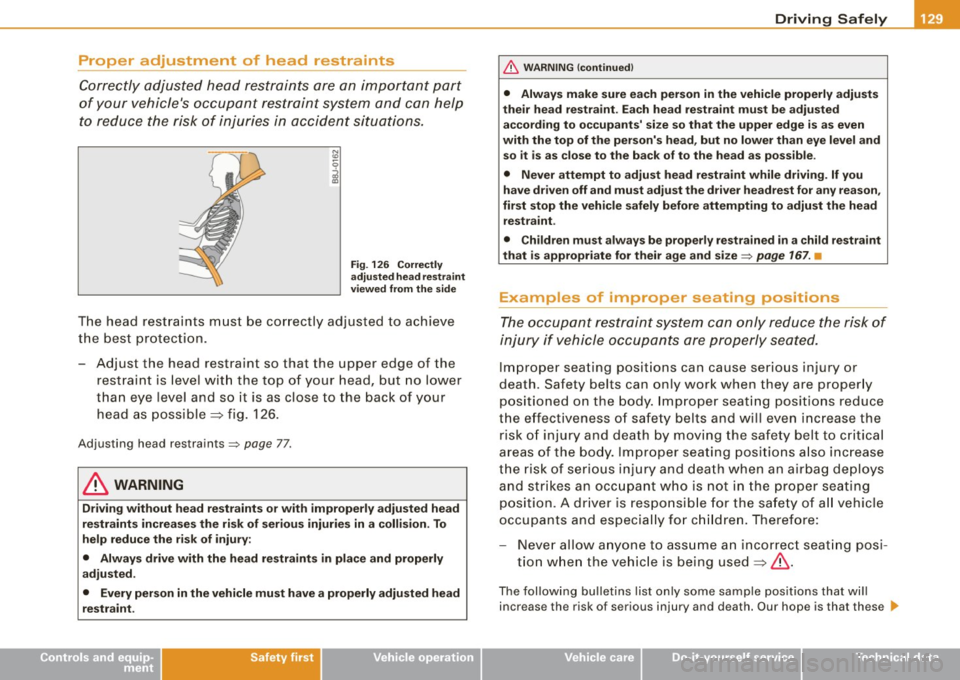
- Adjust the head restraint so that the upper edge of the
restraint is leve l with the top of your head, but no lower
than eye level and so it is as close to the back of your
head as possible ~ fig. 126.
Adjusting head restraints=> page 77.
& WARNING
Driving without head restraints or with improperly adjusted head
restraints increases the risk of serious injuries in a collision. To
help reduce the risk of injury :
• Always drive with the head restraints in place and properly
adjusted.
• Every person in the vehicle must have a properly adjusted head
restraint.
Controls and equip ment Safety first Vehicle operation
& WARNING
(continued)
• Always make sure each person in the vehicle properly adjusts
their head restraint. Each head restraint must be adjusted according to occupants' size so that the upper edge is as even
with the top of the person's head, but no lower than eye level and so it is as close to the back of to the head as possible .
• Never attempt to adjust head restraint while driving. If you
have driven off and must adjust the driver headrest for any reason,
first stop the vehicle safely before attempting to adjust the head restraint.
• Children must always be properly restrained in a child restraint
that is appropriate for their age and size=>
page 167. •
Examples of improper seating positions
The occupant restraint system can only reduce the risk of
injury if vehicle occupants ore properly seated.
Improper seating positions can cause serious injury or
death . Safety belts can only work when they are properly
positioned on the body. Improper seating positions reduce
the effectiveness of safety belts and will even increase the
r isk of injury and death by moving the safety belt to critical
areas of the body. Improper seating positions also increase
the risk of ser ious injury and death when an a irbag deploys
and strikes an occupant who is not in the proper seating
position . A driver is responsible for the safety of all vehicle
occupants and especially for children. Therefore:
- Never allow anyone to assume an incorrect seating posi
tion when the vehicle is being used~& .
The following bulletins list only some sample positions that will
increase the risk of serious injury and death. Our hope is that these .,_
Vehicle care Do-it-yourself service Technical data
Page 142 of 320

___ S_a_ f_ e_ t-= y_ b_e_ l_ t _s _______________________________________________ _
-Insert t he tongue into the correct b uckle of y our seat
unt il you h ea r it la tc h securely~ fig. 134.
Pull on t he belt to make sure that it is securely latched in
the buckle.
Aut om ati c sa fe ty belt re tra cto rs
Eve ry safety be lt is equipped with an automatic belt retractor on the
shoulder belt. This feature locks the belt when the belt is pulled out
fast, during hard braking and in an accident. The belt may a lso lock
when you drive up or down a steep hill or through a sharp curve .
During normal driving the belt lets you move free ly.
Safety belt prete nsi oners
The safety belts are equipped with a be lt pretensioner that he lps to
tighten the sa fety be lt and remove slack when the pretensioner is
activated. The function of the pretensioner is monitored by a
warning light=>
page 14 .
Swit chable locking fe ature
Every safety belt except the one on the driver sea t is equipped with
a switchab le locking feature that
must be used when the safety belt
is used to a ttach a chi ld safe ty sea t. Be sure to read the important
information about this feature=>
page 177.
& WARNING
Improper ly positioned safet y belts can cause seriou s inj ury in an
accident =>
page 140 , "Safety belt po sitio n".
• Safet y belts offer opt imum protection on ly when the seat back
i s upright and belt s are properly po sition ed on t he bod y.
• Always make sure that the rear seat backrest to whi ch the
c enter r ear sa fet y belt i s atta ched i s sec ure ly lat ched whe nev er
the rear center saf ety belt i s being us ed. If the ba ckrest is not
s ecu rely lat ched, the pas senge r will mo ve fo rward with the back
rest dur ing sudden braking , in a sudden maneu ver and e spec iall y
in a cra sh.
& W AR N ING (continu ed )
• Never attach the safety belt to the buck le for anothe r seat .
Atta ch ing th e be lt to the wrong buckle will reduce safety belt
e ffe cti venes s and can ca use seriou s per son al injur y.
• A p assenger who i s not prope rly re str ained can be s eriousl y
injured by the saf ety belt it self wh en it m ove s from the stronger
p art s of the body into criti ca l area s like the abd omen .
• Alway s lock the convert ible lo ck ing retractor when you are
s ecu ring a ch ild safety se at in the ve hi cle =>
page 179. •
Safety belt position
Correc t belt posi ti o n is the key to getting maximum
protecti on f rom safety be lts.
Fig . 1 35 Head r est ra in t
an d safe ty belt p osi
tion a s seen from th e
sid e
Standard features on your vehicle help you adjust the position of
the safety belt to match your body size .
• belt height adjustment for the front seats,
• automatic belt height adjustment for the rear seats.
Page 144 of 320

___ S_a_ f_ e_ t-= y_ b_e_ l_ t _s _______________________________________________ _
& WARNING
Improperly positioned safety belts can cause serious personal
injury in an accident.
• Expectant mothers must always wear the lap portion of the
safety belt as low as possible across the pelvis and below the
rounding of the abdomen.
• Always read and heed all WARNINGS and other important infor
mation ~
& in "Fastening safety belts" on page 139. •
Unfastening safety belts
Unbuckle the safety belt with the red release button only
after the vehicle has stopped.
Fig . 137 Releasing the
tongue from the buckle
-Push the red release button on the buckle=> fig. 137. The
belt tongue will spring out of the buckle=>& .
- Let the be lt wind up on the retractor as you guide the belt
tongue to its stowed pos ition.
& WARNING
Never unfasten safety belt while the vehicle is moving. Doing so
will increase your risk of being injured or killed .•
Adjusting safety belt height
With the aid of the safety belt height adjustment, the three
point safety belt strap routing can be fitted to the shoulder area, according to body size.
Fig . 138 Safety belt
height adjustment for
the front seats -loop
around fittings
Push the loop -around fittings up => fig. 138 @, or
- squeeze together the G) button , and push the loop
around f ittings
down @.
- Pull the belt to make sure that the upper attachment is
properly e ngaged .
& WARNING
Always read and heed all WARNINGS and other important informa
tion
~ page 138.
[ i ] Tips
• The shoulder belt part should route approximately over the
middle of you r shoulder -und er no circu mstanc es should it route
over your neck and throat area
~ & in "Safety belt position" on
pag e 140. ~
Page 145 of 320
_______________________________________________ S_a _f _e _t -=-y _ b_ e_lt _s __ ftllll
• With the front seats, the height adjustment of the seat can also
be used to adjust the position of the safety belts. •
Improperly worn safety belts
Incorrectly positioned safety belts can cause severe inju
ries.
Wearing safety belts improperly can cause serious injury or
death. Safety belts can only work when they are correctly positioned on the body. Improper seating posit ions reduce
the effectiveness of safety belts and w ill even increase the
risk of injury and death by moving the safety belt to critical
areas of the body . Improper seating positions also increase
the r isk of serious injury and death when an airbag deploys
and strikes an occupant who is not in the correct seating position. A driver is responsible for the safety of all vehicle
occupants and especially for children. Therefore:
-Never permit anyone to assume an incorrect sitting posi -
tion in the vehicle while traveling~& .
The following lists only some examples of improperly worn safety
bel ts that will increase the risk of serious injury and death. Our hope
is that these examples will make you more aware of seating posi
tions that are dangerous.
Therefore, whenever the vehicle is moving:
• never wear the shoulder belt under your arm
• never let the shoulder belt pass over your neck
• never wear the safety belt loosely
• never place the lap belt portion of the safety belt across your
abdomen ~& -
Controls and equip
ment Safety first Vehicle operation
& WARNING
Improperly worn
safety belts increase the risk of serious personal
injury and death whenever a vehicle is being used.
• Always make sure that all vehicle occupants are correctly
restrained and stay in a correct seating position whenever the
vehicle is being used.
• Always read and heed all WARNINGS and other important infor
mation
~ page 138. •
Safety belt pretensioners
How safety belt pretensioners work
In front, side and rear end collisions above a particular
severity, safety belts are tensioned automatically.
The safety belts are equipped with safety belt pretensioners . The
system is activated by sensors in front, side and rear -end collisions
of great severity . This tightens the belt and takes up belt slack~ &
in "Service and disposal of safety belt pretensioner " on
page 144.
Taking up the slack helps to reduce forward occupant movement
during a collision.
0 Note
Never let the belt remain over a rear seat back that has been folded
forward.
[ i] Tips
The safety belt pretensioners can only be activated once.
• In minor frontal and side collisions, in rear -end collisions, in a
rollover and in accidents involving very little impact force , the safety
belt pretensioner are not activated . .,_
Vehicle care Do-it-yourself service Technical data
Page 147 of 320

__________________________________________________ A_ i_ r _b _a...; g::- s_ y=--- s_t _e _m __ llll
Airbag system
Important things to know
Importance of wearing safety belts and
sitting properly
Airbags are only supplemental restraints. For airbags to
do their job, occupants must always properly wear their
safety belts and be in a proper seating position.
For your safety and the safety of your passengers, before
driving off, always:
- Adjust the driver's seat and steering wheel properly
=>
page 126,
-Adjust the front passenger's seat properly=> page 73,
-Wear safety belts properly=> page 138,
- Always properly use the proper child restraint to protect
children=>
page 167.
In a collision, airbags must inflate within the blink of an eye and with
considerable force . The supplemental airbags can cause injuries if
the driver or the front seat passenger is not seated properly. There
fore in order to help the airbag to do its job, it is important, both as
a driver and as a passenger to sit properly at all times.
By keeping room between your body and the steering wheel and the
front of the passenger compartment, the airbag can inflate fully and
completely and provide supplemental protection in certain frontal
collisions =>
page 126. For details on the operation of the seat
adjustment controls =>
page 74.
It's especially important that children are properly restrained
=>
page 167.
Controls and equip ment Safety first Vehicle operation
There is a lot that the driver and the passengers can and must do to
help the individual safety features installed in your Audi work
together as a system .
Proper seating position is important so that the front airbag on the
driver side can do its job. If you have a physical impairment or
condition that prevents you from sitting properly on the driver seat
with the safety belt properly fastened and reaching the pedals, or if
you have concerns with regard to the function or operation of the
Advanced Airbag System, please contact your authorized Audi dealer or other qualified workshop, or call Audi Customer CARE at 1-
800 -822 -2834 for possible modifications to your vehicle.
When the airbag system deploys, a gas generator will fill the
airbags, break open the padded covers, and inflate between the
steering wheel and the driver and between the instrument panel
and the front passenger. The airbags will deflate immediately after
deployment so that the front occupants can see through the wind
shield again without interruption .
All of this takes place in the blink of an eye, so fast that many people don't even realize that the airbags have deployed. The airbags also
inflate with a great deal of force and nothing should be in their way
when they deploy. Front airbags in combination with properly worn
safety belts slow down and limit the occupant's forward movement .
Together they help to prevent the driver and front seat passenger
from hitting parts of the inside of the vehicle while reducing the
forces acting on the occupant during the crash. In this way they help
to reduce the risk of injury to the head and upper body in the crash.
Airbags do not protect the arms or the lower parts of the body.
Both front airbags will not inflate in all frontal collisions. The trig
gering of the airbag system depends on the vehicle deceleration
rate caused by the collision and registered by the electronic control
unit. If this rate is below the reference value programmed into the
control unit, the airbags will not be triggered, even though the car
may be badly damaged as a result of the collision. Vehicle damage,
9J),
Vehicle care Do-it-yourself service Technical data
Page 150 of 320

___ A_ ir_ b_ a-g _ s_y _s_ t_ e_ m _________________________________________________ _
as defin ed i n th e el ectron ic contro l u n it=> page 157, " PASSE NGER
AI R BAG OFF lig ht".
A lways rem em ber, a c hild safet y se at or infant carr ier installe d on
the front seat may be struck and k nocked o ut of po sition by t he
rap id ly in fla ting passe nger's air bag in a fron tal colli sion . The airb ag
cou ld great ly re duce the effectivene ss of the ch ild restrain t and
e ve n seri ous ly injure the chi ld dur ing in flatio n.
For th is reason, and beca use the bac k seat is the safest plac e for
chi ldren -wh en prop erly rest rained acc ording to th eir age and size
- we strong ly recommend that ch ildren a lways sit in the bac k se at
=> p age 167, "Ch ild Safe ty ".
& WARNING
A child in a rearward -facing child safety seat installed on the front
passenger seat will be ser iously injured and can be killed if the
front airbag inflates - even with an Advanced Airbag System .
• The inflating airbag will hit the child safety seat or infant
carrier with great force and will smash the child safety seat and
child against the backrest, center armrest, door or roof .
• Always install rear -facing child safety seats on the rear seat .
• If you must install a rearward facing child safety seat on the
front passenger seat because of exceptional circumstances and
the PASSENGER AIR BAG OFF light does not come on and stay on ,
immediately install the rear-facing child safety seat in a rear
seating position and have the airbag system inspected by your
authorized Audi dealer.
• Forward-facing child safety seats installed on the front
passenger's seat may interfere with the deployment of the airbag
and cause serious personal injury to the child .
& WARNING
If, in exceptional circumstances, you must install a forward-facing
child restraint on the front passenger's seat:
& WARNING (continued)
• Always make sure the forward-facing seat has been designed
and certified by its manufacturer for use on a front seat with a
passenger front and side airbag .
• Never put the forward-facing child restraint up against or very
near the instrument panel.
• Always move the passenger seat into its rearmost position in
the seat's fore and aft adjustment range, as far away from the
airbag as possible before installing the forward-facing child
restraint. The backrest must be adjusted to an upright position .
• Make sure that the PASSENGER AIR BAG OFF light comes on
and stays on all the time whenever the ignition is switched on.
& WARNING
To reduce the risk of serious injury , make sure that the PASSENGER
AIR BAG OFF light will be displayed whenever a child restraint is
installed on the front passenger seat and the ignition is switched
on.
• If the PASSENGER AIR BAG OFF light does not stay on , perform
the checks described
=> page 156, "Monitoring the Advanced
Airbag System" .
• Take the child restraint off the front passenger seat and install
it properly at one of the rear seat positions if the PASSENGER AIR
BAG OFF light does not stay on.
• Have the airbag system inspected by your authorized Audi
dealer immediately.
• Always carefully follow instructions from child restraint manu
facturers when installing child restraints .
& WARNING
If, in exceptional circumstances, you must install a forward or
rearward-facing child restraint on the front passenger's seat :
Page 154 of 320

-Airbag system ----------------
& WARNING
(continued)
the PASSENGER AIR BAG OFF light does not come on and stay on,
immediately install the rear-facing child safety seat in a rear
seating position and have the airbag system inspected by your
authorized Audi dealer.
& WARNING
If, in exceptional circumstances, you must install a forward-facing
child restraint on the front passenger's seat:
• Always make sure the forward -facing seat has been designed
and certified by its manufacturer for use on a front seat with a
passenger front and side airbag.
• Never put the forward-facing child restraint up against or very
near the instrument panel .
• Always move the passenger seat into its rearmost position in
the seat's fore and aft adjustment range, as far away from the
airbag as possible, before installing the forward-facing child
restraint . The backrest must be adjusted to an upright position.
• Make sure that the PASSENGER AIR BAG OFF light comes on
and stays on all the time whenever the ignition is switched on. •
Advanced Airbag System components
The front passenger seat in your vehicle has a lot of very important
parts of the Advanced Airbag System in it. These parts include the
weight-sensing mat, sensors, wiring, brackets, and more. The func
tion of the system in the front passenger seat is checked by the elec
tronic control unit when the ignition is on. The control unit monitors
the Advanced Airbag System and turns the airbag indicator light on
when a malfunction in the system components is detected. The
function of the airbag indicator light is described in greater detail
below. Because the front passenger seat contains important parts
of the Advanced Airbag System, you must take care to prevent it from being damaged.
Damage to the seat may prevent the
Advanced Airbag for the front passenger seat from doing its job in
a crash .
The front Advanced Airbag System consists of the
following: • Crash sensors in the front of the vehicle that measure vehicle
acceleration/deceleration to provide information to the Advanced
Airbag System about the severity of the crash.
• An electronic control unit, with integrated crash sensors for front
and side impacts. The control unit "decides" whether to fire the
front airbags based on the informa tion received from the crash
sensors. The control unit also "decides" whether the safety belt
pretensioners should be activated.
• An Advanced Airbag with gas generator for the driver inside the
steering wheel hub .
• An Advanced Airbag with gas generator inside the instrument
panel for the front passenger.
• A weight-sensing mat under the upholstery padding of the front
passenger seat cushion that measures the total weight on the seat.
The information registered is sent continuously to the electronic
control unit to regulate deployment of the front Advanced Airbag on
the passenger side.
• An airbag monitoring system and indicator light in the instru
ment cluster => page 156.
• Th e PASSENGER AIR BAG OFF light comes on and stays on in the
center of the instrument panel=> page 157, fig. 142 and tells you
when the front Advanced Airbag on the passenger side has been
turned off.
• A sensor below the safety belt latch for the front seat passenger
to measure the tension on the safety belt . The tension on the safety
belt and the weight registered by the weight -sensing mat help the
control unit "decide" whether the front airbag for the front
passenger seat should be turned off or not=> page 147, "Child
restraints on the front seat -some important things to know". .,_
Page 174 of 320
-Child Safety -------'"---------------
& WARNING
(continued)
-Always move the front passenger seat into the rearmost
position of the passenger seat's fore and aft adjustment range,
and as far away from the airbag as possible before installing
the child restraint .
- Always make sure that nothing prevents the front
passenger's seat from being moved to the rearmost position in
its fore and aft adjustment range .
- Always make sure that the backrest is in the upright posi
tion.
• Always buckle the child safety seat firmly in place even if a
child is not sitting in it. A loose child safety seat can fly around
during a sudden stop or in a collision.
• Always read and heed all WARNINGS whenever using a child
restrained in a vehicle is being used=>
page 135, "Safety belts",
=>
page 145, "Airbag system" and=> page 167, "Child Safety".
& WARNING
To reduce the risk of serious injury, make sure that the PASSENGER
AIR BAG OFF light comes on and stays on whenever a child
restraint is installed on the front passenger seat and the ignition
is switched on.
• Take the child restraint off the front passenger seat and install
it properly at one of the rear seat positions if the PASSENGER AIR
BAG OFF light does not stay on.
• Have the airbag system inspected by your authorized Audi
dealer immediately.
& WARNING
A child in a child restraint installed with the LATCH lower anchor
ages or with the standard safety belt on the rear seat may play
& WARNING (continued)
with unused rear seat safety belts and become entangled
resulting in serious personal injury and even death.
• Always buckle unused rear seat safety belts out of reach of chil
dren in child seats and properly activate the convertible locking
retractor so that the child cannot unreel the safety belt from the
retractor. •
Child safety seats
Infant seats
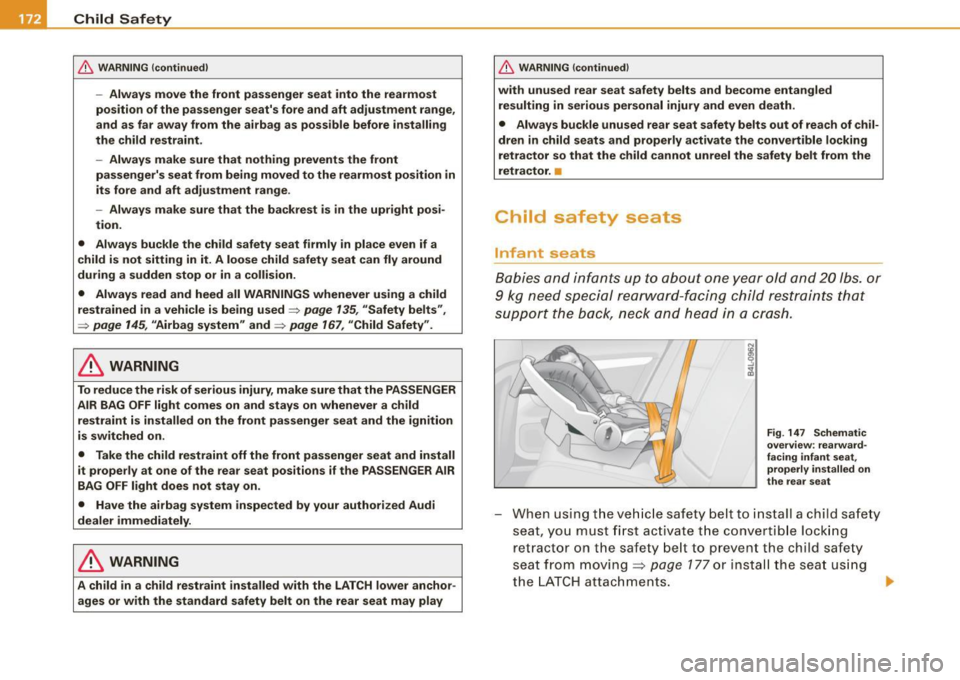
Babies and infants up to about one year old and 20 lbs. or
9 kg need special rearward-facing child restraints that
support the back, neck and head in a crash .
Fig. 147 Schematic
overview: rearward
facing infant seat,
properly installed on
the rear seat
- When using the vehicle safety belt to install a child safety
seat, you must first act ivate the convertible locking
retrac tor on the safety belt to prevent the child safety
seat from moving=>
page 177 or install the seat using
the LATCH attachments. ..,_
Page 177 of 320
& WARNING !continued)
• Always follow the manufacturer's instructions provided with
the child safety seat or infant carrier.
• Always move the front passenger seat into the rearmost posi
tion of the passenger seat's fore and aft adjustment range, and as
far away from the airbag as possible before installing the child
restraint.
• Always make sure that nothing prevents the front passenger's
seat from being moved to the rearmost position in its fore and aft
adjustment range .
• Always make sure the backrest is in an upright position .
• Make sure that the PASSENGER AIR BAG OFF light comes on
and stays on all the time whenever the ignition is switched on.
• If the light does not stay on, perform the checks~
page 156,
uMonitoring the Advanced Airbag System ".
• Take the child restraint off the front passenger seat and install
it properly at one of the rear seat positions if the PASSENGER AIR
BAG OFF light does not stay on whenever the ignition is switched
on. •
Safety first
Child Safety
Booster seats and safety be lts
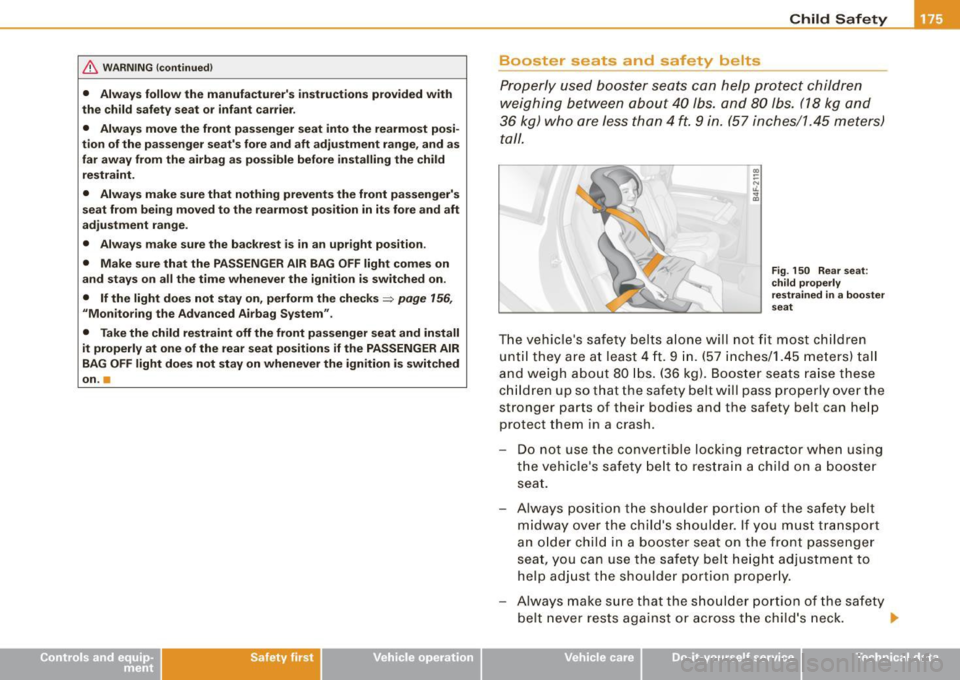
Properly used booster seats can help protect children
weighing between about 40 lbs. and 80 lbs. (18 kg and
36 kg) who are less than 4
ft. 9 in. (57 inches/1.45 meters)
tall.
Fig . 150 Rear seat:
child properly
restrained in a booster
seat
The vehicle's safety belts alone will not fit most children
until they are at least 4 ft. 9 in. (57 inches /1.45 meters) tall
and weigh about 80 lbs. (36 kg). Booster seats raise these
children up so that the safety belt will pass properly over the
stronger parts of their bodies and the safety belt can help
protect them in a crash.
- Do not use the convertible locking retractor when using
the vehicle's safety belt to restrain a child on a booster
seat.
- Always position the shoulder portion of the safety belt
midway over the child's shoulder. If you must transport
an older child in a booster seat on the front passenger
seat, you can use the safety belt height adjustment to
help adjust the shoulder portion properly.
- Always make sure that the shoulder portion of the safety
belt neve r rests against or across the child's neck.
9'>
Vehicle care I I irechnical data
Page 180 of 320
-Child Safety -------=---------------------------------------
& WARNING (continued )
• It is safer to install a forward-f acing child safety seat on the rear
seat.
• Always read and heed all WARNINGS whenever using a child
restrained in a vehicle is being used=>
page 167. Special precau
tions apply when installing a child safety seat on the front
passenger seat:::::,
page 147, "Child restraints on the front seat -
some important thing s to know ".
& WARNING
Always take special precautions if you must install a forward or
rearward-facing child restraint on the front passenger's seat in
exceptional situations :
• Whenever a forward or rearward -facing child restraint is
installed on the front passenger seat , the PASSENGER AIR BAG
OFF light must come on and stay on whenever the ignition is
switched on.
• If the PASSENGER AIR BAG OFF light does not come on and stay
on , perform the checks described=>
page 156, "Monitoring the
Advanced Airbag System ".
• Take the child restraint off the front passenger seat and install
it properly at one of the rear seat positions if the PASSENGER AIR
BAG OFF light does not stay on whenever the ignition is switched
on .
• Improper installation of child restraints can reduce their effec
tiveness or even prevent them from providing any prote ction .
• An improperly installed child restraint can interfere with the
airbag as it deploys and seriously injure or even kill the child .
• Always carefully follow the manufacturer's instructions
provided with the child safety seat or carrier .
• Never place additional items on the seat that can increase the
total weight registered by the weight-sensing mat and can cause
injury in a crash .
& WARNING
Forward-facing ch ild restraints :
• Always make sure the forward-facing seat has been designed
and certified by its manufa cturer for use on a front seat with a
passenger front and side airbag .
• Never put the forward-facing child restraint up , against or very
near the instrument panel.
• Always move the passenger seat into its rearmost position in
the seat's fore and aft adjustment range , as far away from the
airbag as possible before installing the forward-facing child
re straint. The backrest must be adjusted to an upright position.
• Make sure that the PASSENGER AIR BAG OFF light comes on
and stays on all the time whenever the ignition is switched on.
& WARNING
Re arward -facing child restraints :
• A child in a rearward -facing child safety seat installed on the
front passenger seat will be seriously injured and can be killed if
the front airbag inflates -even with an Advanced Airbag System.
• The inflating airbag will hit the child safety seat or infant
carrier with great force and will smash the child safety seat and
child against the backrest , center armrest , door or roof .
• Always be e specially careful if you must install a rearward
facing child safety seat on the front passenger seat in exceptional
circumstances .
• A tight tether strap on a rearward-facing child restraint
attached to the front pas senger seat can put too much pres sure
on the weight -m at in the seat and register a heavier weight in the
Advanced Airbag System. The heavier weight registered can make
the system work as though an adult were on the seat and deploy
the Advanced Airbag when it must be suppressed causing ser ious
or even fatal injury to the child.
Ill-