instrument cluster AUDI S3 2010 Owner's Manual
[x] Cancel search | Manufacturer: AUDI, Model Year: 2010, Model line: S3, Model: AUDI S3 2010Pages: 320, PDF Size: 75.34 MB
Page 137 of 320

Safety belts -----------------=------
Safety belts
General notes
Always wear safety belts!
Wearing safety belts correctly saves lives!
This chapter explains why safety belts are necessary, how
they work and how to adjust and wear them correctly.
- Read all the information that follows and heed all of the
instruct ions and WARNINGS.
& WARNING
Not wearing safety belts or wearing them improperly increases
the risk of serious personal injury and death.
• Safety belts are the single most effective means available to
reduce the risk of serious injury and death in automobile acci
dents . For your protection and that of your passengers , always
correctly wear safety belts when the vehicle is moving.
• Pregnant women, injured, or physically impaired persons must
also use safety belts . Like all vehicle occupants, they are more
likely to be seriously injured if they do not wear safety belts . The
best way to protect a fetus is to protect the mother -throughout
the entire pregnancy. •
Number of seats
Your Audi has a total of five seating positions: two in the front and
three in the rear. Each seating position has a safety belt.
Controls and equip ment Safety first
Vehicle operation
& WARNING
Not wearing safety belts or wearing them improperly increases
the risk of serious personal injury and death .
• Never strap more than one person, including small children,
into any belt. It is especially dangerous to place a safety belt over
a child sitting on your lap.
• Never let more people ride in the vehicle than there are safety
belts available.
• Be sure everyone riding in the vehicle is properly restrained
with a separate safety belt or child restraint. •
Safety belt warning light ~
Your vehicle has a warning system for the driver and front
seat passenger (on USA models only) to remind you about
t he importance of buckling-up.
Before driving off, always:
Fig. 128 Safety belt
warning light in the
instrument cluster -
enlarged
- Fasten your safety belt and make sure you are wearing it
properly.
1J,,
Vehicle care Do-it-yourself service Technical data
Page 138 of 320
___ S_a_ f_ e_ t-= y_ b_e_ l_ t _s _______________________________________________ _
- Make sure that your passengers also b uckle up and prop
erly wea r th eir sa fety belts.
Protect children wit h a child restraint system appropriate
for the size and age.
The warning light i in the instrument cluster lights up when the
ignition is switched on as a reminder to fasten the safety belts. In
addition , you will hear a warning tone.
After the ignition is switched on, the warning light in the instrument cluster will a lways come on for about 6 seconds and if the driver has
not fastened the safety belt, a warning tone will also sound for
about 6 seconds . As soon as the driver has fastened the safety belt,
the warning tone will stop and the warning light will go out .
If the driver or front seat passenger have not buckled -up within
about 10 seconds after the warning tone has stopped and the
vehicle is moving faster than about 15 mph, the warning tone will
sound again for about 6 seconds and then stop for 24 seconds and
then repeat this reminder sequence for a maximum of 2 minutes. At
speeds be low 5 mph, the warning tone will not sound.
Fa sten your safe ty belt and m ake su re that your p assengers also
properl y put on th eir s afet y belts .
& WARNING
• Safety belt s are the single mo st effective mean s available to
reduce th e risk of ser ious injur y and death in a utomobile acci
dent s. For your prote ction and th at of your pas senger s, alwa ys
c orre ctl y we ar safety belt s when t he vehicle is moving .
• Failure t o pay att ention to th e warning light that co me on,
c ould lead to per sonal injury .•
Why safety belts?
Frontal co11isions and the law of physics
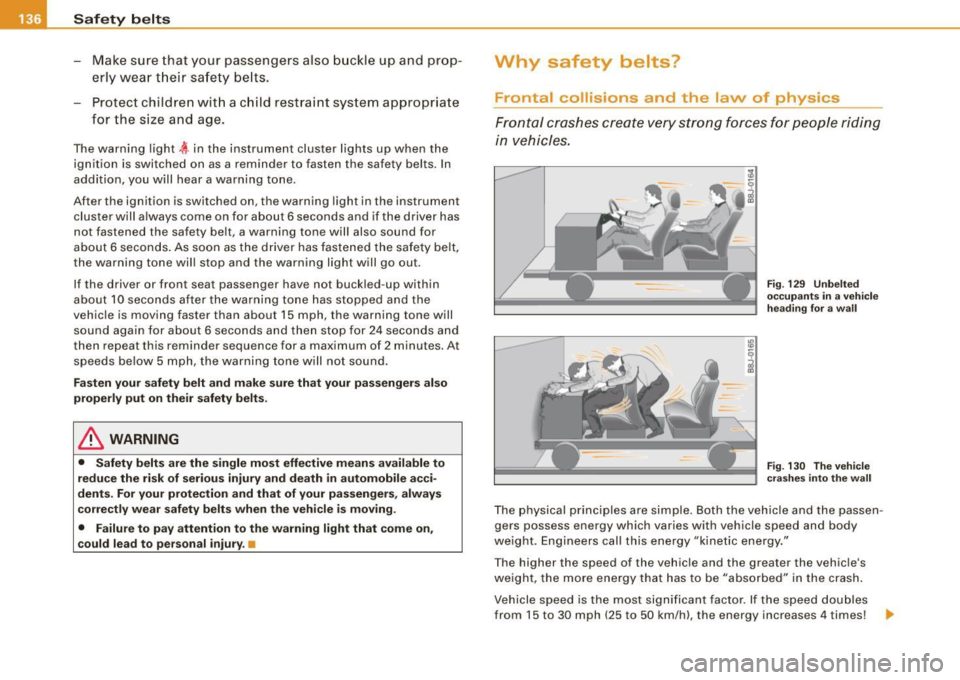
Front al crashes create very strong forces for pe ople riding
in vehicles.
F ig. 12 9 Unbel ted
o cc up ants i n a ve hicle
he ading for a wa ll
Fi g. 13 0 The vehi cle
c ras hes in to t he wa ll
The physical principles are simple. Both the vehicle and the passen
gers possess energy which varies with vehicle speed and body
we ight . Engineers cal l this energy "kinetic energy ."
T he higher the speed of the vehicle and the greater the vehic le's
we ight, the more energy that has to be "absorbed" in the crash .
Vehicle speed is the most significan t factor. If the speed doubles
from 15 to 30 mph (25 to 50 km/h), the energy increases 4 times! .,
Page 149 of 320
__________________________________________________ A_ i_ r _b _a...; g::- s_ y=--- s_t _e _m __ !II
Child restraints on the front seat -some
important things to know
- Be sure to read the important information and head the
WARNINGS for important details about children and
Advanced Airbags :=>
page 167.
Even though your vehicle is equipped with an Advanced Airbag
System, make certain that all children, especially those 12 years and
younger, always ride in the back seat properly restrained for their age and size . The airbag on the passenger side makes the front seat
a potentially dangerous place for a child to ride . The front seat is not
the safest place for a child in a forward -facing child safety seat. It
can be a very dangerous place for an infant or a child in a rearward
facing seat.
The Advanced Airbag System in your vehicle has been certified to
comply with the requirements of United States Federal Motor
Vehicle Safety Standard 208 as applicable at the time your vehicle
was manufactured.
The Standard requires the front airbag on the passenger side to be
turned off ("suppressed") if a child up to about one year of age
restrained in one of the rear-facing or forward-facing infant
restraints listed in Federal Motor Vehicle Safety Standard 208 with
which the Advanced Airbag System in your vehicle was certified has been installed on the front passenger seat. For a listing of the child
restraints that were used to certify compliance with the US Safety
Standard =>
page 169.
The PASSENGER AIR BAG OFF light in the instrument panel tells you
when the front Advanced Airbag on the passenger side has been
turned off by the electronic control unit.
Each time you turn on the ignition, the
PASSENGER AIR BAG OFF
light will come on for a few seconds and:
• will stay on if the front passenger seat is not occupied,
Controls and equip
ment Safety first Vehicle operation
•
will stay on if there is a small child or child restraint on the front
passenger seat,
• will go off if the front passenger seat is occupied by an adult as
registered by the weight-sensing mat=>
page 156, "Monitoring the
Advanced Airbag System" .
The
PASSENGER AIR BAG OFF light comes on when the control unit
detects a total weight on the front passenger seat that requires the
front airbag to be turned off.
If the total weight on the front passenger seat is more than that of
a typical 1 year-old child but less than the weight of a small adult,
the front airbag on the passenger side can deploy (the
PASSENGER
AIR BAG OFF
light does not come on). If the PASSENGER AIR BAG
OFF
light does not come on, the front airbag on the passenger side
has not been turned off by the electronic control unit and can
deploy if the control unit senses an impact that meets the condi
tions stored in its memory.
For example, the airbag may deploy if:
• a small child that is heavier than a typical 1 year -old child is on
the front passenger seat (regardless of whether the child is in one
of the child safety seats listed=>
page 169), or
• a child who has outgrown child restraints is on the front
passenger seat.
If the front passenger airbag is turned off, the
PASSENGER AIR BAG
OFF
light comes on in the instrument cluster and stays on.
The front airbag on the passenger side may
not deploy (the
PASSENGER AIR BAG OFF light does not illuminate and stay lit) even
if a small adult or teenager, or a passenger who is not sitting upright
with their back against a non-reclined backrest with their feet on the
vehicle floor in front of the seat is on the front passenger seat
=>
page 126, "Proper seating position for the driver".
If the front passenger airbag deploys, the Federal Standard requires
the airbag to meet the "low risk" deployment criteria to reduce the risk of injury through interaction with the airbag . "Low risk" deploy
ment occurs in those crashes that take place at lower decelerations
I),
Vehicle care Do-it-yourself service Technical data
Page 154 of 320

-Airbag system ----------------
& WARNING
(continued)
the PASSENGER AIR BAG OFF light does not come on and stay on,
immediately install the rear-facing child safety seat in a rear
seating position and have the airbag system inspected by your
authorized Audi dealer.
& WARNING
If, in exceptional circumstances, you must install a forward-facing
child restraint on the front passenger's seat:
• Always make sure the forward -facing seat has been designed
and certified by its manufacturer for use on a front seat with a
passenger front and side airbag.
• Never put the forward-facing child restraint up against or very
near the instrument panel .
• Always move the passenger seat into its rearmost position in
the seat's fore and aft adjustment range, as far away from the
airbag as possible, before installing the forward-facing child
restraint . The backrest must be adjusted to an upright position.
• Make sure that the PASSENGER AIR BAG OFF light comes on
and stays on all the time whenever the ignition is switched on. •
Advanced Airbag System components
The front passenger seat in your vehicle has a lot of very important
parts of the Advanced Airbag System in it. These parts include the
weight-sensing mat, sensors, wiring, brackets, and more. The func
tion of the system in the front passenger seat is checked by the elec
tronic control unit when the ignition is on. The control unit monitors
the Advanced Airbag System and turns the airbag indicator light on
when a malfunction in the system components is detected. The
function of the airbag indicator light is described in greater detail
below. Because the front passenger seat contains important parts
of the Advanced Airbag System, you must take care to prevent it from being damaged.
Damage to the seat may prevent the
Advanced Airbag for the front passenger seat from doing its job in
a crash .
The front Advanced Airbag System consists of the
following: • Crash sensors in the front of the vehicle that measure vehicle
acceleration/deceleration to provide information to the Advanced
Airbag System about the severity of the crash.
• An electronic control unit, with integrated crash sensors for front
and side impacts. The control unit "decides" whether to fire the
front airbags based on the informa tion received from the crash
sensors. The control unit also "decides" whether the safety belt
pretensioners should be activated.
• An Advanced Airbag with gas generator for the driver inside the
steering wheel hub .
• An Advanced Airbag with gas generator inside the instrument
panel for the front passenger.
• A weight-sensing mat under the upholstery padding of the front
passenger seat cushion that measures the total weight on the seat.
The information registered is sent continuously to the electronic
control unit to regulate deployment of the front Advanced Airbag on
the passenger side.
• An airbag monitoring system and indicator light in the instru
ment cluster => page 156.
• Th e PASSENGER AIR BAG OFF light comes on and stays on in the
center of the instrument panel=> page 157, fig. 142 and tells you
when the front Advanced Airbag on the passenger side has been
turned off.
• A sensor below the safety belt latch for the front seat passenger
to measure the tension on the safety belt . The tension on the safety
belt and the weight registered by the weight -sensing mat help the
control unit "decide" whether the front airbag for the front
passenger seat should be turned off or not=> page 147, "Child
restraints on the front seat -some important things to know". .,_
Page 160 of 320

___ A_ ir_ b_ a-g _ s_y _s_ t_ e_ m _________________________________________________ _
the weight-sensing mat to measure more weight than is actual ly on
th e seat .
If the PASSENGER AIR BAG OFF light still does not come on and does
not stay on continuous ly (when the ignition is switched on),
• t ake the c hild res traint off t he front passe ng er seat a nd ins tall it
properly at one of the rear seat pos it ions. Have the a irbag system
ins pect ed by y our aut horize d Au di d eale r im me dia te ly.
• move the chi ld to a rear seat position and make sure that the
c h ild is pro pe rly restrai ned in a c hild restraint that is app ropriat e for
its size and age.
The
PASSENGER AIR BAG OFF l igh t sho uld NOT come on when the
ignition is on and an adult is sitt ing in a proper seating position on
the front passenge r seat . If the
PASSENGER AIR BAG OFF light
comes on a nd s tays o n or fl ashes for about 5 seco nds whi le d riving,
under these ci rcumstances, make sure that:
• the adu lt on the fron t pass enger sea t is pro perly seate d on the
cent er of the seat cushion with his or her back up against the back
rest an d the back res t is n ot recline d=> page 126, "Proper seati ng
position for the driver",
• t he ad ult is not ta king w eig ht o ff the sea t by hol ding o n to the
passenger assist hand le above the front passenger door or
su ppo rting their w eigh t on the arm res t,
• the safety be lt is being proper ly worn and that there is not a lot
o f sla c k in the sa fe ty b elt webbi ng,
• accessory seat covers or cushions or other things that may cause
an incorrect read ing o r impression on t he w eight -s e nsin g mat
under the upho lstery of the seat have been removed from the front
pass enger seat,
• a safety be lt extender has not been left in the safety be lt latc h for
th e fro nt passenger sea t.
In addition to the
PASSENGER AIR BAG OFF l ight in the center of the
instrument pane l, the mes sage
PASSENGER AIR BAG OFF o r
PASSENGER AIR BAG ON will br iefly appear in the instrument cluster display. This is to inform the driver of the curren
t front passenger
air bag status .•
Important safety instructions on monitoring
the Advanced Airbag System
& WARNING
An airbag system that is not functioning properly cannot provide
supplemental protect ion in a frontal crash .
• If the airbag indicator l ight comes on , it means that there may
be something wrong with the Advanced Airbag System . It is
possible that the airbag will inflate when it is not supposed to, or
will not inflate when it should .
• Have the airbag system inspected immediately by your autho
rized Audi dealer.
& WARNING
If the front airbag inflates, a child without a child restraint , or in a
rearward-facing child safety seat , or in a forward-facing child
restraint that has not been properly installed will be seriously
injured and can be killed .
• Even though your vehicle is equipped with an Advanced Airbag
System , make certain that all children , espec ially 12 years and
younger, always ride on the back seat properly restrained for their
age and si ze .
• Always install forward or rear -facing child safety seats on the
rear seat -even with an Advanced Airbag System .
• If you must install a rearward -facing child safety seat on the
front passenger seat be cause of exceptional cir cumstances and
the PASSENGER AIR BAG O FF light does not appear and stay on ,
immediately install the rear -facing child safety seat in a rear
~
Page 163 of 320

<£> For the sake of th e environm ent
Undeployed airbag modules and pretensioners might be classified
as Perchlorate Material -special handling may apply, see
www.dtsc.ca.gov/hazardouswaste/perchlorate . When the vehicle or
parts of the restraint system including airbag modules and safety
belts with pretensioners are scrapped, all applicable laws and regu
lations must be observed . Your authorized Audi dealer is familiar
with these requirements and we recommend that you have your dea ler perform this service for you. •
Side airbags
Description of side airbags
The airbag system can provide supplemental protection
to properly restrained occupants.
Fig. 143 Si de air bag
l oc ation in th e dri ver's
seat
The s ide airbags are located in the s ides of the front seat backrests
=> fig. 143 and the rear backrest * facing the doors. They are identi
fied by the word "AIRBAG".
T he sid e air bag sy stem b asica lly co nsis ts of :
• the electronic control module and external side impact sensors
• the two side airbags located in the sides of the front backrests
Safety first
Airb ag sy ste m
• two rear side airbags (as an ordered option)
• the airbag warning light in the instrument cluster.
The airbag system is monitored e lectronically to make certain that
it is functioning properly at all times. Each time you turn on the igni
tion, the airbag system indicator light will come on for a few seconds (self diagnostics).
The side airbag system supplements the safety be lts and can help
to reduce the risk of injury to the driver's, front and rear*
passenger's upper torso on the side of the vehicle that is struck in a
side collision . The airbag dep loys on ly in side impacts and only
when the vehic le acceleration registered by the control unit is high
enough . If this rate is below the reference value programmed into
the control unit, the side airbags will not be triggered, even though
the car may be badly damaged as a result of the collision . It is not
possible to define an airbag triggering range that will cover every
possible angle of impact, since the circumstances will vary consid
erab ly between one collision and another. Important factors
inc lude, for examp le, the nature (hard or soft) of the impacting
object, the angle of impact, vehicle speed, etc.=>
page 163, "Impor
tant safety instructions on the side airbag system".
Aside from their normal safety function, safety belts work to help keep the driver or front passenger in posi tion in the event of a side
collision so that the side airbags can provide protection .
The airbag system is
not a substitute for your safety belt. Rather, it
is part of the overall occupant restraint system in your vehicle.
Always remember that the side airbag system can only help to
pro tect you if yo u are wearing your safety belt and wearing it prop
erly. This is another reason why you should always wear your safety
belts, not just because the law requires you to do so=>
page 135,
"General notes".
It is important to remember that while the supplemental side airbag
system is designed to reduce the likelihood of serious injuries, other
injuries, for example, swelling, bruising, and minor abrasions can
also be associa ted with deployed side airbags. Remember too, side •
Vehicle care I I irechnical data
Page 191 of 320
actual vehicle behavior. If the two do not match, for example when
th e vehicle begins to skid, ESP brakes the appropriate wheel auto
matical ly .
The vehicle is stabilized again by the forces acting on the wheel
during braking. With an oversteering vehicle (tendency for the rear
end to skid out of the curve), the brake application is mainly at the
front wheel on the outside of the curve, with an
understeering
vehicle (tendency to run wide in the curve) at the rear wheel on the
inside of the curve or additionally at the other wheels as needed.
This brake application is accompanied by noises.
ESP works in conjunction with ABS=>
page 192. If there is malfunc
tion in the ABS, ESP is also inoperative.
Activating
The ESP is automatica lly activated when the engine is started, and
it performs a self-test. As soon as the test is completed, the system
is in normal operating mode. With ASR deactivated, or with ESP/ASR
deactivated, pressing the button=>
page 188, fig. 158 returns the
system to normal operation.
Deactivating
ESP should normally be activated at all times because this ensures
optimum vehicle stability. Only in certain exceptional cases it does
make sense to deactivate Anti-Slip Regulation (ASR) or the Elec
tronic Stability Program (ESP) by pressing the button =>
page 188,
fig. 158. Both deactivation stages can only be activated from normal
mode .
Deactivating ASR
Tap the switch. Deactivation is indicated by slow flashing of the ESP
lamp in the instrument cluster. In certain situations (e .g. driving
with snow chains, in deep snow or on loose ground, or when
rocking the car free), it may be necessary to deactivate ASR.
Deactivating ESP/ASR
Press the button for more than 3 seconds. Deactivation is indicated
by the ESP lamp in the ins trument cluster staying on permanently.
Controls and equip
ment Safety first Vehicle operation
Intelligent technology
This
deactivates the Electronic Stability Program (ESP) in addition to
ASR. No Elec tronic Stability System operation and no Anti -Slip
Regulation is available across the entire speed range; ASR and ESP
are activated only when the brakes are used for the duration of the
braking action and remain active until a stable vehicle condition has
been reached. There is no driving situation which requires ESP to be
deactivated, so this should only be done if the driver's skill and the
traffic situation permit.
& WARNING
• The limits of physics cannot be suspended by ESP. Even in vehi
cles with ESP. you should always adapt your driving to road and
traffic conditions. This is particularly true on a slippery and wet
road . Do not be tempted by the increased safety provided to take
risks -danger of an accident!
• Please note that when ASR or ESP /ASR is deactivated , the drive
wheels can spin on icy and slippery roads and the vehicle can
break away -danger of skidding!
Electronic differential lock CED1
.)
The electronic differential lock monitors the rotational
speed of the drive wheels.
General notes
The elect ronic differential lock (EDU helps the car to start moving,
accelerate and c limb a gradient on surfaces providing poor or
a lmost no grip. Without EDL, this would be difficult, if not impos
s ible.
How the system works
The EDL operates automatical ly. It monitors the rotationa l speed of
the drive wheels on an axle with the help of the ABS sensors
=>
page 192. If a noticeable difference in rotational speed between
the drive wheels on one axle is detected (e.g. on slippery ground
on
one side),
the spinning wheel is braked, thereby transferring power
Vehicle care Do-it-yourself service Technical data
Page 204 of 320

___ T_ r _a_ il_e _r_ t_ o_ vv_ in__... g,_ __________________________________________________ _
Weig ht dis tributi on
Towing a loaded trailer with an empty car resu lts in a high ly
unstable distribution of weight . If this cannot be avoided drive at
very low speeds on ly to avoid the risk of losing steering control.
A "ba lanced" rig is easier to operate and control. This means that
the tow vehicle should be loaded to the extent possible and permis
sib le while keeping the trai ler as light as possib le under the circum
stances. Whenever possible, transfer some cargo to the luggage
compartment of the tow vehicle while observing tongue load requirements and vehicle loading considerations .
Speed
The higher the speed, the more difficult it becomes for the driver to
control the rig . Do not drive at the maximum permissible speed.
Reduce your speed even more under unfavorable load, weather or
wind conditions -particularly when going downhill.
Reduce vehicle speed
imm ed ia tely if the trailer shows the sl ightest
sign of swaying. Do not try to s top the s wayi ng by a ccelerating .
Observe speed limits . In some areas speeds for vehicles towing
trai lers are lower than for regular vehicles.
Always app ly brakes early. When driving downhill, shift into lower
gear to use the engine braking effect to slow down the vehicle. Use
of the brakes alone can cause them to overheat and fail.
C oo la nt tempe ra tu re
The coolant temperature gauge ~ page 9 must be observed care
ful ly. If the needle moves close to the upper end of the scale, reduce
speed immediately and/or switch off the air condit ioner.
If the coolant temperature warning light in the instrument cluster
starts flashing -~-, pull off the road, stop and let the engine
idle for
about two minutes to prevent heat build -up .
& WARNING
An yone not p rope rly res train ed in a mo ving vehi cle is a t a mu ch
gre ater risk in a n accident. Neve r let an yone ride in your car who
is not p rop erly we ari ng th e res tra int s pro vide d b y Aud i.
c
Trailer towing tips
Important to know
Your vehicle handles different ly when towing a trailer because of
the additional weight and weight distribution . Safety, performance
and economy w ill great ly depend on how carefu lly you load your
trailer and operate your rig.
Before you actually tow you r trailer, practice turn ing, stopping and
backing up in an area away from traffic. Keep practicing unti l you
have complete ly become familiar with the way your vehicle -trailer
combination behaves and responds .
Backing up is difficult and requires practice. Backing up with a
trailer genera lly requires steering ac tion opposite of that when
backing up your vehicle without a trailer .
Maintain a greater distance between your vehicle and the one in
front of you. You will need more room to stop.
T o compensate for the trailer, you wi ll need a larger than normal
turning radius .
When passing, remember that you cannot accelerate as fast as you n ormal ly wou ld because of the added load . Make su re you have
enough room to pass. After passing, al low plenty of room for your
trailer before changing lanes again .
Avoid jerky starts, sharp turns o r rapid lane changes.
Page 230 of 320
-~_C_ h_e _c _ k_ i_n ...:::g::;...._ a_n_ d_ f_ i_ll _in -'g:::;.._ ___________________________________________ _
Under some circumstances the engine oil should even be changed
more frequently. Change oil more often if you drive mostly short
distances, operate the vehicle in dusty areas or mostly under stop
and -go traffic conditions, or when you use your vehicle where
temperatures stay below freezing point for long periods .
Detergent additives in the oil will make fresh oil look dark after the
engine has been running for a short time. This is normal and is not
a reason to change the oil more often than recommended .
Damage or malfunctions due to lack of maintenance
It is essential that you change your oi l at the recommended intervals
using only engine oil that complies with Audi oil standard
VW 502 00 (vehicles with gasoline engine) or VW 507 00 (vehicles
with diesel engine). Your Limited New Vehicle Warranty does not
cover damage or malfunctions due to failure to follow recom
mended maintenance and use requirements as set forth in the Audi
Owner's Manual and Warranty
& Maintenance booklet. Your dealer
will have to deny warranty coverage unless you present to the dealer proof in the form of Service or Repair Orders that all scheduled
maintenance was performed in a timely manner .•
Engine oil consumption
The engine in your vehicle depends on an adequate
amount of oil to lubricate and cool all of its moving parts.
In order to provide effective lubrication and cooling of interna l
engine components, all internal combustion engines consume a
certain amount of oil. Oil consumption varies from engine to engine
and may change significant ly over the life of the engine. Typically,
engines with a specified break -in period (see=>
page 195) consume
more oil during the break-in period than they consume after oil
consumption has stabilized.
Under normal conditions, the rate of oil consumption depends on
the quality and viscosity of the oil, the RPM (revolutions per minute)
at which the engine is operated, the ambient temperature and road
conditions. Further factors are the amount of oil dilution from water condensation or fuel residue and the oxidation level of the oil. As
any
engine is subject to wear as mileage builds up, the oil consump
tion may increase over time until replacement of worn components
may become necessary .
With all these variables coming into play, no standard rate of oi l
consumption can be established or specified. There is no alternative
to regular and frequent checking of the oil level, see
Note.
If the yellow engine oil level warning symbol in the instrument
cluster lights up, you should check the oil level as soon as
possible
with the oil dipstick=> page 229. Top off the oi l at your
earliest convenience =>
page 230.
& WARNING
Before you check anything in the engine compartment, always
read and heed all WARNINGS
=> &. in "Work ing in the engine
compartment" on
page 224.
0 Note
Driving with an insufficient oil level is likely to cause severe damage
to the engine.
[ i ] Tips
• The oil pressure warning display~ is not an indicator of the oil
level. Do not rely on it. Instead, check the oil level in your engine at
regular intervals , preferably each time you refuel, and always before
going on a long trip.
• If you have the impression your engine consumes excessive
amounts of oil, we recommend that you consu lt your authorized
Audi dealer to have the cause of your concern properly diagnosed .
Keep in mind that the accurate measurement of oil consumption
requires great care and may take some time. Your authorized Audi
dealer has instructions about how to measure oil consumption
accurately. •
Page 265 of 320

__________________________________________ T_i_r e _ p =----r_e _s _ s_ u_ r_e _ m_ o_n_ i_ t _o _r_ i_n -=g =-- s....: y:.... s_ te_ m_ * __ lffllll
•
Tire pressure monitoring system *
Applies to vehicles: with tire pressu re mon ito ring system
General notes _J
Each tire, including the spare (if provided), should be checked
month ly when cold and inflated to the inflation pressure recom
mended by the vehicle manufacturer on the vehicle placard or tire
inflation pressure label. (If your vehicle has tires of a different size
than the size indicated on the vehicle placard or tire inflation pres
sure label, you should determine the proper tire inflation pressure
for those tires.)
As an added safety feature, your vehicle has been equipped with a
tire pressure monitoring system (TPMS) that illuminates a low tire
pressure tellta le when one or more of your tires is significantly
under-inflated. Accord ingly, when the low t ire pressure te llta le i llu
minates, you should stop and check your tires as soon as possible,
and inflate them to the proper pressure . Driving on a significantly
under-inflated tire causes the tire to overheat and can lead to tire
failure . Under -inflation also reduces fue l efficiency and tire tread
life, and may affect the vehicle's handling and stopping ability.
Please note that the TPMS is not a substitute for proper tire mainte
nance, and it is the driver's responsibi lity to maintain correct tire
pressure, even if under -inflation has not reached the leve l to trigger
illumination of the TPMS low tire pressure te lltale.
Your vehicle has also been equipped with a TPMS malfunction indi
cator to indica te when the system is not opera ting proper ly . The
T PMS malfunction indicator is combined with the low tire pressure
t elltale. When the system detects a ma lfunction, the telltale w ill
flash for approximately one minute and then remain continuously illuminated. This sequence will continue upon subsequent vehicle
start-ups as long as the malfunction exists .
When the malfunction indicator is illuminated, the system may not
be ab le to detect or signa l low tire pressure as intended. TPMS
malfunctions may occur for a variety of reasons, inc luding the insta
llation of replacement or alternate tires or wheels on the
vehicle that prevent the TPMS from functioning properly . A lways
check the TPMS malfunction telltale after replac ing one or more
tires or whee ls on your vehicle to ensure that the replacement or
alternate tires and wheels allow the TP MS to continue to function
proper ly. •
App lies to veh ic les: w ith tire pressure monitoring system
Introduction
The tire pressure monitoring system monitors air pressure
in all four road wheels while the vehicle is moving .
As soon as the tire pressure monitor ing syste m senses a signi ficant
loss of air pressure in one or severa l tires, text messages and yellow
symbols appear in the ins trument c luster dis play to alert the d river .
The warning light in the instrument cluster comes on when the
t ire is sig nificantly unde rinflated
~ page 12 .
The warn ing light { also i lluminates in the case of a system
malfunction.
Be aware that tire p ressu re is also dependent on the tempe ra ture of
the tire . For every 18 °F (1 O °Cl increase in tire temperature, tire pres
su re increases by about 1 .5 psi (0 .1 bar). The ti re wa rms up wh ile the
vehicle is moving and tire pressure rises. So you should adjust tire pressure only when they are
cold, when the temperature of the tires
is roughly the same as the ambient air temperature.
I n order to keep the tire pressure monitoring system properly cali
brated, tire pressure on all fou r tires sh ould be checked at regular
interva ls, adjusted if necessary, and saved in the proper setting
(recommended pressure)~
page 265.
The tire pressure is shown either on the driver's side B-pil lar or on
the inside of the fuel filler f lap . _..
Vehicle care I t •